Tag: Moving Tips

  • Moving Truck Rental: The Complete 2026 Comparison & Booking Guide

    Moving Truck Rental: The Complete 2026 Comparison & Booking Guide

    Sticking with one brand for your next move is likely costing you hundreds of dollars in hidden fees and outdated rates. The “Loyalty Tax” in the logistics industry is real. Comparing major providers is the only way to find the true market rate for your moving truck rental. You deserve a transparent price that doesn’t change when you hand over your credit card at the counter.

    We know the stress of moving day. You’re probably worried about trucks being unavailable or dealing with confusing mileage rates that blow your budget. It’s common to fear choosing the wrong size and being left with furniture on the sidewalk. These hurdles make a high-stakes task feel overwhelming and unnecessarily complex when you just want to get settled.

    This guide changes that. You’ll find the perfect truck at the lowest possible rate by comparing every top provider’s 2026 pricing and availability in one place. We’ve analyzed the latest data from U-Haul, Penske, and Budget to give you total clarity. We’ll walk through size selections, insurance gaps, and how to secure a confirmed reservation with zero surprises on your final bill.

    Key Takeaways

    • Modernize your search with digital-first booking. See real-time rates from top providers side-by-side to ensure you never overpay for a move.
    • Select the right size the first time. Discover why a slightly larger truck often saves you more time and effort than a cramped, cheaper alternative.
    • Compare the big names with confidence. Learn how to weigh Penske’s newer fleet quality against Budget’s competitive local rates for your specific moving truck rental.
    • Stop hidden fees from wrecking your budget. Spot mileage surcharges and environmental fees early so your final cost matches your initial quote.
    • Simplify your booking process. Use a streamlined comparison tool to filter by size and price to get a confirmed reservation in just a few clicks.

    Understanding Moving Truck Rental in 2026

    A moving truck rental is more than just a vehicle hire. It is a service that gives you access to commercial-grade box trucks for a do-it-yourself relocation. Instead of hiring a full-service moving company, you take the wheel. This model offers maximum control over your schedule and your budget. In 2026, the process has shifted toward a digital-first approach. You no longer need to call multiple locations for quotes. Real-time rate comparison tools now allow you to see exactly what you will pay before you arrive at the lot.

    Efficiency is the standard today. The industry has moved away from estimated costs. Modern booking platforms prioritize transparency. You can compare availability across different brands instantly. This shift removes the traditional stress of wondering if a truck will actually be there on moving day. Demand remains high for the 2026 moving season. Booking your vehicle several weeks in advance is no longer just a suggestion. It is a requirement for securing the best rates and ensuring the specific size you need is ready for pickup.

    Local vs. One-Way Rentals

    Your choice between a local or one-way rental dictates your entire pricing structure. A local rental involves picking up and dropping off the vehicle at the same location. These are ideal for short moves within the same city. You typically pay a low base rate plus a fee for every mile driven. One way truck rentals for moving are essential for cross-country moves. You pick up the truck in one city and drop it off in another. These often come with a flat rate that includes a set number of days and miles. The drop-off location significantly affects cost. If you’re moving to a high-demand area, the price might be lower because the company needs more trucks in that specific city.

    Commercial vs. Residential Rental Standards

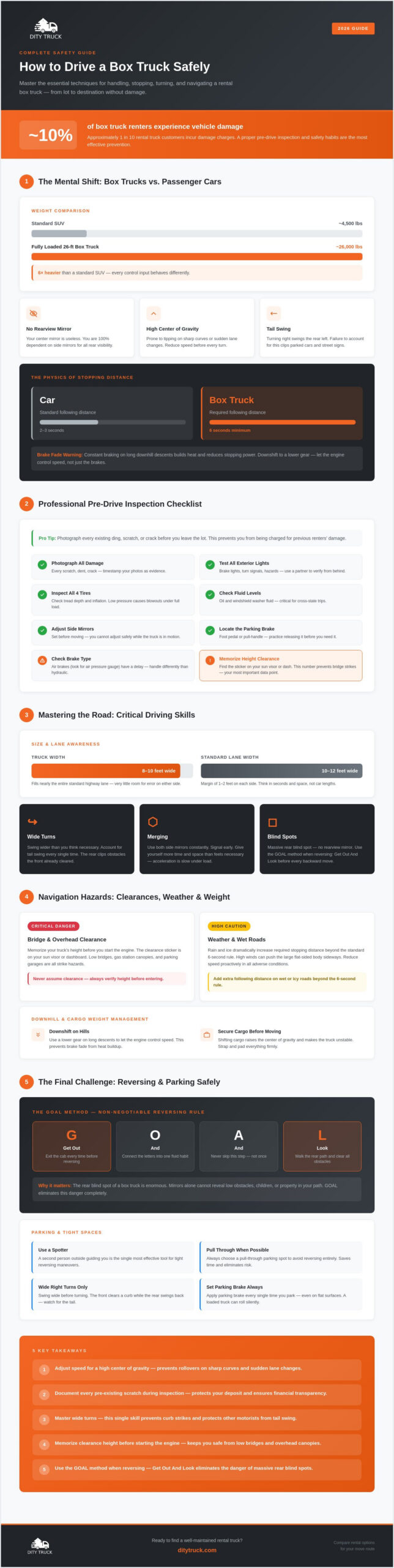
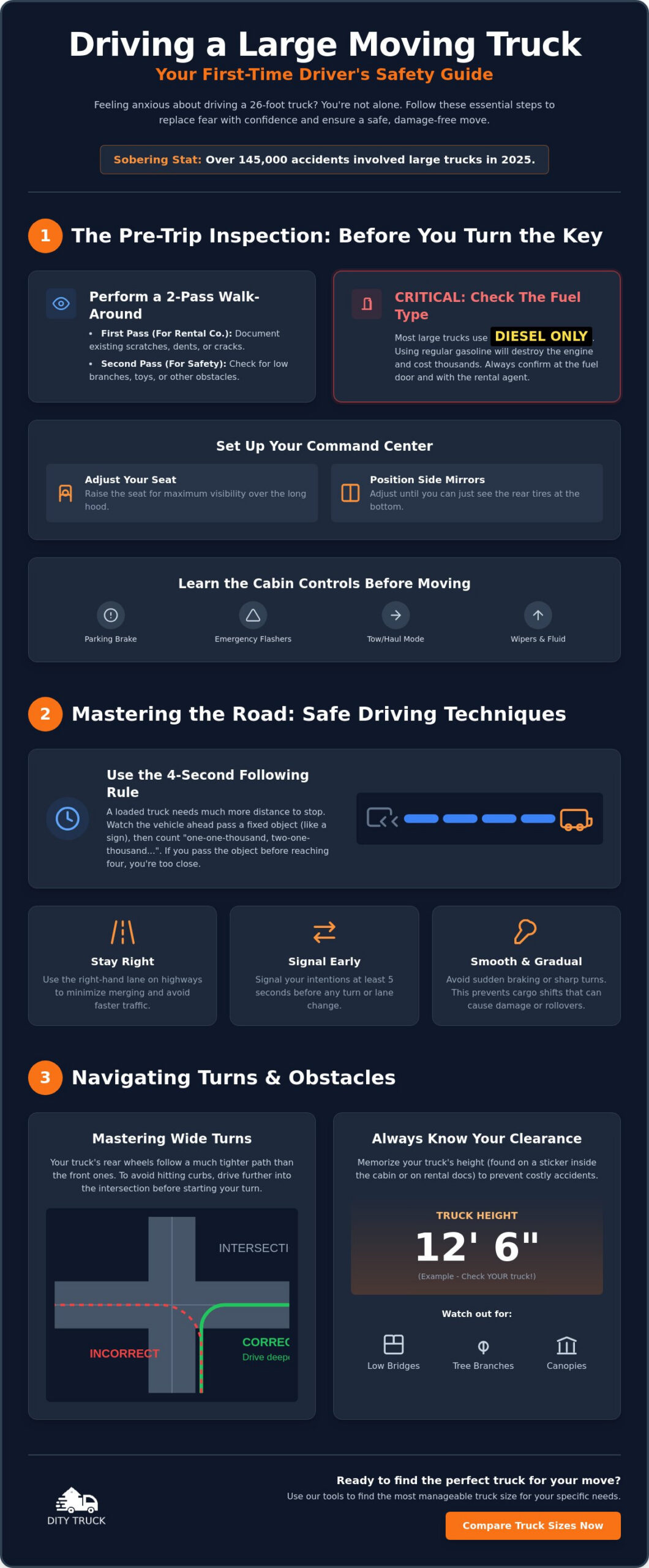
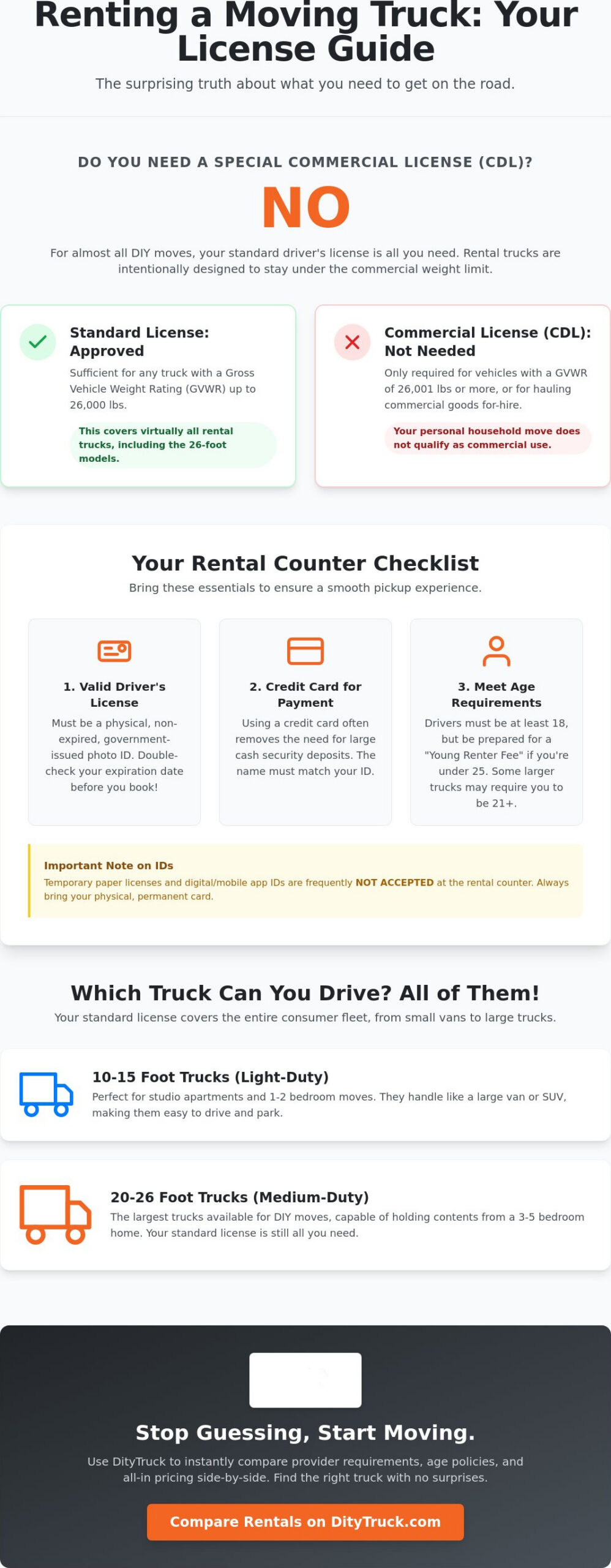
    Moving trucks are built to different standards than your personal car. They are classified by their Gross Vehicle Weight Rating (GVWR). This number represents the maximum weight of the vehicle including its load. Most 26-foot box trucks fall under the threshold for commercial requirements. You don’t need a Commercial Driver’s License (CDL) for a personal moving truck rental. A standard, government-issued driver’s license is sufficient for almost all residential moves. However, these vehicles handle differently. They require wider turns and longer braking distances. Understanding these physical differences ensures a safe trip from your old home to your new one.

    Sizing Your Move: Choosing the Right Vehicle

    Selecting a truck that is too small is the most expensive mistake you can make. It leads to multiple trips. It wastes your time. It forces you to leave items behind or start over. A 26-foot rental truck averages only 8 to 10 miles per gallon. If you have to drive back and forth because of a sizing error, your fuel costs double instantly. With diesel prices around $4.15 per gallon in 2026, efficiency is your best friend. Choosing the right size on day one protects your budget and your sanity.

    A slightly larger truck is often the safer choice. It allows you to pack items loosely rather than forcing a high-stakes game of Tetris. This extra space prevents furniture from rubbing together and causing damage. Most large trucks feature a “mother-in-law attic,” which is the storage compartment located directly over the cab. Use this space for fragile boxes or light, bulky items like pillows and blankets. Pull-out loading ramps are also standard on larger models. These are essential tools that save your back and significantly speed up the loading process. Before you sign a contract, you can compare vehicle specs and rates to ensure you’re getting the best value for the space you need.

    Weight limits impact your move more than you might think. Every vehicle has a maximum capacity that affects how it handles on the road. Overloading a truck reduces your fuel economy and puts unnecessary strain on the tires and brakes. It also changes how the vehicle responds to steering. For a safe and legal move, review the Protect Your Move guidelines provided by the FMCSA. These resources help you understand your rights and safety responsibilities when operating a commercial-grade vehicle for personal use.

    Cargo Vans and Pickups

    These vehicles are the best fit for studio apartments, dorm rooms, or small furniture deliveries. They offer significant fuel efficiency advantages over larger box trucks. Their smaller footprint makes them easy to maneuver and park in dense urban environments. You won’t have to worry about low-hanging branches or narrow city streets. If you only have a few large items and a dozen boxes, this is the most cost-effective moving truck rental option available.

    Medium to Large Box Trucks

    A 12-foot to 16-foot truck is the sweet spot for 1-2 bedroom homes. They provide enough floor space for appliances and mattresses without being intimidating to drive. For houses with three or more bedrooms, you need a 22-foot or 26-foot model. These are built for heavy loads and full households. Always pay attention to clearance height. Most large trucks require 12 to 14 feet of overhead space. Damaging the roof on a low bridge or apartment overhang is a common error that insurance rarely covers fully. Check the height sticker on the dashboard before you leave the lot.

    Moving Truck Rental: The Complete 2026 Comparison & Booking Guide

    Comparing the Major Moving Truck Companies

    Choosing the right provider is as critical as choosing the right size. It’s about balancing cost with reliability. Each national moving truck rental company has a specific strength that might align with your move. DityTruck stands out for its fleet quality. Our trucks are often newer, which leads to fewer breakdowns on long trips. We prioritize transparent pricing with very few surprises at the rental counter. This makes DityTruck a top choice for long-distance relocations where vehicle health is paramount.

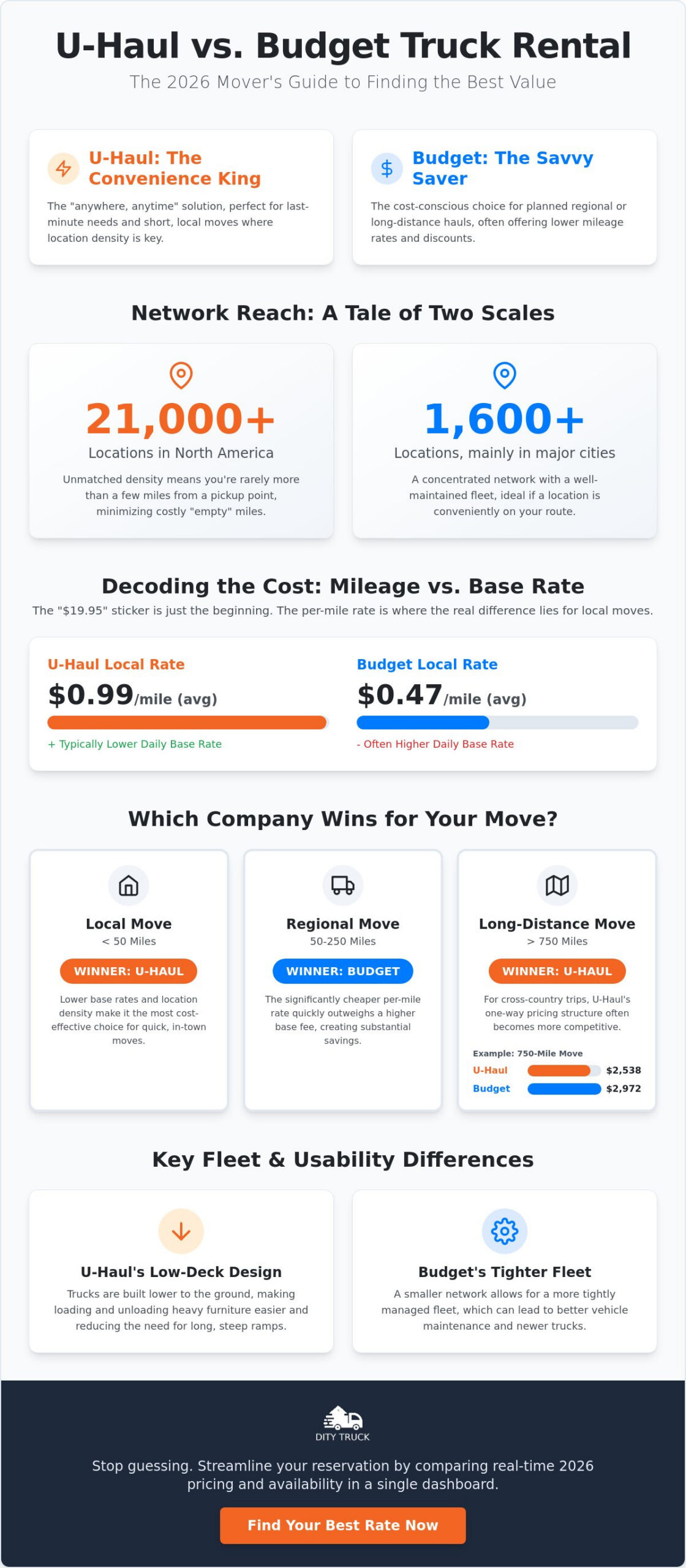
    While some providers prioritize aggressive pricing, often leading on cost for local moves, especially on weekdays, others excel in widespread location density. These companies offer unmatched convenience for pickup and drop-off, though their fleet age can vary, meaning you might get a brand-new vehicle or one with higher mileage. Additionally, some providers specialize in commercial-grade pickups and cargo vans, offering a professional experience for those with fewer items or specific business needs.

    Staying safe during the booking process is essential. Always verify that your provider is a registered, legitimate business. You can review the Red Flag Indicators of Moving Fraud to spot potential scams before you pay. Legitimate companies will provide clear contracts and won’t demand cash-only deposits upfront.

    Pricing Models and Rate Fluctuations

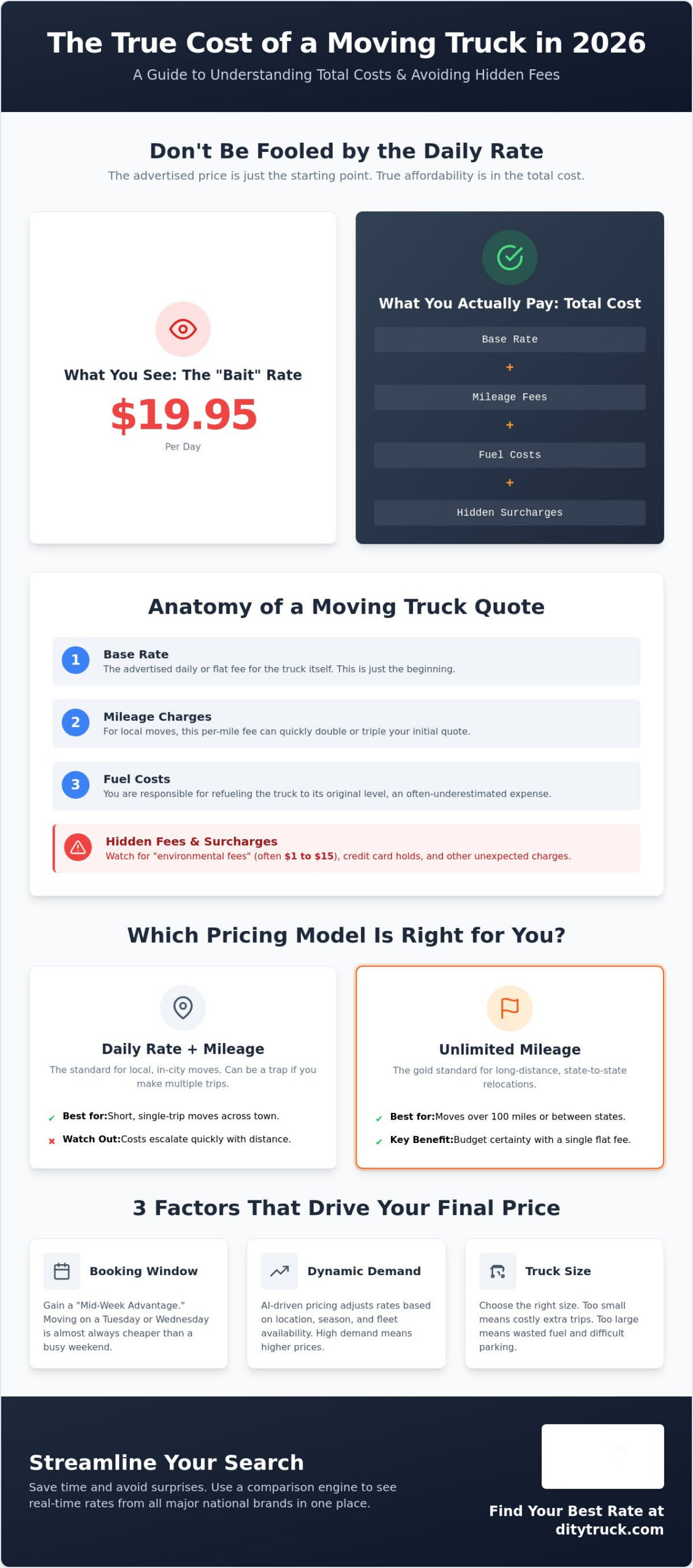
    Pricing in the moving industry is dynamic. Rates fluctuate based on supply and demand. Peak summer weekends are the most expensive times to rent because everyone is moving at once. One-way quotes typically offer a flat rate for a set number of days, while local moves rely on a daily base fee plus mileage. Booking a weekday rental can save you up to 30% compared to Saturday rates. Planning your move for a Monday or Wednesday is the fastest way to slash your total costs without sacrificing vehicle quality.

    Reliability and Roadside Assistance

    Fleet age impacts your peace of mind. Leading providers like DityTruck typically maintain newer inventories for enhanced reliability and safety. In contrast, other companies may offer a wider range of vehicle ages. Most standard roadside assistance packages cover mechanical failures, flat tires, and jump-starts. It’s your responsibility to perform a quick pre-trip inspection. Check the tire tread and fluid levels at pickup. Ensure the lights and signals work correctly. Taking five minutes to inspect the vehicle ensures your moving truck rental doesn’t stall your progress on the highway.

    The Real Cost: Avoiding Hidden Fees and Surcharges

    The base rate on a rental quote is rarely the final price you pay. It is a starting point. Hidden surcharges can easily double your expected expenses if you don’t account for them during the planning phase. Most users focus on the daily fee but overlook the silent budget killers that appear on the final invoice. Understanding these costs is the only way to ensure your moving truck rental stays within your financial limits. To see exactly how these fees impact your total, get a transparent quote comparison that includes estimated surcharges.

    Mileage charges are the most common source of sticker shock for local moves. Companies like U-Haul often charge between $0.59 and $1.39 per mile. A seemingly short trip to across town can add $50 or more to your bill just in distance fees. You must also account for environmental fees, which typically range from $1 to $5 per rental. State taxes and local registration recovery fees are also added at the end. These are rarely included in the initial “as low as” price you see on a billboard or landing page.

    The empty tank penalty is a completely avoidable expense. Rental companies charge a premium for fuel if you return the truck with less than you started with. This rate is often significantly higher than the local pump price. Always photograph the fuel gauge and the odometer before you leave the lot. This provides date-stamped proof of the vehicle’s status. If the gauge is slightly lower than the paperwork says, report it to the agent immediately. This simple step prevents you from paying for the previous driver’s fuel.

    Insurance Options Explained

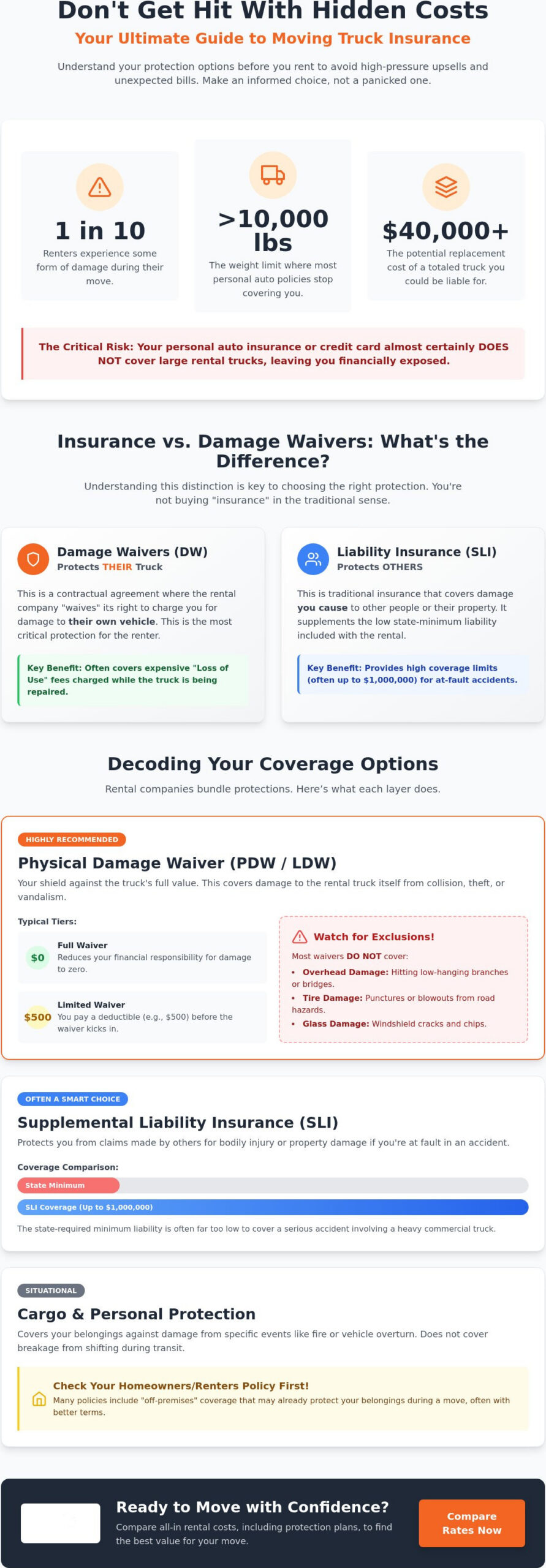
    Expect to pay between $30 and $50 per day for rental truck insurance. This is a necessary expense for most. Your personal auto insurance policy likely excludes commercial-grade box trucks. Most standard credit card rental protections also have a specific exclusion for vehicles with cargo beds or box attachments. A Collision Damage Waiver (CDW) protects you from repair costs if you hit a low-hanging branch or scrape a wall. You should also consider cargo insurance. This specifically protects your belongings inside the truck from fire, windstorms, or theft while in transit.

    Fuel and Equipment Add-ons

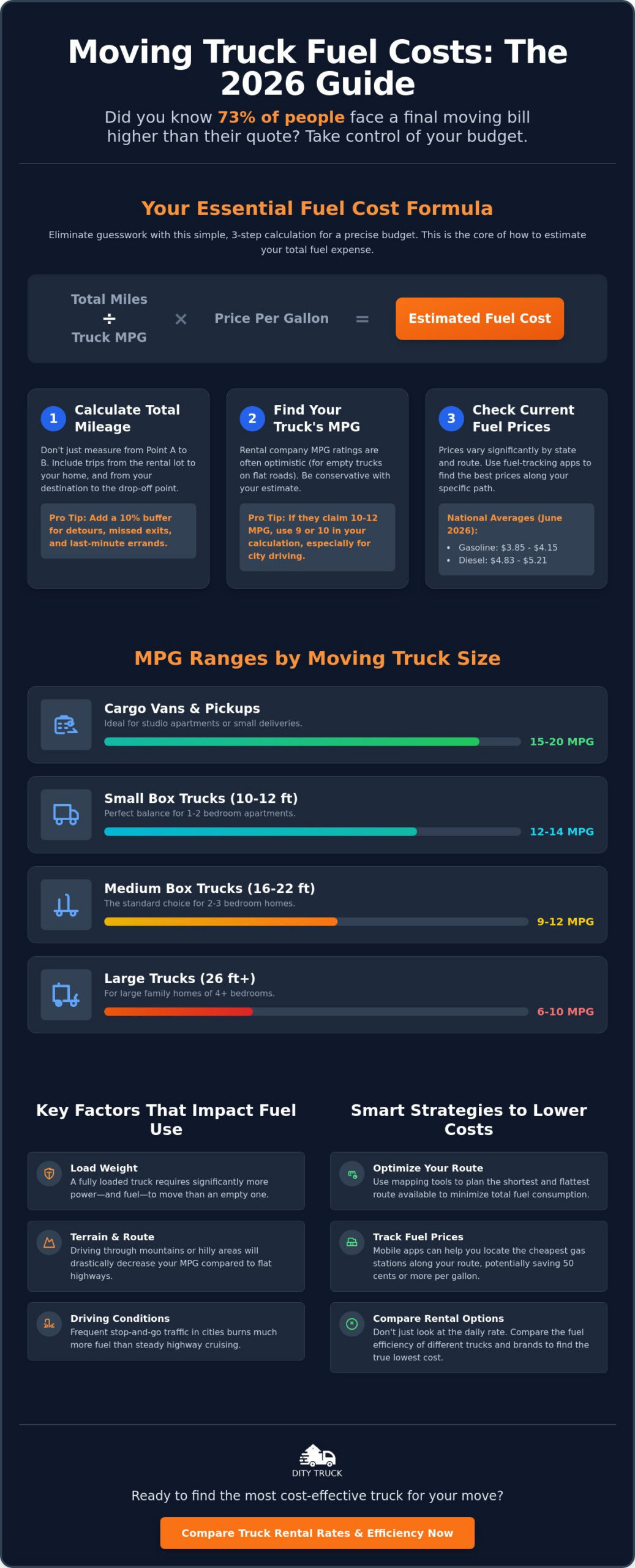
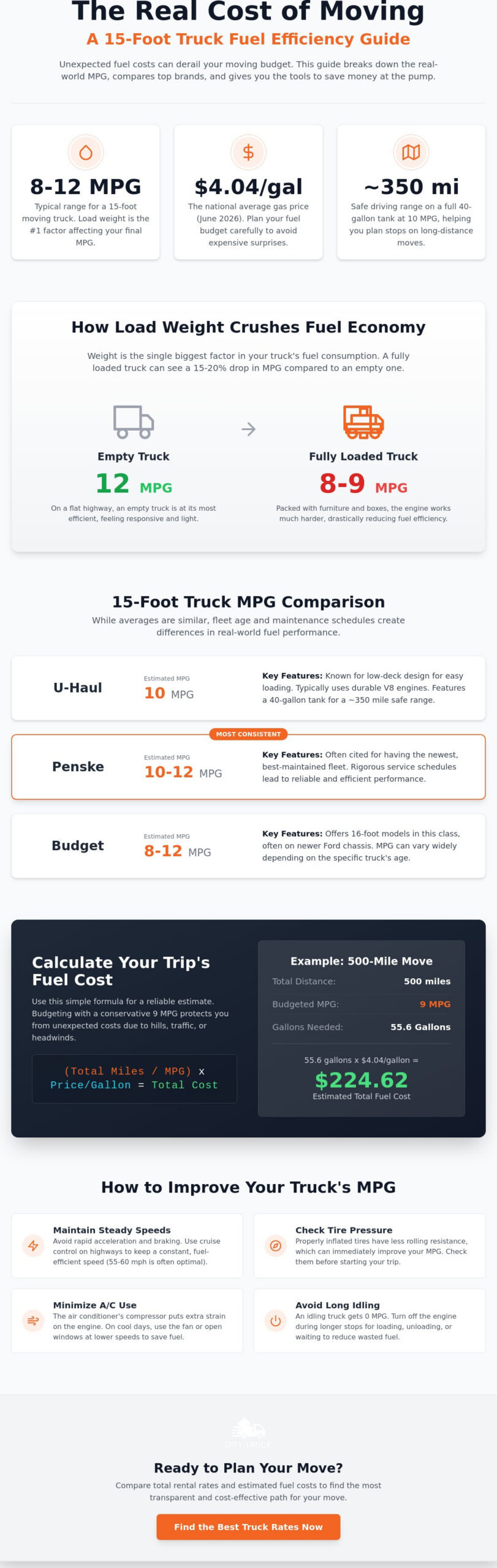
    Fuel costs are a major factor in your 2026 moving budget. A 26-foot truck averages only 8 to 10 miles per gallon. With diesel prices hovering around $4.15 per gallon, a 100-mile trip will cost you roughly $40 to $50 in fuel alone. Don’t forget the cost of equipment rentals. Dollies, furniture pads, and towing ramps are usually charged as separate daily items. These small additions can add $20 to $40 to your total. Finally, be aware of late return fees. Most companies charge a full extra day if you are even an hour behind schedule. Always negotiate a grace period at pickup if you anticipate heavy traffic. If you’re planning a long-distance relocation, reviewing a detailed 2026 comparison guide for one way truck rentals for moving can help you identify which providers offer the most transparent mileage and drop-off fee structures.

    How to Compare and Book Your Truck in Minutes

    Traditional booking is a chore. You open five tabs. You enter the same data five times. You lose track of which quote included mileage. DityTruck fixes this. It brings every major moving truck rental quote onto a single screen. You see the full market in seconds. This transparency removes the guesswork and the loyalty tax. You gain the power to choose based on real data, not brand habit. It is the shortest path between your needs and a confirmed reservation. If you want a complete walkthrough of every step involved when you rent a truck for moving, our ultimate 2026 step-by-step guide covers the entire process from sizing to pickup day.

    Use the comparison tool to filter by your specific requirements. You can sort by the lowest price or the exact truck size you identified earlier. If you need a 26-foot truck for a four-bedroom home, the tool shows you who has that inventory available right now. Once you find the right fit, the Reserve Now button is your final step. Pay close attention to your confirmation number. In the rental industry, this number is your proof of contract. It ensures the vehicle you booked is actually on the lot when you arrive. Save a screenshot or print the email. It is your primary leverage if a location claims they are overbooked on a busy Saturday.

    Before you click the final button, run through a quick checklist. Verify the pickup location address. Confirm the drop-off time. Check for any young renter fees if you are under 25. Most companies require drivers to be at least 18, but those under 25 often face additional surcharges. Knowing these details upfront prevents frustration at the counter. A few minutes of diligence now saves hours of hassle on moving day. This simple process turns a high-stakes task into a manageable win.

    Streamlining the Reservation Process

    Accuracy starts with your data. Enter your pickup and drop-off zip codes along with your exact move dates. This provides real-time accuracy for availability. The tool calculates total estimated costs, including mileage and environmental fees. This prevents the sticker shock often found at the rental counter. Secure your rate early. Seasonal price hikes occur as the peak summer season approaches. Booking today locks in current market rates before high demand drives prices higher.

    Preparing for Pickup Day

    Arrive ready to move. You need a valid, government-issued driver’s license and a credit card in your name. Most providers also require a backup contact number for their records. Before you drive away, perform a thorough walk-around inspection. Document every scratch, dent, or upholstery tear with your phone’s camera. Check the tire tread and fluid levels as well. This protects you from being charged for damage or maintenance issues you didn’t cause. Once you’re satisfied with the vehicle’s condition, you’re ready to hit the road. Find and compare the best moving truck rental rates on DityTruck to start your journey with confidence.

    Take Control of Your Move Today

    A successful relocation starts with the right tools. You now understand how to size your vehicle correctly to avoid costly second trips. You know that comparing major brands is the only way to beat the loyalty tax. Most importantly, you have the knowledge to spot hidden fees before they hit your bank account. Finding a reliable moving truck rental no longer has to be a source of stress. It is a logical process with a clear, cost-effective outcome.

    Efficiency is just a click away. You don’t need to spend hours on multiple websites. DityTruck provides real-time quotes from Penske, Budget, and other top providers on a single screen. There is no hidden markup on rental provider rates. Whether you are planning a local shift or a one-way cross-country journey, this streamlined booking process ensures your vehicle is ready when you are. Your time and peace of mind are valuable.

    Compare Real-Time Moving Truck Rates Now

    Your move is a major milestone. With the right preparation and a transparent price, you can move with complete confidence. As you start this next chapter, especially if you’re settling in the Greater Rochester area, Stone Road Auto provides a helpful guide for those looking to secure a reliable pre-owned vehicle for their daily needs.

    Frequently Asked Questions

    How old do I need to be to rent a moving truck?

    Most moving truck rental companies require drivers to be at least 18 years old. Some providers may set a minimum age of 21 for larger box trucks. If you are under 25, be prepared for a “young renter fee” that adds to your daily total. Always verify the specific age requirements of your selected provider before you finalize your booking.

    Do I need a special license to drive a 26-foot box truck?

    No, a standard, government-issued driver’s license is all you need for a personal move. You don’t need a commercial driver’s license (CDL) to operate these vehicles for residential purposes. While these trucks are large, they are designed for non-professional drivers. Just remember that they require wider turns and longer distances to come to a complete stop safely.

    What is the cheapest day of the week to rent a moving truck?

    Midweek days like Tuesday and Wednesday are typically the most affordable times to rent. Demand for a moving truck rental peaks on weekends and at the start or end of the month. By scheduling your move for a Monday or Thursday, you can often secure lower base rates and better vehicle availability than you would on a busy Saturday.

    Is it cheaper to rent a truck one-way or return it to the same location?

    Local rentals with the same pickup and drop-off point are usually cheaper for short distances. You pay a low daily rate plus a fee for every mile driven. One-way rentals are better for long-distance moves because they often include a set number of miles and days in a flat rate. This prevents mileage fees from becoming a silent budget killer during interstate relocations.

    How much does a moving truck rental typically cost per mile?

    Mileage fees for a local moving truck rental generally range from $0.59 to $1.39 per mile. Some providers, like Penske, may charge between $1 and $2 per mile for local trips. These costs are added to your daily base rate. It’s essential to estimate your total distance accurately so you aren’t surprised by the final bill at the drop-off location.

    Does my personal car insurance cover a rental truck?

    Most personal auto insurance policies and credit card protections exclude commercial-grade box trucks. These vehicles are often classified as “cargo equipment” rather than passenger cars. This means you likely need to purchase a damage waiver or supplemental liability insurance from the rental company. These add-ons typically cost between $15 and $50 per day but provide essential protection.

    What happens if I return the moving truck late?

    Returning a truck late usually results in a full extra day of rental fees. Most companies operate on strict 24-hour cycles. If your contract says 10:00 AM and you arrive at 11:30 AM, you will likely be charged for another 24 hours. Always call the rental office if you are stuck in traffic to see if they can offer a brief grace period.

    How far in advance should I book my moving truck rental?

    You should book your vehicle at least two to four weeks before your moving date. During the peak summer season, inventory can disappear quickly. Reserving early ensures you get the exact truck size you need for your household. It also allows you to lock in lower rates before seasonal price hikes take effect as availability decreases across the fleet.

  • Moving Truck Size Calculator: Find the Perfect Fit for Your Move in 2026

    Moving Truck Size Calculator: Find the Perfect Fit for Your Move in 2026

    What if the most expensive part of your move isn’t the rental fee, but the six inches of space you didn’t account for? Standing in your driveway with a full truck and half a house left to pack is a logistics nightmare. Finding the right fit starts with a precise moving truck size calculator that cuts through the confusion of cubic feet and inconsistent brand labels. It’s the smartest way to ensure your furniture fits the first time without overpaying for empty air.

    We know that moving is stressful enough without playing a high-stakes guessing game. You’ve likely felt the anxiety of staring at a stack of boxes and wondering if they’ll actually fit in one go. This guide will show you how to calculate the exact truck size you need for your specific inventory. You’ll avoid wasted space and secure the lowest possible price for your rental choice. We’ll break down sizing by room count, explain the inventory method, and compare top rental brands to get you moving with total confidence in 2026.

    Key Takeaways

    • Avoid the “second trip” nightmare by using the Goldilocks rule. It helps you find a truck that is neither too small nor too expensive.
    • Use a moving truck size calculator to turn your inventory into precise cubic feet. This stops you from paying for empty air.
    • Learn why truck dimensions vary between rental brands. Decipher nominal versus actual cargo space before you sign a contract.
    • Master the inventory method and account for the “Tetris Factor.” This ensures your volume audit reflects real-world packing conditions.
    • Move from estimation to booking. Use a comparison tool to filter the entire market and secure the lowest price for your specific size.

    The Moving Truck Size Dilemma: Why Estimation Matters

    Sizing is a balancing act. Too small, and you are left with leftovers on the sidewalk. Too large, and you are paying to transport empty air. This is the Goldilocks rule of logistics. You need a fit that is just right. In 2026, many rental fleets have standardized internal volumes. However, labels across the industry remain inconsistent. One provider’s “large” vehicle might be another’s “medium.” This makes a reliable moving truck size calculator essential for a friction-free move. It translates confusing marketing labels into actual cargo capacity.

    Financial impact is the most immediate concern. Wrong sizing leads to mileage overages and wasted fuel. Safety is also a priority. An overstuffed truck is a road hazard. It changes vehicle handling and increases braking distances. Understanding standard moving truck sizes provides a foundational classification before you book. It ensures you don’t push a vehicle beyond its intended mechanical capacity.

    The Hidden Costs of the “Second Trip”

    Guessing usually results in a 20% cost increase. It’s rarely a clean mistake. You pay for extra gas and additional mileage fees. Then there is the labor. Doubling your trips means doubling your exhaustion. The psychological toll is heavy. A move that should take six hours quickly turns into a twelve-hour ordeal. It’s a high-stakes task that requires clarity from the start. Don’t wing it. Use a moving truck size calculator to get a definitive recommendation.

    Volume vs. Weight: What Actually Limits You?

    Space isn’t your only constraint. You must account for the Gross Vehicle Weight Rating (GVWR). This is the maximum weight the vehicle can safely carry. A truck full of heavy books requires different sizing than one filled with lightweight sofas. Suspension limits are real. If you pack for volume but ignore weight, you risk a breakdown or a fine at a weigh station. Balance your cubic footage with these mechanical limits. It’s the shortest path to a successful, stress-free relocation.

    Metrics for Success: Bedrooms, Boxes, and Cubic Feet

    Finding the right fit requires the right metrics. Most people start with the Bedroom Method. It’s the industry standard for quick planning. If you have a two-bedroom home, you look for a truck marketed for two bedrooms. It’s simple but risky. This method assumes you have an average amount of furniture. It doesn’t account for your massive sectional or that basement full of power tools. For a more accurate result, professional movers use the Cubic Foot Method. This calculates the actual volume of every item. A moving truck size calculator bridges the gap between these two approaches. It gives you a data-driven starting point so you don’t overpay for empty space.

    According to the official consumer moving guide, understanding your inventory is the first step in avoiding unexpected costs. You can also use the Box Count Method if you’re a minimalist. If most of your belongings fit in medium boxes, you can estimate your needs based on total box volume rather than furniture pieces. A medium box is roughly 3 cubic feet. If you have 50 boxes, that’s 150 cubic feet before you even count the furniture. Converting rooms into truck feet is a matter of density. For every fully furnished room, plan for about 150 to 200 cubic feet of truck space. This level of detail prevents the “second trip” disaster mentioned earlier.

    Standard Room-to-Volume Conversion Chart

    Use these benchmarks as a starting point. They represent the typical density of modern American households in 2026. These numbers help you narrow down your search before looking at specific brand inventory.

    • Studio or Small Apartment: Requires a 10 to 12 ft truck. This provides approximately 400 to 500 cubic feet of cargo space.
    • 1 to 2 Bedroom Home: Requires a 15 to 16 ft truck. This offers roughly 600 to 800 cubic feet.
    • 3+ Bedroom Home: Requires a 22 to 26 ft truck. These larger vehicles provide 1,200 to 1,600 cubic feet of space.

    Visualizing Cubic Feet: Real-World Examples

    Cubic footage can be hard to picture. Think of your garage. A space that is 5 feet wide, 5 feet deep, and 4 feet high is exactly 100 cubic feet. That is roughly the size of a standard cargo van’s interior. For another comparison, consider a standard refrigerator. It takes up about 60 cubic feet of space. That same footprint could hold a stack of 12 medium moving boxes. A cubic foot is 1,728 cubic inches for precise inventory. Once you have these numbers, you can compare real-time rental rates based on your specific volume requirements. This ensures you only pay for the metal you actually need.

    Moving Truck Size Calculator: Find the Perfect Fit for Your Move in 2026

    Universal Sizing Guide: Comparing Major Rental Brands

    A 16-foot truck at one rental company isn’t the same as a 16-foot truck at another. This is a common industry challenge. Most providers use “nominal sizing,” which is a marketing label rather than a precise measurement of usable floor space. One brand might include the front bumper in their length calculation while another only measures the interior box. This inconsistency makes using a universal moving truck size calculator essential. It translates these confusing labels into actual cargo capacity so you can compare options accurately. You need to look past the sticker on the door to find the real usable volume.

    The “Mom’s Attic” factor adds another layer of complexity to your choice. This is the storage compartment that extends over the truck cab. It adds significant cubic footage, but it isn’t floor space. You can’t put a heavy dresser or a refrigerator there. It’s designed for blankets, pillows, and fragile items. When you see a high volume rating, check how much of it is tucked into that attic. DityTruck simplifies this by aggregating these disparate sizes into a single comparison view. It strips away the marketing fluff to show what you’re actually renting. It’s about total transparency across the entire market.

    Market Sizing Breakdown: Medium to Extra Large

    The medium truck category, typically 15 to 17 feet, is the most popular choice for 2-bedroom moves. Some models in this range feature low deck heights to make loading heavy appliances easier without a steep ramp. Other providers utilize higher decks that align with loading docks. These might require more physical effort to load, but they often provide a smoother ride on the highway. The 26-foot truck remains the ceiling for DIY movers. It is the largest vehicle you can drive without a commercial driver’s license (CDL). It’s the heavy hitter for 4-bedroom homes and long-distance relocations.

    Specialty Vehicles: When to Choose Vans and Pickups

    You don’t always need a massive box truck. For dorm moves or studio apartments, a cargo van or pickup rental is often the smarter choice. These vehicles have higher availability for local moves and are much easier to park on tight city streets. If your moving truck size calculator shows a volume under 250 cubic feet, consider ditching the big rig. A smaller vehicle saves you money on fuel and insurance. It’s the shortest path to a quick, efficient move when you have a smaller inventory.

    The Inventory Method: How to Calculate Your Load Manually

    General estimates provide a baseline. However, a manual inventory audit offers the highest level of precision. This is where you account for the “Tetris Factor.” Professional movers are experts at utilizing every inch of a cargo hold. Most DIY movers are not. You must include a 15% safety buffer in your final calculation. This extra space accounts for the gaps between mismatched boxes and the awkward angles of your furniture. It’s the difference between a single trip and a midnight return to your old driveway. A moving truck size calculator works best when you feed it accurate, audited data from your specific home.

    Step-by-Step DIY Volume Audit

    Follow this five-step process to build a reliable inventory list. It strips away the guesswork and replaces it with functional data.

    • Group by room: Walk through your home. List every major item room by room to ensure nothing is missed.
    • Categorize items: Label everything as “stackable” or “fragile.” Stackable items like plastic bins form your base. Fragile items like lamps go on top.
    • Estimate box counts: Use 10 boxes per room as your safe baseline. If you’ve lived in your home for over five years, increase this to 15.
    • Identify non-stackables: Flag items like bicycles, treadmills, or large potted plants. These “space eaters” cannot have items placed on top of them.
    • Measure the big three: Find your three tallest or widest items. Measure them to ensure they clear the door height of your chosen truck.

    The “Stacking Height” Reality Check

    Advertised volume is often a laboratory number. In the real world, usable volume is often 10 to 15% less than advertised volume due to wheel wells and interior hardware. Most DIYers also struggle with vertical space. The top 12 inches of a truck usually remain empty because it’s difficult and dangerous to stack heavy items that high without professional straps. If you aren’t comfortable stacking boxes above your head, you need to increase your truck size by one tier.

    Don’t forget about your garage and patio. Exercise equipment and outdoor furniture are rarely uniform in shape. They create “dead air” in a truck that you can’t easily fill with boxes. Once you’ve completed your manual audit, you can book your ideal truck size with total confidence. Using a moving truck size calculator alongside your manual audit ensures you get the lowest price for the exact space you need. It’s about being smart with your time and your budget.

    From Calculation to Comparison: Booking Your Ideal Truck

    Knowing your volume is only half the battle. Now you need a rate that fits your budget. Market prices shift daily. A specific size might cost more on a Friday than a Tuesday. Using a moving truck size calculator gives you the specific volume you need. DityTruck then takes that data and finds every available match in your area. It is the fastest way to see the whole market at once. You skip the tedious task of visiting multiple websites. You get clarity instead of confusion.

    The transition from estimation to reservation should be seamless. Once you have a definitive truck size recommendation, you can filter the comparison engine by that exact specification. This ensures you aren’t distracted by “deals” on trucks that are too small for your inventory. You focus only on the vehicles that can actually complete your move in a single trip. It is about efficiency and financial honesty.

    Finding the Best Rate for Your Size

    Rates fluctuate based on seasonal demand. During peak summer months, smaller trucks often sell out first. This can lead to a fleet oversupply of larger vehicles. Paradoxically, the larger truck is sometimes cheaper because the rental company needs it moved to a different location. Always check DityTruck for “pay now” discounts. These upfront payments often secure a lower total price for your specific size compared to paying at the counter.

    Confirming Availability and Pickup

    Understand the difference between a request and a guaranteed reservation. A request is just a placeholder. A guarantee means the truck will be on the lot when you arrive. If your calculated size isn’t available at the nearest lot, look at adjacent zip codes. Sometimes a ten-minute drive saves you significant money. Before you hit the final button, run through this checklist:

    • Verify the pickup location and operating hours.
    • Check for mileage limits on one-way moves.
    • Confirm your insurance coverage options.
    • Review the fuel return policy.

    Book your moving truck rental today on DityTruck for the best rates. By combining your moving truck size calculator results with real-time market data, you ensure a friction-free move. You’ve done the math. You’ve compared the options. Now, secure your truck and start packing with total confidence.

    Take Control of Your Move Today

    Moving doesn’t have to be a guessing game. You now have the tools to avoid the “second trip” nightmare and the cost of wasted space. By mastering the inventory method and understanding the difference between nominal and actual cargo space, you’ve removed the biggest hurdles in the planning process. Using a moving truck size calculator ensures your furniture fits the first time. It replaces anxiety with a clear, data-driven plan. You’ve learned how to account for the “Tetris Factor” and safely buffer your load for real-world conditions.

    The next step is simple. Compare Penske, Budget, and U-Haul in seconds to find the best rate for your specific needs. DityTruck provides real-time 2026 availability across the US with no hidden fees or surprise surcharges. You’ve done the heavy lifting of calculation. Now, let us handle the comparison. Compare moving truck rates and book your perfect size now. You are ready for a smooth, efficient transition to your new home. Secure your rental today and start packing with total peace of mind.

    Frequently Asked Questions

    What size moving truck do I need for a 2 bedroom house?

    A 15 to 17 foot truck is the standard recommendation for a 2 bedroom house. This size typically provides 600 to 800 cubic feet of space. It’s ideal for a home with roughly 1,200 square feet of living space. If you have a large sectional or a packed garage, consider using a moving truck size calculator to see if you need to move up to a 20 foot model for a single trip.

    Is a 10 foot or 15 foot truck better for a studio apartment?

    A 10 foot truck is usually sufficient for a studio apartment with minimal furniture. It offers approximately 400 cubic feet of space, which fits a bed, a small sofa, and about 20 boxes. However, if you have oversized items like a king sized mattress or a large desk, a 15 foot truck provides a safer buffer. Choosing the larger option prevents the exhaustion of a second trip.

    How many boxes can fit in a 16 foot moving truck?

    A 16 foot moving truck can hold approximately 250 to 300 medium sized boxes if it is completely empty. In a real world move with furniture, you can typically fit 60 to 90 boxes alongside your larger items. This assumes you stack boxes efficiently from floor to ceiling. Always place heavier boxes at the bottom to create a stable base and protect your fragile belongings.

    What happens if I rent a moving truck that is too small?

    Renting a truck that is too small forces you to make multiple trips. This immediately increases your mileage fees and fuel costs. It also adds hours of extra labor to your moving day. In some cases, you might have to leave items behind or rent a second vehicle at the last minute. This mistake often results in a 20% increase in your total moving expenses.

    Can I drive a 26 foot moving truck with a normal license?

    Yes, you can drive a 26 foot moving truck with a standard driver’s license in the United States and Canada. These vehicles are classified for consumer use and fall below the weight limit that requires a Commercial Driver’s License. However, you must be at least 18 to 21 years old depending on the rental company and have a valid license. Always check specific brand requirements before booking.

    Does the truck size include the space over the cab?

    Yes, most rental companies include the over cab compartment in their total cubic footage ratings. While this space adds volume, it is not part of the main floor length. It is designed for fragile items, blankets, or light boxes. When using a moving truck size calculator, remember that this space cannot support heavy furniture. It is a supplement to the main cargo area, not a replacement.

    Is it better to get a larger truck than I think I need?

    Yes, renting one size larger than your estimate is a smart strategy to avoid the stress of tight packing. A larger truck allows for easier loading and prevents you from having to stack items dangerously high. While the daily rate might be slightly higher, it is far cheaper than the cost of a second trip or damaged furniture caused by overstuffing a small vehicle.

    How do I calculate cubic feet for my furniture?

    Calculate cubic feet by multiplying the length, width, and height of an item in feet. For example, a dresser that is 5 feet long, 2 feet wide, and 3 feet tall is 30 cubic feet. For a faster result, use a moving truck size calculator that provides pre set volumes for common household items. This ensures your inventory audit is accurate and saves you time during the planning phase.

  • What Size Moving Truck Do I Need? A Universal 2026 Comparison Guide

    What Size Moving Truck Do I Need? A Universal 2026 Comparison Guide

    What if the 16-foot truck you’re eyeing is actually a recipe for a two-day headache? Most people guess their load size and end up either making three extra trips or paying for a massive, half-empty cargo hold. You don’t want to realize you’re out of room while the sun is setting and your couch is still on the sidewalk. It’s equally stressful to navigate a vehicle that feels way too large for your comfort level. Determining what size moving truck do I need shouldn’t feel like a high-stakes gamble.

    We understand that logistics are stressful enough without the math. This guide strips away the complexity to give you a clear, inventory-based recommendation. You’ll find the perfect balance between volume and weight capacity so your move stays safe, legal, and efficient. We promise to help you avoid wasted space and unnecessary costs. Our goal is to replace your moving anxiety with total clarity and simple, actionable steps.

    We will break down everything from 10-foot vans to 26-foot giants. You’ll learn how to estimate your cubic footage like a pro and discover how to lock in the lowest rates for the exact size you require.

    Key Takeaways

    • Master the “Goldilocks” principle. Avoid paying for empty space or making costly second trips.
    • Understand why room counts fail. Use cubic feet for a precise, reliable measurement of your belongings.
    • Follow our simple inventory audit. Finally answer what size moving truck do I need with total confidence.
    • Apply the 10-box-per-room rule. Prevent mid-move space shortages by accurately estimating your total box volume.
    • Compare real-time rates. Find the most cost-effective option for your specific move by viewing all brands in one place.

    Why Choosing the Right Moving Truck Size Is Your Biggest Money-Saver

    Determining what size moving truck do I need is the most impactful decision you’ll make for your budget. It’s the “Goldilocks” principle of logistics. A truck that is too small leads to a disaster. A truck that is too large is a waste of your hard-earned cash. Every extra inch of unused space represents money spent on fuel and higher daily rates. You don’t want to pay for air. Conversely, running out of room mid-day creates a bottleneck that can double your costs instantly.

    Efficiency starts with your wallet. Larger vehicles are heavier and less aerodynamic. They naturally return lower fuel economy. If you choose a 26-foot truck for a job that a 15-foot truck could handle, you are paying to burn more gas. Mileage fees also add up quickly. Most local rentals charge between $0.70 and $1.00 per mile. If you make a second trip because you underestimated the load, you pay those mileage fees twice. You also double your fuel consumption and your time on the road.

    The Cost of the Wrong Choice

    The math of a second trip is brutal. If your destination is 20 miles away, a second trip adds 40 miles to your total. At a standard rate of $0.85 per mile, that is an extra $34 just in mileage. Add the extra gas for a heavy truck and you’ve easily spent more than the cost of a larger rental. Time is your most valuable asset. A second trip can add four hours to your day. This leads to fatigue and unnecessary stress. There is also the risk of damage. Packing a truck that is too large often leaves gaps. Gaps allow furniture to shift during transit. Shifting cargo leads to broken legs on tables or cracked screens. A properly sized truck allows for a tight, secure load; this protects your belongings.

    Understanding the Industry Standard

    National rental providers don’t always use the same labels. One company might market a 12-foot vehicle as a “small truck.” Another might call it “medium.” This inconsistency makes it hard to answer the question: what size moving truck do I need? To find clarity, you must look past the marketing names. Focus on the standard moving truck sizes and their actual interior dimensions.

    Internal cubic footage is the only metric that matters. The length of the truck provides a baseline. The height and width of the box determine the total volume. By understanding these categories, you can make a logical choice. Choosing the right size saves money. It allows you to move faster. It ensures you only pay for the space you actually use. Efficiency is the shortest path to a successful moving day.

    Standard Moving Truck Sizes: From Cargo Vans to 26-Foot Box Trucks

    Most rental companies label their fleets with simple numbers, but these designations can be deceptive. A 10-foot truck from one provider may have significantly less interior volume than a 10-foot truck from another. This inconsistency is why answering the question what size moving truck do I need requires looking at the actual cubic footage. You are renting space, not just a length of metal. Understanding these categories helps you visualize your inventory inside the cargo hold.

    The industry generally divides trucks into four main tiers. Cargo vans and pickups offer 245 to 320 cubic feet of space. Small box trucks, ranging from 10 to 12 feet, provide 350 to 450 cubic feet. Medium trucks between 15 and 17 feet jump to 650 to 865 cubic feet. Finally, large 20 to 26-foot trucks offer a massive 1,000 to 1,800 cubic feet. You can compare these dimensions across all major brands on ditytruck.com to see which fleet matches your inventory.

    Small Scale: Vans and 10-Footers

    Cargo vans and 10-foot trucks are the preferred choice for studio apartments, dorm rooms, or small office relocations. They are incredibly agile in urban environments. You can park these vehicles in standard residential spots or navigate tight city alleys with ease. This saves you from the stress of blocking traffic or receiving parking tickets. However, there is a crucial limitation to consider. Most cargo vans and 10-foot models do not include loading ramps. You will have to lift every box and appliance into the back by hand. This makes them ideal for boxes and small items, but difficult for heavy dressers or refrigerators. If you have any large furniture, skipping the ramp might be a painful mistake.

    The Family Move: 15 to 26-Foot Trucks

    The 16-foot truck is the industry workhorse. It is the most popular choice for the average family living in a two-bedroom apartment or a small home. These vehicles strike a perfect balance between capacity and drivability. They almost always include wide loading ramps and low decks. A low deck height means you don’t have to push heavy items up a steep incline. This reduces physical strain and speeds up the loading process.

    For larger three to five-bedroom households, the 26-foot truck is the standard requirement. These heavy-duty vehicles are designed for massive loads and long distances. They also offer superior towing capabilities. If you need to attach a car trailer or a tow dolly, you generally need at least a 15-foot truck to handle the weight safely. Always verify the towing capacity before you book. Choosing a truck with a built-in ramp and towing hitch ensures your entire household, including the family car, moves in a single trip.

    What Size Moving Truck Do I Need? A Universal 2026 Comparison Guide

    Beyond Room Counts: Understanding Cubic Feet and Weight Capacity

    Room counts are a trap. A “three-bedroom home” label is a vague marketing term used by rental companies to simplify a complex choice. It assumes a standard amount of furniture that may not match your reality. A minimalist’s bedroom is vastly different from a room filled with heavy oak dressers and floor-to-ceiling bookshelves. To accurately answer what size moving truck do I need, you must look at the math of cubic feet and weight capacity.

    Total volume is the primary metric for most moves. However, volume alone doesn’t tell the full story. You must also consider the Gross Vehicle Weight Rating (GVWR). This is the maximum weight the vehicle can safely carry, including the truck itself, passengers, fuel, and your cargo. Ignoring this limit leads to safety hazards and potential legal fines. It’s about more than just fitting everything inside; it’s about making sure the truck can actually move it.

    Cubic Feet vs. Real-World Space

    Visualizing cubic feet is difficult. It’s helpful to think in terms of stackable units. However, you should never plan to use 100% of the advertised space. We recommend the 80% rule. This accounts for awkward gaps between furniture, odd-shaped items, and the necessary air space for padding. If a truck offers 800 cubic feet, plan to fit about 640 cubic feet of actual inventory. This buffer prevents you from having to force items into tight spots, which often causes damage.

    High ceilings in modern box trucks change your packing strategy. You must stack items vertically to maximize the floor plan. Many trucks also feature an overhead compartment known as “Mom’s Attic.” This space is perfect for fragile items or light electronics that need to stay away from heavy furniture. Using this overhead space effectively can be the difference between needing a larger truck or fitting everything into a medium-sized one. If you’re asking what size moving truck do I need for a long-distance haul, these vertical dimensions become your best friend.

    The Weight Factor

    Weight capacity is often the hidden limitation of a move. Standard movers estimate between 1,000 and 1,500 pounds of weight per fully furnished room. Heavy appliances like refrigerators, washing machines, and cast-iron tubs add up quickly. A 16-foot truck may have the volume for your items but might struggle with the total payload if you’re moving heavy machinery or dense book collections.

    Overloading a truck is dangerous. It significantly increases your braking distance. It puts extreme stress on the tires, which leads to blowouts on the highway. In some states, rental trucks are required to stop at weigh stations. If you exceed the GVWR, you may face heavy fines or be forced to unload items on the spot. If your inventory is exceptionally heavy, it’s often smarter to opt for a 26-foot truck simply for its higher weight rating. This ensures a safer drive and keeps you compliant with federal regulations.

    The Inventory Audit: How to Accurately Estimate Your Load

    Answering the question what size moving truck do I need requires a methodical inventory audit. Guessing leads to stress and wasted money. A systematic approach ensures you book the right vehicle the first time. Follow these four steps to eliminate the guesswork and move with confidence.

    • Step 1: Identify your anchors. Count every “large footprint” item. This includes beds, sofas, dining tables, and large appliances. These pieces dictate the floor plan of the truck.
    • Step 2: Estimate your box count. A reliable rule of thumb is to allow 10 boxes per furnished room. This provides a baseline for the stackable portion of your load.
    • Step 3: Account for the garage factor. Don’t forget outdoor tools, patio gear, and bicycles. These items are often bulky and consume significant volume.
    • Step 4: Compare the totals. Take your total estimated volume and check it against the truck’s actual internal dimensions.

    Measuring Your Largest Items

    Moving is a game of Tetris. You must think in three dimensions. Accurately answering what size moving truck do I need depends on your ability to stack. Measure the length, width, and height of your largest furniture pieces. This data allows you to visualize how they will fit together in a tight, secure load. Disassembling items is a game changer. Taking the legs off a table or breaking down bed frames can save up to 20% of your total truck space. This simple step often allows you to fit into a smaller, cheaper truck category.

    Identify non-stackable items early. Electronics, delicate antiques, and mirrors cannot have weight placed on top of them. These items create “dead space” in your load. You must account for this lost volume. If you have many fragile or odd-shaped items, you might need to step up one size to avoid crushing your valuables. It’s better to have a little extra breathing room than to stack heavy boxes on a vintage lamp.

    The Box Estimation Guide

    Boxes are the building blocks of your move. Standard small boxes are roughly 1.5 cubic feet. Medium boxes are 3 cubic feet. Large boxes reach 4.5 cubic feet. Using uniform box sizes makes the loading process much faster. They stack securely and leave fewer gaps. If you use a mix of random containers, you’ll lose space to “honeycombing.” This is when items don’t fit snugly, leaving pockets of empty air you still have to pay for.

    Don’t forget the oddballs. Items like vacuum cleaners, floor lamps, and yard tools don’t fit in boxes. They are awkward and consume more space than their weight suggests. A single bicycle can take up the same volume as six medium boxes. Once you have your total count, compare real-time truck availability to find the most efficient match for your specific inventory.

    How DityTruck Simplifies Your Search for the Perfect Rental

    Logistics shouldn’t be a gamble. You’ve calculated your cubic footage. You’ve analyzed your payload limits. Now you need a reliable way to find that specific vehicle without calling five different rental offices. DityTruck serves as your savvy consumer advocate. We strip away the traditional hurdles of truck rental. Our platform provides a transparent, friction-free path to your destination. It’s the fastest way to solve the puzzle of what size moving truck do I need.

    Pricing transparency is our priority. Most people worry about hidden fees or bait-and-switch rates. We present real-time pricing for every category. Whether you need a 10-foot van or a massive 26-foot box truck, the data is clear. You see the costs upfront. This allows for total financial clarity before you commit. You can compare rates across multiple providers at once. This ensures you never overpay for the space you require.

    One Search, Every Size

    DityTruck aggregates major national providers into a single, intuitive interface. You can view all top industry brands side-by-side. No more jumping between browser tabs. No more repeating your move details on multiple forms. You simply enter your location and date. The system does the heavy lifting for you. This creates momentum toward your goal. You get a birds-eye view of every available option in your local area instantly.

    Filtering is where the efficiency happens. You can sort by truck type, length, or capacity. Match these filters to your recent inventory audit. If your audit showed you need 1,200 cubic feet, you can immediately narrow your search to 22-foot models. This is the smartest way to verify what size moving truck do I need based on real-time data. You see local availability across multiple national providers in one view. This saves hours of manual research. It gives you the confidence that you are getting the best deal in your area without the hassle of individual site searches.

    Secure Your Move Today

    Timing is everything in logistics. Approximately 62% of people who move choose the DIY route. This creates high demand for specific truck sizes, especially during peak season. If you wait until the last minute, you might be forced into a truck that is too large and expensive. Or worse, you might end up with a van that requires three trips. This leads to exhaustion and wasted fuel. Early action is the only way to protect your budget.

    Booking 4 to 6 weeks in advance is the golden rule. It secures your specific size before inventory runs low. DityTruck makes this reservation process simple. We charge a straightforward booking fee of $4.99 for local moves or $29.99 for one-way rentals. This small investment ensures your truck is ready when you are. It provides the peace of mind you deserve during a high-stakes task. Book Your Ideal Moving Truck Now and start your move with total confidence.

    Secure Your Moving Day Strategy

    Moving day success depends on preparation rather than guesswork. Room counts are just the beginning. The real math lies in cubic footage and payload capacity. Apply the 80% rule. Conduct a thorough inventory audit. These actions eliminate the risk of multiple trips. You won’t pay for a massive vehicle you don’t actually fill. These simple steps turn a high-stakes task into a manageable, logical process.

    Stop wondering what size moving truck do I need and start comparing your options with total clarity. DityTruck provides real-time pricing from top national providers. We offer a comprehensive selection from cargo vans to 26-foot trucks. Our transparent fee structure ensures you see the full financial picture before you book. Compare Moving Truck Sizes and Rates at DityTruck to secure the perfect vehicle for your timeline and inventory.

    You have the tools to move smarter. Logistics don’t have to be complicated when you have the right data. Take the next step. Finish your move with total confidence.

    Frequently Asked Questions

    Will a 10-foot truck fit a 1-bedroom apartment?

    A 10-foot truck usually fits a small one-bedroom apartment or a studio. These vehicles offer roughly 400 cubic feet of space. This is enough for a queen bed, a sofa, and about 20 boxes. If you have bulky appliances or a large dining set, you’ll likely need a 12-foot or 15-foot model instead. Always measure your largest items first to avoid making multiple trips.

    Is a 26-foot moving truck hard to drive for beginners?

    Driving a 26-foot truck requires extra focus but is manageable for most confident drivers. You must account for wider turns and significantly longer braking distances. Height clearance is the biggest risk. You have to watch for low-hanging branches and gas station awnings. Most beginners find that sticking to main roads and using a spotter for backing up makes the experience much safer.

    Can I tow my car behind a 16-foot rental truck?

    Yes, you can typically tow a vehicle behind a 16-foot rental truck. Most trucks in this size category come equipped with a towing hitch and the necessary engine power for a car trailer or tow dolly. Always verify the specific weight limits of the hitch before you depart. Towing adds length and complexity to your drive. It also decreases your fuel economy during the trip.

    What happens if I rent a truck that is too small?

    Renting a truck that is too small usually results in a second trip. This doubles your mileage fees and your fuel costs. If you’re moving long-distance, you might be forced to leave belongings behind or rent a second vehicle at the last minute. This creates massive stress and unexpected expenses. It’s always safer to choose one size larger than your initial estimate to provide a volume buffer.

    Do I need a special license to drive a large box truck?

    You do not need a Commercial Driver’s License (CDL) to rent most large box trucks. Standard rental trucks, even the 26-foot models, are designed to stay under the federal weight limit for non-commercial vehicles. A valid standard driver’s license is sufficient. However, you must be at least 18 or 21 years old depending on the rental provider’s specific policy. Always check state-specific requirements before booking.

    How much extra space should I leave in the truck for safety?

    We recommend following the 80% rule for loading. Leaving 20% of the truck’s volume empty provides a necessary buffer for awkward furniture shapes and padding materials. This prevents you from forcing items into tight spots; this reduces the risk of scratches or structural damage. A loosely packed truck is actually more dangerous because items can shift. Use tie-downs to secure the load within that available space.

    Does the truck size affect the price of insurance?

    Yes, the size of the vehicle often impacts the cost of your rental insurance. Larger trucks have a higher replacement value and carry more potential for damage in a collision. Providers usually offer tiered protection plans based on the truck’s size and the distance of your move. Reviewing these options helps you answer what size moving truck do I need while staying within your total insurance budget.

    What is the most popular truck size for a 3-bedroom house?

    The 26-foot truck is the most popular and reliable choice for a three-bedroom house. It provides up to 1,800 cubic feet of space. This capacity allows you to fit large appliances, multiple bedroom sets, and a full living room without the fear of running out of room. If you are a minimalist, a 22-foot truck might suffice. Most families prefer the extra space of the 26-footer for peace of mind.