
That $19.95 base rate looks great on a bumper, but it rarely reflects what you actually pay at the counter. With 41% of renters now booking through mobile apps, the speed of the transaction often masks the complexity of the costs. You shouldn’t have to guess about box truck rental prices or worry that a “small” truck won’t fit your heaviest furniture. Hidden mileage fees and mandatory environmental surcharges can quickly turn a budget move into a financial headache.
You deserve a straightforward path to a confirmed reservation. We understand the frustration of surprise insurance requirements and the fear of choosing a vehicle that is too small for your belongings. This guide provides a clear look at 2026 national rates and decodes the fine print that providers often hide. You’ll learn how to match cubic capacity to your specific needs so you can stop stressing and start moving. We’ve simplified the comparison process to give you total price transparency and confidence in minutes.
Key Takeaways
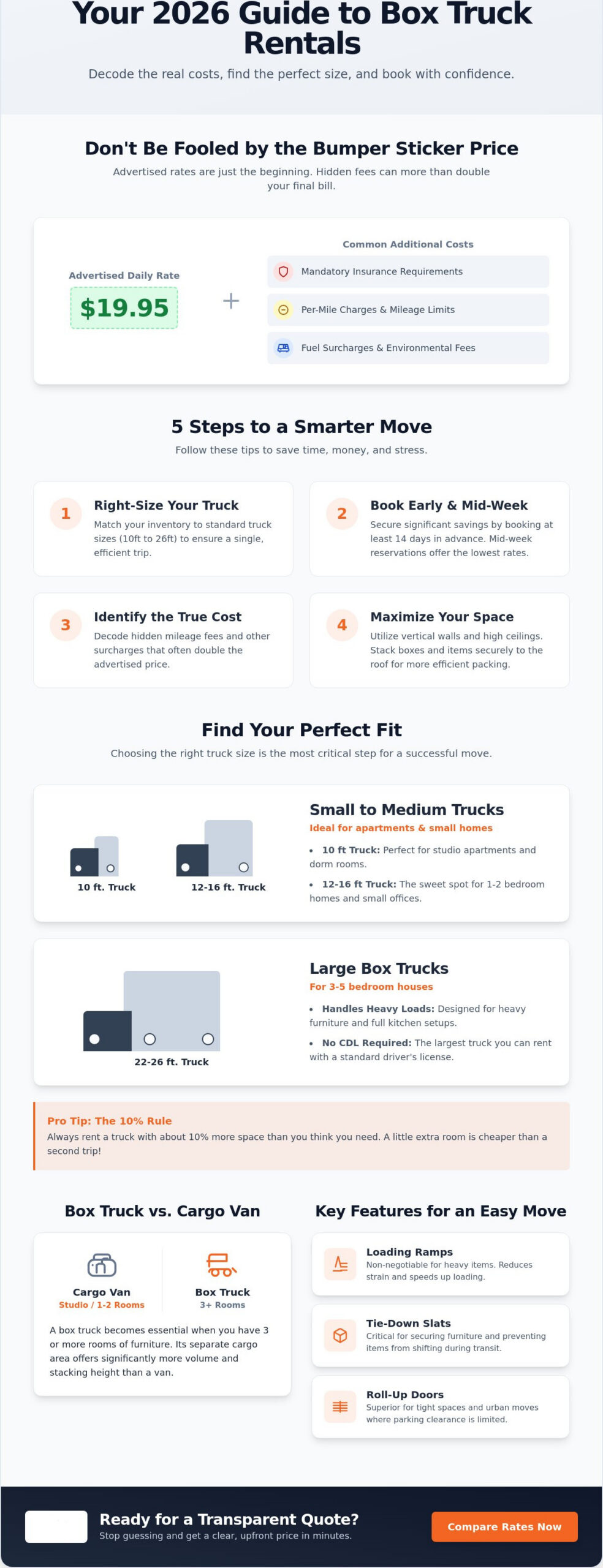
- Match your inventory to industry-standard sizes-from 10-foot mini boxes to 26-foot super movers-to ensure a single, efficient trip.
- Identify the true total cost by decoding hidden mileage fees-these extras often double the advertised box truck rental prices.
- Compare top-tier providers side-by-side-determine which fleets offer the best reliability for local versus long-distance moves.
- Secure significant savings by booking at least 14 days in advance-mid-week reservations offer the lowest rates.
- Maximize your storage potential-utilize vertical walls and high ceilings for safer, more efficient packing.
Understanding Box Truck Rental Options for Your 2026 Move
A box truck is defined by its enclosed cargo area. This space is structurally separate from the driver’s cab. Unlike trailers, the box is permanently attached to the chassis. This design provides a rigid, secure environment for your belongings. When you evaluate box truck rental prices, you are paying for this specialized architecture. The flat, vertical walls and high ceilings are the primary advantages. They allow you to stack boxes and furniture all the way to the roof. You maximize every square inch of floor space. It makes the loading process much more efficient than using a standard van.
The 2026 rental fleet has evolved significantly. Modern trucks now prioritize fuel economy to offset rising gas costs. Most units now come standard with high-definition backup cameras. This makes maneuvering a large vehicle much safer for DIY movers. Box trucks outperform cargo vans because they offer wider floor plans and integrated loading tools. You get more room and better equipment for the same trip. You can research box truck sizes and classes to understand the different weight ratings available for your specific cargo needs.
Box Truck vs. Cargo Van: Identifying the Threshold
Choosing between a van and a truck depends on your total inventory. Cargo vans are ideal for studio apartments or 1-2 rooms of furniture. Once you reach 3 rooms or more, a box truck becomes essential. Consider the “walk-through” factor. Vans allow you to move from the driver’s seat to the cargo area without stepping outside. Box trucks do not. This separation provides more cargo volume. It does require you to exit the cab to access the load. For a deeper dive, read our guide on cargo van vs box truck to see which fits your specific move.
Essential Features: Ramps, Rails, and Roll-up Doors
Efficiency depends on the hardware. Understanding the equipment helps you justify the box truck rental prices you’ll encounter. Loading ramps are a non-negotiable feature for heavy items. They reduce physical strain. They speed up the process. Look for rentals with wide-plank, aluminum ramps for better stability. Inside the box, tie-down slats are critical. These rails allow you to secure heavy furniture using straps. This prevents shifting during long hauls. Pay attention to the door style. Roll-up rear doors are superior for urban moves. They allow you to park and unload in tighter spaces. Swing doors require several feet of clearance. You might not have that extra space on a busy street. These features are standard in the 2026 fleets to ensure a friction-free experience.
Box Truck Sizes and Capacity: Finding the Perfect Fit
Sizing is the foundation of a successful move. If you choose a truck that is too small, you face the nightmare of multiple trips. This doubles your labor. It doubles your fuel costs. It can even impact your final box truck rental prices if you exceed your mileage limit. Standard industry sizes range from 10-foot “mini” boxes to 26-foot “super” movers. Most people focus only on cubic feet, but you must also check the payload capacity. This is the maximum weight the truck can safely carry. Heavy appliances like washers and stone-top tables add up quickly. If you overload the vehicle, you risk mechanical failure or safety fines. Checking the weight rating ensures your truck can actually move what you pack.
Follow the 10% rule. Always rent a truck with 10% more volume than you think you need. This buffer accounts for inefficient packing or last-minute items you forgot to count. It is much cheaper to have a little extra space than to leave furniture on the curb. For official consumer protection advice regarding safe loading and transport, check the FMCSA guidelines. It helps ensure you stay within legal weight limits while on the road.
Small to Medium Trucks (10ft – 16ft)
10ft trucks are the standard choice for studio apartments and dorm relocations. They are easy to drive. They fit in most residential driveways. The 12ft-16ft range is the “sweet spot” for 1-2 bedroom homes and small offices. These sizes offer enough floor space for queen-sized mattresses and several dozen boxes. Review our 2026 sizing & comparison guide to map your specific inventory to the right vehicle.
Large Box Trucks (22ft – 26ft)
When you are moving a 3-5 bedroom house, you need a 26ft truck. This is the largest vehicle you can drive without a Commercial Driver’s License (CDL). These trucks have a high Gross Vehicle Weight Rating (GVWR), which allows them to handle heavy furniture and full kitchen setups without strain. Large box truck rental prices often vary based on availability, so booking early is key. Understanding the cost to rent a 26 foot moving truck is vital for long-distance budgeting. If you want to simplify your search, you can compare rental options to find the best fit for your heavy-duty needs.
Comparing the Best Box Truck Rental Companies Side-by-Side
Choosing a provider requires looking past the flashy base rates. Some providers excel in local moves, boasting extensive networks for easy pickup. While their base rates might seem attractive, watch out for per-mile fees that can quickly increase the total cost. Other companies specialize in long-distance relocations, often providing newer, more reliable fleets to minimize the risk of mechanical delays on cross-country trips. For one-way moves, certain budget-friendly options frequently offer promotional codes that can significantly reduce rental costs.
Comparison is the only way to ensure you aren’t overpaying. DityTruck acts as your smart assistant by aggregating these options. You see real-time box truck rental prices from multiple vendors in one place. You don’t have to visit five different websites to find the best deal. We do the heavy lifting so you can book with confidence in seconds.
Local vs. One-Way Rental Dynamics
The math changes depending on your destination. Local rentals typically offer lower daily rates. However, they carry higher per-mile charges. You must return the vehicle to the original pickup spot. One-way rentals work differently. You pay a higher flat fee, but it usually includes a generous mileage allowance. This is the logical path for state-to-state moves. Check out the one way truck rentals comparison to see the 2026 cost breakdown for long-distance travel.
Fleet Quality and Roadside Support in 2026
Reliability is a financial factor. Newer trucks from certain providers often offer better fuel efficiency and have fewer breakdowns. This saves you money at the pump and protects your schedule. Always verify the terms of 24/7 roadside assistance before you sign. It is essential for cross-country hauls where help might be hours away. Compare various provider options to see the latest reliability ratings and support features for the 2026 season.
Decoding Box Truck Rental Prices and Avoiding Hidden Fees
The “Daily Rate” trap is the most common hurdle for DIY movers. You see a low price advertised on a bumper or a website. You assume that is your total. It isn’t. Most headline rates exclude mileage, taxes, and mandatory environmental fees. Local rentals often charge mileage fees ranging from $0.00 to $1.10 per mile. If you are moving across town, these costs can quickly exceed the base daily rate. You need to factor in fuel expenses as well. Most box trucks average between 8 and 12 MPG. Heavy loads and stop-and-go traffic will push you toward the lower end of that spectrum. This makes fuel one of the largest variables in your 2026 moving budget.
Don’t assume your personal auto insurance covers a rental. Most standard policies exclude vehicles with a Gross Vehicle Weight Rating (GVWR) over 10,000 pounds. Large box trucks almost always fall into this excluded category. If you decline the damage waiver and have an accident, you are personally responsible for the repairs. This is why understanding the full scope of box truck rental prices is critical for your financial safety. You can get a transparent price estimate today and avoid the hidden fee trap.
Calculating the Total Cost of Ownership (TCO)
Finding the real price requires a simple formula. Base Rate + (Estimated Miles x Rate) + Fuel + Insurance + Taxes. This “all-in” figure is the only number that matters for your bank account. Be aware of seasonal spikes. Prices can double during peak moving weekends or the summer months. Your total cost is the sum of every line item from pickup to drop-off. Calculating this total prevents budget overruns and ensures a stress-free move.
Insurance and Liability Protection
Protection plans offer relief from high-stakes risks. A Collision Damage Waiver (CDW) is the most common option. It protects you from repair costs if the truck is damaged. Supplemental Liability Insurance (SLI) is equally important. It covers third-party claims if an accident occurs during your move. For those with high-value furniture, Cargo Insurance is a smart addition. It protects your belongings from shifting or damage while in transit. These options add to the daily cost but remove the risk of a total loss. They provide the clarity you need to drive with confidence.
How to Secure the Best Box Truck Rental Quote Today
Timing determines your final bill. Booking early is the most effective way to lower your box truck rental prices. In 2026, rates are 30% lower when you reserve at least 14 days in advance. This lead time gives providers better visibility into their fleet distribution. They reward your organization with lower costs because it helps them manage regional logistics. Waiting until the week of your move is a high-stakes gamble. You risk paying convenience premiums or facing a total lack of inventory. Secure your rate early to lock in the savings and your peace of mind.
Calendar choice is your second-best tool for savings. Avoid the weekend surge. Tuesday and Wednesday rentals are significantly cheaper than Fridays or Saturdays. Moving companies and DIYers flood the market on weekends to avoid taking time off work. This creates a supply shortage that drives prices upward. If you can shift your move to a Tuesday, you’ll find more truck options and shorter wait times at the counter. It is a simple adjustment that yields a high return on your investment. Choosing the right day is just as important as choosing the right size.
Efficiency is about more than just the daily rate. It is about avoiding the friction of a broken process. When you use a smart assistant to manage your logistics, you strip away the complexity of the task. You gain clarity through transparent data. This allows you to make a fast, confirmed reservation without the typical stress of moving day. You get a reliable tool that respects your time and your budget.
The DityTruck Efficiency Advantage
Skip the multi-tab browser fatigue. We pull the data into one clear view so you don’t have to. Most rental sites hide their fee schedules behind multiple clicks and confusing checkout flows. We bring that information to the surface immediately. Transparent comparisons ensure you see the total cost before you enter your credit card info. It is about speed and honesty. Start your moving truck rental comparison here to secure the right vehicle for your timeline.
Pro-Tips for a Smooth Pickup
Preparation prevents friction at the rental counter. You need a valid driver’s license and the specific credit card used for the reservation. Digital copies are rarely accepted for the physical handover. Once you have the keys, perform a thorough inspection. Document every existing scratch, dent, or interior stain with your phone camera. This is your evidence for the return process. Confirm the fuel level matches the contract exactly. Don’t pay for someone else’s gas. Finally, test the hardware. Deploy the loading ramp. Cycle the liftgate. If these tools fail at your new home, your move stops. Verify functionality before you leave the lot.
Master Your Move with Total Price Clarity
Mastering your move starts with stripping away the guesswork. You now know that the 10% volume rule prevents the nightmare of a second trip. You understand how to calculate the total cost of ownership by factoring in mileage, insurance, and fuel. Most importantly, you have the tools to avoid the hidden fees that traditionally inflate box truck rental prices. Logistics don’t have to be a source of stress. By booking 14 days in advance and choosing mid-week dates, you can secure significant savings and guarantee vehicle availability.
Your relocation deserves a friction-free start. We pull data from top national brands into one clear view so you can make a fast, informed decision. Compare Box Truck Rental Rates and Book Now to see real-time rates with no hidden booking fees. Compare sizes side-by-side and find the perfect fit for your inventory in minutes. You are now equipped to handle the heavy lifting with total financial clarity. Secure your truck today. Start your next chapter with confidence.
Frequently Asked Questions
Do I need a special license to drive a box truck rental?
No, you do not need a Commercial Driver’s License (CDL) for a standard rental. A standard driver’s license is sufficient for vehicles with a Gross Vehicle Weight Rating (GVWR) of up to 26,000 pounds. This includes almost every consumer box truck on the market. Always verify the weight rating on your contract to ensure you stay within legal limits for your specific vehicle.
What is the cheapest box truck rental company for a local move?
Budget is often the most affordable choice for local moves in 2026. While some competitors offer low base rates, Budget’s average local mileage fee of $0.47 per mile is significantly lower than the industry average. This helps keep the total box truck rental prices manageable for short-distance trips. Enterprise also provides competitive round-trip rates if you return the truck to the pickup location.
How much does a 16-foot box truck rental cost per day?
A 16-foot truck typically costs between $130 and $250 per day for local rentals. This base rate excludes the per-mile fee, which is a major component of box truck rental prices. For a standard local move, you should budget for a total of $150 to $200. This estimate includes the daily rate, mileage, and mandatory environmental fees required at the counter.
Does my credit card insurance cover moving truck rentals?
No, most personal credit card insurance policies exclude large box trucks. These cards generally cover passenger vehicles but exclude trucks with a Gross Vehicle Weight Rating (GVWR) over a certain limit. Since your personal auto policy likely has similar exclusions, purchasing a collision damage waiver is a necessary step. It provides the financial honesty and protection you need for a high-stakes task.
Are one-way box truck rentals more expensive?
One-way rentals have higher flat fees but can be cheaper for long-distance travel. These rates often include a set mileage allowance or even unlimited mileage. This prevents per-mile charges from stacking up over hundreds of miles. For example, Penske often offers unlimited mileage on one-way trips. This makes it a predictable and cost-effective choice for state-to-state moves where local rates would be prohibitive.
How many rooms of furniture can fit in a 26-foot box truck?
A 26-foot box truck can typically hold the contents of a 3 to 5-bedroom home. This includes large appliances, multiple bedroom sets, and dozens of medium-sized boxes. It is the largest non-CDL vehicle available for residential moves. If you have a large family home, this size ensures you can complete your move in a single trip without leaving heavy items behind.
What happens if I return the rental truck with less gas than I started with?
You will face steep penalties if you return the truck with less fuel than required. Most companies charge around $5.00 per gallon plus a flat service fee to refuel the vehicle for you. It is much cheaper to stop at a gas station near the drop-off lot before you arrive. Always keep your final fuel receipt to prove you met the tank level requirements.
Can I rent a box truck if I am under 25 years old?
Yes, the minimum age to rent most box trucks is 18. However, you should expect a daily “young renter” surcharge if you are under 25. Some companies also restrict the size of the truck available to younger drivers to ensure safety. Always check the specific age policy of the branch before you finalize your reservation to avoid surprises or delays at the rental counter.
Leave a Reply