Tag: 2026 Guide

  • Box Truck Rental: The 2026 Guide to Sizes, Rates, and Comparison

    Box Truck Rental: The 2026 Guide to Sizes, Rates, and Comparison

    Choosing the cheapest advertised base rate for your box truck rental is often the most expensive mistake you can make. You’ve likely spent hours toggling between browser tabs, trying to guess if a 12-foot truck actually fits your furniture or if hidden mileage fees will eventually double your budget. It’s a high-stakes task that shouldn’t feel like a gamble. We understand that you want clarity, not a surprise bill on moving day.

    This 2026 guide simplifies your logistics by providing a transparent look at real-time rates and truck sizing across all major national providers. You’ll find exactly what you need to move with confidence. We’ll compare the top fleets, break down the latest 2026 mileage and insurance costs, and show you how to secure a fast reservation without checking five different websites. Get ready for a friction-free move where the only thing you have to worry about is which box to unpack first.

    Key Takeaways

    • Understand why a box truck rental is the gold standard for secure, weather-protected transportation compared to other moving options.
    • Avoid the stress of running out of space by applying the “Golden Rule” of vehicle sizing for your inventory.
    • Identify which national providers offer the best value for your specific distance, whether you need long-distance reliability or local savings.
    • Learn to spot hidden mileage fees and insurance costs before they inflate your final moving bill.
    • Streamline your reservation process using smart filters to find and book the right truck in minutes.

    Understanding the Box Truck Rental Market in 2026

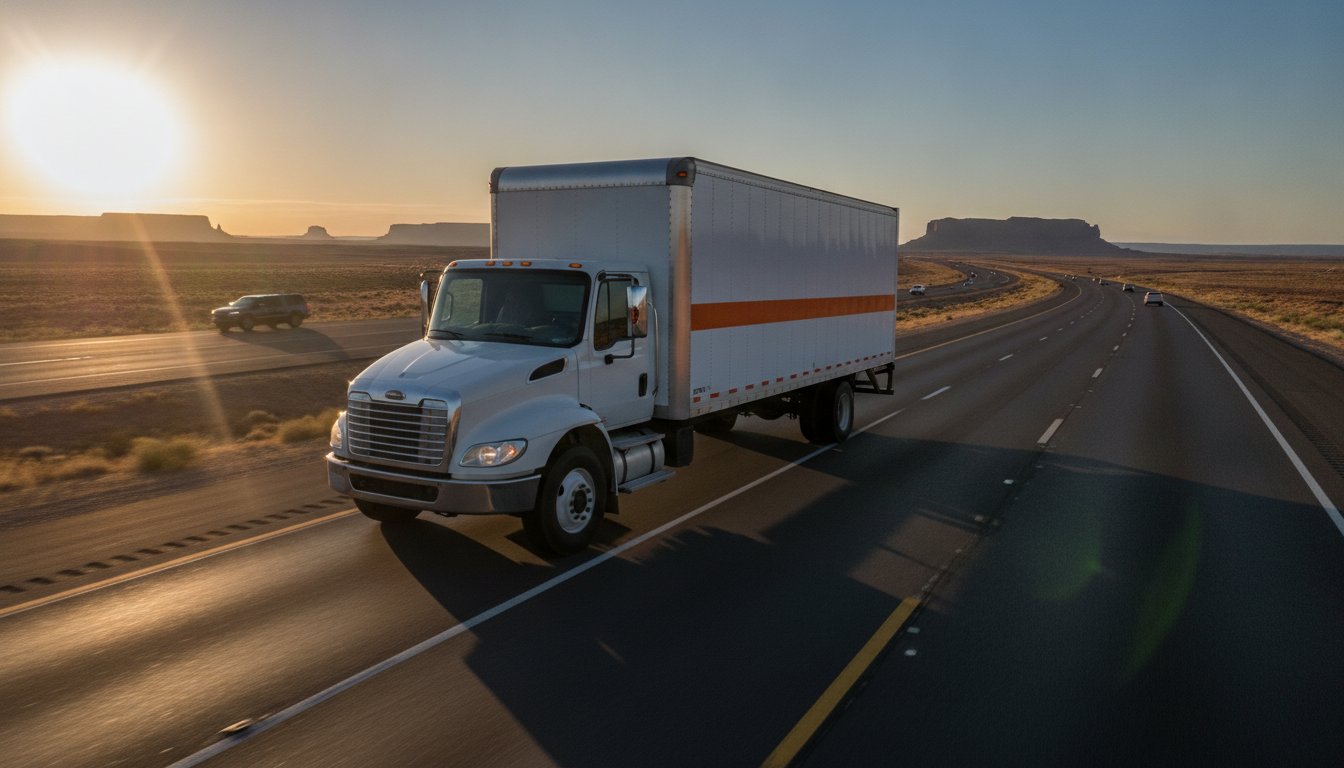
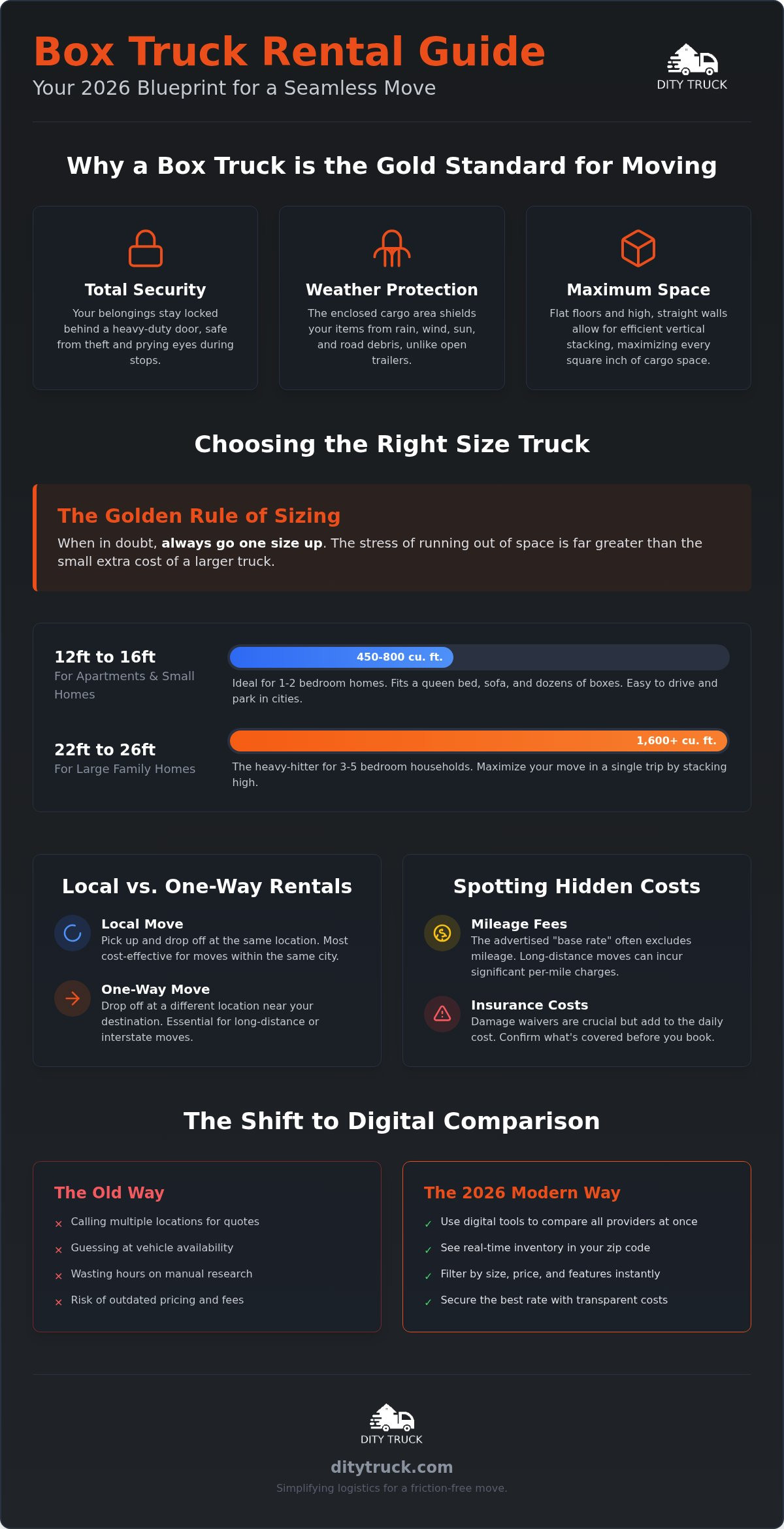
    A box truck rental is more than just a large vehicle. It is a purpose-built tool for logistics. Technically, a box truck consists of a cab-chassis design with a separate, enclosed cuboid cargo area. This unique structure allows for a flat floor and high walls, which are essential for vertical stacking. When you explore box truck sizes and classifications, you’ll see that these vehicles are designed to maximize every square inch of space. They provide a level of security and weather protection that open trailers simply can’t match. Your belongings stay locked behind a heavy-duty door, safe from rain, road debris, and prying eyes.

    The 2026 landscape has introduced significant improvements to rental fleets. Modern trucks now feature much better fuel efficiency than models from just a few years ago. This helps keep your total move cost down despite fluctuating gas prices. Newer vehicles also come equipped with advanced driver-assist features. Lane-keep assist and collision warnings are now standard in many fleets, making these large trucks much easier for a non-professional to drive with confidence. Efficiency isn’t just about the engine; it’s about making the entire experience less intimidating.

    Your destination is the primary factor that dictates your rental strategy. Local rentals involve picking up and dropping off the truck at the same location. This is usually the most cost-effective path for moves within the same city. One-way rentals allow you to drop the truck off at a different branch near your new home. While the base rate for one-way moves is often higher, it saves you the massive headache of driving a heavy truck back across state lines. Choosing the right strategy early prevents expensive surprises later.

    Box Truck vs. Cargo Van: Which do you need?

    Many people struggle to decide between a cargo van and a box truck. Cargo vans are excellent for studio apartments or delivering a single large appliance. However, once you move into a two-bedroom home, a box truck rental becomes essential. It isn’t just about cubic feet; it’s about payload limits. Box trucks are engineered to carry the weight of heavy oak dressers and multiple appliances without straining the suspension. If you try to cram a whole house into a van, you risk exceeding weight limits, which makes the vehicle dangerous to handle.

    The Shift to Digital Comparison Tools

    The old way of renting involved calling three different local lots and hoping someone would answer the phone. That process is dead. Today, we rely on real-time data syncs. Platforms like DityTruck connect directly with national inventory systems to show you exactly what is available in your zip code. This shift to digital comparison means you can compare rates and sizes once and save hours of manual research. It’s an action-result process. You input your move details, and the smart assistant finds the best match instantly. This transparency ensures you aren’t paying a “convenience fee” just because you didn’t have time to check other providers.

    Choosing the Right Size: Box Truck Dimensions and Capacity

    Selecting a box truck rental size requires more than a rough guess. The “Golden Rule” of moving is simple. If you aren’t sure, always go one size up. Renting a truck that is too small leads to multiple trips; or worse, leaving furniture on the curb. Most providers offer standard lengths including 10ft, 12ft, 16ft, 22ft, and 26ft options. Each jump in size significantly increases your stacking potential and reduces the risk of a logistical bottleneck on moving day.

    Don’t just look at total cubic feet. Measuring your largest items is critical. Remember that wheel wells intrude into the cargo area. A king-sized mattress or a long sectional sofa might not sit flat if the wheel well is in the way. You also need to consider the loading height. Larger trucks sit higher off the ground. This creates a steeper ramp angle. If you’re lifting heavy appliances, a steeper ramp requires more physical strength. This is especially true for the 26ft models, which feature the highest decks in the consumer rental market.

    12ft to 16ft: The Sweet Spot for Small Moves

    These sizes are ideal for studio apartments or small 1-2 bedroom residences. They offer roughly 450 to 800 cubic feet of space. This is usually enough for a queen bed, a sofa, and several dozen boxes. Maneuverability is the key benefit here. Drivers who aren’t used to large vehicles find these sizes much easier to park and turn. They feel more like driving a large SUV than a commercial freighter. This size range is the most popular for local city moves where tight corners and narrow streets are common.

    22ft to 26ft: Handling Large Family Homes

    If you’re moving a 3-5 bedroom household, you need the heavy hitters. These trucks provide up to 1,600+ cubic feet of volume. This allows for maximum efficiency by letting you stack items to the ceiling. Many users worry about commercial driver’s license (CDL) requirements for these larger units. Most rental companies intentionally manufacture these trucks to stay under the 26,000 lbs Gross Vehicle Weight Rating (GVWR) limit. This keeps them legal for standard license holders. The professional nature of these vehicles is reflected in trucking industry employment data, which shows the scale and specialization of the transport sector. Before you commit, it helps to see what’s actually available in your area. You can compare real-time sizing and rates to ensure you don’t overpay for space you won’t use. Choosing the larger option also gives you a buffer for last-minute items like garage tools or patio furniture that are often forgotten during the initial inventory.
    Box Truck Rental: The 2026 Guide to Sizes, Rates, and Comparison

    Comparing Major Box Truck Rental Companies Side-by-Side

    Most rental sites only show you their own trucks. This forces you to switch between five different tabs to find the best deal. We break that cycle. By looking at the market side-by-side; you see the trade-offs between fleet age, pricing, and availability immediately. This transparency removes the guesswork from your box truck rental decision and puts the power back in your hands.

    • Penske: They are the leaders in reliability. Their fleet is generally the newest in the industry. This makes them the top choice for long-distance hauls where a breakdown could ruin your schedule.
    • Budget: They strike a balance. Their trucks are well-maintained; but their pricing is often more aggressive for local moves than Penske.
    • U-Haul: They have the most locations by far. You can find a U-Haul in almost every small town. However; you must monitor the per-mile costs. A low base rate can quickly balloon once you start driving.
    • Enterprise: This is a premium choice for commercial-grade trucks. They primarily serve business accounts, but their consumer rentals offer high-spec vehicles with impressive payload capacities.

    Penske vs. Budget: The Long-Distance Debate

    Penske often includes unlimited mileage on one-way moves. This offers massive savings potential for cross-country trips. You pay one price and drive without watching the odometer. Budget counters this with frequent promo codes. These discounts often bring their total price down to rival Penske, especially if you book during the off-season. For a deeper look; read our One Way Truck Rentals for Moving: 2026 Comparison Guide. It breaks down the specific mileage policies that can save you hundreds of dollars.

    U-Haul vs. The Market: Availability vs. Total Cost

    U-Haul’s main advantage is convenience. Pickup and drop-off are incredibly easy due to their massive network of neighborhood dealers. But don’t let the $19.95 base rate fool you. By the time you add mileage, insurance, and environmental fees; the final bill looks very different. Comparing this total cost against the flat-rate packages from other providers is essential. Finding the right box truck rental depends on your specific route. Check out our U-Haul vs. Budget Truck Rental: The Definitive 2026 Comparison Guide to see the real numbers. Seeing the final price before you arrive at the lot prevents “sticker shock” and keeps your moving budget on track.

    Box Truck Rental Prices: Managing Costs and Avoiding Hidden Fees

    The advertised daily rate is rarely what you actually pay. A box truck rental involves a layered pricing structure. Understanding these layers prevents budget creep. It turns a stressful financial guess into a predictable expense. Transparency is the only way to avoid the dreaded “sticker shock” when you return the keys.

    Your base rate is the starting point. This is the flat daily fee for the vehicle itself. However; the real driver of the final bill is the mileage fee. These typically range from $0.79 to $1.29 per mile. If you’re moving within a single zip code; the impact is minor. If you’re crossing several counties; the mileage fee can easily exceed the daily rental cost. It’s a variable you must track closely.

    Insurance is another non-negotiable cost. Most personal auto policies do not cover commercial-grade vehicles. You’ll likely need a Collision Damage Waiver (CDW) or Supplemental Liability Insurance (SLI). Without this; you are personally responsible for any damage to the truck or third-party property. Finally; look for small surcharges like environmental fees and vehicle licensing recovery fees. These are standard industry add-ons that appear on your final invoice.

    Calculating the Total Cost of Your Move

    Planning your budget requires a specific formula. Take your (Daily Rate x Days) and add (Estimated Miles x Rate). Then add your insurance and fuel. Fuel is the most overlooked expense. Large trucks are heavy and aerodynamic as a brick. They average only 8 to 12 MPG. For a 100-mile move; that is roughly 10 gallons of gas. Factor the current pump price into your total. For more detailed breakdowns; view our guide on Box Truck Rental Prices: The 2026 Guide to Sizes, Rates & Savings. It helps you visualize every dollar before you sign the contract.

    Pro Tips for Lowering Your Bill

    Timing is everything. Move mid-week if possible. Tuesdays and Wednesdays are significantly cheaper than high-demand Saturdays. You should also book 2 to 4 weeks in advance. This locks in lower seasonal rates before the fleet gets picked over. Another smart move is checking your credit card benefits. Some premium cards offer coverage for commercial rentals. If yours does; you can safely decline the rental company’s coverage. You can compare real-time pricing and fees right now to see which provider fits your budget best. Taking five minutes to compare prevents hours of financial regret later.

    How to Reserve Your Box Truck Rental Online with DityTruck

    Reserving a box truck rental shouldn’t feel like a part-time job. You’ve already done the hard work of comparing sizes and calculating mileage. Now it’s time to lock in your choice. The process is designed to be fast. You start by entering your pickup location and move dates. If you’re doing a one-way move, specify the destination. This immediate input allows our system to pull actual inventory from local lots. It removes the uncertainty of “calling for availability” and gives you immediate answers.

    Once your details are in, use the smart assistant to filter by size. Remember the sizing advice from earlier; always lean toward more space if you’re on the fence. You’ll see real-time quotes from providers like Penske and Budget side-by-side. There’s no need to jump between sites. You see the availability. You see the price. You make the call. Once you select the best fit, you can secure your reservation instantly. This one-click approach ensures you don’t lose your preferred truck to another mover while you’re still weighing options.

    The DityTruck Advantage: Transparency First

    We prioritize transparency above all else. Most booking processes hide fees until the final confirmation page. We don’t. We highlight the total estimated cost upfront. This includes the base rate and the anticipated fees we discussed in the pricing section. You get a one-stop shop experience. You manage everything through a single, streamlined interface. Whether you’re moving across town or across the country, our national reach ensures you have access to inventory in every major US city effortlessly. It’s the shortest path between a logistical problem and a confirmed solution.

    Final Checklist Before You Drive Away

    Your reservation is set, but the job isn’t done until you’re behind the wheel. Before you drive off the lot, perform a final sweep. Verify your driver’s license is valid and meets the age requirements. Most companies require drivers to be at least 18 or 25 depending on the truck size. Inspect the vehicle for any pre-existing damage. Take clear photos of every side, including the roof and interior cargo area. This documentation is your best defense against unfair damage claims. Finally, check the fuel level. Confirm the return policy. Most providers expect the tank to be at the same level as when you started. A quick check prevents expensive refilling surcharges and ensures your move starts on a positive note.

    Secure Your Move with a Confident Rental Strategy

    Finding the right box truck rental doesn’t have to be a gamble. You now know how to apply the “Golden Rule” of sizing to avoid space shortages and logistical delays. You also understand how mileage fees and fuel costs dictate your actual final bill. By comparing national providers side-by-side, you can choose the fleet that matches your specific route and budget without the usual stress.

    Stop wasting time on multiple browser tabs. You can compare rates from Penske, Budget, and other major providers in seconds. We provide transparent pricing for every move so you never deal with hidden fees at the rental counter. With national availability across the United States, your ideal truck is ready when you are. Compare Box Truck Rental Rates and Book Your Move Instantly.

    Moving is a major life milestone. It marks a fresh start. With the right tools and a clear plan, you’re ready to make it a friction-free success. Drive safe and enjoy your new home.

    Frequently Asked Questions

    How much does it cost to rent a box truck for a day?

    Daily base rates for local moves typically range from $20 for small trucks to $130 for large 26-foot models. These prices reflect the vehicle itself and do not include mileage fees, which often range from $0.47 to $2.00 per mile. Your final bill will also include fuel, insurance, and environmental surcharges. For long-distance hauls, expect daily rates to be higher as they often include a set number of miles or unlimited mileage packages.

    Do I need a special license to drive a 26-foot box truck?

    You generally do not need a Commercial Driver’s License (CDL) to operate a 26-foot box truck rental. Most major rental companies design these vehicles to have a Gross Vehicle Weight Rating (GVWR) of 26,000 pounds or less. This keeps them legal for anyone with a standard driver’s license. However, you should always verify the specific weight rating on the unit’s door jamb before you start your trip.

    Is insurance required when renting a box truck for moving?

    Financial protection is essential because most personal auto insurance policies specifically exclude commercial-sized vehicles. While the rental company might not legally force you to buy their specific plan, you are personally liable for any damage to the truck or third-party property. Purchasing a Collision Damage Waiver (CDW) or Supplemental Liability Insurance (SLI) protects your bank account from high repair costs and provides peace of mind during a stressful move.

    What is the most fuel-efficient box truck rental?

    Smaller trucks in the 10 to 12-foot range are the most fuel-efficient options in any fleet. These vehicles typically average between 10 and 12 MPG, while larger 26-foot trucks may drop to 8 MPG. To maximize efficiency, look for newer models with aerodynamic designs and advanced engine technology. Keeping your speed steady and avoiding rapid acceleration will also help you save money at the pump during your box truck rental period.

    Can I rent a box truck for a one-way move?

    One-way rentals are available from most major national providers and are ideal for long-distance relocations. This allows you to pick up the truck in one city and drop it off at a location near your new home. While one-way rates are usually higher than local rates, they save you the time and fuel costs of a return trip. Penske is a popular choice for this as they often provide unlimited mileage on one-way contracts.

    What happens if I return the rental truck late?

    Returning a truck late usually results in additional fees that can equal or exceed a full day’s rental rate. Most companies charge by the hour or apply a flat late fee for every 24-hour period the vehicle is overdue. If you know you are running behind, call the rental office immediately. They may be able to extend your reservation, though this is not always possible during peak moving seasons when trucks are in high demand.

    Are there age restrictions for renting a moving truck?

    Most rental companies require drivers to be at least 18 years old for local moves, though some may require you to be 25 for larger vehicles or long-distance hauls. Drivers under 25 often face “young renter” surcharges that increase the daily cost. Always have a valid driver’s license and a major credit card ready. These are standard requirements regardless of your age and are necessary to secure the vehicle.

    How far in advance should I book my box truck rental?

    You should book your rental at least 2 to 4 weeks in advance to ensure availability and secure the best rates. Demand spikes significantly during the peak moving season from May through September and on weekends. Making your reservation early prevents the stress of settling for a truck that is too small or paying a premium price for a last-minute booking. It’s the easiest way to keep your logistics on schedule.

  • Top Moving Truck Rental Companies: 2026 Comparison Guide

    Top Moving Truck Rental Companies: 2026 Comparison Guide

    The cheapest quote on your screen isn’t always the lowest price you’ll pay at the counter. Most people start their search for moving truck rental companies looking for the smallest number, only to get hit with mileage fees and insurance costs later. It’s frustrating to plan a budget around a base rate that doubles by the time you’ve signed the paperwork. You deserve a clear view of what a rental actually costs before you commit your time and money.

    We’ve done the heavy lifting to bring you a transparent side-by-side comparison of the industry’s leaders for 2026. This guide breaks down the complicated math of local versus long-distance pricing so you can book with confidence. You’ll learn which companies offer unlimited mileage, how to choose a truck size that actually fits your furniture, and where to find the best availability in your area. We focus on the facts to ensure your move stays on track and under budget. Let’s find the smartest path to your new front door.

    Key Takeaways

    • Compare real-time rates instead of relying on brand loyalty—ensure you get the best deal in the current 2026 market.
    • Match your move to the right vehicle size—choose between cargo vans and 26-foot trucks to avoid paying for empty space.
    • Review the top moving truck rental companies side-by-side—weigh U-Haul’s local availability against Penske’s long-distance reliability.
    • Spot hidden fees before checkout—identify environmental charges and late penalties that often inflate your final bill.
    • Simplify your booking process—use an aggregator to see total costs upfront and secure your truck reservation instantly.

    Moving used to involve calling multiple local lots and hoping for a truck. In 2026, the DIY moving landscape is entirely digital. Most moving truck rental companies now prioritize online reservations over phone calls or walk-ins. If you wait to visit a physical location to book your vehicle, you’ll likely find an empty lot. The shift toward digital-first booking means you need to be faster and more informed than ever before.

    Sticking to one brand often costs you more than you think. Loyalty doesn’t pay in the logistics world. Prices fluctuate daily based on local demand and current fleet availability. A provider that was affordable last year might be the most expensive option today. Booking early is your best defense against the 2026 peak moving season. We recommend securing your vehicle at least four weeks in advance. This avoids the steep last-minute surcharges that appear when inventory gets low.

    The national market relies on the “Big Three” providers. U-Haul, Penske, and Budget manage the majority of the country’s rental fleet. For a deeper look at the industry’s largest player, this U-Haul company overview explains their massive neighborhood presence. These companies offer the most pickup and drop-off points. This makes them the standard for cross-country relocations where you need reliable support in every state.

    The Rise of Aggregator Platforms

    Visiting five different websites to find a truck is a waste of your time. Each site requires you to enter the same dates, locations, and personal details over and over. Aggregator platforms like DityTruck solve this problem by pulling real-time data into a single dashboard. This bridges the gap between major providers and movers. It replaces hours of manual searching with a few seconds of automated comparison. You see the real-time inventory from various moving truck rental companies side-by-side. This transparency ensures you don’t overpay for a vehicle that is sitting just a few blocks away.

    Local vs. Long-Distance Logistics

    Distance dictates your total cost and your rental strategy. A “one-way” rental makes the most financial sense for state-to-state moves. You pick up the vehicle near your current home and drop it off at your destination. This eliminates the need to drive an empty truck back to the starting point. Local moves usually involve round-trip rentals. These come with a lower daily rate but a significant mileage trap. Per-mile fees can quickly exceed the base rental price if your new home is more than a few miles away. National availability trends for 2026 show that one-way trucks are often concentrated in high-growth regions. Using a comparison tool helps you find where the fleet is located right now. This saves you from driving across town just to find a specific 15-foot box truck.

    Key Factors for Evaluating Rental Truck Companies

    Choosing between different moving truck rental companies is a balancing act of space and expense. The base rate you see on a website is just the starting point. To find the real value, you must account for fuel, mileage, and protection plans. Most DIY movers get overwhelmed by the options. Breaking these down into specific categories simplifies the decision and prevents budget overruns.

    Protection plans are often where the total price jumps. Your personal car insurance rarely covers a commercial sized truck. Understanding your consumer rights when moving helps you navigate these add-ons without feeling pressured. Always check if the plan covers the truck, your belongings, or both. A reliable provider will be transparent about what their “basic” coverage actually includes.

    Don’t forget the physical tools. A truck without a ramp or a dolly is just a giant box. Confirm that your chosen provider has these available at your specific pickup location. Many moving truck rental companies charge per item. Factor these small costs into your final budget. It’s better to pay for a dozen moving blankets now than to pay for a scratched dresser later.

    Finding the Right Size Vehicle

    Size matters for both your budget and your stress levels. A truck that is too small requires multiple trips. One that is too large means your belongings will slide around during transit. Use these general guidelines for 2026 fleet standards:

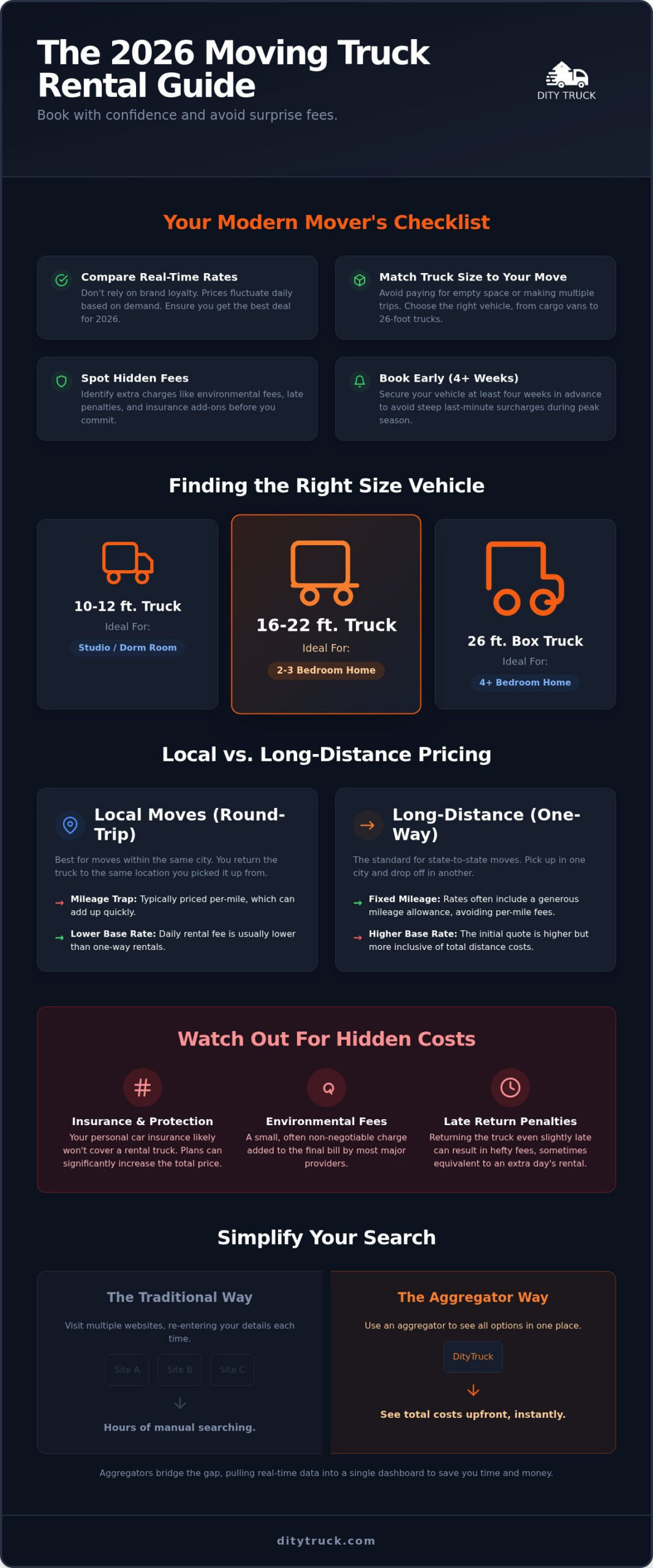
    • 10-12 foot truck: Ideal for studio apartments or dorm rooms. They handle like a large SUV and are easy to park in tight city streets.
    • 16-22 foot truck: These are the workhorses for 2-3 bedroom homes. They offer enough vertical height for stacked boxes and large furniture.
    • 26-foot box truck: This is the largest vehicle you can drive without a commercial license. It’s the only choice for four-bedroom homes or large households.

    Mileage and Fuel Policies

    Pricing varies significantly based on your total distance. Local moves usually use per-mile pricing. If you’re driving across town, this is usually the cheapest path. For longer trips, look for flat-rate options that include unlimited mileage. In 2026, even modern box trucks struggle with aerodynamics, typically averaging between 8 and 12 miles per gallon depending on the load weight. GVWR refers to the Gross Vehicle Weight Rating, which is the absolute limit for the combined weight of the truck, fuel, passengers, and cargo. You can compare these specific fleet details in one place to avoid surprises on moving day.

    Top Moving Truck Rental Companies: 2026 Comparison Guide

    Comparing the Major Moving Truck Rental Providers Side-by-Side

    Choosing between moving truck rental companies requires matching their strengths to your specific route. U-Haul is the leader in local accessibility. They operate over 21,000 locations across North America, making them the easiest option for neighborhood moves. Forbes’ 2026 comparison highlights their dominance in sheer volume and proximity. If you need a truck ten minutes from your current door, U-Haul is the likely answer.

    Penske focuses on the long-distance mover. Their business model prioritizes fleet reliability and highway performance. They often provide unlimited mileage on one-way rentals, which eliminates the stress of counting every exit. Budget occupies the middle ground. They have fewer locations than U-Haul but often beat them on price through consistent seasonal promotions. Enterprise is a strong contender if your move is small. They specialize in cargo vans and pickup trucks, offering a more comfortable driving experience for light loads.

    Reliability and Fleet Age

    Fleet maintenance is a critical factor for state-to-state moves. A mechanical failure on a remote highway can derail your entire schedule. Penske and Enterprise maintain some of the newest fleets in the industry. They rotate vehicles out of service more frequently to ensure high reliability. This focus on newer models often results in better fuel economy and fewer breakdowns. All major moving truck rental companies provide 24/7 roadside assistance. U-Haul’s massive network ensures that help is usually nearby, even in rural areas. Interior features also differ. U-Haul trucks are designed with a lower deck height, which results in shorter, steeper loading ramps. Penske trucks sit higher, requiring longer ramps that are easier on your legs during a long day of lifting.

    The Discount Landscape

    Your status as a student, military member, or AAA subscriber can lead to significant savings. Budget is particularly well-known for honoring these groups with discounts up to 20%. Timing your booking is just as important as your affiliation. Moving on a Tuesday or Wednesday is almost always cheaper than a Friday or Saturday. Demand spikes on weekends, which naturally inflates box truck rental prices across all providers. Shifting your move date by just 48 hours can save you enough to cover your fuel costs. Always check for seasonal codes before you finalize your reservation. These small efforts turn a standard rental into a high-value deal.

    Avoiding Hidden Fees and Booking Smart

    Hidden costs turn a budget move into a financial headache. Most moving truck rental companies advertise a low daily rate to get you in the door. The final bill often includes environmental fees, which typically range from $1 to $5, and local taxes that vary by state. These small numbers add up quickly. Returning a truck late is another common trap. Even a one-hour delay can trigger a full “extra day” charge. For one-way rentals, companies like Penske charge $100 per additional day. Always plan your route with a two-hour buffer to avoid these penalties.

    Refueling is the most expensive mistake you can make. Rental companies charge a premium—often double the local gas station price—to fill the tank for you. Always return the vehicle with the exact amount of fuel specified in your contract. Cleaning fees are equally avoidable. Sweep out the cargo area before you lock the door. A few crumbs or some dirt can result in a $25 to $50 cleaning surcharge. These details matter when you want a stress-free experience.

    Insurance: To Buy or Not to Buy?

    Your personal auto insurance likely stops at the bumper of a rental truck. Most standard policies exclude commercial vehicles over a certain weight. Credit card coverage usually follows the same rule. They often explicitly exclude box trucks and cargo vans. You need to decide between a Damage Waiver (CDW) and Supplemental Liability (SLI). CDW covers the truck itself. SLI protects you against claims from other drivers. Understanding these differences prevents you from paying for redundant coverage or leaving yourself exposed during a long trip.

    The Reservation vs. Guarantee

    A reservation is not always a guarantee. This is a hard truth in the rental industry. High demand can mean your truck is still in another city on your moving day. Call your pickup location 48 hours in advance to confirm the vehicle is on-site. If you’re deciding between the two biggest names, check our guide on uhaul vs budget truck rental for specific policy differences. Being proactive ensures you aren’t left standing on a sidewalk with a pile of boxes. You deserve a booking process that values your time.

    Stop guessing about the final price. You can book your truck through DityTruck to see a transparent breakdown of costs before you commit.

    Streamlining Your Search with DityTruck

    Finding the right fit among moving truck rental companies shouldn’t be a full-time job. Most movers waste hours jumping between tabs and re-entering the same data. DityTruck acts as your smart assistant. It performs the heavy lifting of price hunting by aggregating live inventory from the industry’s most trusted names into one streamlined dashboard. You get a clear view of the market without the manual labor.

    Efficiency is the core of our platform. One search delivers multiple quotes. You can compare a cargo van for a local studio move or a 26-foot box truck for a cross-country relocation in seconds. We support every type of DIY move. Our system pulls real-time data to ensure the price you see is the price you get. This eliminates the “sticker shock” that often happens at the rental counter. You deserve a booking experience that is as fast as it is honest.

    The Comparison Advantage

    Transparency is your biggest money-saving tool. DityTruck saves users an average of 15-20% simply by making prices visible side-by-side. When companies have to compete for your business on a single screen, you win. Many providers claim they offer the best rates when you book direct. Our data often proves otherwise. By seeing every available option, you can spot the provider that has an oversupply of trucks in your specific city. This leads to lower rates that you wouldn’t find by visiting just one website. We strip away the complexity of logistics. You get the relief of knowing you didn’t leave money on the table. Secure your move today with our streamlined booking tool and put your focus back on your new home.

    Next Steps for Your Move

    Your move is a high-stakes task. Don’t leave the details to chance or settle for the first quote you find. Use the DityTruck search tool to compare live 2026 rates across the national market. If you need more depth on the logistics of your trip, visit our pillar page on moving truck rental for a full breakdown of the process. We provide the clarity you need to make a confident decision. Once you’ve found the perfect balance of price and reliability, you can finalize your reservation instantly. Stop the endless searching and start your journey with a plan. Compare and book your moving truck now to experience a friction-free move.

    Take Control of Your 2026 Moving Logistics

    Moving day doesn’t have to be a gamble. You now have the tools to navigate the landscape of 2026 moving truck rental companies with total clarity. Choosing the right vehicle size is the first step toward a stress-free experience. It prevents the frustration of multiple trips or the danger of shifting cargo. By keeping an eye on refueling requirements and cleaning standards, you protect your budget from unnecessary surcharges. Success comes down to matching your specific distance and volume to the provider that offers the best value for that exact route.

    Stop wasting time visiting individual websites and re-entering your details. DityTruck simplifies your search by providing real-time price comparisons across major national providers. You get a transparent look at the market with no hidden booking fees to worry about. It acts as your smart assistant, performing the heavy lifting so you can focus on the journey ahead. Find the best rates for your move on DityTruck and secure your vehicle in minutes. Your new front door is waiting. You’ve got this.

    Frequently Asked Questions

    What are the best moving truck rental companies for long distance?

    Penske is the top choice for long-distance relocations because they frequently include unlimited mileage on one-way rentals. Their average price for moves over 1,000 miles is $2,471.20, which is nearly $300 below the industry average. This flat-rate approach prevents unexpected costs during cross-country trips. Budget is also a strong contender with an average long-distance price of $1,520.

    How much does it cost to rent a moving truck on average?

    Costs vary based on distance and vehicle size. A local move in a medium-sized truck averages approximately $138. For long-distance relocations, the average cost rises to about $1,809. Budget Truck Rental tends to be slightly more affordable than the competition, with an average price of $1,520 across various move types. These figures include base rates but exclude variable mileage fees.

    Which rental company is the cheapest for local moves?

    U-Haul offers the lowest base rates starting at $19.95 per day for cargo vans and pickup trucks. Larger 26-foot models typically start between $39.95 and $49.95. Budget is also competitive, with local moves for two-bedroom homes averaging around $200. Always factor in per-mile fees which range from $0.59 to $1.39 depending on the location and vehicle size.

    Do I need a special license to drive a 26-foot moving truck?

    No, you don’t need a Commercial Driver’s License (CDL) to drive a 26-foot rental truck. These vehicles are specifically designed for consumer use and fall under non-CDL weight limits. You only need a standard, valid driver’s license to operate the largest trucks offered by most moving truck rental companies. Always confirm weight ratings if you plan to tow a trailer.

    Is Penske or U-Haul better for a one-way move?

    Penske is generally better for the budget-conscious one-way mover because of their unlimited mileage policies on long-distance routes. However, U-Haul is superior for convenience. They have over 21,000 locations in North America. This ensures you’ll have a drop-off point close to your destination, even in remote or rural areas where Penske might not have a presence.

    What happens if I return my rental truck late?

    Late returns trigger significant daily penalties that are often higher than the original daily rate. U-Haul charges $40 per day for trucks kept past the contract deadline. Penske’s late fee is significantly higher at $100 per day. It’s always cheaper to book an extra day in advance than to pay these surprise penalties when you drop off the keys.

    Are there hidden fees when renting a moving truck?

    The advertised base rate rarely covers the total cost of the move. You must account for mileage fees, fuel replacement, and environmental charges which usually cost between $1 and $5. Insurance is another common add-on. Safemove coverage through U-Haul, for example, typically costs between $14 and $28 per day depending on the level of protection you choose.

    Can I rent a moving truck if I am under 25?

    Yes, you can rent a truck if you’re at least 21 years old in most states. Renters in New York and Michigan can book vehicles as young as 18 due to state-specific laws. Keep in mind that moving truck rental companies like Enterprise apply a young renter surcharge for anyone under 25. Always check the specific age requirements and fees for your pickup location.

  • Box Truck Rental Prices: The 2026 Guide to Sizes, Rates & Savings

    Box Truck Rental Prices: The 2026 Guide to Sizes, Rates & Savings

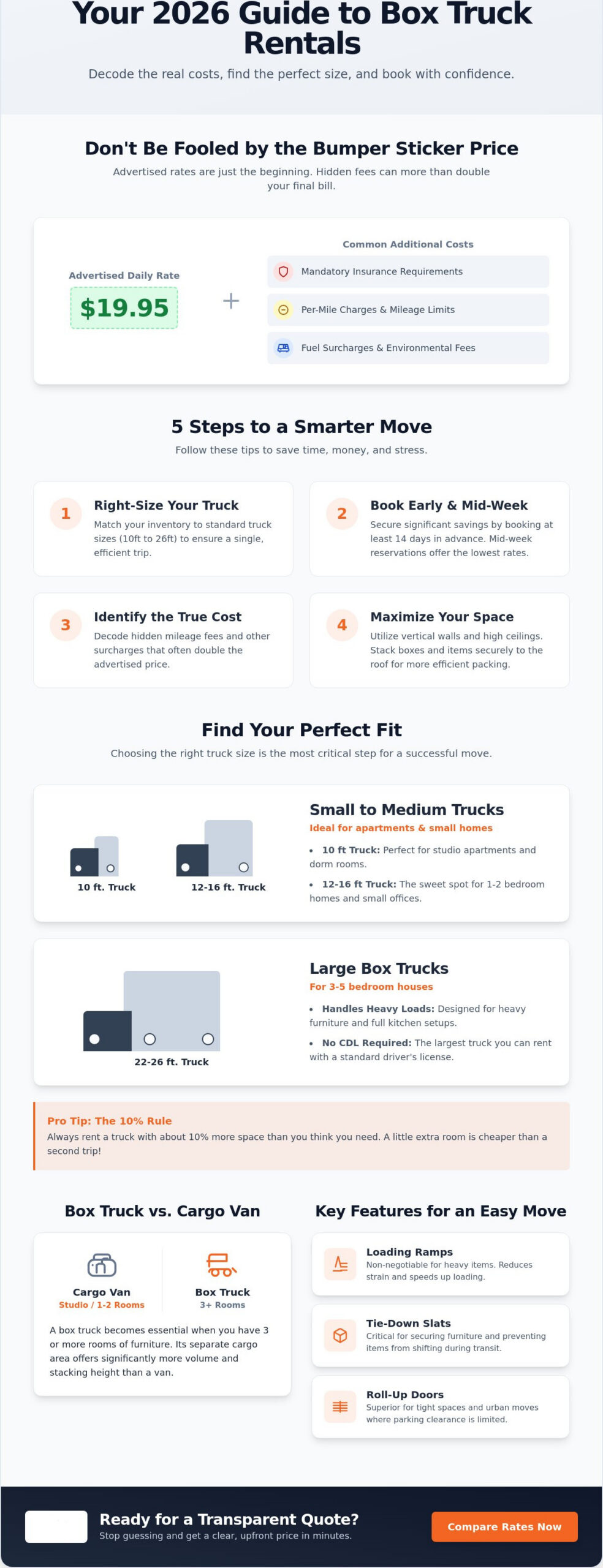
    That $19.95 base rate looks great on a bumper, but it rarely reflects what you actually pay at the counter. With 41% of renters now booking through mobile apps, the speed of the transaction often masks the complexity of the costs. You shouldn’t have to guess about box truck rental prices or worry that a “small” truck won’t fit your heaviest furniture. Hidden mileage fees and mandatory environmental surcharges can quickly turn a budget move into a financial headache.

    You deserve a straightforward path to a confirmed reservation. We understand the frustration of surprise insurance requirements and the fear of choosing a vehicle that is too small for your belongings. This guide provides a clear look at 2026 national rates and decodes the fine print that providers often hide. You’ll learn how to match cubic capacity to your specific needs so you can stop stressing and start moving. We’ve simplified the comparison process to give you total price transparency and confidence in minutes.

    Key Takeaways

    • Match your inventory to industry-standard sizes-from 10-foot mini boxes to 26-foot super movers-to ensure a single, efficient trip.
    • Identify the true total cost by decoding hidden mileage fees-these extras often double the advertised box truck rental prices.
    • Compare top-tier providers side-by-side-determine which fleets offer the best reliability for local versus long-distance moves.
    • Secure significant savings by booking at least 14 days in advance-mid-week reservations offer the lowest rates.
    • Maximize your storage potential-utilize vertical walls and high ceilings for safer, more efficient packing.

    Understanding Box Truck Rental Options for Your 2026 Move

    A box truck is defined by its enclosed cargo area. This space is structurally separate from the driver’s cab. Unlike trailers, the box is permanently attached to the chassis. This design provides a rigid, secure environment for your belongings. When you evaluate box truck rental prices, you are paying for this specialized architecture. The flat, vertical walls and high ceilings are the primary advantages. They allow you to stack boxes and furniture all the way to the roof. You maximize every square inch of floor space. It makes the loading process much more efficient than using a standard van.

    The 2026 rental fleet has evolved significantly. Modern trucks now prioritize fuel economy to offset rising gas costs. Most units now come standard with high-definition backup cameras. This makes maneuvering a large vehicle much safer for DIY movers. Box trucks outperform cargo vans because they offer wider floor plans and integrated loading tools. You get more room and better equipment for the same trip. You can research box truck sizes and classes to understand the different weight ratings available for your specific cargo needs.

    Box Truck vs. Cargo Van: Identifying the Threshold

    Choosing between a van and a truck depends on your total inventory. Cargo vans are ideal for studio apartments or 1-2 rooms of furniture. Once you reach 3 rooms or more, a box truck becomes essential. Consider the “walk-through” factor. Vans allow you to move from the driver’s seat to the cargo area without stepping outside. Box trucks do not. This separation provides more cargo volume. It does require you to exit the cab to access the load. For a deeper dive, read our guide on cargo van vs box truck to see which fits your specific move.

    Essential Features: Ramps, Rails, and Roll-up Doors

    Efficiency depends on the hardware. Understanding the equipment helps you justify the box truck rental prices you’ll encounter. Loading ramps are a non-negotiable feature for heavy items. They reduce physical strain. They speed up the process. Look for rentals with wide-plank, aluminum ramps for better stability. Inside the box, tie-down slats are critical. These rails allow you to secure heavy furniture using straps. This prevents shifting during long hauls. Pay attention to the door style. Roll-up rear doors are superior for urban moves. They allow you to park and unload in tighter spaces. Swing doors require several feet of clearance. You might not have that extra space on a busy street. These features are standard in the 2026 fleets to ensure a friction-free experience.

    Box Truck Sizes and Capacity: Finding the Perfect Fit

    Sizing is the foundation of a successful move. If you choose a truck that is too small, you face the nightmare of multiple trips. This doubles your labor. It doubles your fuel costs. It can even impact your final box truck rental prices if you exceed your mileage limit. Standard industry sizes range from 10-foot “mini” boxes to 26-foot “super” movers. Most people focus only on cubic feet, but you must also check the payload capacity. This is the maximum weight the truck can safely carry. Heavy appliances like washers and stone-top tables add up quickly. If you overload the vehicle, you risk mechanical failure or safety fines. Checking the weight rating ensures your truck can actually move what you pack.

    Follow the 10% rule. Always rent a truck with 10% more volume than you think you need. This buffer accounts for inefficient packing or last-minute items you forgot to count. It is much cheaper to have a little extra space than to leave furniture on the curb. For official consumer protection advice regarding safe loading and transport, check the FMCSA guidelines. It helps ensure you stay within legal weight limits while on the road.

    Small to Medium Trucks (10ft – 16ft)

    10ft trucks are the standard choice for studio apartments and dorm relocations. They are easy to drive. They fit in most residential driveways. The 12ft-16ft range is the “sweet spot” for 1-2 bedroom homes and small offices. These sizes offer enough floor space for queen-sized mattresses and several dozen boxes. Review our 2026 sizing & comparison guide to map your specific inventory to the right vehicle.

    Large Box Trucks (22ft – 26ft)

    When you are moving a 3-5 bedroom house, you need a 26ft truck. This is the largest vehicle you can drive without a Commercial Driver’s License (CDL). These trucks have a high Gross Vehicle Weight Rating (GVWR), which allows them to handle heavy furniture and full kitchen setups without strain. Large box truck rental prices often vary based on availability, so booking early is key. Understanding the cost to rent a 26 foot moving truck is vital for long-distance budgeting. If you want to simplify your search, you can compare rental options to find the best fit for your heavy-duty needs.

    Box Truck Rental Prices: The 2026 Guide to Sizes, Rates & Savings

    Comparing the Best Box Truck Rental Companies Side-by-Side

    Choosing a provider requires looking past the flashy base rates. Some providers excel in local moves, boasting extensive networks for easy pickup. While their base rates might seem attractive, watch out for per-mile fees that can quickly increase the total cost. Other companies specialize in long-distance relocations, often providing newer, more reliable fleets to minimize the risk of mechanical delays on cross-country trips. For one-way moves, certain budget-friendly options frequently offer promotional codes that can significantly reduce rental costs.

    Comparison is the only way to ensure you aren’t overpaying. DityTruck acts as your smart assistant by aggregating these options. You see real-time box truck rental prices from multiple vendors in one place. You don’t have to visit five different websites to find the best deal. We do the heavy lifting so you can book with confidence in seconds.

    Local vs. One-Way Rental Dynamics

    The math changes depending on your destination. Local rentals typically offer lower daily rates. However, they carry higher per-mile charges. You must return the vehicle to the original pickup spot. One-way rentals work differently. You pay a higher flat fee, but it usually includes a generous mileage allowance. This is the logical path for state-to-state moves. Check out the one way truck rentals comparison to see the 2026 cost breakdown for long-distance travel.

    Fleet Quality and Roadside Support in 2026

    Reliability is a financial factor. Newer trucks from certain providers often offer better fuel efficiency and have fewer breakdowns. This saves you money at the pump and protects your schedule. Always verify the terms of 24/7 roadside assistance before you sign. It is essential for cross-country hauls where help might be hours away. Compare various provider options to see the latest reliability ratings and support features for the 2026 season.

    Decoding Box Truck Rental Prices and Avoiding Hidden Fees

    The “Daily Rate” trap is the most common hurdle for DIY movers. You see a low price advertised on a bumper or a website. You assume that is your total. It isn’t. Most headline rates exclude mileage, taxes, and mandatory environmental fees. Local rentals often charge mileage fees ranging from $0.00 to $1.10 per mile. If you are moving across town, these costs can quickly exceed the base daily rate. You need to factor in fuel expenses as well. Most box trucks average between 8 and 12 MPG. Heavy loads and stop-and-go traffic will push you toward the lower end of that spectrum. This makes fuel one of the largest variables in your 2026 moving budget.

    Don’t assume your personal auto insurance covers a rental. Most standard policies exclude vehicles with a Gross Vehicle Weight Rating (GVWR) over 10,000 pounds. Large box trucks almost always fall into this excluded category. If you decline the damage waiver and have an accident, you are personally responsible for the repairs. This is why understanding the full scope of box truck rental prices is critical for your financial safety. You can get a transparent price estimate today and avoid the hidden fee trap.

    Calculating the Total Cost of Ownership (TCO)

    Finding the real price requires a simple formula. Base Rate + (Estimated Miles x Rate) + Fuel + Insurance + Taxes. This “all-in” figure is the only number that matters for your bank account. Be aware of seasonal spikes. Prices can double during peak moving weekends or the summer months. Your total cost is the sum of every line item from pickup to drop-off. Calculating this total prevents budget overruns and ensures a stress-free move.

    Insurance and Liability Protection

    Protection plans offer relief from high-stakes risks. A Collision Damage Waiver (CDW) is the most common option. It protects you from repair costs if the truck is damaged. Supplemental Liability Insurance (SLI) is equally important. It covers third-party claims if an accident occurs during your move. For those with high-value furniture, Cargo Insurance is a smart addition. It protects your belongings from shifting or damage while in transit. These options add to the daily cost but remove the risk of a total loss. They provide the clarity you need to drive with confidence.

    How to Secure the Best Box Truck Rental Quote Today

    Timing determines your final bill. Booking early is the most effective way to lower your box truck rental prices. In 2026, rates are 30% lower when you reserve at least 14 days in advance. This lead time gives providers better visibility into their fleet distribution. They reward your organization with lower costs because it helps them manage regional logistics. Waiting until the week of your move is a high-stakes gamble. You risk paying convenience premiums or facing a total lack of inventory. Secure your rate early to lock in the savings and your peace of mind.

    Calendar choice is your second-best tool for savings. Avoid the weekend surge. Tuesday and Wednesday rentals are significantly cheaper than Fridays or Saturdays. Moving companies and DIYers flood the market on weekends to avoid taking time off work. This creates a supply shortage that drives prices upward. If you can shift your move to a Tuesday, you’ll find more truck options and shorter wait times at the counter. It is a simple adjustment that yields a high return on your investment. Choosing the right day is just as important as choosing the right size.

    Efficiency is about more than just the daily rate. It is about avoiding the friction of a broken process. When you use a smart assistant to manage your logistics, you strip away the complexity of the task. You gain clarity through transparent data. This allows you to make a fast, confirmed reservation without the typical stress of moving day. You get a reliable tool that respects your time and your budget.

    The DityTruck Efficiency Advantage

    Skip the multi-tab browser fatigue. We pull the data into one clear view so you don’t have to. Most rental sites hide their fee schedules behind multiple clicks and confusing checkout flows. We bring that information to the surface immediately. Transparent comparisons ensure you see the total cost before you enter your credit card info. It is about speed and honesty. Start your moving truck rental comparison here to secure the right vehicle for your timeline.

    Pro-Tips for a Smooth Pickup

    Preparation prevents friction at the rental counter. You need a valid driver’s license and the specific credit card used for the reservation. Digital copies are rarely accepted for the physical handover. Once you have the keys, perform a thorough inspection. Document every existing scratch, dent, or interior stain with your phone camera. This is your evidence for the return process. Confirm the fuel level matches the contract exactly. Don’t pay for someone else’s gas. Finally, test the hardware. Deploy the loading ramp. Cycle the liftgate. If these tools fail at your new home, your move stops. Verify functionality before you leave the lot.

    Master Your Move with Total Price Clarity

    Mastering your move starts with stripping away the guesswork. You now know that the 10% volume rule prevents the nightmare of a second trip. You understand how to calculate the total cost of ownership by factoring in mileage, insurance, and fuel. Most importantly, you have the tools to avoid the hidden fees that traditionally inflate box truck rental prices. Logistics don’t have to be a source of stress. By booking 14 days in advance and choosing mid-week dates, you can secure significant savings and guarantee vehicle availability.

    Your relocation deserves a friction-free start. We pull data from top national brands into one clear view so you can make a fast, informed decision. Compare Box Truck Rental Rates and Book Now to see real-time rates with no hidden booking fees. Compare sizes side-by-side and find the perfect fit for your inventory in minutes. You are now equipped to handle the heavy lifting with total financial clarity. Secure your truck today. Start your next chapter with confidence.

    Frequently Asked Questions

    Do I need a special license to drive a box truck rental?

    No, you do not need a Commercial Driver’s License (CDL) for a standard rental. A standard driver’s license is sufficient for vehicles with a Gross Vehicle Weight Rating (GVWR) of up to 26,000 pounds. This includes almost every consumer box truck on the market. Always verify the weight rating on your contract to ensure you stay within legal limits for your specific vehicle.

    What is the cheapest box truck rental company for a local move?

    Budget is often the most affordable choice for local moves in 2026. While some competitors offer low base rates, Budget’s average local mileage fee of $0.47 per mile is significantly lower than the industry average. This helps keep the total box truck rental prices manageable for short-distance trips. Enterprise also provides competitive round-trip rates if you return the truck to the pickup location.

    How much does a 16-foot box truck rental cost per day?

    A 16-foot truck typically costs between $130 and $250 per day for local rentals. This base rate excludes the per-mile fee, which is a major component of box truck rental prices. For a standard local move, you should budget for a total of $150 to $200. This estimate includes the daily rate, mileage, and mandatory environmental fees required at the counter.

    Does my credit card insurance cover moving truck rentals?

    No, most personal credit card insurance policies exclude large box trucks. These cards generally cover passenger vehicles but exclude trucks with a Gross Vehicle Weight Rating (GVWR) over a certain limit. Since your personal auto policy likely has similar exclusions, purchasing a collision damage waiver is a necessary step. It provides the financial honesty and protection you need for a high-stakes task.

    Are one-way box truck rentals more expensive?

    One-way rentals have higher flat fees but can be cheaper for long-distance travel. These rates often include a set mileage allowance or even unlimited mileage. This prevents per-mile charges from stacking up over hundreds of miles. For example, Penske often offers unlimited mileage on one-way trips. This makes it a predictable and cost-effective choice for state-to-state moves where local rates would be prohibitive.

    How many rooms of furniture can fit in a 26-foot box truck?

    A 26-foot box truck can typically hold the contents of a 3 to 5-bedroom home. This includes large appliances, multiple bedroom sets, and dozens of medium-sized boxes. It is the largest non-CDL vehicle available for residential moves. If you have a large family home, this size ensures you can complete your move in a single trip without leaving heavy items behind.

    What happens if I return the rental truck with less gas than I started with?

    You will face steep penalties if you return the truck with less fuel than required. Most companies charge around $5.00 per gallon plus a flat service fee to refuel the vehicle for you. It is much cheaper to stop at a gas station near the drop-off lot before you arrive. Always keep your final fuel receipt to prove you met the tank level requirements.

    Can I rent a box truck if I am under 25 years old?

    Yes, the minimum age to rent most box trucks is 18. However, you should expect a daily “young renter” surcharge if you are under 25. Some companies also restrict the size of the truck available to younger drivers to ensure safety. Always check the specific age policy of the branch before you finalize your reservation to avoid surprises or delays at the rental counter.

  • Penske Truck Rental Prices: The Complete 2026 Buying Guide

    Penske Truck Rental Prices: The Complete 2026 Buying Guide

    The “cheapest” truck rental quote often becomes the most expensive line item on your budget after the first breakdown. It is a common trap that turns a simple move into a logistical nightmare. You want a balance between upfront cost and mechanical reliability because you shouldn’t have to choose between a fair price and a truck that actually makes it to your new front door. We understand the anxiety that comes with hidden mileage fees and the fear of driving an aging, poorly maintained fleet. This guide provides the clear, honest facts you need on penske truck rental prices to make a smart, stress-free decision for your 2026 move.

    You will learn how to leverage specific membership discounts for AAA members, military personnel, and students to slash your total bill significantly. We also break down the specific benefits of the unlimited mileage policy for one-way trips, which often makes this provider the most cost-effective choice for long-distance relocations despite a higher base rate. We’ll walk you through the current 2026 fleet standards, fee structures, and the SUNNY26 discount strategy to ensure your move stays on track and under budget. It is time to replace moving day confusion with a transparent, efficient plan.

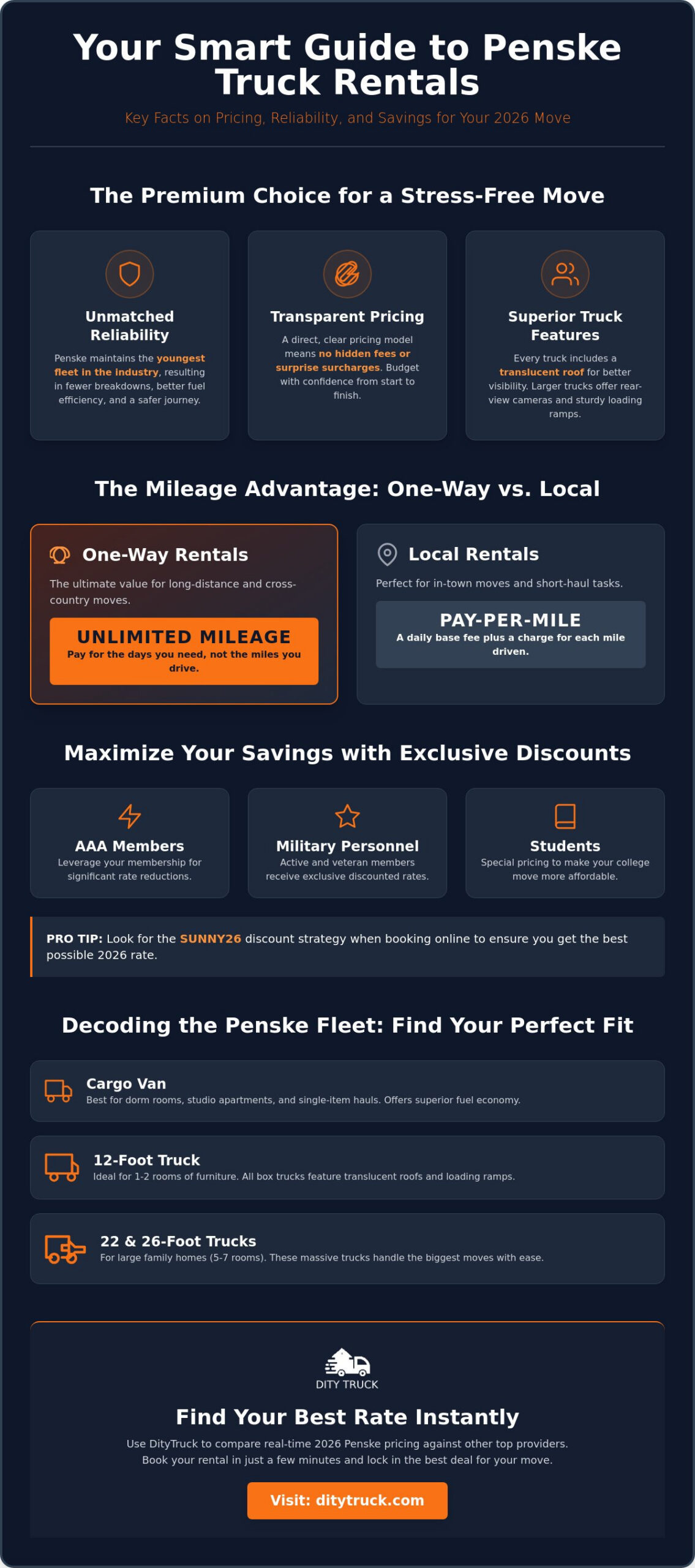
    • Rent with confidence. Penske maintains the youngest fleet in the industry to prevent mechanical breakdowns and ensure a safe 2026 move.
    • Load faster with better visibility. Every truck features a translucent roof that lets in natural light so you’ll see everything clearly.
    • Get the facts on penske truck rental prices. Unlimited mileage on one-way rentals often delivers exceptional long-distance value.
    • Save more with targeted discounts. AAA members, students, and military personnel access exclusive rates to lower the total bill.
    • Find your best rate instantly. Use DityTruck to compare real-time 2026 pricing and book your rental in just a few minutes.

    Why Penske Truck Rental is the Premium Choice for 2026 Moves

    Choosing a truck involves more than just picking the lowest quote. You need a vehicle that actually finishes the trip. Penske Truck Leasing operates with a clear focus on fleet quality. They maintain the youngest fleet in the industry. This strategy directly results in fewer mechanical failures on the road. Newer trucks also mean better fuel efficiency and modern safety features. It’s a logistical advantage that removes a major source of moving day stress.

    Transparency matters when you’re calculating your total move budget. Many budget-tier brands lure customers with a low base rate only to add unexpected costs later. Penske uses a more direct pricing model. You get a clear view of your costs upfront. This clarity helps you understand exactly how penske truck rental prices fit into your overall financial plan. There are no hidden processing fees or surprise surcharges waiting at the counter. It’s about financial honesty from the first click to the final drop-off.

    Reliability is part of their operational DNA. Every vehicle follows a strict, standardized maintenance schedule. This means a truck picked up at any of their nationwide locations is equally prepared for a long-distance journey. Their national network simplifies the process through:

    • Thousands of pickup and drop-off points nationwide.
    • Streamlined check-in processes that save you time.
    • Consistent equipment standards across all 50 states.

    You spend less time driving to the rental lot and more time focusing on your destination. This efficiency is why many experienced movers prefer their service for high-stakes relocations.

    The Reliability Factor: Newer Trucks, Better Moves

    Penske retires its trucks much earlier than its main competitors. This ensures you’re driving a vehicle with the latest engine technology and cab comforts. Before you ever turn the key, each truck undergoes a rigorous pre-move inspection. This proactive approach minimizes the risk of roadside delays. If a rare issue does occur, their 24/7 roadside assistance is ready to help. It is a safety net designed for multi-state relocations where time is critical.

    One-Way vs. Local Rental Dynamics

    Understanding the distance of your move is key to managing penske truck rental prices. One-way moves are where the value truly shines because of the unlimited mileage policy. You pay for the days you need without watching the odometer. Local moves operate differently. These typically involve a daily base fee plus a specific charge for every mile driven. For a deeper look at how distance impacts your bottom line, check our one way truck rentals for moving: 2026 comparison guide for a full breakdown of distance logistics. Choosing the right structure prevents overpaying for your specific route.

    Decoding the Penske Fleet: Sizes and Features

    Choosing the right truck size is the most direct way to manage penske truck rental prices for your 2026 move. Penske offers five primary vehicle sizes to match different needs. These range from high-roof cargo vans to massive 26-foot box trucks. Each vehicle is designed for specific tasks. For example, every truck in the fleet features a translucent roof. This simple design choice allows natural light to flood the cargo area. It makes loading and organizing your belongings much easier during the day. You can also visit the official Protect Your Move website to learn more about your rights and responsibilities during a relocation.

    Modern features come standard on most larger units. You will find rear-view cameras and sturdy walk-ramps on the box trucks. These tools reduce the physical strain and safety risks of DIY moving. Additionally, fuel-efficient engines are a priority for the 2026 fleet. This focus helps lower the overall cost of multi-state trips. When you compare penske truck rental prices, remember that a newer, more efficient engine saves you money at the pump. It is a hidden way to keep your total travel budget under control.

    • Natural Lighting: Translucent roofs eliminate dark corners in the cargo hold.
    • Safety Tech: Rear-view cameras simplify backing up in tight residential areas.
    • Loading Ease: Wide walk-ramps reduce the steepness of the incline for heavy appliances.

    Small Moves: Cargo Vans and 12-Foot Trucks

    Cargo vans are the go-to choice for dorm rooms or single-room furniture hauls. These high-roof vans offer superior fuel economy. They are ideal for quick city-to-city transitions where a full truck isn’t necessary. If you have bulky items like a queen-sized mattress, the 12-foot truck is a better option. It provides the vertical clearance needed to stand furniture upright. This maximizes every inch of floor space and prevents damage to your items.

    Large Moves: 16-Foot to 26-Foot Box Trucks

    For larger households, the 16-foot and 26-foot trucks provide the necessary volume. The 26-foot model is the industry standard for 5-7 room homes. It is built for heavy-duty hauls. These larger trucks often feature three-person seating in the cab. This allows family members or helpers to ride together comfortably. Before you book, compare the cost to rent a 26 foot moving truck: 2026 pricing & comparison guide to see how these larger units stack up against the competition. Selecting the right size ensures you don’t pay for empty space.

    Getting an accurate estimate is the first step toward a successful move. You can compare real-time rental rates to see which fleet size fits your specific timeline and budget requirements.

    Comparing Penske Truck Rental Prices Against U-Haul and Budget

    When you start gathering quotes, the price difference between major carriers can be jarring. U-Haul often presents the lowest base rate for local moves. However, they rely on a massive network of independent dealers where equipment age varies wildly. Budget Truck Rental competes by offering aggressive, rotating discounts that appeal to the most price-sensitive movers. Penske sits in the premium tier. While penske truck rental prices might look higher on a preliminary quote, the value lies in the equipment quality and the contractual reliability. You pay for the peace of mind that comes with a newer vehicle.

    Penske offers a reservation guarantee that many competitors lack. If you book a truck, it will be there. This prevents the nightmare of arriving at a rental lot only to find your reserved vehicle was rented to someone else an hour earlier. It is a critical layer of protection for a high-stakes task. When you weigh the cost of a lost day against a slightly higher rental rate, the premium option often proves its worth. It is about removing the friction from a complex process.

    The Unlimited Mileage Advantage

    One-way moves are where the financial math shifts in Penske’s favor. Most competitors, including U-Haul, use a capped mileage system for long-distance trips. If you go over your allotted miles, the fees accumulate quickly. Penske includes unlimited miles on one-way rentals. This allows you to take a safer route or make a detour without watching the odometer. For a deeper look at the price leaders in the budget category, read our u-haul vs. budget truck rental: the definitive 2026 comparison guide to see how they stack up. Unlimited mileage turns a variable expense into a fixed, predictable cost.

    Total Value: Mileage, Insurance, and Fuel

    The “Total Cost of Rental” includes more than the base rate. Fuel efficiency is a major factor for 2026 relocations. Because Penske maintains a newer fleet, their engines often achieve better MPG. This can save you $50 to $100 on fuel for a multi-state move. Insurance is also transparent. Options like Limited Damage Waiver (LDW) and Personal Accident Insurance (PAI) are clearly explained at checkout. You can cross-reference these safety standards with FMCSA’s Protect Your Move program to ensure you’re making a secure choice. Sticking to return protocols, such as refueling to the required level, keeps your final bill honest and free of surprise adjustments.

    Penske Truck Rental Prices: The Complete 2026 Buying Guide

    Strategic Booking: Maximizing Discounts and Avoiding Fees

    Timing is everything. Booking your truck at least two to three weeks in advance secures the best seasonal 2026 rates. If you wait until the last minute, you risk limited availability and higher demand-based pricing. Avoid the last weekend of the month. This is when most leases end and demand spikes. Choosing a mid-week pickup often lowers penske truck rental prices significantly. It is a simple way to keep more money in your pocket. Planning ahead ensures you get the exact truck size you need without paying a premium for urgency. Rates are also higher in the summer, so if your schedule allows, moving during the off-season can save you hundreds. This dynamic pricing model rewards flexibility and foresight.

    Smart movers don’t just use one discount. They stack them. You can combine seasonal promo codes like SUNNY26 with your existing membership perks. This strategy can lead to total savings of 20% or more. Most competitors don’t allow this level of flexibility. It turns a premium service into a highly competitive financial option. This transparency allows you to build a predictable budget. You won’t have to guess about the final cost of your move when you arrive at the counter.

    The AAA and Military Advantage

    Verify your status before you book to apply your savings automatically. AAA members receive a consistent 12% discount on one-way and local rentals. Military personnel and veterans are eligible for a 15% discount. This is one of the most generous offers in the logistics industry. These savings apply to both the truck rate and your moving accessories like hand trucks or furniture pads. College students also benefit from a 10% discount. Penske even waives underage surcharges for renters aged 18 to 23. It’s a massive relief for younger movers who often face extra fees at other rental agencies.

    Avoiding Hidden Surcharges

    Protect your final bill from unnecessary fees by following a few simple rules. Return the truck with the same fuel level it had at pickup. Refueling penalties at the rental lot are much higher than standard gas station prices. Clean the cargo area thoroughly before you hand over the keys. A quick sweep prevents a “debris removal” charge. Also, double-check your designated return location. Dropping the truck off at the wrong site or returning it late can trigger a $200 per day fee. Be aware of the small environmental fee, which is typically around $15. It is a standard charge that supports sustainable disposal practices. Knowing these details upfront prevents any “sticker shock” and keeps penske truck rental prices honest and your move on track.

    Ready to lock in your savings? Compare 2026 rental rates and find the best deal for your route today.

    Finding the Best 2026 Rates with DityTruck

    Searching for the perfect rental doesn’t have to be a full-time job. DityTruck acts as your smart assistant by aggregating penske truck rental prices alongside every major national competitor. You get a single, clear view of the market. This transparency allows you to make an informed choice without visiting multiple websites. Our tool is built for speed. You can filter results by truck size, specific dates, and total distance. This ensures you see real-time 2026 availability that matches your unique move requirements. It is the shortest path to a confirmed reservation.

    The real value of a comparison tool lies in identifying the total cost. As discussed, base rates can be misleading. DityTruck helps you see the hidden savings in Penske’s unlimited mileage offers for one-way trips. You can quickly calculate if a higher daily rate is actually cheaper once you remove per-mile fees from the equation. This clarity prevents expensive mistakes. You secure your reservation in minutes through a streamlined, action-oriented process. We prioritize your time and your budget by stripping away the complexity of logistics pricing.

    Why Use a Comparison Service?

    Rental rates fluctuate daily. This happens because equipment demand varies by region and season. One provider might offer a lower price for a cargo van in your city, while another wins on 26-foot trucks for a cross-country haul. DityTruck does the heavy lifting for you. We track these shifts so you don’t have to. You save hours of manual site-hopping and data entry. It is an efficient way to ensure you never overpay for a vehicle. Our platform provides a logical comparison that highlights the best path for your specific financial goals.

    Ready to Move Forward?

    Starting your search is simple. First, select your move type: Local or One-Way. Then, enter your preferred dates to see how penske truck rental prices compare to the rest of the 2026 market. This real-time data gives you the confidence to book immediately. For a deeper look at the entire process, consult our moving truck rental: the complete 2026 comparison & booking guide to start. You will find everything you need to organize a friction-free relocation. Take the guesswork out of your logistics and focus on your new destination instead.

    Secure Your 2026 Move Today

    Your move deserves a reliable foundation. You now know that Penske provides the youngest fleet in the industry. Quality equipment. Fewer breakdowns. Better safety. By leveraging unlimited mileage on one-way rentals and stacking membership discounts, you can manage penske truck rental prices effectively. It’s about choosing a partner that values your time and the safety of your belongings. A premium truck ensures you arrive at your new home without unnecessary delays or mechanical stress.

    Efficiency starts with the right data. You don’t need to spend hours on manual site-hopping or complex spreadsheets. You can access real-time price comparisons and nationwide fleet availability in seconds. No hidden booking fees. No surprises. This clarity allows you to focus on the packing while we handle the logistics. Compare Penske Rates and Book Your Truck on DityTruck to lock in your 2026 equipment now. Moving marks a fresh start. With a clear plan and a reliable vehicle, you are ready to hit the road with complete confidence.

    Frequently Asked Questions

    Does Penske really offer unlimited mileage on all moves?

    Penske offers unlimited mileage exclusively for one-way rentals. This feature is a primary reason why penske truck rental prices are so competitive for long-distance relocations. Local moves typically follow a different structure, charging a base daily rate plus a fee for every mile driven. Always confirm your move type during the booking process to ensure you receive the correct mileage terms for your specific route.

    Is Penske more expensive than U-Haul for local moves?

    Penske often has a higher daily base rate for local moves compared to U-Haul’s entry-level quotes. However, the total value often balances out when you consider fuel efficiency and the higher reliability of a newer fleet. You are paying a small premium for a guaranteed reservation and a truck that is less likely to break down. It is a choice between the lowest sticker price and a friction-free experience.

    What is the most popular truck size for a 3-bedroom house?

    The 22-foot or 26-foot trucks are the standard choices for a typical three-bedroom home. These larger units provide the cubic footage necessary for heavy appliances, multiple furniture sets, and dozens of boxes. Choosing the 26-foot truck ensures you have enough overhead clearance for bulky items like mattresses. This prevents the need for multiple trips, which saves you both time and significant fuel costs during your move.

    Can I tow my personal vehicle with a Penske rental truck?

    You can tow a personal vehicle using a Penske tow dolly or car carrier. These attachments are available for most 16-foot, 22-foot, and 26-foot trucks. Towing your car behind the rental truck is an efficient way to move your entire household in a single trip. It eliminates the need for a second driver or the high cost of professional vehicle shipping services. It is a practical solution for multi-state moves.

    Do I need a special commercial license to drive a 26-foot Penske truck?

    You do not need a Commercial Driver’s License (CDL) to operate a 26-foot Penske truck for personal, non-commercial use. A standard, valid driver’s license is sufficient for DIY movers. However, you must be at least 18 years old to sign the rental agreement. Driving a large truck requires extra caution, especially when making wide turns or backing into tight residential driveways. Always account for the extra height clearance needed for bridges.

    What happens if my Penske truck breaks down during a multi-state move?

    Penske provides 24/7 roadside assistance for every rental vehicle in their fleet. If you experience a mechanical issue during a multi-state trip, their support team coordinates immediate repairs or provides a replacement vehicle. This safety net is a core part of why penske truck rental prices are considered a premium value. It ensures your belongings stay secure and your move remains on schedule regardless of the total distance traveled.

    How far in advance should I reserve my Penske truck for a summer move?

    You should reserve your truck at least four weeks in advance for a summer move. June, July, and August are the busiest months for the rental industry. Booking early secures your preferred truck size and locks in a more favorable rate. If you wait until the week of your move, you risk higher demand-based pricing or being forced to use a smaller, less efficient vehicle that doesn’t fit your needs.

    Does Penske offer discounts for college students and faculty?

    Penske offers a 10% discount for college students on both one-way and local rentals. They also waive the standard underage surcharge for renters aged 18 to 23 who provide a valid student ID. This makes it an affordable, reliable option for dorm transitions or moving into a first apartment. Faculty members should also check for specific university partnership codes that might offer additional savings on their next relocation.

  • Finding the Least Expensive Moving Truck Rental: 2026 Roundup & Savings Guide

    Finding the Least Expensive Moving Truck Rental: 2026 Roundup & Savings Guide

    The lowest advertised daily rate is almost never the actual price you will pay at the rental counter. Most DIY movers start their search looking for the least expensive moving truck rental, only to be blindsided by mileage fees, environmental surcharges, and insurance costs that were not in the initial quote. It is a frustrating cycle of manual price comparisons and opaque math that eats up your time and your budget.

    You deserve a transparent look at what your move will really cost. We have done the heavy lifting to help you secure a reliable truck without the typical logistics headache. This 2026 guide reveals how to compare real-time rates across major providers and avoid the hidden fees that inflate your total. We will break down the current market, including specific discount codes and mileage policies, so you can book the best deal without visiting five different websites. You will gain the clarity needed to lock in a total cost estimate that fits your budget and your schedule.

    Key Takeaways

    • Calculate the true bottom-line cost. Avoid the base rate trap by accounting for mileage and mandatory fees before you book.
    • Secure early-bird inventory. Booking 14 days out and choosing mid-week dates can significantly lower your total rental rate.
    • Find the least expensive moving truck rental through real-time aggregation. Stop visiting five different sites and compare live prices in one place.
    • Match the truck to the move. Choosing a larger vehicle can actually save money by eliminating the need for multiple trips.

    Why the Least Expensive Moving Truck Rental Is Often a Moving Target

    Searching for the least expensive moving truck rental often feels like chasing a ghost. You see a low number on a billboard. You click a link promising a bargain. By the time you reach the checkout screen, that price has doubled. In 2026, the “least expensive” option isn’t the one with the lowest starting price. It is the one with the lowest bottom-line cost after every fee is calculated. True affordability requires looking past the marketing and into the final receipt.

    Dynamic pricing is now the industry standard. Rental companies adjust their rates daily based on equipment availability, local demand, and seasonal spikes. A truck that costs a certain amount on a Tuesday might cost twice as much by Friday. This volatility makes transparency essential. Without a clear view of the total reservation cost, you are just guessing. Confident simplicity comes from seeing the full price before you hand over your credit card information.

    The Difference Between Base Rates and Total Costs

    The base rate is just the “entry fee” to get the keys. Real costs hide in the details. Mileage fees can range significantly depending on the day and location. Environmental fees, taxes, and mandatory surcharges add up quickly. Even fuel economy matters. A slightly more expensive truck that gets better miles per gallon can be cheaper over a long distance. Use this checklist before clicking book:

    • Check the per-mile rate for local moves.
    • Verify if insurance is truly optional or required for your specific route.
    • Confirm the environmental fee amount.
    • Ask about credit card processing fees or “convenience” charges.

    Local vs. One-Way Pricing Models

    Your destination dictates your pricing structure. Local moves usually focus on daily rates plus mileage. This is ideal for short trips across town where you return the truck to the same spot. One-way moves usually offer a flat rate package. These packages include a specific number of days and miles to complete the process of moving to a new city or state.

    Some companies specialize in one-way trips by offering unlimited mileage or higher allowances. Others dominate the local market with massive fleets and low daily minimums. Choosing the wrong provider for your specific distance is the fastest way to lose money. Real savings come from matching the company’s specialty to your actual route. Finding the least expensive moving truck rental is about identifying which model fits your specific trip today, not just following a brand name you recognize.

    The Core Factors Driving Moving Truck Rental Prices in 2026

    Securing the least expensive moving truck rental requires more than just luck. It requires a strategy based on how rental companies manage their fleets. Prices are not static; they are a reflection of real-time supply and demand. Understanding the variables that push costs up or down allows you to manipulate the system in your favor. Your goal is to find the intersection of low demand and high inventory.

    Choosing the Right Size to Save

    Size selection is the most common area where movers lose money. A cargo van might have a lower daily rate than a 10-foot box truck, but it lacks the vertical space for large furniture. If you underestimate your inventory, you face the “second trip” penalty. Doubling your mileage and fuel consumption quickly makes a “cheap” small truck the most expensive option. Optimum capacity is the point where you maximize space without paying for empty air. Choose a truck that fits everything in one trip to keep your total costs predictable. You can compare truck dimensions and rates side-by-side to see which size offers the best value for your specific load.

    Timing Your Move for Maximum Savings

    The calendar is your biggest ally or your worst enemy. Seasonal demand peaks between May and September, which can cause rental rates to double. If you must move during the summer, avoid the beginning and end of the month. Most leases expire on the 1st or the 31st, creating a massive surge in demand that drives prices to their highest point. Aim for a mid-month move to capture lower rates.

    The day of the week also plays a critical role in your final bill. Tuesday is statistically the least expensive day to rent a truck because rental volume is lowest mid-week. Most people wait until Friday or Saturday, leading to inventory shortages and premium pricing. Booking at least 14 days in advance locks in “early bird” tiers before the remaining trucks are sold at a higher price point.

    Finally, consider your liability. While it is tempting to skip insurance to save money, a single accident can result in thousands of dollars in out-of-pocket costs. Balance your budget by choosing a basic protection plan that covers the vehicle itself. For more information on your rights and how to avoid common pitfalls, the Federal Motor Carrier Safety Administration provides a comprehensive guide at Protect Your Move. Taking these steps ensures you find the least expensive moving truck rental without sacrificing your financial security.

    Finding the Least Expensive Moving Truck Rental: 2026 Roundup & Savings Guide

    Roundup: Comparing the Most Affordable Moving Truck Companies

    Every rental company has a specific “sweet spot” where they offer the best value. Choosing the wrong provider for your specific route can cost you hundreds of extra dollars. In 2026, the market is split between companies that prioritize low base rates and those that focus on all-inclusive value. Your goal is to match their business model to your moving needs.

    U-Haul remains the leader in availability. With over 21,000 locations across North America, you’ll likely find a pickup point just minutes away. This density reduces the time and fuel spent just getting the vehicle to your home. For local moves, U-Haul offers a base rate starting at $19.95 for small trucks. However, the per-mile fee, which ranges from $0.59 to $1.39, can add up quickly if you have a long drive between houses.

    Budget Truck Rental targets price-sensitive movers with aggressive discounting. They frequently offer 25% off for Costco members and up to 40% off select one-way rentals. Identifying the least expensive moving truck rental for a regional trip often leads back to Budget. Their fleet is generally older than Penske’s, but the upfront savings are hard to ignore if you are on a strict budget.

    Penske Truck Rental takes a different approach. Their local daily rates are higher, often starting between $130 and $250. However, they lead the industry in transparency. They don’t hide costs in the fine print. For one-way moves, Penske often includes unlimited mileage. This makes them the value leader for long-distance relocations. You pay more at the start to avoid a massive bill at the drop-off location.

    Enterprise Truck Rental is the specialist. They don’t focus on massive box trucks for 4-bedroom homes. Instead, they provide high-quality cargo vans and heavy-duty pickups. They are the right choice for small apartment moves or commercial-grade tasks where vehicle reliability is the top priority. Finding the least expensive moving truck rental with Enterprise usually means booking a van for a quick, same-day task.

    Top Budget-Friendly Brands for Local Moves

    Local moves are about speed and convenience. U-Haul and Home Depot dominate this space. Home Depot is unique because they offer flat hourly rates for very short trips. If you only need a truck for 75 minutes to move a single large item, Home Depot is often cheaper than paying a daily base rate elsewhere. If your move will take all day, U-Haul becomes the more logical path. To save more, pick up your truck from a suburban depot to avoid high-traffic surcharges found at downtown locations.

    Best Value Providers for Long-Distance Relocations

    Cross-country moves require a different math. Budget offers the lowest sticker price for one-way trips, especially with promo codes. Penske wins on the “all-in” cost because of their newer fleet and unlimited mileage options. Newer engines mean better fuel efficiency. This can save you significant money in gas over 1,000 miles. For a deeper look at these specific logistics, read our One Way Truck Rentals for Moving: 2026 Comparison Guide.

    Proven Strategies to Secure the Lowest Rental Rate

    Securing a bargain requires a proactive approach. Booking at least 14 days in advance is the most reliable way to lock in “early bird” inventory. As moving day approaches, available trucks disappear. Rental companies raise prices on the remaining fleet to capitalize on late bookings. If your schedule allows for a “flex date,” aim for a mid-week pickup. Tuesday remains the gold standard for low demand. Finding the least expensive moving truck rental depends on your ability to bypass standard retail pricing and target these inventory gaps.

    Examine your current insurance coverage before you reach the rental counter. Many personal auto policies and premium credit cards already provide protection for rental vehicles. Declining the optional “Safemove” or liability damage waivers can save you between $15 and $30 per day. This simple check ensures you aren’t paying twice for the same peace of mind. Every dollar saved on add-ons brings your total bottom-line cost closer to your initial budget goals. For a full breakdown of every expense you should anticipate, our guide to moving truck rental cost in 2026 explains exactly how base rates, mileage fees, and insurance charges combine into your final bill.

    The Art of the Comparison Search

    Checking individual rental websites one-by-one is a losing strategy. It is time-consuming and often hides the best deals. Regional surpluses occur when a company has too many trucks in one city and needs them moved elsewhere. These “fire sales” aren’t always advertised on the main homepage. Comparison platforms force providers to show their most competitive rates side-by-side. This creates a transparent environment where you can compare “apples to apples.” Ensure you are looking at the same truck size, the same dates, and the same pickup locations. This clarity prevents you from choosing a low base rate that actually costs more after hidden fees are applied. You can search for the best rates across multiple providers in seconds.

    Leveraging Discounts and Memberships

    Your professional or personal affiliations are powerful tools for cost reduction. AAA members often receive 12% off at Penske. Military personnel, veterans, and college students can find discounts ranging from 10% to 15% across major brands like Budget and U-Haul. Don’t stop at just one discount. Many providers allow you to combine these membership perks with seasonal promo codes. Stacking is the most effective way to drop a rate below the advertised minimum. This strategy transforms a standard rental into the least expensive moving truck rental available in your market. Always ask the representative or check the “promo code” field during the online booking process to ensure every possible cent is shaved off your final total. For a complete breakdown of what drives these costs up or down, our guide to moving truck rental prices in 2026 walks through every cost component in detail.

    How DityTruck Simplifies Your Search for the Least Expensive Rental

    Manual price hunting is a relic of the past. DityTruck acts as your smart assistant for DIY moving logistics. We consolidate the entire market into a single, scannable interface. Instead of opening five different browser tabs, you get a bird’s-eye view of every available option. This efficiency is the key to securing the least expensive moving truck rental without wasting your afternoon on manual data entry. We perform the heavy lifting behind the scenes so you can focus on your destination.

    Real-time data is the core of our platform. Traditional rental sites often lure you in with static “starting at” prices. These numbers rarely reflect current inventory levels or regional demand. DityTruck pulls live rates directly from Penske, Budget, and other major providers. This ensures the price you see reflects the actual market conditions for your specific route today. You get the immediate benefit of regional surpluses and seasonal fire sales without having to dig for them yourself. It is a friction-free solution for a high-stakes task.

    Transparency is our priority. We know that hidden fees are the biggest pain point for movers. Our aggregation tool factors in the mandatory costs that others hide until the final checkout screen. This approach provides a clear, honest total. You can make an informed decision based on the bottom line, not a misleading base rate. Confident simplicity starts with knowing exactly what you will pay before you arrive at the rental counter.

    Real-Time Rates in One Location

    Our platform handles the heavy lifting of price discovery. You can view all available truck sizes side-by-side. This makes it easy to see if a slightly larger truck actually offers better value for your specific trip. Comparing these options in one location eliminates the guesswork. It prevents you from feeling overwhelmed by conflicting pricing structures. For a complete walkthrough of how to optimize your reservation, read our Moving Truck Rental: The Complete 2026 Comparison & Booking Guide.

    Book Your Move with Confidence

    Reserving through a trusted national comparison partner provides immediate peace of mind. Our one-step booking process saves hours of manual research. You simply enter your details, compare the live results, and lock in your price. There is no need to visit multiple depots or handle high-pressure sales calls. You are in control of the process from start to finish. This is the shortest, most logical path between your moving problem and a successful resolution. Find your least expensive moving truck rental on DityTruck now and start your move with total clarity.

    Lock in Your Moving Savings

    You now have the strategy to navigate the 2026 rental market with absolute confidence. Success comes down to looking past the initial sticker price and calculating the true bottom-line cost. By matching the right truck size to your inventory and booking mid-week, you avoid the most common financial pitfalls. You understand that the least expensive moving truck rental is found through smart comparison, not just brand loyalty.

    DityTruck is here to perform the heavy lifting for you. Our platform offers real-time pricing from top national providers in one scannable view. We provide a streamlined one-step reservation process that values your time. You can rely on transparent cost comparisons with no hidden surprises. It is the most logical path to a stress-free relocation. Compare real-time truck rental rates and save today. Your next chapter is waiting. Start it with the clarity and savings you deserve.

    Frequently Asked Questions

    Which moving truck company is usually the least expensive?

    Budget Truck Rental often provides the lowest base rates for local moves. Penske is frequently the value leader for long-distance relocations because they often include unlimited mileage in their flat-rate quotes. U-Haul offers the most pickup locations, which can save on fuel and transit time. The least expensive moving truck rental for your specific route depends on these individual brand strengths and current regional inventory.

    How can I avoid hidden fees when renting a moving truck?

    Review the total bottom-line quote rather than just the advertised daily rate. Pay close attention to environmental fees, credit card processing surcharges, and mandatory taxes. Declining optional insurance if your credit card already provides coverage can also lower costs. Using a real-time comparison tool ensures these hidden expenses are visible before you finalize your reservation.

    Is it cheaper to rent a truck one-way or return it to the same location?

    Returning a truck to the same location is usually more affordable for local moves under 50 miles. These rentals typically charge a low daily rate plus a per-mile fee. One-way rentals are better for long-distance relocations because they offer a flat rate that includes a set number of miles and days. This prevents you from paying massive per-mile penalties on cross-country trips.

    What is the cheapest day of the week to rent a moving truck?

    Tuesday is statistically the most affordable day to rent a moving truck. Demand for rental equipment drops significantly during the middle of the week. Most people schedule their moves for Friday or Saturday, which causes providers to raise rates and reduces available inventory. Booking your pickup for a Tuesday or Wednesday allows you to secure the least expensive moving truck rental available in your area.

    Does car insurance cover moving truck rentals?

    Most standard personal auto insurance policies do not cover large commercial trucks or box trucks over a certain weight. Some premium credit cards offer rental protection, but this often excludes vehicles with more than four wheels. Always verify your specific coverage with your insurance agent before declining the rental company’s protection plan. This prevents unexpected financial liability in the event of an accident.

    How much does mileage typically cost for a local truck rental?

    Local mileage rates typically range from $0.59 to $1.39 per mile depending on the day and location. These fees apply to round-trip rentals where you return the vehicle to the starting point. For one-way moves, mileage is usually bundled into the flat-rate price. Always estimate your total travel distance accurately to avoid overage charges that can inflate your final bill.

    Are cargo vans less expensive than small box trucks?

    Cargo vans generally have a lower base rate and better fuel economy than 10-foot box trucks. They are the ideal choice for studio apartments or single-room moves. However, if your inventory requires two trips in a van, a larger box truck becomes the cheaper option. One trip in a slightly larger vehicle is always more cost-effective than two trips in a smaller one.

    Can I get a discount for booking my moving truck early?

    Booking at least 14 days in advance allows you to access early bird pricing tiers. Rental companies use dynamic pricing that increases as inventory levels drop. Securing your reservation early protects you from these last-minute price surges. Early booking also ensures you get the specific truck size you need rather than being forced into a more expensive larger vehicle.