Why does the price you see online rarely match the final bill you pay at the rental counter? It’s a common frustration for anyone trying to calculate a moving truck rental cost. You start with a low base rate, but hidden fees and confusing mileage charges quickly inflate the total. It feels like the process is designed to keep you guessing, which makes it nearly impossible to set a realistic budget for your move. You want transparency, not a surprise bill.
This guide strips away that complexity. You’ll learn how to master the specific variables behind current pricing and secure the lowest possible rate for your trip. We’ll break down the differences between local and long-distance hauls, clarify insurance and fuel expenses, and show you how to compare different companies side-by-side. Our goal is to provide a fast path to the cheapest option available. You’ll get total clarity on every charge so you can move with confidence and keep your budget intact.
Key Takeaways
- Uncover the formula for your total moving truck rental cost, including how base rates and mileage fees interact to change your final bill.
- See how choosing between local and one-way rentals can drastically shift your price based on your specific destination.
- Identify the “size trap” where choosing a smaller truck actually leads to higher mileage costs and extra labor.
- Plan for the most common hidden expenses, such as insurance and fuel, to keep your moving budget realistic and transparent.
- Learn the specific booking windows and calendar dates that help you secure the absolute lowest rates available.
Understanding the Components of Moving Truck Rental Cost
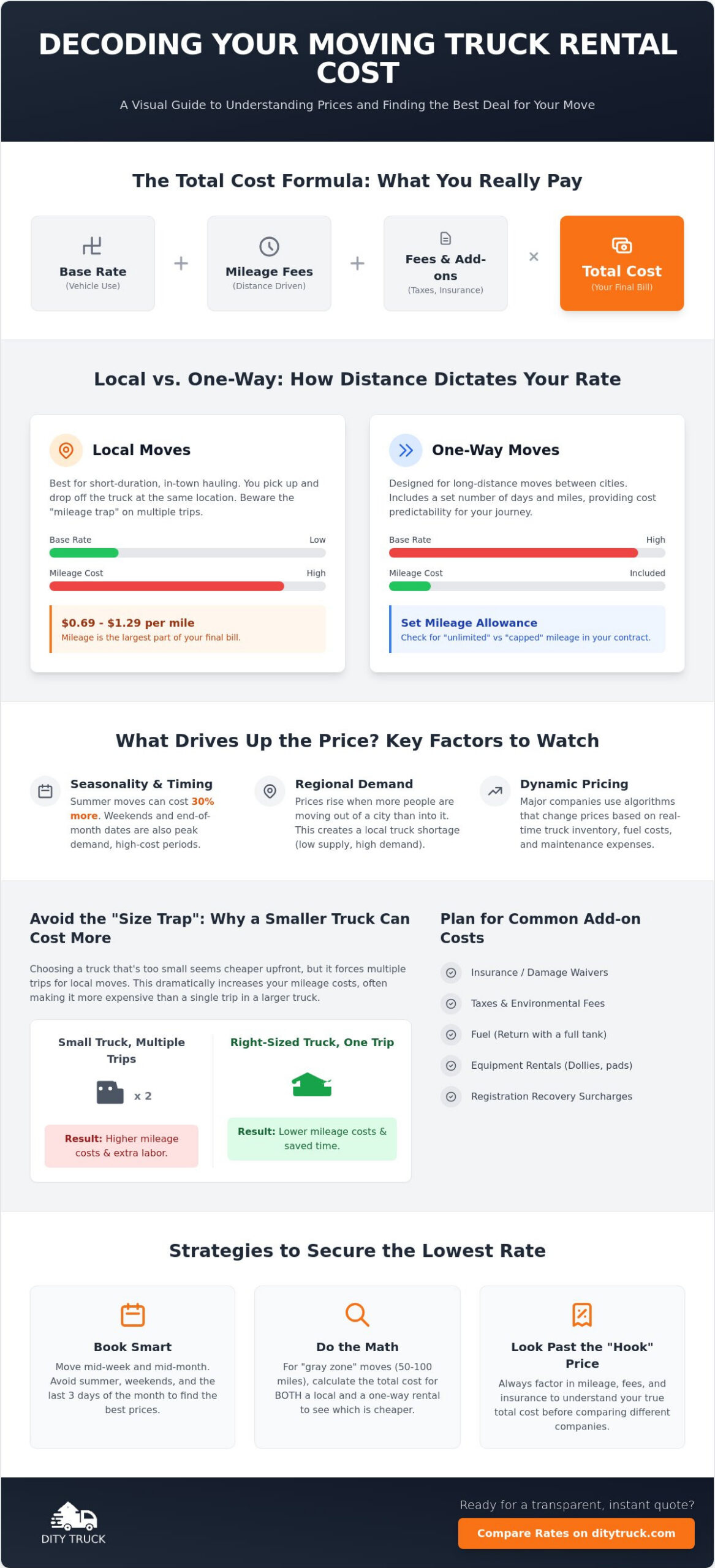
Your total moving truck rental cost isn’t a single, flat number. It’s a calculation based on three distinct parts: the base rate, mileage expenses, and mandatory fees. Think of the base rate as the cost of the hardware. It covers the vehicle use for a set period, which is typically 24 hours. If you need the truck for a second day, that base rate repeats. It’s the starting point for every rental contract, but it’s rarely the final amount you’ll pay.
Daily rates are highly sensitive to timing. If you plan to move on a weekend or during the final three days of the month, expect to pay more. These are peak demand windows. Regional demand also creates price swings. If more people are moving out of your city than into it, the local fleet shrinks. Companies raise prices to manage this inventory gap. It’s a simple case of supply and demand playing out in real time across the map.
Base Rates vs. Total Moving Costs
It’s easy to get distracted by the “hook” price. You see a low daily rate advertised on a billboard and assume that’s your total. That is rarely the case. For local moves, the daily fee is just the entry price. The real cost accumulates with every mile you drive. One-way rentals are different. They usually feature a higher flat rate but include a set mileage allowance for your specific route. This makes the math easier for long-distance trips, but the initial number will look much higher than a local quote.
In 2026, market rates are more volatile than in previous years. Fleet maintenance costs have risen. Companies are passing those expenses to the consumer. Major national providers use dynamic pricing models that change based on how many trucks are sitting on their lots at any given hour. Your final invoice will include taxes, environmental fees, and registration recovery surcharges that the “hook” price never mentions.
Market Factors Affecting 2026 Pricing
Seasonality remains the biggest driver of price changes. Moving during the summer months can cost 30% more than a mid-winter relocation. When demand peaks, the available inventory drops. This scarcity allows rental companies to charge a premium. Beyond the calendar, broad economic trends also influence the moving truck rental prices you’ll see when you search for a quote. Fuel price volatility and labor shortages in the maintenance sector keep the industry on its toes. If you want the best deal, you have to look past the base rate and understand these underlying market forces.
Local vs. One-Way: How Distance Dictates Your Rate
Distance is the single most important factor in determining your final moving truck rental cost. Every rental company operates on two distinct pricing models: local and one-way. Choosing the wrong one for your specific route can double your bill. Local moves focus on a low daily base rate but charge heavily for every mile you drive. One-way moves use a higher flat rate that typically includes a set number of miles and several days of use. Understanding which model fits your trip is the first step toward a realistic budget.
The choice isn’t always obvious for moves between 50 and 100 miles. This is the “gray zone” where you must do the math for both options. One-way pricing depends heavily on equipment balancing. If a company has too many trucks in your destination city, they will charge you more to take another one there. If they need trucks in that city, you might find a significant discount. It pays to check both scenarios before you book.
Local Moves: Navigating the Mileage Trap
Local rentals are designed for short-duration, high-volume hauling. You pick up and drop off the truck at the same location. While the daily rate might look like a bargain, local mileage rates typically range from $0.69 to $1.29 per mile. These costs add up fast. You must calculate the total distance, including the drive to your new home, the return trip, and even small detours to the gas station or drop-off point. If you’re making multiple trips across town, the mileage fee will likely become the largest part of your invoice. You can compare local rates instantly to see which provider offers the best balance of base fees and mileage charges for your specific zip code.
One-Way Moves: Fixed Rates and Flexibility
One-way contracts are built for distance. These agreements usually include 2 to 5 days of rental time, which gives you a buffer for loading and unloading. You won’t pay a per-mile fee as long as you stay within the allotted mileage for your route. However, you must check for “unlimited mileage” versus “capped mileage” in the contract. Some companies offer unlimited miles on one-way trips, while others charge a premium if you exceed the pre-calculated distance. According to data on the Cheapest Moving Truck Rental Companies, the price gap between providers can be hundreds of dollars depending on the specific route and current inventory needs. For a deeper look at how different brands handle these long-distance hauls, refer to our one way truck rentals for moving guide. It breaks down the specific mileage allowances and time limits for each major player in the industry.
How Truck Size and Provider Choice Impact the Bottom Line
Sizing is a financial decision. It’s tempting to book the smallest truck to save on the daily rate. This often backfires. If the truck is too small, you’re forced to make multiple trips. Your mileage fees double. Your fuel consumption doubles. Your total moving truck rental cost spikes because of poor planning. Efficiency is the key to a low bill. Choose a vehicle that fits your entire home in one go.
Larger trucks carry higher base rates. They also have lower fuel efficiency. A 26-foot truck typically averages only 8 to 10 miles per gallon. This makes every mile expensive. For studio apartments or small loads, cargo vans and pickups are the least expensive moving truck rental options. They avoid the steep surcharges associated with larger box trucks. Match the truck to the load size. It’s the fastest way to protect your budget.
Sizing Your Truck for Maximum Efficiency
Most rental companies categorize their fleets by home size. Use these guidelines to avoid the multiple trip trap:
- 10–12 foot trucks: These are best for dorm rooms, studio apartments, or 1-bedroom units with minimal furniture.
- 15–16 foot trucks: This is the “sweet spot” for small 2-bedroom homes or large 1-bedroom apartments with heavy appliances.
- 22–26 foot trucks: These are essential for 3+ bedroom homes. They provide the cubic footage needed to avoid extra trips. If you’re moving a large household and need a detailed breakdown of what you’ll actually pay, our guide on the cost to rent a 26 foot moving truck covers 2026 pricing from all major providers.
Don’t guess your inventory. List your large items before you book. A 15-foot truck might look big in the parking lot, but it fills up quickly once you load a sofa and a mattress.
Comparing Provider Pricing Archetypes
Provider choice dictates your experience and your price. High-volume national brands often offer the lowest base rates for local moves. They’re a solid choice for cross-town relocations where distance is minimal. These companies dominate the market because of their massive footprint. You can find a pickup location in almost every neighborhood.
Long-distance specialists take a different approach. Their base rates are often higher, but they target movers crossing state lines. They maintain a newer fleet with better reliability. This reduces the risk of breakdowns during a cross-country trip. Other companies specialize in commercial-grade trucks and pickups. They’re an excellent option for shorter distances where you need a heavy-duty vehicle but don’t want a traditional box truck. Each company has a specific pricing archetype. To accurately compare moving truck rental prices across these different archetypes, you need to look beyond the base rate and evaluate total cost of ownership for your specific route and load size.
Avoiding Sticker Shock: Common Fees and Add-on Costs
The advertised daily rate is just the starting point. Your final moving truck rental cost includes several layers of mandatory and optional fees that rarely appear on a billboard. These add-ons can increase your total by 20% to 50% depending on your choices. Understanding the “total cost of ownership” for your rental is the only way to avoid a surprise at the checkout counter. State taxes and environmental recovery fees are non-negotiable. They typically add 5% to 15% to your final invoice. You should also watch out for cleaning and refueling penalties. You can avoid these by returning the truck in its original condition with a full tank of gas.
Insurance and Protection Plans
Insurance is the most frequent hidden expense. It often costs between $30 and $150 per move. Do not assume you are already covered. Most personal auto insurance policies specifically exclude commercial box trucks. Most credit card rental protections do the same. You have to decide between a Damage Waiver (CDW) and supplemental liability insurance. A CDW protects you if the truck is damaged. Liability covers damage to other people or property. For a large 26-foot truck, basic protection is usually worth the cost. It provides a sense of confident simplicity during a high-stakes task. Check your existing policies first. You might save fifty dollars by declining coverage you already have through a specialized provider.
Fuel, Equipment, and Environmental Fees
Fuel is a major variable that people often overlook. Moving trucks are heavy and lack aerodynamic efficiency. They average only 8 to 12 miles per gallon. To estimate your fuel bill, divide your total distance by 10 and multiply by the current price of gas. A 100-mile trip can easily cost $40 to $50 in fuel alone. Rental equipment is another line item. Dollies and furniture pads usually cost $10 to $20 each. These small costs add up quickly. Environmental and licensing recovery fees are standard across major providers. They cover the cost of disposing of hazardous materials like oil and tires. These fees are small but mandatory. To see a full breakdown of these charges before you book, get a transparent truck rental quote that includes all estimated fees.
The best way to protect your budget is to plan for the “exit” of the rental. Refill the tank to the exact level required by your contract. Take photos of the cargo area once it is empty. This prevents cleaning fees that can range from $25 to $100. Being proactive saves you money. It turns a stressful transaction into a friction-free solution.
Beyond the vehicle logistics, streamlining your personal tasks can significantly reduce stress during a move. For those relocating in the Southern California area, Laundry Breeze offers professional laundry services that allow you to focus on the heavy lifting while they handle your linens and clothing.
Strategies for Securing the Lowest Possible Rental Rate
Securing the lowest moving truck rental cost requires a proactive strategy. You can’t leave your booking to the last minute and expect a bargain. Lock in your rate at least two to four weeks before your move date. This window allows you to capture current market pricing before the inventory shrinks. If you wait until the week of your move, you’ll pay a premium for whatever vehicles are left on the lot. Planning ahead is the simplest way to keep your budget under control.
Always ask about specialized discounts. Most major providers offer reduced rates for AAA members, active military personnel, and students. These savings might not appear on the initial quote page. You often need to verify your status during the checkout process to see the final adjusted price. These small percentage drops can save you fifty dollars or more on a long-distance haul. It’s a quick win for your wallet that requires almost no effort.
Timing Your Move for Maximum Savings
Tuesday and Wednesday are statistically the cheapest days to rent a truck. Demand hits its lowest point during the middle of the week. You should also avoid the last weekend of the month. This is the peak moving rush when leases expire and demand for equipment skyrockets. If your schedule allows, plan a winter move. Rental companies have more leverage to negotiate long-distance rates during the colder months when fewer people are relocating. Moving during the off-season turns a high-stakes task into a manageable expense.
The Power of Real-Time Comparison
Manual searching is slow and inefficient. Rates change daily based on local supply and regional demand. Checking five different websites one by one takes time you don’t have. There is a significant price delta between providers for the same route. One company might charge double what another charges simply because their lot is empty. You need a tool that performs the heavy lifting behind the scenes so you don’t have to.
DityTruck solves this by aggregating real-time data. You see all provider rates on one screen. This transparency ensures you never overpay for your moving truck rental. Reserve your vehicle through a comparison tool to simplify the logistics and secure the best available market price. It’s the shortest, most logical path to a successful and affordable move.
Master Your Move with Confidence
Mastering your move starts with understanding the math. You now know that timing, distance, and truck size are the primary drivers of your final bill. Avoiding the weekend rush and choosing the right vehicle for your load size can protect your budget. Transparency is your best defense against hidden fees and surprise mileage charges. It turns a high-stakes task into a manageable process.
Calculating your total moving truck rental cost shouldn’t be a source of stress. You deserve a clear path to the best available rate without the manual legwork of checking every provider site. DityTruck provides real-time price aggregation from major providers and transparent fee breakdowns. Our fast, simple online reservation process strips away the complexity of logistics so you can focus on your new home.
Compare real-time moving truck rates and save on your move with DityTruck. Move with confidence. Your affordable, friction-free relocation is just a few clicks away.
Frequently Asked Questions
How much does it typically cost to rent a moving truck for a local move?
Local moves generally range from $150 to $300 in total. This includes the base rate and mileage fees for a standard two-bedroom home. You’ll pay a low daily fee, usually between $20 and $50, plus a per-mile charge. These costs fluctuate based on the day of the week and local demand. Planning for a mid-week move often helps you land at the lower end of this price spectrum.
Is it cheaper to rent a truck one-way or return it to the same location?
Returning a truck to the same location is cheaper for short distances within the same city. These local rentals use lower base rates but charge for every mile driven. One-way rentals are more cost-effective for long-distance trips because they include a set mileage allowance and several days of use. The best choice depends on your route and whether the company needs to move inventory to your destination.
Do moving truck rental prices include gas?
No, fuel costs are never included in your moving truck rental cost. You’re responsible for returning the vehicle with the same amount of fuel it had at pickup. Most trucks average between 8 and 12 miles per gallon, so fuel is a significant expense. If you return the truck with less gas than required, the rental company will charge a steep refueling penalty that far exceeds local pump prices.
What is the average cost per mile for a rental truck?
Local mileage fees typically range from $0.59 to $1.39 per mile. Some companies may charge up to $2.00 during peak periods or for larger vehicles. One-way rentals usually don’t have a per-mile fee unless you exceed the mileage cap stated in your contract. Always calculate the total distance of your trip, including detours, to estimate this portion of your bill accurately before you finalize your booking.
Does my car insurance cover a rental moving truck?
Most personal auto insurance policies and credit card protections do not cover large moving trucks. They typically view these as commercial vehicles rather than standard passenger cars. You should call your provider to verify your specific coverage before declining the rental company’s protection plan. Most movers find that purchasing a basic damage waiver provides the necessary peace of mind for driving a heavy, unfamiliar vehicle through traffic.
Are there hidden fees I should watch out for when booking?
Yes, several common fees can inflate your final bill. Watch out for environmental recovery fees, state taxes, and registration surcharges that aren’t always shown in the initial quote. You’ll also pay extra for rental equipment like dollies or furniture pads. Late return fees and cleaning penalties are also common. Reviewing a transparent breakdown of all estimated charges is the best way to avoid sticker shock at the rental counter.
How can I get the best deal on a moving truck rental in 2026?
Booking at least two to four weeks in advance is the most effective way to secure a low moving truck rental cost. Move on a Tuesday or Wednesday to avoid the high demand and price hikes associated with weekends. You should also use a comparison tool to see real-time rates from multiple providers on a single screen. This allows you to find the cheapest option for your specific route quickly.
Do I need a special license to drive a 26-foot moving truck?
You do not need a Commercial Driver’s License (CDL) to drive a 26-foot moving truck. These vehicles are classified as non-commercial for personal use. A standard, valid driver’s license is sufficient for most rentals in the United States. However, you must be at least 18 or 24 years old depending on the rental company’s specific policy. Always verify the age requirements and license validity before arriving at the pickup location.
Leave a Reply