Most people pick a truck based on length. That is the fastest way to leave your sofa on the sidewalk. It is a mistake that leads to expensive double trips or the anxiety of driving a massive 26-foot vehicle you don’t actually need. When you ask what size moving truck do I need, you are really looking for a way to fit everything in one go. You don’t want to pay for empty air. We know the frustration of inconsistent sizing between brands. It is confusing and adds unnecessary stress to an already big day.
This 2026 guide provides the definitive answer to your sizing dilemma. You will learn to master stackable volume so you can book with total confidence. We compare the real-world capacity of 10-foot to 26-foot trucks across the major rental brands. We also highlight current opportunities like the Penske “SUNNY26” discount and Home Depot’s flat-rate options. You will find the shortest path to a lower rental cost and a move that actually fits. Our goal is to replace your logistics anxiety with a sense of confident simplicity.
Key Takeaways
- Select the smallest safe vehicle to lower fuel costs and mileage fees. Every extra foot of empty space is a drain on your budget.
- Find a definitive answer to what size moving truck do I need by focusing on inventory density. Room counts are only a rough starting point.
- Identify the “Goldilocks Zone” for your specific move. A two-bedroom home often requires a 17-foot truck to ensure you only make one trip.
- Use the 10% Buffer Rule to account for awkward items. This small margin of error prevents the stress of leaving belongings on the curb.
- Compare real-time rates and brand-specific dimensions in one place. Stop guessing and start booking with total confidence.
Why Your Choice of Moving Truck Size Dictates Your Entire Budget
Your moving budget lives or dies by the vehicle you select. It is tempting to think bigger is better for peace of mind. That logic often leads to overpaying for empty air. When you ask what size moving truck do I need, you are really asking how to balance space against cost. The goal is to find the Goldilocks Zone. This is the smallest possible vehicle that fits your inventory safely. Finding this balance saves you on daily rates, fuel, and mileage fees. Roughly 62% of people who moved recently handled the process themselves. For these DIY movers, the truck is the single largest variable expense.
Sizing isn’t just about the physical floor space. It dictates your fuel efficiency, insurance premiums, and the ease of your drive. A massive 26-foot truck handles differently than a cargo van. It requires more clearance and wider turns. If you rent more truck than you can handle, the anxiety of the drive can ruin your day. Conversely, a truck that is too small forces you into a logistical corner. You must decide what to leave behind or commit to a second trip. Both options are expensive and stressful. Success starts with understanding Box Truck Specifications before you sign a rental agreement.
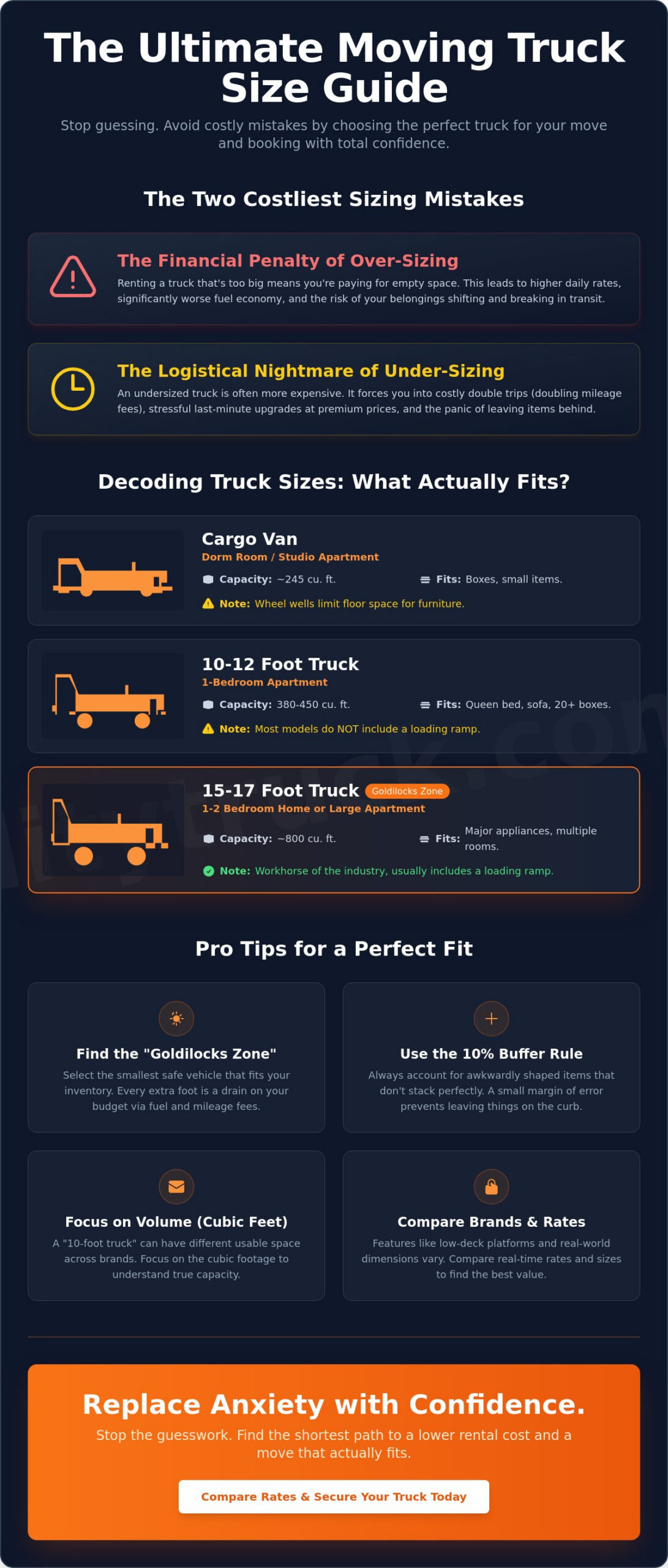
The Financial Penalty of Over-Sizing
Larger trucks have lower MPG. A heavy 26-foot box truck consumes significantly more fuel than a 10-foot model. On a long-distance move, this difference can add hundreds of dollars to your total spend. Daily rates also jump at specific size thresholds. Moving from a cargo van to a box truck increases your base cost instantly. Over-sizing is a calculated financial risk for DIY movers that often results in wasted capital and shifting loads that damage furniture. If the truck is too empty, your boxes will slide during transit. This leads to broken glass and scratched finishes. You pay more for the truck and then pay again to replace your belongings.
The Logistics Nightmare of Under-Sizing
Under-sizing is even more expensive than over-sizing. If everything doesn’t fit, you face the reality of double trips. Double trips mean double the mileage fees. Because mileage is often the most expensive part of a local rental, this mistake can double your planned budget. You also face a psychological disaster. Seeing half your life still on the curb at 4:00 PM creates instant panic. Last-minute upgrades at the rental counter are rarely discounted. You end up paying a premium because you are in a position of weakness. Most states require you to update your driver’s license within 30 days of moving; don’t let a sizing mistake eat up your valuable time during this window.
Decoding Moving Truck Dimensions: From Vans to 26-Foot Box Trucks
Understanding the numbers on the side of the truck is only half the battle. A 10-foot truck from one brand might offer less usable space than a 10-foot truck from another due to deck height and wheel well placement. When you ask what size moving truck do I need, you must look at the cubic footage rather than just the length. Brand-specific designs like low-deck platforms make loading easier but can sacrifice total vertical volume. You can find a deeper breakdown of these industry standards in CNET’s moving truck size guide. Before you commit to a specific brand, you can compare real-time sizing and rates to see which deck design actually fits your furniture.
Small Moves: Cargo Vans and 10-12 Foot Trucks
Cargo vans are the elite choice for dorm rooms or studio apartments. They offer roughly 245 cubic feet of space. They are easy to park and drive in tight city streets. However, the wheel wells eat into your floor space. This makes it difficult to lay large furniture flat. If you are weighing your options for a small move, a budget cargo van rental can be significantly cheaper than renting a full box truck or a traditional car. Small box trucks, ranging from 10 to 12 feet, provide a more uniform rectangular space. These are the transition point for one-bedroom apartments. They typically hold between 380 and 450 cubic feet. This is enough for a queen mattress, a small sofa, and up to 20 medium boxes. Most 10-foot trucks do not include a ramp. You will need to lift your heavy items directly onto the deck. If you are still deciding between these two vehicle types, a detailed look at the cargo van vs box truck comparison can help you weigh the trade-offs in capacity, maneuverability, and total cost before you book.
Medium Moves: 15-17 Foot Trucks
The 15-foot truck is the workhorse of the DIY moving industry. It is the most popular choice for local relocations. These vehicles usually feature a loading ramp. This is a back-saving necessity for heavy dressers and appliances. A 15-foot truck can typically hold the contents of a one to two-bedroom apartment. If you have a larger two-bedroom home, you should look at the 17-foot option. These trucks handle roughly 30 to 40 boxes along with furniture for three rooms. They strike a balance between high capacity and manageable driving. You get the space you need without the extreme bulk of a commercial-grade vehicle.
Large Family Relocations: 20-26 Foot Trucks
A 26-foot truck is the largest rental vehicle you can drive without a Commercial Driver’s License (CDL). It is designed for three to five-bedroom homes. These giants offer payload capacities up to 10,000 lbs. They are essential for long-distance hauls where you cannot afford a second trip. A 20-foot truck can usually hold the contents of a two to three-bedroom home. Moving up to the 26-foot model gives you the vertical height needed for tall wardrobes and heavy appliances. These trucks are wide and tall. You must be mindful of low-hanging branches and bridge clearances. They are the ultimate solution for large family relocations where volume is the primary concern.
Matching Your Inventory to Truck Capacity: A Room-by-Room Guide
Room counts are a helpful baseline. They are not a guarantee. Your specific furniture density determines the final fit. A minimalist two-bedroom apartment might squeeze into a 15-foot truck. A standard home with a garage and patio set almost always requires more volume. When you start your moving truck rental planning, look beyond the floor plan. Consider the “Mom’s Attic” feature found in some brands. This storage extension sits over the cab. It provides a safe spot for fragile items or small boxes. It adds roughly 20 to 30 percent more usable space without increasing the truck’s footprint.
Using the right data saves you from the “half-empty” penalty. If you book too much space, your items shift. If you book too little, you make two trips. Most people asking what size moving truck do I need forget to account for vertical space. Stackability is your secret weapon. If your furniture is sturdy and flat-topped, you can stack boxes to the ceiling. This effectively doubles your floor space. If you have delicate, antique furniture, you lose that vertical volume. You must book a longer truck to compensate for the lack of stacking.
Estimating Volume for Studios and 1-Bedroom Apartments
Cargo vans are perfect for dorm rooms. They handle a bed and a few boxes with ease. Once you add a sofa or a dining table, you need the height of a 10-foot truck. This is especially true for one way truck rentals where you cannot simply go back for a second load. A 10-foot truck allows you to stand a queen mattress upright. This clears the floor for heavy dressers and up to 20 medium boxes. If you have a large desk or a sectional sofa, jump to the 12-foot or 15-foot range immediately. Don’t risk a failed pack on a long-distance haul.
Sizing Up for 2-3 Bedroom Houses
Two-bedroom apartments are the most common source of sizing errors. A 15-foot truck is often marketed for this size. In reality, a 17-foot truck is the safer choice for modern households. It accounts for dining sets, multiple bed frames, and the “hidden” items in closets. If your home includes a garage or a basement, the 20-foot truck becomes your necessary safety net. You must also watch your weight limits. Every vehicle has a Gross Vehicle Weight Rating (GVWR). Heavy appliances and solid wood furniture add up fast. Exceeding the GVWR makes the truck dangerous to drive and can lead to mechanical failure. Always prioritize a small volume buffer to stay within safe operating limits.
Pro Tips for Estimating Your Load Like a Logistics Expert
Moving like a pro means thinking in three dimensions. Most renters only look at floor space. Logistics experts look at volume. When you ask what size moving truck do I need, you must apply the 10% Buffer Rule. This margin accounts for items you forgot or boxes that don’t stack perfectly. It is the difference between a smooth move and a stressful midnight trip for a second rental. To visualize your load, remember that one cubic foot is roughly the size of a standard milk crate. If you have 500 milk crates’ worth of belongings, you need at least 550 cubic feet of truck space to stay safe.
Don’t guess your inventory. Use a spreadsheet to tally every large item before you book. List your sofa, bed frames, and appliances first. Then, estimate your box count. A typical two-bedroom home uses 30 to 40 medium boxes. This data-driven approach removes the guesswork and prevents overpaying. Once you have your total, you can use the ‘High-Load’ strategy. This involves packing heavy, flat items at the bottom and stacking boxes all the way to the ceiling. Maximizing vertical space allows you to downsize your truck rental. This saves you money on the daily rate and reduces your total fuel consumption.
The Secret of Cubic Feet vs. Linear Feet
Trucks are sold by linear feet, which is the length of the cargo area. They are packed by cubic feet, which is the total volume. You calculate the volume of a standard box by multiplying length by width by height. Most rental trucks have an interior height of roughly 7 to 8 feet. This vertical clearance is your greatest asset. If you only fill the floor, you are paying for 70% empty air. Use every inch of that height to keep your truck size and your bill as small as possible. This efficiency is the shortest path to a lower rental cost.
Accounting for Space Killers and Odd-Shaped Items
Some items refuse to cooperate with a tidy stack. Bicycles, treadmills, and floor lamps are “space killers” because they cannot be stacked upon. They create “dead space” that is difficult to fill with standard boxes. This is common with outdoor gear and patio equipment too. These awkward shapes often force a move to the next truck size up even if your total volume seems low. If your inventory is full of odd shapes, increase your buffer to 15% or 20%. Before you commit, compare truck capacities and book your ideal size to ensure everything fits on the first try.
Compare Rates and Secure Your Ideal Truck Size with DityTruck
Knowledge is power. Application is relief. You now have the metrics to answer what size moving truck do I need. Now you need a tool to execute that plan. DityTruck acts as your smart assistant. It strips away the complexity of logistics. It replaces hours of manual research with instant clarity. You don’t have to visit multiple sites to check if a 15-foot truck is available in your zip code. We aggregate the data for you. This is the shortest path between your inventory list and a confirmed reservation. Our platform is built for the 2026 mover who values time as much as money. We focus on stripping away the stress of the search so you can focus on the move itself.
Why Real-Time Comparison Beats Manual Searching
Manual searching is a drain on your energy. You usually have to open five different tabs. You have to compare Budget, Penske, and U-Haul side-by-side. Each brand uses different terminology for their sizes. A “Medium Truck” at one company might be 15 feet while another calls 17 feet “Medium.” DityTruck standardizes this information for you. You see exactly what each provider offers for your specific move. Our interface highlights the cheapest rate for the exact volume you require. This transparency prevents you from overpaying for a name brand when a better value is available nearby. It is efficient. It is honest. It puts you in control of your moving budget. You get a clear view of deck heights, ramp availability, and fuel types without clicking through a dozen pages.
Booking Your Choice in Minutes
Speed is our priority. Once you find the perfect fit, you can lock in your rate immediately. Our reservation process is streamlined for clarity. We avoid complex jargon and hidden fees. You get a straightforward breakdown of your costs. This includes the daily rate and estimated mileage. Booking with confidence means knowing your truck will be there on moving day. It means knowing you didn’t leave money on the table. DityTruck performs the heavy lifting behind the scenes. You focus on the packing. We handle the logistics. Our system is designed for rapid decision-making. We move as fast as you do. Stop guessing and start moving with a plan that works. Find the perfect truck size and compare rates now at DityTruck.
Master Your Move with Confidence
Choosing the right vehicle is the foundation of a successful DIY move. You now have the professional tools to answer what size moving truck do I need without the stress of guesswork. Remember to prioritize stackable volume over simple truck length. Apply the 10% buffer rule to handle those last-minute items. By maximizing vertical space and choosing a size that fits your specific inventory density, you avoid the high cost of double trips. You also skip the anxiety of driving a vehicle that is unnecessarily large for your needs.
Efficiency doesn’t stop at planning. It carries through to your final booking. DityTruck provides a streamlined platform to see real-time rates from top national providers side-by-side. You get transparent pricing with no hidden fees or complex jargon. This clarity allows you to lock in the best value for your specific route instantly. Stop checking multiple websites and start moving forward with a clear, logical plan. Compare Moving Truck Sizes and Rates Instantly at DityTruck and secure your ideal fit today. Your perfect move is just a few clicks away.
Frequently Asked Questions
Is a 10-foot truck big enough for a one-bedroom apartment?
A 10-foot truck is typically only sufficient for a studio or a very minimalist one-bedroom apartment. If you own a full-sized sofa, a dining set, or a large desk, you’ll likely run out of floor space. Most standard one-bedroom moves require a 12-foot or 15-foot truck to hold furniture and boxes without making multiple trips. This extra volume prevents the stress of leaving half your life on the sidewalk.
What is the largest moving truck I can drive without a special license?
You can drive a 26-foot box truck with a standard driver’s license. This is the largest rental vehicle available for personal use that doesn’t require a Commercial Driver’s License (CDL). These trucks are designed for three to five-bedroom homes. While they’re large, they’re built on standard chassis that make them legal for any licensed driver. Always check the rental company’s age requirements, as some require you to be 25 or older.
How do I know if I need a 15-foot or a 20-foot truck?
The decision between a 15-foot and a 20-foot truck usually depends on your storage areas. If your two-bedroom home includes a garage, basement, or attic, the 20-foot truck is the safer choice. A 15-foot truck is the workhorse for standard two-bedroom apartments. When asking what size moving truck do I need, always choose the larger size if you have heavy appliances or outdoor furniture that cannot be stacked easily.
Do moving truck sizes include the space over the cab?
Yes, the advertised cubic footage of a moving truck usually includes the Mom’s Attic or cab-over storage area. This space is perfect for fragile items, electronics, or small boxes that you want to keep separate from heavy furniture. However, the linear length refers only to the main floor of the cargo area. Always verify the specific internal dimensions if you have extremely long items like a 16-foot ladder that must lay flat.
Can I fit a king-size bed in a cargo van?
No, a standard king-size mattress won’t fit in a cargo van. The wheel wells and the narrow rear opening create physical barriers that prevent the mattress from laying flat. You’ll need at least a 10-foot box truck to transport a king-size bed safely. Box trucks provide the necessary width and height to slide the mattress in alongside your other furniture. This ensures your bed remains clean and undamaged during the move. Understanding the key differences in a cargo van vs box truck rental can help you make the right call before moving day.
What happens if I rent a truck that is too small?
Renting a truck that’s too small results in expensive double trips or the loss of your belongings. You’ll pay twice the mileage fees, which are often the most significant part of a local move. If you’re moving long-distance, you may be forced to pay for a last-minute trailer rental or a second truck at a much higher rate. This mistake adds hours of labor and unnecessary stress to your moving day.
How much extra space should I leave in the truck for safety?
You should aim to leave roughly 10% to 15% of the truck’s volume empty as a safety buffer. This extra space allows for better weight distribution and prevents fragile items from being crushed under pressure. It also accounts for the dead space created by odd-shaped items like bicycles. When you wonder what size moving truck do I need, remember that a slightly larger truck is always cheaper than a forced second trip.
Are all 16-foot moving trucks the same size across different brands?
No, 16-foot trucks vary significantly between brands. One company might offer a lower deck for easier loading, while another provides more vertical height. These design choices change the total cubic footage even if the length is identical. Always compare the internal width and height specifications rather than relying on the length alone. Checking these details ensures your tallest furniture pieces will fit through the rear door without getting stuck or damaged.
Leave a Reply