
The cheapest quote on your screen isn’t always the lowest price you’ll pay at the counter. Most people start their search for moving truck rental companies looking for the smallest number, only to get hit with mileage fees and insurance costs later. It’s frustrating to plan a budget around a base rate that doubles by the time you’ve signed the paperwork. You deserve a clear view of what a rental actually costs before you commit your time and money.
We’ve done the heavy lifting to bring you a transparent side-by-side comparison of the industry’s leaders for 2026. This guide breaks down the complicated math of local versus long-distance pricing so you can book with confidence. You’ll learn which companies offer unlimited mileage, how to choose a truck size that actually fits your furniture, and where to find the best availability in your area. We focus on the facts to ensure your move stays on track and under budget. Let’s find the smartest path to your new front door.
Key Takeaways
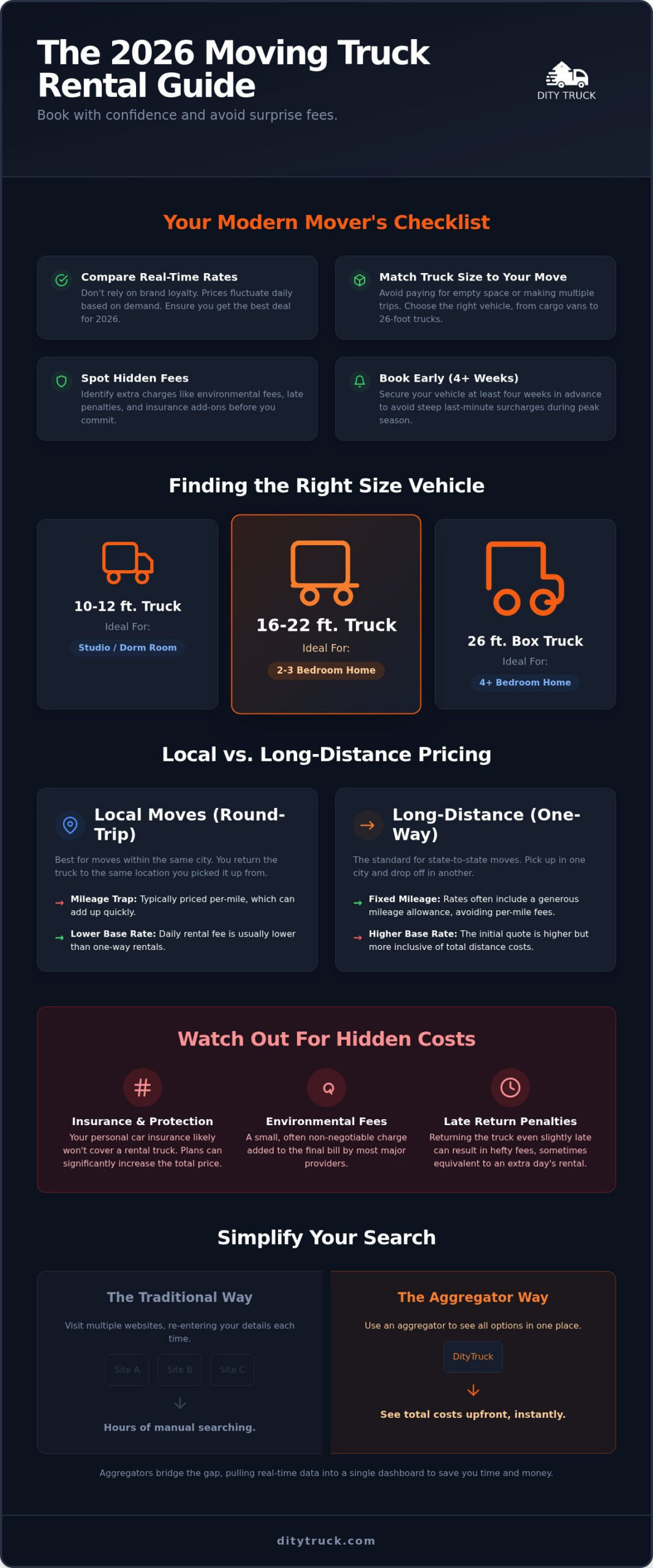
- Compare real-time rates instead of relying on brand loyalty—ensure you get the best deal in the current 2026 market.
- Match your move to the right vehicle size—choose between cargo vans and 26-foot trucks to avoid paying for empty space.
- Review the top moving truck rental companies side-by-side—weigh U-Haul’s local availability against Penske’s long-distance reliability.
- Spot hidden fees before checkout—identify environmental charges and late penalties that often inflate your final bill.
- Simplify your booking process—use an aggregator to see total costs upfront and secure your truck reservation instantly.
Navigating the 2026 Moving Truck Rental Market
Moving used to involve calling multiple local lots and hoping for a truck. In 2026, the DIY moving landscape is entirely digital. Most moving truck rental companies now prioritize online reservations over phone calls or walk-ins. If you wait to visit a physical location to book your vehicle, you’ll likely find an empty lot. The shift toward digital-first booking means you need to be faster and more informed than ever before.
Sticking to one brand often costs you more than you think. Loyalty doesn’t pay in the logistics world. Prices fluctuate daily based on local demand and current fleet availability. A provider that was affordable last year might be the most expensive option today. Booking early is your best defense against the 2026 peak moving season. We recommend securing your vehicle at least four weeks in advance. This avoids the steep last-minute surcharges that appear when inventory gets low.
The national market relies on the “Big Three” providers. U-Haul, Penske, and Budget manage the majority of the country’s rental fleet. For a deeper look at the industry’s largest player, this U-Haul company overview explains their massive neighborhood presence. These companies offer the most pickup and drop-off points. This makes them the standard for cross-country relocations where you need reliable support in every state.
The Rise of Aggregator Platforms
Visiting five different websites to find a truck is a waste of your time. Each site requires you to enter the same dates, locations, and personal details over and over. Aggregator platforms like DityTruck solve this problem by pulling real-time data into a single dashboard. This bridges the gap between major providers and movers. It replaces hours of manual searching with a few seconds of automated comparison. You see the real-time inventory from various moving truck rental companies side-by-side. This transparency ensures you don’t overpay for a vehicle that is sitting just a few blocks away.
Local vs. Long-Distance Logistics
Distance dictates your total cost and your rental strategy. A “one-way” rental makes the most financial sense for state-to-state moves. You pick up the vehicle near your current home and drop it off at your destination. This eliminates the need to drive an empty truck back to the starting point. Local moves usually involve round-trip rentals. These come with a lower daily rate but a significant mileage trap. Per-mile fees can quickly exceed the base rental price if your new home is more than a few miles away. National availability trends for 2026 show that one-way trucks are often concentrated in high-growth regions. Using a comparison tool helps you find where the fleet is located right now. This saves you from driving across town just to find a specific 15-foot box truck.
Key Factors for Evaluating Rental Truck Companies
Choosing between different moving truck rental companies is a balancing act of space and expense. The base rate you see on a website is just the starting point. To find the real value, you must account for fuel, mileage, and protection plans. Most DIY movers get overwhelmed by the options. Breaking these down into specific categories simplifies the decision and prevents budget overruns.
Protection plans are often where the total price jumps. Your personal car insurance rarely covers a commercial sized truck. Understanding your consumer rights when moving helps you navigate these add-ons without feeling pressured. Always check if the plan covers the truck, your belongings, or both. A reliable provider will be transparent about what their “basic” coverage actually includes.
Don’t forget the physical tools. A truck without a ramp or a dolly is just a giant box. Confirm that your chosen provider has these available at your specific pickup location. Many moving truck rental companies charge per item. Factor these small costs into your final budget. It’s better to pay for a dozen moving blankets now than to pay for a scratched dresser later.
Finding the Right Size Vehicle
Size matters for both your budget and your stress levels. A truck that is too small requires multiple trips. One that is too large means your belongings will slide around during transit. Use these general guidelines for 2026 fleet standards:
- 10-12 foot truck: Ideal for studio apartments or dorm rooms. They handle like a large SUV and are easy to park in tight city streets.
- 16-22 foot truck: These are the workhorses for 2-3 bedroom homes. They offer enough vertical height for stacked boxes and large furniture.
- 26-foot box truck: This is the largest vehicle you can drive without a commercial license. It’s the only choice for four-bedroom homes or large households.
Mileage and Fuel Policies
Pricing varies significantly based on your total distance. Local moves usually use per-mile pricing. If you’re driving across town, this is usually the cheapest path. For longer trips, look for flat-rate options that include unlimited mileage. In 2026, even modern box trucks struggle with aerodynamics, typically averaging between 8 and 12 miles per gallon depending on the load weight. GVWR refers to the Gross Vehicle Weight Rating, which is the absolute limit for the combined weight of the truck, fuel, passengers, and cargo. You can compare these specific fleet details in one place to avoid surprises on moving day.
Comparing the Major Moving Truck Rental Providers Side-by-Side
Choosing between moving truck rental companies requires matching their strengths to your specific route. U-Haul is the leader in local accessibility. They operate over 21,000 locations across North America, making them the easiest option for neighborhood moves. Forbes’ 2026 comparison highlights their dominance in sheer volume and proximity. If you need a truck ten minutes from your current door, U-Haul is the likely answer.
Penske focuses on the long-distance mover. Their business model prioritizes fleet reliability and highway performance. They often provide unlimited mileage on one-way rentals, which eliminates the stress of counting every exit. Budget occupies the middle ground. They have fewer locations than U-Haul but often beat them on price through consistent seasonal promotions. Enterprise is a strong contender if your move is small. They specialize in cargo vans and pickup trucks, offering a more comfortable driving experience for light loads.
Reliability and Fleet Age
Fleet maintenance is a critical factor for state-to-state moves. A mechanical failure on a remote highway can derail your entire schedule. Penske and Enterprise maintain some of the newest fleets in the industry. They rotate vehicles out of service more frequently to ensure high reliability. This focus on newer models often results in better fuel economy and fewer breakdowns. All major moving truck rental companies provide 24/7 roadside assistance. U-Haul’s massive network ensures that help is usually nearby, even in rural areas. Interior features also differ. U-Haul trucks are designed with a lower deck height, which results in shorter, steeper loading ramps. Penske trucks sit higher, requiring longer ramps that are easier on your legs during a long day of lifting.
The Discount Landscape
Your status as a student, military member, or AAA subscriber can lead to significant savings. Budget is particularly well-known for honoring these groups with discounts up to 20%. Timing your booking is just as important as your affiliation. Moving on a Tuesday or Wednesday is almost always cheaper than a Friday or Saturday. Demand spikes on weekends, which naturally inflates box truck rental prices across all providers. Shifting your move date by just 48 hours can save you enough to cover your fuel costs. Always check for seasonal codes before you finalize your reservation. These small efforts turn a standard rental into a high-value deal.
Avoiding Hidden Fees and Booking Smart
Hidden costs turn a budget move into a financial headache. Most moving truck rental companies advertise a low daily rate to get you in the door. The final bill often includes environmental fees, which typically range from $1 to $5, and local taxes that vary by state. These small numbers add up quickly. Returning a truck late is another common trap. Even a one-hour delay can trigger a full “extra day” charge. For one-way rentals, companies like Penske charge $100 per additional day. Always plan your route with a two-hour buffer to avoid these penalties.
Refueling is the most expensive mistake you can make. Rental companies charge a premium—often double the local gas station price—to fill the tank for you. Always return the vehicle with the exact amount of fuel specified in your contract. Cleaning fees are equally avoidable. Sweep out the cargo area before you lock the door. A few crumbs or some dirt can result in a $25 to $50 cleaning surcharge. These details matter when you want a stress-free experience.
Insurance: To Buy or Not to Buy?
Your personal auto insurance likely stops at the bumper of a rental truck. Most standard policies exclude commercial vehicles over a certain weight. Credit card coverage usually follows the same rule. They often explicitly exclude box trucks and cargo vans. You need to decide between a Damage Waiver (CDW) and Supplemental Liability (SLI). CDW covers the truck itself. SLI protects you against claims from other drivers. Understanding these differences prevents you from paying for redundant coverage or leaving yourself exposed during a long trip.
The Reservation vs. Guarantee
A reservation is not always a guarantee. This is a hard truth in the rental industry. High demand can mean your truck is still in another city on your moving day. Call your pickup location 48 hours in advance to confirm the vehicle is on-site. If you’re deciding between the two biggest names, check our guide on uhaul vs budget truck rental for specific policy differences. Being proactive ensures you aren’t left standing on a sidewalk with a pile of boxes. You deserve a booking process that values your time.
Stop guessing about the final price. You can book your truck through DityTruck to see a transparent breakdown of costs before you commit.
Streamlining Your Search with DityTruck
Finding the right fit among moving truck rental companies shouldn’t be a full-time job. Most movers waste hours jumping between tabs and re-entering the same data. DityTruck acts as your smart assistant. It performs the heavy lifting of price hunting by aggregating live inventory from the industry’s most trusted names into one streamlined dashboard. You get a clear view of the market without the manual labor.
Efficiency is the core of our platform. One search delivers multiple quotes. You can compare a cargo van for a local studio move or a 26-foot box truck for a cross-country relocation in seconds. We support every type of DIY move. Our system pulls real-time data to ensure the price you see is the price you get. This eliminates the “sticker shock” that often happens at the rental counter. You deserve a booking experience that is as fast as it is honest.
The Comparison Advantage
Transparency is your biggest money-saving tool. DityTruck saves users an average of 15-20% simply by making prices visible side-by-side. When companies have to compete for your business on a single screen, you win. Many providers claim they offer the best rates when you book direct. Our data often proves otherwise. By seeing every available option, you can spot the provider that has an oversupply of trucks in your specific city. This leads to lower rates that you wouldn’t find by visiting just one website. We strip away the complexity of logistics. You get the relief of knowing you didn’t leave money on the table. Secure your move today with our streamlined booking tool and put your focus back on your new home.
Next Steps for Your Move
Your move is a high-stakes task. Don’t leave the details to chance or settle for the first quote you find. Use the DityTruck search tool to compare live 2026 rates across the national market. If you need more depth on the logistics of your trip, visit our pillar page on moving truck rental for a full breakdown of the process. We provide the clarity you need to make a confident decision. Once you’ve found the perfect balance of price and reliability, you can finalize your reservation instantly. Stop the endless searching and start your journey with a plan. Compare and book your moving truck now to experience a friction-free move.
Take Control of Your 2026 Moving Logistics
Moving day doesn’t have to be a gamble. You now have the tools to navigate the landscape of 2026 moving truck rental companies with total clarity. Choosing the right vehicle size is the first step toward a stress-free experience. It prevents the frustration of multiple trips or the danger of shifting cargo. By keeping an eye on refueling requirements and cleaning standards, you protect your budget from unnecessary surcharges. Success comes down to matching your specific distance and volume to the provider that offers the best value for that exact route.
Stop wasting time visiting individual websites and re-entering your details. DityTruck simplifies your search by providing real-time price comparisons across major national providers. You get a transparent look at the market with no hidden booking fees to worry about. It acts as your smart assistant, performing the heavy lifting so you can focus on the journey ahead. Find the best rates for your move on DityTruck and secure your vehicle in minutes. Your new front door is waiting. You’ve got this.
Frequently Asked Questions
What are the best moving truck rental companies for long distance?
Penske is the top choice for long-distance relocations because they frequently include unlimited mileage on one-way rentals. Their average price for moves over 1,000 miles is $2,471.20, which is nearly $300 below the industry average. This flat-rate approach prevents unexpected costs during cross-country trips. Budget is also a strong contender with an average long-distance price of $1,520.
How much does it cost to rent a moving truck on average?
Costs vary based on distance and vehicle size. A local move in a medium-sized truck averages approximately $138. For long-distance relocations, the average cost rises to about $1,809. Budget Truck Rental tends to be slightly more affordable than the competition, with an average price of $1,520 across various move types. These figures include base rates but exclude variable mileage fees.
Which rental company is the cheapest for local moves?
U-Haul offers the lowest base rates starting at $19.95 per day for cargo vans and pickup trucks. Larger 26-foot models typically start between $39.95 and $49.95. Budget is also competitive, with local moves for two-bedroom homes averaging around $200. Always factor in per-mile fees which range from $0.59 to $1.39 depending on the location and vehicle size.
Do I need a special license to drive a 26-foot moving truck?
No, you don’t need a Commercial Driver’s License (CDL) to drive a 26-foot rental truck. These vehicles are specifically designed for consumer use and fall under non-CDL weight limits. You only need a standard, valid driver’s license to operate the largest trucks offered by most moving truck rental companies. Always confirm weight ratings if you plan to tow a trailer.
Is Penske or U-Haul better for a one-way move?
Penske is generally better for the budget-conscious one-way mover because of their unlimited mileage policies on long-distance routes. However, U-Haul is superior for convenience. They have over 21,000 locations in North America. This ensures you’ll have a drop-off point close to your destination, even in remote or rural areas where Penske might not have a presence.
What happens if I return my rental truck late?
Late returns trigger significant daily penalties that are often higher than the original daily rate. U-Haul charges $40 per day for trucks kept past the contract deadline. Penske’s late fee is significantly higher at $100 per day. It’s always cheaper to book an extra day in advance than to pay these surprise penalties when you drop off the keys.
Are there hidden fees when renting a moving truck?
The advertised base rate rarely covers the total cost of the move. You must account for mileage fees, fuel replacement, and environmental charges which usually cost between $1 and $5. Insurance is another common add-on. Safemove coverage through U-Haul, for example, typically costs between $14 and $28 per day depending on the level of protection you choose.
Can I rent a moving truck if I am under 25?
Yes, you can rent a truck if you’re at least 21 years old in most states. Renters in New York and Michigan can book vehicles as young as 18 due to state-specific laws. Keep in mind that moving truck rental companies like Enterprise apply a young renter surcharge for anyone under 25. Always check the specific age requirements and fees for your pickup location.
Leave a Reply