
The $19.95 sticker on a rental truck is often the most expensive price you’ll ever pay. When you compare uhaul vs budget truck rental, the advertised base rate is just the starting line. One company wins on availability while the other dominates on per-mile value. Choosing the wrong one based on a “low” daily rate can quickly double your final bill. It’s a frustrating trap that turns a simple move into a financial headache.
Moving is stressful enough without the fear of a massive bill waiting at the drop-off location. You want a truck that’s actually there when you show up. You need a price that doesn’t balloon with hidden environmental fees or confusing insurance options. We’ve crunched the 2026 data on local, regional, and long-distance hauls to show you exactly where your money goes. This guide provides a transparent breakdown of fleet options and hidden charges to give you total price confidence. You’ll discover which carrier offers the best value for your specific route and how to avoid the mileage traps that catch most movers off guard.
Key Takeaways
- Decode the “low daily rate” myth and learn which provider offers the best per-mile value for your specific distance.
- Compare U-Haul’s massive network of 21,000 locations against Budget’s newer fleet and specialized discount programs.
- Identify the clear winner for uhaul vs budget truck rental based on whether you are moving across town or across the country.
- Evaluate physical loading advantages, including U-Haul’s low-deck design, to minimize effort and back strain on moving day.
- Streamline your booking process by aggregating real-time 2026 pricing and availability in a single dashboard.
U-Haul vs. Budget Truck Rental: The 2026 Mover’s Dilemma
The choice between uhaul vs budget truck rental often feels like a trade-off between total convenience and bottom-line savings. In 2026, the logistics landscape is more competitive than ever. U-Haul maintains its status as the industry giant through sheer volume. Budget positions itself as the savvy alternative for those willing to plan ahead. Brand recognition matters less than terminal proximity. A truck five miles away is almost always a better deal than one twenty miles away once you calculate fuel costs and mileage surcharges. Both companies have modernized their digital booking systems to offer contactless pickup, yet these apps often mask the reality of fleet availability until the final checkout screen.
The “hidden” cost of convenience is a trap for many movers. You might choose the closest location to save time, but that convenience often comes with a premium per-mile rate. Conversely, driving an extra ten minutes to a different terminal could slash your variable costs significantly. It’s a game of geography and timing. Success requires looking past the flashy daily rates to see the total cost of ownership for your specific moving day.
Network Reach: Locations and Pickup Reliability
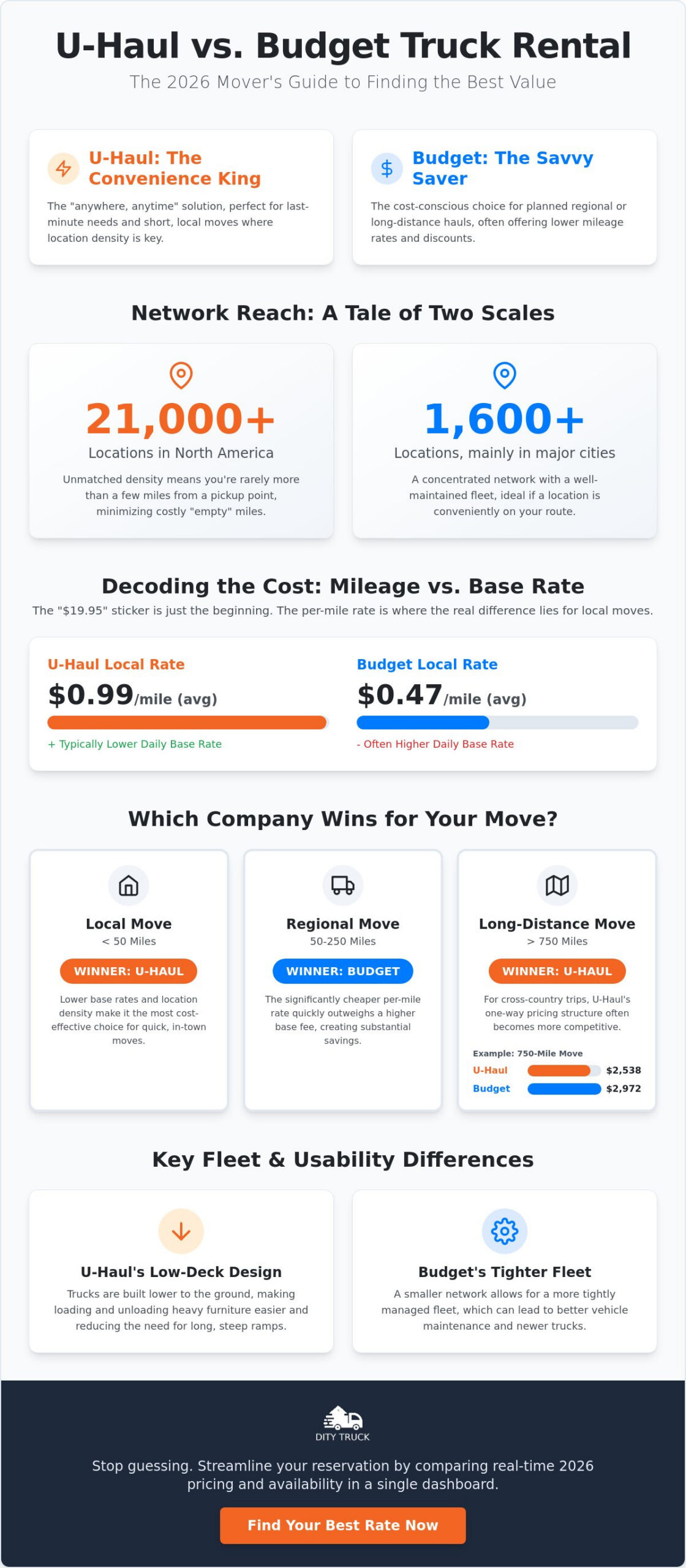
U-Haul operates over 21,000 locations across North America. This density is a massive logistical advantage. A quick look at the U-Haul company background reveals a decades-long strategy of turning local gas stations and hardware stores into rental hubs. This means you’re rarely more than a few miles from a pickup point. Budget operates a smaller, more concentrated network of approximately 1,600 locations. While they’re present in almost every major city, their suburban and rural coverage is thinner.
This location gap impacts your “empty” mileage. Every mile you drive from the rental lot to your front door costs money. With U-Haul, those miles are usually minimal. With Budget, you might face a thirty-minute drive just to reach the yard. There’s also the matter of reliability. U-Haul offers a $50 reservation guarantee, but fleet shortages still happen. If your truck isn’t there, you’re often redirected to another site. Budget manages a tighter fleet, which can lead to better vehicle maintenance but less flexibility if your original equipment isn’t returned on time by the previous user.
The Core Value Propositions for 2026
U-Haul remains the “anywhere, anytime” solution. It’s the best fit for local apartment moves where you need a truck for four hours and don’t want to drive across town to get it. Their 2026 fleet is diverse, ranging from small cargo vans to 26-foot trucks. They prioritize accessibility and 24/7 self-service through their mobile app. If you need a truck on a Tuesday morning with zero notice, U-Haul is your most likely path to success.
Budget is the cost-conscious choice for planned, regional, or long-distance hauls. They frequently offer deep discounts for students, military members, and AARP customers that U-Haul rarely matches. For a move spanning 100 miles or more, Budget’s lower per-mile rates often outweigh the inconvenience of their fewer locations. Both brands have standardized their 2026 roadside assistance. You no longer wait on hold; you report issues through an app that sends your GPS coordinates directly to a technician. This digital-first approach has significantly reduced downtime during cross-country trips.
Decoding the Cost: Base Rates, Mileage, and Hidden Fees
That $19.95 sticker on the side of a truck is a marketing masterpiece. It’s rarely the price you pay. In 2026, the gap between an initial quote and the final receipt remains wide. When you compare uhaul vs budget truck rental, you’re looking at a puzzle of base rates, per-mile charges, and mandatory surcharges. You must account for the environmental fee, vehicle licensing recovery fee, and local taxes. These aren’t optional. Your Total Moving Bill is the only metric that matters for your bank account.
Local vs. One-Way Pricing Dynamics
U-Haul often wins on extremely short local moves. Their base rates are low, but their mileage is aggressive. In early 2026, U-Haul’s local mileage averages $0.99 per mile. Budget takes a different approach. Their local mileage rate is significantly lower at roughly $0.47 per mile. However, Budget’s base rental price is often higher, which balances the scales. For a quick 30-mile trip, U-Haul might cost around $131.37 while Budget sits at $153.50. The math flips once you cross the 50-mile mark. Budget’s lower mileage rate makes them the clear value leader for regional hauls between 50 and 250 miles. For long-distance, cross-country moves, the roles reverse again. A 750-mile move can cost $2,538 with U-Haul compared to $2,972 with Budget. To get a clear picture for your specific route, use this u haul cost calculator to avoid sticker shock at checkout.
The Insurance and Add-on Trap
Insurance is where clarity often disappears. U-Haul offers SafeMove, while Budget provides Value Protection. These daily fees can add $30 to $60 to your total. Don’t assume your personal car insurance covers a 26-foot box truck; it usually doesn’t. Then come the equipment rentals. A utility dolly costs about $7 to $10. Furniture pads add another $10 per dozen. These small items stack up fast. Finally, watch the fuel gauge. Both companies have strict refill policies. If you return the truck even an eighth of a tank short, you’ll face a penalty of roughly $5 per gallon plus a flat service fee. It’s a high price for a simple oversight. Before you finalize your reservation, review the full breakdown of box truck rental prices to understand exactly which fees are mandatory and which are optional add-ons. You can also compare real-time quotes to see which provider includes these items in their bundled packages and find the most honest price for your move.
Fleet Comparison: Capacity, Comfort, and Features
The physical design of your truck determines the physical toll of your move. When you evaluate uhaul vs budget truck rental, you’re choosing between two different engineering philosophies. U-Haul prioritizes ease of loading. Their signature “Low Deck” design sits significantly closer to the pavement than a standard freight truck. This lower center of gravity creates a shorter, less steep ramp. It’s a massive advantage when you’re pushing a 300-pound refrigerator or a stack of heavy boxes. Budget trucks typically follow a more traditional commercial design. They sit higher off the ground, which requires more leg power to clear the incline. For a local move with many heavy items, the height of the deck is often more important than the price of the rental.
Box Truck Sizes and Loading Ramps
U-Haul offers a specialized 26-foot truck that features “Mom’s Attic.” This is a unique cargo area located directly above the driver’s cab. It provides a safe, isolated space for fragile items, electronics, or small boxes that might otherwise be crushed under heavier furniture. Budget’s 26-foot models offer a straightforward, rectangular cargo hold. While you lose the attic, you gain a consistent ceiling height from the front to the back of the box. Ramp quality also varies. U-Haul uses wide, high-traction aluminum ramps that feel stable underfoot. Budget ramps are durable but can be narrower. This makes loading wide items, like a sectional sofa, a bit more challenging for a two-person team. If your move involves tight turns or heavy appliances, the extra width of the U-Haul ramp provides a welcome safety margin.
Vehicle Age and Roadside Reliability
Budget often wins on vehicle age and cabin comfort. Their 2026 fleet relies heavily on recent partnerships with Ford and GMC. This means you are more likely to get a truck with lower mileage and better fuel economy. On a long-distance trip, the savings at the pump add up quickly. The interiors of Budget trucks generally feel more like a modern SUV. You’ll find responsive AC systems, comfortable ergonomic seating, and standard Bluetooth connectivity for your navigation and music.
U-Haul’s fleet is the largest in the world, which leads to more variation in vehicle condition. They’ve tightened their 2026 maintenance schedules, but in rural markets, you might still encounter an older model with a stiffer ride. Roadside assistance is reliable for both companies. U-Haul’s advantage is its massive network of 21,000 locations. If a truck breaks down, a replacement or a technician is usually just a few miles away. Budget uses a smaller network of contractors. While they are efficient, you might face a longer wait if you’re stuck on a remote stretch of highway. Choosing Budget is a bet on a newer, more comfortable truck. Choosing U-Haul is a bet on the safety net of their ubiquitous service network.
Decision Framework: Which Company Wins for Your Move?
Choosing between uhaul vs budget truck rental comes down to the geometry of your trip. One provider isn’t universally better; it’s about matching the provider to your specific distance and timeline. If you’re moving four blocks, your priorities are different than if you’re crossing three state lines. You need a reliable framework to cut through the marketing noise. Use the scenarios below to identify your move type and find the most logical choice for your budget.
Best for Small Local Studio Moves
U-Haul is the undisputed king of the short-range, local apartment move. If your total trip is under 20 miles, the convenience of a neighborhood pickup usually outweighs any minor price difference. Their cargo vans and 10-foot trucks are designed for high-turnover local use. You can often book, pick up, and return a truck within a four-hour window without leaving your zip code. Local traffic is a silent budget killer. When you’re stuck in gridlock, U-Haul’s high per-mile rate of $0.99 still applies, but their base rates remain the most competitive for “In-Town” rentals. For a detailed look at how these costs fluctuate by city, consult the U-Haul vs. Budget Truck Rental: 2026 Price and Feature Comparison for specific local data.
Best for Multi-State, Long-Distance Relocations
The math changes once you cross the 50-mile threshold. Budget dominates the regional move category. For trips between 50 and 250 miles, Budget’s average cost of $267.01 is significantly lower than U-Haul’s $439.97. This gap is driven by Budget’s lower mileage rates, which are often less than half of what U-Haul charges for local and regional hauls. If you’re moving 500 miles or more, verify if Budget is running an unlimited mileage promotion. These deals can save you hundreds of dollars compared to a per-mile billing structure.
Drop-off flexibility is another critical factor. Budget’s smaller network means you must confirm a drop-off location near your new home before booking. If the nearest Budget terminal is 40 miles away from your destination, those “savings” disappear instantly. You should also consider how they stack up against other competitors in our u-haul vs penske truck rental guide to ensure you aren’t leaving money on the table.
For an emergency, last-minute move, U-Haul’s 21,000 locations make them the only viable choice. They have the fleet depth to handle a Saturday morning booking that Budget simply cannot match. However, if you have at least two weeks of lead time, Budget’s discounts for students and AARP members often provide the lowest total price. You can book your truck rental now to lock in these rates before seasonal demand drives prices higher.
Streamlining Your Reservation with DityTruck
Checking individual rental websites is a waste of your moving day energy. You have boxes to pack, utilities to transfer, and a tight schedule to keep. Opening multiple tabs to compare uhaul vs budget truck rental is a slow, inefficient process. Rates fluctuate constantly based on local demand and equipment availability. DityTruck aggregates these real-time 2026 rates into one clean dashboard. You see the full picture immediately. There’s no need to click through five different screens just to find the final price with fees included.
The “DityTruck Advantage” is rooted in financial honesty. We don’t just show you the lowest base rate. We help you find the lowest total cost for your specific route. As we’ve seen, a lower base rate doesn’t always mean a cheaper move once mileage is added. If you want to lock in the best possible 2026 rate, timing matters. Book your truck on a Tuesday or Wednesday. Weekend rates are historically higher due to peak demand. Booking mid-week can often save you 15% or more on the base rental quote. It’s a simple step that yields immediate relief for your budget.
Real-Time Comparison: Why Manual Checking Fails
Truck rental pricing is incredibly volatile. Rates change by the hour based on what’s left in the local yard. Manual checking is simply too slow for a fast-moving market. By the time you find a deal on one site, the inventory has often shifted on the other. There’s also the “Cookie Trap” to consider. Many travel and rental sites track your repeated visits. They recognize your interest and may raise the price on your third or fourth visit. Our platform simplifies the moving truck rental process by providing an objective, third-party view. We strip away the tracking games. You get a transparent comparison of uhaul vs budget truck rental without the artificial price hikes. This ensures you book with total confidence.
Booking Your 2026 Rental: A Final Checklist
Success on moving day starts with a solid reservation. Confirm your pickup time at least 48 hours in advance. This helps you avoid the “no-truck” nightmare that can derail your entire schedule. Double-check your driver’s license. It must be valid, physical, and in the name of the primary renter. Most providers require a major credit card for the security deposit. While some locations accept debit cards, they often trigger higher deposit amounts or mandatory credit checks. Having the right card ready ensures a friction-free checkout. Don’t leave your moving costs to chance. Ready to move? Compare real-time rates on DityTruck now and secure the best value for your 2026 move.
Lock in Your 2026 Moving Rate
The choice between uhaul vs budget truck rental doesn’t have a single winner. It has a logical choice based on your specific route. U-Haul provides the footprint you need for a quick cross-town trip. Budget offers the mileage savings that make regional relocations affordable. You now have the framework to choose based on deck height, fleet age, and total cost rather than just a sticker price. Transparency is your best tool for avoiding unexpected fees at the drop-off location.
Don’t waste your moving week chasing quotes on multiple browser tabs. DityTruck provides real-time 2026 pricing data and transparent fee breakdowns in one dashboard. With national coverage across the US, you can find the right truck in seconds without the manual effort. We do the heavy lifting so you can focus on the packing. Compare U-Haul and Budget rates instantly on DityTruck to lock in your savings and guarantee your equipment availability. You’ve done the research. Now take the final step toward a stress-free and cost-effective moving day. You’re ready for a smooth transition to your new home.
Frequently Asked Questions
Is U-Haul or Budget cheaper for local moves?
U-Haul is typically cheaper for very short trips under 30 miles. For a 30-mile move in early 2026, U-Haul cost approximately $131.37 compared to Budget’s $153.50. However, Budget’s mileage rate of $0.47 per mile is less than half of U-Haul’s $0.99 rate. This makes Budget the better value for local moves that exceed 50 miles once you calculate the total mileage cost.
Does Budget Truck Rental have hidden fees?
Budget includes several standard industry surcharges that might surprise first-time movers. These include environmental fees, vehicle licensing recovery fees, and local taxes. You will also pay for any equipment like dollies or furniture pads. To avoid the highest “hidden” cost, always refill the fuel tank to the required level before returning the truck. This avoids the heavy per-gallon service penalty.
Can I pick up a U-Haul and drop it off at a Budget location?
No, you cannot mix and match rental locations between different brands. U-Haul and Budget are separate companies with their own inventory management systems. Returning a truck to a competitor’s lot will result in significant abandonment fees and logistical headaches. Always return your equipment to an authorized location specified in your original rental agreement to ensure your contract is closed correctly.
Which company has better trucks for long-distance moving?
U-Haul is often the more cost-effective choice for long-distance hauls. In a 2026 test for a 750-mile move, U-Haul quoted $2,538 while Budget quoted $2,972. While Budget trucks are often newer, U-Haul’s network of 21,000 locations provides a superior safety net. If you break down in a remote area, U-Haul can usually get you back on the road faster because of their density.
Do I need special insurance for a rental truck?
Most personal auto insurance policies exclude commercial-sized box trucks from their coverage. You should check your specific policy details before declining the rental company’s protection. Purchasing a damage waiver or supplemental liability protection from the provider is usually the safest path. This prevents a moving day accident from impacting your personal insurance premiums or causing massive out-of-pocket expenses.
How far in advance should I book my 2026 truck rental?
You should aim to book at least two to four weeks before your moving date. Demand for uhaul vs budget truck rental options spikes on weekends and during the summer months. Booking early ensures you get the specific truck size you need at a lower base rate. Mid-week reservations also offer better availability and potential savings compared to high-demand Saturday morning pickups.
What happens if the truck I reserved isn’t available?
Availability issues are a common pain point in the moving industry. U-Haul provides a $50 reservation guarantee, but this often just covers your trouble if you have to drive to a different pickup location. Budget has fewer locations, so a missing truck can be harder to replace on short notice. Always call the specific pickup location 24 hours before your move to confirm the equipment is physically on-site.
Are there any discounts for military or students in 2026?
Budget is the clear leader for specialized discounts in 2026. They offer dedicated savings programs for active-duty military, students, and AARP members. U-Haul focuses on competitive base pricing rather than targeted percentage discounts. When you compare uhaul vs budget truck rental as a student or veteran, Budget’s specialized offers often make them the more affordable choice for long-distance trips.
Leave a Reply