The lowest advertised daily rate is often a trap that leads to the most expensive move of your life. You see a $19.95 sticker and assume you’ve won. Then the mileage hits. The insurance fees follow. Comparing u-haul vs budget vs penske isn’t just about the base price. It’s about the total cost of getting your life from point A to point B without a breakdown or a surprise fee at the counter.
You need a truck that actually shows up when you reserved it. You shouldn’t have to worry about engine trouble on a long-distance haul or confusing insurance tiers that don’t actually cover your belongings. We’ve done the heavy lifting to find the perfect balance of price, reliability, and availability for your 2026 move. Our goal is to replace your logistics stress with a sense of confident simplicity and financial honesty.
We’ll break down why Penske is the top choice for long-distance moves with their unlimited mileage offers. We’ll also explore why Budget often wins on local trips under 100 miles and how U-Haul’s network of 21,000 locations offers unmatched convenience. You’ll get the facts on fleet quality and customer satisfaction to secure a guaranteed reservation without the headache.
Key Takeaways
- Fleet age directly impacts your moving budget. Newer trucks provide better fuel economy and minimize the risk of stressful roadside delays.
- Advertised daily rates are rarely the final price. We break down the mileage fees and insurance costs that usually double your total at checkout.
- The best choice for u-haul vs budget vs penske depends on your distance. We show you which brand wins for local moves and which dominates long-distance hauls.
- Transparency saves time and money. Use a comparison service to view all available rates in one place and secure a guaranteed truck rental booking instantly.
The Big Three: U-Haul vs. Budget vs. Penske Comparison
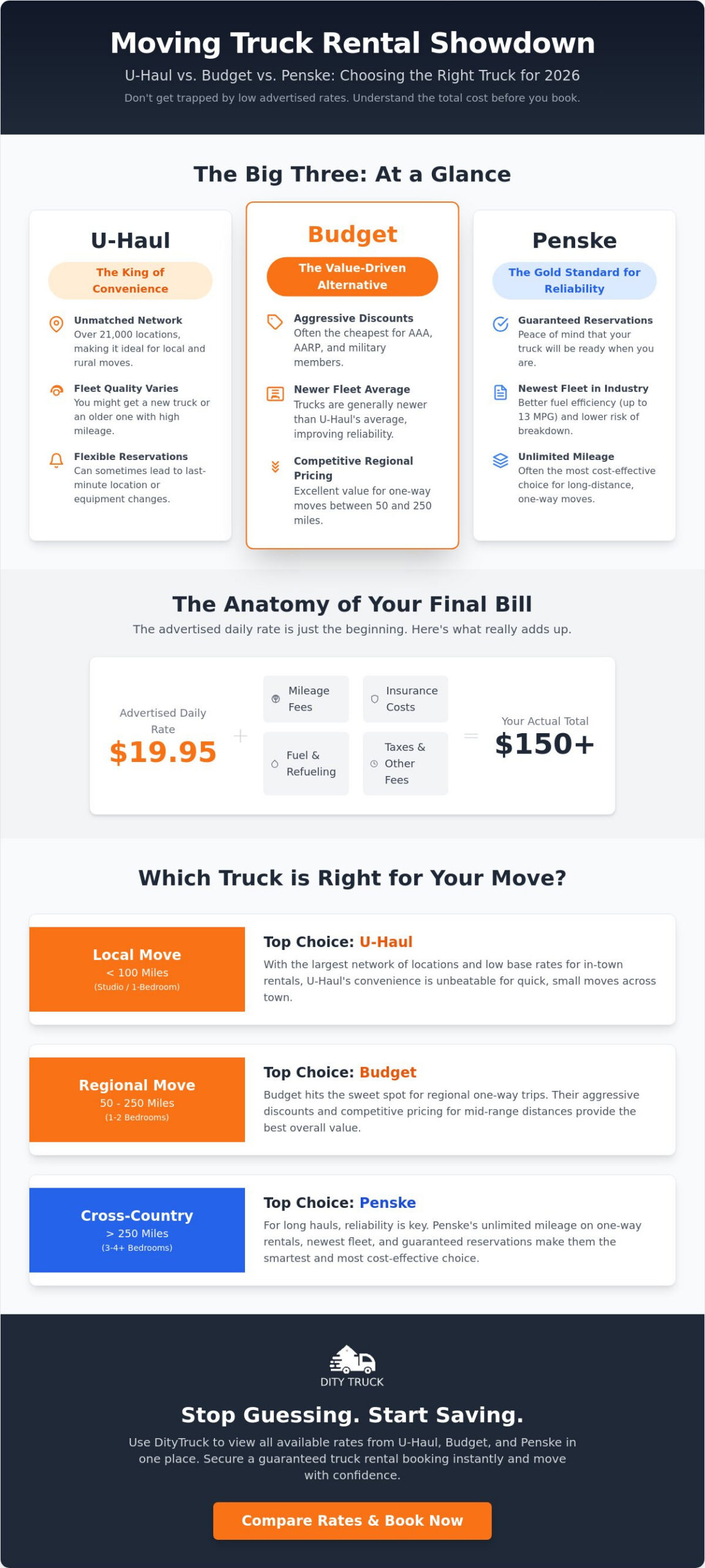
Selecting a rental truck is a high-stakes decision. The landscape for u-haul vs budget vs penske in 2026 is defined by dynamic pricing and real-time availability. You can’t just pick the closest one and hope for the best. Each brand operates with a distinct philosophy. One prioritizes sheer volume and proximity. Another focuses on aggressive discounting. The third bets on mechanical reliability and premium service. Understanding these core identities is the first step toward a friction-free moving day.
Most people start their search by looking for a Moving company or a DIY truck rental based on the lowest daily rate. This is a mistake. The daily rate is a tiny fraction of your total investment. Your final bill includes mileage, fuel, insurance, and environmental fees. Your best choice will shift based on your specific zip code and move date. Demand varies by city. A truck that’s cheap in Dallas might be a premium in Chicago on the same weekend. Total cost transparency is your only defense against checkout surprises.
U-Haul: The King of Local Convenience
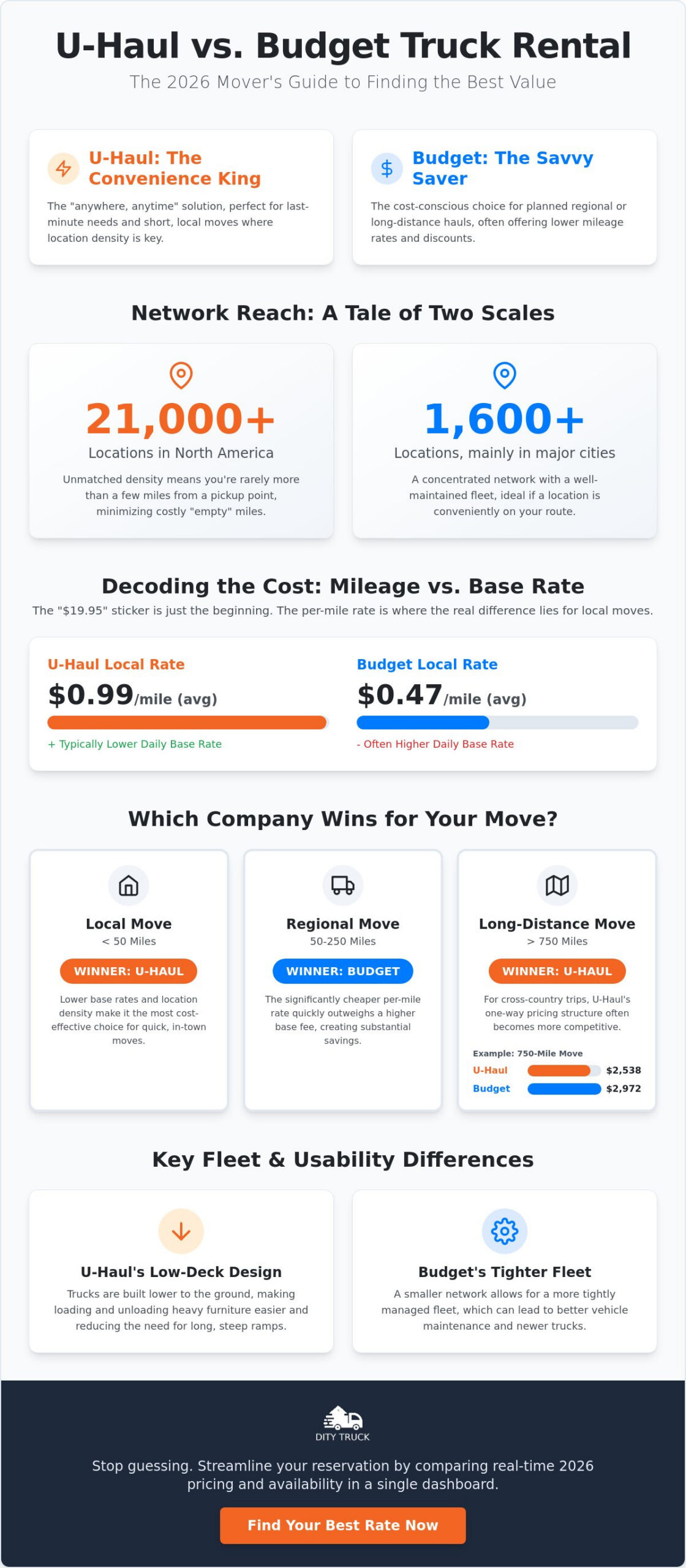
U-Haul owns the largest network in North America with over 21,000 locations. Their philosophy is simple: availability above all else. If you’re doing a quick local move, their low base rates for small trucks and cargo vans are hard to beat. They are likely the only option if you live in a rural area. However, their massive fleet means maintenance standards can vary. You might get a brand-new vehicle, or you might get an older model with high mileage. Their reservation system is also famously flexible. This sometimes leads to last-minute location changes that can disrupt your moving schedule.
Budget: The Value-Driven Alternative
Budget positions itself as the price leader for mid-range moves. They don’t have as many storefronts as U-Haul, but they make up for it with aggressive discounts. If you’re a member of AAA, AARP, or the military, Budget is often your cheapest path. Their one-way pricing is particularly competitive for regional moves between 50 and 250 miles. Their trucks are generally newer than the U-Haul average. The downside is their smaller network. You might have to drive further for pickup and drop-off, which adds time and fuel costs to your journey.
Penske: The Gold Standard for Reliability
Penske focuses on the high-end DIY mover who values peace of mind. They maintain the newest fleet in the industry. This leads to better fuel efficiency and a lower risk of mechanical failure. Unlike their competitors, Penske offers guaranteed reservations. When you book a truck, it’s actually there. They also include unlimited mileage on one-way rentals. This often makes them the most cost-effective choice for cross-country hauls despite their higher daily rates for local trips. Their roadside assistance is widely considered the best in the business, earning them high customer satisfaction scores in 2026.
Analyzing Truck Sizes and Fleet Quality
Your choice of truck size determines your fuel bill and your physical exhaustion level. Comparing u-haul vs budget vs penske involves more than just cubic feet. It’s about how that space is designed. Fleet age is the silent factor in your budget. Newer trucks from Penske offer superior fuel efficiency, often reaching 13 MPG for their largest 26-foot models. Older trucks in the U-Haul fleet might struggle to hit double digits. This difference adds up quickly on a multi-state trip. For a deeper look at how these two giants stack up on fleet quality and pricing, our penske vs uhaul definitive 2026 comparison guide breaks down the data by route type and truck size.
Small Moves: Vans and 10-Foot Trucks
U-Haul dominates the market for studio apartments and dorm rooms. Their 10-foot trucks and cargo vans are available at almost every corner. They are built for quick, in-town trips where distance isn’t the primary concern. Budget offers competitive rates on cargo vans that often undercut the competition for 24-hour rentals. Penske has a more limited small fleet, focusing instead on larger professional-grade equipment. If you’re only moving a bed and a few boxes, a pickup truck is the most efficient path. It’s easier to park and much simpler to drive through tight city streets.
Large Moves: The 26-Foot Box Truck Battle
Penske is the preferred choice for 3 to 4 bedroom homes. Their 26-foot trucks are designed for heavy loads and long distances. They feature newer engines and better suspension. This reduces the stress of driving a massive vehicle on the highway. U-Haul counters this with their “Low Deck” design. Their loading ramps are shorter and the deck is closer to the ground. This makes heavy lifting significantly easier for DIY movers. Budget provides reliable 26-foot options for long-distance routes, though their availability can fluctuate during peak summer months.
Loading features like translucent roofs and interior tie-down rails vary by brand. These small details prevent damage and make the packing process faster. Before you commit to a specific size, you should compare truck rental options to see which brand has the newest inventory in your area. Fleet quality remains a top priority for customer satisfaction. Evaluating the physical specs of u-haul vs budget vs penske ensures your belongings arrive in one piece without draining your gas budget.
Pricing Truths: Hidden Fees and Mileage Rates
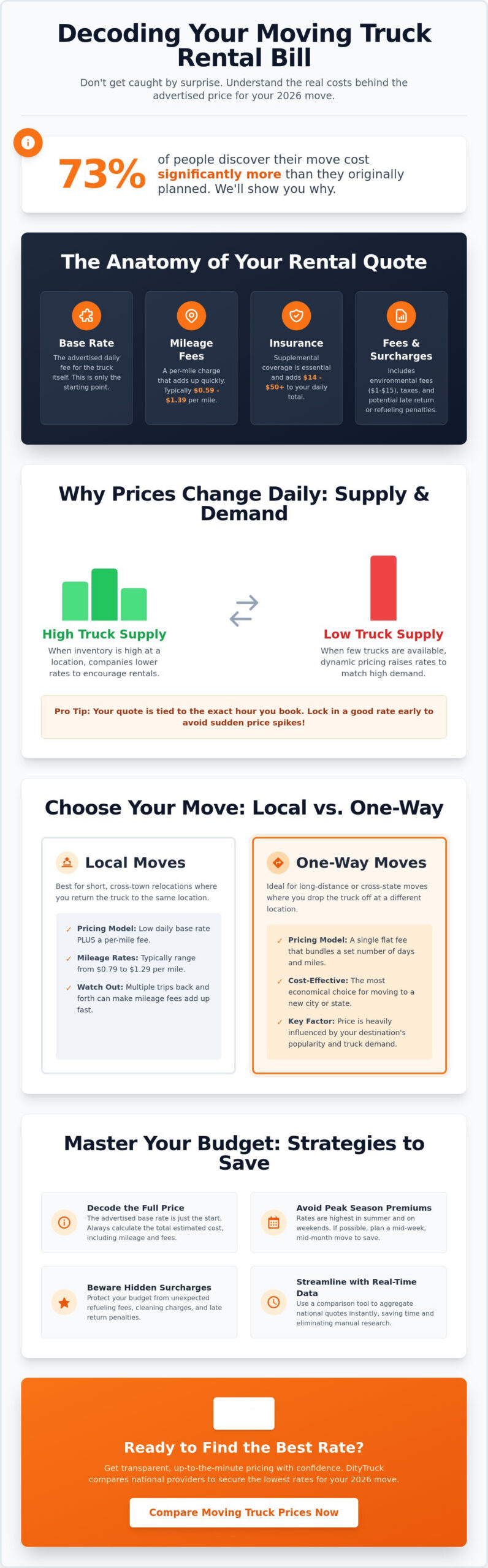
The $19.95 rate is a starting point, not a destination. It is the industry’s most successful marketing hook. Comparing u-haul vs budget vs penske requires a deep dive into the fine print to find the actual total. Local moves are almost always charged by the mile. At rates ranging from $0.99 to $1.39 per mile, a simple 30-mile round trip adds roughly $40 to your bill instantly. This doesn’t include the fuel you’ll burn along the way.
Insurance is another significant variable in your budget. You have choices to make at the counter. Damage waivers protect you from paying for truck repairs if you have an accident. Supplemental liability covers third-party claims. Skipping these is risky. Most personal insurance providers exclude commercial-sized rental trucks from their standard coverage. Expect to pay between $15 and $30 per day for this peace of mind. It is a small price to pay for a friction-free experience.
Local vs. Long-Distance Pricing Structures
Local moves focus on that low daily rate paired with high mileage fees. This works well for cross-town trips. Long-distance moves flip the script entirely. They use a flat-rate model based on your destination and move date. Penske often dominates this category by including unlimited mileage in their one-way quotes. This removes the stress of counting every mile on the odometer. You should use one way truck rentals for moving to compare these specific structures side-by-side for your route.
Avoiding the “Hidden Fee” Trap
The “hidden” costs are usually right in front of you in the contract. Environmental fees and state taxes are mandatory additions. Fuel is the biggest trap for the unprepared. If you return the tank even slightly lower than the pickup level, you will face a premium per-gallon charge plus a service fee. Equipment rentals also add up. Furniture pads and dollies are not included in the truck price. You will pay $7 to $15 per item. Even leaving a few scraps of cardboard in the truck bed can trigger a $25 cleaning fee.
Timing is your best tool for savings. Moving on a Tuesday or Wednesday can slash your base rate by 20% or more. Demand peaks on weekends and at the end of the month. If your schedule is flexible, a mid-week reservation is the easiest way to lower your total cost without sacrificing quality. This simple shift in timing often yields more savings than any coupon code.
Decision Matrix: Determining the Best Moving Truck Rental for You
No single company wins every move. The choice for u-haul vs budget vs penske requires mapping your specific logistics profile against their operational strengths. Selecting the wrong provider for your route can lead to mechanical delays or inflated mileage costs. We’ve simplified the selection process by categorizing the most common moving scenarios into a definitive framework.
Scenario 1: The Local Studio Apartment Move
Proximity is your primary driver for small, local trips. U-Haul is the logical pick here because their 21,000 locations mean you won’t waste fuel driving to a distant pickup site. Their base rates for 10-foot trucks stay consistently low for in-town use. However, you must perform a thorough pre-trip inspection. Check the tire tread and fluid levels before leaving the lot. To ensure you don’t miss a critical detail, use this guide to compare local moving truck rentals before signing your contract.
Scenario 2: The Cross-Country Family Relocation
Reliability and unlimited mileage are non-negotiable for multi-state hauls. Penske is the clear champion for this scenario. Their trucks are newer, better maintained, and typically achieve 12 to 13 MPG. This fuel efficiency saves hundreds of dollars over a 1,000-mile journey. Budget is a strong secondary choice if you qualify for their 10% to 15% discounts for AAA members or military personnel. It’s vital to remember that the cost to rent a 26 foot moving truck fluctuates based on equipment demand at your destination. If everyone is moving to Florida, trucks leaving that state will be significantly cheaper than those arriving.
Roadside assistance provides the ultimate safety net for high-stakes logistics. Penske and U-Haul currently lead the industry with 4.8/5 customer satisfaction scores in 2026. This reflects their ability to deploy help quickly during a breakdown. Budget trails slightly at 4.5/5, though they remain a viable option for well-traveled regional routes. Don’t leave your moving day to chance. You can book your truck rental now to lock in your rate and guarantee your equipment is ready when you are.
Your “Reliability Score” should also factor in the age of the specific unit you receive. Ask the agent for the truck’s mileage and last service date. A newer truck with slightly higher daily fees is often cheaper than an old truck that requires a mid-move repair or excessive fuel stops. Efficiency isn’t just about the price on the screen. It’s about the shortest, most logical path to your new front door.
Use DityTruck to Compare Rates and Reserve Instantly
Stop visiting three different websites. Comparing u-haul vs budget vs penske shouldn’t be a part-time job that drains your energy before you even pack a box. DityTruck acts as your smart assistant. It performs the heavy lifting by pulling real-time data into a single, clean interface. You get financial honesty and a clear path to the lowest total price. It’s about stripping away the friction of logistics so you can focus on the actual move.
We act as a savvy consumer advocate. Our platform doesn’t favor one rental giant over another. We prioritize your specific needs for speed, ease, and transparency. By using a single interface, you eliminate the risk of missing a better deal or a more reliable truck in your immediate area. We provide the relief and clarity you need for a high-stakes task. It’s the shortest, most logical path between your current problem and a successful resolution.
How Our Comparison Tool Works
Our tool is built for quick scanning and rapid decision-making. You enter your move details exactly once. Within seconds, you get a side-by-side breakdown of every available truck rental in your zip code. There is no unnecessary preamble or decorative fluff. You see the results immediately and can filter them to match your exact requirements.
- Filter by Truck Size: Whether you need a cargo van or a 26-foot box truck, you can narrow your search instantly.
- Price Transparency: View the total cost upfront. We factor in the base rates and common fees so there are no surprises at the counter.
- Company Reputation: Compare customer satisfaction scores for 2026 to ensure you’re booking with a reliable provider.
- Direct Booking: We handle the reservation process for you. There are no redirects, no hassle, and no hidden hurdles.
Book Your 2026 Move with Confidence
The year 2026 is the era of the savvy, comparison-first mover. Dynamic pricing means rates change by the hour based on local demand and equipment availability. A smart assistant that tracks these shifts is your best tool for staying under budget. You don’t have to guess which company offers the best value today. You can see it for yourself in real-time.
Logistics shouldn’t be a mystery. You deserve a reliable truck that won’t break down and a price that doesn’t balloon at the checkout counter. Before you finalize your plans, review our final checklist on how to rent a truck for moving safely. Once you’re ready, take control of your move. You can Compare and Reserve Your Truck Now to secure your equipment and your peace of mind.
Secure Your Moving Day Success
Choosing between u-haul vs budget vs penske isn’t just about picking a familiar name. It’s about matching your specific route to the right fleet philosophy. You now know that Penske’s unlimited mileage often wins for long hauls. You’ve seen how Budget’s targeted discounts can slash local costs. Most importantly, you understand that fleet quality and real-time availability determine your true moving day stress level. Don’t let hidden fees or a missing reservation at the counter derail your plans.
Efficiency starts with absolute transparency. Our no-fee comparison service provides secure online reservations nationwide. You can view real-time pricing from U-Haul, Budget, and Penske in one place to find the most logical path to your new front door. This smart assistant approach removes the guesswork from your logistics. Ready to lock in your 2026 rates? Compare Real-Time Rental Rates and Book Your Truck now. You’ve got the data and the strategy. Take the wheel and move with confidence.
Frequently Asked Questions
Which is cheaper: U-Haul, Budget, or Penske?
Budget typically offers the lowest total cost for local moves under 100 miles. Their mileage rates can be as low as $0.47 per mile in 2026. Penske is often the most cost-effective for long-distance hauls because they include unlimited mileage. U-Haul remains the best fallback for short-notice, in-town trips due to their massive network of 21,000 locations.
Does Penske really offer unlimited mileage on one-way moves?
Yes, Penske includes unlimited mileage on all one-way rentals. This removes the stress of calculating costs for cross-country trips. It is their primary competitive advantage in the 2026 market. You pay a flat rate for the truck and the days you need it, which simplifies your moving budget significantly.
Is Budget Truck Rental reliable for long-distance driving?
Budget is a reliable choice for long-distance driving, though their fleet is generally older than Penske’s. They earned a 4.5/5 satisfaction score in 2026. Their trucks are well-maintained for highway use. You should always verify the specific unit’s condition and tire tread before leaving the rental lot for a multi-state journey.
What happens if my U-Haul reservation is not honored?
U-Haul offers a $50 Reservation Guarantee if your truck isn’t available at the scheduled time and location. This doesn’t always solve the logistical problem of a missing truck on moving day. You might be sent to a different location for pickup. Using a comparison tool helps you see alternative options in real-time if a delay occurs at your primary site.
How do I avoid hidden fees when renting a moving truck?
Read the fuel and cleaning policies carefully before you sign the contract. Trucks must be returned with the exact fuel level recorded at pickup. Even a small discrepancy results in high per-gallon charges and service fees. Avoid renting moving pads or dollies at the last minute. These individual costs inflate your total bill more than the truck itself.
Can I tow my car with a rental truck from any of these companies?
All three companies provide towing equipment like car carriers and tow dollies. You must verify that your specific rental truck has the necessary hitch and weight capacity for your vehicle. U-Haul has the largest inventory of specialized towing trailers. Penske and Budget also offer these as add-ons during the booking process for long-distance moves.
Which company has the best roadside assistance?
Penske is widely recognized for the best roadside assistance in the industry. They maintain the newest fleet, which naturally leads to fewer mechanical issues on the road. Both Penske and U-Haul maintained 4.8/5 satisfaction ratings in 2026. Their response times are typically faster in major metropolitan areas compared to smaller regional providers.
Do I need special insurance if I rent through a comparison site like DityTruck?
You do not need special insurance just because you used a comparison platform. Your insurance contract is directly with the rental provider you choose. When evaluating u-haul vs budget vs penske, you should decide whether to purchase their internal damage waivers. Most personal auto policies do not cover large commercial trucks, so these waivers provide essential financial protection.