Tag: box truck rental

  • Box Truck Rental: The 2026 Guide to Sizes, Rates, and Comparison

    Box Truck Rental: The 2026 Guide to Sizes, Rates, and Comparison

    Choosing the cheapest advertised base rate for your box truck rental is often the most expensive mistake you can make. You’ve likely spent hours toggling between browser tabs, trying to guess if a 12-foot truck actually fits your furniture or if hidden mileage fees will eventually double your budget. It’s a high-stakes task that shouldn’t feel like a gamble. We understand that you want clarity, not a surprise bill on moving day.

    This 2026 guide simplifies your logistics by providing a transparent look at real-time rates and truck sizing across all major national providers. You’ll find exactly what you need to move with confidence. We’ll compare the top fleets, break down the latest 2026 mileage and insurance costs, and show you how to secure a fast reservation without checking five different websites. Get ready for a friction-free move where the only thing you have to worry about is which box to unpack first.

    Key Takeaways

    • Understand why a box truck rental is the gold standard for secure, weather-protected transportation compared to other moving options.
    • Avoid the stress of running out of space by applying the “Golden Rule” of vehicle sizing for your inventory.
    • Identify which national providers offer the best value for your specific distance, whether you need long-distance reliability or local savings.
    • Learn to spot hidden mileage fees and insurance costs before they inflate your final moving bill.
    • Streamline your reservation process using smart filters to find and book the right truck in minutes.

    Understanding the Box Truck Rental Market in 2026

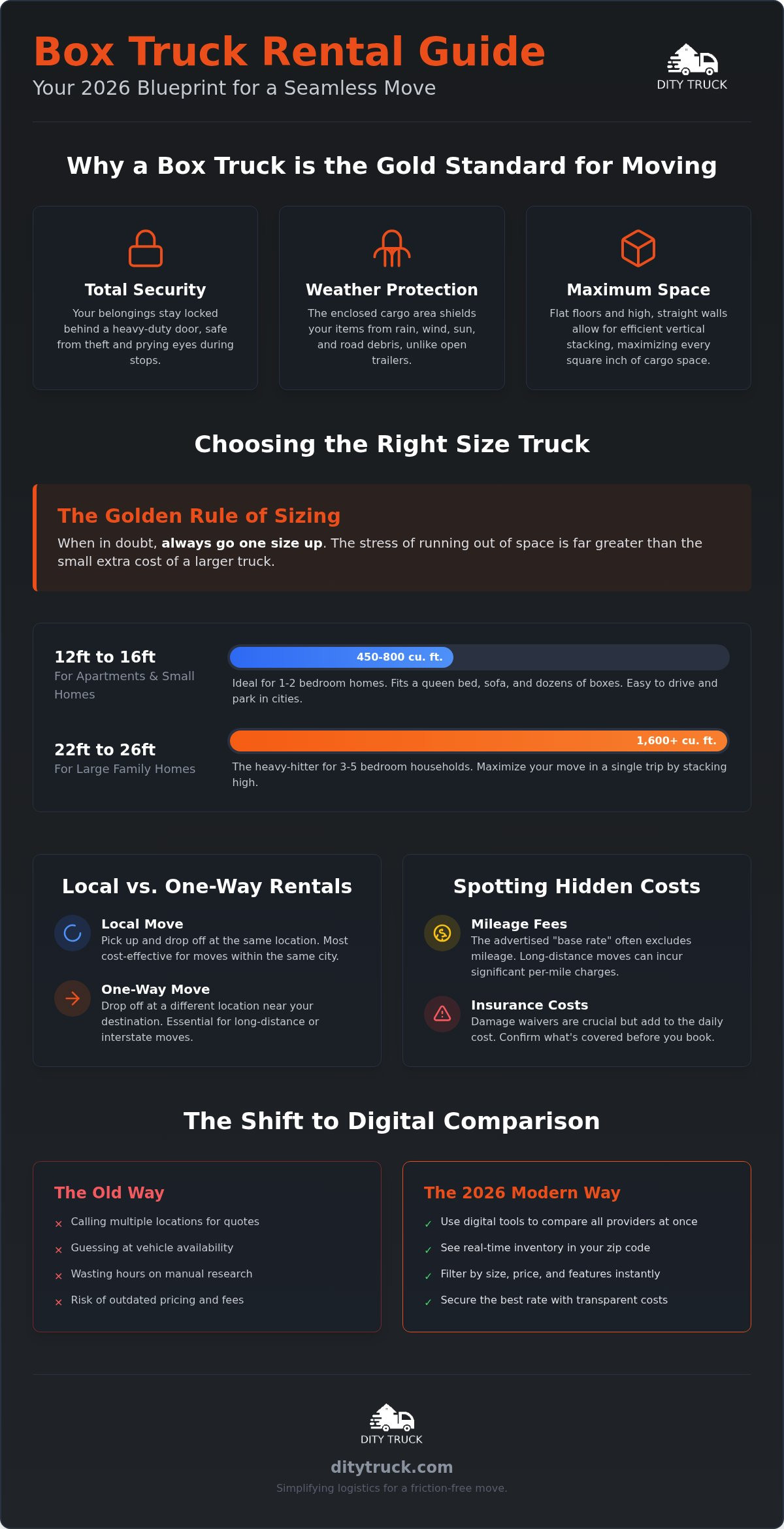
    A box truck rental is more than just a large vehicle. It is a purpose-built tool for logistics. Technically, a box truck consists of a cab-chassis design with a separate, enclosed cuboid cargo area. This unique structure allows for a flat floor and high walls, which are essential for vertical stacking. When you explore box truck sizes and classifications, you’ll see that these vehicles are designed to maximize every square inch of space. They provide a level of security and weather protection that open trailers simply can’t match. Your belongings stay locked behind a heavy-duty door, safe from rain, road debris, and prying eyes.

    The 2026 landscape has introduced significant improvements to rental fleets. Modern trucks now feature much better fuel efficiency than models from just a few years ago. This helps keep your total move cost down despite fluctuating gas prices. Newer vehicles also come equipped with advanced driver-assist features. Lane-keep assist and collision warnings are now standard in many fleets, making these large trucks much easier for a non-professional to drive with confidence. Efficiency isn’t just about the engine; it’s about making the entire experience less intimidating.

    Your destination is the primary factor that dictates your rental strategy. Local rentals involve picking up and dropping off the truck at the same location. This is usually the most cost-effective path for moves within the same city. One-way rentals allow you to drop the truck off at a different branch near your new home. While the base rate for one-way moves is often higher, it saves you the massive headache of driving a heavy truck back across state lines. Choosing the right strategy early prevents expensive surprises later.

    Box Truck vs. Cargo Van: Which do you need?

    Many people struggle to decide between a cargo van and a box truck. Cargo vans are excellent for studio apartments or delivering a single large appliance. However, once you move into a two-bedroom home, a box truck rental becomes essential. It isn’t just about cubic feet; it’s about payload limits. Box trucks are engineered to carry the weight of heavy oak dressers and multiple appliances without straining the suspension. If you try to cram a whole house into a van, you risk exceeding weight limits, which makes the vehicle dangerous to handle.

    The Shift to Digital Comparison Tools

    The old way of renting involved calling three different local lots and hoping someone would answer the phone. That process is dead. Today, we rely on real-time data syncs. Platforms like DityTruck connect directly with national inventory systems to show you exactly what is available in your zip code. This shift to digital comparison means you can compare rates and sizes once and save hours of manual research. It’s an action-result process. You input your move details, and the smart assistant finds the best match instantly. This transparency ensures you aren’t paying a “convenience fee” just because you didn’t have time to check other providers.

    Choosing the Right Size: Box Truck Dimensions and Capacity

    Selecting a box truck rental size requires more than a rough guess. The “Golden Rule” of moving is simple. If you aren’t sure, always go one size up. Renting a truck that is too small leads to multiple trips; or worse, leaving furniture on the curb. Most providers offer standard lengths including 10ft, 12ft, 16ft, 22ft, and 26ft options. Each jump in size significantly increases your stacking potential and reduces the risk of a logistical bottleneck on moving day.

    Don’t just look at total cubic feet. Measuring your largest items is critical. Remember that wheel wells intrude into the cargo area. A king-sized mattress or a long sectional sofa might not sit flat if the wheel well is in the way. You also need to consider the loading height. Larger trucks sit higher off the ground. This creates a steeper ramp angle. If you’re lifting heavy appliances, a steeper ramp requires more physical strength. This is especially true for the 26ft models, which feature the highest decks in the consumer rental market.

    12ft to 16ft: The Sweet Spot for Small Moves

    These sizes are ideal for studio apartments or small 1-2 bedroom residences. They offer roughly 450 to 800 cubic feet of space. This is usually enough for a queen bed, a sofa, and several dozen boxes. Maneuverability is the key benefit here. Drivers who aren’t used to large vehicles find these sizes much easier to park and turn. They feel more like driving a large SUV than a commercial freighter. This size range is the most popular for local city moves where tight corners and narrow streets are common.

    22ft to 26ft: Handling Large Family Homes

    If you’re moving a 3-5 bedroom household, you need the heavy hitters. These trucks provide up to 1,600+ cubic feet of volume. This allows for maximum efficiency by letting you stack items to the ceiling. Many users worry about commercial driver’s license (CDL) requirements for these larger units. Most rental companies intentionally manufacture these trucks to stay under the 26,000 lbs Gross Vehicle Weight Rating (GVWR) limit. This keeps them legal for standard license holders. The professional nature of these vehicles is reflected in trucking industry employment data, which shows the scale and specialization of the transport sector. Before you commit, it helps to see what’s actually available in your area. You can compare real-time sizing and rates to ensure you don’t overpay for space you won’t use. Choosing the larger option also gives you a buffer for last-minute items like garage tools or patio furniture that are often forgotten during the initial inventory.
    Box Truck Rental: The 2026 Guide to Sizes, Rates, and Comparison

    Comparing Major Box Truck Rental Companies Side-by-Side

    Most rental sites only show you their own trucks. This forces you to switch between five different tabs to find the best deal. We break that cycle. By looking at the market side-by-side; you see the trade-offs between fleet age, pricing, and availability immediately. This transparency removes the guesswork from your box truck rental decision and puts the power back in your hands.

    • Penske: They are the leaders in reliability. Their fleet is generally the newest in the industry. This makes them the top choice for long-distance hauls where a breakdown could ruin your schedule.
    • Budget: They strike a balance. Their trucks are well-maintained; but their pricing is often more aggressive for local moves than Penske.
    • U-Haul: They have the most locations by far. You can find a U-Haul in almost every small town. However; you must monitor the per-mile costs. A low base rate can quickly balloon once you start driving.
    • Enterprise: This is a premium choice for commercial-grade trucks. They primarily serve business accounts, but their consumer rentals offer high-spec vehicles with impressive payload capacities.

    Penske vs. Budget: The Long-Distance Debate

    Penske often includes unlimited mileage on one-way moves. This offers massive savings potential for cross-country trips. You pay one price and drive without watching the odometer. Budget counters this with frequent promo codes. These discounts often bring their total price down to rival Penske, especially if you book during the off-season. For a deeper look; read our One Way Truck Rentals for Moving: 2026 Comparison Guide. It breaks down the specific mileage policies that can save you hundreds of dollars.

    U-Haul vs. The Market: Availability vs. Total Cost

    U-Haul’s main advantage is convenience. Pickup and drop-off are incredibly easy due to their massive network of neighborhood dealers. But don’t let the $19.95 base rate fool you. By the time you add mileage, insurance, and environmental fees; the final bill looks very different. Comparing this total cost against the flat-rate packages from other providers is essential. Finding the right box truck rental depends on your specific route. Check out our U-Haul vs. Budget Truck Rental: The Definitive 2026 Comparison Guide to see the real numbers. Seeing the final price before you arrive at the lot prevents “sticker shock” and keeps your moving budget on track.

    Box Truck Rental Prices: Managing Costs and Avoiding Hidden Fees

    The advertised daily rate is rarely what you actually pay. A box truck rental involves a layered pricing structure. Understanding these layers prevents budget creep. It turns a stressful financial guess into a predictable expense. Transparency is the only way to avoid the dreaded “sticker shock” when you return the keys.

    Your base rate is the starting point. This is the flat daily fee for the vehicle itself. However; the real driver of the final bill is the mileage fee. These typically range from $0.79 to $1.29 per mile. If you’re moving within a single zip code; the impact is minor. If you’re crossing several counties; the mileage fee can easily exceed the daily rental cost. It’s a variable you must track closely.

    Insurance is another non-negotiable cost. Most personal auto policies do not cover commercial-grade vehicles. You’ll likely need a Collision Damage Waiver (CDW) or Supplemental Liability Insurance (SLI). Without this; you are personally responsible for any damage to the truck or third-party property. Finally; look for small surcharges like environmental fees and vehicle licensing recovery fees. These are standard industry add-ons that appear on your final invoice.

    Calculating the Total Cost of Your Move

    Planning your budget requires a specific formula. Take your (Daily Rate x Days) and add (Estimated Miles x Rate). Then add your insurance and fuel. Fuel is the most overlooked expense. Large trucks are heavy and aerodynamic as a brick. They average only 8 to 12 MPG. For a 100-mile move; that is roughly 10 gallons of gas. Factor the current pump price into your total. For more detailed breakdowns; view our guide on Box Truck Rental Prices: The 2026 Guide to Sizes, Rates & Savings. It helps you visualize every dollar before you sign the contract.

    Pro Tips for Lowering Your Bill

    Timing is everything. Move mid-week if possible. Tuesdays and Wednesdays are significantly cheaper than high-demand Saturdays. You should also book 2 to 4 weeks in advance. This locks in lower seasonal rates before the fleet gets picked over. Another smart move is checking your credit card benefits. Some premium cards offer coverage for commercial rentals. If yours does; you can safely decline the rental company’s coverage. You can compare real-time pricing and fees right now to see which provider fits your budget best. Taking five minutes to compare prevents hours of financial regret later.

    How to Reserve Your Box Truck Rental Online with DityTruck

    Reserving a box truck rental shouldn’t feel like a part-time job. You’ve already done the hard work of comparing sizes and calculating mileage. Now it’s time to lock in your choice. The process is designed to be fast. You start by entering your pickup location and move dates. If you’re doing a one-way move, specify the destination. This immediate input allows our system to pull actual inventory from local lots. It removes the uncertainty of “calling for availability” and gives you immediate answers.

    Once your details are in, use the smart assistant to filter by size. Remember the sizing advice from earlier; always lean toward more space if you’re on the fence. You’ll see real-time quotes from providers like Penske and Budget side-by-side. There’s no need to jump between sites. You see the availability. You see the price. You make the call. Once you select the best fit, you can secure your reservation instantly. This one-click approach ensures you don’t lose your preferred truck to another mover while you’re still weighing options.

    The DityTruck Advantage: Transparency First

    We prioritize transparency above all else. Most booking processes hide fees until the final confirmation page. We don’t. We highlight the total estimated cost upfront. This includes the base rate and the anticipated fees we discussed in the pricing section. You get a one-stop shop experience. You manage everything through a single, streamlined interface. Whether you’re moving across town or across the country, our national reach ensures you have access to inventory in every major US city effortlessly. It’s the shortest path between a logistical problem and a confirmed solution.

    Final Checklist Before You Drive Away

    Your reservation is set, but the job isn’t done until you’re behind the wheel. Before you drive off the lot, perform a final sweep. Verify your driver’s license is valid and meets the age requirements. Most companies require drivers to be at least 18 or 25 depending on the truck size. Inspect the vehicle for any pre-existing damage. Take clear photos of every side, including the roof and interior cargo area. This documentation is your best defense against unfair damage claims. Finally, check the fuel level. Confirm the return policy. Most providers expect the tank to be at the same level as when you started. A quick check prevents expensive refilling surcharges and ensures your move starts on a positive note.

    Secure Your Move with a Confident Rental Strategy

    Finding the right box truck rental doesn’t have to be a gamble. You now know how to apply the “Golden Rule” of sizing to avoid space shortages and logistical delays. You also understand how mileage fees and fuel costs dictate your actual final bill. By comparing national providers side-by-side, you can choose the fleet that matches your specific route and budget without the usual stress.

    Stop wasting time on multiple browser tabs. You can compare rates from Penske, Budget, and other major providers in seconds. We provide transparent pricing for every move so you never deal with hidden fees at the rental counter. With national availability across the United States, your ideal truck is ready when you are. Compare Box Truck Rental Rates and Book Your Move Instantly.

    Moving is a major life milestone. It marks a fresh start. With the right tools and a clear plan, you’re ready to make it a friction-free success. Drive safe and enjoy your new home.

    Frequently Asked Questions

    How much does it cost to rent a box truck for a day?

    Daily base rates for local moves typically range from $20 for small trucks to $130 for large 26-foot models. These prices reflect the vehicle itself and do not include mileage fees, which often range from $0.47 to $2.00 per mile. Your final bill will also include fuel, insurance, and environmental surcharges. For long-distance hauls, expect daily rates to be higher as they often include a set number of miles or unlimited mileage packages.

    Do I need a special license to drive a 26-foot box truck?

    You generally do not need a Commercial Driver’s License (CDL) to operate a 26-foot box truck rental. Most major rental companies design these vehicles to have a Gross Vehicle Weight Rating (GVWR) of 26,000 pounds or less. This keeps them legal for anyone with a standard driver’s license. However, you should always verify the specific weight rating on the unit’s door jamb before you start your trip.

    Is insurance required when renting a box truck for moving?

    Financial protection is essential because most personal auto insurance policies specifically exclude commercial-sized vehicles. While the rental company might not legally force you to buy their specific plan, you are personally liable for any damage to the truck or third-party property. Purchasing a Collision Damage Waiver (CDW) or Supplemental Liability Insurance (SLI) protects your bank account from high repair costs and provides peace of mind during a stressful move.

    What is the most fuel-efficient box truck rental?

    Smaller trucks in the 10 to 12-foot range are the most fuel-efficient options in any fleet. These vehicles typically average between 10 and 12 MPG, while larger 26-foot trucks may drop to 8 MPG. To maximize efficiency, look for newer models with aerodynamic designs and advanced engine technology. Keeping your speed steady and avoiding rapid acceleration will also help you save money at the pump during your box truck rental period.

    Can I rent a box truck for a one-way move?

    One-way rentals are available from most major national providers and are ideal for long-distance relocations. This allows you to pick up the truck in one city and drop it off at a location near your new home. While one-way rates are usually higher than local rates, they save you the time and fuel costs of a return trip. Penske is a popular choice for this as they often provide unlimited mileage on one-way contracts.

    What happens if I return the rental truck late?

    Returning a truck late usually results in additional fees that can equal or exceed a full day’s rental rate. Most companies charge by the hour or apply a flat late fee for every 24-hour period the vehicle is overdue. If you know you are running behind, call the rental office immediately. They may be able to extend your reservation, though this is not always possible during peak moving seasons when trucks are in high demand.

    Are there age restrictions for renting a moving truck?

    Most rental companies require drivers to be at least 18 years old for local moves, though some may require you to be 25 for larger vehicles or long-distance hauls. Drivers under 25 often face “young renter” surcharges that increase the daily cost. Always have a valid driver’s license and a major credit card ready. These are standard requirements regardless of your age and are necessary to secure the vehicle.

    How far in advance should I book my box truck rental?

    You should book your rental at least 2 to 4 weeks in advance to ensure availability and secure the best rates. Demand spikes significantly during the peak moving season from May through September and on weekends. Making your reservation early prevents the stress of settling for a truck that is too small or paying a premium price for a last-minute booking. It’s the easiest way to keep your logistics on schedule.

  • Box Truck Rental Prices: The 2026 Guide to Sizes, Rates & Savings

    Box Truck Rental Prices: The 2026 Guide to Sizes, Rates & Savings

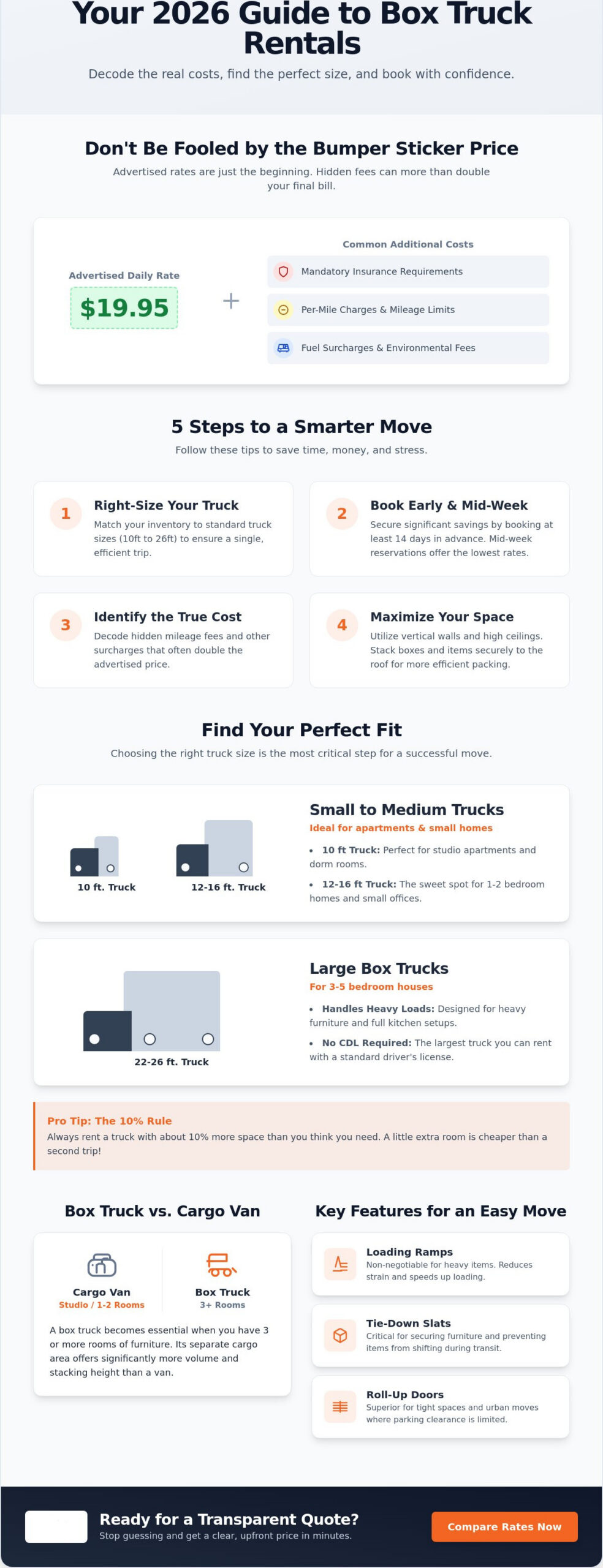
    That $19.95 base rate looks great on a bumper, but it rarely reflects what you actually pay at the counter. With 41% of renters now booking through mobile apps, the speed of the transaction often masks the complexity of the costs. You shouldn’t have to guess about box truck rental prices or worry that a “small” truck won’t fit your heaviest furniture. Hidden mileage fees and mandatory environmental surcharges can quickly turn a budget move into a financial headache.

    You deserve a straightforward path to a confirmed reservation. We understand the frustration of surprise insurance requirements and the fear of choosing a vehicle that is too small for your belongings. This guide provides a clear look at 2026 national rates and decodes the fine print that providers often hide. You’ll learn how to match cubic capacity to your specific needs so you can stop stressing and start moving. We’ve simplified the comparison process to give you total price transparency and confidence in minutes.

    Key Takeaways

    • Match your inventory to industry-standard sizes-from 10-foot mini boxes to 26-foot super movers-to ensure a single, efficient trip.
    • Identify the true total cost by decoding hidden mileage fees-these extras often double the advertised box truck rental prices.
    • Compare top-tier providers side-by-side-determine which fleets offer the best reliability for local versus long-distance moves.
    • Secure significant savings by booking at least 14 days in advance-mid-week reservations offer the lowest rates.
    • Maximize your storage potential-utilize vertical walls and high ceilings for safer, more efficient packing.

    Understanding Box Truck Rental Options for Your 2026 Move

    A box truck is defined by its enclosed cargo area. This space is structurally separate from the driver’s cab. Unlike trailers, the box is permanently attached to the chassis. This design provides a rigid, secure environment for your belongings. When you evaluate box truck rental prices, you are paying for this specialized architecture. The flat, vertical walls and high ceilings are the primary advantages. They allow you to stack boxes and furniture all the way to the roof. You maximize every square inch of floor space. It makes the loading process much more efficient than using a standard van.

    The 2026 rental fleet has evolved significantly. Modern trucks now prioritize fuel economy to offset rising gas costs. Most units now come standard with high-definition backup cameras. This makes maneuvering a large vehicle much safer for DIY movers. Box trucks outperform cargo vans because they offer wider floor plans and integrated loading tools. You get more room and better equipment for the same trip. You can research box truck sizes and classes to understand the different weight ratings available for your specific cargo needs.

    Box Truck vs. Cargo Van: Identifying the Threshold

    Choosing between a van and a truck depends on your total inventory. Cargo vans are ideal for studio apartments or 1-2 rooms of furniture. Once you reach 3 rooms or more, a box truck becomes essential. Consider the “walk-through” factor. Vans allow you to move from the driver’s seat to the cargo area without stepping outside. Box trucks do not. This separation provides more cargo volume. It does require you to exit the cab to access the load. For a deeper dive, read our guide on cargo van vs box truck to see which fits your specific move.

    Essential Features: Ramps, Rails, and Roll-up Doors

    Efficiency depends on the hardware. Understanding the equipment helps you justify the box truck rental prices you’ll encounter. Loading ramps are a non-negotiable feature for heavy items. They reduce physical strain. They speed up the process. Look for rentals with wide-plank, aluminum ramps for better stability. Inside the box, tie-down slats are critical. These rails allow you to secure heavy furniture using straps. This prevents shifting during long hauls. Pay attention to the door style. Roll-up rear doors are superior for urban moves. They allow you to park and unload in tighter spaces. Swing doors require several feet of clearance. You might not have that extra space on a busy street. These features are standard in the 2026 fleets to ensure a friction-free experience.

    Box Truck Sizes and Capacity: Finding the Perfect Fit

    Sizing is the foundation of a successful move. If you choose a truck that is too small, you face the nightmare of multiple trips. This doubles your labor. It doubles your fuel costs. It can even impact your final box truck rental prices if you exceed your mileage limit. Standard industry sizes range from 10-foot “mini” boxes to 26-foot “super” movers. Most people focus only on cubic feet, but you must also check the payload capacity. This is the maximum weight the truck can safely carry. Heavy appliances like washers and stone-top tables add up quickly. If you overload the vehicle, you risk mechanical failure or safety fines. Checking the weight rating ensures your truck can actually move what you pack.

    Follow the 10% rule. Always rent a truck with 10% more volume than you think you need. This buffer accounts for inefficient packing or last-minute items you forgot to count. It is much cheaper to have a little extra space than to leave furniture on the curb. For official consumer protection advice regarding safe loading and transport, check the FMCSA guidelines. It helps ensure you stay within legal weight limits while on the road.

    Small to Medium Trucks (10ft – 16ft)

    10ft trucks are the standard choice for studio apartments and dorm relocations. They are easy to drive. They fit in most residential driveways. The 12ft-16ft range is the “sweet spot” for 1-2 bedroom homes and small offices. These sizes offer enough floor space for queen-sized mattresses and several dozen boxes. Review our 2026 sizing & comparison guide to map your specific inventory to the right vehicle.

    Large Box Trucks (22ft – 26ft)

    When you are moving a 3-5 bedroom house, you need a 26ft truck. This is the largest vehicle you can drive without a Commercial Driver’s License (CDL). These trucks have a high Gross Vehicle Weight Rating (GVWR), which allows them to handle heavy furniture and full kitchen setups without strain. Large box truck rental prices often vary based on availability, so booking early is key. Understanding the cost to rent a 26 foot moving truck is vital for long-distance budgeting. If you want to simplify your search, you can compare rental options to find the best fit for your heavy-duty needs.

    Box Truck Rental Prices: The 2026 Guide to Sizes, Rates & Savings

    Comparing the Best Box Truck Rental Companies Side-by-Side

    Choosing a provider requires looking past the flashy base rates. Some providers excel in local moves, boasting extensive networks for easy pickup. While their base rates might seem attractive, watch out for per-mile fees that can quickly increase the total cost. Other companies specialize in long-distance relocations, often providing newer, more reliable fleets to minimize the risk of mechanical delays on cross-country trips. For one-way moves, certain budget-friendly options frequently offer promotional codes that can significantly reduce rental costs.

    Comparison is the only way to ensure you aren’t overpaying. DityTruck acts as your smart assistant by aggregating these options. You see real-time box truck rental prices from multiple vendors in one place. You don’t have to visit five different websites to find the best deal. We do the heavy lifting so you can book with confidence in seconds.

    Local vs. One-Way Rental Dynamics

    The math changes depending on your destination. Local rentals typically offer lower daily rates. However, they carry higher per-mile charges. You must return the vehicle to the original pickup spot. One-way rentals work differently. You pay a higher flat fee, but it usually includes a generous mileage allowance. This is the logical path for state-to-state moves. Check out the one way truck rentals comparison to see the 2026 cost breakdown for long-distance travel.

    Fleet Quality and Roadside Support in 2026

    Reliability is a financial factor. Newer trucks from certain providers often offer better fuel efficiency and have fewer breakdowns. This saves you money at the pump and protects your schedule. Always verify the terms of 24/7 roadside assistance before you sign. It is essential for cross-country hauls where help might be hours away. Compare various provider options to see the latest reliability ratings and support features for the 2026 season.

    Decoding Box Truck Rental Prices and Avoiding Hidden Fees

    The “Daily Rate” trap is the most common hurdle for DIY movers. You see a low price advertised on a bumper or a website. You assume that is your total. It isn’t. Most headline rates exclude mileage, taxes, and mandatory environmental fees. Local rentals often charge mileage fees ranging from $0.00 to $1.10 per mile. If you are moving across town, these costs can quickly exceed the base daily rate. You need to factor in fuel expenses as well. Most box trucks average between 8 and 12 MPG. Heavy loads and stop-and-go traffic will push you toward the lower end of that spectrum. This makes fuel one of the largest variables in your 2026 moving budget.

    Don’t assume your personal auto insurance covers a rental. Most standard policies exclude vehicles with a Gross Vehicle Weight Rating (GVWR) over 10,000 pounds. Large box trucks almost always fall into this excluded category. If you decline the damage waiver and have an accident, you are personally responsible for the repairs. This is why understanding the full scope of box truck rental prices is critical for your financial safety. You can get a transparent price estimate today and avoid the hidden fee trap.

    Calculating the Total Cost of Ownership (TCO)

    Finding the real price requires a simple formula. Base Rate + (Estimated Miles x Rate) + Fuel + Insurance + Taxes. This “all-in” figure is the only number that matters for your bank account. Be aware of seasonal spikes. Prices can double during peak moving weekends or the summer months. Your total cost is the sum of every line item from pickup to drop-off. Calculating this total prevents budget overruns and ensures a stress-free move.

    Insurance and Liability Protection

    Protection plans offer relief from high-stakes risks. A Collision Damage Waiver (CDW) is the most common option. It protects you from repair costs if the truck is damaged. Supplemental Liability Insurance (SLI) is equally important. It covers third-party claims if an accident occurs during your move. For those with high-value furniture, Cargo Insurance is a smart addition. It protects your belongings from shifting or damage while in transit. These options add to the daily cost but remove the risk of a total loss. They provide the clarity you need to drive with confidence.

    How to Secure the Best Box Truck Rental Quote Today

    Timing determines your final bill. Booking early is the most effective way to lower your box truck rental prices. In 2026, rates are 30% lower when you reserve at least 14 days in advance. This lead time gives providers better visibility into their fleet distribution. They reward your organization with lower costs because it helps them manage regional logistics. Waiting until the week of your move is a high-stakes gamble. You risk paying convenience premiums or facing a total lack of inventory. Secure your rate early to lock in the savings and your peace of mind.

    Calendar choice is your second-best tool for savings. Avoid the weekend surge. Tuesday and Wednesday rentals are significantly cheaper than Fridays or Saturdays. Moving companies and DIYers flood the market on weekends to avoid taking time off work. This creates a supply shortage that drives prices upward. If you can shift your move to a Tuesday, you’ll find more truck options and shorter wait times at the counter. It is a simple adjustment that yields a high return on your investment. Choosing the right day is just as important as choosing the right size.

    Efficiency is about more than just the daily rate. It is about avoiding the friction of a broken process. When you use a smart assistant to manage your logistics, you strip away the complexity of the task. You gain clarity through transparent data. This allows you to make a fast, confirmed reservation without the typical stress of moving day. You get a reliable tool that respects your time and your budget.

    The DityTruck Efficiency Advantage

    Skip the multi-tab browser fatigue. We pull the data into one clear view so you don’t have to. Most rental sites hide their fee schedules behind multiple clicks and confusing checkout flows. We bring that information to the surface immediately. Transparent comparisons ensure you see the total cost before you enter your credit card info. It is about speed and honesty. Start your moving truck rental comparison here to secure the right vehicle for your timeline.

    Pro-Tips for a Smooth Pickup

    Preparation prevents friction at the rental counter. You need a valid driver’s license and the specific credit card used for the reservation. Digital copies are rarely accepted for the physical handover. Once you have the keys, perform a thorough inspection. Document every existing scratch, dent, or interior stain with your phone camera. This is your evidence for the return process. Confirm the fuel level matches the contract exactly. Don’t pay for someone else’s gas. Finally, test the hardware. Deploy the loading ramp. Cycle the liftgate. If these tools fail at your new home, your move stops. Verify functionality before you leave the lot.

    Master Your Move with Total Price Clarity

    Mastering your move starts with stripping away the guesswork. You now know that the 10% volume rule prevents the nightmare of a second trip. You understand how to calculate the total cost of ownership by factoring in mileage, insurance, and fuel. Most importantly, you have the tools to avoid the hidden fees that traditionally inflate box truck rental prices. Logistics don’t have to be a source of stress. By booking 14 days in advance and choosing mid-week dates, you can secure significant savings and guarantee vehicle availability.

    Your relocation deserves a friction-free start. We pull data from top national brands into one clear view so you can make a fast, informed decision. Compare Box Truck Rental Rates and Book Now to see real-time rates with no hidden booking fees. Compare sizes side-by-side and find the perfect fit for your inventory in minutes. You are now equipped to handle the heavy lifting with total financial clarity. Secure your truck today. Start your next chapter with confidence.

    Frequently Asked Questions

    Do I need a special license to drive a box truck rental?

    No, you do not need a Commercial Driver’s License (CDL) for a standard rental. A standard driver’s license is sufficient for vehicles with a Gross Vehicle Weight Rating (GVWR) of up to 26,000 pounds. This includes almost every consumer box truck on the market. Always verify the weight rating on your contract to ensure you stay within legal limits for your specific vehicle.

    What is the cheapest box truck rental company for a local move?

    Budget is often the most affordable choice for local moves in 2026. While some competitors offer low base rates, Budget’s average local mileage fee of $0.47 per mile is significantly lower than the industry average. This helps keep the total box truck rental prices manageable for short-distance trips. Enterprise also provides competitive round-trip rates if you return the truck to the pickup location.

    How much does a 16-foot box truck rental cost per day?

    A 16-foot truck typically costs between $130 and $250 per day for local rentals. This base rate excludes the per-mile fee, which is a major component of box truck rental prices. For a standard local move, you should budget for a total of $150 to $200. This estimate includes the daily rate, mileage, and mandatory environmental fees required at the counter.

    Does my credit card insurance cover moving truck rentals?

    No, most personal credit card insurance policies exclude large box trucks. These cards generally cover passenger vehicles but exclude trucks with a Gross Vehicle Weight Rating (GVWR) over a certain limit. Since your personal auto policy likely has similar exclusions, purchasing a collision damage waiver is a necessary step. It provides the financial honesty and protection you need for a high-stakes task.

    Are one-way box truck rentals more expensive?

    One-way rentals have higher flat fees but can be cheaper for long-distance travel. These rates often include a set mileage allowance or even unlimited mileage. This prevents per-mile charges from stacking up over hundreds of miles. For example, Penske often offers unlimited mileage on one-way trips. This makes it a predictable and cost-effective choice for state-to-state moves where local rates would be prohibitive.

    How many rooms of furniture can fit in a 26-foot box truck?

    A 26-foot box truck can typically hold the contents of a 3 to 5-bedroom home. This includes large appliances, multiple bedroom sets, and dozens of medium-sized boxes. It is the largest non-CDL vehicle available for residential moves. If you have a large family home, this size ensures you can complete your move in a single trip without leaving heavy items behind.

    What happens if I return the rental truck with less gas than I started with?

    You will face steep penalties if you return the truck with less fuel than required. Most companies charge around $5.00 per gallon plus a flat service fee to refuel the vehicle for you. It is much cheaper to stop at a gas station near the drop-off lot before you arrive. Always keep your final fuel receipt to prove you met the tank level requirements.

    Can I rent a box truck if I am under 25 years old?

    Yes, the minimum age to rent most box trucks is 18. However, you should expect a daily “young renter” surcharge if you are under 25. Some companies also restrict the size of the truck available to younger drivers to ensure safety. Always check the specific age policy of the branch before you finalize your reservation to avoid surprises or delays at the rental counter.

  • Box Truck with Liftgate Rental: The 2026 Comparison Guide

    Box Truck with Liftgate Rental: The 2026 Comparison Guide

    A liftgate isn’t just a convenience. It’s the only thing standing between a successful delivery and a back injury that sidelines your crew for weeks. You need to move heavy equipment safely, and you need the right tools to do it. You’ve likely felt the stress of wondering if the box truck with liftgate rental you reserved will actually be waiting for you at the lot. It’s a common fear. Nobody wants to deal with the confusion of CDL requirements or the sting of hidden fees that appear only after you’ve finished the job.

    We believe logistics should be simple and honest. This 2026 comparison guide strips away the complexity to help you find the perfect vehicle. We’ve compiled payload capacities, liftgate limits, and provider details into one efficient resource. You’ll discover how to secure a truck with a 3,000 pound lift capacity, compare specs from brands like Penske and Ryder, and avoid the typical hurdles of commercial renting. We’ll show you exactly how to match a truck’s specs to your cargo weight so you can book with total confidence. Let’s get your cargo moving without the guesswork.

    Key Takeaways

    • Match your cargo to the right equipment. Compare tuck-under and rail liftgate capacities before you book.
    • Secure a box truck with liftgate rental from providers like Penske and Enterprise without visiting multiple websites.
    • Don’t skip the pre-trip checklist for hydraulic systems and hinges. This ensures your equipment works when you arrive.
    • Clarify payload limits and licensing requirements to avoid the stress of overweight fines or pickup delays.
    • Compare live rates across major fleets in one step. Find transparent pricing and skip hidden counter fees.

    Why a Box Truck with a Liftgate is Essential for Heavy Moves

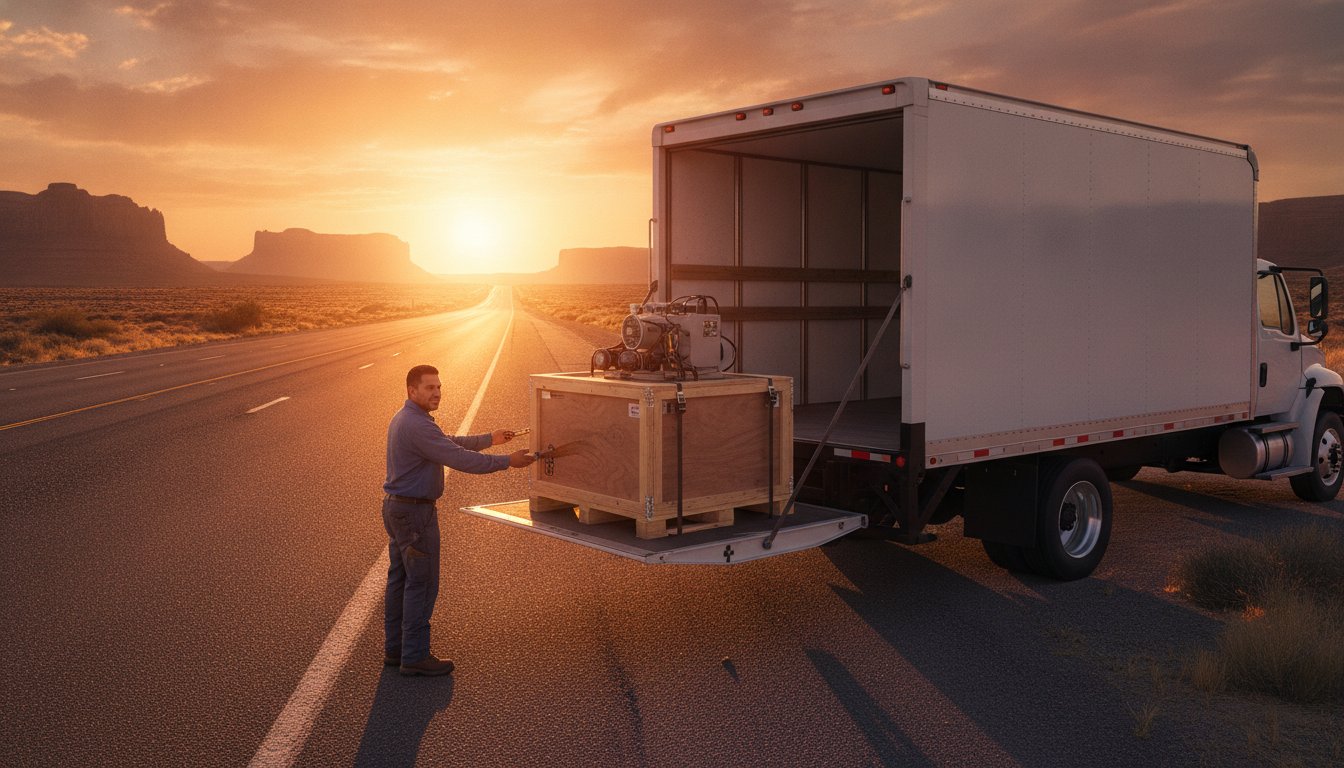
    A liftgate is a hydraulic platform mounted at the rear of a vehicle. It functions as a moving floor to bridge the gap between the ground and the truck bed. This tool is the ultimate solution for heavy lifting. It removes the physical strain of pushing heavy items up a steep, narrow ramp. You simply place the cargo on the platform and let the hydraulics do the work. It’s a friction-free way to handle high-stakes logistics without the typical stress.

    Safety is the primary driver for choosing a box truck with liftgate rental. Manual lifting is the fastest way to suffer a back injury or damage expensive equipment. A liftgate provides a stable, level surface for your cargo. It minimizes the risk of items tipping or sliding during the loading process. Beyond safety, you gain massive efficiency. Moving palletized goods or oversized furniture becomes a one-person job. You can finish your load in half the time compared to using traditional methods.

    When to Choose a Liftgate Over a Traditional Ramp

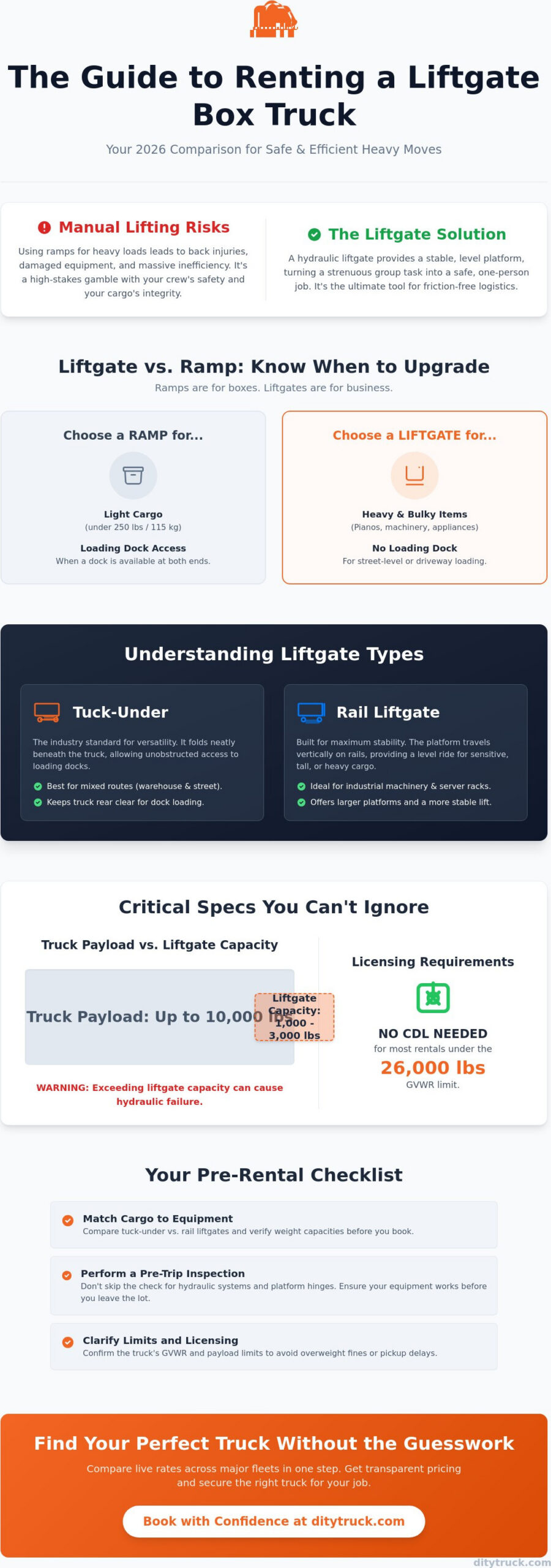
    Ramps are fine for light boxes, but they fail when items exceed 250 pounds. Pianos, industrial machinery, and large appliances require a mechanical solution. You also need a liftgate when your origin or destination lacks a loading dock. It allows you to load and unload directly from the street or a driveway. Fragile items with a high center of gravity stay upright because the platform remains perfectly horizontal. Researching different types of liftgates can help you understand which platform size fits your specific cargo dimensions.

    Commercial vs. Personal Use Requirements

    Small businesses rely on these trucks for delivery routes and warehouse logistics. It’s a smart way to scale operations without the overhead of vehicle maintenance. DIY movers are also shifting toward these specialized vehicles. A 16-foot truck with a liftgate makes a residential move significantly easier for anyone working without professional help.

    Licensing is a common point of confusion. Most rental box trucks are designed to stay under the 26,000 pound Gross Vehicle Weight Rating (GVWR) limit. This is a critical threshold. As long as the truck stays under this weight, you don’t need a Commercial Driver’s License (CDL) to drive it. You get professional-grade lifting power with the simplicity of a standard driver’s license. It’s the shortest path to a successful move.

    Understanding Liftgate Types and Payload Capacities

    Choosing a box truck with liftgate rental requires more than just picking a truck length. You need to understand the hardware attached to the back. The two most common designs you will encounter are tuck-under and rail liftgates. Each serves a specific purpose, and picking the wrong one can complicate your loading process.

    Tuck-under liftgates are the industry standard for versatility. They fold neatly beneath the truck frame when you aren’t using them. This design allows the truck to back flush against a loading dock without the gate getting in the way. It is the ideal choice for routes that mix street-level deliveries with warehouse stops. If your move involves a mix of environments, this is likely the gate you want.

    Rail liftgates are built for stability. They travel vertically along tracks mounted to the rear of the truck body. These platforms are typically larger and offer a more level ride for sensitive cargo. They don’t tilt as much as tuck-under models during the lift cycle. If you’re moving a heavy industrial lathe or a tall server rack, the stability of a rail gate is worth the extra effort to find one. These are common on larger 26-foot vehicles.

    Weight Capacity: Matching the Truck to Your Load

    Don’t confuse the truck’s payload with the liftgate’s capacity. A 26-foot truck might carry 10,000 pounds of total cargo, but the liftgate is often limited to 3,000 pounds. Exceeding this limit can cause hydraulic failure or platform bending. Most medium-duty rentals offer liftgate capacities between 1,000 and 3,000 pounds. Larger trucks usually feature the most powerful hydraulic systems. Checking the Federal Motor Carrier Safety Regulations can give you a better sense of why these weight limits are strictly enforced for commercial safety. Always verify the specific lift rating before you start loading.

    Platform Dimensions and Materials

    Surface area is just as important as weight limits. A standard platform is usually 80 to 90 inches wide, but depth varies significantly. If your item is 60 inches deep but the platform is only 48 inches, you have a major safety issue. Steel platforms are the most durable for heavy industrial use. Aluminum platforms are lighter and easier to handle, which can help with the truck’s overall weight balance. Look for “cart stops” on the edge. These small metal tabs flip up to prevent wheeled items from rolling off during the ascent. If you want to compare truck specs across multiple providers, start your search by focusing on the platform size your cargo requires.

    Box Truck with Liftgate Rental: The 2026 Comparison Guide

    Comparing Top Providers for Box Truck Liftgate Rentals

    Not all rental fleets are built for the same tasks. Finding a reliable box truck with liftgate rental depends heavily on the provider’s specialization. One major national leader in the medium-duty space dominates the 22 to 26-foot segment. Their inventory focuses on trucks that come standard with hydraulic lifts. If you move heavy pallets or industrial equipment, this type of provider is your most consistent option. Their vehicles are designed for the high-intensity cycle of commercial logistics.

    Other providers focus on the light to medium-duty market. They specialize in 15 to 16-foot parcel vans. These are ideal for residential moves with heavy appliances or smaller commercial delivery routes. These specialists often maintain newer fleets. You get modern safety features and better fuel efficiency. Some discount chains are the most affordable for local moves, but liftgates are significantly rarer in their inventory. They prioritize residential customers who only need a loading ramp. If you choose a discount provider, call the specific lot to confirm equipment before you pay.

    Regional providers offer a smart alternative for specialized needs. These local companies often stock unique hardware like extra-large rail gates or side-loading lifts. They lack national reach, but they provide personal service and specific equipment that national chains might overlook. They are the best choice for cargo with unusual dimensions that standard platforms can’t handle.

    National Leaders vs. Parcel Specialists: The Liftgate Showdown

    National brands offer higher availability for non-CDL 26-foot models. These trucks provide maximum cargo space without requiring a special license. Parcel specialists counter this with commercial flexibility. They offer tailored rates for business accounts and simpler paperwork for short-term needs. For long-distance moves, the national leaders have the edge. Their roadside assistance networks are extensive. They have more service centers equipped to handle hydraulic repairs. This provides reassurance when you are hundreds of miles from home.

    How to Ensure Your Reservation Includes a Liftgate

    The “Request Only” trap is a common frustration for renters. Many websites allow you to select a liftgate, but they don’t guarantee it. You might arrive at the lot only to find a truck with a standard ramp. This happens because fleets are constantly moving. To avoid this, verify the truck class before you book. A Class 6 vehicle is much more likely to have a permanent liftgate than a Class 4 or 5 truck.

    The most efficient way to secure your equipment is to use a dedicated search tool. You can use DityTruck to filter for specific equipment needs across multiple brands at once. This tool strips away the guesswork. It shows you which providers actually have the hardware you need in stock. It is the shortest, most logical path to a successful booking. Always call the local branch 24 hours before pickup to confirm the liftgate is functional and ready for your arrival.

    Essential Checklist for Booking and Operating Your Rental

    Getting the keys is just the start. Before you drive away, you must verify the box truck with liftgate rental is in top condition. Hydraulic systems are the heart of this equipment. If they fail, your entire move stops. Start by checking the fluid levels if the reservoir is visible. Look for any signs of pooling oil under the chassis. Check the hinges and the platform surface. A warped platform makes it impossible to keep cargo level. These small details prevent a breakdown in the middle of your route.

    Testing the controls is a non-negotiable step. Run the liftgate up and down several times. Watch for any hesitation in the motor. Listen for grinding sounds. These are red flags that the equipment hasn’t been properly maintained. While operating the lift, establish a clear safety perimeter. Never stand directly under the platform. Keep bystanders at least ten feet away. A hydraulic line failure can happen without warning. You need to be out of the path of travel if the platform drops. It is a high-stakes task that requires your full attention.

    Operational Safety and Best Practices

    Loading requires focus. Secure every item with straps or chocks before you hit the “up” button. An unsecured refrigerator can slide off the edge in seconds. Pay close attention to your feet. Pinch points exist where the platform meets the truck floor. Keep your toes back. Most modern rentals include a master power switch. Find it and learn how it works. Turning this off prevents the liftgate from being tampered with while parked. It also stops slow power leaks from killing the battery. If the gate stops moving, don’t force the controls. Check for debris in the tracks or a tripped circuit breaker before calling for assistance.

    Insurance and Liability for Liftgate Equipment

    Liability is a high-stakes topic. Standard collision damage waivers often ignore hydraulic failures caused by user error. If you exceed the weight capacity, you are likely on the hook for expensive repairs. Always document the current state of the liftgate. Use your phone to record a video of the gate operating smoothly at the rental office. This proves the equipment was functional when you started. It also highlights any pre-existing dents or scratches. This simple habit saves you from paying for damage you didn’t cause. Protection starts with clear evidence.

    Ready to find a reliable vehicle? Compare vetted truck rental providers to ensure you get equipment that works as hard as you do.

    Find the Best Box Truck Rental Rates with DityTruck

    Searching for a box truck with liftgate rental often feels like a full-time job. You jump between different websites. You struggle to compare rates that aren’t formatted the same way. It’s a slow, frustrating process. DityTruck eliminates this friction. We bring all major national fleets into one clear, unified view. You see real-time availability for 16ft, 22ft, and 26ft trucks across the US. The data is live. The process is instant. It’s the shortest path between your logistical problem and a confirmed booking.

    We prioritize financial honesty. You won’t deal with hidden fees that suddenly appear at the rental counter. Our platform emphasizes transparent pricing from the start. You see the total cost upfront. This clarity allows you to plan your budget with total confidence. There are no surprises. No hurdles. Just a straightforward tool designed to respect your time and your bottom line. We act as your smart assistant. We perform the heavy lifting of data collection so you don’t have to. You get the relief of knowing exactly what you’ll pay before you arrive at the lot.

    How DityTruck Simplifies Your Search

    We aggregate data from the biggest names in the industry. You get instant comparisons without the manual legwork. Our filters allow you to sort by truck size and specific equipment features. If your move requires a high-capacity rail gate or a non-CDL 26-foot model, you can locate it in seconds. This efficiency helps you identify the most cost-effective options for your route. It’s particularly effective for finding competitive rates on one-way truck rentals. You find the best equipment at the best price without the typical stress of traditional logistics. We strip away the noise so you can focus on the move itself.

    Lock in Your 2026 Moving Rates Today

    Specialty equipment is always in high demand. Trucks equipped with hydraulic lifts are the first to disappear from rental lots during peak moving seasons. Booking early is essential. It’s the only way to ensure you aren’t stuck using a steep ramp for heavy cargo. In a global truck rental market projected to reach USD 45.7 Billion in 2026, competition for specialized vehicles is increasing. Securing your equipment early is a smart financial move.

    We offer flexible cancellation policies to give you peace of mind. If your schedule changes, we help you pivot without the headache. You get the security of a reservation with the flexibility your project demands. It’s the fastest, most reliable way to secure your 2026 logistics. Compare moving truck rental rates now and experience a friction-free booking process.

    Secure Your Equipment and Simplify Your Logistics

    Heavy lifting shouldn’t be a source of stress. You now have the knowledge to select the right liftgate type and verify critical weight limits. Choosing the correct box truck with liftgate rental ensures your cargo stays level and your team stays safe. It’s about replacing logistical complexity with a clear, logical plan for your 2026 move. You’re ready to avoid hidden fees and equipment mismatches that slow you down. Confidence comes from having the right tools for the job.

    Our platform acts as your reliable guide for every step of the search. We provide real-time price comparisons and nationwide fleet availability to help you find the best deal instantly. You’ll enjoy a transparent booking process that puts you in total control of your move. Compare Box Truck Rental Rates with Liftgates today. Your next successful delivery starts with the right equipment and a smarter search. It’s time to experience a move without the typical hurdles. Let’s get your cargo on the road.

    Frequently Asked Questions

    Do I need a CDL to rent a 26-foot box truck with a liftgate?

    No, a Commercial Driver’s License is usually not required. Most national rental fleets spec their 26-foot trucks to stay under the 26,001-pound Gross Vehicle Weight Rating. This classifies them as Class 6 vehicles. You can operate them with a standard driver’s license. Always check the paperwork at the counter to confirm the specific weight rating of your vehicle.

    How much weight can a standard rental truck liftgate hold?

    Capacity typically ranges from 1,000 to 3,000 pounds. Larger 26-foot trucks usually feature the most powerful systems. You can find the exact limit on a safety decal near the operating switch. Don’t guess the weight of your cargo. Overloading the hydraulics can lead to a sudden drop or permanent damage to the platform hinges.

    Do all major rental companies offer box trucks with liftgates?

    No, many brands focused on residential DIY moves only provide pull-out ramps. If your project requires a box truck with liftgate rental, you must book through a commercial-focused fleet. These providers stock the heavy-duty hardware needed for palletized freight and industrial equipment. Always verify equipment availability before finalizing your reservation.

    Are liftgates available on 10-foot or 12-foot rental trucks?

    Liftgates are rarely found on trucks smaller than 16 feet. These compact vehicles lack the frame strength and battery capacity to support hydraulic machinery. If you need mechanical lifting power, plan to rent at least a 16-foot parcel van. These larger models provide the necessary chassis stability for safe liftgate operation.

    What is the difference between a tuck-under and a rail liftgate?

    A tuck-under gate folds into sections and stores beneath the truck bed. This design is perfect for backing into loading docks. A rail liftgate travels vertically on tracks and offers a larger, more stable platform. Rail gates stay perfectly level throughout the lift. They are the better choice for tall items or cargo with a high center of gravity.

    How much extra does it cost to rent a truck with a liftgate?

    Pricing varies by provider and equipment class. Some fleets include the liftgate in the base rate for larger trucks. Others apply a daily equipment surcharge or a higher mileage fee. Using a comparison tool is the fastest way to see the total price. It helps you identify which providers offer the best value for your specific equipment needs.

    Can I use a liftgate to load a car into a box truck?

    No, you should never use a standard liftgate to load a vehicle. Cars exceed the weight capacity of most rental lifts. The platform is also too short to support a car’s wheelbase safely. Attempting this will likely destroy the hydraulic cylinders and cause severe injury. Stick to dedicated car trailers or professional towing services for vehicle transport.

    What should I do if the liftgate fails during my move?

    Stop using the controls immediately. Don’t attempt to repair the hydraulic lines or electrical switches yourself. Secure any cargo on the platform so it cannot slide. Call the 24/7 roadside assistance number provided in your rental agreement. They will send a technician to safely stow the gate or swap your vehicle so you can finish your route.