Did you know that 73% of people find their final moving bill is significantly higher than the original quote? It’s a common stressor. You plan your budget carefully, only to get hit with a massive fuel charge at the finish line. Most of that frustration comes from not knowing how to estimate fuel costs for a moving truck accurately. Between fluctuating diesel prices and confusing MPG ratings, it feels like a guessing game. You want clarity. You need a budget that actually sticks.
We’re stripping away the complexity to give you total control over your moving expenses. This 2026 guide provides the exact formula you need to predict your spending with confidence. We will break down June 2026 national averages, compare efficiency across truck sizes, and show you how to calculate your total cost before you pick up the keys. It’s time to replace the stress of hidden fees with a sense of confident simplicity.
Key Takeaways
- Calculate your total trip expenses using a simple formula that combines actual mileage with truck-specific efficiency ratings.
- Discover how to estimate fuel costs for a moving truck by matching your specific vehicle size to accurate 2026 fuel consumption data.
- Identify how weight and terrain variables can shift your fuel needs to prevent unexpected price hikes at the pump.
- Use smart route optimization and fuel-tracking tools to minimize total consumption and find the best local gas prices.
- Compare real-time rates and fuel efficiency across major rental brands to ensure you choose the most cost-effective logistics solution.
The Essential Formula for Estimating Moving Truck Fuel Costs
Budgeting for a move often feels like trying to hit a moving target. You get a quote for the truck rental, but that number rarely represents the total amount you will actually pay. Fuel is the biggest variable. It can swing your final bill by hundreds of dollars if you aren’t prepared. Learning how to estimate fuel costs for a moving truck isn’t about guesswork; it’s about applying a specific, logical math problem to your unique trip. By breaking the process down into four concrete steps, you can eliminate the anxiety of the “low fuel” light and the surprise bill at the pump.
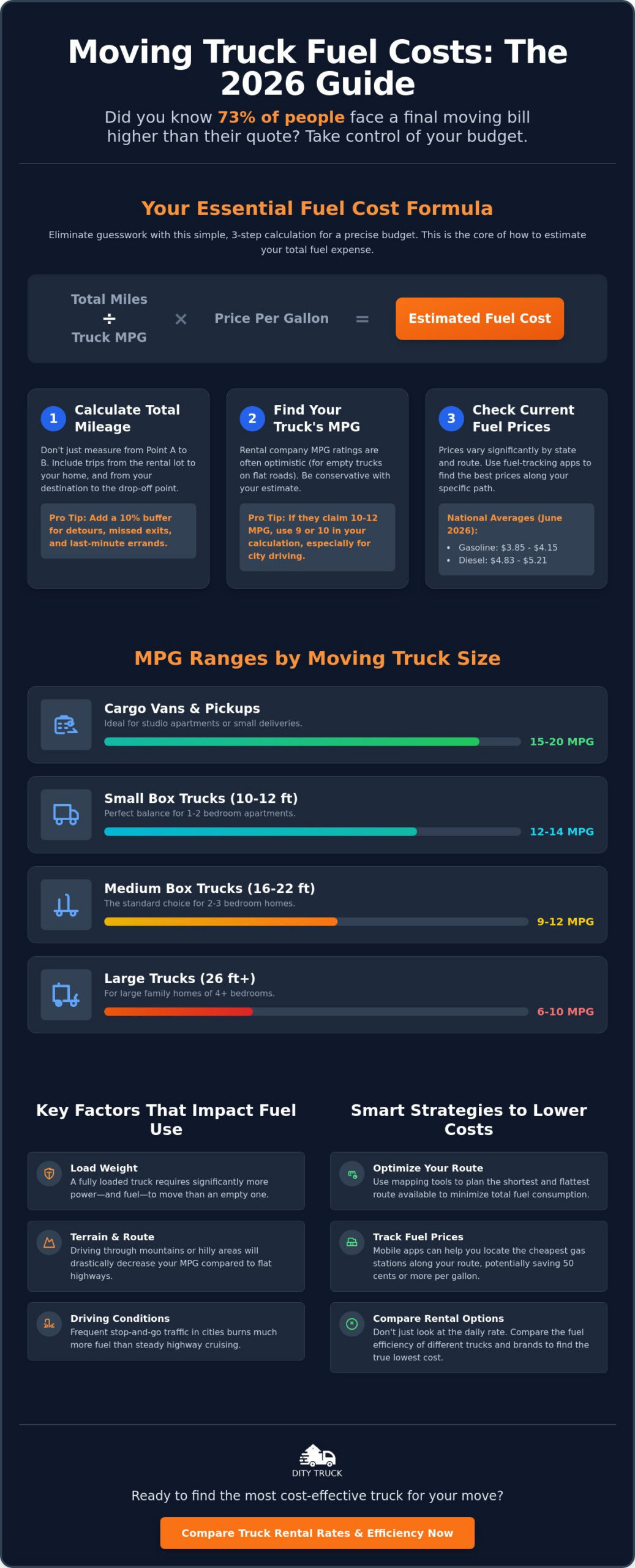
The core formula is straightforward: (Total Miles ÷ MPG) × Fuel Price = Estimated Fuel Cost. This calculation gives you a baseline. It strips away the complexity of logistics and replaces it with a clear, actionable number. To get this right, you need accurate inputs. A small error in your mileage or a misunderstood MPG rating can throw the entire budget off balance. Let’s look at how to gather the right data for each part of the equation.
Step 1: Calculate Total Mileage
Accuracy starts with knowing exactly how far that truck will travel. Most people only look at the distance between their old front door and their new one. This is a mistake. You must include the “hidden” miles that accumulate before and after the heavy lifting. Start by measuring the distance from the rental lot to your current home. Add the primary trip distance to your destination. Finally, include the mileage to the specific drop-off location. It’s rarely the same place you started.
Always add a 10% buffer to your final number. This accounts for unexpected detours, missed exits, or the inevitable “one last trip” to the hardware store. If you’re moving locally, factor in multiple trips if your items won’t fit in a single load. Overestimating your mileage by a few miles is a safe play; underestimating leads to budget shortfalls.
Step 2: Find Your Truck’s MPG
Moving trucks are not fuel efficient. They are heavy, boxy, and designed for hauling rather than aerodynamics. Understanding Fuel Economy is essential when you’re switching from a sedan to a 26-foot box truck. You can usually find the estimated MPG on your rental agreement or the provider’s website. However, take these numbers with a grain of salt. Most estimates are based on empty trucks driving on flat highways.
Use conservative estimates. If a rental company claims a truck gets 10-12 MPG, assume you’ll get 9 or 10, especially if you’re driving through a city with frequent stop-and-go traffic. Older rental fleets often have lower efficiency than newer models. If the truck looks like it has seen better days, drop your MPG estimate by another point. This ensures your budget remains realistic even if the vehicle is less than perfect.
Step 3: Check Current Fuel Prices
Fuel prices in June 2026 are volatile. National averages for regular gasoline are currently hovering around $3.85 to $4.15 per gallon. If your truck requires diesel, expect to pay significantly more, with averages ranging between $4.83 and $5.21 per gallon. Don’t rely on the prices at your local neighborhood station. Check the rates along your specific route using a fuel-tracking app. Prices can vary by 50 cents or more just by crossing a state line. Knowing the actual price at the pump is the final piece of the puzzle for how to estimate fuel costs for a moving truck accurately.
Understanding MPG Ranges by Moving Truck Size
Generic averages fail. A cargo van and a 26-foot behemoth operate on entirely different scales. If you use a single “8 MPG” rule for every vehicle, you will either overpay or run out of cash. Precision matters. Knowing the specific range for your vehicle class is the first step in learning how to estimate fuel costs for a moving truck. Different sizes face different physical hurdles, from wind resistance to engine load.
Efficiency of Cargo Vans and Pickups
Cargo vans are the champions of efficiency. Most modern models deliver between 15 and 20 MPG. They are the logical choice for studio apartments or small cross-town furniture deliveries. If you’re moving long-distance alone, these offer the lowest fuel impact. They drive like a standard SUV. This makes them approachable for drivers who are nervous about handling larger rigs. You get the benefit of lower fuel consumption without the stress of a massive vehicle.
Small box trucks in the 10-12 foot range strike a functional balance. They usually achieve 12-14 MPG. You get significantly more vertical space than a van without a massive fuel penalty. Medium box trucks (16-22 ft) are the standard for 2-3 bedroom homes. These typically fall into the 9-12 MPG range. At this size, the weight of your belongings starts to have a measurable impact on your wallet. Heavier loads require more energy to move, which pulls your efficiency toward the lower end of the spectrum.
Fuel Economy for Large 26-Foot Trucks
Large 26-foot trucks prioritize capacity over savings. Expect 7-10 MPG. A fully loaded truck on a hilly highway will likely hit the lower end of that scale. Engine type is a critical factor here. Many 26-foot models run on diesel. While diesel engines provide better torque for heavy loads, the fuel price is currently higher. In June 2026, diesel averages are reaching $5.21 per gallon in some regions. Gasoline is closer to $4.15. This price gap changes your math significantly.
Driving habits also shift the numbers. The U.S. Department of Energy highlights several Variables That Impact Fuel Consumption, such as aggressive braking or carrying unnecessary weight. When planning a large-scale relocation, it’s helpful to review the cost to rent a 26 foot moving truck to see how fuel fits into the total price. You can compare truck rental rates across all major brands to find the most efficient vehicle for your route. This transparency is the key to how to estimate fuel costs for a moving truck without the usual stress.
Variables That Impact Your Actual Fuel Consumption
Your baseline calculation is a vital starting point. However, real-world conditions often push your actual spending away from the theoretical average. To truly master how to estimate fuel costs for a moving truck, you must look at the physical forces acting on your vehicle. Weight, wind, and the path you choose all dictate how much you will pay at the pump. Ignoring these variables is how budgets get blown before you even reach the state line.
Payload Weight and Fuel Drag
Payload weight is the most immediate factor. A truck packed to the ceiling with heavy oak furniture and appliances requires more energy to reach highway speeds. Expect a fully loaded truck to drop your MPG by 1 to 2 points compared to the manufacturer’s estimate. If you decide to tow a car behind the truck, the impact is even more severe. Consumption will increase significantly because the engine is working twice as hard. Distributing your weight properly across the truck bed helps. It improves handling and prevents the engine from overcompensating for an uneven load.
The Impact of Speed and Terrain
Speed and terrain play equally large roles in your final bill. Moving trucks are essentially large, metal bricks. They have poor aerodynamics. Driving at 70 mph creates massive drag compared to a steady 55 mph. Slowing down can save you 10% to 15% in total fuel costs. If your route cuts through mountainous terrain, your budget needs a larger cushion. Steep grades force the engine into lower gears and higher RPMs. This burns through fuel at an accelerated rate. You should also account for urban traffic. Idling in a heavy construction zone or city gridlock consumes fuel without moving you a single inch toward your destination.
Finally, consider the rental company’s fuel policy. Most providers use a “Return to Full” rule. They give you a full tank and expect it back the same way. If you return it even slightly lower, they will charge a premium rate per gallon that far exceeds current average gas prices. Some offer pre-paid fuel options. These might seem convenient, but you rarely use exactly a full tank. You often end up paying for fuel you never burned. Sticking to the “Return to Full” policy and filling up at a local station is usually the most cost-effective path for your budget. This transparency is essential when figuring out how to estimate fuel costs for a moving truck without overpaying for convenience.
Practical Strategies to Lower Your Total Moving Fuel Bill
Estimating is only half the battle. Once you know how to estimate fuel costs for a moving truck, your goal shifts to beating that number. Small adjustments to your driving habits and preparation can shave 10% to 20% off your total bill. Moving is expensive. Every gallon saved is money back in your pocket for other essentials. Efficiency isn’t a happy accident; it’s the result of a few smart, intentional choices.
Route Optimization for Savings
The shortest path isn’t always the cheapest. Heavy stop-and-go traffic kills fuel efficiency. Use GPS tools that offer “eco-friendly” or “fuel-efficient” routing. These tools prioritize steady speeds over the absolute shortest distance. Avoid steep mountain passes if a flatter alternative exists. Climbing a grade at high RPMs burns fuel at a terrifying rate. When planning one way truck rentals for moving, look at the elevation changes across different route options. A slightly longer, flatter road often costs less than a direct mountain route.
Preparation starts before you leave the lot. Check the tire pressure. Under-inflated tires increase rolling resistance. This forces the engine to work harder and wastes fuel. Ask the rental agent to verify the pressure in your presence. It’s a five-minute task that pays off over a long-distance trip. A well-maintained truck is a more efficient truck. Don’t settle for a vehicle that sounds or feels sluggish at the start.
Refueling Tactics
Location matters. Gas stations directly off the interstate usually charge a premium for convenience. Drive two or three miles into a town to find better rates. Use fuel-tracking apps to compare prices in real-time. This is especially critical for diesel trucks. Diesel pumps are sometimes located in separate truck-stop lanes designed for high-speed filling. These lanes save time and often offer better prices for high-volume users. Always refill to the exact level required by your contract. Rental companies charge massive surcharges for even a small deficit.
Don’t just look at the daily rental rate. A cheaper truck that gets poor MPG can end up being more expensive than a newer, more efficient model with a higher daily fee. Always factor in the fuel estimate when comparing providers. This is the only way to truly understand how to estimate fuel costs for a moving truck without missing the big picture. You can compare and book your truck rental through a platform that aggregates these details for you. This ensures you see the full financial impact before you sign the agreement.
Compare Truck Rental Rates and Efficiency with DityTruck
You have the formula. You have the variables. Now, you need the right vehicle to finish the job. DityTruck simplifies this final step. We aggregate real-time rates from every major national rental brand in one place. No more jumping between tabs. No more manual spreadsheets. We provide the transparent data you need to finalize your budget. Knowing how to estimate fuel costs for a moving truck is powerful. Seeing those costs alongside actual rental rates is even better.
Finding the Best Value Beyond the Daily Rate
A low daily rate often hides a high fuel bill. It’s a common industry trap. Compare moving truck rental options side by side to see the total value of your reservation. Some companies prioritize newer, more fuel-efficient fleets. These trucks provide better MPG and fewer mechanical headaches. DityTruck helps you identify these savings instantly. You can filter by truck size and location to find the perfect match for your payload. Lock in a competitive rate today. Avoid the stress of last-minute price hikes.
Efficiency also depends on choosing the right tool for the task. Renting a truck that’s too large means you’ll pay for empty space and wasted fuel. If it’s too small, multiple trips will double your costs. Our platform provides expert guides to help you choose the right truck size from the start. This precision ensures your fuel estimates remain accurate. It keeps your move on schedule and under budget.
No Surprises, Just Moving
Different brands have different fuel strategies. Check our major brand comparison guide to understand specific fuel nuances. One provider might offer better gas mileage for quick local moves. Another might provide the diesel power needed for a cross-country trek. DityTruck acts as your savvy consumer advocate. We do the heavy lifting behind the scenes so you don’t have to. You get a friction-free experience from start to finish. This is the ultimate way to apply what you’ve learned about how to estimate fuel costs for a moving truck.
Move forward with confidence. Our streamlined booking process handles local and long-distance moves with equal speed. Complete your reservation in minutes. No surprises at the pump. No hidden fees at the lot. Just a clear, logical path to your new home. It’s the shortest distance between a logistics problem and its resolution. Trust DityTruck to provide the clarity you deserve for a high-stakes task.
Take Control of Your Moving Expenses
Fuel expenses don’t have to be a wildcard in your moving plan. By applying the (Total Miles ÷ MPG) × Fuel Price formula, you turn budget uncertainty into a concrete, actionable number. You now understand that a 26-foot truck faces entirely different physical hurdles than a nimble cargo van. You also know that your driving speed and the weight of your belongings are the silent drivers of your final bill. Mastering how to estimate fuel costs for a moving truck is the final step in taking total control of your relocation logistics. It’s about replacing stress with confident simplicity.
Stop guessing and start comparing. DityTruck acts as your smart assistant and independent consumer advocate for DIY movers. We perform the heavy lifting by gathering real-time rates from top-tier national providers in one place. Our simple, one-step comparison tool ensures you see the full financial picture before you ever pick up the keys. You deserve a move defined by clarity and relief rather than surprises at the pump. Compare moving truck rates and book your rental on DityTruck. Your friction-free journey starts here.
Frequently Asked Questions
How many miles per gallon does a 26-foot moving truck get?
A 26-foot moving truck typically gets between 7 and 10 miles per gallon. This range depends heavily on the total weight of your cargo and the terrain of your route. A fully loaded truck driving through mountainous areas will likely stay at the lower end of that efficiency scale. Expect better results on flat, open highways at steady speeds.
Is it cheaper to buy fuel from the rental company or at a gas station?
It is always cheaper to buy fuel at a local gas station. Rental companies charge a massive premium for refueling services. This often includes a high flat fee plus a per-gallon rate that far exceeds the June 2026 national average of $4.15 for gasoline. Filling the tank yourself before return is the most effective way to protect your budget.
Do moving trucks take regular gas or diesel?
Most small to medium box trucks and cargo vans take regular unleaded gasoline. However, many large 26-foot trucks require diesel to handle the increased weight capacity. Always check the fuel cap or your rental agreement before pumping. Using the wrong fuel type will cause catastrophic engine damage and lead to expensive repair fees.
How much does it cost to fill up a 16-foot moving truck?
Filling a 16-foot truck usually costs between $120 and $165 based on current 2026 fuel prices. These trucks typically have gas tanks that hold 30 to 40 gallons. If you are starting from empty, the bill at the pump will be significant. Factoring this into your initial plan is a key part of learning how to estimate fuel costs for a moving truck accurately.
What happens if I return the moving truck with less fuel than I started with?
The rental company will charge you a refueling penalty that is much higher than local pump prices. They don’t just charge for the fuel used; they add a service fee for the labor of sending an employee to the station. You will likely pay double what it would have cost to fill the tank yourself. Always keep your final gas receipt as proof of a full tank.
Can I estimate fuel costs for a one-way move versus a local move?
Yes, the formula remains the same regardless of the move type. For a one-way move, your mileage is a fixed distance between two points. For local moves, you must account for multiple trips back and forth between locations. Using a consistent formula for how to estimate fuel costs for a moving truck ensures you aren’t surprised by the total mileage at the end of the day.
How big is the gas tank on a standard moving truck?
Gas tank sizes vary by vehicle class. Cargo vans usually have 25-gallon tanks, while 10-15 foot box trucks often hold 30 to 40 gallons. The largest 26-foot trucks feature tanks as large as 50 or 60 gallons to support long-distance travel. Knowing the tank size helps you plan your refueling stops and avoid the stress of running low in unfamiliar territory.
Does towing a trailer with a rental truck use more gas?
Towing a trailer significantly increases your fuel consumption. The extra weight and wind resistance can drop your fuel economy by 2 to 4 miles per gallon. If you plan to tow a car or a cargo trailer, you must adjust your budget to account for this extra drag. It forces the engine to work harder, especially during acceleration and hill climbs.
Leave a Reply