
That $19.95 rental truck sticker is rarely the final price of your move. You likely already suspect that the pros and cons of renting a moving truck lean toward savings on paper, but the fear of hidden mileage fees and the anxiety of driving a massive box truck often gets in the way. It’s a valid concern. You want the cost benefits without the logistical nightmare or a surprise bill at the end of the trip. The confusion around fuel costs and insurance often makes the decision feel like a gamble.
This guide analyzes the real logistics to help you decide if the physical effort is actually worth the savings in 2026. We will strip away the complexity of fuel surcharges and equipment rentals to find your personal financial tipping point. You will learn how to identify the lowest possible rates and gain the confidence to manage your own logistics. We’ll break down the real price difference between a rental and professional movers so you can move forward with total clarity. Discover exactly how to eliminate the rental premium and keep your moving budget under control.
Key Takeaways
- Identify the primary trade-off between total control over your schedule and the physical labor required for a successful DIY move.
- Weigh the pros and cons of renting a moving truck against the all-inclusive cost of professional movers to find your true budget winner.
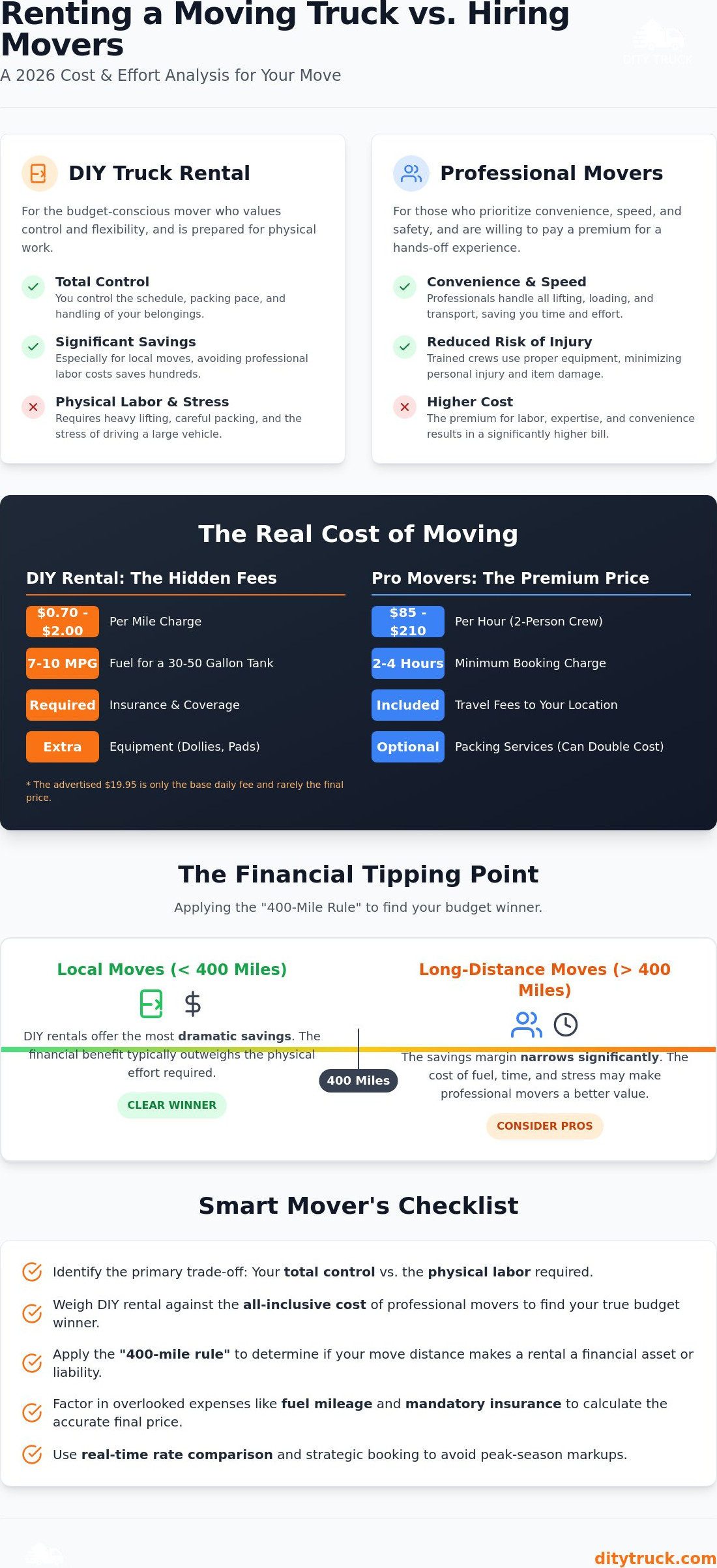
- Apply the “400-mile rule” to determine if your distance and load volume make a rental truck a financial asset or a liability.
- Factor in often-overlooked expenses like fuel mileage and mandatory insurance to calculate an accurate final price.
- Use real-time rate comparison and strategic booking to avoid peak-season markups and secure the best available pricing.
Pros and Cons of Renting a Moving Truck for a DIY Move
Deciding between a DIY approach and hiring help is the first hurdle of any relocation. Roughly 62% of people who move in the U.S. choose to skip the full-service experience in favor of a more hands-on method. Understanding the pros and cons of renting a moving truck allows you to strip away the guesswork. While a professional moving company handles the heavy lifting, they also control the clock. DIY moving hands that power back to you. It’s about more than just the bottom line. It’s about managing your own peace of mind.
The Major Advantages of DIY Logistics
Packing at your own pace is a massive win. You aren’t watching a crew stand around while you finish taping boxes. There are no hourly labor charges ticking up while you decide which boxes go in which room. You decide when the day starts and when it ends. This flexibility is vital for people with complex schedules or those who need to move in stages. Fragile items get the attention they deserve because you’re the one holding them. You know exactly where the heirloom china is. There is also a significant privacy benefit. You don’t have strangers walking through your bedrooms or handling your personal belongings. It’s just you and your trusted help.
- Timeline Control: Move at 2:00 AM or 2:00 PM without scheduling penalties.
- Item Safety: You know exactly how that vintage mirror is secured and padded.
- Privacy: Keep your home and belongings between you and your family.
The Primary Drawbacks to Consider
The physical demand is the most immediate hurdle. Loading a truck isn’t just about strength. It’s about endurance. You’ll spend hours lifting, pivoting, and stacking. The potential for injury is real if you aren’t used to this level of activity. Then there’s the drive. Navigating a 26 foot moving truck through city traffic or narrow residential streets is stressful. These vehicles don’t handle like SUVs. They require wider turns and significantly longer braking distances. You also own the responsibility for the equipment. Any scrapes or dents are on your tab unless you’ve secured the right coverage. Finally, consider the time. You have to pick up the vehicle, load it, drive it, unload it, and return it. It’s a full-time commitment that can span several days.
The upfront savings are the biggest draw for local moves. You avoid the $85 to $210 hourly rates typical for two-person crews. For a short distance, this makes the pros and cons of renting a moving truck lean heavily toward the DIY side. You trade your sweat for a significantly lower bill. It’s a logical choice for the budget-conscious mover who has the physical capacity to manage the load. By eliminating the “labor premium,” you keep more of your budget for the things that matter in your new home.
Cost of Movers vs Renting a Truck: The Real Math
The math behind the pros and cons of renting a moving truck often reveals a wider gap than most expect. On the surface, a $100 rental looks like a steal compared to a $1,200 professional moving quote. However, the true price of DIY moving is a moving target. It shifts based on the volume of your belongings and the distance to your new front door. Small, local moves typically offer the most dramatic savings. Large, cross-country hauls often narrow that margin until the physical effort no longer matches the financial reward.
Calculating the Professional Mover Premium
Professional movers charge for convenience and expertise. For local relocations, you usually face an hourly rate between $85 and $210 for a two-person crew. Most companies enforce a 2-4 hour minimum regardless of the actual time spent. You’re also paying for the travel fee, which covers the time it takes the crew to get to your home and back to their warehouse. Professional packing services add another layer of cost, often doubling your total bill. While expensive, this premium buys you a hands-off experience. Small moves see the largest disparity because the overhead of a professional crew is high compared to the simple cost of a small van.
The True Cost of a Rental Truck
Rental pricing is rarely a flat fee. Local moves rely on a daily rate plus a per-mile charge that can range from $0.70 to $2.00. The total cost of ownership for a one-day local rental includes the base daily fee, per-mile charges, and the expense of refilling a 30-to-50 gallon tank at 7-10 miles per gallon. For long-distance trips, companies often switch to a flat rate with a set number of days and miles. To get an accurate starting point, you should consult a guide on box truck rental prices to see how size affects the base rate.
Distance is the ultimate math-breaker. A 1,000-mile move in a rental truck requires multiple fuel stops and potentially hotel stays. When you add these up, the $2,000 you saved might feel like a poor trade for three days of exhausting labor. Your time has a dollar value. If moving yourself takes 20 hours of your weekend, determine what that time is worth to you. Before you sign a contract, compare rental options to ensure the math actually works in your favor. Weighing the pros and cons of renting a moving truck requires looking past the sticker price to see the total investment of both money and energy.
Hidden Logistics: What Most People Forget About Rental Trucks
The advertised daily rate is a starting line, not the finish. When weighing the pros and cons of renting a moving truck, you must look at the fine print. Small fees add up quickly. A $30 rental can easily double before you even turn the key. Most people focus on the base price and ignore the operational reality. Transparency is your best tool for staying on budget. It turns a stressful surprise into a manageable line item.
Insurance and Liability Protection
Don’t assume your personal auto policy covers a 26-foot box truck. Most standard insurance providers exclude commercial-sized vehicles from their coverage. Credit card rental protections often have the same limitation. This leaves you vulnerable. Rental companies offer Damage Waivers (CDW) and Personal Accident Insurance (PAI) to bridge this gap. These typically cost between $14 and $30 per day. Skipping this protection is a high-risk gamble. One minor scrape against a low-hanging branch can lead to thousands in out-of-pocket repairs. Premium plans offer the most relief. They often feature a zero-dollar deductible and total peace of mind.
Equipment and Accessory Costs
A truck is just an empty shell. You need tools to fill it safely. Most rentals don’t include dollies or furniture pads in the base price. For a 3-bedroom home, you should plan for at least three to four dozen moving blankets. This prevents scratches and keeps your furniture in top condition. Loading ramps are essential for heavy appliances. Check if your specific model includes one. Some smaller vans omit the ramp entirely. You’ll also face a cleaning fee if you return the truck with dirt or debris inside. Sweep it out before drop-off to keep that money in your pocket. It’s a small task that saves a significant charge.
Fuel is the largest variable expense. These trucks are heavy and aerodynamically inefficient. Expect a fuel economy of roughly 7 to 10 miles per gallon. If you’re moving 100 miles, you’ll burn at least 10 to 14 gallons of gas. At July 2026 prices, this adds a significant chunk to your total spend. You must also account for environmental fees. These usually range from $1 to $5. Local sales taxes also apply. These small charges are mandatory. Factoring them in early prevents that sinking feeling when you see the final invoice. Clarity on these costs is the only way to ensure your DIY move stays cheaper than hiring help. Understanding the full pros and cons of renting a moving truck means seeing the total investment, not just the sticker price.
The Tipping Point: When to Rent vs. When to Hire
Every DIY move has a breaking point where the money saved no longer justifies the exhaustion. Finding this threshold is essential for a successful relocation. You need to weigh the pros and cons of renting a moving truck against your actual capacity to finish the job. For many, the decision comes down to a simple “400-mile rule.” If your destination is within 400 miles, the savings of a rental truck usually outweigh the costs. Beyond that mark, the combination of fuel, lodging, and physical fatigue starts to rival the price of professional help.
The Distance Factor
State-to-state moves introduce variables that local trips don’t face. Driving a large rig for ten hours a day is a specialized skill. It requires intense focus and physical stamina. If you are crossing multiple state lines, one way truck rentals for moving are the standard choice. These allow you to drop the vehicle off near your new home rather than driving it back to the origin. This saves time but often comes with a higher base rate. You must calculate the physical toll of a multi-day drive. If you arrive at your new house too tired to unload, you’ll end up paying for local labor anyway. This negates the initial savings of the DIY route.
- Local Moves: High savings potential. Minimal driving stress.
- Long-Distance Moves: High fuel costs. Significant time commitment. Requires hotel stays.
The Volume and Complexity Factor
Size matters when choosing your equipment. A 26 foot moving truck is the largest vehicle you can drive without a commercial license. It’s the right tool for a four-bedroom home, but it becomes a liability in tight urban areas. Navigating narrow alleys or steep driveways in a vehicle this size is a recipe for property damage. Complexity also extends to your inventory. Moving a piano, a pool table, or high-value antiques without professional training is risky. Two people can realistically load about 150 cubic feet per hour. For a large home, that’s a full day of back-breaking work.
Relying on friends often seems like a budget win. However, the “pizza and beer” economy has its limits. Friends lack the insurance and equipment of a professional crew. If a helper gets injured or drops your television, the social and financial cost is high. Professional crews bring speed and accountability. If your move involves three flights of stairs or narrow hallways, their expertise is worth the investment. Before you commit to the heavy lifting, search for the best rental rates to see if the price gap is small enough to justify hiring help instead. Balancing the pros and cons of renting a moving truck means being honest about what you can realistically handle without burning out.
How to Secure the Best Moving Truck Rental Rates in 2026
You’ve analyzed the pros and cons of renting a moving truck. You’ve done the math on fuel, insurance, and labor. Now, the final step is securing the vehicle at the best possible price. Efficiency in booking is just as important as efficiency in packing. A few strategic choices during the reservation process can save you hundreds of dollars. Your goal is to strip away the brand premium and find the most cost-effective tool for the job. It’s about being a savvy consumer in a market that often relies on hidden fees and dynamic pricing.
Compare Rates in One Simple Step
Brand loyalty rarely pays off in the moving industry. Checking major national providers side-by-side often reveals a price gap of 20% or more for the exact same route. DityTruck acts as your smart assistant by aggregating these rates into one transparent view. You get to see the most accurate 2026 prices without the friction of visiting multiple websites. This transparency ensures you aren’t paying extra just because you didn’t see a cheaper alternative. Booking through a third-party platform provides a layer of clarity that single-brand sites often hide. It levels the playing field so you can make a decision based on data, not marketing.
Strategic Booking Tips
Timing your move is the easiest way to slash costs. Peak moving season runs from May through September. Research shows that prices are typically 20% to 30% higher during these high-demand months. If your schedule allows, aim for a mid-week move. Tuesday and Wednesday rentals are significantly cheaper than Friday or Saturday bookings. When demand drops, the rates follow. It is the most logical way to keep your budget under control. You’ll also find that pickup and drop-off locations are less crowded, making the logistics even smoother.
Don’t wait until the last minute to secure your vehicle. Booking 14 days in advance is the recognized sweet spot for savings. This window protects you from inventory shortages that drive up prices in the final 48 hours. When fleet availability is high, companies are more likely to offer competitive rates to fill their trucks. Compare 2026 truck rental rates now at DityTruck to lock in your lowest rate. Using a data-driven approach is the only way to move with total financial confidence.
Use this final checklist before you hit the reserve button:
- Confirm that the pickup and drop-off locations are convenient and correct.
- Verify that a loading ramp is included for your specific truck size.
- Check for student, military, or senior discounts that might apply.
- Review the fuel return policy to avoid high refueling charges at the lot.
Confidence in your choice comes from having the right data at the right time. When you use a comparison platform, you eliminate the guesswork and the stress of hidden fees. You move forward knowing you’ve found the shortest, most logical path to a budget-friendly relocation. The physical effort of a DIY move is high, but with these strategies, the financial reward is even higher. Take control of the process and keep your hard-earned money in your pocket.
Take Command of Your 2026 Relocation
Choosing the DIY route is a high-stakes decision that rewards those who plan with precision. You now understand the pros and cons of renting a moving truck, from the freedom of your own timeline to the reality of fuel mileage and insurance gaps. Success comes down to two factors: being honest about your physical limits and being ruthless with your budget. For local moves, the labor savings are undeniable. For long-haul trips, the “400-mile rule” remains your best guide for avoiding burnout.
Don’t let hidden fees or single-brand markups inflate your bill. You deserve a friction-free booking experience that prioritizes your time and your wallet. DityTruck provides real-time rate comparison for 2026 with transparent pricing across top-tier providers nationwide. There are no surprises here. Just clear, actionable data that helps you find the shortest path to your new home. Find the cheapest rates for your move—Compare truck rentals at DityTruck. You’ve got the plan. Now get the keys and move with confidence.
Frequently Asked Questions
Is it cheaper to hire movers or rent a truck for a local move?
Renting a truck is almost always cheaper for local moves because you eliminate the high hourly labor costs of professional crews. While pros often charge between $85 and $210 per hour, a local truck rental starts with a low daily base fee. You trade your own labor for significant savings. It’s the most logical choice for small apartments or those with a reliable group of helpers.
What are the most common hidden fees when renting a moving truck?
The most common hidden fees include mileage charges, fuel replacement costs, and environmental fees. Mileage rates for local moves can range from $0.70 to $2.00 per mile. You also face cleaning fees if the cargo area isn’t swept out before return. Understanding these pros and cons of renting a moving truck helps you avoid a surprise bill at the drop-off counter.
Does my personal car insurance cover a rental moving truck?
Most personal auto insurance policies don’t cover large box trucks because they’re classified as commercial-use vehicles. Credit card rental protections typically have the same exclusion for vehicles over a certain weight or size. You should verify your coverage with your provider before declining the rental company’s damage waiver. Buying supplemental protection is the safest way to avoid massive out-of-pocket repair costs.
How much gas does a 26-foot moving truck actually use?
A 26-foot moving truck typically gets between 7 and 10 miles per gallon depending on the load weight and driving conditions. These vehicles are heavy and lack aerodynamic efficiency. You must factor in the cost of refilling a large tank, which can hold 30 to 50 gallons of fuel. Planning your fuel stops ahead of time prevents overpaying at expensive highway stations during your trip.
Can I drive a large moving truck with a standard driver’s license?
You can drive a large moving truck with a standard, valid driver’s license in the United States. A commercial driver’s license (CDL) isn’t required for rental trucks used for personal, non-commercial purposes. Most companies require the driver to be at least 18 years old, though some set the minimum at 21. Always bring a second form of ID to the rental counter to speed up the process.
Is it better to do a one-way rental for long-distance moves?
One-way rentals are better for long-distance moves because they save you the time and fuel cost of driving an empty truck back to the origin. While the base rate for a one-way trip is higher, it usually includes a set number of days and miles. This eliminates the stress of a ticking clock. It’s the most efficient path for state-to-state relocations and cross-country hauls.
How much should I tip friends who help me move with a rental truck?
Tipping friends isn’t mandatory, but providing a meal and drinks is the standard etiquette for a DIY move. If your friends spend several hours doing heavy lifting, a cash gift of $20 to $50 per person is a generous way to show appreciation. It’s still significantly cheaper than hiring a professional crew. Your total investment in food and gratitude is a small price for reliable help.
How do I know what size moving truck I need for my house?
Choosing the right size depends on the number of rooms in your home rather than just square footage. A 10-foot truck is ideal for a studio, while a 26-foot truck is necessary for a four-bedroom house. Most rental platforms provide a room-count guide to help you decide. Selecting a slightly larger truck is safer than trying to cram everything into a vehicle that is too small.
Leave a Reply