Tag: budgeting

  • Hidden Costs of Hiring Movers vs. Renting a Truck: The 2026 Transparency Guide

    Hidden Costs of Hiring Movers vs. Renting a Truck: The 2026 Transparency Guide

    Your professional moving quote is likely a mirage. It looks solid on paper, but moving day often brings a wave of expensive surprises. Many homeowners don’t realize the hidden costs of hiring movers can inflate a bill by 25% or more before the truck even leaves the driveway. From stair fees to fuel surcharges, the final total rarely matches the initial handshake. It’s a high-stakes task made unnecessarily complex by a lack of transparency.

    We agree that logistics should be simple and predictable. You deserve a moving process that prioritizes your time and your budget. This guide exposes the secret fees professional companies hide in the fine print. You’ll learn how a DIY truck rental provides the cost-clarity and control your move requires. We provide a clear breakdown of common mover surcharges and a framework to compare professional services against the honesty of a rental truck. You’ll gain the confidence to choose the most cost-effective path without the fear of your belongings being held hostage by an unexpected final bill.

    Key Takeaways

    • Identify the “low-ball quote” trap used by rogue movers—learn why initial estimates rarely reflect the final price you pay on moving day.
    • Uncover the hidden costs of hiring movers, including specific surcharges for stairs, elevators, and long driveways that often stay hidden in the fine print.
    • Apply the DIY Savings Framework to eliminate labor-related fees—renting a truck offers fixed pricing and total control over your final bill.
    • Master a two-step budgeting strategy to audit professional quotes for exclusions and secure the best available rates through real-time comparison.
    • Simplify your logistics by using a comparison platform to view truck rental options side-by-side—replacing industry opacity with confident simplicity.

    The Baseline Mirage: Why Your Moving Quote Isn’t the Final Price

    Your initial estimate is rarely the final bill. In the logistics world, a quote is often just a starting point. We define the hidden costs of hiring movers as any expense not explicitly detailed in that first hourly or flat-rate number. These costs usually hide in the fine print of your Bill of Lading. This document is the legal contract between you and the moving company. It often contains clauses for fuel, labor adjustments, and equipment fees that trigger only when the work begins. It’s a baseline mirage that creates a false sense of financial security.

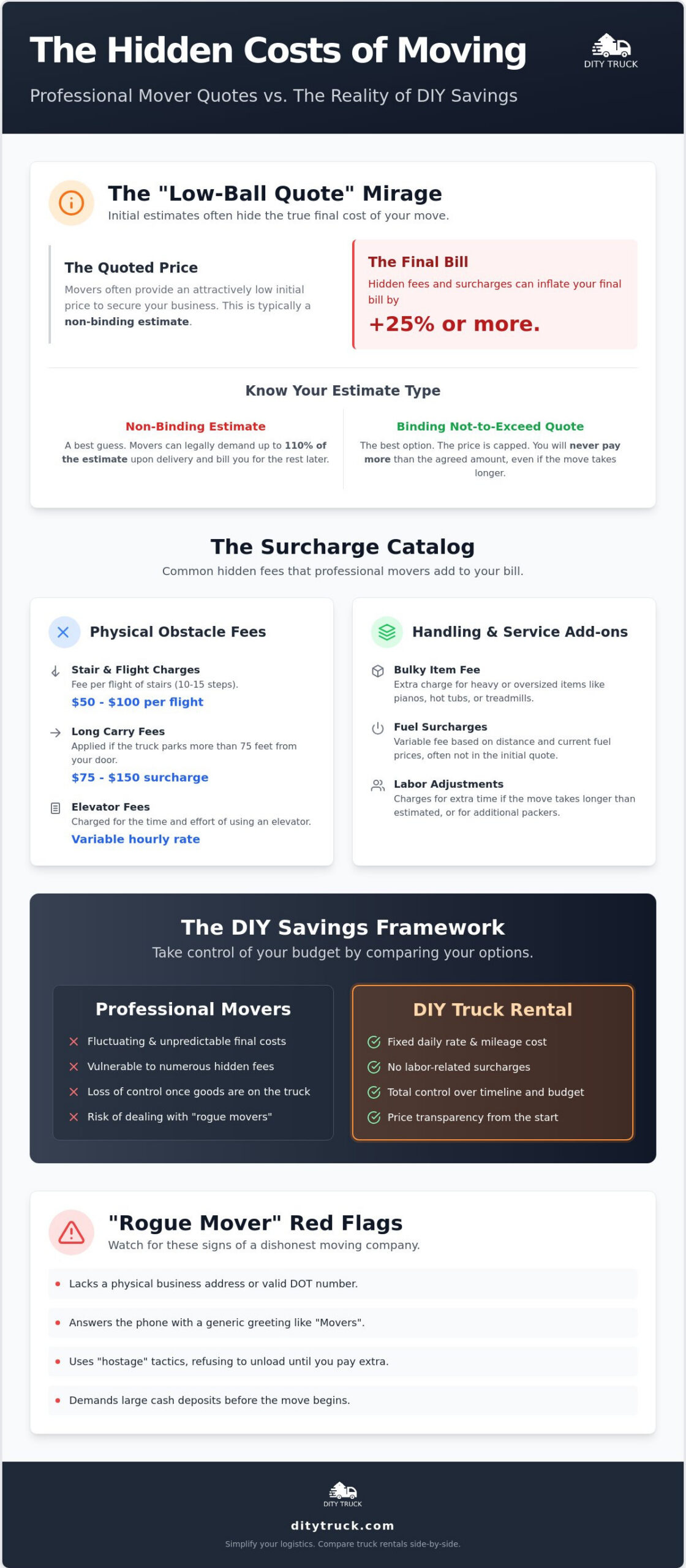
    Rogue movers frequently use the “Low-Ball Quote” trap to secure your booking. They offer a price significantly lower than competitors. You see the savings and sign. Once your belongings are on the truck, the price shifts. The movers might claim the inventory was underestimated or the walk to the truck was too long. This action-result progression leads to a final bill that can be double the original estimate. This is why the hidden costs of hiring movers are so damaging to a strict budget. You lose control of the transaction the moment the ramp hits the pavement.

    There is a distinct psychological relief in having a locked-in rental rate. When you rent a truck yourself, you trade a fluctuating service bill for a fixed equipment cost. You aren’t paying for a crew’s coffee breaks or slow pace. The transparency of a rental agreement provides the clarity your budget needs. You know the daily rate. You know the mileage cost. There are no surprises waiting at your new front door.

    Binding vs. Non-Binding Estimates

    A non-binding estimate is essentially a best guess. It is not a legal guarantee of the final price. If the move takes longer than expected, the price climbs. Under federal law, movers can demand 110% of a non-binding quote at the time of delivery. They can then bill you for the remaining balance later. To protect yourself, always demand a “Binding Not-to-Exceed” quote. This specific contract type ensures you never pay more than the agreed cap, even if the move proves more difficult than the estimator predicted.

    The “Rogue Mover” Red Flags

    Identifying a dishonest company early saves thousands. Watch for movers who lack a physical business address or a valid DOT number. Be wary if they answer the phone with a generic greeting like “Movers” instead of a specific company name. Some use “hostage” tactics, where they refuse to unload your goods until you pay an unquoted surcharge. The FMCSA database is the primary tool for verifying the legitimacy and safety records of interstate movers.

    The Surcharge Catalog: Hidden Fees That Professional Movers Charge

    Accessorial charges are the industry’s way of billing for effort rather than distance. If a task isn’t strictly driving the truck, it’s likely a surcharge. These line items transform a simple move into a financial puzzle. Understanding the hidden costs of hiring movers requires a deep dive into the surcharge catalog. Most people expect to pay for labor. Few expect to pay for the specific way their furniture moves through a door. These fees aren’t always disclosed during a phone estimate; they often appear once the crew assesses the physical layout on moving day.

    Professional crews apply logistical surcharges based on your home’s architecture. If you live in an apartment or a house with a steep driveway, your bill will grow. Service-based additions like furniture disassembly also add up quickly. You might also face the stress of overlapping leases, delayed move-ins, and last-minute scrambles that drive costs even higher. To avoid these service-based surprises, many savvy movers choose to compare rental truck rates instead.

    Physical Obstacle Fees (Stairs, Elevators, Long Carries)

    Flight charges are a standard industry addition. Movers typically charge per floor or for every 10 to 15 steps. Current 2026 research shows these fees often range from $50 to $100 per flight. Long carry fees apply when the truck cannot park close to your entrance. If the crew must walk more than 75 feet from the ramp to your door, expect a surcharge between $75 and $150. Elevator fees are equally common. You pay for the time spent padding the interior or waiting for the lift to arrive. These physical hurdles turn a standard quote into a high-cost project.

    Special Handling and Labor Add-ons

    Bulky items require specialized equipment and extra manpower. Treadmills, hot tubs, and pool tables usually carry separate line-item fees. Appliance servicing is another common addition. You’ll pay for the crew to disconnect and secure your washer or refrigerator. Packing supplies purchased directly through movers often have a 200% markup compared to retail stores. These service additions ensure the hidden costs of hiring movers remain a significant part of your final bill.

    Post-move expenses add a final layer of complexity. Fuel surcharges are now standard due to diesel prices averaging $4.15 per gallon in early 2026. These surcharges typically range from $50 to $150 depending on the distance. You also need to budget for travel time from the warehouse to your door. Tipping is a final, unwritten cost. It’s recommended to provide $20 to $50 per worker per day. These variables make it difficult to predict your total spend until the move is complete.
    Hidden Costs of Hiring Movers vs. Renting a Truck: The 2026 Transparency Guide

    Cost of Movers vs. Renting a Truck: The DIY Savings Framework

    Professional labor rates are a moving target. Current 2026 data shows that hiring two movers and a truck for a local move costs between $108 and $125 per hour. This creates a “ticking clock” anxiety. Every minute spent navigating traffic or waiting for a slow elevator increases your final bill. By contrast, box truck rental prices are fixed equipment expenses. You pay for the tool, not the time it takes to use it. This transparency allows for a multi-day move without the threat of expensive overtime rates.

    The “Zero Labor Surcharge” benefit is the most significant advantage of the DIY path. As we explored in the previous section, the hidden costs of hiring movers often include fees for every flight of stairs or every 75 feet of walking distance. When you rent a truck, these surcharges vanish. You don’t pay extra for your home’s architecture. You also gain clarity on fuel costs. Movers often charge a fuel surcharge as a percentage of the total bill, which can range from $50 to $150. With a rental, you simply refill the tank at the current average rate of $4.15 per gallon. You pay for what you actually use; nothing more.

    Eliminating the “Middleman” Markup

    Professional movers often act as retailers for secondary services. They profit from a 200% markup on packing supplies and sell valuation coverage that mimics insurance. You can bypass these markups entirely. Sourcing your own boxes and checking your personal auto insurance for rental coverage can save hundreds. This level of oversight is a key recommendation within the Federal Motor Carrier Safety Administration’s Protect Your Move guidance. Managing these details yourself replaces industry opacity with confident simplicity.

    Transparency in Long Distance Moving

    Interstate moves with professional companies are typically weight-based. You receive an estimate, but the final price depends on a scale at a truck stop. This makes budgeting a guessing game. Switching to one way truck rentals for moving shifts the cost to a mileage-based model. Mileage is a known variable. You can calculate your exact spend before you even turn the key. You also avoid “storage-in-transit” fees. These occur when movers cannot deliver on your schedule and charge to hold your items in a warehouse. DIY keeps your belongings under your control and on your timeline.

    Strategic Budgeting: How to Outsmart Moving Day Expenses

    Outsmarting moving day expenses requires a side-by-side audit of your options. Start by getting a baseline professional quote. Scrutinize the fine print for exclusions immediately. We’ve already identified the hidden costs of hiring movers, such as long carry fees and stair surcharges, that rarely appear in a phone estimate. Once you have that number, use a comparison platform to view real-time uhaul vs budget truck rental rates. This gives you a market-accurate baseline for equipment costs before you commit to a service contract.

    The next step is calculating your “Real DIY Total.” This sum includes the rental rate, estimated fuel, insurance, and even the cost of pizza for friends. Compare this total against the “Mover Quote + 25%.” This 25% buffer represents the typical hidden fee margin in the professional industry. It accounts for the unforeseen labor spikes and logistical surcharges that frequently appear on the final bill after your goods are loaded. This comparison replaces guesswork with financial honesty.

    The 25% Buffer Rule

    Always add 25% to a professional mover’s estimate to protect your budget. This isn’t pessimism; it’s practical logistics. Professional quotes are often non-binding guesses that can shift once the work begins. By contrast, DIY moves rarely exceed their initial estimate by more than 5 to 10 percent. Fuel is the only major variable in a DIY move, which is easily calculated. Since you know your route and the early 2026 diesel average of $4.15 per gallon, you can predict your pump costs with high accuracy before you even turn the key.

    Vetting Your Rental Options

    Comparing local vs. national rental brands is essential for securing the best rate. Equipment availability and seasonal demand cause rates to fluctuate daily. Booking early is the best way to avoid the “hidden” cost of rental truck unavailability. Last-minute rentals often carry a premium or force you into a larger, more expensive vehicle than you actually need. DIY moving makes you the manager. You aren’t vetting a company’s reputation; you are vetting the data to ensure the shortest path to a cost-effective move. You can compare truck rental rates now to lock in your baseline and take control of your budget.

    Simplify Your Logistics: Compare and Save with DityTruck

    DityTruck acts as your savvy consumer advocate. It replaces the traditional fog of moving logistics with a sense of confident simplicity. The hidden costs of hiring movers often stem from a lack of accessible market data. Our platform solves this problem by aggregating real-time rates from top providers in one place. You can see moving truck rental options side-by-side. This ensures you never settle for a high-pressure quote out of desperation or a lack of alternatives.

    We provide a “No Hidden Fees” promise. The rate you see on our platform is the provider’s actual rate. There are no surprise logistical surcharges added at the end of the process. Our streamlined booking system allows you to move from comparison to reserved in just a few minutes; it is the shortest and most logical path to a successful move. By stripping away the complexity, we provide the friction-free solution your high-stakes task requires.

    The Power of Choice

    You remain the manager of your move throughout the entire process. Our platform allows you to filter by specific truck size. This ensures you don’t pay for space you don’t actually need. You can instantly compare local pickup rates against one-way drop-off options to find the most efficient route. The process is entirely digital and highly functional. It offers a reassuring level of control and immediate comprehension that professional service bills simply cannot match. You see the result of your choices in real-time.

    Ready to Move? Start Here

    DIY moving is defined by financial honesty. When you view your options through the DityTruck lens, you see the full financial picture immediately. We’ve shown how professional quotes can be mirages that hide expensive surcharges for stairs, fuel, and labor. You don’t have to accept that uncertainty. We encourage you to take just 60 seconds to compare rates before you sign any professional mover contract. It is the most effective way to protect your budget and ensure a stress-free transition to your new home.

    Find your perfectly priced moving truck on DityTruck today.

    Take Control of Your Moving Budget

    Moving doesn’t have to be a financial guessing game. You now understand that initial professional quotes are often just starting points. We’ve exposed the hidden costs of hiring movers; these surcharges and fine-print fees don’t have to dictate your budget. By applying the DIY Savings Framework and the 25% buffer rule, you can protect your hard-earned money. Choosing a rental truck replaces industry opacity with total control over your timeline and your expenses.

    Clarity is just a few clicks away. You can access real-time rates from major national providers and use our transparent pricing comparison to find the best deal. Our streamlined online booking moves you from search to reservation in minutes.

    Compare moving truck rates and avoid hidden fees on DityTruck

    You have the tools to outsmart moving day surprises. Step into your new home with your budget intact and your peace of mind secured.

    Frequently Asked Questions

    Is it always cheaper to rent a truck than to hire movers?

    Renting a truck is almost always more cost-effective for local moves because it eliminates the hourly labor rates that drive up professional bills. While the equipment fee is lower, you must account for fuel and insurance. For long-distance moves, the savings increase as you avoid weight-based pricing. You trade your physical labor for financial transparency and a lower final bill that stays within your control.

    What is a “long carry” fee and how much does it cost?

    A long carry fee is a surcharge applied when movers cannot park the truck within 75 feet of your entrance. This fee typically ranges from $75 to $150 depending on the total distance. It compensates the crew for the extra time and effort required to transport your items manually. You can avoid this specific expense by renting a truck and parking it exactly where you need it.

    Do moving companies charge extra for stairs and elevators?

    Most professional companies charge extra for stairs and elevators to account for the increased difficulty of the move. These “flight charges” often range from $50 to $100 per floor or per 10 to 15 steps. Elevator fees are similarly common and cover the time spent waiting for or padding the lift. These are major hidden costs of hiring movers that stay buried in the fine print until moving day.

    How much should I tip professional movers if there are hidden fees?

    Tipping is recommended at $20 to $50 per worker per day regardless of any surcharges on your bill. Tips are separate from the company’s service fees and go directly to the labor crew. Since 61 percent of customers report tipping their movers, it is a standard expense to include in your budget. DIY moves eliminate this cost entirely, allowing you to keep that cash in your pocket.

    Does my car insurance cover a rental moving truck?

    Most standard personal auto insurance policies do not cover large rental trucks because they are classified as commercial vehicles. You should contact your insurance provider to verify your specific coverage before booking. If your policy excludes trucks, rental companies offer supplemental insurance. This is a fixed, transparent cost that you can calculate and approve before you drive the vehicle off the lot.

    What happens if a mover demands more money than the quote?

    Your rights depend on whether you have a binding or non-binding estimate. If you have a non-binding quote, movers can legally demand 110 percent of the estimate at the time of delivery. They can then bill you for the remaining balance later. If a mover refuses to unload your goods for more than the 110 percent limit, they may be violating federal consumer protection regulations.

    How do I calculate the fuel cost for a DIY moving truck?

    Calculate fuel costs by dividing your total trip mileage by the truck’s estimated miles per gallon and multiplying by the current fuel price. With diesel prices averaging $4.15 per gallon in early 2026, a 100 mile trip in a truck getting 10 MPG would cost approximately $41.50. This calculation provides the financial honesty that professional fuel surcharges often lack. You pay for the fuel you actually use.

    Are packing supplies included in professional moving quotes?

    Packing supplies are rarely included in a standard moving quote and often carry a 200 percent markup when purchased through the company. Hiring professional packing services can add an additional $350 to $600 to your total move. You can reduce the hidden costs of hiring movers by sourcing your own boxes and packing your items yourself. This simple step keeps your budget focused on transportation rather than cardboard.

  • How to Estimate Fuel Costs for a Moving Truck: A 2026 Guide

    How to Estimate Fuel Costs for a Moving Truck: A 2026 Guide

    Did you know that 73% of people find their final moving bill is significantly higher than the original quote? It’s a common stressor. You plan your budget carefully, only to get hit with a massive fuel charge at the finish line. Most of that frustration comes from not knowing how to estimate fuel costs for a moving truck accurately. Between fluctuating diesel prices and confusing MPG ratings, it feels like a guessing game. You want clarity. You need a budget that actually sticks.

    We’re stripping away the complexity to give you total control over your moving expenses. This 2026 guide provides the exact formula you need to predict your spending with confidence. We will break down June 2026 national averages, compare efficiency across truck sizes, and show you how to calculate your total cost before you pick up the keys. It’s time to replace the stress of hidden fees with a sense of confident simplicity.

    Key Takeaways

    • Calculate your total trip expenses using a simple formula that combines actual mileage with truck-specific efficiency ratings.
    • Discover how to estimate fuel costs for a moving truck by matching your specific vehicle size to accurate 2026 fuel consumption data.
    • Identify how weight and terrain variables can shift your fuel needs to prevent unexpected price hikes at the pump.
    • Use smart route optimization and fuel-tracking tools to minimize total consumption and find the best local gas prices.
    • Compare real-time rates and fuel efficiency across major rental brands to ensure you choose the most cost-effective logistics solution.

    The Essential Formula for Estimating Moving Truck Fuel Costs

    Budgeting for a move often feels like trying to hit a moving target. You get a quote for the truck rental, but that number rarely represents the total amount you will actually pay. Fuel is the biggest variable. It can swing your final bill by hundreds of dollars if you aren’t prepared. Learning how to estimate fuel costs for a moving truck isn’t about guesswork; it’s about applying a specific, logical math problem to your unique trip. By breaking the process down into four concrete steps, you can eliminate the anxiety of the “low fuel” light and the surprise bill at the pump.

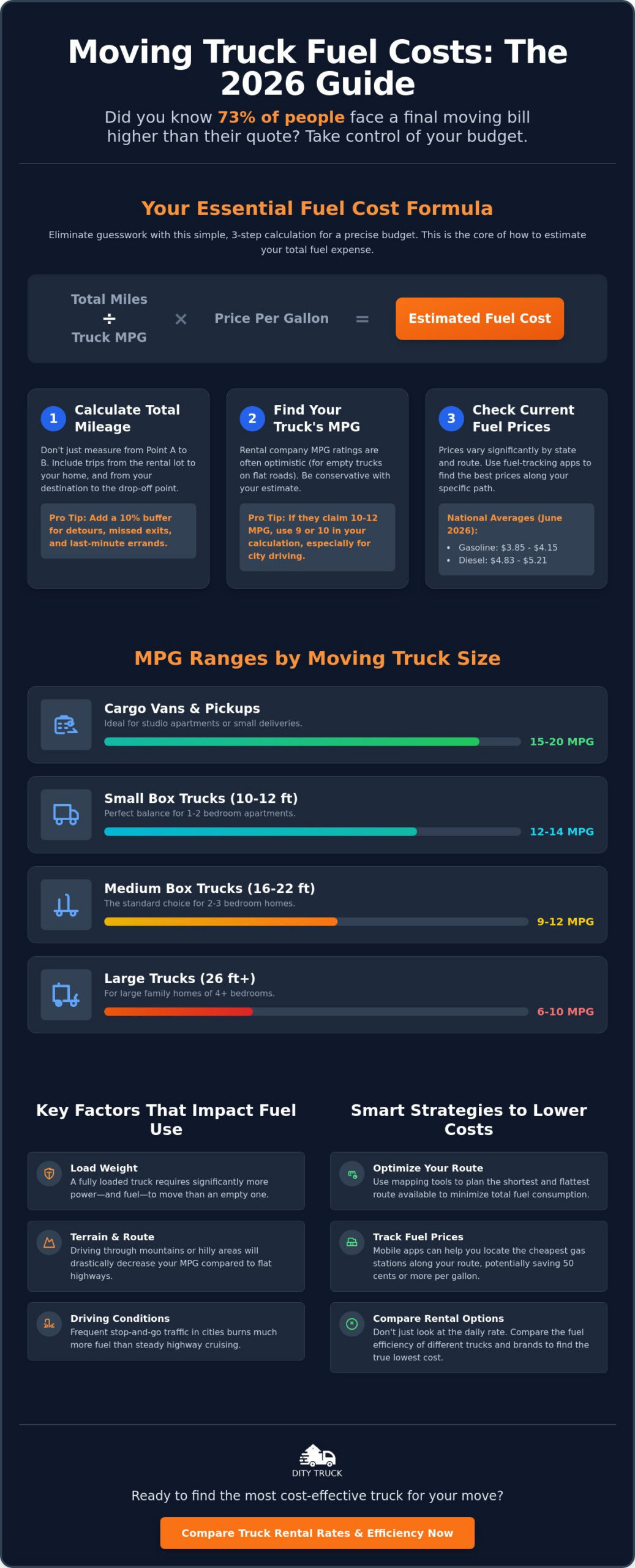
    The core formula is straightforward: (Total Miles ÷ MPG) × Fuel Price = Estimated Fuel Cost. This calculation gives you a baseline. It strips away the complexity of logistics and replaces it with a clear, actionable number. To get this right, you need accurate inputs. A small error in your mileage or a misunderstood MPG rating can throw the entire budget off balance. Let’s look at how to gather the right data for each part of the equation.

    Step 1: Calculate Total Mileage

    Accuracy starts with knowing exactly how far that truck will travel. Most people only look at the distance between their old front door and their new one. This is a mistake. You must include the “hidden” miles that accumulate before and after the heavy lifting. Start by measuring the distance from the rental lot to your current home. Add the primary trip distance to your destination. Finally, include the mileage to the specific drop-off location. It’s rarely the same place you started.

    Always add a 10% buffer to your final number. This accounts for unexpected detours, missed exits, or the inevitable “one last trip” to the hardware store. If you’re moving locally, factor in multiple trips if your items won’t fit in a single load. Overestimating your mileage by a few miles is a safe play; underestimating leads to budget shortfalls.

    Step 2: Find Your Truck’s MPG

    Moving trucks are not fuel efficient. They are heavy, boxy, and designed for hauling rather than aerodynamics. Understanding Fuel Economy is essential when you’re switching from a sedan to a 26-foot box truck. You can usually find the estimated MPG on your rental agreement or the provider’s website. However, take these numbers with a grain of salt. Most estimates are based on empty trucks driving on flat highways.

    Use conservative estimates. If a rental company claims a truck gets 10-12 MPG, assume you’ll get 9 or 10, especially if you’re driving through a city with frequent stop-and-go traffic. Older rental fleets often have lower efficiency than newer models. If the truck looks like it has seen better days, drop your MPG estimate by another point. This ensures your budget remains realistic even if the vehicle is less than perfect.

    Step 3: Check Current Fuel Prices

    Fuel prices in June 2026 are volatile. National averages for regular gasoline are currently hovering around $3.85 to $4.15 per gallon. If your truck requires diesel, expect to pay significantly more, with averages ranging between $4.83 and $5.21 per gallon. Don’t rely on the prices at your local neighborhood station. Check the rates along your specific route using a fuel-tracking app. Prices can vary by 50 cents or more just by crossing a state line. Knowing the actual price at the pump is the final piece of the puzzle for how to estimate fuel costs for a moving truck accurately.

    Understanding MPG Ranges by Moving Truck Size

    Generic averages fail. A cargo van and a 26-foot behemoth operate on entirely different scales. If you use a single “8 MPG” rule for every vehicle, you will either overpay or run out of cash. Precision matters. Knowing the specific range for your vehicle class is the first step in learning how to estimate fuel costs for a moving truck. Different sizes face different physical hurdles, from wind resistance to engine load.

    Efficiency of Cargo Vans and Pickups

    Cargo vans are the champions of efficiency. Most modern models deliver between 15 and 20 MPG. They are the logical choice for studio apartments or small cross-town furniture deliveries. If you’re moving long-distance alone, these offer the lowest fuel impact. They drive like a standard SUV. This makes them approachable for drivers who are nervous about handling larger rigs. You get the benefit of lower fuel consumption without the stress of a massive vehicle.

    Small box trucks in the 10-12 foot range strike a functional balance. They usually achieve 12-14 MPG. You get significantly more vertical space than a van without a massive fuel penalty. Medium box trucks (16-22 ft) are the standard for 2-3 bedroom homes. These typically fall into the 9-12 MPG range. At this size, the weight of your belongings starts to have a measurable impact on your wallet. Heavier loads require more energy to move, which pulls your efficiency toward the lower end of the spectrum.

    Fuel Economy for Large 26-Foot Trucks

    Large 26-foot trucks prioritize capacity over savings. Expect 7-10 MPG. A fully loaded truck on a hilly highway will likely hit the lower end of that scale. Engine type is a critical factor here. Many 26-foot models run on diesel. While diesel engines provide better torque for heavy loads, the fuel price is currently higher. In June 2026, diesel averages are reaching $5.21 per gallon in some regions. Gasoline is closer to $4.15. This price gap changes your math significantly.

    Driving habits also shift the numbers. The U.S. Department of Energy highlights several Variables That Impact Fuel Consumption, such as aggressive braking or carrying unnecessary weight. When planning a large-scale relocation, it’s helpful to review the cost to rent a 26 foot moving truck to see how fuel fits into the total price. You can compare truck rental rates across all major brands to find the most efficient vehicle for your route. This transparency is the key to how to estimate fuel costs for a moving truck without the usual stress.

    How to Estimate Fuel Costs for a Moving Truck: A 2026 Guide

    Variables That Impact Your Actual Fuel Consumption

    Your baseline calculation is a vital starting point. However, real-world conditions often push your actual spending away from the theoretical average. To truly master how to estimate fuel costs for a moving truck, you must look at the physical forces acting on your vehicle. Weight, wind, and the path you choose all dictate how much you will pay at the pump. Ignoring these variables is how budgets get blown before you even reach the state line.

    Payload Weight and Fuel Drag

    Payload weight is the most immediate factor. A truck packed to the ceiling with heavy oak furniture and appliances requires more energy to reach highway speeds. Expect a fully loaded truck to drop your MPG by 1 to 2 points compared to the manufacturer’s estimate. If you decide to tow a car behind the truck, the impact is even more severe. Consumption will increase significantly because the engine is working twice as hard. Distributing your weight properly across the truck bed helps. It improves handling and prevents the engine from overcompensating for an uneven load.

    The Impact of Speed and Terrain

    Speed and terrain play equally large roles in your final bill. Moving trucks are essentially large, metal bricks. They have poor aerodynamics. Driving at 70 mph creates massive drag compared to a steady 55 mph. Slowing down can save you 10% to 15% in total fuel costs. If your route cuts through mountainous terrain, your budget needs a larger cushion. Steep grades force the engine into lower gears and higher RPMs. This burns through fuel at an accelerated rate. You should also account for urban traffic. Idling in a heavy construction zone or city gridlock consumes fuel without moving you a single inch toward your destination.

    Finally, consider the rental company’s fuel policy. Most providers use a “Return to Full” rule. They give you a full tank and expect it back the same way. If you return it even slightly lower, they will charge a premium rate per gallon that far exceeds current average gas prices. Some offer pre-paid fuel options. These might seem convenient, but you rarely use exactly a full tank. You often end up paying for fuel you never burned. Sticking to the “Return to Full” policy and filling up at a local station is usually the most cost-effective path for your budget. This transparency is essential when figuring out how to estimate fuel costs for a moving truck without overpaying for convenience.

    Practical Strategies to Lower Your Total Moving Fuel Bill

    Estimating is only half the battle. Once you know how to estimate fuel costs for a moving truck, your goal shifts to beating that number. Small adjustments to your driving habits and preparation can shave 10% to 20% off your total bill. Moving is expensive. Every gallon saved is money back in your pocket for other essentials. Efficiency isn’t a happy accident; it’s the result of a few smart, intentional choices.

    Route Optimization for Savings

    The shortest path isn’t always the cheapest. Heavy stop-and-go traffic kills fuel efficiency. Use GPS tools that offer “eco-friendly” or “fuel-efficient” routing. These tools prioritize steady speeds over the absolute shortest distance. Avoid steep mountain passes if a flatter alternative exists. Climbing a grade at high RPMs burns fuel at a terrifying rate. When planning one way truck rentals for moving, look at the elevation changes across different route options. A slightly longer, flatter road often costs less than a direct mountain route.

    Preparation starts before you leave the lot. Check the tire pressure. Under-inflated tires increase rolling resistance. This forces the engine to work harder and wastes fuel. Ask the rental agent to verify the pressure in your presence. It’s a five-minute task that pays off over a long-distance trip. A well-maintained truck is a more efficient truck. Don’t settle for a vehicle that sounds or feels sluggish at the start.

    Refueling Tactics

    Location matters. Gas stations directly off the interstate usually charge a premium for convenience. Drive two or three miles into a town to find better rates. Use fuel-tracking apps to compare prices in real-time. This is especially critical for diesel trucks. Diesel pumps are sometimes located in separate truck-stop lanes designed for high-speed filling. These lanes save time and often offer better prices for high-volume users. Always refill to the exact level required by your contract. Rental companies charge massive surcharges for even a small deficit.

    Don’t just look at the daily rental rate. A cheaper truck that gets poor MPG can end up being more expensive than a newer, more efficient model with a higher daily fee. Always factor in the fuel estimate when comparing providers. This is the only way to truly understand how to estimate fuel costs for a moving truck without missing the big picture. You can compare and book your truck rental through a platform that aggregates these details for you. This ensures you see the full financial impact before you sign the agreement.

    Compare Truck Rental Rates and Efficiency with DityTruck

    You have the formula. You have the variables. Now, you need the right vehicle to finish the job. DityTruck simplifies this final step. We aggregate real-time rates from every major national rental brand in one place. No more jumping between tabs. No more manual spreadsheets. We provide the transparent data you need to finalize your budget. Knowing how to estimate fuel costs for a moving truck is powerful. Seeing those costs alongside actual rental rates is even better.

    Finding the Best Value Beyond the Daily Rate

    A low daily rate often hides a high fuel bill. It’s a common industry trap. Compare moving truck rental options side by side to see the total value of your reservation. Some companies prioritize newer, more fuel-efficient fleets. These trucks provide better MPG and fewer mechanical headaches. DityTruck helps you identify these savings instantly. You can filter by truck size and location to find the perfect match for your payload. Lock in a competitive rate today. Avoid the stress of last-minute price hikes.

    Efficiency also depends on choosing the right tool for the task. Renting a truck that’s too large means you’ll pay for empty space and wasted fuel. If it’s too small, multiple trips will double your costs. Our platform provides expert guides to help you choose the right truck size from the start. This precision ensures your fuel estimates remain accurate. It keeps your move on schedule and under budget.

    No Surprises, Just Moving

    Different brands have different fuel strategies. Check our major brand comparison guide to understand specific fuel nuances. One provider might offer better gas mileage for quick local moves. Another might provide the diesel power needed for a cross-country trek. DityTruck acts as your savvy consumer advocate. We do the heavy lifting behind the scenes so you don’t have to. You get a friction-free experience from start to finish. This is the ultimate way to apply what you’ve learned about how to estimate fuel costs for a moving truck.

    Move forward with confidence. Our streamlined booking process handles local and long-distance moves with equal speed. Complete your reservation in minutes. No surprises at the pump. No hidden fees at the lot. Just a clear, logical path to your new home. It’s the shortest distance between a logistics problem and its resolution. Trust DityTruck to provide the clarity you deserve for a high-stakes task.

    Take Control of Your Moving Expenses

    Fuel expenses don’t have to be a wildcard in your moving plan. By applying the (Total Miles ÷ MPG) × Fuel Price formula, you turn budget uncertainty into a concrete, actionable number. You now understand that a 26-foot truck faces entirely different physical hurdles than a nimble cargo van. You also know that your driving speed and the weight of your belongings are the silent drivers of your final bill. Mastering how to estimate fuel costs for a moving truck is the final step in taking total control of your relocation logistics. It’s about replacing stress with confident simplicity.

    Stop guessing and start comparing. DityTruck acts as your smart assistant and independent consumer advocate for DIY movers. We perform the heavy lifting by gathering real-time rates from top-tier national providers in one place. Our simple, one-step comparison tool ensures you see the full financial picture before you ever pick up the keys. You deserve a move defined by clarity and relief rather than surprises at the pump. Compare moving truck rates and book your rental on DityTruck. Your friction-free journey starts here.

    Frequently Asked Questions

    How many miles per gallon does a 26-foot moving truck get?

    A 26-foot moving truck typically gets between 7 and 10 miles per gallon. This range depends heavily on the total weight of your cargo and the terrain of your route. A fully loaded truck driving through mountainous areas will likely stay at the lower end of that efficiency scale. Expect better results on flat, open highways at steady speeds.

    Is it cheaper to buy fuel from the rental company or at a gas station?

    It is always cheaper to buy fuel at a local gas station. Rental companies charge a massive premium for refueling services. This often includes a high flat fee plus a per-gallon rate that far exceeds the June 2026 national average of $4.15 for gasoline. Filling the tank yourself before return is the most effective way to protect your budget.

    Do moving trucks take regular gas or diesel?

    Most small to medium box trucks and cargo vans take regular unleaded gasoline. However, many large 26-foot trucks require diesel to handle the increased weight capacity. Always check the fuel cap or your rental agreement before pumping. Using the wrong fuel type will cause catastrophic engine damage and lead to expensive repair fees.

    How much does it cost to fill up a 16-foot moving truck?

    Filling a 16-foot truck usually costs between $120 and $165 based on current 2026 fuel prices. These trucks typically have gas tanks that hold 30 to 40 gallons. If you are starting from empty, the bill at the pump will be significant. Factoring this into your initial plan is a key part of learning how to estimate fuel costs for a moving truck accurately.

    What happens if I return the moving truck with less fuel than I started with?

    The rental company will charge you a refueling penalty that is much higher than local pump prices. They don’t just charge for the fuel used; they add a service fee for the labor of sending an employee to the station. You will likely pay double what it would have cost to fill the tank yourself. Always keep your final gas receipt as proof of a full tank.

    Can I estimate fuel costs for a one-way move versus a local move?

    Yes, the formula remains the same regardless of the move type. For a one-way move, your mileage is a fixed distance between two points. For local moves, you must account for multiple trips back and forth between locations. Using a consistent formula for how to estimate fuel costs for a moving truck ensures you aren’t surprised by the total mileage at the end of the day.

    How big is the gas tank on a standard moving truck?

    Gas tank sizes vary by vehicle class. Cargo vans usually have 25-gallon tanks, while 10-15 foot box trucks often hold 30 to 40 gallons. The largest 26-foot trucks feature tanks as large as 50 or 60 gallons to support long-distance travel. Knowing the tank size helps you plan your refueling stops and avoid the stress of running low in unfamiliar territory.

    Does towing a trailer with a rental truck use more gas?

    Towing a trailer significantly increases your fuel consumption. The extra weight and wind resistance can drop your fuel economy by 2 to 4 miles per gallon. If you plan to tow a car or a cargo trailer, you must adjust your budget to account for this extra drag. It forces the engine to work harder, especially during acceleration and hill climbs.

  • Compare Moving Truck Rental Prices: The 2026 Guide to Affordable Moving Trucks

    Compare Moving Truck Rental Prices: The 2026 Guide to Affordable Moving Trucks

    The low daily rate splashed across the side of a rental truck is rarely the price you’ll actually pay. It is a marketing starting point that often leads to sticker shock once mileage, fuel, and environmental fees hit your final bill. If you want to accurately compare moving truck rental prices, you have to look at the total cost of ownership rather than just the base quote. You need a way to cut through the noise and find a price that stays consistent from booking to drop-off.

    Moving is stressful enough without the headache of inconsistent pricing across different brands. You want a clear, honest look at what your DIY relocation will cost before you ever pick up the keys. We’ll help you master the art of comparing rental rates so you can uncover the most affordable moving trucks for your 2026 move. No more manual searches on a dozen different websites or worrying about hidden mileage charges that blow your budget.

    This guide provides a reliable way to evaluate all major providers in one place. We’ll break down the latest 2026 pricing models and show you exactly how to secure the best value for your trip. You’ll gain the confidence that you’ve found the most affordable option available for your specific route.

    Key Takeaways

    • Calculate the total cost of ownership to find true affordability beyond the advertised daily rate.
    • Identify whether an unlimited mileage model or a daily plus mileage model fits your specific moving distance.
    • Learn to compare moving truck rental prices while accounting for hidden environmental fees and credit card holds.
    • Use a step-by-step checklist to inventory your belongings and determine the exact truck size required.
    • Save time by using a comparison engine that aggregates real-time rates from all major national brands.

    Defining Affordable Moving Trucks: More Than Just a Daily Rate

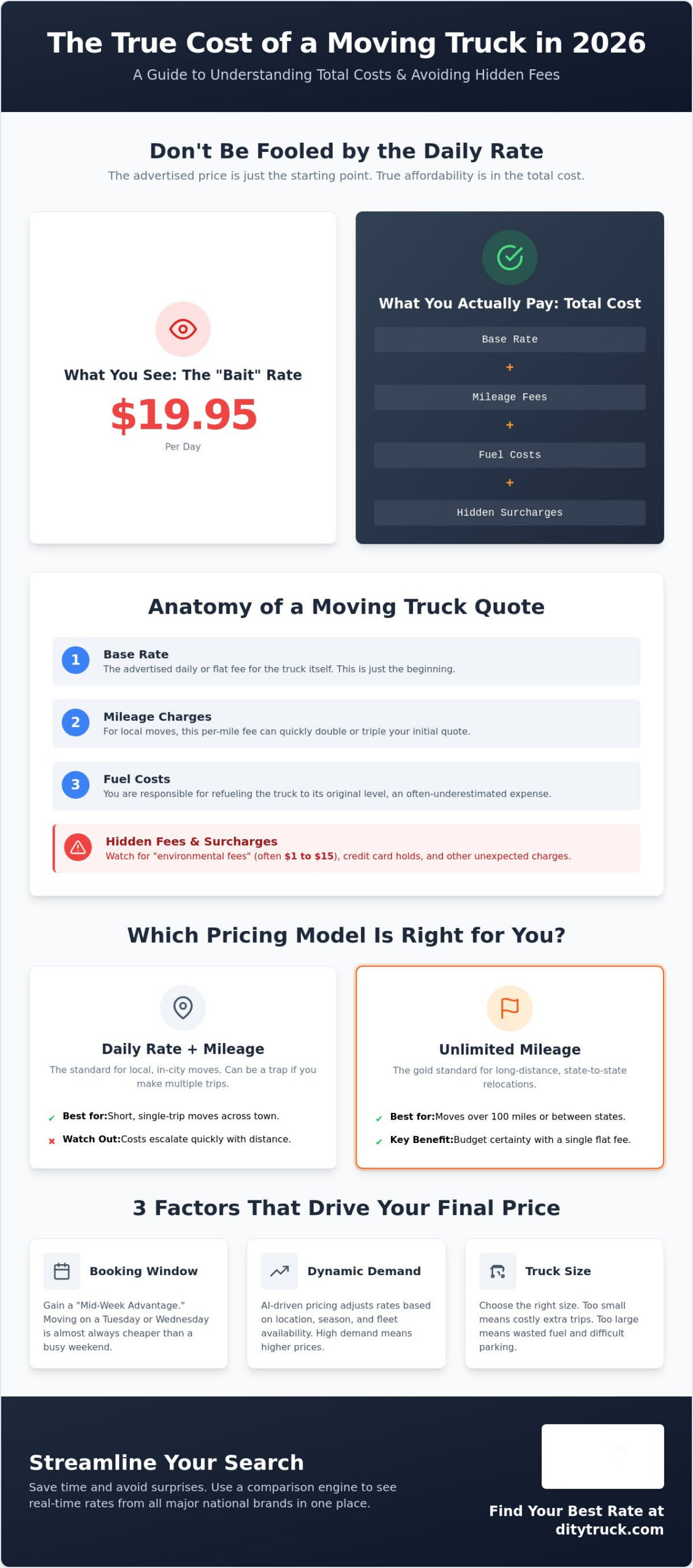
    True affordability isn’t found on a billboard. It’s found in the fine print. Many people start their search by looking for the lowest daily number. They see a $19.95 sticker and assume they’ve found a bargain. But when you compare moving truck rental prices, you’ll see that the base rate is only one piece of the puzzle. A low daily rate often masks high per-mile charges. For local moves, these mileage fees can quickly double your expected cost. You need to look at the total cost of ownership. This includes the rental fee, mileage, fuel, and mandatory surcharges. It’s a calculation, not just a quote.

    In 2026, pricing models favor the prepared. Booking early or staying flexible with your dates can lead to significant savings. The size of the truck also plays a massive role in efficiency. A truck that’s too small requires multiple trips, which doubles your mileage costs. A truck that’s too large wastes fuel and is harder to park. Finding the “Goldilocks” size is the first step toward a truly affordable move. It ensures you only pay for the space you actually use.

    The Anatomy of a Moving Truck Quote

    A moving quote has several layers. The base rate covers the truck itself for a set period. Then come the variable costs. Local moves usually follow a “daily plus mileage” structure. One-way moves often use a flat rate that includes a specific mileage allowance. Be wary of “loss leader” pricing. This is a tactic where a company advertises an impossibly low rate to get you in the door. Once you’re there, they add on environmental fees, which can range from $1 to $15. Understanding what to know about moving companies helps you spot these tactics before you sign a contract. Always look for the “estimated total” rather than the starting price to avoid surprise costs at the rental counter.

    Why National Availability Affects Your Price

    Prices fluctuate based on where the trucks are located. If everyone is moving out of a city, the cost to rent a truck there will skyrocket. If you’re moving into that same city, you might find a massive discount. The company needs their equipment returned to high-demand areas. Fleet distribution is the invisible hand behind your quote. 2026 pricing models rely heavily on dynamic pricing. This means rates change in real-time based on supply and demand; to learn more about how this technology manages rate automation, visit RateHighway. Booking a truck in a high-demand window, like a holiday weekend, will always increase your quote. National comparison tools help you compare moving truck rental prices across different regions to bypass local price spikes. They let you see the big picture so you can choose the most logical path for your budget.

    How to Compare Moving Truck Rental Prices Across Major Models

    Choosing the right pricing model is the fastest way to slash your moving expenses. Most providers offer two distinct structures. The “Unlimited Mileage” model is the gold standard for long-distance, state-to-state moves. You pay a flat fee that covers the truck and the distance, which simplifies your budget. On the other hand, the “Daily + Mileage” model remains the standard for local, same-city relocations. It’s often cheaper for a quick trip across town, but those per-mile fees can become a trap if you’re making multiple runs. To truly compare moving truck rental prices, you must project your total distance accurately before committing to a model.

    Local vs. Long-Distance Pricing Structures

    The “break-even” point is where a flat-rate one-way quote becomes cheaper than paying by the mile. If your move exceeds 100 miles, the mileage-based model usually loses its appeal. It’s also vital to realize that moving truck rental prices fluctuate based on your specific drop-off location. If you are moving to a city with a truck shortage, your rate will be higher. Checking one-way availability even for shorter regional moves can sometimes unlock lower rates because companies want to rebalance their fleets. Always verify your provider’s credentials through official channels to protect yourself from moving fraud and ensure you are dealing with a legitimate operation.

    Dynamic Pricing in 2026: When to Book

    In 2026, AI-driven pricing engines adjust rental rates by the hour. These systems track demand, weather, and fleet availability to maximize profits during peak moving season. To beat the algorithm, aim for the “Mid-Week Advantage.” Moving on a Tuesday or Wednesday is almost always more affordable than a Friday or Saturday. Last-minute bookings are the biggest threat to your moving budget. Waiting until the final week can result in a 30% price hike or, worse, no truck at all. If you want to see how these variables impact your specific trip, you can compare real-time rates across multiple providers instantly. Don’t forget to ask about specialized discounts for AAA members, military personnel, or students, as these can often be stacked on top of existing promotions.

    Compare Moving Truck Rental Prices: The 2026 Guide to Affordable Moving Trucks

    Exposing the Hidden Fees: What “Cheap” Quotes Often Hide

    A “cheap” quote is often just the beginning. When you compare moving truck rental prices, the initial number rarely accounts for the mandatory extras that appear at checkout. Environmental fees are standard across most brands. These cover hazardous waste disposal and emissions compliance. They typically range from $1 to $15 per rental. State-mandated taxes also vary. A quote in one state might look better than another simply because of local tax laws. You must look past the banner ads to find the real price. It is the only way to avoid a surprise bill on moving day.

    Financial transparency is key. You should also watch out for credit card holds. Even an “affordable” rental can temporarily tie up hundreds of dollars. This isn’t a final charge; it just limits your available cash during a move. Fuel surcharge traps are another common pitfall. If you don’t return the tank to the agreed-upon level, companies often charge a premium per gallon. This rate is usually double the local pump price. They might also charge a “refueling fee” just for the labor of driving the truck to a station. When you compare moving truck rental prices, always ask about the grace period for returns. Being just one hour late can trigger a full extra day of rental fees. Some brands don’t offer a grace period at all. This turns a small delay into a major expense.

    Insurance and Protection Plans

    Your personal auto insurance might not cover a large commercial vehicle. Most policies exclude trucks over a certain weight. This makes supplemental protection a common necessity. You can compare top moving truck rental companies to see which ones offer the best balance of coverage and cost. Skipping this protection to lower your moving truck rental cost is a high-risk gamble. A single scratch on a 26-foot box truck can cost more than the rental itself. Damage waivers protect your wallet from these sudden expenses. They provide peace of mind during a high-stakes drive.

    Equipment and Accessory Rental Costs

    Convenience has a price. Dollies, ramps, and furniture pads are rarely included in the base rate. Renting these items can add a notable amount to your bill. It is often cheaper to buy your own supplies if you plan to move again. Specialized equipment like car trailers or tow dollies also impacts your total rate. These additions change the weight and fuel efficiency of your vehicle. They also require specific hitch setups that might cost extra. Always factor these accessories into your final budget before you finalize your booking. This ensures you have a complete picture of the total cost.

    Your 2026 Resource Checklist for Finding Affordable Moving Trucks

    Preparation is the only way to beat the algorithm. Most renters wait until the last minute and pay a premium for whatever inventory is left on the lot. To find a truly budget-friendly solution, you must follow a systematic process. This checklist ensures you don’t miss the small details that turn a “cheap” rental into an expensive ordeal. Use this framework to compare moving truck rental prices with total clarity and confidence.

    • Step 1: Inventory your move. Walk through every room. Count the large furniture pieces and estimate the number of boxes. Don’t guess. Accurate volume data is the foundation of a good quote.
    • Step 2: Use a comparison engine. Don’t visit ten different websites. Use a tool that pulls real-time rates from major brands into one view. This highlights the price gaps between providers instantly.
    • Step 3: Factor in the “hidden” variables. Look at fuel economy ratings for different models. Check the cost of supplemental insurance. These daily expenses often outweigh a small difference in the base rental rate.
    • Step 4: Verify logistics. Check the exact pickup and drop-off locations. Some “affordable” quotes are only cheap because the lot is 30 miles out of your way. That extra driving adds mileage and fuel costs.
    • Step 5: Secure your rate. Once you find a price that works, book it. In the 2026 market, rates can climb overnight as fleet availability drops.

    Choosing the Right Size to Save Money

    Renting a truck that is too small is the most expensive mistake you can make. If you can’t fit everything in one trip, you are forced to drive double the miles. This doubles your fuel consumption and mileage fees. For three-bedroom homes or larger, understanding the cost to rent a 26 foot moving truck is essential. These larger vehicles allow for a single trip, which is almost always more efficient than making two runs in a smaller 16-foot truck. “Oversizing” slightly gives you a safety margin for oddly shaped items and prevents the stress of a packed-to-the-ceiling load.

    Verification Checklist Before You Sign

    The final contract is where the real costs are settled. Always check for “hidden” mileage caps on one-way rentals. Some companies offer a low flat rate but charge heavily if you deviate from the most direct route. You should also verify the fuel type. Diesel trucks often get better mileage for heavy loads, but diesel fuel can be more expensive at the pump. Finally, confirm the cancellation policy. Moving dates often shift. Having the flexibility to change your reservation without a massive penalty protects your budget from the unexpected. You can compare moving truck rental prices and book your equipment with full transparency today.

    Streamline Your Search: Compare and Book with DityTruck

    Manual price hunting is a relic of the past. You don’t have time to sit with ten browser tabs open while cross-referencing mileage rates and base quotes. DityTruck acts as your personal logistics assistant. We do the heavy lifting behind the scenes. Our platform aggregates real-time data from the top national providers. This gives you an immediate, side-by-side view of the entire market. When you compare moving truck rental prices through our interface, you’re seeing the most current rates available in 2026. No delays. No guesswork. You get the facts you need to make a decision right now.

    Simplicity is our priority. We’ve stripped away the complexity of traditional booking. Instead of navigating confusing corporate websites, you get a clean and functional dashboard. This “Smart Assistant” approach ensures you find the most logical path between your current home and your next one. You can move from comparison to confirmation in minutes. It’s about saving your time and your peace of mind. Seeing the full market in one place gives you the confidence that you haven’t missed a better deal elsewhere. You avoid the friction of manual searches. You gain the clarity of a professional tool.

    Our technology monitors fleet availability across the country. This means the prices you see are accurate to the minute. You don’t have to worry about a quote disappearing while you’re trying to find a phone number. Everything is centralized. Everything is fast. The process follows a clear action-result progression. You search. You compare. You book. This speed mirrors the physical act of moving. It keeps you in motion and prevents the stagnation that comes with over-analyzing fragmented data from multiple sources. You stay in control of your timeline and your budget.

    The DityTruck Comparison Advantage

    Transparency is the core of our service. Most sites hide fees until the final checkout screen. We don’t. Our displays include the environmental fees and surcharges that others bury in the fine print. This makes finding the least expensive moving truck rental options straightforward and honest. We cover the entire United States. Whether you’re moving three blocks or three states away, our national network has you covered. You get the same efficient experience regardless of your destination. It’s the shortest route to a stress-free relocation budget. You see the total cost upfront. You avoid the sticker shock that ruins moving day.

    Ready to Move? Your Next Steps

    Starting your search is easy. Just enter your zip codes and moving dates into our tool. The system instantly scans available inventory across all major brands. You’ll see a ranked list of options based on total cost. This includes the base rate and estimated mileage. Once you find the right fit, you can finalize your reservation immediately. This locks in your 2026 rates before dynamic pricing causes them to spike. Don’t let your moving budget be a victim of demand fluctuations. Take control of your logistics right now. We provide the most direct path to an affordable DIY move. Find your affordable moving truck on DityTruck today!

    Take Control of Your 2026 Relocation Budget

    Finding a budget-friendly truck requires looking past the sticker price. You now understand how to spot hidden environmental fees and fuel traps before they impact your bank account. You also know that selecting the correct truck size prevents expensive second trips. The most efficient way to compare moving truck rental prices is to use a tool that aggregates the entire market into one transparent view. This eliminates the need for manual searches. It ensures you find the best value for your specific route without the typical logistics headache.

    DityTruck provides real-time rates from all major US providers through a no-nonsense interface. You get transparent pricing with no hidden surprises. This design allows for rapid decision-making so you can focus on the move itself rather than the paperwork. Our smart assistant approach does the heavy lifting for you. You deserve a move that is simple, honest, and affordable.

    Compare Real-Time Moving Truck Rates Now

    Your DIY move doesn’t have to be a financial mystery. Take the first step toward a friction-free relocation today and move with confidence.

    If your relocation involves flying into or out of the Twin Cities, arranging a professional MSP Chauffeur Service ensures that your airport transportation is as seamless as your truck rental.

    Frequently Asked Questions

    How do I truly compare moving truck rental prices between different companies?

    You must calculate the total cost of ownership to effectively compare moving truck rental prices across different brands. A low base rate often hides high per-mile charges. Use a centralized platform to view all fees, mileage estimates, and insurance costs in one dashboard. This approach prevents you from visiting multiple websites and manually calculating the final bill yourself. It provides the clarity needed for a fast decision.

    What is considered an affordable moving truck rate for a local move in 2026?

    A median cost of $113 is a standard benchmark for an affordable local move in 2026. This price usually covers a medium-sized truck with a base rate between $19.95 and $39.95 per day. You should also account for mileage fees, which typically range from $0.59 to $1.39 per mile. Prices vary based on your specific location and the truck size you select for your trip.

    Are there hidden fees I should look for when renting a moving truck?

    Environmental fees and fuel surcharges are the most frequent additions to your final bill. Most companies charge an environmental fee between $1 and $15 for hazardous waste disposal and emissions compliance. You should also watch for refueling penalties. If you don’t return the tank to the agreed level, you’ll pay a premium per gallon that is often double the local pump price.

    Is it cheaper to rent a truck one-way or return it to the same location?

    Round-trip rentals are more cost-effective for same-city moves where you return the truck to the starting point. For long-distance relocations, one-way rentals are the logical choice. Some providers offer unlimited mileage on many one-way routes. This eliminates the fear of going over a set distance limit and receiving a surprise charge at the end of your trip. It simplifies your moving budget.

    Which moving truck company has the best gas mileage?

    Modern diesel trucks typically provide the best fuel efficiency for heavy, long-distance hauls. While gas trucks are common for local moves, they often consume more fuel when fully loaded. You can improve your mileage by maintaining a steady speed and avoiding rapid acceleration. Always check the fuel type before you leave the lot so you can budget for current pump prices and avoid refueling errors.

    Can I get a lower price by booking my moving truck on a specific day of the week?

    Booking your rental for a Tuesday or Wednesday is the most reliable way to secure a lower price. Demand for trucks peaks on weekends and during the last few days of the month. Rental companies use dynamic pricing to raise rates when inventory is low. Scheduling your move during the middle of the week helps you bypass these predictable price hikes and ensures better equipment availability.

    Does my personal car insurance cover a rental moving truck?

    Personal auto insurance rarely covers large rental trucks due to their weight and commercial classification. Most standard policies only apply to passenger vehicles like sedans or SUVs. You should contact your insurance agent to confirm your specific limits before your move. If your policy doesn’t cover the truck, purchasing supplemental insurance between $14 and $50 per day is a necessary step for your protection.