Category: Uncategorized

  • Budget Cargo Van Rental: 2026 Comparison & Savings Guide

    Budget Cargo Van Rental: 2026 Comparison & Savings Guide

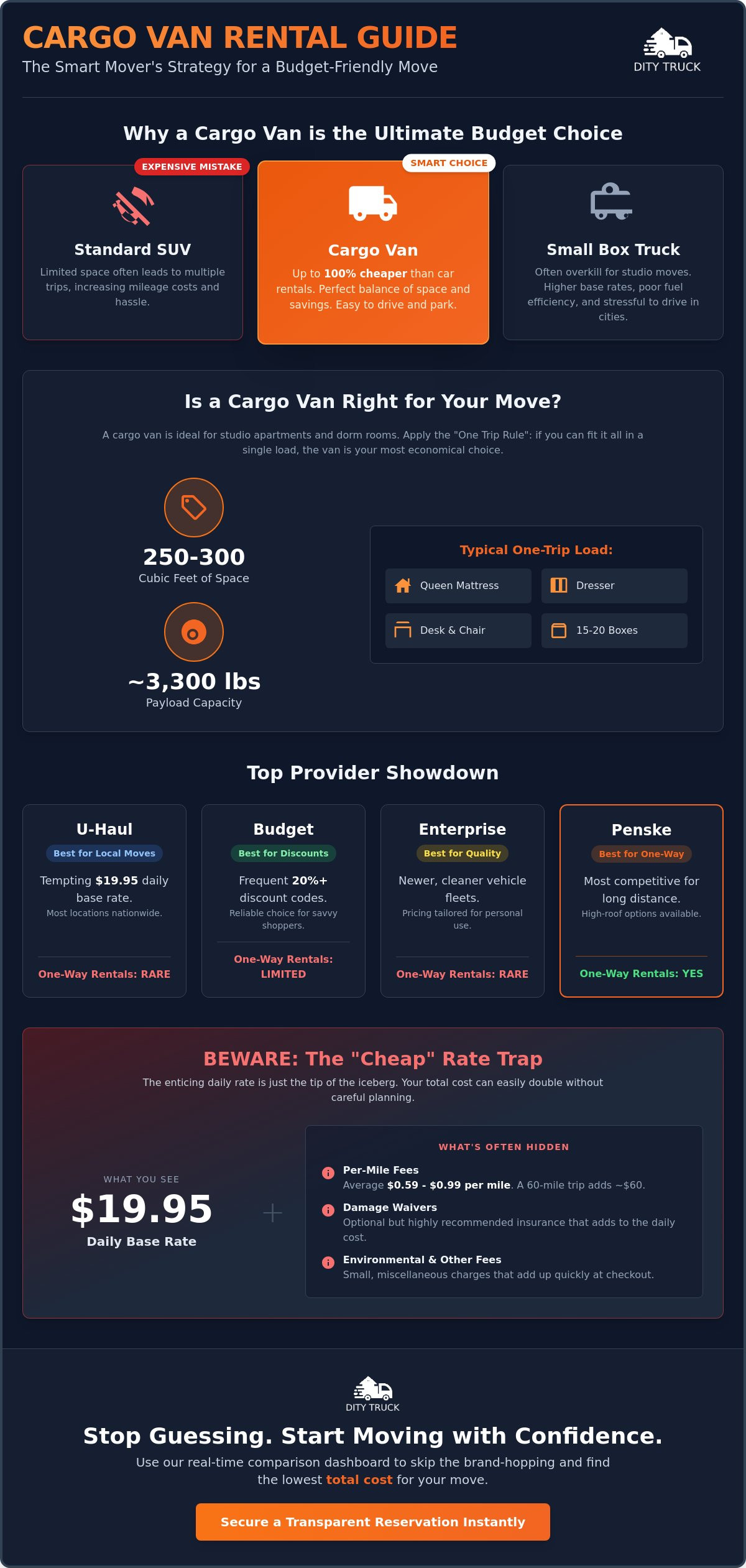
    Renting a standard SUV for your small move might seem like the easy choice, but it’s often the most expensive mistake you can make. On average, a cargo van rental is 100% cheaper than a traditional car rental. You likely already know the frustration of staring at a quote that looks affordable until the opaque mileage fees and insurance add-ons start piling up. It’s confusing to navigate the split between car and truck rental divisions when you just need a reliable budget cargo van rental that fits your furniture. You need clarity, not a math project.

    We’ve done the heavy lifting for you. This 2026 guide compares the industry’s top providers side-by-side to reveal the lowest total cost for your specific trip. You’ll learn which brands offer the best flat rates versus mileage-based pricing and see a clear winner for the cheapest daily rate. We will help you confirm a reservation at a transparent price. You can stop worrying about the bill and start moving with confidence. This is the shortest path between your current stress and a successful move.

    Key Takeaways

    • Cargo vans are the most cost-effective solution for studio apartments and dorm moves—providing the space you need without the high price of a box truck.
    • Compare top providers side-by-side to find a budget cargo van rental with the lowest total cost rather than just the lowest base rate.
    • Identify hidden “cheap” traps like damage waivers and environmental fees that can double your daily rate if not accounted for upfront.
    • Learn the “One Trip” rule to determine if 250 cubic feet of space is sufficient for your load or if a larger vehicle is actually the cheaper choice.
    • Use a real-time comparison dashboard to skip the manual brand-hopping—catch price drops as they happen and secure a transparent reservation instantly.

    Why a Cargo Van is the Ultimate Budget Moving Strategy

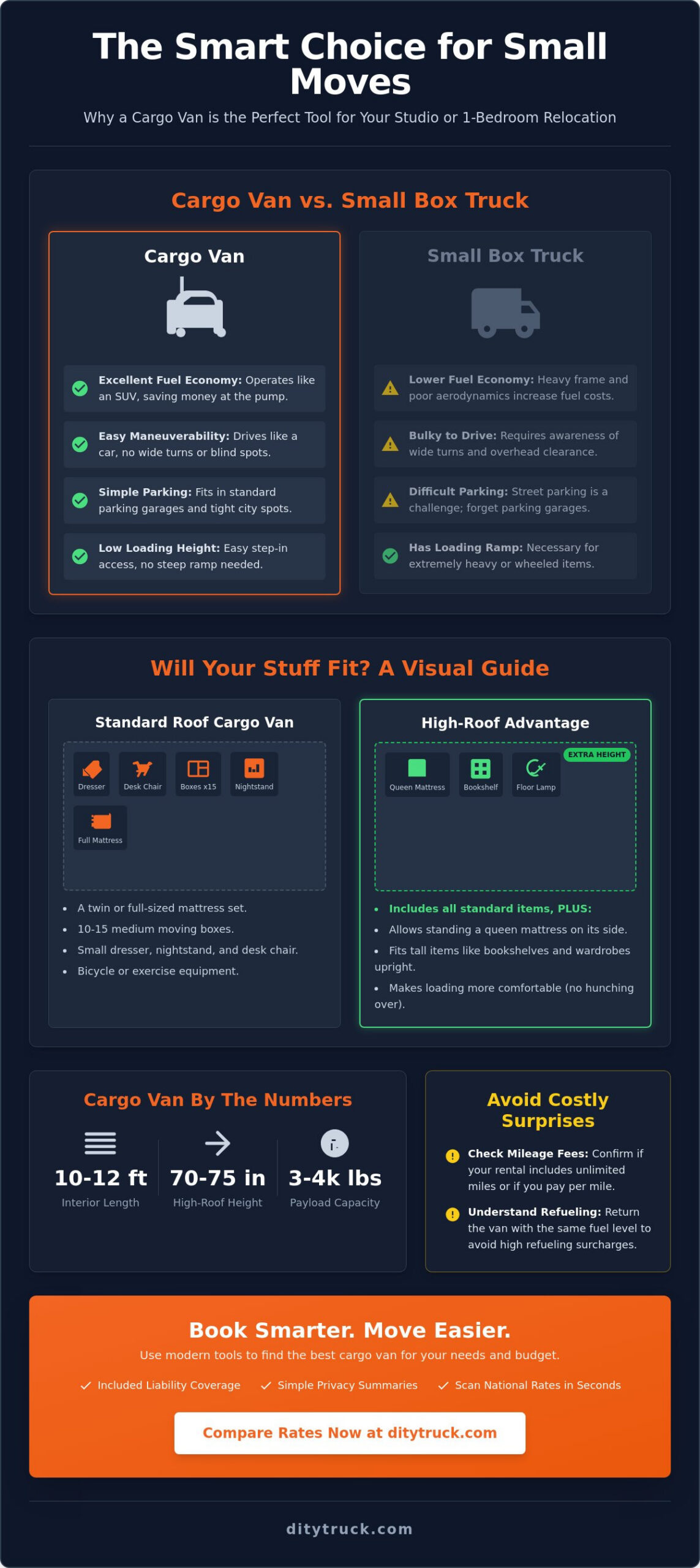
    Choosing the right vehicle changes your entire moving day. Most people default to a large box truck. This is often overkill for small moves. A budget cargo van rental is the secret weapon for studio apartments, dorm rooms, and single-room hauls. It provides the perfect balance of space and savings. You avoid the high costs and logistical hurdles of hiring a full-service Moving company. It’s DIY moving at its most efficient. You get the utility you need without paying for empty space you won’t use.

    Driving a massive truck is stressful. Narrow city streets and low-hanging branches become immediate hazards. Cargo vans solve this problem. They handle like a standard SUV or large minivan. You can navigate tight alleys and parallel park with ease. This “zero-stress” driving experience is vital for first-time renters. You focus on your belongings, not the fear of clipping a mirror or getting stuck in a parking garage. The result is a faster move and a lower heart rate. It’s the simplest path from point A to point B.

    Cargo Van vs. Small Box Truck: The Cost Gap

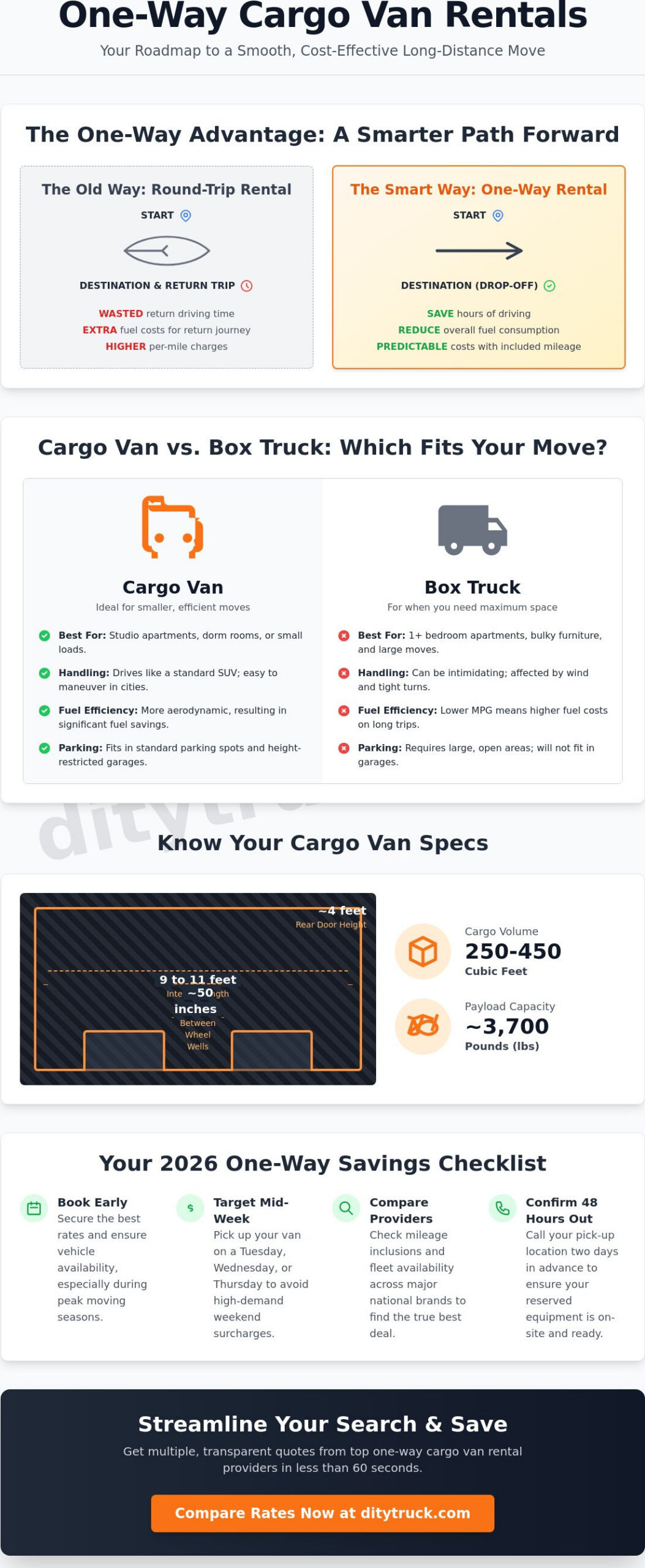
    The financial advantage starts with the base rate. Securing a budget cargo van rental often provides a lower daily price than even the smallest 10-foot box trucks. The savings don’t stop there. Fuel efficiency is the real winner. Box trucks have the aerodynamics of a brick. Cargo vans are designed for the road. You get significantly better miles per gallon. This reduces your total spend at the gas station. Parking is another hidden cost-saver. You won’t face “oversized vehicle” surcharges in urban lots. You won’t get hit with tickets for blocking traffic while you search for a massive loading zone. Every mile driven in a van puts more money back in your pocket. For a deeper look at how these two vehicle types stack up on capacity, maneuverability, and total costs, see our full cargo van vs box truck comparison guide.

    When a Cargo Van is the Right Choice

    Success depends on knowing your volume. The sweet spot for a cargo van is between 250 and 300 cubic feet of cargo space. This is enough for a queen-sized mattress, a desk, a dresser, and about 15 to 20 medium boxes. It’s the ideal choice for college students or residents moving out of a furnished studio. If you can fit your life into one load, the van is your best bet. If you need two trips, the mileage fees might eat your savings. Check your weight before you load. 2026 cargo van models typically feature a payload capacity of approximately 3,300 pounds. This allows you to transport heavy appliances or dense furniture without exceeding the vehicle’s safety limits. A balanced van is a safe van.

    Comparing Top Budget Cargo Van Providers Side-by-Side

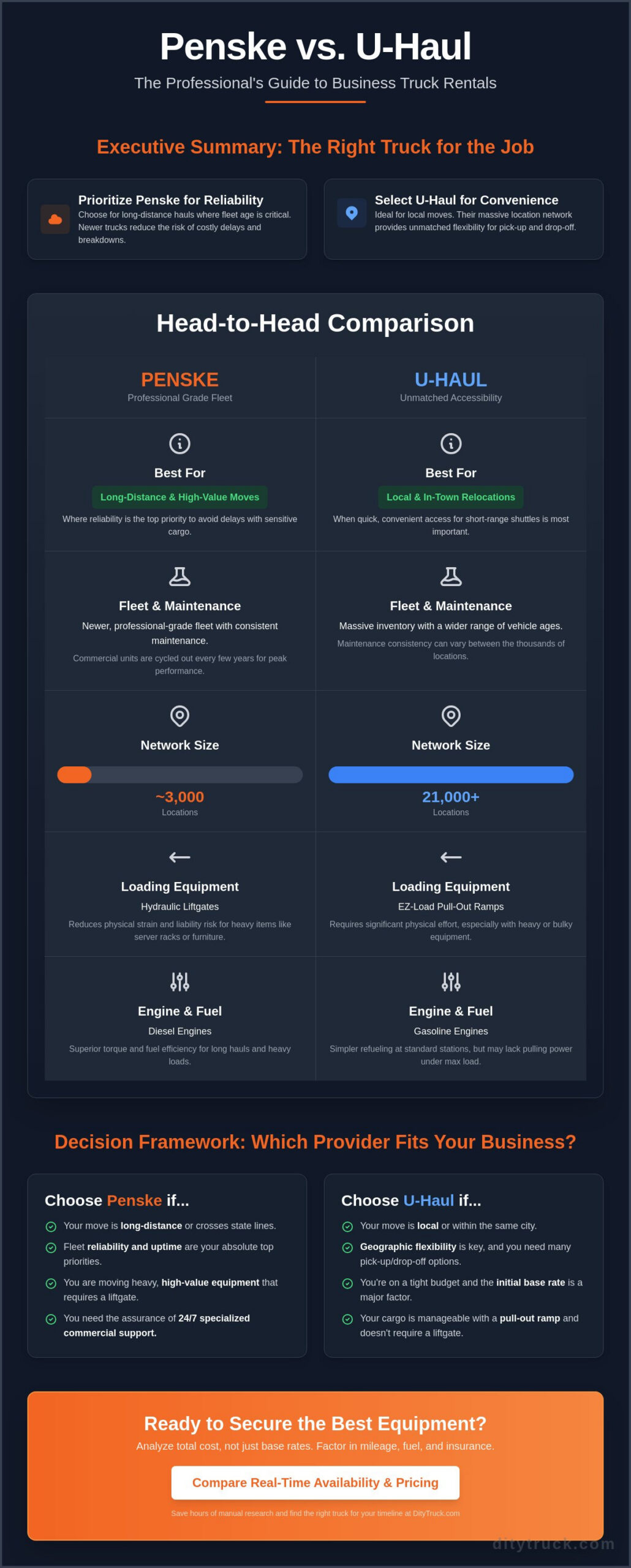
    Finding the right brand isn’t about loyalty. It’s about the bottom line. Every major provider has a specific strength. U-Haul is the giant in the room. They offer the most locations and a tempting $19.95 daily base rate for local moves. It’s the baseline for the industry. Budget Truck Rental is the go-to for savvy shoppers. They offer frequent discount codes that can slash 20% or more off your total. It’s a reliable choice for local hauls. You get a familiar experience with a focus on affordability.

    Enterprise Truck Rental operates differently. They prioritize newer, cleaner fleets. Their pricing structures are often tailored for longer personal use rather than just quick hourly moves. Then there’s Penske. Many people overlook them for a budget cargo van rental. That’s a mistake. Penske is often the most competitive option for one-way, long-distance moves. They offer high-roof options that provide more space than a standard van. Choosing the wrong provider means paying for services you don’t need. It’s about matching the tool to the task.

    Daily Rates vs. Mileage Fees: The Great Divide

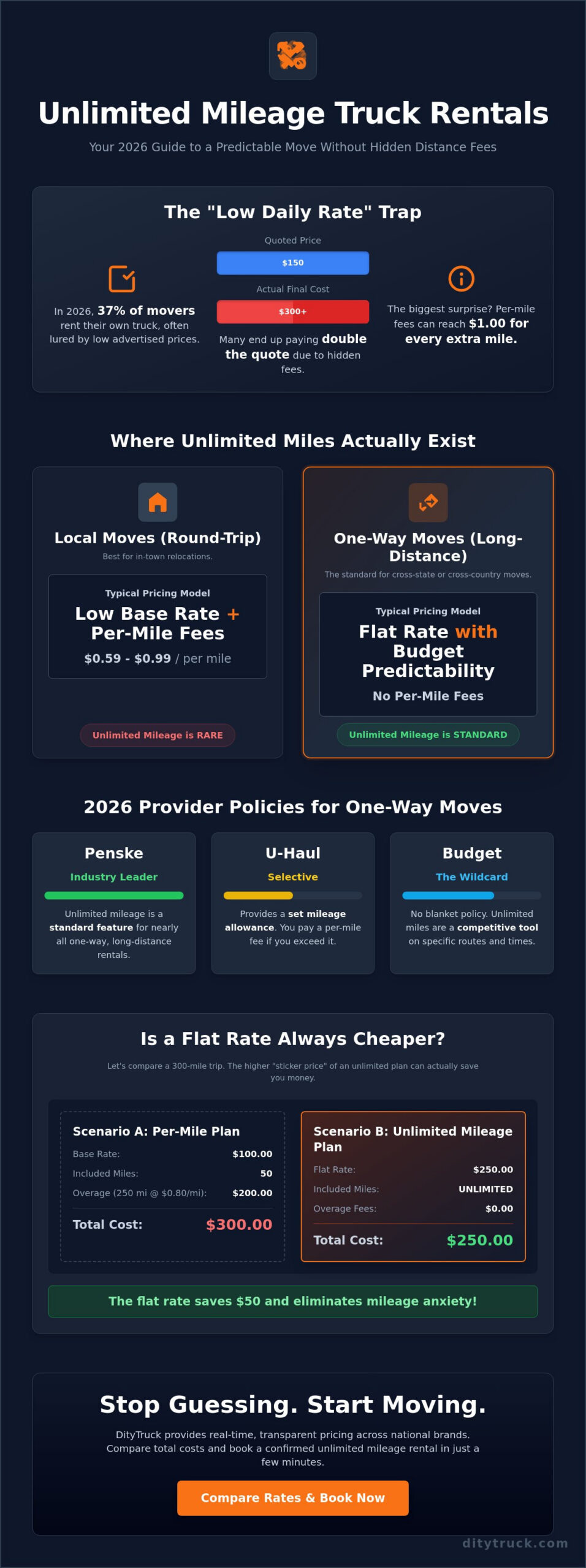
    The “Low Base Rate” trap is real. That $19.95 sticker price is just the beginning. It rarely reflects the final bill. You have to account for the average per-mile fee. Most top providers charge between $0.59 and $0.99 per mile. If your round trip is 60 miles, you’ve already added nearly $60 to that “cheap” rate. Budget’s pricing model often rewards short-distance local moves. Enterprise may have a higher daily rate but offers different mileage packages. Understanding your consumer rights in moving ensures you aren’t surprised by these line items at checkout. Always calculate the total cost based on your estimated distance.

    Availability and One-Way Rental Options

    One-way rentals are the biggest hurdle in the van market. U-Haul generally keeps their cargo vans for local, round-trip use only. If you need to drop the van in a different city, Penske is your best bet. They are one of the few brands that consistently allow one way cargo van rental moves. Be careful with “drop-off fees” from other providers. These fees can be hundreds of dollars, instantly destroying your budget. You don’t have to visit five different websites to check these rules. You can compare all major providers through a single dashboard. This gives you a clear view of who has a van available and who allows the drop-off you need. It’s the fastest way to book with confidence.
    Budget Cargo Van Rental: 2026 Comparison & Savings Guide

    The “Cheap” Trap: Decoding Hidden Fees and Total Rental Costs

    A low base rate is a marketing tool. It isn’t your final total. You must look at the line items that appear at the final confirmation screen. A budget cargo van rental can quickly double in price if you ignore the fine print. Using a comprehensive moving checklist helps you track these variables before you hand over your credit card. Transparency is your best defense against a bloated bill. You want a clear price, not a surprise at the counter.

    Understanding Rental Insurance Options

    Most personal auto policies don’t cover commercial vehicles. Cargo vans often fall into this category. Credit cards usually exclude them from their rental insurance benefits as well. Verify your specific coverage for 2026 models before declining the counter offer. Collision Damage Waivers (CDW) are common. They protect you from high repair costs but add a significant daily fee. Basic liability is the legal minimum. It might not cover the items inside the van. Protecting your deposit and your peace of mind is worth the extra few dollars. It’s about eliminating risk from your move.

    Calculating the Real Price Per Mile

    Distance is the biggest variable in your total cost. A 50-mile move at a standard rate adds a manageable amount to your bill. A 100-mile move can cost more in mileage than the actual daily rental rate. Weekend moves are the most expensive. High demand often drives up the per-mile cost on Saturdays and Sundays. In a standard 2026 rental agreement, mileage fees are calculated by multiplying the recorded odometer difference by a fixed per-unit rate that is determined at the time of reservation. Plan your route carefully. Avoid unnecessary detours to keep your mileage low. Efficiency saves money.

    Don’t forget the “small” charges. Environmental fees and vehicle licensing recovery fees are standard across the industry. They look like small change, but they add up at checkout. Fuel is the easiest trap to avoid. Rental companies charge a massive premium to refill the tank for you. It’s often double the local pump price. Return the van with the exact fuel level you started with. It takes five minutes at a gas station to save twenty dollars.

    Keep the interior clean. Muddy floors or leftover packing tape can trigger a cleaning fee. These charges are steep. Late returns are even worse. Most brands charge a full extra day if you’re even an hour behind schedule. Set a timer on your phone. Give yourself a 30-minute buffer for traffic. Staying organized ensures your budget cargo van rental actually stays within your budget.

    Sizing Up Your Load: Is a Cargo Van Actually Enough?

    Visualizing 250 cubic feet is difficult until you’re standing in front of the open rear doors. It’s roughly the size of a small walk-in closet. You can comfortably fit a queen-sized mattress, a dresser, and about 20 medium-sized boxes. However, you must be strategic with your budget cargo van rental space. Every inch counts. Use the “One Trip” rule to guide your decision. If your move requires two trips in a van, you’re likely wasting money. The extra mileage fees for a second round trip often exceed the higher base rate of a 10-foot truck. Finishing in one go is the most efficient way to protect your budget.

    Loading is easier in a van because of the low deck height. Most models sit just 29 inches off the ground. You don’t need a steep ramp to move heavy items. Use a bottom-heavy stacking strategy. Place your heaviest furniture on the floor to lower the center of gravity. Fill the gaps between furniture legs with soft items like bags of clothes or pillows. This prevents shifting during transit. For a full breakdown of dimensions across different vehicle types, consult our what size moving truck do I need guide. It will help you decide if a van truly meets your needs.

    The Studio Apartment Litmus Test

    A queen mattress is 80 inches long. Most cargo van floors offer about 120 inches of length. It fits, but it takes up the majority of the floor space. You’ll need to stack your boxes on top of or around the mattress. High-roof models are the better choice for studio moves. They offer up to 450 cubic feet of space, allowing you to stand items vertically. Large appliances like refrigerators are the deal-breaker. A standard fridge will fit, but it leaves almost no room for a bed or sofa. If you have more than one major appliance plus a full room of furniture, it’s time to upgrade to a box truck. Don’t force a fit that isn’t there. Our cargo van vs box truck guide can help you make that call with confidence.

    Weight and Payload Capacity

    Volume tells only half the story. You must respect the vehicle’s Gross Vehicle Weight Rating (GVWR). Most 2026 cargo vans have a payload capacity of approximately 3,300 pounds. Exceeding this limit is a major safety risk. Overloading strains the engine and significantly increases your braking distance. It also destroys your fuel economy, which raises your total cost at the pump. A van packed with dense items like book collections or weight sets handles differently than an empty one. Safety should always come before saving a few dollars. Compare van and truck sizes instantly to ensure you book a vehicle that can safely handle your specific load.

    How to Secure the Lowest Cargo Van Rate with DityTruck

    Stop wasting your afternoon on dozens of browser tabs. Every major provider has its own site, its own login, and its own hidden fees. DityTruck strips away this complexity. We aggregate every top brand into one efficient dashboard. You get a direct view of the market without the marketing fluff. This is the smartest way to find a budget cargo van rental that actually fits your bank account. Real-time rate updates ensure you never miss a price drop. If a provider slashes their rates for a low-traffic Tuesday move, you’ll see it first. Efficiency is the key to savings.

    Logistics shouldn’t be a mystery. We provide a clear path to the lowest total cost. Our platform allows you to adjust your dates on the fly. Sometimes moving 24 hours earlier can save you a significant percentage on the daily rate. We make these patterns visible. You gain the power of a savvy consumer advocate without doing the heavy lifting yourself. It is about transparency. You see the total bill before you ever reach for your wallet. You get relief from the typical rental headache. It is simple. It is fast.

    The Benefits of Using a Comparison Service

    Comparison shopping usually feels like a chore. We make it a strategy. Our results are unbiased. We don’t favor one brand over another; we favor your bottom line. You see the lowest rate immediately. There is no guesswork. You save hours of manual research and prevent the frustration of missing a better deal elsewhere. For those planning a larger relocation beyond a studio, check our moving truck rental pillar for a full comparison of larger fleet options. We provide the data. You make the choice. It is the shortest distance between your problem and a resolution.

    Booking Your Budget Van in 3 Simple Steps

    Simplicity is our priority. You shouldn’t need a manual to book a vehicle. Start by inputting your dates and move type. Choose between local round-trips or one-way hauls. Our system scans every available budget cargo van rental in your zip code instantly. Next, filter your results. Select “Cargo Van” to isolate the cheapest units in your area. You can compare high-roof models against standard vans side-by-side. Finally, confirm and save. Enter your details to receive an instant booking voucher. You see the total cost upfront. No hidden mileage surprises. No last-minute fees that weren’t in the quote. You get a transparent price and a confirmed reservation. This is logistics made easy. Take control of your moving costs. Find the cheapest cargo van rental for your move today!

    Lock in Your Moving Savings Today

    Moving day shouldn’t be defined by financial surprises. You now have the tools to avoid the “low base rate” trap and calculate a true total cost. Successful moves depend on matching your cargo volume to the right vehicle and dodging unnecessary mileage fees. A smart budget cargo van rental strategy turns a high-stakes task into a manageable win. You focus on the transition. We handle the logistics. Clarity is the ultimate relief.

    Skip the endless tabs and opaque pricing. DityTruck provides real-time rate comparisons with national coverage across all major brands. You see the full price immediately. There are no hidden booking fees to inflate your final bill. It is the smart assistant you need to perform the heavy lifting behind the scenes. This platform is the shortest, most logical path to a stress-free move. Compare and Book Your Budget Cargo Van Rental Now and secure your reservation with total confidence. Your move is almost complete. You’ve got this.

    Frequently Asked Questions

    What is the average cost of a budget cargo van rental for a day?

    Most providers offer a daily base rate starting between $19.95 and $29.99 for local moves. This sticker price is just the starting point for your budget. Total costs usually increase once you factor in mileage, taxes, and environmental fees. Always check for seasonal discounts or promo codes to lower this base rate even further. Comparing total costs upfront is the only way to find the true winner for your specific move.

    Do I need a special license to drive a rental cargo van?

    You don’t need a Commercial Driver’s License to operate a standard cargo van. A valid, standard driver’s license is sufficient for almost all consumer rentals. Ensure your license is current and includes a clear photo. Some providers may require a secondary form of identification or a major credit card to secure the vehicle at the time of pickup. It is a straightforward process that mirrors renting a standard passenger car.

    Can I rent a cargo van for a one-way move?

    One-way options are limited for cargo vans compared to larger box trucks. Most major brands require these vehicles to be returned to the original pickup location. Penske is a notable exception that often allows one-way cargo van rentals for long-distance trips. Always confirm the drop-off policy during the booking process to avoid massive “wrong location” return fees. This detail is crucial for planning your route and your final budget.

    Is insurance included in the advertised “cheap” rental price?

    Insurance is almost never included in the base daily rate. The advertised “cheap” price reflects only the vehicle use. You will typically see options for Collision Damage Waivers or supplemental liability coverage added during checkout. Verify your personal auto policy or credit card benefits beforehand. Many standard plans exclude commercial-sized vans from their coverage. Paying for protection at the counter is often the safest path for a DIY move.

    How many rooms can fit in a standard cargo van?

    A standard cargo van is designed for a studio apartment or a single dorm room. It fits roughly 250 to 300 cubic feet of belongings. This typically includes a queen-sized mattress set, several large boxes, and a few pieces of smaller furniture. If you are moving a one-bedroom apartment or larger, you will likely need to upgrade to a box truck. Sizing your load correctly prevents the need for multiple expensive trips.

    What happens if I go over the mileage limit on my rental?

    Exceeding your mileage limit results in per-mile overage charges. These fees are usually clearly stated in your rental agreement and can range from $0.59 to $0.99 per mile. If you anticipate a long trip, look for a budget cargo van rental package that includes a higher mileage allowance or a flat daily rate. Tracking your odometer is vital for staying within your budget. It prevents a surprise bill at the end of your move.

    Are there age restrictions for renting a cargo van in 2026?

    Most rental companies require drivers to be at least 18 or 21 years old. Drivers under the age of 25 often face “Young Renter” surcharges that add to the daily cost. These age-related fees are standard across the industry and help cover higher insurance risks. Always bring a valid government-issued ID to prove your age and identity when you arrive at the rental counter. This ensures a smooth and fast pickup process.

    Does a cargo van get better gas mileage than a box truck?

    Cargo vans offer significantly better fuel efficiency than box trucks. Most modern models average around 18 miles per gallon. Even the smallest box trucks often struggle to reach 10 or 12 mpg due to their heavier weight and boxy aerodynamics. This improved efficiency directly reduces your total trip cost. It makes the van a superior choice for small-scale moves where fuel budget is a primary concern. You save money at every pump.

  • Cross Country Moving Truck Rental Deals: The 2026 Comparison Guide

    Cross Country Moving Truck Rental Deals: The 2026 Comparison Guide

    The cheapest quote on a rental website is almost never the final price you pay at the drop-off location. It’s a frustrating reality for anyone trying to secure cross country moving truck rental deals while managing a tight budget. You’ve likely spent hours toggling between tabs, only to find that mileage fees and environmental surcharges change the math every time you refresh. We know that finding a reliable truck shouldn’t feel like a gamble.

    We agree that transparency is the only way to move. You deserve a locked-in rate and a vehicle that won’t leave you stranded on the side of the interstate. This 2026 comparison guide promises to find you the absolute lowest rates by analyzing real-time deals across every major provider in one place. We’ll preview how to navigate one-way versus round-trip value, highlight specific 2026 promotional codes like Penske’s SUNNY26, and expose the surprise fees that usually hide in the fine print. It’s time to get your move started with total clarity and confidence.

    Key Takeaways

    • Understand why standard daily rates don’t apply to state-to-state moves. Learn to calculate the base, mileage, and fee structure to avoid sticker shock at the counter.
    • Decode the “unlimited mileage” myth. We break down how different providers structure their long-distance fees so you can choose the most cost-effective option for your specific route.
    • Find the absolute lowest cross country moving truck rental deals by comparing real-time inventory in one place. Use live data to secure a locked-in rate before you hit the road.
    • Identify the “Golden Window” for booking your truck. Strategic timing helps you avoid seasonal price hikes and surge pricing that often doubles the cost of summer moves.
    • Simplify the booking process with a transparent comparison of major providers. Focus on total value and vehicle reliability rather than just the initial sticker price.

    The Reality of Cross Country Moving Truck Rental Deals in 2026

    Moving across state lines in 2026 requires more than a map and a driver’s license. It requires a strategy to navigate the complex world of cross country moving truck rental deals. For rental providers, “cross-country” refers specifically to one-way agreements. You pick up a truck in one city and drop it off in another. This is a fundamentally different product than the local rental you use for a quick furniture pickup across town.

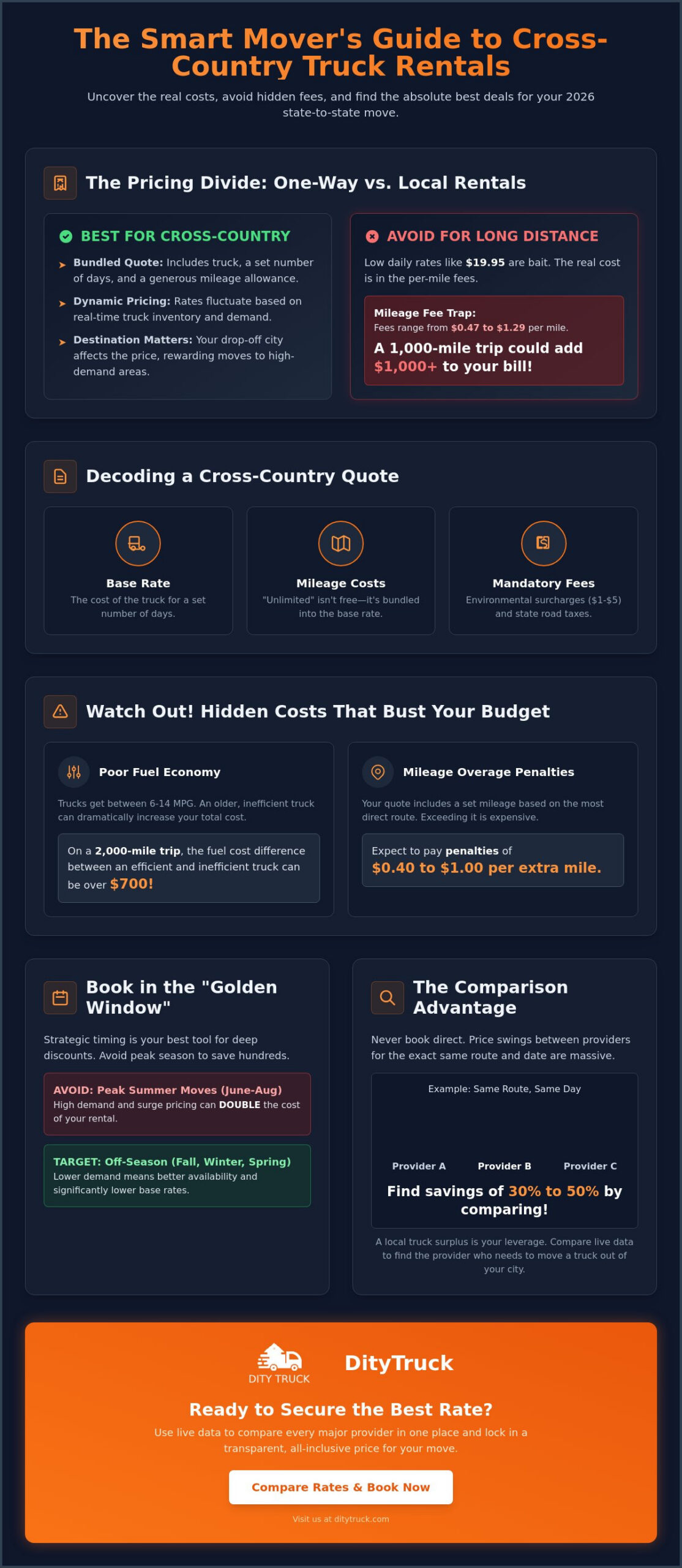
    Standard daily rates do not apply to these long-distance trips. For local moves, you might see a low base rate like $19.95. For state-to-state moves, companies bundle the truck, a specific number of days, and a mileage allowance into one flat quote. In 2026, these quotes are governed by aggressive dynamic pricing models. These models track truck inventory in real-time. If a city has too many trucks, prices drop to encourage rentals. If trucks are scarce, prices spike instantly.

    You also need to understand “deadhead” miles. This term describes the cost of moving empty trucks back to high-demand areas. If you are moving to a popular destination, the rental company knows that truck will be easy to rent again. If you are moving to a remote area, they may increase your rate to cover the cost of relocating that vehicle later. Your quote reflects the company’s need to balance its fleet across the country.

    One-Way vs. Local: The Pricing Divide

    Choosing a one-way rental is the only logical path for long distances. These contracts include set mileage and day limits based on your specific route. Your drop-off location is the primary factor in the initial deal you receive. Returning a truck to a high-demand hub often results in a lower overall cost. Finding the best cross country moving truck rental deals starts with acknowledging that your destination city matters as much as your pickup city. Avoid the temptation to use a local truck for a long trip. Local mileage fees range from $0.47 to $1.29 per mile. On a 1,000-mile move, those fees alone could exceed $1,000.

    Why Comparison is Non-Negotiable for Long-Distance

    Price swings between major brands are common. You might see a 30% to 50% difference for the exact same route on the same day. This happens because inventory is localized. A surplus in your origin city is your biggest leverage point. One brand might be desperate to move inventory out of your neighborhood while another is already sold out. This moving industry overview highlights that while DIY moving saves money, success depends on timing. The Comparison Advantage for 2026 movers is the tactical use of real-time inventory data to secure a lower rate when a provider has a surplus of trucks in your pickup city.

    Decoding Long-Distance Rates: Miles, Days, and Hidden Costs

    A cross-country quote consists of three main pillars: the base rate, mileage costs, and mandatory fees. These elements combine to create the final price you see at checkout. Understanding your consumer rights and responsibilities is the first step toward avoiding overpayment. Many providers advertise “unlimited mileage” for one-way moves. This isn’t exactly a gift. The cost of those miles is usually bundled into a higher base rate. You pay for the flexibility whether you use it or not. Companies also adjust these fees based on “Drop-off Demand.” If you leave a truck in a city where inventory is already high, expect a surplus fee to appear in the breakdown.

    Fuel economy is the largest variable in your total budget. Rental trucks typically get between 6 and 14 miles per gallon. On a 2,000-mile trip, the difference between a fuel-efficient late-model truck and an older gas-guzzler can cost you hundreds of dollars. Beyond gas, look for small surcharges that add up. Most companies charge an environmental fee between $1 and $5. State road taxes also apply based on your route. Finding the best cross country moving truck rental deals requires looking past the sticker price to see these operational costs.

    The Mileage Trap: When “Free” Isn’t Free

    Companies calculate “allowed” mileage by mapping the most direct route between your zip codes. They usually add a small buffer for detours or fuel stops. If you exceed this limit, expect per-mile penalties. These charges can range from $0.40 to nearly $1.00 per extra mile. Some brands offer capped mileage with a lower base rate. This works well if your route is straightforward. If you plan on taking scenic detours, the unlimited option provides better peace of mind. You can compare these mileage structures side-by-side to see which fits your specific itinerary.

    Insurance and Protection Plans

    Standard auto insurance rarely covers large commercial rental trucks. Credit card protection plans often exclude them too. Long-distance moves involve higher risks like highway fatigue and unfamiliar terrain. This makes a Collision Damage Waiver (CDW) or a similar protection plan essential. Some deals include basic liability in the quote. Others wait until the final booking screen to add it. Check the fine print early. Knowing exactly what is protected helps you avoid high-pressure sales tactics at the rental counter. Securing the right level of coverage ensures your cross country moving truck rental deals don’t turn into financial liabilities if an accident occurs.

    Cross Country Moving Truck Rental Deals: The 2026 Comparison Guide

    Top Providers for Cross-Country Moves: Who Offers the Best Value?

    Finding the best cross country moving truck rental deals requires looking past the first number you see on a brand’s homepage. Most websites only show their own inventory. They want you to believe their rate is the market standard. In reality, the “best” provider changes based on your specific route and the time of year. Total value isn’t just a low sticker price. It’s the combination of fuel efficiency, truck reliability, and location convenience. A cheap truck that breaks down in a remote area will cost you thousands in lost time and emergency labor.

    Evaluating the major players involves comparing Penske, Budget, and U-Haul against your specific needs. Each brand has a different strategy for interstate moves. Some focus on fleet reliability. Others prioritize having a drop-off location in every small town. You can find a deeper dive into these logistics in our One Way Truck Rentals for Moving: 2026 Comparison Guide. For 2026, the gap between the highest and lowest quotes for a 1,000-mile move remains significant. Comparison is the only way to force these brands to compete for your business.

    Penske: The Reliability Leader?

    Penske is often the top choice for long-haul reliability. Their fleet is generally newer than the competition. This leads to better fuel economy, averaging 12 to 13 miles per gallon. High-mileage maintenance standards mean fewer mechanical failures on the road. If you are renting a 26-foot truck for a large home, Penske frequently offers the most competitive total value. Use the promotional code SUNNY26 through June 2026 to secure 10% or more off your one-way rental. They also offer consistent discounts for AAA members and military personnel, which can drop the final price further than a standard coupon.

    Budget and U-Haul: The Price-Aggressive Options

    Budget and U-Haul use different tactics to attract movers. Budget relies on aggressive percentage-based coupons. You can often find deals for 20% off if you book between Sunday and Thursday. This makes them a strong contender for mid-week moves. However, their fuel efficiency varies widely from 6 to 14 miles per gallon depending on truck age. U-Haul wins on pure convenience. With over 21,000 locations, they have the most extensive network in the country. Their base rates for local moves start low, but for cross-country trips, the total cost often climbs due to equipment age and varying maintenance quality. Always check the truck’s odometer and tire tread before leaving the lot to ensure your cross country moving truck rental deals don’t come with hidden mechanical risks.

    Strategic Timing: How to Unlock the Deepest Rental Discounts

    Timing determines your final price. In the moving industry, demand peaks when residential leases end. This creates a predictable cycle of price hikes at the end of every month. To find the best cross country moving truck rental deals, you must move mid-month. The 48-hour window around the 15th often yields the lowest rates because truck availability is at its peak. Seasonal shifts are equally dramatic. Summer moves can cost twice as much as winter rentals. Moving in January or February allows you to capitalize on low demand and high inventory. You should also consider “Reverse Migration” patterns. Moving toward a city where trucks are currently leaving can slash your quote by 30% or more. Providers want their equipment moved back to high-demand hubs and will discount your trip to make it happen.

    The 14-Day Rule for Long-Distance Booking

    Booking 14 days in advance is the sweet spot for long-distance logistics. At this two-week mark, rental companies have a clear view of their upcoming inventory. They’re often willing to lower rates to ensure trucks aren’t sitting idle on the lot. Last-minute reservations are dangerous for cross-country trips. You risk high surge pricing or, worse, no truck availability in your size. This scarcity forces you into a larger, more expensive vehicle you don’t actually need. Most major providers allow you to reserve a vehicle online without an immediate deposit. This lets you lock in a baseline rate while you continue to monitor the market for better cross country moving truck rental deals. If a lower rate appears elsewhere, you can simply cancel and re-book.

    Mid-Week Savings and Holiday Surges

    Pick your pickup day carefully to maximize savings. A Tuesday pickup is significantly cheaper than a Friday start. Budget, for example, offers up to 20% off for rentals between Sunday and Thursday. This mid-week strategy avoids the weekend rush when local and long-distance demand collide. Holiday weekends like Memorial Day or Labor Day are the most expensive times to move. Availability drops to near zero, and prices skyrocket to reflect the scarcity. You should aim to move at least three days before or after a major holiday. You can compare real-time rates across a 7-day period to identify the exact moment prices dip. This data-driven approach removes the guesswork from your moving budget and keeps your costs transparent.

    Securing Your Deal: Why Comparison Booking Wins

    Securing the best cross country moving truck rental deals is the final step in your DIY journey. You’ve already learned about dynamic pricing, fleet reliability, and the importance of timing. Now, you need a smart assistant to execute the plan. Comparison booking works because it forces brands to compete for your specific route in real-time. Instead of visiting three different websites and losing track of your quotes, you see every available truck in one view. This centralized approach simplifies tracking. If you need to change your pickup date or add a trailer, you manage it from one organized dashboard.

    For a deeper look at the logistics of your trip, read our Moving Truck Rental: The Complete 2026 Comparison & Booking Guide. This resource helps you master every detail of the process. In 2026, transparency is your best tool. You shouldn’t have to hunt for environmental fees or mileage caps. A reliable comparison tool strips away the complexity. It presents the total cost upfront. This clarity allows you to book with confidence and focus on the road ahead. You can move forward knowing you haven’t left money on the table.

    Final Checklist Before You Click Book

    Accuracy is the key to avoiding surprise charges. Verify your drop-off location before finalizing. U-Haul, for example, may charge a “wrong destination” fee if you return the truck to a different lot than specified in your contract. This fee can be significant. Confirm that your equipment add-ons are included in the quote. If you need furniture pads or a utility dolly, add them now. Prices for these items are often higher if you wait until the morning of your move. Finally, double-check driver age requirements. Most companies allow 18-year-olds to drive smaller trucks, but larger 26-foot vehicles sometimes require the driver to be at least 24 years old. Verifying these details now prevents friction later.

    Take the Stress Out of Long-Distance Logistics

    Transparency transforms a high-stakes task into a manageable process. A successful move depends on honest pricing and reliable equipment. DityTruck simplifies the 2026 rental market by doing the heavy lifting for you. We aggregate data from the industry’s top providers to ensure you never miss a discount. You get a direct path to the most cost-effective solution without the usual friction. No hidden obstacles. No surprise fees at the drop-off lot. Just a straightforward booking that respects your time and your budget. You can compare cross country moving truck rental deals now and lock in your rate today.

    Take Control of Your Long-Distance Move

    You now have a complete blueprint for a smarter, more affordable relocation. Success starts with looking past the initial sticker price. True value comes from weighing fuel efficiency against base rates and understanding how inventory affects your specific route. Remember to leverage the 14-day booking window and target mid-month dates to bypass the most aggressive surge pricing. These strategies transform a complex logistical puzzle into a series of simple, manageable decisions.

    Finding the absolute lowest cross country moving truck rental deals shouldn’t be a source of stress. We offer real-time rate comparisons from the industry’s top providers. You get transparent pricing with no hidden surprises and dedicated support designed specifically for DIY movers. This friction-free approach ensures you spend less time on spreadsheets and more time preparing for your new home. It’s time to simplify your logistics and secure a rate you can trust.

    Find and Book the Best Cross Country Moving Truck Deals

    Your cross-country journey is a significant milestone. With a reliable truck and a locked-in rate, you can focus on the road ahead and the excitement of your new destination. Safe travels on the interstate.

    Frequently Asked Questions

    How much does it typically cost to rent a moving truck cross country?

    The cost typically ranges from $1,200 to $3,000 depending on the distance and truck size. For example, a 1,000-mile move for a medium-sized home often averages around $1,800. These rates generally include the vehicle rental for a set number of days and a specific mileage allowance. Your final price will fluctuate based on seasonal demand and fuel costs.

    Is it cheaper to rent a truck one-way or return it to the same location?

    One-way rentals are the most cost-effective choice for long-distance moves. While the base rate might appear higher than a local rental, you save hundreds on fuel and avoid the time required for a return trip. Driving an empty truck back across the country is rarely a logical or affordable strategy. One-way agreements are designed specifically for these interstate routes.

    Do cross country truck rentals include unlimited mileage?

    Unlimited mileage is a standard feature for some providers, like Penske, on one-way contracts. Other companies provide a capped mileage limit based on the most direct route between your zip codes. If you go over this limit, you’ll face per-mile penalties. Comparing cross country moving truck rental deals helps you identify which brands offer the most flexibility for your specific itinerary.

    What is the best company for long distance moving truck rentals?

    The best company depends on whether you prioritize price, reliability, or convenience. Penske is often recognized for fleet reliability and newer trucks. Budget frequently wins on price for mid-week moves due to aggressive couponing. U-Haul offers the most locations, making it the most convenient option for picking up or dropping off in smaller towns or remote areas.

    Can I get a discount on a moving truck for a military or student move?

    Most major rental brands provide dedicated discounts for military members and students. Penske and Budget offer some of the most consistent programs for active-duty personnel and veterans. You’ll need to show a valid ID during pickup to verify your status. These savings often stack with existing promotional codes to reduce your total out-of-pocket expenses significantly.

    How far in advance should I book a cross country moving truck?

    You should book your truck at least 14 days before your move. This two-week window gives providers enough time to manage their inventory and lock in your rate. Booking at the last minute for a long-distance trip often leads to limited truck availability and higher surge pricing. Early reservations provide the most transparency and peace of mind for your budget.

    Are there hidden fees in “cheap” cross country moving truck quotes?

    Cheap quotes often omit essential costs like environmental fees, state road taxes, and mandatory protection plans. You might also encounter surcharges for late returns or dropping the truck off at the wrong location. Reviewing the full breakdown of your cross country moving truck rental deals ensures you won’t face unexpected charges when you reach your final destination.

    What happens if the rental truck breaks down during a cross country trip?

    Major rental companies provide 24/7 roadside assistance for all long-distance rentals. If a mechanical failure occurs, the provider will coordinate repairs or send a replacement vehicle to your location. Some companies also offer reimbursement for lodging if the repair requires an overnight stay. Always keep your rental agreement and the roadside assistance contact number easily accessible in the truck cab.

  • Best Truck Rental for Long Distance Moves: 2026 Comparison Guide

    Best Truck Rental for Long Distance Moves: 2026 Comparison Guide

    The cheapest daily rate you see online is often a trap that leads to the most expensive cross-country move. Between surprise mileage fees and the fuel inefficiency of an aging fleet, that “budget” choice can quickly drain your bank account. Finding the best truck rental for long distance moves shouldn’t feel like a gamble with your belongings. It’s natural to feel anxious about driving an old truck across state lines or getting hit with unexpected drop-off fees. You need a solution that prioritizes your time and your budget over industry jargon.

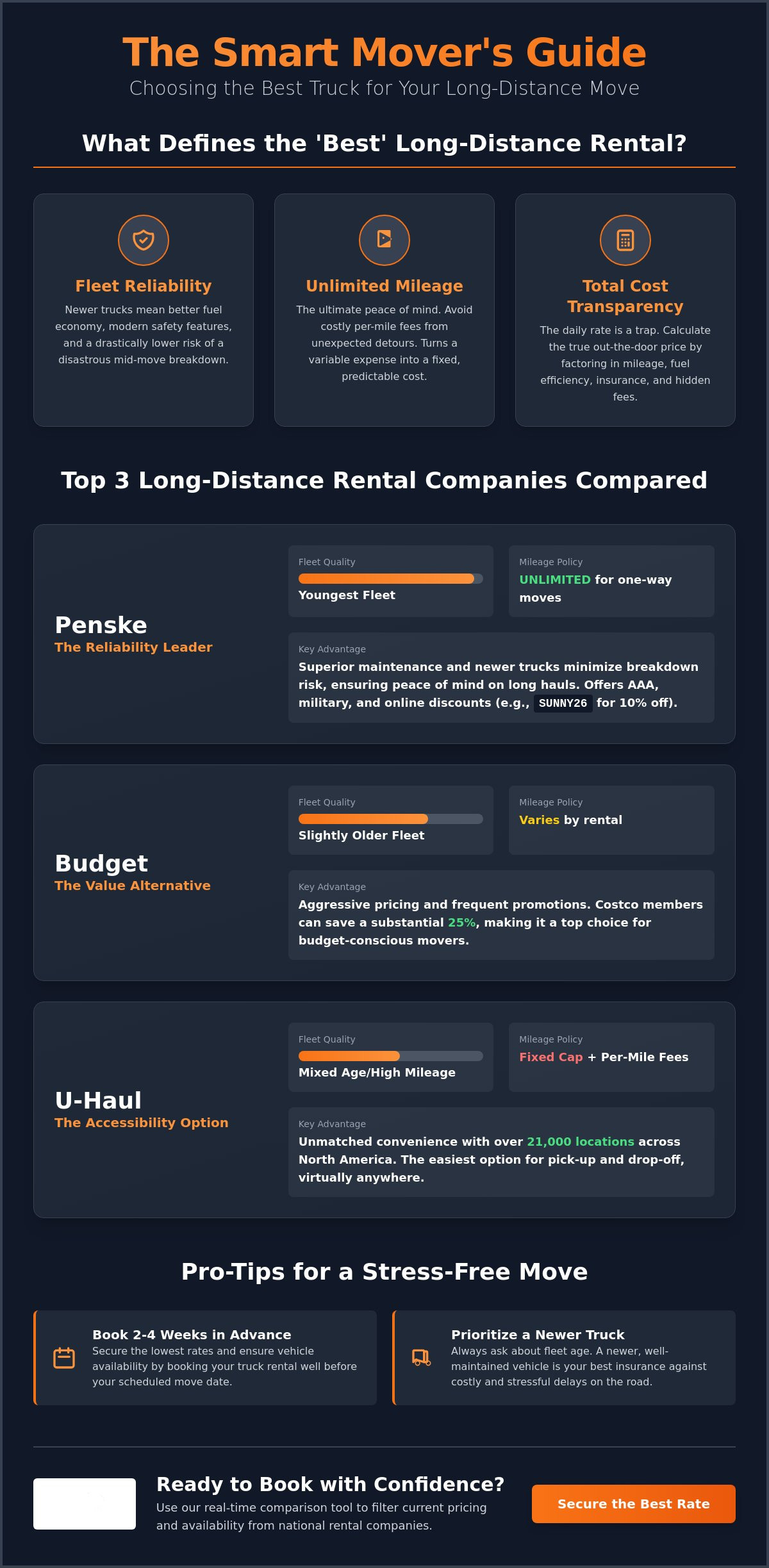
    This guide strips away the complexity to reveal which companies offer the most reliable vehicles and the most transparent pricing models. You’ll learn how to secure unlimited mileage, access 24/7 roadside assistance, and utilize current deals like the Penske “SUNNY26” discount or the 25% Costco member savings at Budget. We compare fleet age, total cost transparency, and regional availability. We’ve analyzed the 2026 data so you can book with total confidence and move without the drama. This is the shortest path to a stress-free relocation.

    Key Takeaways

    • Evaluate fleet age and maintenance history to find the best truck rental for long distance moves that won’t break down mid-journey.
    • Compare mileage policies between top providers to avoid surprise fees and hidden charges at your final drop-off location.
    • Factor in fuel efficiency and insurance options to calculate the true out-the-door cost rather than relying on the base rate.
    • Secure the lowest possible rates by booking your truck rental two to four weeks before your scheduled move date.
    • Use real-time comparison tools to instantly filter through current pricing and availability from multiple national rental companies.

    What Makes a Truck Rental ‘Best’ for Long Distance?

    Choosing the best truck rental for long distance moves means looking beyond the sticker price. A long-distance move is any one-way journey that crosses state lines or exceeds 100 miles. You aren’t just renting a vehicle. You’re renting a mobile storage unit that must survive days of highway travel. The criteria for success are different here than they are for a quick trip across town. You need reliability, transparency, and a contract that doesn’t penalize you for the distance traveled. Efficiency is the goal. Simplicity is the requirement.

    One-Way vs. Local Rental Models

    One-way rentals are the backbone of the DIY moving company sector. You pick up the truck near your current home. You drop it off near your destination. Local rentals work differently. They require you to return the truck to the original lot. Using a local truck for a long haul is a common mistake. These contracts usually include high per-mile charges. Those cents add up to hundreds of dollars over a thousand miles. One-way agreements bundle the mileage into a flat rate or provide a generous allowance. This makes them the only viable option for cross-country logistics. It eliminates the need for a return trip, saving you time and fuel.

    The Reliability Factor: Fleet Age Matters

    A breakdown in the middle of a move is a disaster. It leads to hotel bills, spoiled food, and delayed arrivals. Newer trucks are simply safer and more efficient. They feature modern engines with better fuel economy. This saves you money at every gas station. National brands typically reserve their newest inventory for long-distance customers. They cycle older, high-mileage trucks into their local rental pools. You want a vehicle that has passed rigorous multi-point inspections. Maintenance records matter. A well-maintained fleet reduces the mental load of a high-stakes move. It ensures you focus on the road, not the check engine light.

    Unlimited mileage offers the ultimate peace of mind. It removes the stress of tracking every mile on the odometer. Some companies offer a fixed mileage cap based on the shortest route. This can be risky. Road construction or traffic accidents might force you onto a longer path. If you exceed your cap, you pay for every extra mile. Unlimited mileage policies eliminate this risk entirely. They turn a variable expense into a fixed cost. That clarity is essential for accurate moving budgets. When searching for the best truck rental for long distance moves, prioritize providers that offer this flexibility. It is the most effective way to avoid surprise fees at the end of your trip.

    Comparing the Top 3 Long-Distance Truck Rental Companies

    Selecting the right provider transforms a stressful haul into a manageable task. You need a company that balances cost with mechanical integrity. The industry leaders, Penske, Budget, and U-Haul, each offer distinct advantages. Understanding these differences is the first step toward finding the best truck rental for long distance moves. Reliability and accessibility are the two main pillars of a successful cross-country journey. You want a partner that provides clear terms and a vehicle that can handle 1,000 miles of highway without hesitation.

    Penske Truck Rental: The Reliability Leader

    Penske is the gold standard for mechanical peace of mind. They maintain a younger fleet. This translates to better fuel economy and fewer breakdowns. For one-way moves, they offer a unique unlimited mileage policy. This is a massive benefit for those crossing multiple state lines. You don’t have to worry about extra costs if you take a longer route to avoid traffic. Through June 30, 2026, you can use the code SUNNY26 for a 10% discount on one-way rentals reserved online. They also prioritize professional maintenance, making them a top contender for the best truck rental for long distance moves. AAA members and military personnel can access further specialized discounts to lower their total costs.

    Budget Truck Rental: The Value Alternative

    Budget lives up to its name by offering aggressive pricing and frequent promotions. They are often the most affordable choice for cost-conscious movers. Costco members currently receive a substantial 25% discount, which can save hundreds on a long haul. Their pricing is dynamic. It fluctuates based on regional demand and truck availability. While their trucks might be slightly older than Penske’s, their national support network is robust. This ensures help is available if an issue arises on the road. Before you book, it is wise to review consumer protection regulations for interstate moves to understand your rights regarding estimates and insurance coverage.

    U-Haul: The Most Accessible Option

    U-Haul offers unmatched convenience. They operate over 21,000 locations across North America. This massive network makes pickup and drop-off incredibly simple, even in remote areas. They typically use a per-day pricing model for long hauls. This includes a fixed mileage allowance tailored to your specific route. It works well if your path is direct and your schedule is tight. However, truck quality can vary. Many U-Haul locations are independent dealers rather than corporate hubs. Always perform a thorough inspection of the tires and fluids before signing the paperwork. To see live availability and compare these three giants side-by-side, check out the comparison tools at DityTruck. This allows you to find the most efficient path between your current home and your new destination.

    Best Truck Rental for Long Distance Moves: 2026 Comparison Guide

    Calculating the True Cost of Your Cross-Country Move

    The advertised base rate is rarely what you actually pay. For a thousand-mile journey, the sticker price is just the beginning. Real-world costs include taxes, fuel, and protection plans that can double your initial estimate. Finding the best truck rental for long distance moves requires looking at the “out-the-door” total. Industry data indicates the median cost for a long-distance rental often reaches $1,321. This figure varies based on your specific route and the size of the vehicle. You need a clear breakdown to avoid budget fatigue before you even leave your driveway.

    Hidden fees often hide in the fine print of your rental agreement. Environmental fees and state-specific taxes apply to almost every contract. Peak-day surcharges are also common. Moving on a Friday or during the final week of the month usually costs more due to high demand. You can check a 2026 comparison of truck rental companies to see how these administrative fees vary across national brands. Transparency is your best defense against these surprise charges. Always ask for a guaranteed quote that includes all mandatory surcharges.

    Fuel Costs and Estimations

    Fuel is your largest variable expense on a long haul. A 16-foot truck typically gets 10 to 12 miles per gallon. A larger 26-foot truck might only get 8 to 10 miles per gallon. These numbers drop significantly when the truck is fully loaded or traveling through mountainous terrain. Diesel engines offer better torque and slightly better efficiency for heavy hauls. However, diesel fuel often costs more per gallon than gasoline. Use a fuel estimator tool before you leave. It prevents cash flow issues at the pump. For more details on budgeting for these variables, see our Moving Truck Rental: The Complete 2026 Comparison & Booking Guide.

    Insurance and Protection Plans

    Don’t assume your personal car insurance covers a rental truck. Most standard policies exclude commercial-sized box trucks over a certain weight. This creates a dangerous liability gap. If you hit a low-hanging branch or an overpass, you are responsible for the full cost of repairs. Damage waivers (CDW) are essential for long hauls. They limit your financial exposure if the truck is damaged. Cargo insurance is another vital layer of protection. It covers your furniture and belongings if there is an accident or theft during the trip. Supplemental liability insurance is a long-distance must. It protects your personal assets if you’re involved in a collision with another vehicle on the interstate.

    Essential Accessories for a Safe Long-Distance Drive

    A long-distance drive tests your packing skills more than any local move. Over a thousand miles, your belongings face constant vibration and shifting. The best truck rental for long distance moves provides the vehicle, but the right accessories ensure your items arrive in one piece. You need more than just a truck. You need a strategy for stability and safety. This starts with high-quality loading equipment and ends with a secure towing setup for your personal vehicle.

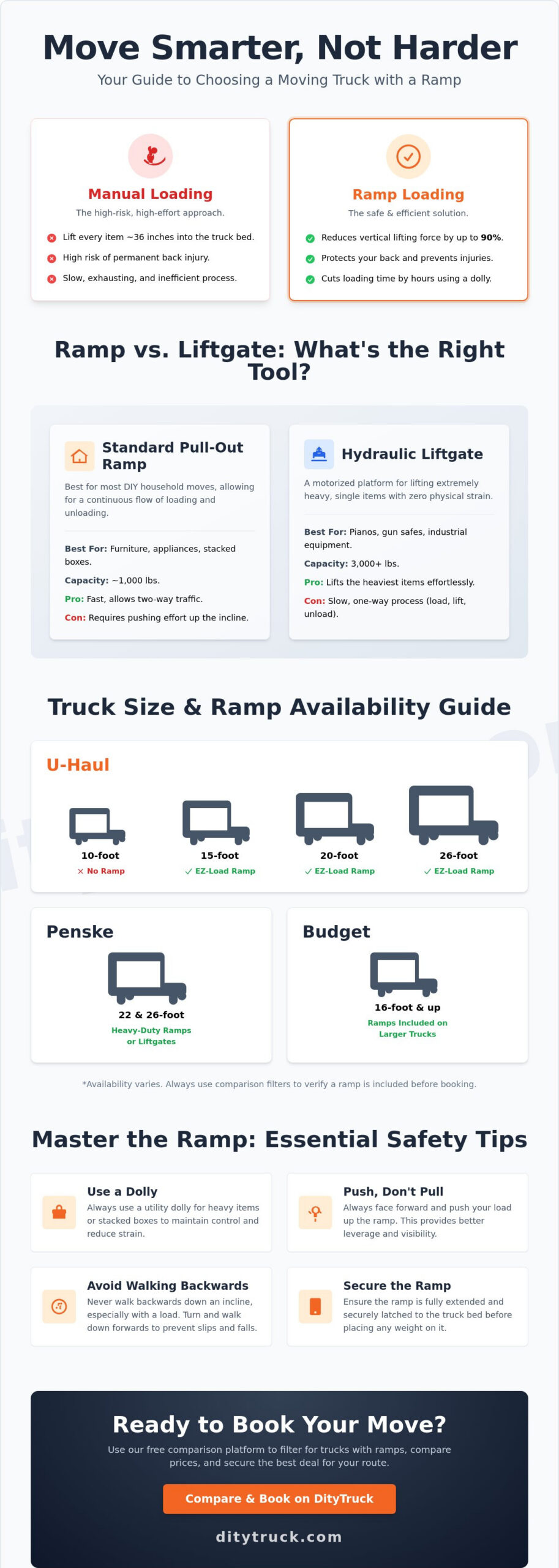
    Loading ramps are a fundamental requirement for one-way moves. They reduce physical exhaustion by allowing you to roll heavy items instead of lifting them. Most national fleets include pull-out ramps as standard. Pair these with heavy-duty tie-downs. These straps prevent “load shift,” which occurs during sudden stops or sharp turns on the interstate. Without them, even the heaviest furniture can slide and cause damage. Furniture pads are equally vital. Use them to wrap every finished surface. They provide a necessary buffer against the relentless friction of the road.

    Towing Your Car: Dolly vs. Carrier

    Moving your personal car alongside a box truck requires a specific towing setup. You have two primary options. A tow dolly is a small trailer that lifts only the front wheels of your car. It is a cost-effective choice for front-wheel drive vehicles. However, it still leaves the rear wheels on the pavement, causing minor tire wear. For all-wheel drive (AWD) vehicles or maximum peace of mind, choose a car carrier. This trailer lifts the entire car off the ground. It is more stable at highway speeds and protects your car’s transmission from damage. Driving a “combo” rig requires caution. Your braking distance increases significantly. You must also take wider turns to account for the extra length of the trailer.

    Loading for the Long Haul

    Weight distribution is the secret to a stable drive. Place your heaviest items, like appliances and solid wood furniture, toward the front of the truck near the cab. This prevents the back of the truck from fishtailing at high speeds. Utilize the “Mom’s Attic” or over-cab storage space for light, fragile items. This area is separate from the main floor and experiences less direct impact from road bumps. Secure everything tightly. If you can move a box with your hand, the road will move it with ease. Use furniture pads between every layer of boxes to absorb vibrations. This simple step prevents “finish rub” on your wooden furniture. To secure the right equipment for your specific route, compare rental packages and accessories today.

    How to Secure the Best Rates with DityTruck

    Efficiency drives a low-cost move. Don’t waste time opening dozens of browser tabs or calling local dealers for quotes. DityTruck streamlines the search for the best truck rental for long distance moves by centralizing every major provider in one clear view. We act as your smart assistant. We perform the heavy lifting behind the scenes so you don’t have to. Our platform is built for speed and rapid decision-making. You get the clarity you need to move forward with confidence and relief.

    Timing is everything in the logistics industry. Booking your vehicle two to four weeks before your move date usually yields the lowest rates. Last-minute reservations are expensive and risky. Availability drops as your date approaches; this causes prices to spike. Planning ahead ensures you get the specific truck size your inventory requires. It also gives you time to review our One Way Truck Rentals for Moving: 2026 Comparison Guide for deeper insights into regional pricing trends and fleet availability.

    The 1-Minute Comparison Process

    Start by entering your origin and destination cities. Our tool instantly scans available national fleets to provide real-time data. You can filter the results by truck size or specific mileage policies. We prioritize financial honesty above all else. Every estimate includes the “Total Cost” which factors in known fees and mileage allowances. This prevents the shock of a high bill at the drop-off counter. It is the most logical path between your logistical problem and a successful resolution.

    Booking and Confirmation

    Once you find your match, secure the reservation directly through our platform. This locks in your rate and guarantees your vehicle at the selected location. You’ll receive a clear confirmation to keep for your records. On moving day, bring your valid driver’s license and a credit card. Ensure the name on the card matches the primary driver on the contract. Double-check your confirmation number before you arrive at the counter. This keeps the pickup process fast and friction-free.

    Perform a final walk-around before you leave the rental lot. Check the fuel levels. Inspect the tires for proper inflation. Verify that any extra equipment, like furniture pads or dollies, is already loaded in the back. Document any existing scratches or dents with your phone camera. This protects you from false damage claims at the end of your trip. Finding the best truck rental for long distance moves is about more than just the daily rate. It is about the security of a reliable tool. DityTruck helps you start your journey with total peace of mind.

    Secure Your Move with Confidence

    A successful relocation depends on choosing the right partner. You’ve learned that the best truck rental for long distance moves balances a younger, reliable fleet with transparent mileage policies. Don’t let hidden fees or old equipment derail your plans. Focus on the total out-the-door cost rather than just the base rate. It’s essential to secure your accessories and insurance early to avoid last-minute stress. This preparation ensures your belongings arrive safely and your budget stays intact.

    DityTruck simplifies this entire process for you. We provide real-time rates from industry leaders like Penske, Budget, and U-Haul. There are no hidden booking fees to worry about. Our platform is already trusted by thousands of DIY movers nationwide. We provide the clarity you need to make a fast, smart decision. Compare Long-Distance Truck Rental Rates Now and lock in your savings today.

    Your move represents a fresh start. We’re here to make sure the logistics are the easiest part of your transition. Safe travels on the road ahead.

    Frequently Asked Questions

    Is Penske or U-Haul better for long distance moves?

    Penske is generally the superior choice for mechanical reliability because they maintain a younger fleet and offer unlimited mileage on one-way moves. U-Haul provides better geographic accessibility with over 21,000 locations across North America. If your priority is a newer truck and predictable pricing, Penske is the leader. If you need a drop-off point in a remote area, U-Haul’s network is unmatched.

    Does anyone offer unlimited mileage on one-way truck rentals?

    Penske Truck Rental is the primary national provider that offers unlimited mileage for one-way, long-distance reservations. This policy helps them rank as the best truck rental for long distance moves for many DIY movers. It removes the anxiety of route changes or traffic detours. You pay one flat rate for the distance regardless of the final odometer reading.

    How much does it cost to rent a moving truck for a 1,000-mile move?

    Rental costs vary based on the season, truck size, and demand for your specific route. Industry data shows the median cost for a long-distance move is approximately $1,321. This figure does not include fuel, which can add several hundred dollars to your total. Always get a comprehensive quote that includes taxes and environmental fees to see the true cost.

    Can I tow my car behind a rental moving truck?

    Yes, you can tow a personal vehicle using either a tow dolly or a car carrier provided by the rental company. A tow dolly is an efficient choice for front-wheel drive vehicles, while a car carrier is necessary for all-wheel drive cars to prevent transmission damage. Ensure your rental truck is equipped with the proper hitch and lighting connections before you leave the lot.

    What is the best size truck for a 3-bedroom house move?

    A 26-foot box truck is the standard recommendation for a 3-bedroom home. This size offers enough cubic footage to handle large appliances, multiple mattresses, and dozens of boxes. Using a smaller 16-foot or 22-foot truck for a large home often results in running out of space. It’s better to have a little extra room than to leave essential belongings behind.

    Are there hidden fees in long-distance truck rentals?

    Common extra costs include environmental taxes, state-specific surcharges, and peak-period fees for moving during holidays or weekends. You will also pay for supplemental insurance and any equipment rentals like furniture pads or dollies. To avoid surprises, look for the best truck rental for long distance moves that provides a transparent, itemized breakdown of all mandatory charges upfront.

    Do I need a special license to drive a 26-foot moving truck?

    You don’t need a Commercial Driver’s License (CDL) to drive a 26-foot rental truck for a personal, household move. These vehicles are designed for consumer use and are exempt from professional licensing requirements. You only need a valid standard driver’s license and must be at least 18 to 25 years old depending on the company’s specific policy.

    How early should I book my long-distance truck rental?

    You should secure your reservation two to four weeks before your move date to get the best pricing and guaranteed availability. Booking early is especially critical during the peak summer moving season when fleets are often fully committed. This lead time allows you to compare rates and choose the most cost-effective provider for your specific destination.

  • Penske Truck Rental Cost Guide 2026: Real Pricing and Fees

    Penske Truck Rental Cost Guide 2026: Real Pricing and Fees

    The cheapest truck rental quote often becomes the most expensive one by the time you reach your new home. Hidden fees and mechanical delays turn a bargain into a logistical nightmare. You’ve likely felt that familiar anxiety when looking at a quote. You wonder if the final bill will match the estimate. You worry if the truck will handle a long-distance haul without a hitch. It’s a high-stakes task that demands total clarity.

    We’re here to provide that relief. This guide breaks down the penske truck rental cost for 2026 to help you budget with absolute precision. You’ll discover exactly how Penske calculates its rates, why their reliability justifies the premium, and how to spot every mandatory fee before you sign. We’ll cover everything from unlimited mileage benefits on one-way trips to the specific discounts available for military personnel. You’ll find a clear, logical path to a friction-free move without the usual surcharges or stress. It is time to stop guessing and start planning with confidence.

    What You Will Learn

    • Compare local per-mile rates against one-way moves. Secure the unlimited mileage advantage for your specific route.
    • Navigate the variables affecting your penske truck rental cost. Balance truck size selection with seasonal demand shifts.
    • Identify mandatory 2026 surcharges. Spot environmental fees and damage protection costs before they hit your bill.
    • Stack AAA, military, and student discounts. Use location-based hacks to reduce your final rental bill.
    • Evaluate cost-effectiveness across four truck sizes. Pick the right capacity for your home to avoid paying for empty space.

    The Penske Pricing Architecture: Local vs. One-Way Moves

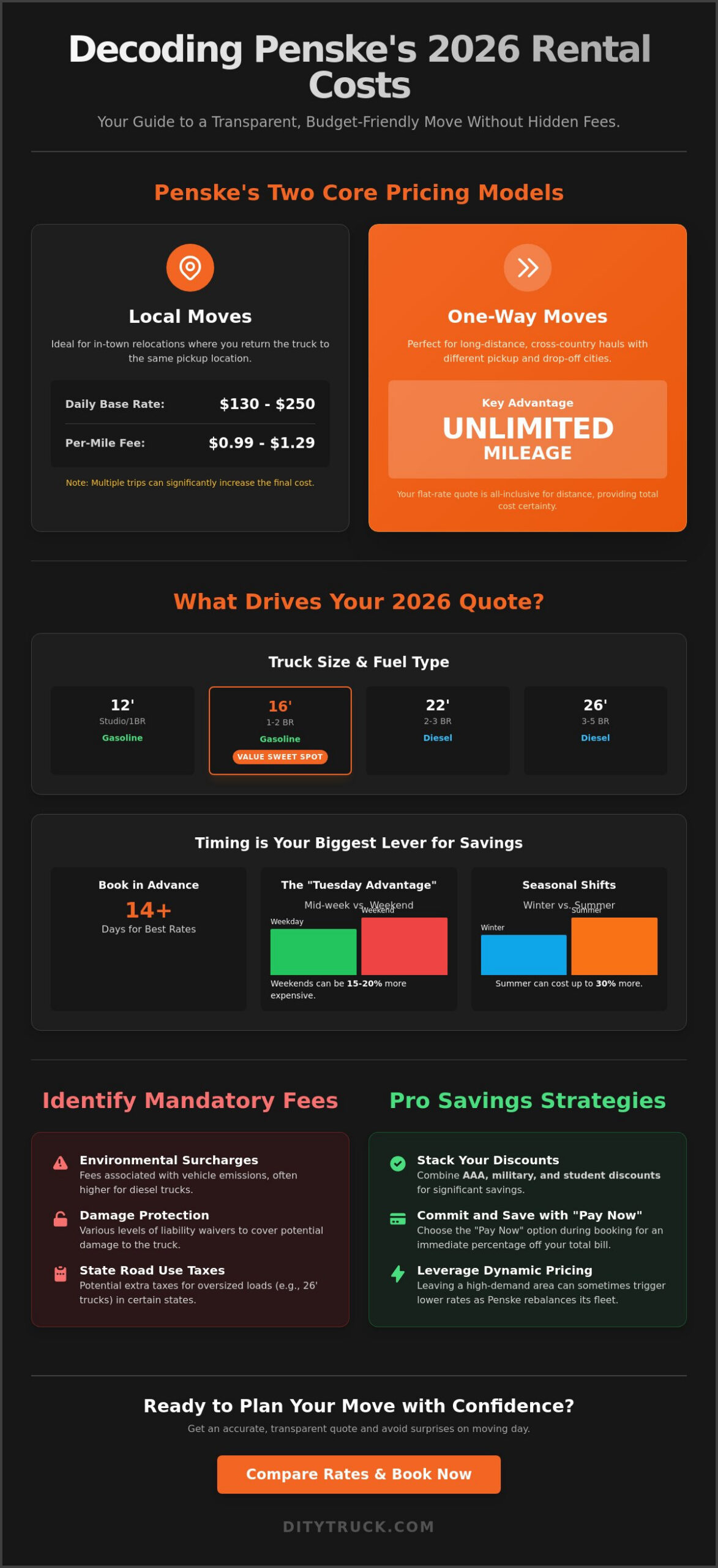
    Every rental quote starts with a fundamental choice between two distinct pricing structures. Local moves follow a traditional utility model. One-way moves function as a comprehensive package deal. Your penske truck rental cost depends entirely on which path your logistics require. Understanding the math behind these models is the only way to avoid a budget collapse on moving day.

    Inventory levels in 2026 play a massive role in your initial quote. Penske uses dynamic pricing that fluctuates based on truck availability in your specific zip code. If a location has an oversupply of 22-foot trucks but a shortage of 16-foot models, you might find the larger truck is actually cheaper. You also have control over the final price through payment tiers. The “Pay Now” option is the most efficient choice for savvy movers. It rewards your commitment with a lower rate compared to the “Pay Later” tier. This simple decision can shave a significant percentage off your total bill immediately.

    Local Rentals: Managing the Per-Mile Variable

    For local moves where you return the truck to the same location, you pay a daily base rate plus a fee for every mile driven. In 2026, base rates for popular 12-foot and 16-foot trucks typically range from $130 to $250 per day. The mileage fee is the variable that usually catches people off guard. These surcharges often sit between $0.99 and $1.29 per mile. A local move across town looks affordable on paper. However, the costs compound quickly if you make three or four trips. Total clarity requires you to map your route and estimate your total mileage before booking. This prevents the “short” move from becoming a major financial hurdle.

    One-Way Moves: The Unlimited Mileage Benefit

    Long-distance moves operate on a flat-rate model that includes unlimited mileage. This is a significant competitive advantage in the 2026 market. While other companies track every mile on a cross-country haul, Penske allows you to focus on the drive. Your quote is based on the truck size, the distance between cities, and current demand at your destination. Penske Truck Leasing manages one of the largest fleets in North America to keep these rates stable, but moving to a high-demand city will always cost more. This model provides a sense of confident simplicity. You know the price of the journey before you turn the key. It eliminates the anxiety of watching the odometer and allows for a friction-free transition to your new home.

    Factors That Drive Your 2026 Penske Rental Quote

    Your penske truck rental cost fluctuates based on more than just distance. It is a live calculation. National inventory shifts in 2026 mean that prices in one metropolitan area might look nothing like prices in another. Logistics software now tracks truck concentrations in real-time. If everyone is moving to a popular destination region, the price to take a truck there rises. Conversely, leaving a high-demand area can sometimes trigger a lower rate as Penske seeks to rebalance its fleet. Understanding these market forces allows you to move with confident simplicity.

    Truck Size and Fuel Type Impact

    Choosing the right size is about more than fitting your couch. It dictates your fuel economy and mandatory fees. Penske’s 12-foot and 16-foot trucks typically run on gasoline. These are easier for casual drivers to handle. The 22-foot and 26-foot models often utilize diesel engines. Diesel provides better torque for heavy loads but comes with different pump prices and higher environmental surcharges. The 16-foot truck remains the sweet spot for value. It offers enough space for a two-bedroom home without the heavy-duty fees associated with the largest chassis. Oversized loads in 26-foot trucks may also trigger additional road use taxes in certain states. You should understand your rights and responsibilities when you move to ensure your estimate accurately reflects these state-level variables.

    Timing Your Reservation for Savings

    Timing is the most effective tool for budget control. Booking at least 14 days in advance in 2026 secures the best available inventory rates. If you wait until the week of your move, you’re competing for whatever is left on the lot. Demand spikes significantly at the end of the month when leases expire. This creates a price premium that can easily be avoided by moving mid-month. Moving during the week also provides a clear advantage. The “Tuesday Advantage” is a real strategy to reduce your bill. Mid-week rentals often bypass the heavy demand of weekend warriors. Weekend rentals often see a 15-20% price hike compared to a Tuesday or Wednesday pickup.

    Seasonal shifts are even more dramatic. Summer moves in 2026 can cost 30% more than the exact same route in January. If your schedule allows for a winter move on a Tuesday, you’ve found the most efficient path to savings. You can compare truck rental rates across different dates to find these specific windows of opportunity. This proactive approach turns a high-stakes task into a manageable process. It ensures your penske truck rental cost stays within your original budget without any unpleasant surprises at the counter.

    The True Cost of a Penske Move: Fees and Surcharges

    A base quote is rarely the final number you pay at the counter. Calculating the total penske truck rental cost requires looking past the daily rate to identify mandatory fees and optional protections. These line items transform a simple estimate into a realistic moving budget. You need to account for specific factors that drive your rental quote to avoid budget creep on moving day. Most users prioritize the truck itself, but the supporting equipment and regulatory fees often dictate the final balance.

    Mandatory environmental fees are a standard part of the 2026 landscape. Recent quotes for long-distance moves show a consistent $15 environmental fee applied to the total. You also need to budget for physical tools. Dollies, furniture blankets, and loading ramps are available for a fee. Adding these to your reservation ensures a safer move; however, they do increase the bottom line. Fuel is the largest variable. Penske trucks average 12 to 13 miles per gallon. Returning the truck with less fuel than you started with triggers a significant per-gallon penalty. This surcharge is always higher than local pump prices. Fill the tank at a station near the drop-off center to protect your budget.

    Insurance and Protection Plan Tiers

    Standard personal auto insurance and credit cards almost never cover commercial box trucks. This creates a coverage gap you must fill. Penske offers several tiers, including Limited Damage Waiver (LDW) and Supplemental Liability Insurance (SLI). LDW releases you from financial responsibility if the truck is damaged. SLI provides protection against third-party claims. In one verified 2026 quote for an eight-day rental, damage coverage added approximately $666 to the total cost. While optional, these protections provide the relief of knowing a single accident won’t lead to financial ruin.

    Avoidable Post-Move Charges

    You can keep your penske truck rental cost down by following basic return protocols. A simple sweep of the truck bed prevents a cleaning fee that often starts at $50. Timing is equally critical. Late returns on one-way rentals can result in a $100 daily penalty. Missing your window by even a few hours can disrupt the next customer’s reservation and your own finances. You can see how these fees stack up against other providers in our U-Haul vs. Penske Truck Rental: The Complete 2026 Comparison Guide. Staying organized and returning the equipment in its original condition is the shortest path to a friction-free experience.

    Penske Truck Rental Cost Guide 2026: Real Pricing and Fees

    Penske Truck Sizes and Their Cost-Effectiveness

    Choosing the right truck size is a critical financial decision. If the truck is too small, you face the high cost of multiple trips or a second rental. If it is too large, you pay for unused space and extra fuel. Your penske truck rental cost is directly tied to the chassis you select. Penske maintains a modern fleet to ensure mechanical reliability, but the efficiency of that fleet depends on your load planning. Matching the truck to your inventory creates a friction-free moving day with no wasted budget.

    Small Scale Moves: 12ft and 16ft Units

    The 12-foot truck is the entry point for college students and studio dwellers. It handles small apartments with ease and fits into tighter urban parking spots. For those moving a one or two-bedroom home, the 16-foot truck is the standard choice. It provides the necessary clearance for larger furniture items without the intimidating footprint of a commercial freighter. Both of these smaller box trucks typically run on gasoline. Average fuel economy across the fleet sits at 12 to 13 miles per gallon. These units are ideal for local, high-mileage moves where agility and ease of refueling are priorities. You can see how these dimensions compare to other providers in our Moving Truck Rental: The Complete 2026 Comparison & Booking Guide. Selecting the right small-scale unit ensures you don’t overpay for capacity you don’t need.

    Large Scale Moves: 22ft and 26ft Units

    Heavy-duty moves require the 22-foot or 26-foot behemoths. These trucks are designed for families with three to five rooms of furniture. While the daily rate is higher, these large trucks offer superior cost-per-room efficiency. One trip in a 26-foot truck is significantly cheaper than two trips in a smaller unit when you factor in mileage fees and time. 26-foot trucks often require diesel fuel, so you must budget accordingly for different pump prices. These models also come with a higher Gross Vehicle Weight Rating (GVWR). You must stay aware of weight limits to avoid potential scale fees or safety issues on the road. A fully loaded 26-foot truck handles differently than a standard van. It requires a focused driver and a clear understanding of your route’s clearance.

    Maximizing your penske truck rental cost means picking the largest size you can comfortably drive that fits your entire home in one pass. This strategy eliminates the variable of extra mileage and keeps your logistics simple. If you are ready to secure your vehicle, you can book your 2026 truck rental today to lock in current inventory rates. This proactive step removes the uncertainty of last-minute price hikes and ensures the right size is waiting for you on the lot.

    How to Lower Your Penske Rental Cost in 2026

    Reducing your penske truck rental cost does not require complex negotiation. It requires strategy. Savvy movers use the “One-Way Hack” to exploit inventory imbalances. If a primary rental center is low on stock, prices climb. Checking a location just ten miles away can often reveal a surplus of trucks and a lower flat rate. This simple search turns a logistical hurdle into a financial win. You should also lock in your rate at least 14 days before your move to avoid the peak-season surges that define the 2026 market. Early action guarantees availability and the most competitive pricing tiers.

    DityTruck acts as your savvy consumer advocate. Use it to verify if other providers beat your initial Penske quote. While Penske offers newer trucks, exploring all options might reveal a better rate for your specific route. For a deeper look at how competing brands stack up on price and features, our U-Haul vs. Budget truck rental 2026 price and feature comparison breaks down the real cost differences beyond the sticker price. Comparison is the only way to ensure you aren’t overpaying for a brand name. It provides the clarity needed for a friction-free decision. This proactive approach strips away the stress of overspending.

    Stacking Discounts and Promotions

    Applying multiple promo codes is the most efficient way to maximize your 2026 savings. Penske often allows you to combine specific group discounts with seasonal promotional codes. Military personnel and AAA members typically receive a 15% discount. Students can often secure 10% off their total bill. These aren’t just marketing fluff; they are direct paths to a more manageable budget. You should also check your employer’s portal for corporate partner benefits. Many large companies have pre-negotiated rates that bypass standard public pricing. If you are considering other options, use a reliable rental cost calculator to see how the numbers stack up. A side-by-side view removes the guesswork from your logistics.

    The Smart Mover’s Final Checklist

    A final review of the fine print prevents unexpected surcharges at the counter. Verify that your quote includes the mandatory environmental fees and any selected protection plans. Using a comparison tool is essential for 2026 DIY logistics because it strips away the complexity of dynamic pricing. It organizes the chaos of truck rental math into a single, logical decision. Once you have identified the best value, finalize your reservation through DityTruck. This ensures you have a reliable record of your rate and a clear path to a successful move. You are now ready to execute your plan with total confidence and a protected budget.

    Secure Your 2026 Moving Budget Today

    Moving involves high stakes and complex logistics. Your budget shouldn’t be a source of constant stress or confusion. You now have the practical tools to decode your penske truck rental cost with total clarity. You understand the fundamental difference between local mileage fees and the unlimited mileage advantage of one-way trips. You know exactly which hidden surcharges to expect at the counter. You’ve learned how to stack specific discounts and time your booking for maximum efficiency.

    DityTruck acts as your no-nonsense logistics assistant to simplify the entire process. We provide real-time comparison across major brands so you never have to guess if you’re getting the best deal. Our platform ensures transparent pricing with no hidden surprises or last-minute hurdles. Compare 2026 Penske rates and book your truck with DityTruck to finalize your plans with confident simplicity. Your next home is waiting. Take the shortest, most logical path to get there and enjoy the relief of a friction-free move.

    Frequently Asked Questions

    How much does a Penske truck rental cost per day in 2026?

    Daily rates for local rentals typically range from $130 to $250 depending on the truck size and location. This base rate does not include mileage fees or fuel costs. One-way rentals operate on a different flat-rate model that covers a set number of days rather than a standard daily fee. This structure helps you build a predictable budget for your move.

    Does Penske really offer unlimited mileage on one-way moves?

    Yes. Penske provides unlimited mileage for one-way, long-distance rentals in 2026. This feature eliminates the stress of watching the odometer during a cross-country journey. It is a significant advantage for those moving between states. Local rentals still utilize a per-mile fee model, so you should calculate your total distance for shorter trips.

    What is the cheapest day of the week to rent a Penske truck?

    Tuesday and Wednesday are consistently the most affordable days to pick up a rental. Mid-week demand is lower than the weekend rush. Booking during these windows can lower your penske truck rental cost by 15% to 20%. Avoiding the end-of-month peak also helps you secure a better rate from available inventory.

    Do I need special insurance to rent a 26-foot Penske truck?

    You do not need a commercial driver’s license, but your personal auto policy likely excludes large box trucks. Most standard credit card protections also stop at 12-foot vans. Penske offers optional protection plans like Limited Damage Waiver (LDW) to bridge this gap. Verifying your current coverage before you arrive at the counter provides essential peace of mind.

    Does Penske require a deposit for a truck rental?

    A deposit is usually required for local moves, often starting at $150 when paying with a credit card. This amount serves as a hold on your funds until the truck is returned. One-way rentals booked with a credit card may have different requirements. Always check your specific reservation details to ensure you have the necessary funds available.

    How much are the typical taxes and environmental fees for Penske?

    Environmental fees are a mandatory surcharge, typically costing around $15 per rental in 2026. Taxes vary based on the state and city where you pick up the vehicle. These fees are added to your base quote and are not negotiable. Understanding these fixed costs helps you calculate a realistic bottom-line total for your moving expenses.

    Is Penske more expensive than U-Haul for local moves?

    Penske often carries a higher daily rate than U-Haul for local tasks. This premium pricing reflects their commitment to a newer fleet and guaranteed reservations. While the initial penske truck rental cost might be higher, the reliability of the equipment can prevent expensive delays. Comparing both options for your specific zip code is the smartest move.

    What happens if I return my Penske truck with a dirty cargo area?

    Returning a truck with debris or dirt in the cargo area results in a cleaning fee that often starts at $50. A simple sweep of the floor before drop-off is the easiest way to avoid this charge. Maintaining the equipment’s condition ensures a friction-free return process and protects your budget from avoidable post-move surcharges.

  • Moving Truck Rental with Ramp: The 2026 Buyer’s Guide to Easier Loading

    Moving Truck Rental with Ramp: The 2026 Buyer’s Guide to Easier Loading

    Your choice of truck size matters, but the piece of metal tucked under the floorboard determines whether you finish your move in a recliner or an emergency room. Lifting a heavy sofa three feet into the air without assistance is a recipe for a permanent back injury. Finding a moving truck rental with ramp is the single most important step you can take to protect your health and your furniture. You’ve likely spent hours worrying about steep inclines or dropping an expensive appliance during the loading process. These fears are valid because the wrong equipment turns a simple task into a dangerous hurdle.

    We’re here to strip away that complexity and give you total clarity. You’ll learn exactly which truck sizes include built-in ramps, such as the 15-foot U-Haul or the 16-foot Budget models. This guide compares the safety differences between standard ramps and hydraulic liftgates so you can make a smart, informed choice. We’ll also walk through the 2026 fleet updates and show you how to use a comparison platform to book the best value for your specific route. Let’s get your move on the right track without the physical strain.

    Key Takeaways

    • Protect your back and reduce vertical lifting by up to 90% by selecting a moving truck rental with ramp for your DIY move.
    • Identify the critical differences between standard pull-out ramps for furniture and hydraulic liftgates for industrial-strength heavy lifting.
    • Compare fleet-specific features like Penske’s wide aluminum ramps and U-Haul’s low-deck designs to find the easiest loading angle for your items.
    • Master essential safety protocols, including the dolly method, to prevent accidents and avoid the danger of walking backward on a steep incline.
    • Use comparison filters to verify that your specific truck size includes a ramp before you finalize your reservation.

    Why a Moving Truck Rental with Ramp is Essential for DIY Moves

    Lifting is the enemy of a successful move. A standard moving truck rental with ramp provides a retractable plane that bridges the gap between the ground and the truck bed. This simple incline transforms a high-risk physical challenge into a manageable logistical task. It’s the difference between a smooth afternoon and a trip to the chiropractor. By using a ramp, you eliminate the need to deadlift your entire life three feet into the air. This tool acts as a mechanical bridge, allowing you to roll items directly into the cargo area with minimal vertical effort.

    Efficiency is the immediate result of choosing the right equipment. Hand-carrying individual boxes or chairs up into a truck is slow and exhausting. You lose momentum. You get tired. Eventually, you start making mistakes. A ramp allows you to use a utility dolly to move multiple items at once. You can stack three or four boxes and roll them up the incline in seconds. This speeds up your loading process significantly, often cutting your total moving time by several hours. It also keeps your energy levels high for the driving portion of your journey.

    Ramp vs. Manual Loading: The Physical Toll

    Truck beds typically sit about 36 inches off the pavement. Lifting a 200-pound refrigerator or a solid wood dresser that distance is a recipe for a musculoskeletal injury. The physics of an incline change everything. A 10 or 12-foot ramp, which functions much like industrial loading dock components, stretches that vertical climb over a long horizontal space. This reduces the force required to move heavy objects by up to 90%. Instead of a dangerous vertical lift, you perform a controlled push. The cost of a moving truck rental with ramp is a tiny fraction of the potential medical bills or lost wages resulting from a back injury.

    Who Needs a Ramp Truck?

    Certain moves simply cannot happen safely without an incline. If your inventory includes large appliances like washers, dryers, or refrigerators, a ramp is mandatory. These items are too heavy and awkward for manual lifting by a small team. You also need a ramp if you’re moving a multi-bedroom household. The sheer volume of heavy furniture, like bed frames and dining tables, will eventually wear down even the strongest helpers. Solo movers or small teams of two benefit the most from this mechanical advantage. It levels the playing field, allowing a smaller crew to handle a large-scale move with professional-grade efficiency and safety.

    Understanding Ramp Types and Truck Size Availability

    Not all trucks are built equal. While smaller cargo vans or 10-foot trucks often lack loading equipment, a moving truck rental with ramp becomes standard as you move into larger fleet sizes. Understanding the specific hardware attached to your vehicle is the only way to avoid a loading day surprise. Standard pull-out ramps are the most common choice. These aluminum or steel planks slide out from a compartment under the truck bed. They usually support around 1,000 pounds, which is plenty for household furniture and most appliances.

    Width is a factor many movers overlook. A 2-foot wide ramp feels narrow when you’re balancing a heavy dresser on a dolly. Newer fleet models often feature 3-foot wide ramps to provide extra stability and room for error. When you’re following safe loading procedures, that extra foot of width makes a massive difference in preventing dolly wheels from slipping off the edge.

    Ramp vs. Liftgate: Which Should You Choose?

    Choosing between a ramp and a hydraulic liftgate depends on your specific inventory. Ramps allow for a continuous flow of traffic. One person can go up while another comes down, keeping the momentum high. Liftgates are motorized platforms that level with the ground. They are perfect for extremely heavy single items like gun safes or pianos. However, liftgates are slow. You have to wait for the motor to cycle for every single load. Most DIY movers prefer a ramp because it keeps the process moving faster.

    Truck Sizes That Typically Include Ramps

    Size availability varies by brand. A 10-foot truck is the cutoff point. Most companies exclude ramps on this size to save weight, meaning you’ll be lifting everything manually. The 15-foot to 20-foot range is the sweet spot. U-Haul’s 15-foot and 20-foot models come equipped with their EZ-Load ramps. Budget offers ramps starting at the 16-foot size. If you step up to a 26-foot truck, you are almost guaranteed a heavy-duty ramp or even a liftgate. Penske’s 22-foot and 26-foot trucks often feature liftgates or ramp combinations with a 3,000-pound capacity.

    Before you commit, verify the specific features of your local fleet. You can compare truck specifications and availability across multiple providers to ensure you get the right ramp for your needs.

    Moving Truck Rental with Ramp: The 2026 Buyer’s Guide to Easier Loading

    Comparing the Best Moving Truck Companies with Ramps

    Your choice of provider determines the quality of the hardware you’ll be using for ten hours straight. Not every moving truck rental with ramp offers the same user experience. Penske is often the top choice for those who value newer equipment. Their fleet is frequently updated, meaning their wide aluminum ramps are less likely to have the dents or warping found in older trucks. This stability is vital when you’re balancing a heavy appliance. Penske’s 22-foot and 26-foot models are particularly impressive. They feature high-capacity ramps or liftgates that support up to 3,000 pounds, making them the heavy-hitters of the DIY world.

    U-Haul takes a different approach with their proprietary EZ-Load ramps. Instead of a standard truck height, U-Haul designs their vehicles to sit lower to the ground. This creates a much shallower incline. A shorter, flatter ramp means you spend less energy fighting gravity. Budget Truck Rental provides a reliable, no-frills alternative. They offer standard ramps on their 16-foot and 26-foot models. While their hardware is basic, it’s consistent and functional for most household moves. DityTruck simplifies this entire selection process. It acts as a smart assistant, pulling data from these major players so you can compare ramp specs and vehicle ages side-by-side.

    Penske vs. U-Haul: The Ramp Showdown

    The battle between these two giants comes down to deck height versus ramp width. U-Haul’s low deck is a massive advantage for solo movers. It makes the walk up the ramp feel more like a gentle stroll than a steep climb. Penske counters this with superior ramp grip and material quality. Their aluminum surfaces provide excellent traction even in damp weather. If you are booking one way truck rentals for moving, both companies offer extensive drop-off networks. Your decision should rest on whether you prefer U-Haul’s easier angle or Penske’s heavy-duty stability.

    Budget and Enterprise: Reliable Alternatives

    Budget is often the winner for local moves due to their competitive pricing and standard equipment. Their 16-foot truck is a popular middle-ground option that always includes a ramp. Enterprise is the dark horse in the consumer market. They focus heavily on commercial-grade vehicles. This means their ramps are often wider and built to withstand more daily abuse than standard consumer rentals. Regardless of which company you choose, you must adhere to official Cargo Securement Rules once your items are inside. Proper securement ensures that the effort you spent using the ramp isn’t wasted by items shifting in transit. You can use DityTruck to find the best moving truck rental rates and confirm ramp availability for your specific dates in seconds.

    Safe Loading Techniques: Mastering the Ramp

    Securing a moving truck rental with ramp is only the first half of the battle. The second half is using that equipment without damaging your property or yourself. Most accidents happen at the transition points, where the ramp meets the ground or the truck bed. You must treat the ramp as a high-traffic zone that requires constant attention. Before you move a single box, ensure the ramp is fully extended. A partially deployed ramp can collapse under weight. Once extended, check that the locking pins are engaged. These small metal tabs are the only things keeping the ramp from sliding backward while you’re halfway up the incline.

    Weight distribution is critical for a safe drive. You should aim to place about 60% of your cargo weight in the front half of the truck, closest to the cab. This stabilizes the vehicle and prevents the front wheels from losing traction. Start by loading your heaviest appliances and solid wood furniture first. Use the ramp to roll these items into the very back of the cargo area. This strategy keeps the center of gravity low and forward, which is essential for highway handling. If you haven’t secured your vehicle yet, you can book a ramp-equipped truck now to ensure you have the right tools for a balanced load.

    The 3-Step Ramp Safety Check

    • Clear the Surface: Check for oil, water, or loose debris. A single pebble can jam a dolly wheel and cause a sudden, dangerous stop.
    • Flush Transition: Ensure the transition plate at the bottom sits flat against the pavement. If there is a gap, use a piece of plywood or a rubber mat to create a smooth entry point.
    • Locking Verification: Physically shake the ramp to confirm the locking pins are seated. If the ramp moves more than an inch, reset it.

    Using a Utility Dolly on an Incline

    Gravity is your biggest challenge on the ramp. When using a utility dolly, never walk backward down the incline. This is how most trips and falls occur. Instead, always keep the load on the uphill side of you. When going up, you push the dolly ahead of you. When coming down, you lead with your body while holding the dolly handles, letting the weight rest against your center of gravity. This gives you maximum leverage to act as a brake.

    Oversized items require a different approach. For sofas or mattresses, always use a spotter. One person guides the item from the top of the ramp while the other pushes from the bottom. Use a steady, walking pace to maintain momentum. If you stop halfway, it’s much harder to get the load moving again. If the weather turns and the ramp becomes slippery, stop immediately. Use sand, salt, or even a piece of old carpet to regain traction. Safety always takes priority over speed.

    How to Book Your Ramp-Equipped Truck with DityTruck

    Booking a moving truck rental with ramp shouldn’t be a guessing game. The process starts with your specific move date and distance. Local moves often have different fleet availability than long-distance hauls. Enter your zip codes into the DityTruck search tool to see what is currently sitting on the lots near you. This platform acts as your logistics filter. It strips away the noise and presents only the vehicles that meet your criteria. You won’t waste time looking at cargo vans that lack the loading equipment you need for heavy furniture. You get clear, actionable data immediately.

    Efficiency is the primary goal. Once you enter your details, use the feature filters to ensure your selected truck size includes a ramp. Remember that the 15-foot to 26-foot range is your best bet for built-in loading inclines. DityTruck pulls real-time rates from major providers like Penske, U-Haul, and Budget. You can compare these prices side-by-side in seconds. This prevents you from overpaying for a standard feature. You get the best value without the hassle of opening ten different browser tabs. The final reservation is a single, simple step that secures both your vehicle and your peace of mind.

    Avoiding Hidden Fees and Surprises

    Hidden costs are the enemy of a stress-free move. You’ll find that a ramp usually doesn’t cost extra. It is typically integrated into the rental price of larger box trucks. However, surprises often happen when a renter switches truck sizes at the last minute. If you downgrade to a 10-foot model to save money, you might lose your ramp entirely. DityTruck provides transparency by confirming ramp availability at your specific pickup location. This ensures the truck waiting for you on moving day actually has the hardware you need. You see the full picture before you commit any funds. No hidden hurdles. Just honest logistics.

    Final Checklist Before You Drive Away

    Your move starts the moment you arrive at the rental lot. Don’t just sign the paperwork and leave. Perform a physical inspection of the loading equipment. Test the ramp operation before you drive away. Pull it out to its full extension. Ensure the locking pins engage firmly. Check the weight rating sticker, usually located near the pull-handle, to verify it can handle your heaviest appliances. If the ramp is bent or difficult to slide, request a different truck immediately. It is much easier to swap vehicles at the lot than to deal with a broken ramp in your driveway. Ready to start? Compare moving truck rates now and lock in your equipment today.

    Secure Your Move with the Right Equipment

    You now have the blueprint for a safer and more efficient loading day. Choosing a moving truck rental with ramp isn’t just about convenience. It’s about protecting your body and your belongings from the physical risks of manual lifting. You understand which fleet sizes offer the best equipment. You’ve learned how to master the incline using the uphill dolly method and a proper safety check. Don’t leave your logistics to chance or settle for a vehicle that forces you to do all the heavy lifting yourself.

    DityTruck acts as your smart assistant by letting you compare Penske, Budget, and U-Haul in one place. We provide real-time pricing transparency so you can see exactly what you’re paying for. This is the most simplified booking experience available for 2026 moves. You can filter for the specific features that matter most to your health and your timeline. Find and Compare Moving Trucks with Ramps Today to lock in a vehicle that fits your specific needs. Your move is a high-stakes task, but it doesn’t have to be a high-stress one. You’re ready to tackle this transition with confidence and ease.

    Frequently Asked Questions

    Do all moving trucks come with a ramp?

    No, smaller vehicles like cargo vans, pickup trucks, and 10-foot box trucks typically lack this feature. Most companies exclude ramps on these sizes to reduce vehicle weight and maximize fuel efficiency. You’ll need to manually lift items into these smaller beds. Always verify the equipment list for your specific moving truck rental with ramp before you finalize your booking to avoid surprises on moving day.

    What is the smallest moving truck with a ramp?

    The 15-foot truck from U-Haul is currently the smallest standard model equipped with a built-in loading ramp. Budget typically starts offering ramps on their 16-foot models. If you opt for a smaller 10-foot or 12-foot truck from most providers, you should expect to lift your items manually. Always check the specific fleet details at your local pickup location because equipment can vary by region.

    Is a ramp or a liftgate better for moving furniture?

    A ramp is superior for general furniture because it allows for a continuous flow of traffic. You can walk up and down quickly without waiting for a motorized platform to cycle. Liftgates are better for single, extremely heavy items like gun safes or pianos that exceed 1,000 pounds. For a standard multi-room move, the speed and simplicity of a ramp usually provide the best experience.

    How wide are standard moving truck ramps?

    Standard ramps are typically between 24 and 36 inches wide. A 2-foot width is common on older or smaller fleet models, while newer 26-foot trucks often feature 3-foot wide aluminum ramps. This extra width is essential when you’re navigating a wide utility dolly or moving oversized items like sofas. The wider surface provides more stability and a larger margin for error during the loading process.

    Can I use a ramp if it is raining or snowing?

    You can use it, but you must take extreme caution because aluminum surfaces become incredibly slick when wet. Rain and ice significantly increase the risk of slips or the dolly losing traction. If you must load in bad weather, use sand or a specialized traction mat to improve your footing. It’s often safer to wait for the weather to clear before you tackle steep inclines with heavy furniture.

    What is the weight limit for a rental truck ramp?

    Most standard pull-out ramps have a weight capacity of approximately 1,000 pounds. This is sufficient for almost all household furniture and standard kitchen appliances. However, some heavy-duty trucks, such as the Penske 22-foot and 26-foot models, offer ramp and liftgate combinations rated for up to 3,000 pounds. Always check the capacity sticker located near the ramp handle to ensure you don’t exceed the safety limits of the metal.

    How do I stow the ramp after loading is finished?

    Slide the ramp back into its designated housing under the truck bed and secure the latch firmly. You must ensure the locking pins or safety hooks are fully engaged so the ramp doesn’t slide out during transit. A loose ramp is a major road hazard. Double-check the security of the handle and the latching mechanism before you start the engine and drive away from your home.

    Are there any extra charges for renting a truck with a ramp?

    There is typically no separate fee for the ramp itself. It is included in the base rate for the specific truck size you’ve selected. You’ll find that a moving truck rental with ramp is a standard offering for most vehicles 15 feet and larger. While the truck itself costs more than a small van, the ramp is a built-in feature designed to speed up your move and prevent injuries.

  • One Way Cargo Van Rental: Compare the Best 2026 Rates

    One Way Cargo Van Rental: Compare the Best 2026 Rates

    Why does a $19.95 daily rate often turn into a $300 bill by the time you reach your destination? Finding a reliable one way cargo van rental shouldn’t feel like a trap. You want to move your items across state lines without the anxiety of surprise drop-off fees or confusing mileage math. It’s a high-stakes task that deserves a friction-free solution. You need clarity, not a math project.

    You already know that one-way rentals are the most efficient way to handle urban moves or long-distance deliveries. With one-way rentals projected to grow 9% this year, finding available inventory at a fair price is becoming more difficult. We promise to help you find the most efficient rental by comparing top providers side-by-side in seconds. You don’t have to guess if your gear will fit or if the price is actually final.

    This guide provides a clear look at the best 2026 rates and policies. We’ll compare payload capacities, such as the 3,700 lbs found in standard cargo models, and break down the latest insurance bundles. You’ll get a simple way to book the right vehicle without visiting five different websites. Let’s find the shortest path between your current location and your new destination.

    Key Takeaways

    • Save time and reduce fuel costs by choosing a drop-off location at your destination rather than returning to your origin.
    • Match your load to the right specs by evaluating payload capacity and standard cargo volumes between 250 and 450 cubic feet.
    • Identify the best one way cargo van rental rates by comparing mileage inclusions and fleet availability across major national providers.
    • Secure the lowest rates by booking your vehicle early and targeting mid-week pick-up dates to avoid high-demand surcharges.
    • Streamline your search using comparison tools that deliver multiple transparent quotes in less than 60 seconds.

    Defining the One Way Cargo Van Rental Advantage

    Moving across state lines is complicated. Returning a rental vehicle to its origin makes it twice as hard. A one way cargo van rental removes this burden entirely. You pick up the van near your current home. You drop it off near your new one. This saves hours of driving. It eliminates the need for a “chase car” or a flight back to your starting point. It’s the shortest path to finishing your move. Think of it as a smart shortcut. You focus on your new home while the rental company handles the vehicle’s relocation.

    Local rentals often look cheaper on paper. They usually charge by the mile. For a cross-country trip, those mileage fees accumulate quickly. One-way models typically include a set number of miles based on your route. You get flexibility. You get a predictable bill. You also save on fuel. Cargo vans are significantly more aerodynamic than box trucks. This means fewer stops at the gas station and more money in your pocket. It’s about financial honesty. You know the cost upfront without fear of a surprise bill at the end of the trip.

    When to Choose a Van Over a Box Truck

    Vans are the smart choice for smaller loads. If you’re moving a studio apartment or a college dorm room, a 10-foot or 16-foot truck is often unnecessary. You’re paying for empty space and burning extra fuel. Cargo vans offer between 250 and 450 cubic feet of room. They handle like a standard SUV. You won’t feel intimidated by highway winds or tight turns. This ease of use reduces the physical stress of the drive. Most importantly, vans fit in parking garages. If your new apartment has a height-restricted loading zone, a van is your only viable option. It allows you to park closer to the elevator and save your back.

    The Logistics of Cross-Country Van Moves

    The logistics are simple but require planning. You return the vehicle to a different franchise location within the same network. This system of one-way rentals relies on a massive infrastructure of drop-off points. Because a one way cargo van rental is popular for last-mile deliveries and small moves, inventory fluctuates. Booking early is essential to secure your preferred dates. For longer journeys, understanding the nuances of one way truck rentals for moving helps you compare rates effectively across different brands. High demand means you should confirm your pick-up location 48 hours in advance. This ensures the equipment is ready when you are. It’s a friction-free way to manage a high-stakes task.

    Evaluating Cargo Van Specs: Dimensions and Weight Limits

    Choosing a one way cargo van rental requires more than just looking at the price. You need to know if your belongings will actually fit inside the metal box. Most standard cargo vans offer between 250 and 450 cubic feet of storage space. This is plenty for a studio apartment, but it requires strategic packing. Unlike larger box trucks, vans have curved walls and wheel wells that eat into your floor space. Every inch counts when you’re moving long distances.

    Accurate specifications help you avoid the stress of a last-minute vehicle swap. While companies provide general categories, the actual dimensions vary by make and model. This lack of transparency is a known issue. Understanding the federal oversight of the moving industry can help you stay informed about your rights as a consumer when rentals don’t match their advertised specs. Clarity is your best tool for a successful move.

    Standard Dimensions You Need to Know

    Floor space is your primary concern. Most cargo vans provide 9 to 11 feet of internal length. However, the width between the wheel wells is the real bottleneck. This space is usually around 50 inches. If you’re moving a queen-sized mattress, you’ll likely need to tilt it or rest it on top of the wells. Check the rear door opening height as well. A standard opening is about 4 feet high. If your dresser or armoire is taller than that, you’ll be forced to load it on its side.

    Weight and Payload Considerations

    Volume isn’t the only limit. Weight matters just as much. Every one way cargo van rental has a Gross Vehicle Weight (GVW) rating. This is the maximum legal weight of the van plus its cargo and passengers. Exceeding this limit is dangerous. It strains the brakes and tires. It can also lead to legal trouble at weigh stations.

    Payload is the specific weight of the items you can put inside. For a standard van, this is often around 3,700 lbs. Don’t confuse payload with towing. Cargo vans are designed for internal storage. They aren’t meant for pulling heavy trailers across the country. A fully loaded van handles differently at highway speeds. Your braking distance increases. Your center of gravity shifts. To ensure you’re getting a van that meets these technical needs, you can compare specific vehicle capabilities before you book.

    Fuel efficiency is another advantage. You can expect 12 to 18 MPG. This varies based on how heavy you load the vehicle. To keep your items safe during the drive, look for interior tie-downs. Most vans have D-rings or rails on the floor and walls. Use them. Securing your cargo prevents shifting. This protects your furniture and keeps the van stable on the road. It’s a simple step that provides massive peace of mind.

    One Way Cargo Van Rental: Compare the Best 2026 Rates

    Comparing Top Providers for Long-Distance Van Moves

    Finding the right one way cargo van rental often involves juggling three major names: U-Haul, Budget, and Penske. Each brand offers a different balance of availability, price, and vehicle quality. U-Haul dominates with the largest fleet in North America. You’ll find a pick-up point in almost every town. However, the age of their vans can vary significantly. You might get a modern vehicle or a high-mileage workhorse. Reliability is key for a long trip. You don’t want to deal with a breakdown when you’re 500 miles from home.

    Budget Truck is a strong choice for the cost-conscious mover. They often include unlimited mileage on one-way cargo van rentals. This removes the stress of counting every mile on the odometer. Penske takes a different approach by focusing on newer fleets. Their vans are generally the most reliable in the industry. For reservations made through June 30, 2026, you can use the code “SUNNY26” to get 10% or more off your rental rate. They also provide free unlimited miles on one-way trips. This level of transparency makes budgeting simple. It’s a friction-free solution for a high-stakes task.

    DityTruck simplifies this process. Instead of visiting three different sites, you see every rate on one screen. It’s a smart assistant that does the heavy lifting for you. You can compare the base prices and the fine print in seconds. Following the FMCSA moving guidelines ensures you stay protected throughout this process. It’s about making an informed choice without the headache. You get clarity. You get relief. You get moving.

    Mileage Policies and One-Way Fees

    One-way quotes are usually flat rates. They include a set number of days and miles deemed sufficient for your route. If you take a detour or need extra days, the costs can climb. Always check for excess mileage charges before you sign. Comparing moving truck rental rates across these national brands helps you spot the best value. Look for “unlimited mileage” labels to avoid the hidden cost of a longer route. It’s the most logical path to a lower bill.

    Insurance and Protection Plans

    Long-distance moves carry higher risks. Your personal car insurance rarely covers a commercial cargo van. Rental companies offer several tiers of protection. A Limited Damage Waiver (LDW) is often the most important. It clears you of financial responsibility if the van is damaged or stolen. Penske, for example, offers bundles like Basic, Standard, and Plus to simplify your choices. Roadside assistance is another essential. You want a provider that offers support if a tire blows or a battery dies in the middle of nowhere. It’s about peace of mind. You focus on the road; the provider handles the hardware.

    The 2026 Booking Checklist for One-Way Savings

    Timing is everything. One-way cargo vans represent a smaller portion of rental fleets compared to standard box trucks. This means inventory disappears fast. Booking your one way cargo van rental at least two to three weeks in advance is the best way to secure a vehicle. If you wait until the last minute, you might be forced into a larger, more expensive truck. Mid-week pick-ups are your secret weapon for savings. Rental demand peaks on Fridays and Saturdays. Shifting your move to a Tuesday or Wednesday can trigger significant discounts. It’s a simple change that leads to immediate relief for your wallet.

    Verify your destination. Not every rental branch is equipped to receive every vehicle type. Confirm that your specific drop-off location accepts cargo vans before you finalize the contract. This prevents a logistical nightmare on moving day. Watch out for the “hidden” extras when finalizing a one way cargo van rental. Environmental fees, local taxes, and fuel surcharges can add 15% or more to your total. Ask for a line-item breakdown. Transparency is the only way to ensure you’re getting a fair deal.

    How to Compare Rates Like a Pro

    Comparison engines are the only logical way to book. Opening ten different browser tabs is a waste of your time. In 2023, 41% of truck rentals in the U.S. were booked online or through mobile apps. This trend is growing because it works. You can compare one-way rental rates instantly to find the best 2026 deals. Focus on the total cost. A low base rate doesn’t matter if the mileage fees are double the industry average. Remember seasonal trends. Summer is the busiest time for moves. If you can move in the spring or fall, you’ll find much better availability and lower prices.

    Final Inspection Before the Drive

    Do a final walk-around. Document every scratch or dent on the van before you leave the lot. Take high-resolution photos of the exterior and the interior cargo area. This is your insurance against false damage claims. Check the fuel level. Ensure the needle matches what is written on your rental agreement. Test the lights and check the tire pressure. Safety is paramount for a long-distance haul. A few minutes of inspection saves hours of stress on the highway. It’s the smart way to start your journey.

    Streamline Your Move with DityTruck Comparison Tools

    Finding a one way cargo van rental shouldn’t be a full-time job. The logistics market is often intentionally confusing. Rates change. Fees hide in the fine print. DityTruck was built to solve this. Our mission is total transparency. We strip away the complexity of cross-country moves. You get a sense of confident simplicity. We act as your savvy consumer advocate. We do the heavy lifting behind the scenes. You get the results. It is a smart way to handle a high-stakes task.

    Speed is our priority. You can get multiple quotes in under 60 seconds. There is no unnecessary fluff. No long-winded forms. Just direct, high-impact data that guides your decision. We prioritize your time and peace of mind. This is a no-nonsense approach to financial honesty. You see the lowest rates first. You avoid the traditional hurdles of rental booking. It’s a friction-free solution. You focus on the destination while we find the vehicle.

    Why Comparison Matters for One-Way Moves

    One-way rates are dynamic. A single brand might charge $100 more than its competitor for the exact same route. These variances happen because of inventory imbalances. One provider may have too many vans in your destination city. Another might be sold out. Our comparison tool identifies these gaps instantly. We act as a smart assistant. We search the market so you don’t have to visit five different websites. This creates momentum for your move. It keeps you moving forward without the stress of overpaying.

    Ready to Book Your Cargo Van?

    Finalizing your reservation is simple. You select your route. You compare the 2026 rates. You book. It’s the most logical path between your problem and a resolution. DityTruck is your reliable guide. We value straightforwardness and honesty above all else. Start your search now to lock in the best prices for your upcoming journey. You can access our comparison tool here to find your one way cargo van rental in seconds. Relief is just a few clicks away. Don’t wait until inventory disappears. Secure your van today.

    Secure Your 2026 Move Today

    A cross-country move is a high-stakes task. You’ve learned that matching your payload to the right specs and booking mid-week are the smartest ways to save. Dropping your vehicle at your destination isn’t just a convenience. It’s a strategic choice that eliminates the stress of a return trip. Finding the right one way cargo van rental requires a tool that values your time as much as your budget. You need clarity to make the most logical decision for your journey.

    DityTruck provides the shortest path to a friction-free move. Get real-time rates from Penske, Budget, and U-Haul on a single screen. We offer national coverage across the United States with absolutely no hidden booking fees. It’s the simplest way to see the total cost before you commit. You focus on the packing. We handle the market research. It’s about relief and honest pricing.

    Ready to lock in your rate? Compare One-Way Cargo Van Rates Now and take the first step toward a successful move. Your new home is waiting. Let’s get you there with confident simplicity.

    Frequently Asked Questions

    Can I rent a cargo van one-way from U-Haul?

    U-Haul typically limits cargo vans to local, in-town rentals. Their one-way service is usually reserved for larger box trucks. If you require a one way cargo van rental, brands like Penske or Budget are more likely to have available inventory. Always check with the specific branch to confirm their current relocation policies. This prevents a last-minute scramble on moving day. It is a smart way to ensure your move stays on schedule without unexpected vehicle changes.

    Are one-way cargo van rentals more expensive than local rentals?

    One-way rentals have higher base rates but often save you money on long trips. Local rentals charge a small daily fee plus a high per-mile rate. For moves over 100 miles, the mileage fees on a local rental will likely exceed the cost of a one-way flat rate. It is a matter of predictable pricing. You get a clear total before you even start the engine. This financial honesty helps you stay within your moving budget.

    Do I need a special license to drive a rental cargo van?

    A standard driver’s license is sufficient for driving a rental cargo van. You don’t need a commercial license or special certification. These vans are designed for ease of use. They handle much like a large SUV. This makes them a stress-free option for drivers who aren’t comfortable with the size of a 26-foot truck. It is a simple solution for a high-stakes task. You can focus on the road with confidence.

    What is the average gas mileage for a one-way cargo van?

    You can expect an average of 12 to 18 MPG from a modern cargo van. This is significantly better than the 8 to 10 MPG offered by most box trucks. Your fuel efficiency will fluctuate based on the total weight of your items. Maintaining a steady speed helps keep costs low. It is a practical way to manage your moving budget during a long haul. Fewer stops at the pump mean more time at your new home.

    Can I drop off my rental van at a different location?

    Dropping the van off at a different location is exactly how one-way rentals work. You return the vehicle to a designated branch at your destination. This saves you the time and fuel required for a return trip. It is the shortest path to finishing your move. The process is designed for maximum efficiency and total convenience. You pick it up in one city and leave it in another. It is that simple.

    How much weight can a standard cargo van hold?

    Standard cargo vans can generally hold up to 3,700 lbs of payload. This limit is crucial for your safety on the highway. Overloading the van strains the tires and increases your braking distance. Always estimate the weight of your heaviest items before booking your one way cargo van rental. Staying within the legal weight limit ensures a smooth and legal trip through weigh stations. It protects your belongings and the vehicle.

    Does my personal insurance cover a one-way rental van?

    Most personal auto insurance policies do not cover commercial rental vans. Your current coverage is likely limited to passenger vehicles under a certain weight. Purchasing a damage waiver from the rental company is the safest choice. It provides immediate relief from financial liability if the vehicle is damaged. It is a small price for total peace of mind. You avoid the risk of high out-of-pocket repair costs on your journey.

    What happens if I go over my allotted mileage on a one-way rental?

    Exceeding your mileage limit results in a per-mile surcharge. Your contract will specify the exact number of miles included in your flat rate. Any distance beyond that is billed at a fixed rate when you return the van. To avoid these fees, use a GPS to find the most direct route. It is the most logical way to keep your move on budget. Planning your route ahead of time prevents surprise charges at the drop-off desk.

  • The Ultimate Checklist to Compare Local Moving Truck Rentals in 2026

    The Ultimate Checklist to Compare Local Moving Truck Rentals in 2026

    The lowest daily rate on a rental truck is often the most expensive way to move. It sounds backward, but a $19.95 sticker price rarely covers the actual cost of a local haul. You want a simple way to get from point A to point B without your budget exploding. It’s a common struggle. Opaque pricing structures and hidden mileage fees turn a quick task into a financial headache. You deserve total clarity before you hand over your credit card.

    This guide helps you compare local moving truck rentals with absolute confidence. We’ve built a comprehensive checklist to reveal hidden costs and identify the best value for your 2026 move. You’ll learn how to spot reliable vehicles, choose the right size, and avoid those dreaded environmental surcharges. We are stripping away the complexity so you can focus on your new home. Here is exactly how to get a clear total cost estimate and a friction-free booking experience without any surprise charges.

    Key Takeaways

    • Inventory your furniture to determine cubic footage requirements. This ensures you choose a truck size that fits your move perfectly.
    • Use a standardized checklist to compare local moving truck rentals. Focus on the total cost including mileage and mandatory fees rather than just the base rate.
    • Perform a “hidden fee” audit to spot environmental surcharges and cleaning costs. This protects your budget from unexpected charges on moving day.
    • Verify the reliability of major brands by checking fleet age and reservation guarantees. Newer vehicles provide peace of mind and reduce the risk of breakdowns.
    • Finalize your choice by using a real-time booking platform. This locks in the best available rate and guarantees your vehicle is ready when you are.

    Essential Pre-Comparison Checklist: Knowing Your Moving Needs

    Success starts with an accurate inventory. Before you look for a vehicle, list every large furniture item you own. Couches, beds, and dining tables take up the most cubic footage. Getting this right prevents you from renting a truck that’s too small. You don’t want to realize your mistake when the ramp is down and the driveway is half-full. This step is the foundation of a successful moving industry overview approach to DIY relocation. Write everything down. A clear list makes the next steps much faster.

    Count your rooms next. Most rental companies categorize their fleets by room count. When you prepare to compare local moving truck rentals, use this room count as your baseline. A studio usually fits in a cargo van, while a three-bedroom home requires a large box truck. Confirm your pickup and drop-off dates early. Prices often spike during weekends or at the end of the month. Booking mid-week can save you a significant amount. Also, call your insurance agent. Many personal auto policies exclude large commercial trucks. Knowing your coverage gaps helps you decide if the rental company’s protection plan is a necessity.

    Determining Your Ideal Truck Size

    Size matters for efficiency. A 10ft cargo van is perfect for small studio apartments or dorm moves. If you have a two-bedroom house, you will likely need a 16ft to 22ft truck. For large family homes, the 26ft model is the standard choice. It’s usually smarter to size up. Renting a slightly larger truck is often cheaper than making two local trips. You save on fuel and mileage fees. Watch out for height clearances. Local routes often have low bridges or overhanging trees. Check your route for restrictions before you drive away from the lot. A taller truck requires a different driving strategy.

    Mapping Your Local Mileage

    Total distance is more than just the gap between houses. You must include the trip from the rental lot to your current home and back again. These miles add up quickly. When you compare local moving truck rentals, look at the difference between round-trip and one-way local drop-off fees. Some companies charge a premium for different drop-off locations. Fuel is another major factor. Larger trucks often run on diesel. Diesel can be more expensive per gallon but offers better torque for heavy loads. Gas engines are common for smaller vans. Factor these differences into your total budget estimate to avoid surprises at the pump. Clarity on mileage prevents bill shock.

    The Comparison Checklist: Evaluating Rental Terms Side-by-Side

    Comparing rental options requires a level playing field. You can’t just look at the big number on a website. To accurately compare local moving truck rentals, you must ask for a breakdown of the base rate, mileage costs, and mandatory fees. Some companies advertise a low price but add a “vehicle licensing recovery fee” or an “environmental fee” at the final step. This guide to renting a moving truck highlights how these small additions inflate your bill. Always get the total number in writing. This transparency prevents stress when it’s time to pay the bill.

    Timing is everything. Check if your rental uses a 24-hour clock or a set calendar day. If you pick up a truck at 4:00 PM on Friday and return it at 10:00 AM on Saturday, a 24-hour policy counts it as one day. A calendar-day policy might charge you for two. It’s an easy way to double your costs without realizing it. Deposit requirements also vary. Most major brands prefer credit cards. Using a debit card or cash often triggers a higher deposit or requires a more rigorous verification process. Don’t forget driver rules. Younger drivers often face daily surcharges. If you want a friend to help drive, expect an extra fee per person. You should compare local moving truck rentals with these specific policy differences in mind to find the actual best deal.

    Daily Rates vs. Mileage Charges

    Low daily rates are often a distraction. A cheap rental with a high per-mile fee is more expensive than a flat-rate rental if you have a long local route. In 2026, more companies are offering “local unlimited” packages to stay competitive. Calculate your break-even point by multiplying your estimated miles by the per-mile rate and adding the base fee. Comparing these totals side-by-side reveals the true winner. If you want to skip the math, you can compare real-time quotes to see these calculations instantly. This approach ensures you choose based on data rather than marketing.

    Pickup and Drop-off Flexibility

    Logistics don’t always follow a 9-to-5 schedule. Verify the lot hours before you book. Some local branches close on Sundays or late at night. If you need to return the truck when the office is closed, ask about the “after-hours” drop-off process. This usually involves a secure key box and a mobile check-in app. Be careful. You remain responsible for the vehicle until the staff inspects it the next morning. A brand with a wide local branch network offers more flexibility. It gives you more options for pickup locations near your current home and drop-off points near your new one. This convenience saves you time and reduces the total miles you pay for.

    The Ultimate Checklist to Compare Local Moving Truck Rentals in 2026

    The “Hidden Fee” Audit: What Most Comparison Sites Miss

    A low daily rate often hides a mountain of surcharges. You must look past the sticker price to see the true cost of your move. When you compare local moving truck rentals, the first thing to audit is the mandatory fee structure. Many companies charge a vehicle licensing recovery fee to cover their own registration costs. Others add a mandatory environmental fee. U-Haul, for example, typically charges between $1 and $5 per rental for this. These small amounts seem minor. They add up quickly when combined with mileage and fuel. Always ask for a line-item breakdown before you sign the contract.

    Cleaning and fuel policies are common traps for the unwary. Most providers expect the truck back in the exact condition you received it. If there is dirt in the cab or debris in the cargo area, you might face a steep cleaning fee. The gas tank policy is even more critical. Some companies require you to return the truck with the same amount of fuel it had at pickup. Others charge a premium if they have to refill it for you. Checking the gas gauge and taking a photo of the odometer at both ends of the trip is essential. This documentation protects your $150 deposit from unfair claims. Knowing how to rent a moving truck correctly means auditing every potential charge before the keys are in your hand.

    Insurance and Liability Coverage Options

    Your personal auto insurance likely stops at the truck’s bumper. Most standard policies and credit card benefits do not cover commercial vehicles or large box trucks over a certain weight. You need to understand the difference between a Collision Damage Waiver (CDW) and Supplemental Liability Insurance (SLI). A CDW covers damage to the truck itself. SLI protects you against claims from other drivers. Cargo insurance is a separate add-on that protects your actual belongings inside the truck. U-Haul offers Safemove coverage starting at $15 per day. It’s a small price for peace of mind during a high-stakes task.

    Mandatory vs. Optional Surcharges

    The Environmental Fee is a non-negotiable industry standard in 2026 that helps companies comply with local emissions regulations. Beyond that, many add-ons are purely optional. You’ll often see prompts for “Moving Help” or labor assistance during the checkout process. These services can double your quote instantly. Decline them if you have friends helping. Be wary of “Peak Day” surcharges as well. Moving on the 1st or 15th of the month, or any Saturday, often triggers higher rates. Equipment like dollies and furniture blankets also carry daily rental fees. If you already own these items, bring your own to keep the total cost low. Every dollar saved on accessories is a dollar kept in your pocket.

    Evaluating Brand Reliability: U-Haul, Penske, and Budget

    Reliability is the invisible cost of a move. A cheap truck that breaks down on a Saturday morning is a disaster. When you compare local moving truck rentals, you must look at fleet age. Newer trucks mean better fuel efficiency and fewer mechanical failures. U-Haul offers a specific advantage with their “low-deck” design. This design keeps the cargo floor closer to the pavement. It makes walking heavy furniture into the truck much easier. It saves your back and speeds up the loading process. Penske, however, often wins on maintenance. They rotate their fleet frequently. You are more likely to get a truck with low mileage and a clean engine. For a data-driven breakdown of how these two giants compare on fleet reliability, pricing transparency, and mileage policies, see our Penske vs. U-Haul definitive 2026 moving truck comparison guide.

    Roadside support is your safety net. U-Haul has over 21,000 locations. This ubiquitous presence means help is usually close. If your truck fails, they can often swap it quickly at a nearby branch. Penske and Budget also offer 24/7 assistance. Always verify the response time expectations. A breakdown mid-move can derail your entire schedule and lead to extra labor costs. Choosing a brand with a robust national network ensures you aren’t stranded for hours on the side of the road. Clarity on these support terms is just as important as the rental price.

    Fleet Quality and Roadside Support

    Penske focuses on commercial-grade vehicles. Their trucks are built for heavy use and undergo frequent, rigorous inspections. This leads to higher reliability for local hauls and fewer unexpected stops. U-Haul has a massive fleet, but equipment age varies significantly by location. You might get a brand-new van or a ten-year-old box truck with high mileage. Budget sits in the middle. They offer a balance of competitive pricing and decent vehicle quality. If a breakdown happens on a busy Saturday, you need a provider that prioritizes your recovery. For a detailed breakdown of how these three providers stack up on price, fleet quality, and availability, see our U-Haul vs. Budget vs. Penske comparison for 2026. Ask about their backup vehicle availability and specific local mechanic partnerships before you book.

    The Reservation Guarantee Reality

    A confirmation number is not a guarantee. This is the industry’s biggest secret. Many renters arrive at the lot only to find their truck hasn’t been returned by the previous user. It’s frustrating and stressful. You can avoid this by using a better tracking method. Book your rental through DityTruck to access providers with superior inventory management and more reliable booking systems. We help you find the most dependable options in your area.

    Use the 24-hour check-in trick. Call the specific local branch one day before your move. Confirm the truck is physically on the lot or scheduled for return. This proactive step prevents morning-of surprises and gives you time to react. If the branch seems unsure, you still have time to find an alternative. Efficiency is about control. Taking these small steps ensures your moving day stays on track and your schedule remains intact.

    Finalizing Your Choice: How to Book the Best Rate

    The research phase is complete. You have identified your inventory. You understand the fee structures. Now you need to execute the plan. To accurately compare local moving truck rentals, you need real-time data from multiple providers simultaneously. Static quotes on individual websites are often outdated by the time you reach the checkout page. 2026 digital rates change based on local inventory and regional demand. Booking online is the only way to lock in these specific prices. It removes the risk of “walk-in” price hikes at the rental counter. You get the best deal when you act on live data.

    Review your final quote one last time. Look for the flags identified in your hidden fee audit. Ensure the environmental fee and mileage rates match your expectations. Confirm the truck size fits the requirements you verified in section one. If everything aligns, proceed to the secure checkout. Digital booking creates a paper trail that protects your reservation. It provides a timestamped agreement that the rental company must honor. This transparency is the key to a stress-free moving day. Don’t leave your budget to chance at the physical rental office.

    Using DityTruck for Real-Time Comparisons

    DityTruck simplifies the final step. Our platform aggregates rates from Penske, Budget, and other major providers in a single view. You don’t have to jump between sites. The biggest benefit is seeing the total estimated price rather than just a base rate. We factor in the variables that others hide until the end. This allows for a true side-by-side evaluation of value. For a deeper look at the current market, read our Moving Truck Rental: The Complete 2026 Comparison & Booking Guide. It provides the context you need for a smart, data-driven decision.

    Securing Your Reservation

    Confidence comes from preparation. When you are ready to rent a truck for moving, have your documents ready. You will need a valid driver’s license and a major credit card. Most digital booking processes require these up front to verify your identity. Some providers may also ask for a secondary form of ID or proof of insurance coverage. Having these files ready prevents session timeouts and lost quotes.

    Check your inbox immediately after booking. You must receive a reservation number and the specific lot address. Don’t rely on a “pending” screen. A confirmed reservation number is your leverage if the lot is busy on moving day. Print a copy or save the confirmation to your phone for quick access. Verify the pickup time and the return deadline one last time. Having this data at your fingertips ensures a friction-free pickup. Your move is now officially on the books. You have the right truck at the right price.

    Take Control of Your 2026 Move

    Moving doesn’t have to be a gamble. You have the tools. You know the traps. Success comes down to preparation. Audit your inventory. Uncover hidden surcharges. Protect your budget and your peace of mind. It’s time to act. You deserve a move that stays on schedule and stays within your financial limits.

    When you compare local moving truck rentals, efficiency is your best asset. You’ve learned to spot the difference between a low sticker price and a true total cost. You know which brands offer the most reliable fleets. Now, see all those options in one place. No manual searching. No unnecessary stress. Just clear data for a smart move.

    We make the final step effortless. Compare Real-Time Moving Truck Rates Now for live pricing from Penske, Budget, and other major providers. No hidden fees. See the total cost upfront. Secure your online booking in under 2 minutes. Get back to what matters. Your new home is waiting. You’ve got this.

    Frequently Asked Questions

    How do I find the cheapest local moving truck rental near me?

    Use a real-time comparison tool to see current rates across all local branches. Prices fluctuate daily based on zip code demand and inventory levels. Booking your rental for a mid-week date like Tuesday or Wednesday typically yields the lowest rates. Always book online to lock in digital-only discounts that aren’t available for walk-in customers at the physical lot.

    Is Penske better than U-Haul for local moves?

    The choice depends on your specific priorities. Penske is widely recognized for maintaining a newer fleet of commercial-grade vehicles. This reduces the risk of mechanical issues. U-Haul provides significantly more pickup locations and a unique low-deck design for easier loading. You should compare local moving truck rentals based on your proximity to their lots and your comfort with driving older versus newer equipment.

    What is the average cost of a local moving truck rental in 2026?

    Total costs are determined by the base rate plus mileage and insurance. While a small van might have a low starting price, a standard move for a two-bedroom home usually totals between $110 and $210. This includes the per-mile fee and fuel. Regional demand and current fuel prices in 2026 will influence your final quote. Always calculate the total cost of ownership rather than just the daily rate.

    Do I need special insurance when I compare local moving truck rentals?

    Yes, because standard personal auto insurance policies and credit card benefits rarely cover large box trucks. You face significant financial risk if the vehicle is damaged or involved in an accident. Purchasing a damage waiver or supplemental liability coverage from the rental provider is the safest path. It ensures you aren’t held liable for expensive repairs to commercial-grade equipment.

    Can I rent a moving truck with a debit card?

    Most major rental brands accept debit cards, but they often require a larger upfront deposit. You may also need to show additional forms of identification or proof of a utility bill at the counter. Credit cards are preferred for a smoother transaction and faster deposit returns. If you use a debit card, ensure you have enough available balance to cover the hold amount for several days.

    What happens if the rental company doesn’t have my truck on moving day?

    You should immediately ask for a free upgrade to the next available size. Most companies have a reservation guarantee policy that pays you a set amount, such as $50, if your equipment isn’t ready. To prevent this, call the local lot 24 hours before your pickup time. Confirming the vehicle is physically on the lot gives you time to find an alternative if there is an inventory error.

    Are there hidden fees when renting a truck for a local move?

    Common fees include the environmental fee, vehicle licensing recovery fee, and cleaning surcharges. You will also pay for any equipment rentals like furniture pads or dollies. To compare local moving truck rentals accurately, always request a full line-item breakdown. This transparency allows you to see the true total before you provide your payment information. Checking the gas tank level at pickup also prevents unfair refueling charges.

    Should I choose a cargo van or a small box truck for a studio apartment?

    A cargo van works well if you only have boxes and small furniture. If your studio includes a bed, dresser, or sofa, choose a 10-foot box truck instead. Box trucks offer a wider interior and a lower deck height. This extra space prevents you from having to stack fragile items too high. It also ensures you can complete the move in a single trip, saving you time and mileage costs.

  • Penske vs. U-Haul Truck Rental: The Best Choice for Your Business Move in 2026

    Penske vs. U-Haul Truck Rental: The Best Choice for Your Business Move in 2026

    A single equipment failure during a time-sensitive move can cost your business far more than the rental fee in lost productivity. When you analyze a penske vs uhaul truck rental for your 2026 operations, the decision usually comes down to a trade-off between fleet reliability and geographic convenience. You need professional-grade equipment that stays on the road. You shouldn’t have to settle for a budget gamble that leaves your assets stranded on the shoulder of the highway.

    It’s frustrating to deal with confusing insurance requirements or the fear of hidden mileage surcharges when your business is on the line. We will help you minimize downtime and secure predictable costs for your next relocation. This guide compares Penske’s newer fleet and updated digital tools against U-Haul’s massive footprint and current $19.95 starting rates. We’ll also look at June 2026 specifics like the SUNNY26 discount code to find your most efficient path. You’ll see exactly which provider offers the best balance of reliability and price for your professional move.

    Key Takeaways

    • Prioritize Penske for long-distance hauls where fleet age and reliability are critical. Newer trucks reduce the chance of expensive delays during your move.
    • Select U-Haul for local business relocations requiring maximum geographic flexibility. Their massive location network makes pick-up and drop-off incredibly convenient for short-range shuttles.
    • Analyze a penske vs uhaul truck rental based on total cost rather than just the base rate. Factor in mileage, fuel, and specific commercial insurance needs for 2026.
    • Use a comparison tool to view real-time availability for both providers. This saves hours of manual research and ensures you secure the best professional equipment for your timeline.

    Evaluating Penske vs. U-Haul for Business Moving Logistics

    Commercial relocations operate on a different clock than residential moves. Efficiency is the priority. Every hour your team spends waiting for a truck is an hour of lost revenue. When you compare a penske vs uhaul truck rental, you aren’t just looking at cargo space. You’re choosing a logistical partner. The unique demands of moving a business include high-value inventory, sensitive electronics, and strict deadlines. One missed window can ripple through your entire quarterly schedule.

    Choosing the cheapest base rate is often a trap. A low upfront cost doesn’t account for the price of a breakdown. If a truck fails with $100,000 of office equipment inside, the “savings” vanish instantly. Reliability is the ultimate currency in commercial logistics. Penske has built a reputation on maintaining a younger, professional-grade fleet. They operate more than 67,000 rental units specifically for commercial customers. For a deeper look at their infrastructure, you can review this Penske Truck Leasing company profile. U-Haul takes a different approach, focusing on unmatched accessibility. With over 21,000 locations, they offer a level of local presence that Penske’s 3,000 locations can’t match.

    The Business Impact of Rental Availability

    U-Haul’s massive footprint is a major asset for local office shifts. It reduces “dead mileage” and keeps your team productive. You can pick up a truck ten minutes away instead of driving across the city. However, the rental industry is notorious for “guaranteed” reservations that don’t always materialize. Penske uses a more centralized fleet management system. This often leads to more predictable inventory. If you book a 26-foot truck for a specific morning, it’s more likely to be waiting for you. This certainty helps you avoid paying a moving crew to sit idle.

    Commercial Account Benefits

    Business moves require clean paperwork. Both providers offer commercial accounts designed to strip away administrative friction. These accounts provide streamlined billing and simplified tax documentation. This saves your accounting department hours of manual entry. You also gain access to priority support channels. A dedicated commercial representative acts as a smart assistant for your move. They handle the heavy lifting of coordination so you can focus on your business operations. When comparing a penske vs uhaul truck rental, evaluate how much you value this professional-tier support. It’s the shortest path to a friction-free relocation.

    This need for specialized coordination is universal across high-stakes industries. For those managing maritime assets, BTR Marine Services LLC provides expert ship brokering services for the sale and purchase of vessels, offering the same level of dedicated support and administrative clarity required for complex logistical operations.

    Fleet Reliability and Maintenance Standards

    A truck’s age directly impacts your bottom line. Comparing a penske vs uhaul truck rental means looking closely at the mechanical condition of the vehicle. This is your first line of defense against costly delays. Penske prioritizes a younger fleet. Their commercial units often cycle out every few years to ensure peak performance. U-Haul operates a much larger inventory with a wider range of vehicle ages. While their trucks are iconic, the maintenance consistency can vary between locations. For a business move, you need a machine that handles heavy loads without hesitation.

    Heavy-load business equipment puts extreme stress on engines and transmissions. Regular maintenance isn’t just a suggestion; it’s a requirement for safety. Penske’s tandem-axle day cab tractors feature up to a 160-gallon fuel capacity and an 80,000 lbs. gross combined weight rating. These are professional-grade specs. Many of their larger trucks utilize diesel engines. Diesel offers superior torque and fuel efficiency for long-distance hauls. U-Haul trucks typically run on gasoline. This makes refueling simpler at standard stations, but you might sacrifice some pulling power on steep grades or under max loads.

    Technical Specifications: Liftgates and Ramps

    Lifting heavy office furniture or server racks by hand is a liability risk. Liftgates are essential for modern business logistics. Penske commercial trucks frequently include hydraulic liftgates. They do the heavy lifting for you. U-Haul relies heavily on pull-out ramps. While their EZ-Load ramps reduce the incline, they still require significant physical effort. A U-Haul 26-foot truck has a max load of 12,859 lbs. and a gross vehicle weight of 25,999 lbs. Ensure your inventory doesn’t exceed these limits. If you want to see which local units have the right specs for your gear, you can compare truck features side-by-side to find the best fit.

    Roadside Assistance and Downtime Prevention

    Breakdowns happen even with the best maintenance. The difference lies in the recovery speed. Penske provides 24/7 specialized truck support. Their technicians understand commercial hardware. They focus on getting your cargo moving again immediately. U-Haul offers general roadside assistance that serves both families and businesses. Their response times can be fast due to their massive network, but the service is less specialized for heavy-duty commercial issues. Uptime is the critical KPI for any business moving truck rental, serving as the definitive measure of how long your equipment stays operational and on schedule.

    Penske vs. U-Haul Truck Rental: The Best Choice for Your Business Move in 2026

    Comparing Commercial Pricing and Fee Structures

    Price is a puzzle. Solving it requires looking beyond the bold numbers on a homepage. When you analyze a penske vs uhaul truck rental, you’re dealing with two distinct financial philosophies. U-Haul targets the low-entry market with a starting flat rate of $19.95 for in-town rentals. This looks attractive on a spreadsheet. However, the per-mile charge can quickly inflate your total for local shuttle moves. Penske often takes a different approach for business routes. They frequently offer competitive pricing for long-distance hauls that includes unlimited mileage. This creates a ceiling for your expenses. It makes your moving budget predictable.

    One-way vs. local pricing fluctuates based on demand and equipment availability. If you’re moving assets across state lines, the math changes significantly. For a detailed breakdown of these differences, see our One Way Truck Rentals for Moving: 2026 Comparison Guide. Don’t forget the fees that often stay hidden until the final checkout screen. Environmental fees and local rental taxes can add 10 to 15 percent to your bill. Look for promotional opportunities like the SUNNY26 code. It currently offers a 10 percent discount on Penske one-way rentals through June 30, 2026. These small wins protect your profit margins.

    Insurance and Liability for Business Assets

    Personal auto insurance rarely covers a commercial truck. It’s a common mistake that leads to massive liability gaps. Penske offers a Limited Damage Waiver (LDW) that can clear your responsibility for damage to the vehicle. U-Haul provides Safemove packages. These are designed to cover the truck and cargo. Check your existing corporate liability policies first. You might already have coverage for hired autos. If not, buying the provider’s protection is the shortest path to peace of mind. It ensures a single accident doesn’t derail your business finances.

    Hidden Costs in Commercial Rentals

    Fuel is a major variable. Most providers use a “return full” policy. If you return the truck half-empty, the refueling surcharges are punitive. They often double the local pump price. Cleaning fees are another risk for industrial moves. If you’re transporting warehouse goods or equipment that leaves debris, expect a charge. Late return penalties are the most dangerous. Business schedules are tight. A three-hour delay in returning the truck can trigger a full extra day of rental fees. This lack of flexibility is why many managers use a comparison platform to find providers with the most forgiving terms. It keeps your logistics streamlined and your costs honest.

    Decision Framework: Which Provider Fits Your Business Model?

    Logistics isn’t a guessing game. It’s a calculation. Choosing between a penske vs uhaul truck rental requires a cold look at your operational needs. The right tool for a tech startup moving across town isn’t the same as the tool for a manufacturing firm relocating across state lines. Efficiency starts with a plan. Use this structured framework to find your shortest path to a successful move.

  • Step 2: Map your distance. Identify your route. Local shuttles favor providers with more neighborhood locations. Cross-country hauls favor providers with better fuel economy and unlimited mileage options.
  • Step 3: Evaluate your team. Be honest about your crew’s physical limits. If you don’t have a professional loading dock, a hydraulic liftgate is mandatory. Ramps are for boxes; liftgates are for business equipment.
  • Step 4: Compare real-time rates. Prices change daily based on fleet demand. Stop toggling between browser tabs. You can compare commercial truck rates in one interface to see the actual cost for your specific dates.
  • Step 5: Verify vehicle age. Call your local branch. Ask for the odometer reading on the unit they’ve assigned to you. Newer trucks mean fewer mechanical variables.

The Best Choice for Small Office Moves

Small business shifts often involve low volumes and tight urban spaces. U-Haul’s cargo vans and 10-foot trucks are the most efficient path here. They’re easy to park. They’re simple to drive. You’ll lower your overhead by only paying for the space you actually use. Their “near me” availability wins for quick, one-day moves. You can pick up the keys, move your files, and return the truck before the close of business. It’s a friction-free solution for localized growth.

The Best Choice for Large-Scale Corporate Relocations

Large moves demand professional-grade hardware. Penske’s 26-foot trucks are the industry standard for a reason. They offer the power of diesel engines and the reliability of newer models. You’ll get better fuel economy over long distances. This offsets the higher base rates often found in a penske vs uhaul truck rental comparison. For a broader look at the industry, check out our Moving Truck Rental: The Complete 2026 Comparison & Booking Guide. It’s the smart assistant you need for high-stakes corporate logistics.

Streamlining Your Business Move with DityTruck

Manual research is a drain on your resources. You have an office to manage. You shouldn’t spend your afternoon toggling between tabs to compare a penske vs uhaul truck rental. DityTruck strips away the complexity of your search by pulling data from both providers into one clear view. It replaces hours of clicking with a single, efficient search. You see the fleet options side-by-side immediately. This transparency is the core of the experience. You won’t find hidden surprises or confusing jargon here. The platform shows you the equipment available in your area right now. This is vital for busy managers who need to lock in a 26-foot truck before the weekend rush. It’s about confident simplicity in a high-stakes environment.

Logistics shouldn’t be a gamble. When you use a centralized interface, you gain a sense of momentum. You move swiftly from identifying a need to securing a solution. DityTruck acts as a practical facilitator. It performs the heavy lifting behind the scenes so you don’t have to. You get the relief of knowing your assets will have a reliable ride. This friction-free approach prioritizes your time and peace of mind above all else. It is the shortest, most logical path between your relocation problem and a professional resolution.

Real-Time Rate Comparison

Identify seasonal price drops without the manual labor. The platform highlights the best values for your specific route. You can avoid the “quote trap” by seeing the total impact of your choice before you commit. DityTruck acts as a smart assistant for business logistics by performing the heavy lifting of data aggregation so you can focus on your operational strategy. Effective June 1, 2026, the platform charges a clear booking fee of $4.99 for local rentals and $29.99 for one-way hauls. These transparent costs ensure you have access to a streamlined tool that values financial honesty. You’ll see the base rates and fees clearly labeled. No hurdles. No complications.

Securing Your Commercial Reservation

The booking process is fast and methodical. First, enter your pickup location and move date. Second, filter by the truck size your inventory requires, whether it’s a small cargo van or a heavy-duty tractor. Third, compare the reliability of Penske against the convenience of U-Haul. Once you choose, the platform guides you through a secure confirmation. DityTruck supports you from the first click to the final confirmation email. You get a professional-grade result with minimal effort. Compare rates and reserve your business truck now.

Secure Your Professional Relocation Strategy

Deciding on a penske vs uhaul truck rental is the final step in a successful business move. You’ve compared the fleet reliability of Penske against the geographic convenience of U-Haul. The most efficient choice matches your specific inventory volume to the right equipment. Don’t let hidden fees or mechanical failure derail your professional timeline. You need a solution that prioritizes uptime and financial honesty.

DityTruck offers real-time rate aggregation from top national providers. You’ll find transparent fee structures with no hidden surprises. This streamlines the booking process for your commercial move. It’s the smart assistant you need for high-stakes logistics. You can Compare Penske and U-Haul rates for your business move on DityTruck to secure your equipment today. Move your business forward with clarity and confidence.

Frequently Asked Questions

Is Penske or U-Haul better for a long-distance business move?

Penske is generally the superior choice for long-distance business moves. They often include unlimited mileage on one-way rentals and maintain a younger fleet of professional-grade vehicles. This reduces the risk of mechanical delays during multi-state hauls. U-Haul has more locations for drop-offs, but their mileage-based pricing on certain routes can make long-distance commercial budgets harder to predict.

Does U-Haul offer specialized commercial accounts for small businesses?

Yes, U-Haul provides commercial accounts designed for small businesses and corporate users. These accounts offer centralized billing and tax-ready documentation to simplify your company’s accounting. Business users also gain access to specialized support teams. This helps office managers handle logistics without the administrative friction found in standard consumer rental agreements.

Which truck rental company has the most reliable fleet for 2026?

When weighing a penske vs uhaul truck rental for 2026, Penske is recognized for having the more reliable fleet. They operate over 67,000 rental units for commercial customers and prioritize aggressive maintenance cycles. While U-Haul has a massive footprint, the mechanical age of their equipment varies by location. Penske’s focus on newer engines offers better peace of mind for time-sensitive relocations.

Do I need a CDL to rent a 26-foot Penske or U-Haul truck for my business?

No, you don’t need a Commercial Driver’s License (CDL) to operate a standard 26-foot rental truck. Both companies design these vehicles to stay under the 26,001 lbs. Gross Vehicle Weight Rating (GVWR) threshold. This allows any employee with a standard license to drive the vehicle. Always verify the specific truck’s weight rating at the counter to ensure compliance with local regulations.

How can I avoid hidden fees when renting a truck for a commercial move?

Avoid hidden fees by returning the truck with a full fuel tank and cleaning the cargo area. Refueling surcharges at the rental center are often double the local pump price. You should also review environmental fees and local rental taxes in your initial quote. Using a comparison tool helps you see these costs upfront before you finalize your reservation and head to the counter.

Does Penske provide liftgates on all their commercial rental trucks?

No, liftgates are not standard on all Penske units, but they are common on their medium-duty commercial trucks. You must specifically request a liftgate when you book your vehicle. U-Haul trucks almost exclusively use pull-out ramps instead. If your business inventory includes heavy machinery or server racks, a hydraulic liftgate is a necessary upgrade to prevent employee injury.

What insurance coverage is required for a business moving truck rental?

Most businesses require a combination of a Limited Damage Waiver (LDW) and supplemental liability insurance. Your existing corporate auto policy might not cover large rental trucks used for relocation. It’s crucial to verify your current coverage with your insurance provider before picking up the keys. Both Penske and U-Haul offer commercial-tier protection packages to fill these specific liability gaps.

Can I rent a cargo van for business deliveries through DityTruck?

Yes, you can book cargo vans for business deliveries directly through the DityTruck platform. The interface allows you to compare a penske vs uhaul truck rental for smaller vehicles and larger box trucks in one place. This makes it easy to find a van for quick local deliveries or office supply runs. It’s an efficient way to manage your short-term fleet needs without manual research.

  • Unlimited Mileage Moving Truck Rental: The 2026 Comparison Guide

    Unlimited Mileage Moving Truck Rental: The 2026 Comparison Guide

    The lowest daily rate on a rental sign is often a trap. In 2026, roughly 37% of movers prefer renting their own truck, but many end up paying double the quoted price because of distance penalties. If you’re crossing state lines, an unlimited mileage moving truck rental isn’t just a luxury. It’s the only way to protect your budget from unpredictable per-mile fees that can reach $1.00 for every extra mile driven.

    We know you’re looking for a simple, friction-free solution to a high-stakes task. You want to know the total cost upfront, without the fear of hidden charges lurking at the drop-off location. It’s frustrating to compare complex quotes when you just need a straight answer. This guide strips away the complexity of logistics. You’ll learn which national brands offer true unlimited miles and how to calculate if a flat rate actually beats a per-mile fee for your specific trip. We’ve compared the latest 2026 policies from Penske, U-Haul, and Budget to ensure you choose the cheapest total-cost option and enjoy a predictable, stress-free move.

    This guide provides the clarity you need to secure a predictable moving budget without hidden distance fees. We’ve analyzed the 2026 rental landscape to help you book your next move with absolute confidence.

    • Define the true meaning of an unlimited mileage moving truck rental. It’s a strategic flat-rate agreement that eliminates the risk of “mileage shock” when you return the keys.
    • Identify where these deals actually live. Unlimited miles are the gold standard for long-distance, one-way moves. Local rentals typically use a “low base plus per-mile” model instead.
    • Calculate your specific break-even point. You’ll learn how to determine if a higher flat rate actually saves you money compared to a cheap daily rate with added distance fees.
    • Secure your inventory and price by booking as early as possible. Flat-rate availability often fluctuates based on truck size, location, and seasonal demand.
    • Use DityTruck to simplify the entire process. Our platform provides real-time transparency across national brands so you can book a confirmed reservation in just a few minutes.

    The Reality of Unlimited Mileage Moving Truck Rentals

    An unlimited mileage moving truck rental is a flat-fee agreement. The base price includes all the distance you travel. There are no per-mile surcharges. This is a critical distinction for anyone planning a long-distance relocation. It eliminates the risk of “mileage shock” at the drop-off location. You won’t face surprise fees for taking a safer route or making an extra stop for supplies. You get total budget predictability. You know exactly what the distance costs before you even turn the key.

    According to a moving industry overview, DIY moves are a cornerstone of modern logistics. For these movers, financial honesty is a top priority. Choosing a flat rate helps you lock in your moving budget early. You trade the potential savings of a “pay as you go” model for the security of a fixed cost. It’s a trade-off that favors peace of mind. However, availability is specific. Unlimited miles are common for one-way moves but remain rare for local, round-trip rentals. Companies use these deals to incentivize drivers to move equipment to high-demand areas.

    How Unlimited Mileage Pricing Works

    Pricing follows a simple action-result logic. You pay a slightly higher daily base rate. You get total distance freedom. Standard contracts often include an “estimated mileage” trap. The provider calculates the shortest distance between your two zip codes and adds a small buffer. If you hit a detour or road construction, that buffer disappears. You end up paying up to $1.00 per mile for the difference. An unlimited mileage moving truck rental removes this stress. Just remember that fuel and insurance remain separate expenses. You’re still responsible for the gas you burn and the protection plan you choose. These costs aren’t part of the mileage fee.

    Major Providers Offering Unlimited Miles in 2026

    Penske remains the industry leader for one-way unlimited mileage. They offer it as a standard feature for almost all cross-country trips. U-Haul and Budget are more selective. U-Haul typically provides a set mileage allowance based on your destination. If you exceed it, you pay. Budget is the wildcard in the 2026 market. They don’t have a blanket policy, but they often use unlimited miles as a competitive tool. You might find it included in a quote for specific high-volume routes during off-peak months. DityTruck acts as your smart assistant here. We aggregate these dynamic terms into one transparent view. You don’t have to dig through fine print. We show you the total cost upfront so you can book with confidence. You compare the terms. You secure the rental. You move without the math.

    One-Way vs. Local: Where Unlimited Miles Actually Exist

    The choice between a one-way trip and a local rental changes the entire math of your move. If you’re moving across state lines, an unlimited mileage moving truck rental is often built right into the quote. For local relocations, the model shifts. Companies prefer a “Low Base + Per Mile” structure for city moves. This keeps the daily price looking attractive on a billboard. However, it can quickly exceed your budget if you make multiple trips across town. You need to know which category your move falls into before you start comparing prices.

    The One-Way Advantage

    Rental companies use unlimited miles as a strategic logistics tool. They need trucks in specific high-demand cities. By offering a flat rate, they incentivize you to move their inventory for them. It’s a win-win. You get a predictable bill. They get their equipment where it needs to be. Most one-way contracts include a set number of days. The miles are unrestricted. You can take the scenic route or detour around traffic without checking the odometer every ten minutes. Before booking, you should explore the one way truck rentals for moving guide to see which specific routes currently offer the best flat-rate terms.

    Navigating Local Move Mileage Fees

    Local moves are where the “unlimited” dream usually ends. In 2026, average per-mile rates for box trucks range from $0.59 to $0.99. Some providers even hit $1.00 during peak weekends. A $29.95 rental sounds cheap. It’s a marketing hook. Once you realize a 40-mile round trip adds another $40 to the bill, the value disappears. To ensure a safe and honest transaction, consult the Protect Your Move resources from the FMCSA. This helps you spot hidden fees before signing your contract.

    If your move spans several days but stays within the same city, you face a unique hurdle. Most providers won’t offer an unlimited mileage moving truck rental for these “local multi-day” rentals. You’ll pay the daily rate for each 24-hour period. Then, you’ll pay for every mile on top of that. This can lead to a massive bill if your new home is far away and you make four trips. In this case, renting a larger truck for a single day might be the smarter financial move. The easiest way to see these differences is to compare local and one-way quotes side-by-side.

    Equipment Limits and Truck Sizes

    Size matters for mileage availability. Cargo vans and pickup trucks are rarely eligible for unlimited mileage, even on one-way trips. These smaller vehicles are high-turnover assets. Companies want them back quickly for the next customer. Larger 16-foot and 26-foot box trucks are the primary candidates for flat-rate distance deals. If you’re moving a small apartment, you might actually save money by renting a larger truck with unlimited miles. It’s often cheaper than a small van with a high per-mile surcharge. Always check the equipment restrictions before you finalize your reservation.

    Crunching the Numbers: Is Unlimited Mileage Always Cheaper?

    Don’t assume the flat rate is your best friend. It’s a hedge against high costs. Sometimes the hedge costs more than the risk. An unlimited mileage moving truck rental usually carries a higher daily base price. You’re paying for the privilege of ignoring the odometer. To find the real value, you have to find your break-even point. This is the exact mileage where the total cost of a per-mile rental equals the flat-rate quote. If your move is shorter than this distance, you’re overpaying for “free” miles you won’t use.

    Finding this balance is common in professional logistics. For example, the U.S. Government Rental Truck Program often utilizes flat rates with unlimited mileage to ensure cost certainty for federal employees. It simplifies the reimbursement process. It prevents budget overruns caused by unexpected detours. For your move, the same logic applies. You want a predictable total. But you don’t want to pay a premium for a benefit that doesn’t save you money in the end.

    Consider a case study of two different moves. If you’re moving 1,500 miles, a per-mile fee of $0.90 adds $1,350 to your bill. In this scenario, the benefit of an unlimited mileage moving truck rental becomes undeniable. The flat rate will almost certainly be lower than that massive surcharge. However, if your move is only 300 miles, that same fee is only $270. If the unlimited option’s base rate is $300 higher than the standard rate, you’re better off paying per mile. Route efficiency also plays a role. GPS errors or missed exits can add 20 to 50 miles to a long trip. A flat rate absorbs those mistakes. A per-mile rate charges you for them.

    The Calculation Framework

    • Step 1: Get two quotes via DityTruck. One for a per-mile rate and one for a flat-rate unlimited option.
    • Step 2: Add 10% to your estimated mileage. This accounts for fuel stops, hotel detours, and road construction.
    • Step 3: Multiply your buffered mileage by the per-mile rate. Add the base fee. Compare this total to the flat-rate quote.

    When to Choose the Per-Mile Rate

    Per-mile rates win in specific scenarios. Short-distance one-way moves under 200 miles often don’t justify a high flat-rate premium. If the base rate difference is significantly higher for the unlimited option, stick to the standard contract. Per-mile is also better for quick local tasks. If you only need the truck for a few hours to move a single large item across town, the mileage fee will be negligible. Always run the numbers before you commit. Clarity leads to savings.

    Unlimited Mileage Moving Truck Rental: The 2026 Comparison Guide

    Selection Guide: Finding the Best Value for Your Distance

    Securing the right truck is about timing and inventory. In the 2026 rental market, availability fluctuates based on seasonal demand and fleet location. If you wait until the last minute, the unlimited mileage moving truck rental you need might be sold out. Reserving your vehicle at least three to four weeks in advance is critical. This locks in the flat-rate price and ensures the specific truck size you require is waiting at your pickup location. Booking early is the simplest way to avoid the stress of limited options.

    Verification is your final safeguard. Never assume a “one-way” quote automatically includes unlimited miles. Some providers use confusing terminology like “Mileage Included.” This often means you have a set allowance, not an unrestricted one. Check the digital contract before you submit your payment. Look for the specific word “Unlimited” in the mileage section. If it lists a specific number of miles, you are on a restricted plan. This transparency prevents surprise charges at the end of your trip.

    Matching Truck Size to Mileage Needs

    Truck size directly impacts your mileage terms. Larger box trucks, specifically those in the 22-foot to 26-foot range, are designed for long-haul moves. Companies often prioritize these for unlimited mileage deals to keep their heavy inventory moving between major hubs. Conversely, cargo vans and pickup trucks are rarely eligible for these plans. They are typically reserved for local, short-term tasks. If you aren’t sure which vehicle fits your inventory, consult the Moving Truck Rental: The Complete 2026 Comparison & Booking Guide for detailed sizing advice. Choosing a slightly larger truck might actually unlock a better mileage deal.

    The DityTruck Comparison Checklist

    Comparing national brands shouldn’t be a chore. DityTruck acts as your smart assistant by pulling real-time data from leaders like Penske and Budget. You can layer promo codes for military or student discounts directly on top of your unlimited mileage quotes. This ensures you aren’t just getting a flat rate, but the lowest possible version of that rate. Our platform strips away the industry jargon. You see the total cost and the mileage terms side-by-side. It’s the shortest path to a confident booking. You can compare real-time rental rates now to see which provider has the best inventory for your route.

    Compare and Book Unlimited Mileage Rentals with DityTruck

    Logistics shouldn’t be a guessing game. DityTruck strips away the stress. We provide the friction-free path you need for a high-stakes move. Our platform acts as your smart assistant. It performs the heavy lifting behind the scenes so you don’t have to. You get immediate clarity on your total costs. No more digging through fine print. No more hidden per-mile traps. We bring the data to you.

    Transparency is our priority. Many booking sites wait until the final checkout screen to reveal environmental fees or mandatory surcharges. We pull those costs forward. You see the honest price from the very first click. This creates relief and builds confidence. You know your budget is safe. You’re choosing the shortest, most logical path to a successful relocation.

    Why Compare with DityTruck?

    We aggregate the top national providers into a single, efficient view. You see Penske, Budget, and other industry leaders side-by-side. Our system specifically highlights which quotes include an unlimited mileage moving truck rental automatically. This saves you hours of manual research. You don’t need to visit five different websites. You don’t need to manage a dozen browser tabs. We present the facts clearly. You make the decision quickly. It’s about valuing your time as much as your money.

    • Real-time inventory: See what’s actually available at your local branches for 2026.
    • Fee transparency: We highlight the costs that competitors try to hide.
    • Efficiency: Move from comparison to a confirmed reservation in minutes.

    Ready to Start Your Move?

    Securing your 2026 move is a simple, three-step process. First, enter your pickup and drop-off zip codes along with your moving date. Our tool immediately scans the national database for available equipment. Second, use the filter to select “Unlimited Mileage.” This isolates the best long-distance options and removes any quotes with restrictive distance caps. Finally, review the total cost and confirm your booking. The result is a guaranteed rate and total peace of mind. You won’t face “mileage shock” at the end of your trip. You won’t have to worry about detour costs. You just drive.

    Take control of your moving budget right now. Use our comparison tool to find the perfect fit for your distance and truck size. Book your rental truck today and lock in your flat rate.

    Secure Your Predictable Moving Budget Today

    Your move doesn’t have to be a source of financial stress. You now have the tools to identify true value. You know that one-way trips offer the best chance for an unlimited mileage moving truck rental. You understand how to calculate your personal break-even point to avoid overpaying for distance you won’t use. These insights protect your wallet and your peace of mind. You are no longer guessing. You are planning with precision.

    DityTruck simplifies this entire search process. Our streamlined 2026 booking interface provides real-time rates from Penske and Budget in seconds. We prioritize financial honesty above all else. You get a clear view of the terms without hidden mileage fees on one-way moves. This creates the confidence you need for a high-stakes task. No more digging through fine print. No more worrying about odometer readings during your drive. We handle the complexity so you can focus on the destination.

    It’s time to move from planning to action. Compare unlimited mileage rates and book your truck now. Secure your equipment today and lock in a rate that stays flat. You’ve done the research and found the smartest path forward. Now, enjoy the relief of a predictable budget and a friction-free transition. Safe travels to your new home.

    Frequently Asked Questions

    Does U-Haul offer unlimited mileage for local moves?

    No, U-Haul does not offer unlimited mileage for local or in-town rentals. You pay a base daily rate plus a per-mile fee that typically ranges from $0.59 to $0.99. For one-way moves, they provide a pre-determined mileage allowance based on your destination. If you exceed this limit, they charge $1.00 for every additional mile driven.

    Which truck rental company is best for long-distance moves with unlimited miles?

    Penske is the clear leader for long-distance moves. They are the only national company that offers free unlimited mileage on all one-way truck rentals across the United States. This policy applies to all their truck sizes. It provides the most financial certainty for cross-country relocations where distance costs can otherwise spiral out of control.

    Is there a limit to “unlimited” mileage in moving truck contracts?

    True unlimited mileage has no distance cap, but it is always tied to a specific time limit. Your contract will specify a set number of days to complete your trip. While you can drive as many miles as you want during that window, you must return the vehicle to the agreed drop-off location by the deadline to avoid late fees.

    How much does it cost if I go over my estimated mileage on a standard rental?

    Overages typically cost between $0.80 and $1.00 per mile. U-Haul charges a flat $1.00 per mile for one-way overages in 2026. Budget usually ranges from $0.80 to $1.00. These fees are calculated at the drop-off point. Choosing an unlimited mileage moving truck rental is the only way to guarantee you won’t face these high surprise charges at the end of your move.

    Does unlimited mileage include the cost of fuel?

    No, unlimited mileage only waives the fee for the distance traveled. You are still responsible for all fuel costs. Moving trucks are not fuel-efficient and typically get between 8 and 14 miles per gallon. You should always budget for gas as a separate expense based on your expected route, even if your mileage rate is flat.

    Can I get unlimited mileage on a cargo van rental?

    Unlimited mileage is rarely offered for cargo vans because they are high-turnover local assets. Most major brands apply a per-mile surcharge to these smaller vehicles. Home Depot is a notable exception for local use. For one-way moves, you will likely need to rent a larger box truck to qualify for a flat-rate distance agreement.

    What happens if I change my destination on an unlimited mileage one-way rental?

    Changing your drop-off location usually invalidates your original contract and triggers extra fees. An unlimited mileage moving truck rental is a specific agreement between two points. If you change your destination, the company will recalculate your rate based on current demand in the new city. Always call the provider before diverting from your planned route to avoid massive penalties.

    Is Penske the only company with unlimited miles?

    Penske is the only national brand with a universal unlimited mileage policy for one-way moves. However, Budget often offers unlimited miles as a promotion for specific high-volume routes. These deals aren’t always advertised on the main site. DityTruck aggregates these dynamic terms in one place so you can find every available flat-rate option for your specific move date.

  • Finding the Least Expensive Moving Truck Rental: 2026 Roundup & Savings Guide

    Finding the Least Expensive Moving Truck Rental: 2026 Roundup & Savings Guide

    The lowest advertised daily rate is almost never the actual price you will pay at the rental counter. Most DIY movers start their search looking for the least expensive moving truck rental, only to be blindsided by mileage fees, environmental surcharges, and insurance costs that were not in the initial quote. It is a frustrating cycle of manual price comparisons and opaque math that eats up your time and your budget.

    You deserve a transparent look at what your move will really cost. We have done the heavy lifting to help you secure a reliable truck without the typical logistics headache. This 2026 guide reveals how to compare real-time rates across major providers and avoid the hidden fees that inflate your total. We will break down the current market, including specific discount codes and mileage policies, so you can book the best deal without visiting five different websites. You will gain the clarity needed to lock in a total cost estimate that fits your budget and your schedule.

    Key Takeaways

    • Calculate the true bottom-line cost. Avoid the base rate trap by accounting for mileage and mandatory fees before you book.
    • Secure early-bird inventory. Booking 14 days out and choosing mid-week dates can significantly lower your total rental rate.
    • Find the least expensive moving truck rental through real-time aggregation. Stop visiting five different sites and compare live prices in one place.
    • Match the truck to the move. Choosing a larger vehicle can actually save money by eliminating the need for multiple trips.

    Why the Least Expensive Moving Truck Rental Is Often a Moving Target

    Searching for the least expensive moving truck rental often feels like chasing a ghost. You see a low number on a billboard. You click a link promising a bargain. By the time you reach the checkout screen, that price has doubled. In 2026, the “least expensive” option isn’t the one with the lowest starting price. It is the one with the lowest bottom-line cost after every fee is calculated. True affordability requires looking past the marketing and into the final receipt.

    Dynamic pricing is now the industry standard. Rental companies adjust their rates daily based on equipment availability, local demand, and seasonal spikes. A truck that costs a certain amount on a Tuesday might cost twice as much by Friday. This volatility makes transparency essential. Without a clear view of the total reservation cost, you are just guessing. Confident simplicity comes from seeing the full price before you hand over your credit card information.

    The Difference Between Base Rates and Total Costs

    The base rate is just the “entry fee” to get the keys. Real costs hide in the details. Mileage fees can range significantly depending on the day and location. Environmental fees, taxes, and mandatory surcharges add up quickly. Even fuel economy matters. A slightly more expensive truck that gets better miles per gallon can be cheaper over a long distance. Use this checklist before clicking book:

    • Check the per-mile rate for local moves.
    • Verify if insurance is truly optional or required for your specific route.
    • Confirm the environmental fee amount.
    • Ask about credit card processing fees or “convenience” charges.

    Local vs. One-Way Pricing Models

    Your destination dictates your pricing structure. Local moves usually focus on daily rates plus mileage. This is ideal for short trips across town where you return the truck to the same spot. One-way moves usually offer a flat rate package. These packages include a specific number of days and miles to complete the process of moving to a new city or state.

    Some companies specialize in one-way trips by offering unlimited mileage or higher allowances. Others dominate the local market with massive fleets and low daily minimums. Choosing the wrong provider for your specific distance is the fastest way to lose money. Real savings come from matching the company’s specialty to your actual route. Finding the least expensive moving truck rental is about identifying which model fits your specific trip today, not just following a brand name you recognize.

    The Core Factors Driving Moving Truck Rental Prices in 2026

    Securing the least expensive moving truck rental requires more than just luck. It requires a strategy based on how rental companies manage their fleets. Prices are not static; they are a reflection of real-time supply and demand. Understanding the variables that push costs up or down allows you to manipulate the system in your favor. Your goal is to find the intersection of low demand and high inventory.

    Choosing the Right Size to Save

    Size selection is the most common area where movers lose money. A cargo van might have a lower daily rate than a 10-foot box truck, but it lacks the vertical space for large furniture. If you underestimate your inventory, you face the “second trip” penalty. Doubling your mileage and fuel consumption quickly makes a “cheap” small truck the most expensive option. Optimum capacity is the point where you maximize space without paying for empty air. Choose a truck that fits everything in one trip to keep your total costs predictable. You can compare truck dimensions and rates side-by-side to see which size offers the best value for your specific load.

    Timing Your Move for Maximum Savings

    The calendar is your biggest ally or your worst enemy. Seasonal demand peaks between May and September, which can cause rental rates to double. If you must move during the summer, avoid the beginning and end of the month. Most leases expire on the 1st or the 31st, creating a massive surge in demand that drives prices to their highest point. Aim for a mid-month move to capture lower rates.

    The day of the week also plays a critical role in your final bill. Tuesday is statistically the least expensive day to rent a truck because rental volume is lowest mid-week. Most people wait until Friday or Saturday, leading to inventory shortages and premium pricing. Booking at least 14 days in advance locks in “early bird” tiers before the remaining trucks are sold at a higher price point.

    Finally, consider your liability. While it is tempting to skip insurance to save money, a single accident can result in thousands of dollars in out-of-pocket costs. Balance your budget by choosing a basic protection plan that covers the vehicle itself. For more information on your rights and how to avoid common pitfalls, the Federal Motor Carrier Safety Administration provides a comprehensive guide at Protect Your Move. Taking these steps ensures you find the least expensive moving truck rental without sacrificing your financial security.

    Finding the Least Expensive Moving Truck Rental: 2026 Roundup & Savings Guide

    Roundup: Comparing the Most Affordable Moving Truck Companies

    Every rental company has a specific “sweet spot” where they offer the best value. Choosing the wrong provider for your specific route can cost you hundreds of extra dollars. In 2026, the market is split between companies that prioritize low base rates and those that focus on all-inclusive value. Your goal is to match their business model to your moving needs.

    U-Haul remains the leader in availability. With over 21,000 locations across North America, you’ll likely find a pickup point just minutes away. This density reduces the time and fuel spent just getting the vehicle to your home. For local moves, U-Haul offers a base rate starting at $19.95 for small trucks. However, the per-mile fee, which ranges from $0.59 to $1.39, can add up quickly if you have a long drive between houses.

    Budget Truck Rental targets price-sensitive movers with aggressive discounting. They frequently offer 25% off for Costco members and up to 40% off select one-way rentals. Identifying the least expensive moving truck rental for a regional trip often leads back to Budget. Their fleet is generally older than Penske’s, but the upfront savings are hard to ignore if you are on a strict budget.

    Penske Truck Rental takes a different approach. Their local daily rates are higher, often starting between $130 and $250. However, they lead the industry in transparency. They don’t hide costs in the fine print. For one-way moves, Penske often includes unlimited mileage. This makes them the value leader for long-distance relocations. You pay more at the start to avoid a massive bill at the drop-off location.

    Enterprise Truck Rental is the specialist. They don’t focus on massive box trucks for 4-bedroom homes. Instead, they provide high-quality cargo vans and heavy-duty pickups. They are the right choice for small apartment moves or commercial-grade tasks where vehicle reliability is the top priority. Finding the least expensive moving truck rental with Enterprise usually means booking a van for a quick, same-day task.

    Top Budget-Friendly Brands for Local Moves

    Local moves are about speed and convenience. U-Haul and Home Depot dominate this space. Home Depot is unique because they offer flat hourly rates for very short trips. If you only need a truck for 75 minutes to move a single large item, Home Depot is often cheaper than paying a daily base rate elsewhere. If your move will take all day, U-Haul becomes the more logical path. To save more, pick up your truck from a suburban depot to avoid high-traffic surcharges found at downtown locations.

    Best Value Providers for Long-Distance Relocations

    Cross-country moves require a different math. Budget offers the lowest sticker price for one-way trips, especially with promo codes. Penske wins on the “all-in” cost because of their newer fleet and unlimited mileage options. Newer engines mean better fuel efficiency. This can save you significant money in gas over 1,000 miles. For a deeper look at these specific logistics, read our One Way Truck Rentals for Moving: 2026 Comparison Guide.

    Proven Strategies to Secure the Lowest Rental Rate

    Securing a bargain requires a proactive approach. Booking at least 14 days in advance is the most reliable way to lock in “early bird” inventory. As moving day approaches, available trucks disappear. Rental companies raise prices on the remaining fleet to capitalize on late bookings. If your schedule allows for a “flex date,” aim for a mid-week pickup. Tuesday remains the gold standard for low demand. Finding the least expensive moving truck rental depends on your ability to bypass standard retail pricing and target these inventory gaps.

    Examine your current insurance coverage before you reach the rental counter. Many personal auto policies and premium credit cards already provide protection for rental vehicles. Declining the optional “Safemove” or liability damage waivers can save you between $15 and $30 per day. This simple check ensures you aren’t paying twice for the same peace of mind. Every dollar saved on add-ons brings your total bottom-line cost closer to your initial budget goals. For a full breakdown of every expense you should anticipate, our guide to moving truck rental cost in 2026 explains exactly how base rates, mileage fees, and insurance charges combine into your final bill.

    The Art of the Comparison Search

    Checking individual rental websites one-by-one is a losing strategy. It is time-consuming and often hides the best deals. Regional surpluses occur when a company has too many trucks in one city and needs them moved elsewhere. These “fire sales” aren’t always advertised on the main homepage. Comparison platforms force providers to show their most competitive rates side-by-side. This creates a transparent environment where you can compare “apples to apples.” Ensure you are looking at the same truck size, the same dates, and the same pickup locations. This clarity prevents you from choosing a low base rate that actually costs more after hidden fees are applied. You can search for the best rates across multiple providers in seconds.

    Leveraging Discounts and Memberships

    Your professional or personal affiliations are powerful tools for cost reduction. AAA members often receive 12% off at Penske. Military personnel, veterans, and college students can find discounts ranging from 10% to 15% across major brands like Budget and U-Haul. Don’t stop at just one discount. Many providers allow you to combine these membership perks with seasonal promo codes. Stacking is the most effective way to drop a rate below the advertised minimum. This strategy transforms a standard rental into the least expensive moving truck rental available in your market. Always ask the representative or check the “promo code” field during the online booking process to ensure every possible cent is shaved off your final total. For a complete breakdown of what drives these costs up or down, our guide to moving truck rental prices in 2026 walks through every cost component in detail.

    How DityTruck Simplifies Your Search for the Least Expensive Rental

    Manual price hunting is a relic of the past. DityTruck acts as your smart assistant for DIY moving logistics. We consolidate the entire market into a single, scannable interface. Instead of opening five different browser tabs, you get a bird’s-eye view of every available option. This efficiency is the key to securing the least expensive moving truck rental without wasting your afternoon on manual data entry. We perform the heavy lifting behind the scenes so you can focus on your destination.

    Real-time data is the core of our platform. Traditional rental sites often lure you in with static “starting at” prices. These numbers rarely reflect current inventory levels or regional demand. DityTruck pulls live rates directly from Penske, Budget, and other major providers. This ensures the price you see reflects the actual market conditions for your specific route today. You get the immediate benefit of regional surpluses and seasonal fire sales without having to dig for them yourself. It is a friction-free solution for a high-stakes task.

    Transparency is our priority. We know that hidden fees are the biggest pain point for movers. Our aggregation tool factors in the mandatory costs that others hide until the final checkout screen. This approach provides a clear, honest total. You can make an informed decision based on the bottom line, not a misleading base rate. Confident simplicity starts with knowing exactly what you will pay before you arrive at the rental counter.

    Real-Time Rates in One Location

    Our platform handles the heavy lifting of price discovery. You can view all available truck sizes side-by-side. This makes it easy to see if a slightly larger truck actually offers better value for your specific trip. Comparing these options in one location eliminates the guesswork. It prevents you from feeling overwhelmed by conflicting pricing structures. For a complete walkthrough of how to optimize your reservation, read our Moving Truck Rental: The Complete 2026 Comparison & Booking Guide.

    Book Your Move with Confidence

    Reserving through a trusted national comparison partner provides immediate peace of mind. Our one-step booking process saves hours of manual research. You simply enter your details, compare the live results, and lock in your price. There is no need to visit multiple depots or handle high-pressure sales calls. You are in control of the process from start to finish. This is the shortest, most logical path between your moving problem and a successful resolution. Find your least expensive moving truck rental on DityTruck now and start your move with total clarity.

    Lock in Your Moving Savings

    You now have the strategy to navigate the 2026 rental market with absolute confidence. Success comes down to looking past the initial sticker price and calculating the true bottom-line cost. By matching the right truck size to your inventory and booking mid-week, you avoid the most common financial pitfalls. You understand that the least expensive moving truck rental is found through smart comparison, not just brand loyalty.

    DityTruck is here to perform the heavy lifting for you. Our platform offers real-time pricing from top national providers in one scannable view. We provide a streamlined one-step reservation process that values your time. You can rely on transparent cost comparisons with no hidden surprises. It is the most logical path to a stress-free relocation. Compare real-time truck rental rates and save today. Your next chapter is waiting. Start it with the clarity and savings you deserve.

    Frequently Asked Questions

    Which moving truck company is usually the least expensive?

    Budget Truck Rental often provides the lowest base rates for local moves. Penske is frequently the value leader for long-distance relocations because they often include unlimited mileage in their flat-rate quotes. U-Haul offers the most pickup locations, which can save on fuel and transit time. The least expensive moving truck rental for your specific route depends on these individual brand strengths and current regional inventory.

    How can I avoid hidden fees when renting a moving truck?

    Review the total bottom-line quote rather than just the advertised daily rate. Pay close attention to environmental fees, credit card processing surcharges, and mandatory taxes. Declining optional insurance if your credit card already provides coverage can also lower costs. Using a real-time comparison tool ensures these hidden expenses are visible before you finalize your reservation.

    Is it cheaper to rent a truck one-way or return it to the same location?

    Returning a truck to the same location is usually more affordable for local moves under 50 miles. These rentals typically charge a low daily rate plus a per-mile fee. One-way rentals are better for long-distance relocations because they offer a flat rate that includes a set number of miles and days. This prevents you from paying massive per-mile penalties on cross-country trips.

    What is the cheapest day of the week to rent a moving truck?

    Tuesday is statistically the most affordable day to rent a moving truck. Demand for rental equipment drops significantly during the middle of the week. Most people schedule their moves for Friday or Saturday, which causes providers to raise rates and reduces available inventory. Booking your pickup for a Tuesday or Wednesday allows you to secure the least expensive moving truck rental available in your area.

    Does car insurance cover moving truck rentals?

    Most standard personal auto insurance policies do not cover large commercial trucks or box trucks over a certain weight. Some premium credit cards offer rental protection, but this often excludes vehicles with more than four wheels. Always verify your specific coverage with your insurance agent before declining the rental company’s protection plan. This prevents unexpected financial liability in the event of an accident.

    How much does mileage typically cost for a local truck rental?

    Local mileage rates typically range from $0.59 to $1.39 per mile depending on the day and location. These fees apply to round-trip rentals where you return the vehicle to the starting point. For one-way moves, mileage is usually bundled into the flat-rate price. Always estimate your total travel distance accurately to avoid overage charges that can inflate your final bill.

    Are cargo vans less expensive than small box trucks?

    Cargo vans generally have a lower base rate and better fuel economy than 10-foot box trucks. They are the ideal choice for studio apartments or single-room moves. However, if your inventory requires two trips in a van, a larger box truck becomes the cheaper option. One trip in a slightly larger vehicle is always more cost-effective than two trips in a smaller one.

    Can I get a discount for booking my moving truck early?

    Booking at least 14 days in advance allows you to access early bird pricing tiers. Rental companies use dynamic pricing that increases as inventory levels drop. Securing your reservation early protects you from these last-minute price surges. Early booking also ensures you get the specific truck size you need rather than being forced into a more expensive larger vehicle.