
The cheapest truck on your screen right now might actually be the most expensive mistake of your move. It’s easy to get lured in by a low daily rate, but those hidden costs add up fast. You need a rental that stays on the road and a price that stays on the page. Moving is stressful enough without worrying about engine failure or a final bill that doubles because of complex mileage fees. You deserve a reliable truck and a transparent total cost. Our comparison of penske vs uhaul helps you find exactly that.
This data-driven 2026 guide cuts through the marketing fluff to show you which giant actually wins for your specific route. We’ve analyzed the latest fleet reliability scores and real-world pricing models to simplify your decision. You’ll discover why U-Haul’s massive network of 21,000 locations offers unmatched convenience for local hops, while Penske’s unlimited mileage on one-way rentals often saves long-distance movers hundreds of dollars. We break down the discounts, the fuel efficiency, and the reservation guarantees you need for a friction-free move. Let’s find the smartest path to your new front door.
Key Takeaways
- Identify the best fit for local moves. U-Haul’s network of 21,000 locations provides unmatched convenience for short trips.
- Maximize long-distance savings. Compare penske vs uhaul to find out which brand offers unlimited mileage for your specific route.
- Prioritize vehicle reliability. Choose newer fleets for cross-country hauls to reduce the risk of stressful roadside breakdowns.
- Calculate the true total cost. Factor in dynamic pricing and hidden fees to avoid surprises on your final bill.
- Simplify your search. See real-time 2026 availability and book your truck in one place.
The Battle of the Giants: Penske vs. U-Haul at a Glance
Choosing between these two giants often feels like a coin flip. It shouldn’t. The right choice depends on your destination and your gear. The truck rental industry has evolved. You’re no longer just renting a box on wheels. You’re buying peace of mind. In 2026, the penske vs uhaul debate centers on one question: do you value proximity or performance?
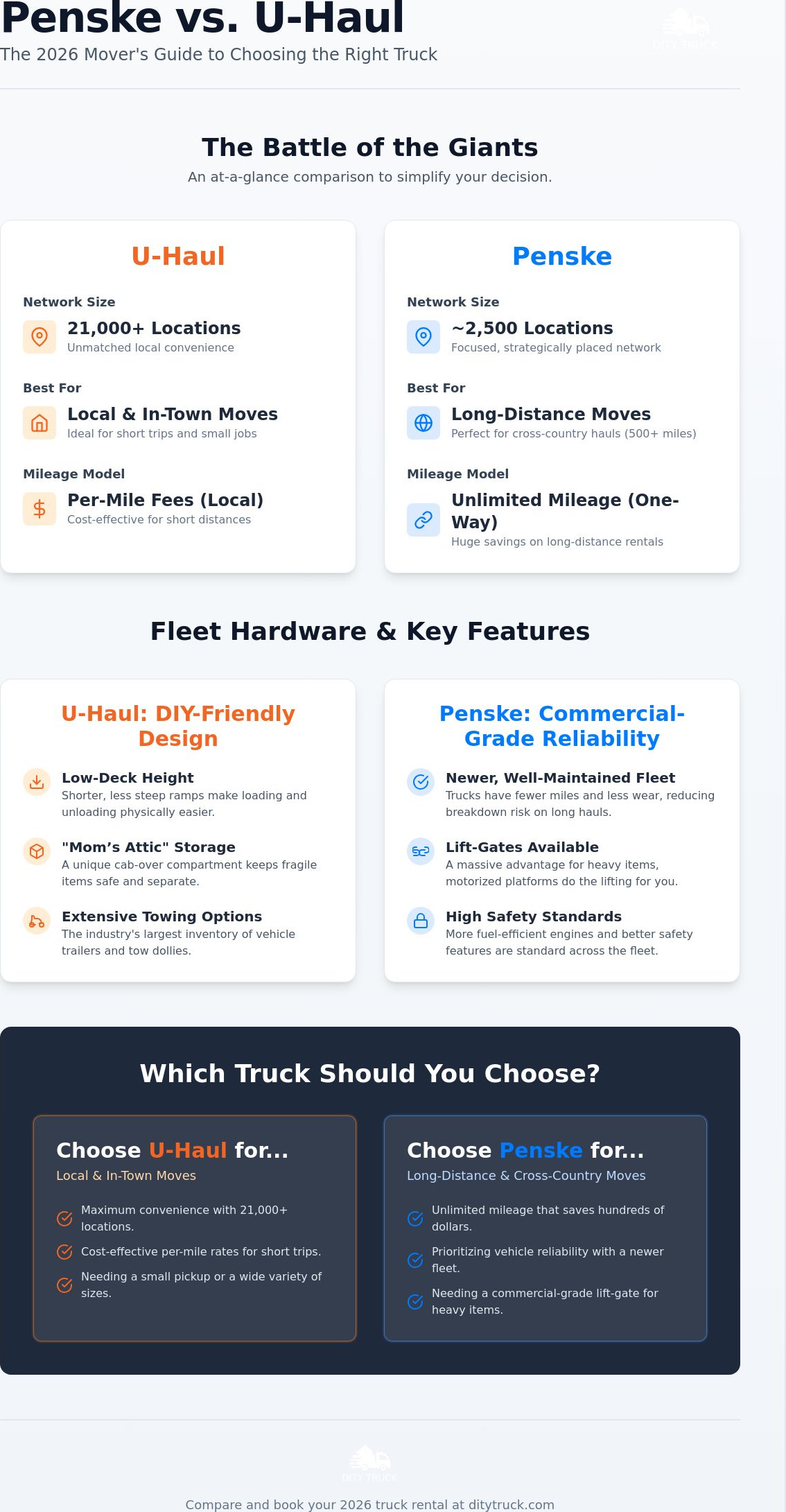
U-Haul dominates the local market with over 21,000 locations. They’re practically everywhere. Penske operates a smaller network but focuses on high-quality equipment. Both companies are fighting for your 2026 move with updated technology and streamlined service. Here is how they stack up at a glance.
| Feature | U-Haul | Penske |
|---|---|---|
| Network Size | 21,000+ Locations | ~2,500 Locations |
| Typical Sizes | 8′ pickup to 26′ truck | 12′ to 26′ truck |
| Best Use Case | Local, In-Town Moves | Long-Distance (500+ miles) |
| Mileage Model | Per-mile fees (Local) | Unlimited (One-way) |
| 2026 User Rating | 4.8 / 5.0 | 4.8 / 5.0 |
Brand Philosophy: Accessibility vs. Reliability
U-Haul focuses on neighborhood convenience. Their goal is to have a truck within five miles of your front door. This accessibility is a lifesaver for quick, local errands or one-room studio moves. You won’t drive far to return the keys. Penske prioritizes fleet maintenance. They treat their rental trucks like commercial assets. This philosophy results in a newer fleet. It’s built for those who fear a breakdown during a 1,000-mile journey. Your choice impacts more than your wallet. It determines your stress level on moving day. Reliability is a premium you might be willing to pay for.
2026 Market Position: What Has Changed?
The market looks different this year. Both companies have updated their fleet standards. You’ll see more fuel-efficient engines and better safety features across the board. Digital check-in processes are now the standard. You can book, verify your ID, and unlock your truck using just your phone. This saves time and removes the friction of waiting in line. However, 2026 pricing is more volatile. Dynamic models mean quotes change fast. Supply chain shifts and fuel costs impact the daily rates. Booking early is no longer a suggestion. It’s a requirement to lock in a fair rate. Both brands are chasing high satisfaction scores. They’ve reached a 4.8 out of 5 rating in recent consumer reviews. Efficiency is the new baseline for the modern mover.
Fleet Comparison: Analyzing Truck Sizes and Loading Features
Your choice of truck determines the physical toll of your move. It isn’t just about cubic feet. It’s about how you get those feet off the ground. When looking at penske vs uhaul, the hardware differences are immediate. U-Haul offers a massive variety. This includes a unique 8-foot pickup truck. It’s perfect for dorm rooms or quick furniture pickups. Penske skips the small pickups. They focus on the heavy hitters. Their inventory starts at 12 feet and scales up to 26-foot beasts designed for three-to-five-bedroom homes.
Both companies provide cargo vans for studio apartments. However, the experience changes once you step up to a box truck. Loading a 26-foot truck is a high-stakes puzzle. The features of the vehicle itself can either help or hinder your progress. Hardware matters. Ramps, lift-gates, and interior height play a massive role in your energy levels by the end of the day.
U-Haul Hardware: The Low-Deck Advantage
U-Haul’s design is built for the DIY mover. Their trucks feature a low-deck height. This means shorter ramps. You won’t struggle against a steep incline while pushing a heavy dresser. Most U-Haul box trucks also include “Mom’s Attic.” This is a specialized storage compartment that extends over the truck cab. It’s the ideal spot for fragile items or small boxes you don’t want crushed. If you need to tow your car, U-Haul has the most robust inventory of vehicle trailers and tow dollies in the industry. It’s a cohesive system designed for simplicity.
Penske Hardware: The Newer Fleet Standard
Penske takes a different approach. They maintain a much younger fleet. Most of their trucks have fewer miles and less wear than the industry average. This focus on reliability is central to their brand. On larger models, Penske often provides lift-gates. This is a motorized platform that does the heavy lifting for you. It’s a massive advantage over U-Haul’s standard ramps. According to an in-depth analysis from Move.org, Penske’s trucks also feature translucent roofs. These let natural light into the cargo area. It makes loading and organizing your belongings much easier during the day. You can see what you’re doing without a flashlight.
Fuel choices matter too. Penske offers diesel engines for their larger trucks. Diesel provides better fuel economy and more torque for heavy loads over long distances. U-Haul relies primarily on gasoline. If you’re overwhelmed by the technical specs, you can compare truck types and availability in seconds. Finding the right hardware makes the difference between a smooth transition and a back-breaking weekend. Choose the tool that fits the task.
The Cost Factor: Base Rates, Mileage, and Hidden Fees
The sticker price is rarely the final price. When comparing penske vs uhaul, looking only at the daily base rate is a mistake. You need to calculate the total cost of ownership for the duration of your move. This includes the rental fee, mileage, environmental fees, taxes, and fuel. One major factor people miss is dynamic pricing. In 2026, both companies use algorithms that shift rates based on demand, equipment availability, and even the time of day you browse. A quote you see on Monday might vanish by Tuesday. Booking early is the only way to lock in a specific rate before it climbs.
Beyond the base rate, expect a few non-negotiable add-ons. Environmental fees are standard across the industry. These cover the cost of disposing of oil and tires. Taxes vary significantly by state and city. Security deposits are another factor. U-Haul often allows cash deposits at certain locations, while Penske typically requires a credit card. Fuel costs also fluctuate based on the vehicle. Penske’s newer fleet often gets better MPG, especially with their diesel options on larger trucks. U-Haul’s gas engines can be thirstier. This adds up quickly on a long haul across several states.
Local Moves: The Mileage Trap
U-Haul is famous for its $19.95 base rate. It looks unbeatable for a quick cross-town trip. However, this is where the mileage trap begins. In 2026, U-Haul’s per-mile fees for local moves typically range from $0.79 to $1.29. If you move 50 miles away, that cheap rental suddenly costs over $80 before you even buy gas. The break-even point is usually around 30 miles. If your total trip is longer than that, a provider with a higher base rate but lower mileage costs might be better. Always check the fuel refill policy. Returning a truck with less gas than you started with results in heavy surcharges.
Long-Distance Moves: Unlimited Miles vs. Flat Rates
For one-way rentals, the math changes completely. Penske often includes unlimited mileage on these long-distance trips. This provides incredible price certainty. You don’t have to worry about a missed exit or a detour adding $50 to your bill. U-Haul uses an allotted miles system. They give you enough miles to get from point A to point B, but they charge for every mile over that limit. If you want to save money, book for a Tuesday or Wednesday. Mid-week base rates are often 20% lower than weekend prices. Penske also offers 10% to 12% discounts for AAA members, students, and military personnel. These percentages make a massive difference on a four-figure move.
One-Way vs. Local Moves: Strategic Brand Selection
Brand loyalty is often a hidden tax on your moving budget. The best choice for a three-mile trip across town is rarely the best choice for a three-day journey across state lines. Your route logistics should dictate your decision. When evaluating penske vs uhaul, you must weigh the convenience of proximity against the security of a guaranteed vehicle. In 2026, the “inventory gamble” remains a significant pain point for DIY movers. Some brands might offer a lower price but struggle to have the specific truck size you reserved at the location you requested. This uncertainty can derail your entire schedule.
The One-Way Strategy: Why Penske Often Wins
Penske is the specialist for long-distance logistics. If your move exceeds 500 miles, the security of a guaranteed reservation becomes your top priority. Penske promises your truck will be there. U-Haul often uses a “preferred location” system. This means you might have to drive to a different neighborhood on moving morning to find your equipment. For a long-haul route, Penske also offers unlimited mileage on one-way rentals. This removes the stress of tracking every exit and detour. You get a newer truck with fewer miles on the odometer. This reduces the fear of a mechanical failure in a remote area. It is a strategy built on reliability and financial certainty.
The Local Strategy: Why U-Haul Dominates
Local moves are about hourly efficiency and proximity. U-Haul’s network of 21,000 locations is a massive advantage here. You probably live within 10 minutes of a dealer. This saves you time on both the pickup and the return. For “in-town” moves, you can often return the truck to the same spot. This simplifies your logistics. U-Haul also provides more options for small loads. Their 8-foot pickups and cargo vans are ideal for moving a single room or a large appliance. While their mileage fees are higher for local trips, the short distance keeps the total cost manageable. You pay for the convenience of having a truck exactly where you need it.
The right choice depends on your specific map. Don’t leave your moving day to chance. You can compare real-time rates and book your rental now to secure your 2026 moving date. Whether you need the reliability of a long-distance specialist or the neighborhood convenience of a local giant, transparency is the key to a stress-free transition. Choose the brand that fits your route, not just the one with the most recognizable logo.
The DityTruck Advantage: Compare and Book Your Rental in Minutes
Stop wasting hours on multiple browser tabs. Finding the right truck shouldn’t be a full-time job. You shouldn’t have to navigate ten different websites just to compare penske vs uhaul. DityTruck does the heavy lifting for you. Our platform aggregates pricing from top providers in one clean interface. You see the major players side-by-side. It is the shortest path from a vague quote to a confirmed reservation. Efficiency is the core of our service. We replace complexity with confident simplicity.
Logistics are high-stakes. You need a tool that respects your time and your budget. In 2026, the “dynamic pricing” trap is real. Rates change while you are still deciding. By the time you check the third website, the price on the first one has already climbed. Our real-time data prevents this frustration. You get the transparency you deserve. No hidden surprises at the counter. Just clear, honest pricing for your specific move date.
How DityTruck Simplifies Your Move
Finding the perfect fit is easy. You can filter by truck size and route type instantly. Whether you need a small cargo van for a studio or a 26-footer for a family home, the results appear in seconds. We aggregate pricing from Penske, U-Haul, and other leading providers. This allows you to spot the best value immediately. You don’t have to guess which brand is cheaper for your specific route. You can see the total cost upfront. Locking in the best rate early is the smartest way to beat the 2026 pricing volatility. We act as your savvy consumer advocate in the logistics world.
Ready to Move? Get Your Quote Now
Your move starts here. Input your dates and locations for a custom comparison. Our system analyzes the latest 2026 availability to give you accurate results. You aren’t just looking at generic estimates. You are seeing the actual trucks available for your journey. Once you find the right match, our streamlined booking interface handles the rest. Secure your truck with a few clicks and get back to the things that matter. Don’t leave your moving day to chance. Book your moving truck on DityTruck today! Experience the relief of a friction-free booking process. It is time to move forward with clarity.
Secure Your 2026 Moving Strategy
Moving day doesn’t have to be a gamble. You now understand how route logistics and equipment quality dictate the winner in the penske vs uhaul debate. U-Haul offers unmatched neighborhood proximity for local hops. Penske provides the commercial-grade reliability and unlimited mileage needed for long-distance certainty. Success comes down to matching the right tool to your specific map and load size. You’ve done the research; now it’s time to act.
Don’t let dynamic pricing inflate your costs while you hesitate. You need a no-nonsense comparison to see the full financial picture. Accessing real-time 2026 pricing and nationwide availability in one place removes the friction from your planning. This transparency ensures you get a reliable truck without hidden fees or last-minute reservation stress. It is the smartest way to protect your budget and your peace of mind.
Compare real-time Penske and U-Haul rates on DityTruck and secure your equipment today. Taking control of your logistics is the first step toward a successful transition. You have the data. Now, take the shortest path to your new front door. Your move is in good hands.
Frequently Asked Questions
Is Penske or U-Haul cheaper for a cross-country move?
Penske is typically the more cost-effective choice for cross-country moves. Their unlimited mileage on one-way rentals provides price certainty. U-Haul provides a set mileage limit. Going over that limit results in per-mile charges that can quickly erase any initial savings on the base rate. Always calculate the total cost including these potential overages.
Do I need special insurance for a Penske or U-Haul truck?
You likely need to purchase supplemental insurance from the rental provider. Most personal auto insurance policies exclude commercial-sized box trucks. Both companies offer various levels of protection. These include damage waivers and liability coverage to ensure you aren’t financially responsible for accidents or theft. Check your credit card benefits, but expect to buy the provider’s coverage for full peace of mind.
Which company is better for a one-way rental?
Penske is the preferred choice for one-way rentals. Their guaranteed reservations mean your truck will be at the pickup location when you arrive. U-Haul’s preferred location system sometimes requires you to travel to a different site to get your equipment. Reliability and location certainty are key for long-distance logistics.
Are Penske trucks newer and more reliable than U-Haul?
Penske maintains a younger fleet with fewer miles than the industry average. This focus on commercial-grade maintenance reduces the risk of mechanical issues. While both companies earned 4.8 out of 5 satisfaction scores in 2026 reviews, Penske’s newer equipment remains a significant advantage for high-stakes journeys across the country.
Does U-Haul or Penske offer better discounts for students or military?
Penske offers more direct percentage-based discounts. They provide 10% to 12% off for AAA members, military personnel, and students. U-Haul focuses on value-add perks. This might include a free month of self-storage. When comparing penske vs uhaul, these discounts can significantly shift the total cost in Penske’s favor for those who qualify.
Can I tow my personal car with a rental moving truck?
You can tow your personal vehicle using trailers or tow dollies from either company. Check your vehicle’s weight and hitch requirements first. U-Haul has a larger inventory of towing equipment. This makes them a convenient option if you need a specific trailer type for a local or one-way trip. Always confirm that your specific truck model is rated for the weight of your car.
What happens if my rental truck breaks down during the move?
Both providers offer 24/7 roadside assistance. If your truck fails, call the emergency number provided in your rental agreement. They will dispatch a technician or arrange for a replacement vehicle. Penske’s focus on fleet age helps minimize these disruptions, but both brands have recovery protocols in place to get you back on the road.
How far in advance should I book my moving truck in 2026?
Book your truck at least two to four weeks in advance for 2026 moves. Dynamic pricing models mean rates fluctuate daily. Earlier bookings help you lock in a lower rate and guarantee equipment availability. This is especially true if you plan to move during the peak summer months or over a holiday weekend when demand is highest.
Leave a Reply