Category: Uncategorized

  • Moving Truck Rental No Credit Check: Your 2026 Guide to Easy Booking

    Moving Truck Rental No Credit Check: Your 2026 Guide to Easy Booking

    You don’t need a high credit score or a premium credit card to get behind the wheel of a 26-foot box truck. Most people assume a credit check is a mandatory hurdle in the moving process, but that’s a common misconception. It’s stressful to worry about being turned away at the rental counter just because you prefer using your own funds. Finding a moving truck rental no credit check is actually about liquidity and having the right documentation ready before you arrive.

    We know the frustration of seeing a massive, unexplained hold on your bank account or dealing with confusing age requirements for debit users. You deserve a straightforward path to your new front door. This guide helps you discover how to secure a moving truck without a credit card by comparing the best debit-friendly options in minutes. We explore specific deposit rules for 2026, explain the difference between no-credit-check and no-credit-card rentals, and provide a clear roadmap for a successful booking. You’ll walk away knowing exactly which provider fits your budget and your bank account.

    Key Takeaways

    • Learn why securing a moving truck rental no credit check is really about having a valid debit card and enough liquidity in your account.
    • Compare the latest 2026 policies for major national brands to find out which companies allow you to book online without a credit card.
    • Discover the exact documents you need to bring to the counter to ensure your rental goes through smoothly.
    • Get clear details on how security deposits and bank holds work. This helps you plan your budget without any surprises.
    • Find out how to use comparison tools to aggregate real-time rates and locate the most debit-friendly providers in your area.

    Understanding No-Credit-Check Moving Truck Rentals

    In the moving world, the phrase “no credit check” is often shorthand for flexible payment options. It signals that a provider accepts debit cards or cash instead of requiring a traditional credit line. This shift is a major win for renters who prefer to manage their finances without debt. Finding a moving truck rental no credit check is simpler than it was five years ago. You just need to know which hoops to jump through before you arrive at the lot.

    Most providers rely on credit cards as a form of risk mitigation. A credit card serves as a pre-authorized safety net for the company. If the truck is returned late or with damage, they have an immediate way to recover costs. When you remove the credit card from the equation, the company loses that layer of protection. They compensate for this by requiring larger deposits or more rigorous identity verification. You must still present a valid driver’s license and proof of insurance. Skipping the credit check doesn’t mean skipping the identification process.

    A general moving industry overview shows that DIY options are becoming more accessible as companies adapt to consumer financial habits. In 2026, the rise of debit-friendly policies reflects a broader trend toward financial inclusivity. Companies are realizing that a credit score isn’t the only way to measure a customer’s reliability. They are now focusing on your current ability to pay rather than your past borrowing history.

    The Difference Between Credit and Debit Rentals

    Credit cards provide an automatic line of trust; debit cards require proof of funds. When you use credit, the bank essentially vouches for you. With a debit card, you’re on your own. Some companies use a soft pull to verify your identity. This is different from a hard credit check because it doesn’t impact your credit score. Your bank balance matters much more than your score for these transactions. You need enough cash to cover the rental fee plus a significant security deposit. If the funds aren’t there, the reservation won’t hold.

    Why Providers Are Moving Away from Strict Credit Checks

    Market demand is the primary driver for this change. A large portion of the population is either unbanked or simply credit-conscious. To stay competitive, rental brands have developed smarter ways to manage risk. Modern technology allows for instant background and fund verification. Debit verification is a real-time fund check rather than a history report. This process gives the provider peace of mind without digging into your financial past. It’s a faster, cleaner way to get you on the road.

    Comparing Major Providers: Who Allows Debit and Cash?

    Every major rental brand has a different appetite for risk. Navigating these policies requires a clear eye for detail. A moving truck rental no credit check is possible at most national chains, but the “how” varies wildly. You don’t want to show up on moving day only to find your card is declined because of an unexpected hold. Preparation is the only way to avoid a last-minute crisis at the counter.

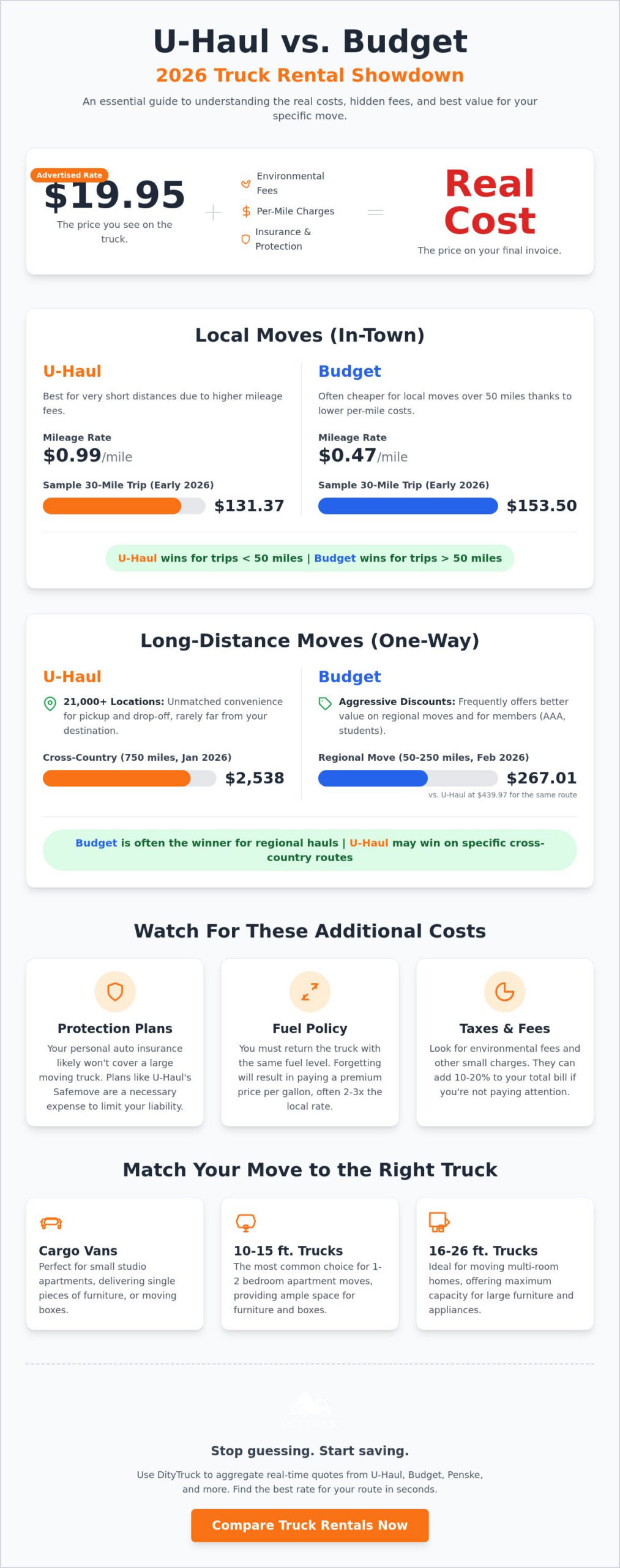
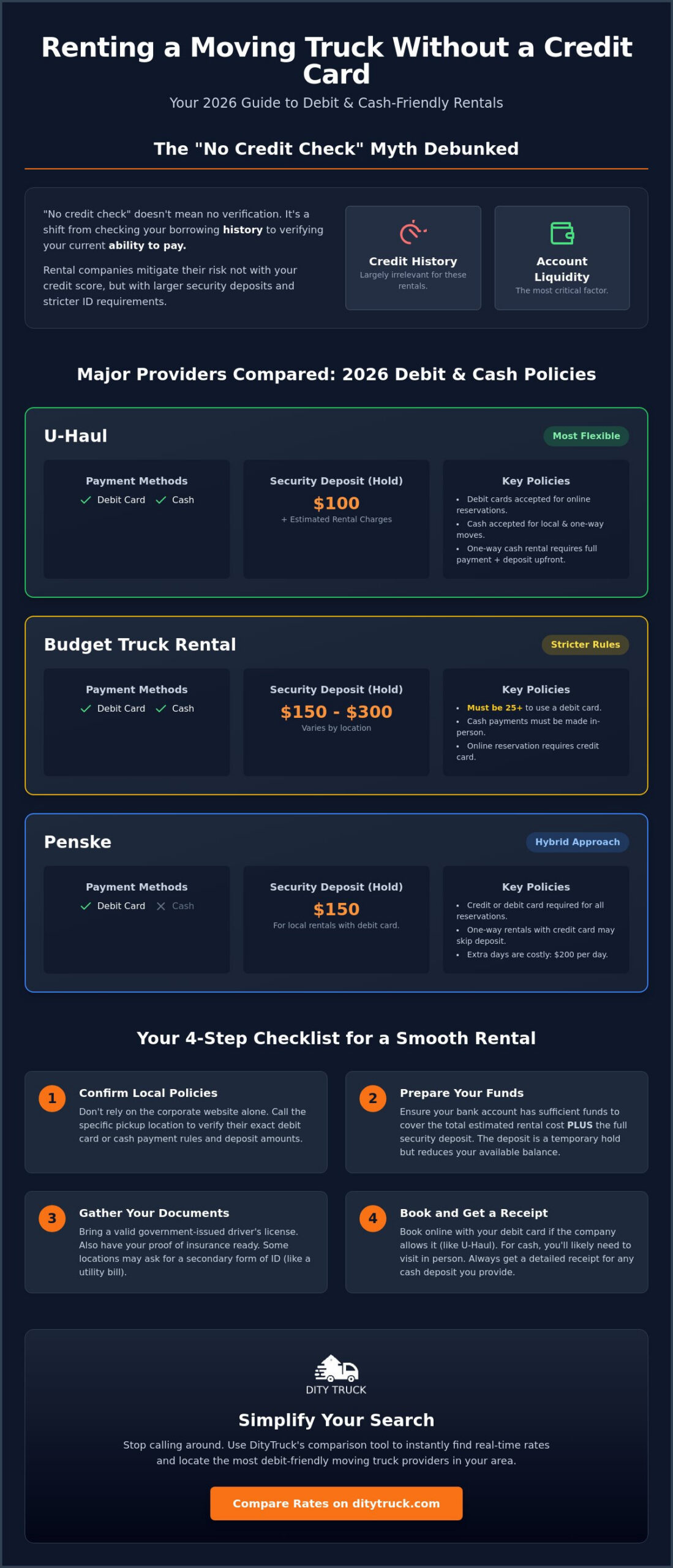
    U-Haul remains the most flexible option for 2026. They allow debit card payments for both online reservations and in-person pickups. If you use a debit card at pickup, expect a hold for the estimated rental charges plus a $100 deposit. Cash is also an option here. For local moves, the deposit is $100 or the estimated total, whichever is greater. One-way moves require the rental rate plus $100 upfront. This makes them a reliable choice for those avoiding credit entirely.

    Budget Truck Rental has stricter rules. You must be 25 or older to use a debit card. They also place a hold on your account that is usually $150. At some locations, this can jump to $300 or the estimated charges plus $80. They accept cash, but you have to handle the process in person. Understanding your consumer rights in moving protects you from unexpected policy shifts at the counter. Always ask for a receipt for any cash deposit provided.

    The Most Flexible Options for 2026

    Penske takes a hybrid approach. You need a valid credit or debit card just to make a reservation. While they accept debit at pickup, they typically require a $150 deposit for local rentals. One-way rentals booked with a credit card often skip the deposit. If you’re planning a long-haul trip, check our guide on Penske truck rental to see how they handle long-distance debit rentals. Be aware that extra days with Penske cost $200 each. This can add up quickly if your timeline shifts.

    What to Look for in the Fine Print

    The “In-Person Only” cash trap is a common hurdle. Most companies won’t let you reserve a truck online with cash. You have to visit a physical location to secure the vehicle. This adds a layer of complexity to your schedule. Local dealer participation also varies. A national policy might exist, but a small independent dealer might still insist on a credit card. Always call the specific lot ahead of time to verify their local rules. You can compare real-time rates and policies to find a location that fits your specific needs.
    Moving Truck Rental No Credit Check: Your 2026 Guide to Easy Booking

    Steps to Secure a Truck Without a Credit Card

    Securing a moving truck rental no credit check requires more than just showing up at the lot. It is a project of preparation. When you bypass the traditional credit path, you must prove your reliability through documentation and liquidity. Rental agents are trained to mitigate risk. Your job is to make their decision easy by arriving with a complete paper trail and a healthy bank balance. This proactive approach eliminates the friction often found at the rental counter.

    Don’t leave your move to chance. Call the specific pickup location 24 hours before your reservation. National policies are helpful, but local managers have the final say on vehicle releases. Confirm that they have your truck on-site and that they accept your specific form of payment. This quick call prevents the “no truck available” nightmare that can derail a moving schedule. It also establishes a rapport with the staff who will be inspecting your documents.

    The Essential Documentation Checklist

    Your driver’s license is just the starting point. When you skip the credit check, providers often require additional proof of stability. Bring a physical copy of a recent utility bill or a signed lease agreement. These documents must match the address on your ID. This “Proof of Residence” is a critical requirement that many competitors fail to mention. It serves as a secondary anchor for the rental company. Bring a backup form of identification too. A passport, social security card, or military ID can bridge the gap if the agent has questions about your primary license.

    Verifying Your Funds and Deposit

    Successful booking depends on your “Liquidity Buffer.” Never use a debit card that has exactly the amount of your quote. If your estimated rental is $150 and the deposit is $150, having $300 in your account is a recipe for failure. Banks often place temporary holds that can exceed the base quote. Aim for a buffer of at least 20 percent above the total expected hold. This ensures the transaction clears without triggering an overdraft or a declined card.

    The size of your deposit depends heavily on the type of move. Local round-trip rentals usually carry a smaller deposit, often around $100. One-way moves are higher stakes for the provider. They may require the full rental rate plus an additional flat fee upfront. Following FTC rental advice can help you understand how these holds impact your available cash. Remember that while a credit card hold just lowers a limit, a debit hold physically removes access to your cash. Plan your grocery and gas spending accordingly during the move.

    Managing the Security Deposit and Bank Holds

    When you swipe your debit card for a moving truck rental no credit check, the bank doesn’t just record a transaction. They trigger a hold. This mechanism keeps the money in your account but makes it inaccessible for other purchases. It is a digital safety net for the rental company. You need to account for this lack of liquidity when planning your moving day budget. If you have exactly enough for the rental but forget the deposit, your card will decline. This is a common point of friction that is easily avoided with a bit of foresight.

    Deposit ranges vary by distance and provider. For local moves, U-Haul typically requires a $100 deposit. Budget often asks for $150; however, this can climb to $300 depending on the specific location and estimated charges. Penske generally holds $150 for round-trip rentals. Long-distance moves are different. These often require the full estimated rental amount plus a flat deposit fee upfront. Always factor in these numbers before you arrive at the lot. The return process triggers the release of these funds, but the timing isn’t always instant.

    Ghost holds are a common frustration for many renters. This happens when the original authorization stays on your account even after the final charge is processed. It looks like you’ve been billed twice. This isn’t a double charge. It is simply the bank’s processing speed. Most ghost holds vanish within a few days, but they can be a major headache if you’re on a tight budget. Keeping a small buffer in your account prevents these temporary holds from causing overdraft fees.

    How Long Does a Refund Take?

    The rental company releases your funds the moment you return the keys and settle the bill. That is the easy part. The delay happens at your bank. Most major financial institutions take 3 to 10 business days to post the funds back to your available balance. This timeline is standard across the industry. If your deposit hasn’t appeared after 10 days, contact the rental lot first. Ask for the authorization release code. You can then give this code to your bank to speed up the process. It is a simple step that resolves most “missing” deposit issues.

    Hidden Costs of No-Credit Rentals

    Skipping the credit check sometimes comes with subtle expenses. Some locations may encourage higher-tier insurance packages for debit users to manage their risk. Also, don’t expect a cash refund if you paid with cash at the start. The “Cash Refund” myth is a frequent trap. Most national brands will mail a corporate check to your new address rather than handing back bills. This can take two weeks to arrive in your mailbox. Compare these potential delays and costs against a one way truck rental to see the full financial impact of your choice. You can find the most transparent rates and deposit rules by using an aggregation tool before you book.

    Simplify Your Search with DityTruck

    Searching for a moving truck rental no credit check usually involves hours of manual research. You have to verify local policies. You have to check deposit amounts. You have to compare mileage rates across multiple tabs. DityTruck changes this dynamic. Our platform aggregates real-time data from the industry’s biggest names into a single view. We do the heavy lifting behind the scenes. This allows you to focus on your packing list instead of rental fine print. It is the shortest path between your logistics problem and a confirmed reservation.

    Efficiency is our priority. Instead of navigating separate FAQs for Budget, Penske, and U-Haul, you see every option in one place. This transparency is vital for avoiding “Counter Shock.” This happens when you arrive at the lot and face fees or deposit requirements you didn’t see online. We prioritize clarity. You get a direct look at the total cost; this includes the estimated holds we discussed in previous sections. It is moving logistics simplified for the modern renter.

    Our “Smart Assistant” approach treats your time as a premium resource. You shouldn’t have to be an expert in rental contracts to get a fair deal. We provide the tools to filter for the best rates and the most flexible payment terms. This ensures you find a provider that respects your financial choices. We act as your advocate. We strip away the complexity of DIY moving and replace it with a streamlined, digital-first experience.

    Compare Rates in One Step

    You only need to input your move details once. Our system then fetches quotes from multiple providers simultaneously. You can easily visualize the cost to rent a 26 foot moving truck across different brands to see which one fits your budget best. This side-by-side view highlights the differences in base rates, mileage fees, and deposit requirements. You book with confidence. The requirements are visible upfront. No more guessing which lot will accept your debit card or how much they will hold.

    Ready to Move?

    A lack of a credit card should never stall your relocation. You have the documentation ready. You understand the bank holds. Now, you just need the right vehicle at the right price. Use our platform to find the most flexible providers in your area today. We help you skip the stress of the credit check. We get you straight to the move. Compare moving truck rates on DityTruck today and secure your rental in minutes.

    Take Control of Your 2026 Move Today

    Securing a moving truck rental no credit check is no longer a complicated process. It is a matter of preparation and knowing which providers offer the most flexibility. You have learned that a valid debit card, a clear paper trail, and a healthy bank buffer are your best tools for success. By understanding how bank holds work and which documents to bring, you eliminate the stress often found at the rental counter. You are ready to bypass the traditional credit hurdles and get on the road.

    DityTruck simplifies the final step. Our platform provides real-time rates from top-tier providers like Penske and Budget. We offer transparent pricing with no hidden comparison fees. Our streamlined booking process is designed specifically for 2026 moving standards. This ensures you find the most debit-friendly options in your area without visiting multiple websites. You get the clarity you need to make an informed decision in minutes.

    Find and Compare Moving Truck Rentals Now. Your next chapter is waiting. Take the shortest path to your new home with a rental process that respects your financial choices and your time. You have got this.

    Frequently Asked Questions

    Can I rent a moving truck with a debit card and no credit check?

    Yes, you can rent a truck without a traditional credit check by using a major debit card at providers like U-Haul and Budget. These companies focus on your bank balance and valid identification rather than your credit history. While a credit card is the industry standard for trust, a debit card serves as a functional alternative when backed by a security deposit. It’s the most reliable way to secure a moving truck rental no credit check in 2026.

    How much is the security deposit for a moving truck rental with a debit card?

    Deposit amounts vary significantly by provider and the type of move you’re planning. U-Haul typically requires a $100 deposit for both local and one-way rentals. Penske generally asks for a $150 deposit for local round-trip bookings. Budget’s requirements are more dynamic; they usually start at $150 but can reach $300 at specific locations. Always ensure these funds are available in your account before arriving at the rental counter to avoid a declined card.

    Do rental companies do a “soft pull” on my credit for debit rentals?

    Some companies perform a soft pull or identity verification when you use a debit card. This process confirms your personal details without impacting your credit score. It’s a standard risk management tool used to replace the automatic trust provided by a credit card. Other providers skip this step entirely and rely solely on a cash deposit. This approach ensures they have collateral if the vehicle is returned late or damaged during the moving process.

    What happens if I don’t have enough money for the deposit hold?

    Your reservation will be cancelled if your bank account can’t cover the total hold amount. The rental system attempts to authorize the estimated rental charges plus the security deposit in a single transaction. If the card is declined, the agent can’t release the keys to you. This is why maintaining a liquidity buffer is essential. It prevents a simple lack of funds from derailing your entire moving schedule on the day of the trip.

    Can I pay for a moving truck with cash at the end of the move?

    Most national brands allow you to settle your final bill with cash once the truck is returned. Penske accepts cash payments only at the end of the rental period. U-Haul is more flexible; they allow cash payments at both the start and the finish. If you pay a cash deposit upfront, remember that the company will likely mail you a refund check rather than handing back physical currency at the counter. This process can take up to two weeks.

    Which moving truck company is the most debit-card friendly?

    U-Haul is widely considered the most debit-friendly provider in the industry. They offer the lowest standard deposit of $100 and have the most inclusive policies for cash users. Their system is built to handle non-credit transactions efficiently across thousands of independent dealer locations. This makes them a top choice for renters who want a moving truck rental no credit check without navigating the stricter age or ID requirements found at other major chains.

    Do I need extra insurance if I am not using a credit card?

    Purchasing the rental company’s insurance is highly recommended when skipping a credit card. Most personal auto policies don’t cover large box trucks, and the secondary coverage provided by many credit cards is unavailable for debit users. Some locations may even require you to buy their basic protection plan if you aren’t using credit. This protects you from massive out-of-pocket costs if an accident occurs during your move. It’s a small price for peace of mind.

    Can someone else pay for my rental truck with their credit card?

    Generally, the person paying for the rental must be the primary driver listed on the contract. Rental companies require the name on the card to match the name on the driver’s license presented at the counter. If a friend or family member wants to pay, they must be present at pickup and sign the agreement as a responsible party. This policy prevents unauthorized use and ensures the company has a clear point of contact for the vehicle throughout the rental.
  • Do You Need a CDL to Drive a 26ft Box Truck? Your 2026 Guide

    Do You Need a CDL to Drive a 26ft Box Truck? Your 2026 Guide

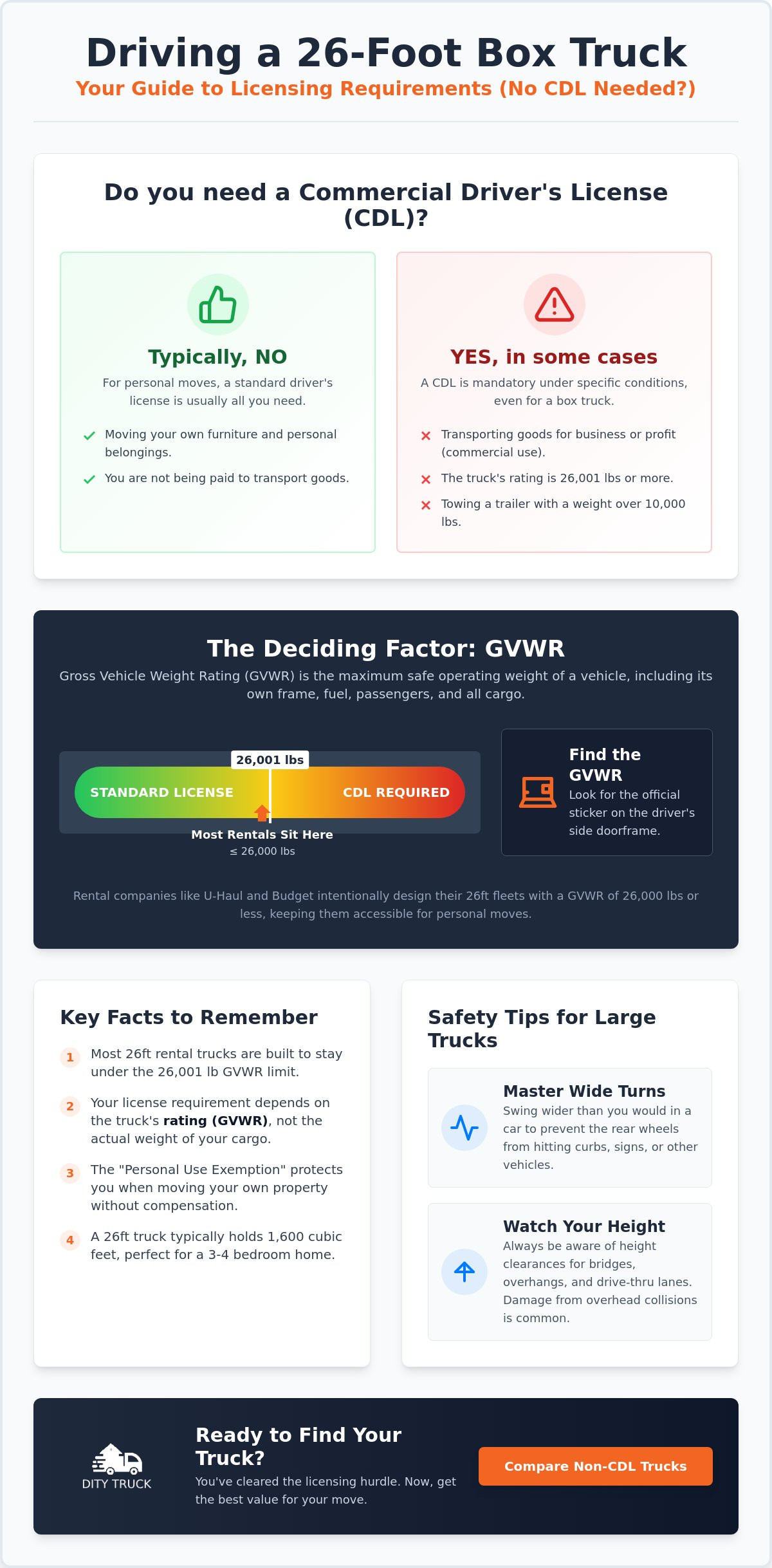
    You can legally pilot a massive 26-foot vehicle without a commercial license, but only if you know the exact number printed on the doorframe. It’s a common fear for DIY movers. You see that towering cargo space and wonder: do you need a CDL to drive a 26ft box truck just to get your furniture across town? The size is intimidating. Handling a vehicle that’s three times longer than a standard SUV naturally causes anxiety about legal compliance and roadside stops.

    We know you want a move that’s free of legal hurdles and hidden complications. This 2026 guide provides the clear, definitive answer you need to book your rental with total peace of mind. You’ll learn exactly how the 26,000-pound weight threshold works and why the manufacturer’s rating matters more than your actual cargo. We also provide a fast way to compare rental options once you’ve cleared the licensing hurdle. You get the facts quickly so you can focus on the heavy lifting.

    Key Takeaways

    • Most 26ft box trucks are built to stay under the 26,001 lb GVWR limit. You usually won’t need a special license for a personal move.
    • Your legal status depends on the Gross Vehicle Weight Rating (GVWR) found on the doorframe. It’s about the truck’s capacity, not just the weight of your cargo.
    • Identify specific triggers that mandate a commercial license. You’ll need to know if you do need a CDL to drive a 26ft box truck when towing trailers or moving for profit.
    • Protect your rental by mastering height clearances and wide turns. These are the most common causes of damage for drivers transitioning from standard SUVs.
    • Compare rental brands to find the best non-CDL options. Prices fluctuate between providers; checking multiple rates ensures the best value for your logistics plan.

    The Short Answer: Do You Need a CDL for a 26ft Box Truck?

    The short answer is no. You typically don’t need a special license for a personal move. If you’ve been asking yourself, do you need a CDL to drive a 26ft box truck, the most common answer is a firm no. Federal law focuses on weight ratings rather than the physical length of the cargo area. Most people can legally pilot these large vehicles using the same Class C license they use for a sedan or an SUV. It’s a massive relief for anyone facing a big relocation.

    Everything hinges on the Gross Vehicle Weight Rating (GVWR). This number represents the maximum weight a truck can safely carry, including its own frame, fuel, and cargo. The legal pivot point is 26,001 pounds. If a truck’s rating is 26,000 pounds or less, a commercial license isn’t required. Rental companies like U-Haul and Budget understand this legal boundary perfectly. They specifically design their 26ft fleets to stay at exactly 26,000 pounds. This engineering choice removes the licensing hurdle for you. You get the maximum space without the professional paperwork.

    Defining the 26ft Box Truck

    These vehicles are the giants of the consumer rental world. A 26ft box truck usually offers about 1,600 cubic feet of storage space. It’s the gold standard for moving a three to four bedroom home in a single trip. While they look intimidating on the road, they are classified as medium-duty vehicles. Their physical dimensions are large, but their mechanical systems are designed for accessibility. You get a massive payload capacity that stays just under the federal weight threshold for commercial regulation.

    The Personal Use Exemption

    Moving your own furniture is legally different from hauling freight for profit. The Federal Motor Carrier Safety Administration (FMCSA) provides a specific carve-out for individuals. If you aren’t being paid to transport goods and the cargo is your own property, you fall under the personal use exemption. Federal guidelines define the personal use exemption as the operation of a vehicle for personal purposes where no compensation is involved. This means you don’t need a Commercial Driver’s License (CDL) to move your family to a new state.

    Knowing whether or not do you need a CDL to drive a 26ft box truck allows you to plan your logistics without legal anxiety. You can focus on packing and route planning instead of license upgrades. Check your license class; in most states, a standard Class C is all you need. You get the professional capacity of a big rig with the simplicity of a personal rental. It’s the most efficient way to handle a high-stakes move without unnecessary complexity.

    Understanding the 26,000 lb. GVWR Threshold

    GVWR stands for Gross Vehicle Weight Rating. It’s the most important number on your rental agreement. This isn’t just a suggestion; it’s a legal limit set by the manufacturer. It represents the maximum weight the vehicle can safely handle. This includes the truck’s own frame, all fluids, every passenger, and your entire household inventory. Understanding this number is the key to answering the question: do you need a CDL to drive a 26ft box truck?

    The magic number is 26,001. According to federal regulations found in 49 CFR Part 383, a Commercial Driver’s License becomes mandatory the moment a vehicle’s rating hits this threshold. If your truck is rated at exactly 26,000 pounds, you’re legally in the clear with a standard license. Most rental companies intentionally cap their 26ft models at this limit to keep them accessible to the general public. It’s a deliberate design choice that simplifies your move.

    You can find this rating easily. Open the driver’s side door and look at the frame or the door jamb. You’ll see a VIN plate or a high-durability sticker. This label lists the GVWR. Always verify this number before you drive away. Knowing the difference between “Gross Weight” and “GVWR” is also vital. Gross weight is what the truck weighs on a scale at any given moment. GVWR is the maximum rating. Licensing laws focus on the rating; road safety laws focus on the actual weight.

    Rating vs. Reality: Why the Label Matters

    Law enforcement officers look at the sticker first. If you’re pulled over, the officer checks the doorframe rating to determine your licensing requirements. It doesn’t matter if the truck is currently empty. If the sticker says 26,001 pounds, you must have a CDL. Rental companies are very careful about this. They often spec their 26ft trucks at exactly 25,999 pounds. This creates a safety buffer that protects you from accidental violations. You can compare rental options now to see which providers offer the best non-CDL configurations.

    The Impact of Payload on Licensing

    A 26ft truck is a heavy piece of machinery. The vehicle itself might weigh 16,000 pounds when empty. This leaves you with a payload capacity of roughly 10,000 pounds. If you pack extremely heavy items like gym equipment or large toolsets, you might approach that 26,000-pound limit quickly. Exceeding the payload doesn’t change your license class, but it can lead to fines at weigh stations. Many drivers visit a CAT scale at a truck stop. It provides a printed receipt of your actual weight. This gives you total peace of mind during long-distance hauls.

    Do You Need a CDL to Drive a 26ft Box Truck? Your 2026 Guide

    When a CDL Becomes Mandatory (Even for a Box Truck)

    While most residential rentals fall under the personal use exemption, certain scenarios override that status. You might start your journey with a standard license, but adding a trailer or changing your cargo can trigger federal requirements. If you are asking do you need a CDL to drive a 26ft box truck, you must consider what you are hauling and what’s hitched to the back. These specific triggers turn a simple DIY move into a commercial operation in the eyes of the Department of Transportation.

    Towing is the most common trap for unsuspecting drivers. The law looks at the Gross Combination Weight Rating (GCWR). If you hitch a heavy trailer to your 26ft truck and the total combined rating exceeds 26,001 pounds, you may need a Class A CDL. This specifically applies if the trailer itself has a GVWR of more than 10,000 pounds. Most small car dollies won’t push you over this limit, but heavy equipment trailers certainly will. Always check the weight rating of both the truck and the trailer before you leave the lot.

    Cargo type and passenger count also matter. Hauling hazardous materials in quantities that require a placard always demands a CDL, regardless of the truck’s size. This includes large amounts of certain chemicals, explosives, or flammable liquids. Similarly, if you’ve modified a box truck to carry 16 or more people including the driver, a commercial license with a passenger endorsement becomes mandatory. These rules ensure that high-risk loads are handled by professionals with specialized training.

    The Air Brake Myth Debunked

    Many drivers believe that any vehicle equipped with air brakes requires a CDL. This is a persistent myth. Federal law does not mandate a commercial license based solely on the braking system. If the truck’s GVWR is 26,000 pounds or less, you can legally drive it with a standard license even if it uses air brakes. Most rental companies choose hydraulic brakes for their 26ft fleets anyway. This choice simplifies the driving experience and avoids unnecessary confusion at weigh stations.

    Commercial vs. Non-Commercial Use

    The “for-hire” distinction is the final legal hurdle. If you are using the truck to move your own household goods, you are generally exempt. However, if you are being paid to move someone else’s property, the vehicle is considered a commercial motor vehicle. This commercial activity often requires a CDL and a DOT medical card. Some states have stricter rules for interstate commerce, so double-check the local DOT regulations for every state on your route. Do you need a CDL to drive a 26ft box truck? Not for your own move, but the rules change the moment you turn it into a business.

    To stay legally compliant, remember these three primary CDL triggers:

    • Operating a vehicle with a GVWR of 26,001 pounds or more.
    • Towing a trailer over 10,000 pounds when the total weight exceeds 26,001 pounds.
    • Transporting hazardous materials that require safety placards.

    Driver Safety and Rental Logistics for Large Trucks

    Confirming the answer to do you need a CDL to drive a 26ft box truck is only your first step. Once you’ve cleared the legal hurdle, you must face the reality of operating a vehicle that is three times longer than a standard SUV. Driving these giants requires a shift in mindset. You are now the captain of a medium-duty machine that demands constant attention to surroundings. Handling the physical size of the truck is often more challenging than the paperwork itself.

    Height clearance is the leading cause of rental truck damage. Most 26ft trucks stand approximately 13 feet tall. This makes low-hanging tree branches, apartment complex awnings, and bank drive-thrus major hazards. You cannot rely on muscle memory from your personal car. Always look for clearance signs before entering any parking lot or underpass. It’s also vital to master the turning radius. With a long wheelbase, you must swing wide on every corner. If you turn too early, the rear wheels will clip curbs, signs, or parked vehicles. Use your mirrors to track the back of the truck through every maneuver.

    Insurance is another critical logistics piece. Don’t assume your personal auto policy covers a 26ft rental. Most standard policies and credit card protections exclude vehicles with a GVWR over 10,000 pounds. Since these trucks weigh significantly more, you are likely unprotected. Purchasing the rental company’s supplemental damage waiver is the most efficient way to avoid financial disaster. It strips away the complexity of claims and ensures you aren’t liable for expensive repairs. You can book your truck rental now to see which providers offer the best protection packages.

    Pre-Trip Inspection Checklist

    Perform a thorough walk-around before leaving the rental lot. Check the tire pressure and look for any visible fluid leaks under the chassis. Testing the lights and signals is essential. Large blind spots make clear communication with other drivers a safety requirement. Document every existing scratch or dent with photos. This simple task prevents hidden fees when you return the vehicle at the end of your move.

    Navigating Weigh Stations

    State laws regarding weigh stations vary significantly. Watch for highway signs that mention “Rental Trucks” specifically. In many states, personal moves are exempt from scales, but some jurisdictions require all commercial-sized vehicles to pull in. If you’re unsure, it’s safer to enter the station and follow the officer’s signals. For detailed budget planning, see our Cost to Rent a 26 Foot Moving Truck guide. It provides a full 2026 pricing comparison to help you manage the financial side of your relocation. Knowing the logistics helps you answer the question do you need a CDL to drive a 26ft box truck with total confidence.

    Finding the Right 26ft Truck with DityTruck

    Confirming that you don’t need a professional license is a massive relief. Now, the challenge is securing the right vehicle at the right price. Pricing for large rentals isn’t uniform across the industry. Major brands use complex algorithms to determine their daily rates. This means the quote you get from one provider might be hundreds of dollars higher than another for the exact same 26ft model. Once you’ve settled the question, do you need a CDL to drive a 26ft box truck, your next move should be a smart comparison.

    DityTruck acts as your savvy logistics assistant. We strip away the complexity of visiting multiple websites by bringing every major rental option into a single, transparent view. You see real-time availability and honest pricing without the traditional hurdles. These large trucks are often the first to sell out during peak moving seasons. Using a centralized search tool ensures you grab the 1,600 cubic feet of space you need before it disappears from the local inventory. It’s the shortest path between identifying your need and resolving your logistics problem.

    Transparent booking is our priority. We want you to avoid the high-pressure environment of the rental counter. By comparing and booking ahead of time, you walk into the rental office with a confirmed reservation and a clear understanding of your costs. There are no hidden obstacles or last-minute surprises. You get the peace of mind that comes with a solid plan, allowing you to focus on the physical act of moving your home.

    Compare and Save on Your Next Move

    Our platform allows you to see Penske, Budget, and U-Haul side-by-side. You can easily filter for the specific 26ft size to ensure the vehicle matches your household volume. This level of clarity is essential for a successful DIY move. For a deeper look at how different providers stack up in 2026, check out our Moving Truck Rental Guide. It provides a full comparison to help you choose the best brand for your specific route and budget.

    Ready to Book Your 26ft Truck?

    The process is fast and methodical. You enter your details, compare the results, and secure your truck. It’s a simple action-result progression that saves you hours of manual research. You can confirm your reservation in minutes, leaving the complex logistics to us. Don’t let the size of the task overwhelm you. We provide the tools to make your relocation efficient and stress-free. Find and Compare 26ft Box Truck Rentals Now to get your move started with confidence. You’ve already answered the question, do you need a CDL to drive a 26ft box truck. Now, it’s time to get behind the wheel and get moving.

    Get Moving with Confidence

    The path to your new home is now clear. You’ve learned that for most personal relocations, the answer to do you need a CDL to drive a 26ft box truck is a definitive no. As long as the vehicle’s GVWR stays at or below 26,000 pounds and you aren’t towing a heavy trailer for profit, your standard license is all you need. You can focus on mastering those wide turns and checking your height clearances instead of worrying about professional certifications.

    Logistics shouldn’t be the hardest part of your move. We provide real-time rate comparisons across major brands to ensure you get the best value without the stress. You can check nationwide availability for your 2026 move and book with total transparency. There are no hidden booking fees to surprise you at the counter. It’s the most efficient way to secure the space you need for a successful transition.

    Compare 26ft Box Truck Rates and Book Your Move Today

    Take control of your move today. You have the facts and the right tools to make this relocation your most organized one yet. Safe travels on the road ahead.

    Frequently Asked Questions

    Is a 26ft box truck hard to drive for a beginner?

    Driving a 26ft truck is manageable for most beginners but requires immediate adjustments to your driving style. You must account for a much wider turning radius and significantly longer braking distances. Visibility is limited to your side mirrors since there is no rearview mirror. Most drivers find they feel comfortable after the first thirty minutes of highway travel. Just remember to take corners slowly and avoid tight residential streets when possible.

    What is the maximum weight I can carry in a 26ft rental truck?

    The typical payload capacity for a 26ft rental truck is between 9,000 and 10,000 pounds. This limit exists because the vehicle itself weighs approximately 16,000 pounds. Adding more than five tons of cargo would push the truck over its 26,000-pound Gross Vehicle Weight Rating. Exceeding this limit can strain the engine, compromise the braking system, and lead to heavy fines at state weigh stations.

    Do I need to stop at weigh stations in a rental truck?

    Requirements for weigh stations vary by state and the purpose of your trip. Many states exempt rental trucks used for personal household moves from stopping at scales. However, states like California or Pennsylvania may require all vehicles over a certain weight to pull in regardless of use. Always watch the highway signage as you approach a station. If a sign specifically mentions rental trucks, you must follow the direction to exit.

    What happens if I drive a truck that requires a CDL without a license?

    Operating a vehicle that requires a commercial license without the proper credentials leads to severe legal consequences. You face heavy individual fines, potential vehicle impoundment, and a permanent mark on your driving record. Your insurance coverage is also likely voided in the event of an accident. This is why confirming the answer to do you need a CDL to drive a 26ft box truck is a vital step before you sign your rental agreement.

    Does a 26ft truck have air brakes?

    Most consumer-grade 26ft rental trucks utilize hydraulic brakes rather than air brakes. Rental companies choose hydraulic systems because they feel more familiar to standard car drivers and require less specialized training. While some heavy-duty commercial versions of these trucks do feature air brakes, they are rarely found in fleets intended for DIY movers. This choice helps keep the vehicle accessible to anyone with a standard Class C driver’s license.

    Can I tow my car behind a 26ft box truck without a CDL?

    You can generally tow a personal vehicle behind a 26ft truck without a commercial license. Most car dollies and trailers weigh less than 10,000 pounds, which keeps you under the federal threshold for a Class A license. However, you must ensure the total weight of the truck and the trailer doesn’t create a safety hazard. If you are still wondering do you need a CDL to drive a 26ft box truck while towing, the answer remains no for most standard car-towing setups.

    How much gas does a 26ft box truck use?

    Expect a 26ft box truck to achieve between 8 and 13 miles per gallon. This fuel economy depends heavily on the total weight of your cargo and whether you are driving through mountainous terrain. Wind resistance also plays a major role due to the truck’s boxy shape. Most modern fleets offer a mix of gasoline and diesel engines. Diesel models often provide slightly better mileage and more torque for hauling heavy household loads over long distances.

    What is the height of a standard 26ft box truck?

    A standard 26ft box truck typically stands about 13 feet tall. This height is significantly greater than any passenger vehicle and requires constant vigilance. You must watch for low-hanging branches, apartment awnings, and bridge clearances. Most rental companies print the exact height of the vehicle on a sticker inside the cab. Always check this number before you start your trip to avoid expensive overhead damage that insurance rarely covers.

  • Can You Rent a Moving Truck at 18? Age Requirements for 2026

    Can You Rent a Moving Truck at 18? Age Requirements for 2026

    Most people assume you need to be 25 to rent any type of vehicle. While that’s often the case for cars, the moving truck industry follows a much more flexible set of rules. You’ve likely felt the stress of wondering if you’ll be turned away at the rental counter on moving day. It’s frustrating to deal with the confusion between car rental laws and truck rental policies, especially when you’re worried about high surcharges for young drivers. You deserve a clear path forward without the logistical headaches.

    The good news is that can you rent a moving truck at 18 if you know which brands to target. We’ve gathered the definitive details on which companies allow 18-year-olds to book and exactly what requirements you need to meet. This guide provides a complete list of accepting providers, a checklist of necessary documents, and a way to compare total costs including age fees. You’ll move from confusion to a finalized booking in just a few minutes.

    Key Takeaways

    • Identify which major national providers allow 18-year-olds to book equipment without the 25-year-old age restriction common in the car rental industry.
    • Confirm exactly how can you rent a moving truck at 18 with companies like U-Haul and Penske while navigating stricter limits at other brands.
    • Review the specific documentation and secondary identification required to clear the rental counter and secure your vehicle on moving day.
    • Understand how young driver surcharges affect your total cost. Learn to factor these daily fees into your final moving budget.
    • Use DityTruck to compare real-time quotes and age-specific policies across multiple providers to find the most cost-effective solution for your move.

    Can You Rent a Moving Truck at 18? The Short Answer

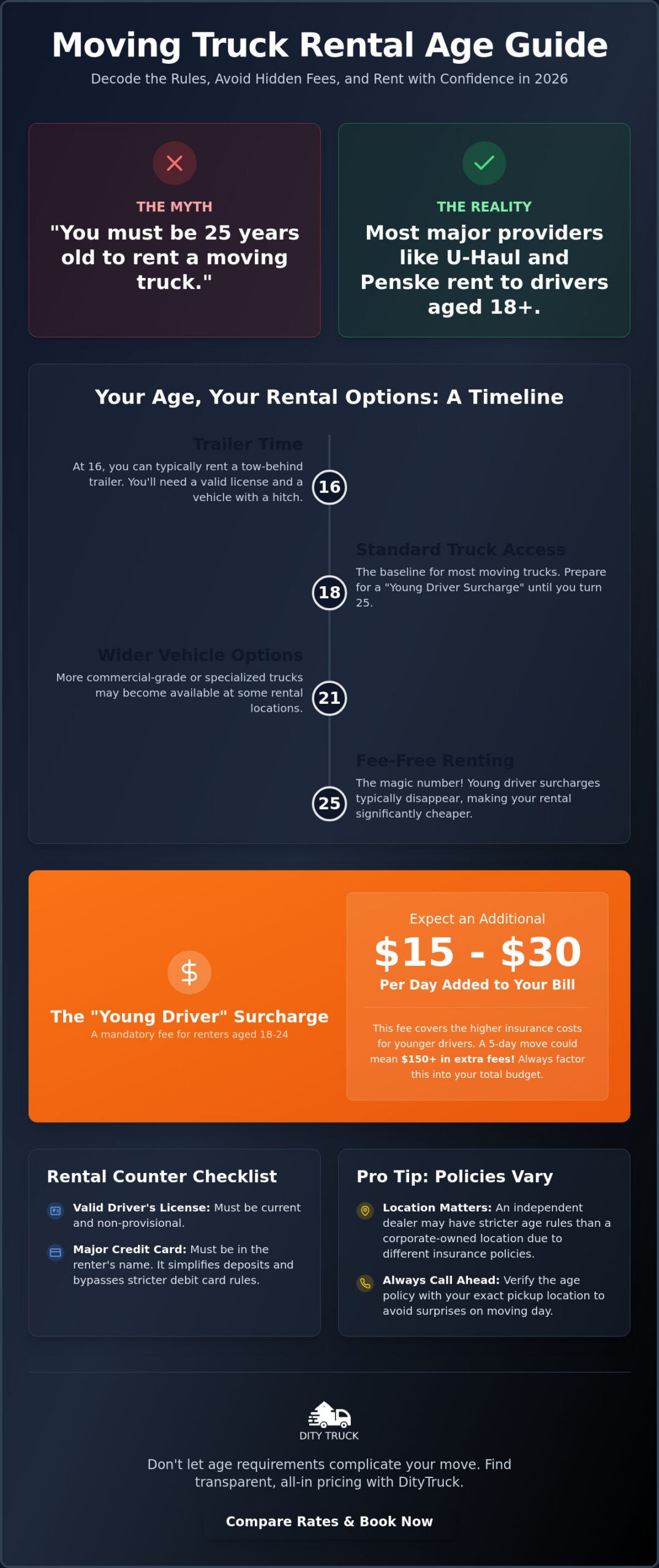
    Yes. You can rent a moving truck at 18. While passenger car companies often gatekeep their fleets until you’re 25, the moving industry is far more accessible. Major national brands like U-Haul and Penske explicitly set their minimum age at 18 for most equipment. You don’t have to wait years to handle your own logistics. You just need to know which companies to call and what paperwork to bring.

    The rules are straightforward. If you have a valid driver’s license and a way to pay, you’re usually cleared for a rental. However, can you rent a moving truck at 18 with every company? Not quite. Some providers, like Budget, typically require you to be 24. Others might let you rent at 18 but add a daily surcharge to your bill. The key is identifying the brands that prioritize young movers. Most 10-foot and 15-foot trucks are readily available to anyone with a standard license. Larger specialized equipment might have different rules; however, for a standard apartment or dorm move, you’re in the clear.

    Why Truck Rental Age Limits Differ from Cars

    Passenger cars and moving trucks fall into different categories. Many rental companies classify their trucks as equipment rather than standard passenger vehicles. This classification changes the insurance landscape. The minimum age for rental cars is high because of statistical accident risks with young drivers in high-speed passenger traffic. Moving truck insurance is structured differently. It favors broader accessibility to help people complete high-stakes tasks like relocating for school or work.

    There is also a massive demand for college-aged movers. Every August, millions of students move into dorms or off-campus housing. Moving companies recognize this market. They’ve created inclusive policies to capture this business. By lowering the age floor, they provide a friction-free solution for young adults who need to move their belongings without hiring expensive full-service movers.

    The Legal Reality of Renting at 18

    Federal law doesn’t stop you from driving a rental truck at 18. Most moving trucks are below the weight threshold that requires a Commercial Driver’s License (CDL). This means your standard class D license is all you need. Since you’re legally an adult at 18, you can sign a binding contract. You’re fully responsible for the equipment and the terms of the rental agreement. State-specific laws rarely interfere with these age limits, but it’s always smart to verify local rules if you’re crossing state lines. In almost every case, the company policy is the only hurdle you’ll face. Clear that hurdle, and you’re ready to hit the road.

    Age Requirements by Major Moving Truck Company

    Finding the right provider depends on your age and the specific equipment you need. While the general answer to can you rent a moving truck at 18 is yes, the fine print varies by brand. Some companies welcome 18-year-olds with open arms. Others treat young drivers as a high-risk category. Knowing these distinctions saves you from a wasted trip to a rental lot. It prevents the frustration of being turned away on moving day.

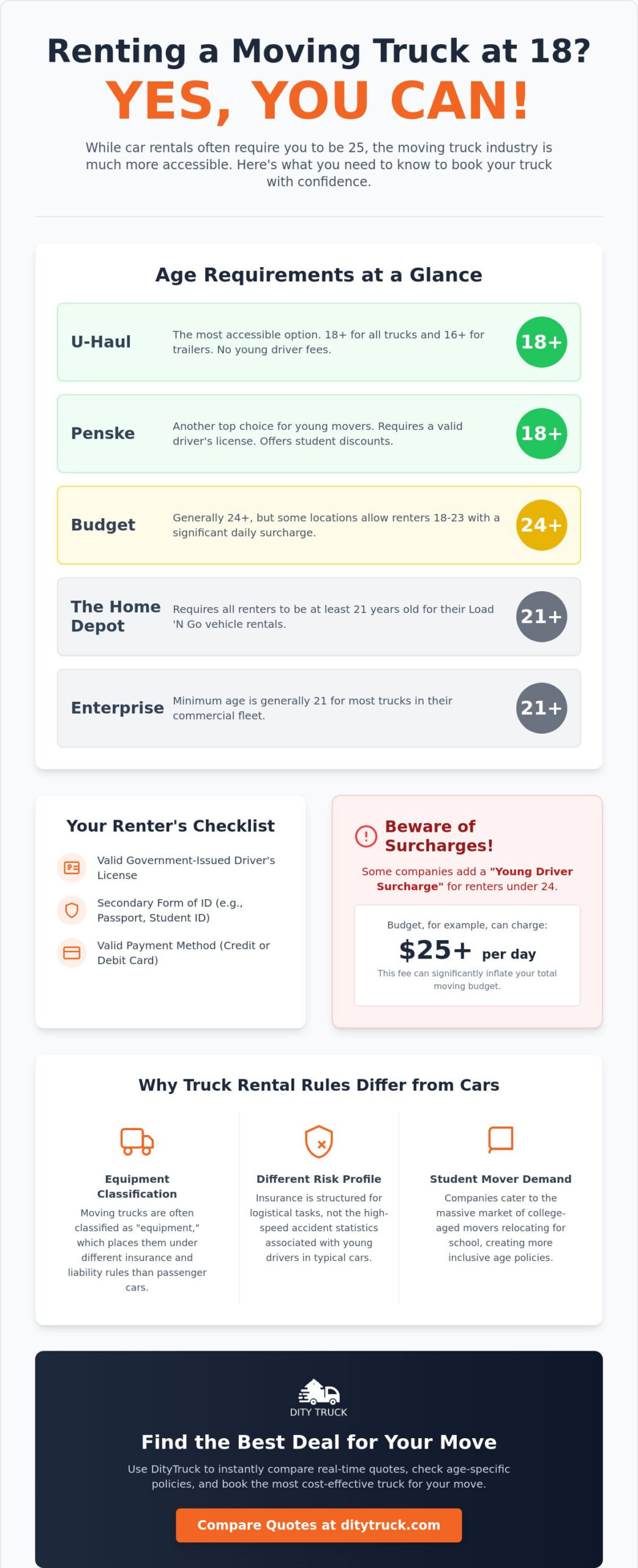
    • U-Haul: 18 years old for trucks; 16 years old for trailers.
    • Penske: 18 years old with a valid driver’s license.
    • Budget Truck Rental: Generally 24; however, some locations accept 18-23 with a daily surcharge.
    • The Home Depot: 21 years old for all vehicle rentals.
    • Enterprise Truck Rental: Typically 21 years old for most truck classes.

    U-Haul vs. Penske: The Best Options for 18-Year-Olds

    U-Haul is the most accessible choice for young movers. They allow 18-year-olds to rent their entire fleet. This includes everything from small pickups to 26-foot trucks. Even more surprising, you only need to be 16 to rent a trailer. This makes U-Haul a primary target for student moves. They also allow additional drivers at no extra charge, provided they are at least 18 and have a license. Penske is another strong contender. They allow 18-year-olds to book without heavy restrictions. You just need a valid license. Penske often appeals to those looking for newer equipment. They also offer student and military discounts. These can offset the base rental costs. Both companies provide a friction-free experience for young adults who need to handle their own logistics.

    Budget and Enterprise: What to Watch For

    Budget Truck Rental is a bit more complicated. While they are often viewed as a budget-friendly option, their age policy includes extra costs. If you are between 18 and 23, Budget often applies a young driver surcharge. This fee is typically $25 per day. This can quickly inflate your total moving budget. Enterprise and Home Depot generally move the goalposts to 21. This higher age floor is often tied to internal insurance policies. It also relates to federal discussions on the best age to operate commercial motor vehicles safely. If you are 18, Enterprise is rarely a viable option for a DIY move.

    Before you book, always confirm the specific policy for your pickup location. Local franchise rules sometimes differ from national corporate guidelines. You can compare real-time quotes to see which brands in your area offer the best rates for your specific age bracket. This step ensures you don’t get hit with a surprise fee at the counter. It helps you find the shortest path to a successful move.

    Can You Rent a Moving Truck at 18? Age Requirements for 2026

    Essential Requirements for 18-Year-Old Renters

    Knowing that can you rent a moving truck at 18 is only half the battle. You also need to arrive at the counter prepared. Rental companies have strict verification protocols to mitigate risk. These rules aren’t meant to be hurdles. They’re designed to ensure the person driving the equipment is exactly who they say they are. Because teenage drivers have crash rates nearly 4 times those of drivers 20 and older, providers require extra layers of security. Preparation is the key to a stress-free pickup.

    A valid, government-issued driver’s license is your most important tool. It must be current and original. Photocopies or digital pictures won’t work. Most companies also require a secondary form of identification. This helps prevent identity fraud. You might also need to provide proof of a permanent address. A utility bill or lease agreement usually does the trick. Finally, bring a charged smartphone. Most 2026 rental processes use digital check-ins and photo uploads to document the truck’s condition before you leave the lot.

    Acceptable Forms of Identification

    Your primary identification must be a standard U.S. state driver’s license. It must remain valid throughout the entire rental period. If you’re a student from abroad, many companies accept foreign licenses if they’re printed in English. If not, you’ll need an International Driving Permit. For secondary ID, a U.S. Passport or a Military ID is the gold standard. These documents carry high trust levels. They often speed up the verification process and get you on the road faster.

    Payment Methods: Credit, Debit, and Cash

    Major credit cards are the simplest way to pay. They provide an immediate line of security for the rental company. If you use a debit card, expect a different experience. Many locations will run a credit check. They may also hold a larger deposit on your account. This hold can range from a few hundred dollars to the full estimated cost of the move. It can take several days for these funds to return to your balance after the move.

    Cash rentals are rare but not impossible. If you don’t have a card, you’ll need to find a location that specifically allows cash. These rentals usually require a significant upfront deposit. You’ll also need to return the truck during business hours to get your cash back. Using a card is always the faster, more transparent path. It removes the need for large cash holdings. It simplifies your final receipt.

    Hidden Costs: Young Driver Surcharges Explained

    Transparency is key to a stress-free move. While the short answer to can you rent a moving truck at 18 is a firm yes, the financial reality includes extra layers. Most rental companies apply what is known as a “young driver surcharge.” This is a daily fee added to your base rate. It typically applies to any renter between the ages of 18 and 24. These fees are often tucked away in the fine print. They don’t always appear in the first quote you see online.

    The cost of these surcharges varies significantly by provider. For example, some locations may apply a charge of $25 per day for drivers in this age bracket. These are not one-time fees; they multiply by every day you keep the vehicle. You might also find that supplemental insurance coverage costs slightly more for younger drivers. Companies use these fees to offset the higher insurance premiums they pay to cover less experienced operators. Understanding these costs upfront prevents a surprise at the rental counter.

    Why Companies Charge Young Driver Fees

    It comes down to risk management. Rental companies view younger drivers as a higher liability based on industry-wide accident data. This perception leads to higher insurance premiums for the rental company itself. They pass these costs on to you through surcharges. There is also the factor of vehicle wear and tear. Less experienced drivers might be harder on the brakes or transmission of a heavy truck. The surcharge acts as a financial buffer for the company. It ensures they can maintain their fleet while still offering equipment to young adults.

    How to Minimize Your Total Rental Cost

    You don’t have to accept the first high price you see. There are ways to keep your budget under control. First, compare the total out-of-pocket cost rather than just the base rate. A low base rate looks great until you add a daily surcharge. Some companies, like Penske, are known for offering student and military discounts. These can significantly lower your overall bill. You should also look for “additional driver” policies. U-Haul doesn’t charge extra for more drivers, while Penske typically charges $10 per person unless they are family members.

    Timing your move also helps. Rental rates fluctuate based on demand. Booking your truck for a Tuesday or Wednesday instead of a holiday weekend can drop the base price. This price drop helps offset the cost of the age-related fees. Efficiency saves money. To find the most honest pricing without the hunt, you should compare moving truck rates that include all applicable age fees. This allows you to see the true total before you commit.

    Always ask for a full breakdown before you sign. Can you rent a moving truck at 18 without these fees? Occasionally, but it is rare. Your goal isn’t necessarily to find a zero-fee rental. It is to find the lowest total cost. Being aware of these hidden charges turns a potential surprise into a manageable part of your moving plan. Clarity leads to confidence. You can move forward knowing exactly what you’ll owe when you return the keys.

    Finding the Best Deal for Young Movers with DityTruck

    Searching for a rental when you’re 18 shouldn’t feel like a part-time job. DityTruck strips away the complexity by aggregating age-specific policies into one simple view. Instead of visiting five different websites to see if can you rent a moving truck at 18, you can view all your options in seconds. We bring the data to you. This includes real-time rates from industry leaders like U-Haul, Budget, and Penske. You get a clear, side-by-side comparison that prioritizes your time and your budget.

    Our platform is built for speed and honesty. You can identify potential hurdles before you ever leave your house. This prevents the fear of being turned away at the counter. Every search result is tailored to your specific needs. You simply enter your details, compare the outcomes, and move forward with clarity. It’s the shortest path between your current home and your next one. We perform the heavy lifting behind the scenes so you don’t have to.

    • Aggregated age policies for all major national brands.
    • Real-time price comparisons to find the lowest base rates.
    • Full disclosure of young driver surcharges before you book.
    • Instant reservation tools to secure your equipment.

    Transparent Pricing for Every Age

    Hidden fees are the biggest source of stress for young movers. DityTruck solves this by highlighting the actual total cost of your move. We don’t just show the base rate. Our tool factors in the young driver surcharges mentioned earlier. This means you stop guessing which company is actually the cheapest for an 18-year-old. You receive actionable data. This helps you make the smartest financial choice without any surprises on your final receipt. Financial honesty is our priority.

    Book Your Moving Truck with Confidence

    Securing your vehicle is the final step toward a successful move. Our digital marketplace makes the process friction-free. You can learn more about moving truck rental options to ensure you have the right equipment for the job. If you’re heading across state lines, check out our guide on one way truck rentals for moving for long-distance relocations. Once you’ve found the perfect fit, compare rates and book your truck today. We provide the tools you need for a confident, organized moving day.

    Take Control of Your Move Today

    You’ve cleared the confusion. You know that major providers like U-Haul and Penske welcome younger drivers with open arms. You understand the importance of bringing a valid license and secondary ID to the counter. Most importantly, you’re aware of the daily surcharges that can impact your final budget. Now, it’s time to turn that knowledge into a confirmed reservation. You don’t need to spend hours clicking through different sites to find out can you rent a moving truck at 18 without breaking the bank.

    DityTruck performs the heavy lifting for you. We provide real-time rate comparisons across all major national brands. We ensure transparent fee disclosure for young drivers so there are no hidden surprises at the counter. Our streamlined online booking process gets you reserved and ready in just a few clicks. It’s the most logical path to a stress-free moving day. Our smart assistant tool handles the complexity while you focus on the packing.

    Compare rates and book your moving truck now.

    Your first solo move is a major milestone. We’re here to ensure the logistics are the easiest part of your journey. Secure your truck today and start your next chapter with confidence.

    Frequently Asked Questions

    Do I need a special license to rent a moving truck at 18?

    No. A standard Class D license is sufficient for most moving trucks. These vehicles are carefully designed to stay below the weight limit that requires a Commercial Driver’s License. As long as your license is valid and government-issued, you are cleared to drive. This is a common point of confusion when people ask can you rent a moving truck at 18 for the first time.

    Can I rent a 26-foot truck if I am only 18 years old?

    Yes. U-Haul and Penske both allow 18-year-olds to rent their largest models. This includes the 26-foot trucks designed for three to four-bedroom homes. You don’t need a special endorsement to operate these larger vehicles. Always check the specific equipment availability at your preferred pickup location before booking. Some smaller locations may have limited stock of the biggest trucks.

    Is there an extra fee for being a young driver under 25?

    Often, yes. Many companies apply a daily surcharge for drivers in this age bracket. While U-Haul is often more lenient, companies like Budget may add a fee of $25 per day. Knowing can you rent a moving truck at 18 is the first step; checking for these hidden costs is the second. Always compare total rates to avoid surprises at the counter.

    Can an 18-year-old rent a U-Haul trailer?

    Yes. U-Haul allows anyone 16 or older to rent a trailer. At 18, you are well above the minimum age requirement. You just need a valid driver’s license and a vehicle with the proper towing capacity and hitch. The rental company will verify your vehicle’s towing rating before attaching the trailer. This ensures your safety and protects the equipment during your trip.

    What happens if I only have a learner’s permit?

    No. You cannot rent a truck with only a learner’s permit. Rental companies require a full, unrestricted driver’s license. The person signing the contract must be legally authorized to operate the vehicle alone. Permits generally require a licensed adult in the passenger seat. This violates standard rental agreements and insurance policies. You must wait until you have your permanent license to book.

    Do I need my own insurance to rent a truck at 18?

    Not necessarily, but you must have coverage. Most personal car insurance policies specifically exclude large moving trucks. You can usually purchase supplemental damage protection directly from the rental company. This provides peace of mind and covers the equipment during your move. It’s the simplest way to ensure you aren’t financially responsible for accidental damage to the fleet.

    Can I pay for my rental truck with a parent’s credit card?

    Only if the parent is present at the counter. The name on the credit or debit card must match the name of the primary renter on the contract. If your parent wants to pay for the move, they should be listed as the primary renter. Alternatively, they must be present during the pickup process to sign the payment authorization. This policy prevents credit card fraud.

    What is the minimum age to be an additional driver on a rental truck?

    The minimum age for an additional driver is typically 18. This is the standard for major companies like U-Haul and Penske. Every driver must present a valid, unexpired license at the time of pickup. This ensures everyone operating the vehicle meets the legal and safety requirements. Some companies may charge a small daily fee for each additional driver you add to the contract.

  • How to Rent a Moving Truck with a Debit Card: 2026 Guide

    How to Rent a Moving Truck with a Debit Card: 2026 Guide

    Imagine standing at the rental counter with your entire life packed into boxes, only to hear that your bank card is not enough to get the keys. For many, the fear of being turned away at pickup is the most stressful part of moving day. You don’t need a high-limit credit card to get on the road, but you do need a tactical plan. You can absolutely rent a moving truck with a debit card in 2026 if you know which providers offer the best terms and exactly what documentation they require at the desk.

    It is frustrating when rental companies hold your moving budget hostage with surprise deposits or strict age limits. We know you want a confirmed reservation without the anxiety of a frozen bank account or hidden fees. This guide simplifies the logistics by breaking down the current debit policies for major carriers like U-Haul, Budget, and Enterprise. You will learn exactly how to bypass common hurdles, which forms of ID are mandatory, and how to manage your deposit refund timeline. We provide the roadmap so you can find the lowest total cost and move forward with total peace of mind.

    Key Takeaways

    • Most major national providers now allow you to rent a moving truck with a debit card. You just need to prepare the correct identity verification and deposit funds in advance.
    • U-Haul and Budget offer flexible debit options. Each requires specific security holds that can impact your immediate moving budget.
    • Calculate your required bank account “buffer” to cover both the estimated rental cost and the upfront refundable deposit.
    • Use DityTruck to aggregate real-time rates and filter for providers with the most favorable debit policies.
    • Confirm your reservation details early to avoid moving-day denials. It’s the best way to ensure your specific branch accepts your bank card.

    Can You Rent a Moving Truck with a Debit Card?

    Most major national providers now allow you to rent a moving truck with a debit card for both the initial reservation and the final bill. This shift reflects a broader trend within the vehicle rental industry toward more inclusive payment options. However, using a bank card isn’t identical to using a credit card. While the truck remains the same, the administrative process is often more rigorous to ensure everyone is protected.

    Companies traditionally prefer credit cards for risk management. A credit card provides a pre-approved line of credit that the company can easily charge for late returns, fuel shortages, or vehicle damage. When you rent a moving truck with a debit card, the company pulls directly from your personal cash. To mitigate this risk, they implement stricter verification steps. They want to ensure the person driving their equipment is financially accountable. This is why you might encounter higher deposits or credit checks that wouldn’t apply to a credit card user.

    The 2026 reality is that your bank card is a valid tool for moving day, provided it carries a Visa or Mastercard logo. These major payment networks provide the security infrastructure that rental companies need to feel confident. Without that logo, your card is just a piece of plastic at the rental desk. Understanding these rules early prevents the panic of a last-minute denial. It turns a potential roadblock into a manageable step in your moving process.

    Credit vs. Debit: What Movers Need to Know

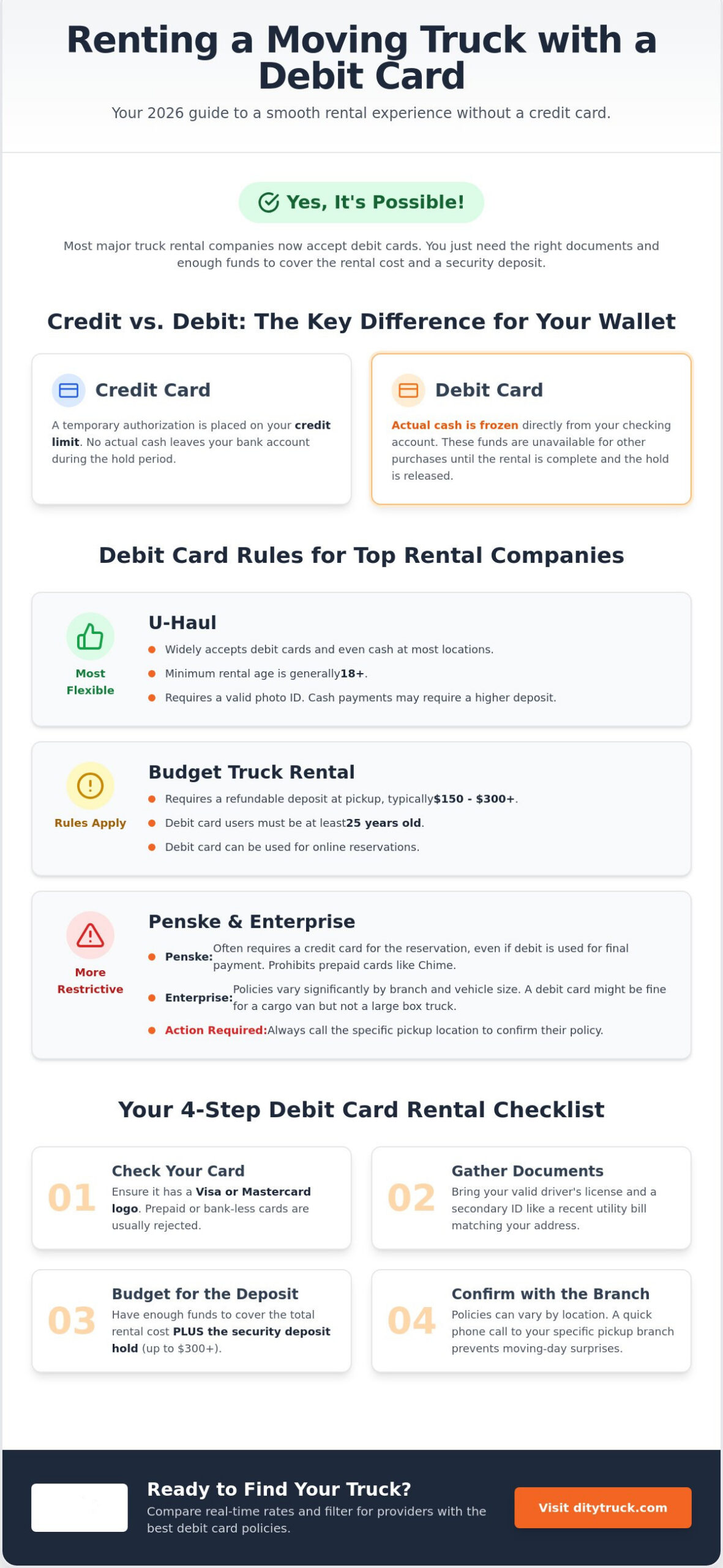
    The biggest difference is the “hold” on your funds. A credit card holds a portion of your credit limit, but a debit card freezes actual cash in your checking account. This money becomes unavailable for other expenses like fuel or food during your trip. Always ensure your card has a major logo. Prepaid cards or cards without a bank association are rarely accepted for reservations or pickups.

    The “Hoops” of Debit Card Renting

    Prepare for extra verification steps at the counter. Rental agents often require a secondary form of identification when you don’t use a credit card. You may need to provide a recent utility bill or a bank statement that matches your license address. Some companies also perform a “soft pull” on your credit. This inquiry verifies your financial reliability without hurting your credit score.

    Debit Card Rules for Top Moving Truck Companies

    Not all rental policies are created equal. You need to know which company aligns with your specific wallet before you arrive at the lot. U-Haul is widely considered the most flexible option for many movers. They allow you to rent a moving truck with a debit card at almost any location. They even accept cash payments. Just be aware that a cash rental still requires a valid photo ID and often a higher upfront deposit to secure the vehicle.

    Budget Truck Rental follows a different path. You can use your bank card for online reservations, but you must be ready to pay a refundable deposit at the counter. This deposit usually ranges from $80 plus estimated rental charges to a flat $300. Budget also requires renters using debit cards to be at least 25 years old. This is a strict rule that catches many younger movers off guard. If you are under 25, you might need to look toward more flexible providers.

    Penske and Enterprise have more nuanced rules. Penske typically requires a credit card to hold your reservation, even if they let you pay with a debit card at pickup. They also explicitly ban Chime and other prepaid cards. Enterprise policies vary significantly by branch. They might allow debit for a small cargo van but demand a credit card for a 26-foot box truck. You can compare these specific brand requirements side-by-side to find the best fit for your trip.

    Comparing Policies for Local vs. Long-Distance Moves

    Local moves are generally simpler to book. Companies see less risk when the truck returns to the same lot. For one way truck rentals for moving, expect higher deposits and more scrutiny. Long-distance trips involve higher mileage and more potential for wear. This often triggers a soft credit pull to verify your identity and financial history. Always call the specific pickup branch to confirm they accept your card for one-way trips.

    Age Requirements and Payment Methods

    Age is a major factor in payment flexibility. While U-Haul allows 18-year-olds to rent, brands like Budget often push that limit to 25 for debit users. If you are in the 18 to 21 age bracket, your options narrow significantly. Review the FTC consumer advice on renting a car to understand how companies block funds. This practice ensures the provider has access to funds for late fees or fuel. Ensure the name on your card matches your driver’s license exactly. Any discrepancy will result in an immediate denial at the counter.

    How to Rent a Moving Truck with a Debit Card: 2026 Guide

    Understanding Deposits, Holds, and the Total Cost

    When you rent a moving truck with a debit card, the transaction is more than a simple purchase. The rental company places a security deposit on your account to cover potential extras. This is standard practice. It protects the company against late returns, fuel shortages, or damaged equipment. Expect this deposit to range from a flat $100 fee to a percentage of your total rental estimate. Some premium vehicles may require even higher amounts. This money stays in your account, but you cannot access it until the rental period ends.

    The “hold” mechanism is where many movers face challenges. Your bank marks these funds as “pending.” The money is effectively invisible to your debit card for other purchases. This is not a final charge. It is a safeguard. Once you return the truck and the agent inspects it, the company calculates the final bill. They then settle the transaction using the held funds. If the total is less than the hold, the remainder is released. If the total is more, they charge the difference to your card immediately.

    Refund timelines depend entirely on your financial institution. While the rental company might release the funds the moment you hand over the keys, your bank may take 3 to 10 business days to update your balance. This delay is why you need a financial plan before you pick up the keys. Understanding the rules for renting a vehicle with a debit card ensures you aren’t left without cash for groceries or gas during your trip. Knowing these timelines prevents the stress of a “zero balance” notification while you are still on the road.

    Budgeting for the “Hold” Amount

    Moving is expensive. You need more than just the rental price in your checking account on pickup day. Calculate a “moving day buffer” to stay safe. This buffer should cover the rental, the deposit, and your actual travel expenses like meals and lodging. If your account balance is too close to the total, you risk a declined transaction at the counter. Keep in mind that the security deposit is a separate requirement from the cost to rent a 26 foot moving truck.

    Avoiding Overdraft Fees During Your Move

    Overdraft fees can ruin a moving budget. Notify your bank about the upcoming rental charge to prevent fraud blocks. Large, out-of-town transactions often trigger alerts. Track your “available balance” instead of your “actual balance.” The actual balance includes the hold, but the available balance shows what you can really spend. If your final bill exceeds the initial hold, the company will charge the difference. This can lead to unexpected overdrafts if your account is already low from other moving expenses.

    How to Rent Your Moving Truck Using a Debit Card

    Success on moving day starts with a clear sequence of actions. You don’t want to arrive at the lot and realize you forgot a utility bill or that your card isn’t accepted. Following a structured process ensures you get the keys without a headache. First, use a truck rental comparison service like DityTruck to evaluate different providers. Policies change frequently. Checking current debit-friendly terms across multiple brands saves time and prevents rejection.

    Once you choose a provider, verify your bank account balance. You need a sufficient buffer to cover the rental price plus the security deposit we discussed earlier. After confirming your funds, gather your paperwork. You will need a valid license and a secondary form of identification. Book your reservation online to lock in the current rate. Finally, bring your physical card to the counter. Digital wallets like Apple Pay or Google Pay are rarely accepted for the initial security hold. The agent needs to swipe or insert the actual plastic to authorize the funds.

    Documentation Checklist for Debit Renters

    Having your documents ready speeds up the pickup process. The rental agent will scrutinize your ID more closely when you rent a moving truck with a debit card. Don’t leave these items to chance. Ensure you have:

    • Primary Driver’s License: It must be valid, unexpired, and government-issued.
    • Secondary Identification: Bring a passport, military ID, or a recent utility bill. The address on the bill must match your license.
    • Proof of Insurance: Check your policy. Many personal car insurance plans exclude large box trucks over a certain weight.

    At the Counter: What to Expect

    The “pre-authorization” process happens immediately. The agent swipes your card to freeze the deposit amount. You will sign a digital or paper agreement acknowledging the hold. Before you drive away, perform a thorough walk-around inspection. Document every scratch or dent with photos. This is critical for debit users. It ensures your deposit is returned without disputes over existing damage. Always request a receipt that clearly shows the exact hold amount. This document is your proof if you need to contact your bank later to release the funds. To get started, book your moving truck rental today and secure the best debit-friendly rates.

    Compare and Book Your Debit-Friendly Rental on DityTruck

    Finding the right vehicle shouldn’t feel like a part-time job. DityTruck removes the friction by aggregating real-time rates from top-tier rental providers in one place. You can rent a moving truck with a debit card without spending hours on the phone. Our platform gathers the latest data so you can compare policies and prices side-by-side. This transparency ensures you choose a brand that welcomes your bank card while offering the best possible rate for your specific route.

    Smart movers prioritize clarity. We focus on stripping away the confusion often found in fine print. You get a clear picture of the total cost before you ever head to the rental counter. There are no hidden fees or surprise “debit-only” surcharges that haven’t been accounted for. You can view various moving truck rental options in one streamlined interface. This allows you to filter for the most affordable trucks that fit your exact payment preferences and budget constraints.

    Why Use a Comparison Tool?

    Efficiency is the goal. You don’t need to call every local branch to ask about their specific debit card rules. A comparison tool helps you spot price differences between brands like U-Haul, Budget, and Penske instantly. This is vital because a local move might be cheaper with one brand, while a long-distance trip favors another. You secure the best rate for your journey without the typical stress of manual research. It is the shortest, most logical path between your current problem and a confirmed reservation.

    Final Steps to a Stress-Free Move

    Your move is almost ready to go. Before you leave, perform a quick final check of your logistics. Double-check your reservation details and your scheduled pickup time. Confirm that your bank account has the necessary buffer for the hold we discussed. Most importantly, ensure your physical debit card is in your wallet. Digital wallets won’t work for that initial security swipe. When you’re ready to lock in your equipment, Find and compare moving truck rentals today to get on the road with confidence.

    Secure Your Moving Truck and Start Your Journey

    You now have a tactical plan to manage your moving day logistics. You know that major national brands accept bank cards, provided you bring a second form of ID and maintain a sufficient account buffer. By understanding the deposit refund timeline and documentation rules, you can successfully rent a moving truck with a debit card without the fear of being turned away at the lot. The road ahead is clear when you remove the guesswork from your payment options.

    DityTruck provides a no-nonsense comparison of real-time pricing from top national brands. Our platform is trusted by thousands of DIY movers who value efficiency and financial honesty. Don’t waste time calling multiple branches when you can see every available option in one place. Take the next step toward a friction-free moving experience and find the equipment you need today.

    Compare Moving Truck Rates and Book Now

    Your move is a significant milestone. We’re here to ensure the logistics are the easiest part of your transition. Safe travels on your upcoming move.

    Frequently Asked Questions

    Do I need a credit card to rent a U-Haul?

    No, you don’t need a credit card for a U-Haul rental. They accept debit cards with a Visa or Mastercard logo and even cash at most locations. If you choose cash, prepare for a higher deposit and an in-person reservation. Using a debit card is the faster path to getting your keys and requires less paperwork at the counter.

    How much is the deposit for a moving truck rental with a debit card?

    Security deposits vary significantly between brands. U-Haul typically requires $100 plus the estimated rental cost. Budget may hold $80 plus charges or a flat $300. Enterprise deposits can range from $200 to $850 depending on the vehicle type. Always check with your specific branch for the exact hold amount before your scheduled pickup day.

    Can I use a prepaid debit card to rent a moving truck?

    Most national brands do not accept prepaid or reloadable debit cards. Companies like Penske and Budget require cards linked directly to a traditional checking account. This allows them to verify your identity and financial history more effectively. If you try to rent a moving truck with a debit card that is prepaid, you will likely face a denial at the counter.

    How long does it take to get a rental truck deposit back on a debit card?

    You can expect your deposit to return within 3 to 10 business days. The rental company releases the hold immediately upon truck return. However, your bank determines the final processing speed. Check your “available balance” in your banking app to see when the funds become spendable again rather than looking at the total balance.

    Will renting a truck with a debit card affect my credit score?

    Renting with a debit card usually has no impact on your credit score. Some providers perform a soft credit inquiry to confirm your identity. This type of check doesn’t show up on your credit report as a hard hit or lower your points. It’s a standard security measure used to protect high-value equipment during the rental period.

    What happens if I don’t have enough money in my account for the deposit hold?

    Your reservation will be declined if your account cannot cover the full hold amount. The rental agent cannot override the system for a partial payment or a lower deposit. Ensure your account has a sufficient buffer for both the rental rate and the security deposit. This prevents a stressful delay when you are ready to start loading your belongings.

    Can I pay for my moving truck rental with cash instead?

    You can pay with cash at U-Haul locations, but you still need to provide a deposit upfront. Most other companies require a debit or credit card for the initial security hold at pickup. You can often pay the final balance in cash when you return the vehicle. This flexibility helps you manage your bank account balance more effectively throughout the move.

    Does Budget Truck Rental accept debit cards for one-way moves?

    Budget Truck Rental accepts debit cards for one-way moves. You must be 25 years of age or older to use this payment method. For one-way trips, your total payment is due at the time of pickup. This is a reliable way to rent a moving truck with a debit card when crossing state lines. Always bring a second form of identification to satisfy their verification requirements.

  • U-Haul vs. Budget Truck Rental: 2026 Price and Feature Comparison

    U-Haul vs. Budget Truck Rental: 2026 Price and Feature Comparison

    The $19.95 sticker on a truck looks like a steal until the final invoice hits your inbox. You might think the most famous brand is always the cheapest. The truth about u-haul vs budget truck rental depends entirely on your odometer. It’s frustrating to jump between websites just to find a straight answer on pricing. You want transparency. You need a truck that is reliable. You want a price that stays predictable without the “sticker price” shock.

    Moving is a high-stakes task. You deserve a friction-free solution that prioritizes your time and your budget. We’ve done the heavy lifting for you by comparing the latest 2026 rates and features side-by-side. This guide promises to reveal which rental giant offers the best value for your specific move. We strip away the complexity of hidden fees to show you the real cost of your trip.

    We provide a clear winner for local, regional, and cross-country hauls. You’ll get a full breakdown of mileage fees, insurance options, and truck availability. This is the shortest, most logical path to booking the right truck at the best possible rate.

    Key Takeaways

    • Identify the real cost beyond the advertised sticker price by comparing 2026 base rates and seasonal price fluctuations.
    • See how a small difference in mileage fees impacts your final bill and learn to spot hidden environmental charges.
    • Decide which provider fits your route by analyzing the u-haul vs budget truck rental trade-off between location convenience and discount codes.
    • Match your move to the right vehicle size with a full breakdown of inventory from cargo vans to 26-foot box trucks.
    • Save time by using real-time aggregation to compare quotes instantly instead of checking multiple websites manually.

    Comparing Base Rental Rates: U-Haul vs. Budget

    The advertised price on the side of a truck is rarely what you pay. It’s a marketing hook designed to get you in the door. When comparing u-haul vs budget truck rental, you must look past the $19.95 base rate. This sticker price trap often hides the true cost of your move. A low daily fee can quickly balloon once you add mileage, insurance, and environmental fees. You need a clear view of the total invoice before you hand over your credit card.

    The U-Haul company history shows a brand built on local accessibility. They pioneered the low-cost local rental model. However, prices for u haul rental are highly sensitive to demand. If you book on a holiday weekend or the last day of the month, expect those rates to climb. Budget often counters this with more aggressive discount codes for AAA members, students, and military personnel. While U-Haul relies on its massive fleet size, Budget uses price as a primary tool to win over savvy shoppers.

    Local Move Rate Structures

    U-Haul typically advertises base rates of $19.95 or $29.95 for local “In-Town” moves. Budget often matches these rates or slightly exceeds them in the initial quote. The real difference appears in the per-mile charge. For a 30-mile move in early 2026, data shows U-Haul can be the cheaper option at $131.37 compared to Budget’s $153.50. However, for moves that cross the 50-mile threshold, Budget’s lower mileage fees often tip the scale in their favor. Reservation timing is critical. Booking your truck mid-week can save you significantly on the base quote compared to a Saturday morning pickup.

    Long-Distance and One-Way Pricing

    One-way moves follow a completely different pricing logic. These quotes are variable and depend on equipment supply. If many people are moving into a city but few are moving out, rates will drop for those willing to take a truck back. Budget often provides better value for regional moves between 50 and 250 miles. In February 2026, regional moves with Budget averaged $267.01 while U-Haul reached $439.97. This represents a substantial gap for a single day of driving.

    For cross-country hauls, the winner changes based on the specific route. A 750-mile move from Dallas to Chicago in January 2026 showed U-Haul at $2,538 and Budget at $2,972. If you find these prices high, you might also consider a u-haul vs penske truck rental comparison to see if a third player offers better long-distance terms. Drop-off location availability plays a massive role here. U-Haul’s 21,000 locations mean you rarely have to drive far to return a truck. Budget has fewer spots, which can sometimes lead to higher one-way fees if your destination is remote.

    The True Cost of Mileage and Protection Plans

    The base rate is just the starting line. Your final bill is actually driven by the miles you drive and the protection you choose. Understanding the u-haul vs budget truck rental fee structure is the only way to avoid a surprise at the drop-off counter. Small fees like environmental taxes and fuel charges might seem minor. They aren’t. They can add 20% or more to your total cost if you aren’t careful. Financial honesty starts with looking at the per-mile cost and the protection plan fine print.

    Mileage Rate Showdown

    Mileage is the biggest variable in a local move. U-Haul often charges an average of $0.99 per mile for local rentals. Budget frequently cuts this rate significantly, sometimes as low as $0.47 per mile. This 52-cent gap adds up fast. On a 50-mile round trip, choosing Budget could save you over $25 in mileage alone. You can use a u haul cost calculator to project these expenses before you commit. To keep costs low, plan your route to minimize extra trips. One long haul is almost always cheaper than three short ones.

    Fuel policies are another area where costs hide. Both companies require you to return the truck with the same amount of fuel it had at pickup. If you forget, you’ll pay a “convenience” fee and a premium price per gallon. These rates are often double or triple what you’ll find at a local gas station. Always stop at a pump within five miles of your drop-off location to save your budget.

    Protection and Insurance Fees

    Your personal auto insurance likely won’t cover a 26-foot box truck. Most policies exclude commercial vehicles over a certain weight class. This makes rental protection plans a necessary shield for your bank account. U-Haul offers Safemove, which covers the truck, your belongings, and medical costs. Budget provides Physical Damage Waivers (PDW) and supplemental liability. These plans provide essential consumer protection for movers by limiting your liability in case of an accident.

    U-Haul often highlights their low-cost damage coverage starting around $15. Budget’s packages can be more comprehensive but sometimes carry a higher daily price. Always ask what the deductible is before signing. A “cheap” plan with a $1,000 deductible offers much less relief than a slightly pricier plan with zero out-of-pocket costs. To see the full picture of these protection costs, you can compare real-time quotes across both providers to see who offers the best total value.

    U-Haul vs. Budget Truck Rental: 2026 Price and Feature Comparison

    Truck Inventory and Capacity Breakdown

    Comparing u-haul vs budget truck rental requires looking closely at the physical hardware. A truck that is too small forces extra trips. A truck that is too big wastes fuel and increases your bill. You need the right fit for your specific inventory to ensure a smooth transition. Efficiency in loading saves time and physical strain on moving day.

    Consider the loading height before you book. U-Haul uses a proprietary Low-Deck design on their box trucks. This lowers the cargo floor closer to the pavement. It creates a shorter, less steep ramp for your heavy items. Budget trucks typically use a standard chassis height. This results in a steeper climb into the cargo area. Your back will notice the difference after ten trips up the ramp with heavy furniture.

    Small Move Options: Vans and Pickups

    Cargo vans are the efficient choice for studio apartments or dorm rooms. They handle like a large SUV and offer the best fuel economy in the fleet. Pickup trucks are available at most local locations for quick tasks. These are ideal for moving a single couch or a new refrigerator across town. Most local branches keep a healthy stock of these smaller vehicles for immediate use. They provide a friction-free solution for small-scale logistics without the bulk of a box truck.

    Large Move Capacity: 16ft to 26ft Trucks

    For a 3-4 bedroom home, you need the maximum capacity of a 26-foot truck. U-Haul offers several intermediate sizes like the 10-foot and 20-foot models that Budget does not carry. This variety allows for a more precise match to your load size. Budget focuses its fleet on 12-foot, 16-foot, and 26-foot options. Choosing the wrong size can lead to shifting cargo or wasted space that you still have to pay for.

    U-Haul trucks feature Mom’s Attic, which is a unique storage compartment located above the cab to protect fragile items from heavier furniture below. This feature serves as a smart assistant for your packing strategy. It keeps electronics and glassware away from the heavy lifting happening on the main deck.

    • Tie-downs and Rails: Both fleets include interior rub rails and tie-down points to secure your straps.
    • Weight Limits: 26-foot trucks are designed for heavy loads but always check the gross vehicle weight rating (GVWR) if you are moving heavy machinery or books.
    • Towing Capabilities: Both brands offer hitches for car trailers, though U-Haul has a more extensive network of specialized towing equipment.

    Inventory availability often dictates your choice. U-Haul has over 21,000 locations, making it easier to find a specific truck size near you. Budget has around 1,600 locations, so your preferred size might require a longer drive to the pickup point. Check availability early to secure the exact dimensions you need for your move.

    Local vs. Long-Distance: Which Provider Wins?

    Choosing between u-haul vs budget truck rental often comes down to a single question: Are you staying in town or crossing state lines? The winner shifts based on your destination. U-Haul offers unmatched convenience through its massive network. Budget counters this with aggressive pricing for specific long-haul routes. You need to weigh the ease of a local drop-off against the potential savings of a discounted regional rate. It’s a balance between time saved and dollars kept.

    U-Haul operates over 21,000 locations across North America. This density is their greatest asset. You can likely find a U-Haul dealer within five miles of your home. This proximity saves time and fuel. Budget has roughly 1,600 locations. While fewer, these are often strategically placed near major highways. If your route is simple, Budget’s lower mileage fees can outweigh the inconvenience of a slightly longer drive to the rental office. Early 2026 data shows Budget’s mileage rates averaging $0.47 per mile, which is significantly lower than U-Haul’s $0.99 per mile for local hauls.

    The Local Move Winner

    U-Haul dominates the 24-hour local rental market. Their mobile pickup service allows you to bypass the counter entirely. This is a friction-free solution for quick moves. To avoid weekend price hikes, book your local move for a Tuesday or Wednesday. Rates are lower. Equipment is more plentiful. You’ll face less stress at the rental lot. Customer satisfaction scores for 2026 show U-Haul at 4.8/5, slightly ahead of Budget’s 4.5/5. Roadside assistance is responsive for both, but U-Haul’s larger network means a replacement truck is usually closer if a breakdown occurs.

    The Long-Distance Value Play

    Budget often wins on price for regional moves between 50 and 250 miles. Research from February 2026 shows Budget’s regional rates averaging $267.01, while U-Haul sits at $439.97. This is where Budget’s partnerships shine. You can stack discounts for AAA, AARP, or military service to lower your bill even further. U-Haul rarely offers percentage-off codes. They prefer value-adds like a free month of self-storage instead.

    For cross-country hauls, inventory availability becomes the deciding factor. U-Haul’s reservation policy is a strong tool, but 2026 customer reviews suggest broken reservations happen more frequently with them than with Budget. You can explore one way truck rentals for moving to see how other players fit into this long-distance landscape. To secure the best rate for your specific route, book your truck rental comparison now and lock in current 2026 pricing.

    Simplify Your Move with Real-Time Truck Comparisons

    The search for the perfect truck often leads to “tab fatigue.” You open one window for U-Haul. You open another for Budget. You enter your zip code, dates, and truck size over and over. This repetition is the opposite of efficiency. It’s a high-stakes task that shouldn’t feel like a part-time job. You need a single source of truth to navigate the u-haul vs budget truck rental landscape. Manual comparison drains your energy and leaves room for error. You deserve a better way to manage your logistics. Our definitive 2026 uhaul vs budget truck rental comparison guide breaks down every fee, fleet option, and hidden charge so you can make a fully informed decision before you book.

    DityTruck acts as your smart assistant. We perform the heavy lifting by aggregating real-time 2026 data into one streamlined view. Instead of chasing quotes across the internet, you see them side-by-side. This transparency ensures you aren’t surprised by a final bill that looks nothing like the initial estimate. You get a friction-free path from a problem to its resolution. We focus on stripping away the stress of hidden fees to provide a sense of confident simplicity.

    Stop the Tab Fatigue

    Comparing prices for u haul rental shouldn’t require a complex spreadsheet. Our platform allows you to see Budget and U-Haul options on a single screen. You can filter by specific truck sizes to ensure you aren’t paying for empty space. You can also compare pickup locations to find the one closest to your front door. This organized approach prevents you from feeling overwhelmed by moving logistics. You see the base rate, the estimated mileage, and the total projected cost in one place. It’s about financial honesty and your peace of mind.

    • Instant Aggregation: See the latest 2026 rates without visiting multiple websites.
    • Custom Filters: Sort by truck capacity, price, or pickup proximity.
    • Transparent Costs: View estimated totals that include the mileage and fees discussed in earlier sections.
    • Speed: Go from comparison to a confirmed booking in under five minutes.

    Reserve Your 2026 Moving Truck Today

    Securing your rate early is the smartest move you can make. Moving truck demand peaks on holiday weekends and at the end of every month. Booking ahead protects you from sudden price spikes and equipment shortages. Our streamlined interface lets you complete your reservation in minutes. You choose your truck. You verify the details. You book. It’s a logical progression that prioritizes your schedule. We provide the shortest path between your current home and your next destination.

    Don’t let hidden fees or broken reservations ruin your moving day. Use a tool that values your time and provides a clear, honest comparison. Compare and book your moving truck now on DityTruck to lock in the best 2026 value for your specific route. Your move starts here.

    Secure Your Best 2026 Moving Rate

    Your moving day success depends on clarity. You now understand that the winner of u-haul vs budget truck rental shifts based on your specific mileage and destination. U-Haul offers unmatched location density for quick local trips. Budget provides significant savings for regional hauls through lower mileage rates and aggressive partner discounts. Choosing the right provider means looking past the sticker price to the total invoice.

    Don’t let hidden fees or complex pricing models dictate your moving budget. You deserve a logistics experience that is simple, predictable, and honest. We help you strip away the complexity of checking multiple sites by putting all the data in one place. This smart approach saves you hours of frustration. It protects your bank account from surprise charges at the drop-off counter.

    You can Find the Lowest Truck Rental Rates on DityTruck by comparing top national brands in seconds. Our platform provides transparent pricing with no hidden surprises and real-time 2026 availability. Take control of your move today. You have the facts. Now lock in the best rate for your journey.

    Frequently Asked Questions

    Is Budget Truck Rental cheaper than U-Haul?

    Budget is typically the more affordable choice for local and regional moves under 250 miles. Data from early 2026 shows Budget offers lower total costs for these shorter distances. However, U-Haul becomes highly competitive on specific long-distance routes over 500 miles. You should always compare quotes for your specific route to see which brand currently holds the price advantage for your destination.

    Does U-Haul or Budget have better mileage rates?

    Budget generally offers significantly lower mileage rates for local moves. Their average per-mile fee is often less than half of the U-Haul average. This gap makes Budget a much stronger option for local round-trips where you return the truck to the same location. These savings keep your final bill manageable and prevent the “sticker price” shock often associated with high-mileage moving days.

    What is the most common hidden fee in truck rentals?

    Mileage fees are the most frequent surprise on a final rental invoice. The advertised daily rate only covers the truck itself. You must also pay for every mile driven, fuel used, and mandatory environmental fees. These costs can double your initial quote if you don’t account for them during the booking process. Financial honesty requires looking at the total projected cost rather than just the base rate.

    Can I drive a 26-foot Budget or U-Haul truck with a standard license?

    You can drive a 26-foot rental truck with a standard driver’s license in most states and provinces. These vehicles are classified for personal household use rather than commercial freight. You don’t need a CDL to operate them for a DIY move. However, these large trucks require extra caution for overhead clearances and wider turning radiuses. Always check local regulations if your move involves crossing international borders.

    Which company is better for a one-way long-distance move?

    U-Haul is often the superior choice for one-way moves because of their 21,000 locations. This massive network ensures that a drop-off point is almost always near your new home. Budget is a strong value play for regional one-way trips under 250 miles where their rates are often lower. When comparing u-haul vs budget truck rental for long distances, location proximity is just as important as the base rate.

    Do U-Haul and Budget offer roadside assistance in 2026?

    Both companies provide 24/7 roadside assistance for their fleets throughout 2026. You are covered for mechanical failures, flat tires, and other equipment issues during your trip. U-Haul’s larger network of dealers often results in faster response times if you need a replacement vehicle in a remote area. This reliable support system provides essential peace of mind for a high-stakes task like a cross-country move.

    How much does insurance cost for a rental moving truck?

    Protection plans typically start around $15 per day but vary based on the coverage level you select. Most personal auto insurance policies exclude large box trucks, making these plans a necessary shield for your bank account. You can choose from basic damage waivers to comprehensive coverage for your belongings and medical expenses. Always verify the deductible amount before you sign your rental agreement to avoid unexpected costs.

    Are there discounts available for Budget or U-Haul rentals?

    Budget is the industry leader for direct discounts for AAA, AARP, students, and military personnel. These percentage-off codes can take a significant bite out of your total bill. U-Haul rarely offers direct price cuts on their rentals. They prefer to offer value-added perks like a free month of self-storage instead. Checking for these deals is a smart way to find the best u-haul vs budget truck rental value for your move.

  • Cargo Van vs. Box Truck: Which Rental Is Right for Your Move?

    Cargo Van vs. Box Truck: Which Rental Is Right for Your Move?

    The biggest truck isn’t always the fastest way to finish your move. Most people assume more space equals less stress, but the wrong vehicle can actually double your workload. When comparing a cargo van vs box truck, the decision usually comes down to a trade-off between driving comfort and loading efficiency. You want to avoid the nightmare of navigating a massive vehicle through tight city streets. At the same time, you don’t want to spend your entire day making three or four extra trips because your furniture didn’t fit. It’s about finding that sweet spot where you feel confident behind the wheel and your belongings fit in one go.

    It’s normal to feel stuck between playing it safe and going big. We’ll help you settle that debate right now. This guide breaks down the critical differences in capacity, maneuverability, and total costs so you can choose the perfect rental for your project. We’ll look at exactly how much each vehicle holds, how they handle on the road, and which option keeps your budget intact. You’ll get the facts on fuel efficiency and hidden fees to ensure there are no surprises at the checkout counter. By the end, you’ll have a clear plan for a stress-free, one-trip move.

    Key Takeaways

    • Match your inventory to the correct cubic footage. Avoid the cost of oversized rentals—and the headache of multiple trips.
    • Compare the maneuverability of a cargo van vs box truck. Find the right balance between easy driving and maximum storage.
    • Evaluate loading heights and ramp availability. Choose the configuration that minimizes heavy lifting—and protects your back.
    • Access real-time rates from major rental brands instantly. Compare options in seconds—securing the best deal for your move.

    What is the Difference Between a Cargo Van and a Box Truck?

    The choice between a cargo van vs box truck starts with how the vehicle is built. A cargo van is a unibody vehicle. This means the cab and the cargo area are one single piece of metal. It drives and feels like a large SUV. A box truck is different. It uses a cab-chassis design. The driving area is a separate unit from the cargo box. This creates a clear physical divide between the driver and the load. It’s a simple distinction that changes everything about how you pack and drive.

    In the 2026 rental market, these two vehicles serve specific roles. Light-duty trucks and vans currently dominate the industry because they are cost-effective and easy to manage. Cargo vans are the go-to for quick urban deliveries or moving a single room. One major perk is the walk-through capability. You can move from the driver’s seat directly into the cargo area without stepping outside. This is a huge time-saver during a busy day. Box trucks are the heavy hitters of the moving world. The isolated cab keeps the noise and heat of the cargo area away from you. It’s a more professional setup for long-distance hauls or large household moves.

    While these options are ideal for one-time residential moves, businesses looking for long-term commercial vehicle solutions can visit Alliance Fleet Solutions to explore professional B2B fleet management and leasing services.

    Key Features of a Cargo Van

    Cargo vans prioritize accessibility and speed. They feature a low step-in height. This makes loading small items or medium-sized boxes easy on your knees. You aren’t constantly climbing up a ladder or a high step. The interior is utilitarian but familiar. If you’ve driven a standard passenger car, you’ll feel at home with the dashboard controls and mirrors. Parking is also a breeze. These vans fit into most standard parking lots. You won’t have to worry about height clearance in most parking garages or at the drive-thru. It’s the ultimate “get-in-and-go” rental.

    Key Features of a Box Truck

    A box truck is a purpose-built hauling machine. According to this Box truck definition, these vehicles feature a separate, box-like cargo area sitting on a sturdy frame. The walls are perfectly vertical. This is a massive advantage for efficiency. You can stack boxes all the way to the ceiling without wasting an inch of space. Most models come with wide rear roll-up doors. These doors allow you to slide in large furniture or even pallets with ease. They also handle much heavier loads. If you’re moving heavy appliances or dense furniture, the higher weight capacity of a box truck is essential. It’s built to carry the weight without compromising the suspension.

    Capacity and Dimensions: Is a Small Box Truck Necessary?

    Cubic footage tells only half the story. A standard cargo van offers roughly 250 to 400 cubic feet of space. This sounds like a lot until you try to fit a queen-sized mattress and a dresser. Because vans have curved walls and wheel wells that protrude into the floor space, you lose significant usable area. This is where the debate of cargo van vs box truck gets practical. If you have bulky furniture, you hit a tipping point quickly. Once you’re moving more than a studio apartment’s worth of goods, the van becomes a liability. You end up playing a frustrating game of Tetris that wastes hours of your day.

    The “stack-ability” factor is what usually settles the argument. In a van, you are limited by the roof’s curve and the narrow rear opening. You can’t safely stack heavy boxes on top of fragile furniture because the floor isn’t perfectly level. When your inventory includes more than ten large boxes and two pieces of furniture, the efficiency of a van drops. You’ll likely face the “multiple trip” trap. Making three trips in a van often costs more in fuel and time than one trip in a larger vehicle. It’s about choosing the right tool for the volume of your life.

    The Small Box Truck Advantage

    Stepping up to a small box truck provides 400 to 500 cubic feet of volume. This is the most popular choice for studio moves for a reason. The square shape is the hero here. Vertical walls allow you to stack boxes safely to the ceiling. Most small box trucks offer over 6 feet of interior height. This means you can stand upright while loading, which saves your back from constant crouching. You also get built-in tie-down slats. These rails allow you to strap furniture directly to the walls. This prevents expensive damage during sharp turns and sudden stops.

    When a Cargo Van Wins

    Vans aren’t obsolete; they’re specialized. They are perfect for dorm room transitions or picking up a single large appliance like a fridge. If your items are mostly soft goods or loose boxes, the van’s interior protects them from shifting too much. Fuel economy is another win for the van. Most 2026 cargo van models average 15 to 20 miles per gallon, while box trucks often drop to 8 to 10 miles per gallon. If you’re doing a local run with just a few items, the van is the smarter financial move. You can compare rental options in your area to see which vehicle fits your specific inventory and budget best.

    Cargo Van vs. Box Truck: Which Rental Is Right for Your Move?

    Maneuverability and Driving: Overcoming the Fear of the Big Truck

    Driving a vehicle larger than a standard SUV can be intimidating. The number one objection for many renters is the fear of handling a big truck. If you feel this way, you aren’t alone. The learning curve is shorter than you think. When comparing a cargo van vs box truck, the difference in maneuverability is significant but manageable. A cargo van handles like a heavy duty passenger vehicle. It has a tight turning radius. This allows you to navigate U-turns and tight corners without much thought. A box truck requires more planning. You need to take wider turns. You must also account for the extra length of the rear chassis behind the wheels.

    Visibility is the biggest adjustment. In a cargo van, you usually have a rear-view mirror and windows. You can see what is directly behind you. In a box truck, that center mirror is useless. You must rely entirely on your side-view mirrors. These mirrors are oversized for a reason. They provide a wide-angle view of the lanes beside you. Before you pull off the rental lot, take five minutes to adjust them perfectly. It makes a world of difference. Proper mirror placement strips away the mystery of what’s happening in your blind spots.

    Height clearance is another critical factor. Most cargo vans are under 8 feet tall. They clear most drive-thrus and residential trees. Box trucks are much taller, often reaching 10 to 12 feet. You cannot take them through standard car washes or low-clearance gas station awnings. Always keep an eye on yellow clearance signs. Striking an overhead obstacle is a common and expensive mistake for new drivers.

    Parking and Residential Navigation

    Vans are the kings of residential parking. They fit into standard driveways. They take up just one street spot. Box trucks are a different story. They often require two or three car lengths of space. If you’re moving into a narrow city street, check local parking regulations first. You might need to permit a loading zone. When it’s time to reverse, always use a spotter. Having a friend stand outside the vehicle to guide you prevents most rental accidents. It’s the simplest way to keep your deposit safe.

    Fuel Economy and Long-Distance Costs

    Physics dictates your fuel budget. A cargo van has an aerodynamic profile that cuts through the air. A box truck is essentially a giant brick on wheels. Wind resistance becomes a major factor at highway speeds. This is especially true for one way truck rentals for moving where you might be driving for hundreds of miles. Expect to pay more at the pump for the box truck. Some providers offer diesel engines. These provide better torque and slightly better mileage for heavy loads. Always ask about fuel types before you book. If you’re planning a long-distance relocation and prefer the maneuverability of a van, reviewing a detailed one way cargo van rental comparison guide can help you understand drop-off fees and mileage costs before you commit.

    Loading Logistics: Ramps, Doors, and Ease of Use

    Physical effort is the hidden cost of any move. The way you load your vehicle determines how tired you feel by noon. When evaluating a cargo van vs box truck, the loading height is the first thing you’ll notice. Cargo vans sit low to the ground. You can step into the back with a single natural motion. This makes them ideal for loading dozens of small boxes or light bags. Box trucks sit much higher, usually at dock height. This elevation is necessary for professional loading docks but requires a different approach for residential moves.

    Floor materials also vary between these vehicles. Most cargo vans feature rubber or plastic floor liners. These are grippy and easy to wipe down if you’re moving garden equipment or messy items. Box trucks typically use heavy-duty wood or metal floors. These surfaces are designed for durability. They allow you to slide heavy furniture or appliances into place without tearing the material. If you’re moving a heavy washing machine, the smooth floor of a box truck is a major advantage.

    Using a Loading Ramp Safely

    A loading ramp is a standard feature on most box trucks, but it’s rare on a cargo van. This tool is a total back-saver. To use it, simply pull the handle at the rear of the truck and slide the ramp out until it locks. Lower the end to the ground. You can now use a dolly to wheel heavy items directly into the hold. Always ensure the ramp is fully secured before stepping on it. Safety is paramount. Never use a ramp in wet or icy conditions without applying extra traction. A slip on a metal ramp can lead to serious injury or damaged belongings.

    Door Access and Tight Spaces

    Door configuration dictates where you can park. Cargo vans usually have side-sliding doors and rear-swing doors. This setup is perfect for curbside loading. You can access your gear from the sidewalk without blocking traffic. Box trucks use rear roll-up doors. These require vertical clearance to open fully. If you’re in a crowded apartment complex with low-hanging wires or trees, the roll-up door can be a challenge. However, the wide opening of a roll-up door allows two people to load side-by-side. This speeds up the process significantly. To find the best configuration for your specific location, compare truck rental features before you commit to a booking.

    Compare Rates and Book Your Rental with DityTruck

    Rental pricing is a moving target. Rates shift based on local demand, holiday schedules, and current inventory levels. The cargo van vs box truck cost gap can shrink or grow in a single afternoon. DityTruck eliminates the guesswork. Our tool aggregates live data from Penske, Budget, and U-Haul in seconds. You get a transparent, side-by-side view of every available option. Comparing a budget cargo van rental price directly against box truck rates allows you to make a data-driven decision. Sometimes the extra space of a truck costs only a few dollars more than a van.

    Run through a final checklist before you finalize your reservation. Double-check the pickup time to ensure it aligns with your helpers’ schedule. Verify the mileage rates for your specific route. Look for included features like loading ramps or side doors. DityTruck presents these facts upfront. We want your experience to be simple and predictable. You pick the best fit. We handle the technical details.

    Finding the Best Value for 2026

    Peak moving weekends are notorious for high prices and low stock. June and July are particularly competitive in the 2026 market. DityTruck helps you uncover availability that isn’t always obvious on individual brand sites. We focus on total cost transparency. Your search results include the base rate, estimated mileage fees, and insurance. No hidden hurdles. No surprise fees. Booking your vehicle several weeks in advance is the best way to secure a low rate. It guarantees your choice and provides peace of mind.

    Final Decision: Van or Truck?

    The choice is about the volume of your belongings. Choose a cargo van for one or two large items or a simple dorm room move. It’s the king of urban maneuverability. Step up to a small box truck for a full room or a studio apartment. The square interior and loading ramp are worth the investment for larger loads. DityTruck performs the market research so you can focus on the logistics of your move. It’s the most logical path to a successful rental. Compare 2026 rental rates for vans and box trucks now to find your perfect match.

    Secure the Right Vehicle for Your Move

    Choosing between a cargo van vs box truck doesn’t have to be a guessing game. You now know that vans offer car-like comfort for small pickups, while box trucks provide the vertical space and ramps needed for larger inventory. The right choice prevents multiple trips and saves your back from unnecessary strain. It’s about matching the vehicle to your specific list of belongings. Once you identify your volume, the next step is finding the best price without the hassle of visiting multiple websites.

    DityTruck simplifies the booking process by aggregating data from the industry leaders you trust. You can compare top providers like Penske and Budget instantly through our platform. We offer national coverage across the United States with total transparency. You’ll see the full cost upfront with no hidden booking fees to worry about. Taking control of your logistics has never been faster or more reliable.

    Compare real-time rental rates for vans and box trucks across the US today. Your stress-free moving day starts with the right rental at the right price. Get started now and cross one more task off your list.

    Frequently Asked Questions

    Do I need a special license to drive a small box truck?

    No special license is required for most consumer rentals. You only need a standard, valid driver’s license to rent and operate a small box truck. These vehicles fall under the weight limit for commercial requirements. Always verify the specific weight rating on your rental agreement to be certain. It is a simple process that keeps your move moving forward without extra paperwork.

    Is a cargo van or a box truck better for fuel economy?

    Cargo vans offer significantly better fuel economy. They are more aerodynamic and lighter than their boxy counterparts. Most 2026 models average 15 to 20 miles per gallon. Box trucks usually drop to 8 to 10 miles per gallon due to wind resistance and weight. If you’re traveling a long distance with a light load, the van is the clear winner for your budget.

    Can I fit a king-size mattress in a cargo van?

    A king-size mattress typically won’t fit in a standard cargo van. The wheel wells and interior width are usually too narrow to lay the mattress flat. You’ll likely need to bend or force it, which can damage the springs. You should step up to a box truck to transport a king mattress safely. The square walls provide the necessary clearance for large furniture.

    Does a 10-foot box truck have a loading ramp?

    Most 10-foot box trucks do not include a loading ramp. This feature usually starts with 12-foot or 15-foot models depending on the rental brand. If you have heavy appliances or heavy furniture, check the specific vehicle details before you book. Relying on a 10-foot truck without a ramp means you’ll be lifting everything by hand to the dock-height floor.

    Which is easier to park in a city: a van or a box truck?

    A cargo van is much easier to park in urban environments. It fits in standard street spots and most residential parking garages. Box trucks require significantly more clearance and often need two full car lengths of space. If you’re moving into a crowded downtown area, the van’s smaller footprint saves you from circling the block for hours.

    What happens if I rent a truck that is too small?

    Renting a vehicle that is too small leads to multiple trips and higher total costs. You’ll pay more in mileage fees and double your fuel consumption. It also adds hours of labor to your day. When you’re debating a cargo van vs box truck, it’s usually safer to choose the larger option. One efficient trip is always better than two stressful ones.

    Are insurance rates different for vans vs. box trucks?

    Insurance rates are generally comparable for both vehicle types through the rental provider. Most companies offer similar damage waiver packages regardless of the size. However, you should check your personal auto policy first. Many standard car insurance policies exclude “box” style trucks but will cover a cargo van. Knowing this ahead of time prevents expensive surprises at the counter.

    How much more does a box truck cost to rent than a van?

    Box trucks typically carry a higher base rate and higher mileage fees. While a van might start at a lower daily price, the truck’s added capacity often saves you money by eliminating the need for extra trips. The price gap fluctuates based on local demand and availability. Use a comparison tool to see the total cost including mileage for your specific route before deciding. If you’re specifically planning a one-way move with a van, our one way cargo van rental guide for 2026 breaks down exactly what drop-off fees and mileage overages to expect from major providers.

  • Understanding Moving Truck Rental Contracts: A Savvy Renter’s Guide

    Understanding Moving Truck Rental Contracts: A Savvy Renter’s Guide

    What if that low daily rate on the side of the truck is actually the least important number you see today? It is a common trap. Most of the 69% of people who choose to drive their own moving truck focus on the sticker price while ignoring the fine print. Truly understanding moving truck rental contracts is the only way to avoid a massive bill at the drop-off window. You want a simple move, not a legal headache.

    We know that staring at a page of jargon feels overwhelming. You just want to move your belongings without hidden fees or anxiety about damage liability. This guide strips away the legal fluff to reveal the clauses that actually impact your budget. We will show you how to identify red flags in seconds, calculate the real total cost beyond the base rate, and protect your security deposit. Let’s turn that stack of paperwork into a clear roadmap for your move.

    Key Takeaways

    • Decode the gap between advertised base rates and your final bill to calculate an accurate moving budget.
    • Differentiate between Damage Waivers and Supplemental Liability Insurance to avoid paying for third-party claims.
    • Master understanding moving truck rental contracts to identify red-flag clauses that could jeopardize your security deposit.
    • Use the walk-around inspection form as a legal shield against charges for pre-existing wear and tear.
    • Compare total agreement costs instead of daily rates to find the most transparent and budget-friendly rental options.

    The Anatomy of a Moving Truck Rental Contract

    Think of your rental contract as a shield, not a hurdle. It is a binding rental agreement that defines exactly who is responsible for the vehicle at every moment. Understanding moving truck rental contracts is the first step toward a stress-free moving day. While the paperwork might look like a wall of text, it serves a clear purpose. It protects the rental company’s fleet while managing your expectations regarding costs and liabilities.

    You will typically encounter two different layers of paperwork. The Master Agreement is a broad document that covers general company policies. The specific Rental Document is what you sign at the counter. This second document is the most critical. It lists your specific truck number, current mileage, and fuel level. It also confirms your return deadline. Missing that deadline by even an hour can trigger an entire extra day of charges. Accuracy here saves money later.

    Key Definitions You Need to Know

    Terminology matters when thousands of dollars are on the line. The Renter is the individual legally responsible for the contract. An Authorized Driver is someone specifically cleared by the rental company to operate the vehicle. If you let a friend drive without adding them to the contract, you risk losing all insurance protection. This distinction is non-negotiable for most providers. Keep the circle of drivers small and documented.

    Pay close attention to the Rental Period. Most companies operate on 24-hour cycles rather than calendar days. If you keep the truck past your return window, the system automatically bills you for another full day. Additionally, your contract will specify if your move is In-Town or One-Way. In-Town rentals usually require returning the truck to the pickup location. One-Way agreements allow for different drop-off points. These often include fixed mileage caps that can be expensive to exceed. Plan your route carefully to stay within these limits.

    Documents Required to Finalize the Agreement

    Preparation prevents delays at the rental counter. You must present a valid driver’s license. For most box trucks up to 26 feet, a standard Class D license is sufficient. However, the name on the license must match the name on your payment method. Using a credit card is usually the fastest path to approval. If you use a debit card, be prepared for the company to hold a larger security deposit on your account until the truck is returned safely. This hold can impact your spending power during the move.

    Finally, verify your insurance status before you sign. Many personal auto policies exclude vehicles over 10,000 or 15,000 pounds. Since a large moving truck easily exceeds these limits, your existing coverage might not apply. Checking this detail early helps you decide if you need to purchase supplemental protection at the counter. Being proactive ensures that understanding moving truck rental contracts leads to real financial security and peace of mind.

    Financial Clauses That Determine Your Total Cost

    The sticker price on the side of a truck is a marketing tool, not a final invoice. It’s the starting point for a complex calculation that happens behind the scenes. True transparency comes from understanding moving truck rental contracts at the granular level. When you learn how to rent a moving truck, you quickly realize that the base rate is just the entry fee. The contract reveals the gap between that low quote and the actual bill you pay at the end of the day.

    Fuel is a major trap. Your contract includes a fuel replacement clause that is strictly enforced. If you return the tank lower than the initial level, the company charges a convenience fee plus the cost of gas. This typically results in paying three times the local pump price. Always keep your final gas receipt as proof of a full tank. It is a small step that protects your wallet from inflated surcharges.

    Timing is everything. Rental periods are rigid 24-hour cycles. A 15-minute delay isn’t just a minor inconvenience for the staff. It’s a contractual trigger that often bills you for an entire second day. Plan to arrive at the lot 30 minutes early to handle the return paperwork. This buffer ensures you don’t pay for time you didn’t actually use.

    Mileage and Boundary Restrictions

    Most local moves rely on a per-mile fee structure. If you exceed your estimated distance, those extra miles add up fast. Overage fees typically range from $0.79 to $1.29 per extra mile. Check for geographic restrictions as well. Some agreements strictly forbid taking the vehicle across state lines. Violating this boundary can void your insurance and lead to heavy surcharges. Always verify your route against the contract’s allowed radius.

    Add-ons and Equipment Rentals

    Don’t ignore the line items for equipment. Dollies and furniture pads are rented separately and come with their own liability rules. If they aren’t returned in the same condition, you’ll face replacement costs that far exceed the rental price. Environmental fees and local taxes are also non-negotiable. These are often tucked into the footer of the document. Finally, keep the cargo area clean. A ‘dirty’ truck can trigger a cleaning fee of $25 or more. A quick sweep is the easiest way to protect your budget. You can compare total rental costs to see which companies offer the most transparent terms for your specific route.

    Understanding Moving Truck Rental Contracts: A Savvy Renter’s Guide

    Liability and Insurance: Deciphering Protection Plans

    Protection plans are often the most confusing part of the paperwork. Many renters assume their personal auto insurance or credit card covers the rental truck. This is a dangerous assumption. Most personal policies exclude vehicles over a certain weight limit, such as a 26-foot box truck. Truly understanding moving truck rental contracts means recognizing that what you buy at the counter is often a waiver, not traditional insurance. These plans are designed to limit your financial exposure if things go wrong on the road.

    A Collision Damage Waiver (CDW) or Loss Damage Waiver (LDW) is a contractual agreement. The rental company agrees to waive its right to sue you for damage to the vehicle. It is a shield for your bank account. Without it, you are legally responsible for the full value of the truck. Supplemental Liability Insurance (SLI) is different. It protects you against third-party claims. If you accidentally hit another car or damage a neighbor’s fence, SLI covers those costs. Finally, consider cargo protection. Your household goods are usually not covered by the base agreement. If a pipe leaks in the truck and ruins your sofa, you need specific cargo protection to recover those losses.

    Beware of the overhead trap. This is a common exclusion in almost every rental agreement. Most contracts specifically exclude damage to the top of the truck. If you drive under a low bridge or hit a tree limb, the protection plan is void. You will be billed for the full repair of the “box” out of pocket. These repairs can cost thousands of dollars. Always know the exact height of your vehicle before leaving the lot.

    Understanding the Deductible

    Deductibles vary by plan. A “Zero Deductible” plan allows you to walk away from most accidents without paying a cent. Standard “Limited Liability” agreements might require you to pay the first $500 or $1,000 of any repair. Be aware of clauses that void your protection entirely. Driving on unpaved roads, leaving the keys in the ignition, or allowing an unauthorized driver to take the wheel will cancel your coverage instantly. Stick to the paved route and the drivers listed on your contract to stay protected.

    What Happens in an Accident?

    Contracts demand immediate action following an incident. You typically have a 24-hour window to file a police report and notify the rental company. Failure to document the accident properly can lead to a denial of your protection claim. You should also watch for “Loss of Use” fees. If the truck is in the repair shop, the company may charge you for the daily revenue they lose while the vehicle is out of service. Understanding moving truck rental contracts helps you identify if your plan covers these downtime charges or if you will be stuck with the bill. Check your roadside assistance clause as well. Some contracts cover jump-starts and tire changes, while others bill you for the service call fee.

    The Walk-Around: Protecting Your Security Deposit

    The walk-around is the most critical five minutes of your move. It is not just a quick look at the paint. The inspection form is a binding amendment to your agreement. If a scratch is not on that form, you are legally responsible for it when you return. Understanding moving truck rental contracts means knowing that the signature you provide at the counter covers the current physical state of the vehicle. You are essentially agreeing that the truck is in the condition described on the paperwork. This is your chance to correct the record.

    Document every minor ding. Previous renters often leave behind small scars that the company might miss. Check the interior cargo area for cleanliness. If there is debris or a spill, ask for a different truck or have the agent note it. Verify your equipment count. If your contract lists two dollies and ten furniture pads, make sure they are physically in the truck. Missing items become expensive line items on your final bill. Research shows a security deposit of around $150 is common. Protecting this money requires meticulous attention to detail during the initial check.

    Check the tires for low pressure or visible damage. Look under the front of the truck for active leaks. Ensuring the vehicle is contractually roadworthy is your right. If the truck breaks down due to a pre-existing issue you ignored, the delay is on your time. A thorough check ensures you aren’t paying for the previous renter’s negligence. It keeps your move on schedule and your budget intact.

    Using Your Smartphone as a Witness

    Use your phone. Take time-stamped photos of all four sides. Don’t forget the roof. Overhead damage is a common exclusion that can void your protection plan. Record a video walk-around for a continuous view. Focus on the windshield and tire treads. Email these files to yourself immediately. This creates a digital paper trail with a verifiable date. It acts as a silent witness if a dispute arises regarding your security deposit. Clear evidence stops arguments before they start.

    Verifying the Odometer and Fuel Gauge

    Verify the odometer and fuel gauge. Discrepancies here are the primary cause of contract disputes. If the fuel gauge is at 7/8 but the contract says “Full,” you will be overcharged at return. Point this out to the agent before you leave the lot. Ensure they update the digital record or sign off on the paper form. Never drive away until the paperwork matches the physical reality of the truck. Understanding moving truck rental contracts helps you realize that the recorded mileage is the only number that matters for billing. You can book a rental truck with providers that prioritize clear, digital inspection processes for your peace of mind.

    Simplify the Search: Compare Transparent Terms with DityTruck

    Comparing daily rates is a trap. A low sticker price often masks aggressive mileage fees or rigid insurance terms. True savings come from understanding moving truck rental contracts at the comparison stage. DityTruck acts as your savvy advocate. We strip away the complexity of DIY logistics. We present the total cost of the agreement upfront. No surprises. No hidden fees. Our goal is simple. We want to provide you with a friction-free solution for your move.

    Most people spend hours digging through fine print on multiple websites. They get lost in insurance jargon and damage liability clauses. DityTruck solves this by centralizing the data. We compare the specific terms that impact your budget most. This includes mileage allowances and protection plan deductibles. You get a clear view of the financial roadmap before you provide a credit card. It is the shortest, most logical path to a successful move.

    How to Compare Major Providers Side-by-Side

    Our platform is built for speed and clarity. You can evaluate one way truck rentals for moving to find the best long-distance terms. This comparison guide highlights which companies offer the most generous mileage caps for 2026. If you are moving a large household, understanding the cost to rent a 26 foot moving truck is essential. We include the mandatory fees that others often hide until the final checkout screen. Use our comprehensive moving truck rental guide to master the entire booking process. It ensures you know exactly what to expect at the rental counter.

    Ready to Book? Start Your Comparison Now

    Enter your moving dates and locations to see real-time availability. Our system pulls live data from top providers. You can filter by truck size to find the perfect fit for your inventory. You can also filter by provider to see who has the best reputation for transparent contracts. This is not just about finding a truck. It is about finding the right agreement for your peace of mind.

    Find your move. Compare the terms. Book with confidence. The process takes minutes, not hours. Once you have mastered understanding moving truck rental contracts, the final step is simple. Secure your vehicle through a platform that values honesty and efficiency. Compare Moving Truck Rates and Terms Now to see how much you can save on your upcoming move.

    Take Control of Your Moving Budget Today

    Mastering the fine print is your best defense against unexpected moving costs. You now know that the base rate is only the beginning of the calculation. You have the skills to protect your security deposit through a meticulous walk-around. You also recognize why supplemental protection is essential for heavy vehicles that personal insurance often ignores. Understanding moving truck rental contracts turns a confusing legal document into a practical tool for financial clarity and relief.

    Don’t waste hours digging through multiple websites to find the best deal. DityTruck provides real-time rate comparisons from top national brands to help you find the best terms in minutes. We prioritize transparent pricing with no hidden surprises. Whether you need a local cargo van or a 26-foot truck for a cross-country journey, we offer easy online booking for local or long-distance moves. Compare Moving Truck Rates and Terms in Seconds and secure a rental that fits your budget and your peace of mind.

    You have the facts. Now, start your journey with absolute confidence.

    Frequently Asked Questions

    Can I cancel my moving truck rental contract without a penalty?

    Most major providers allow you to cancel for free if you do so at least 24 to 48 hours before your pickup time. If you cancel after this window or simply don’t show up, you will likely face a fee. This charge is often around $50. Always verify the specific cancellation window in your agreement to avoid an unnecessary penalty on your credit card.

    What is a ‘Loss of Use’ fee in a rental agreement?

    A ‘Loss of Use’ fee is a charge for the revenue a rental company loses while a vehicle is being repaired. If an accident occurs, you are often responsible for the daily rate of the truck for every day it is out of service. This is a critical detail in understanding moving truck rental contracts. Purchasing a damage waiver usually protects you from this specific financial risk.

    Does my personal car insurance cover a rental moving truck?

    Your personal car insurance almost never covers a large rental truck. Most standard policies have weight limits that exclude vehicles over 10,000 pounds. A typical box truck far exceeds this threshold. Additionally, many credit card rental benefits also exclude trucks of this size. Checking your policy limits before you arrive at the counter ensures you aren’t driving without any financial protection.

    Is there a limit on how many people can drive the rental truck?

    You can have multiple drivers, but every person must be officially authorized on the contract. Most companies charge a small daily fee for each additional driver. If an unlisted person is involved in an accident, your protection plan becomes void immediately. You will be held personally liable for all damages. Stick to the list of drivers you provided at the start of the rental.

    What happens if I return the truck with less fuel than when I started?

    Returning the truck with less fuel triggers a fueling service fee plus an inflated price per gallon. These rates are significantly higher than what you would pay at a local gas station. Most companies require you to return the tank to the exact level it was at when you picked it up. Keep your final gas receipt as proof to avoid any disputes during the return process.

    Are there age restrictions in a moving truck rental contract?

    The minimum age to rent most moving trucks is 21, though some providers allow 18-year-olds with an additional fee. Drivers between the ages of 18 and 23 often face a ‘Young Driver Fee’ that increases the daily cost. There may also be limits on the size of the truck younger drivers are allowed to operate. Always present a valid license and confirm age requirements before booking.

    What is the difference between a Damage Waiver and actual insurance?

    A Damage Waiver is a contract clause where the rental company agrees not to charge you for damage to their truck. It is not a formal insurance policy. Actual insurance, such as Supplemental Liability Insurance, provides coverage for injuries to other people or damage to their property. Understanding moving truck rental contracts helps you see that you might need both for complete peace of mind during your move.

    Can I drive the rental truck into another country (like Canada or Mexico)?

    Driving into Canada is generally allowed with prior notice, but driving into Mexico is strictly prohibited by most contracts. You must inform the rental company if you plan to cross any international border. They will provide the necessary insurance documents for Canadian travel. Crossing into Mexico without permission will void all protection plans and could lead to legal action or vehicle impoundment.

  • Moving Truck Rental Age Requirements: The 2026 Essential Driver Guide

    Moving Truck Rental Age Requirements: The 2026 Essential Driver Guide

    What if your birth year is the most expensive part of your move? Many drivers assume a valid license is the only thing they need to get behind the wheel of a box truck. It’s frustrating to reach the rental counter only to discover you’re too young or owe hundreds in unexpected fees. Understanding moving truck rental age requirements is the first step to a stress-free relocation. You deserve clarity before you start packing the first box.

    This guide provides the definitive breakdown of age limits, daily surcharges, and the documentation you need in 2026. You’ll get clear cut-offs for major brands like U-Haul, Penske, and Budget. We also explain how to calculate your total cost including young driver fees and which forms of ID are mandatory. This article strips away the complexity of rental logistics so you can move with total confidence. We have organized the facts so you can find the best deal and avoid hidden hurdles at the pickup window.

    Key Takeaways

    • Most major providers set the minimum age at 18. Understanding moving truck rental age requirements helps you avoid being turned away at the counter.
    • Renters under 25 should prepare for daily “young driver” surcharges. These fees vary by brand and can significantly impact your total moving budget.
    • A valid, non-provisional driver’s license is non-negotiable. Using a major credit card in your name simplifies the process and bypasses stricter debit card hurdles.
    • Policies aren’t universal; some brands allow 16-year-olds to rent trailers while others require drivers to be 24 for specific truck sizes.
    • Use comparison tools to find real-time rates that include age-related fees. This ensures total price transparency before you book your rental.

    What is the Minimum Age for Moving Truck Rentals?

    Most people assume you must be 25 to rent any large vehicle. That is a myth. In reality, the moving truck rental age requirements for most major US providers start much lower. Standard companies like U-Haul and Penske allow 18-year-olds to book a truck. This lower barrier exists because moving is a critical necessity for college students and young adults. You don’t need to wait until your mid-twenties to handle a DIY relocation. However, you do need to understand the fine print before you arrive at the lot.

    These limits are built around risk management. Driving a heavy box truck requires more skill than steering a compact sedan. Insurance providers set these age floors to balance accessibility with safety. A quick look at a Car rental industry overview shows that while passenger car agencies often have strict age limits, the moving sector remains more flexible. This flexibility allows younger drivers to manage their own moves without hiring expensive full-service crews. It’s a practical solution for a high-stakes task.

    You might see variations between a corporate-owned hub and an independent dealer. Local shops sometimes have stricter policies. This happens if their specific insurance carrier demands it. It’s a common point of confusion. One location might say yes while another a few miles away says no. Always verify the policy with your exact pickup location. It’s the only way to ensure your reservation is honored when you show up with your boxes.

    The 18 vs. 21 vs. 25 Rule

    Age 18 is the baseline for standard moves. You can get a truck and get moving immediately. Once you hit 21, more commercial-grade options often become available. At 25, the logistical hurdles thin out completely. This is the magic number where “Young Driver Fees” typically disappear. It’s the age where your rental becomes significantly cheaper. If you’re under 25, you can still rent, but you’ll likely pay for the privilege.

    Trailers vs. Trucks: Different Age Floors

    Trailers are the exception to the rule. You can often rent a trailer at age 16. You just need a valid license and a vehicle equipped with a hitch. Rental companies view trailers as lower risk because you aren’t operating their engine or transmission. Trucks require more significant liability coverage. They are more expensive to repair and harder to maneuver. Because of this, the age floor for trucks stays firmly at 18. If you’re 16 or 17, a trailer is your only DIY option.

    The “Young Driver” Surcharge: Fees for Renters Under 25

    The base rate you see on a rental website is rarely the final price for younger drivers. If you are between 18 and 24, you will likely face a daily young driver surcharge. This fee is a standard part of moving truck rental age requirements across the industry. It is not a penalty for your driving record. It is a reflection of the increased insurance costs the rental company pays to cover younger operators. Expect to see these charges added to your bill every single day the truck is in your possession.

    Daily fees typically range from $15 to $30. While this might seem small, it adds up quickly on a multi-day cross-country move. These fees can significantly alter the cost to rent a 26 foot moving truck. A five-day rental could easily see an extra $150 in charges before you even turn the key. Transparency is key here. Knowing these fees in advance prevents sticker shock when you sign the contract.

    Why Do Rental Companies Charge Extra?

    Actuarial data drives these pricing decisions. Statistically, drivers under 25 have a higher risk profile for accidents and property damage. Rental companies pass these higher insurance premiums directly to the specific user group. There are exceptions for specific groups. For example, the U.S. Government Truck Rental Agreement often outlines different rules for military personnel on official orders. For most civilians, the fee is a non-negotiable part of the business model. It shifts the liability cost to the people most likely to use the insurance coverage.

    Calculating the Total Cost of a Student Move

    Don’t just look at the daily rental rate. A student move requires a more detailed math equation. Your actual daily total is the base rate plus mileage plus the young driver fee. A company with a low base rate might end up being more expensive than a competitor if the latter has a lower surcharge. Always calculate the full price for your specific age and duration. You can compare total costs side-by-side to see which brand offers the best value for your age group.

    There are a few ways to bypass these costs. Some corporate accounts or university partnerships include fee waivers. AAA memberships occasionally offer discounts that offset the surcharge. Always ask the rental agent if they have any active promotions for students or young professionals. Every dollar saved on fees is a dollar you can spend on your new home. Efficiency in planning leads to honesty in budgeting.

    Moving Truck Rental Age Requirements: The 2026 Essential Driver Guide

    Moving Truck Age Requirements by Major Brand

    Every rental company operates under its own set of rules. While the industry floor is generally 18, the specific moving truck rental age requirements vary significantly between household names. Choosing the wrong provider could result in a canceled reservation or a massive bill you didn’t expect. Efficiency starts with knowing which brands welcome younger drivers and which ones make you jump through extra hoops. These policies exist because insurance companies track teen driver crash statistics closely. Higher risk leads to stricter rental gates.

    Here is how the major players break down their age limits for 2026:

    • U-Haul: You can rent a truck at 18. If you only need a trailer, the age limit drops to 16. This makes them the most accessible option for students and very young movers.
    • Penske Truck Rental: The minimum age is 18. They are known for high-quality fleets, but they require more verification than their competitors.
    • Budget Truck Rental: In most states, Budget requires you to be 24. Some locations allow renters aged 18 to 23, but you should expect a daily surcharge of approximately $25.
    • Enterprise: They often reserve their larger commercial trucks for drivers 21 and older. Policies vary by branch, so calling ahead is mandatory.

    Brand-Specific Nuances for 2026

    Penske maintains a strict documentation policy for younger drivers. You cannot just show up with a license. You need two forms of government-issued ID to secure the keys. U-Haul remains a favorite for 18-year-olds because they rarely add a separate “young driver” daily fee to the base rate. They bake their risk into their standard protection plans instead. Budget’s approach is the most fragmented. Because many Budget locations are franchises, the fees and age cut-offs can change the moment you cross a state line. Always confirm your specific pickup location’s rules before you start packing.

    Selecting the Right Brand for Your Age

    If you are 18, U-Haul is your best bet. They have the lowest barriers and the most flexible trailer options. For those who are 21, Penske is often the superior choice. Their trucks are frequently newer and better maintained, which provides peace of mind for longer trips. If you are 24, look at Budget. You are just one year away from their major fee drop, and they often provide aggressive mid-week discounts to compete with the larger brands. Matching your age to the right brand’s sweet spot saves you time and money.

    Essential Documentation for Young Renters

    Showing up at the rental counter without the right paperwork is a fast way to stall your move. Meeting the basic moving truck rental age requirements is only half the battle. You need a specific set of documents to prove your identity and secure the vehicle. Companies use these records to verify your eligibility and manage their liability. Being organized at this stage ensures you get the keys without a headache. It turns a high-stakes task into a simple transaction.

    Prepare a folder with these mandatory items before you leave the house:

    • Valid Driver’s License: It must be a non-provisional, government-issued license. Learners’ permits are never accepted.
    • Secondary Identification: Bring a backup like a Passport, State ID, or Military ID. Many brands require two forms of ID for renters under 25.
    • Payment Method: You need a card that matches the name on your license. This ensures the person driving is the person paying.

    The Credit Card vs. Debit Card Hurdle

    Rental companies prefer credit cards for drivers under 25. It provides them with an easier path to handle potential damage claims or late fees. If you are 18 and using a debit card, expect higher hurdles. Most providers will hold a significantly larger deposit on your account. This can tie up hundreds of dollars you might need for gas or equipment. Debit cards may trigger a credit check for young renters. This extra step can slow down your pickup process or lead to a denial if your credit history is thin. Using a credit card is the shortest, most logical path to a quick checkout.

    Insurance Needs for Under-25 Drivers

    Your personal auto policy likely stops at the bumper of your own car. Most standard insurance plans do not cover a 26-foot box truck. These vehicles are classified differently than passenger cars. This gap in coverage makes the rental company’s damage waiver a smart investment. You should also consider Supplemental Liability Insurance (SLI). It protects you against third-party claims if an accident occurs. Adding Personal Accident and Cargo Protection provides extra peace of mind for your belongings. It ensures a single mistake doesn’t result in a total financial loss. Book your rental truck now to view the specific insurance options and document requirements for your age group.

    Compare Rates and Age Policies with DityTruck

    Finding the right vehicle shouldn’t feel like a part-time job. DityTruck strips away the stress of researching moving truck rental age requirements across dozens of websites. We aggregate real-time data from the biggest names in the business. This allows you to see every option in one clean interface. It turns a complex logistics puzzle into a simple, friction-free decision. You get the clarity you need to move forward with confidence. No more digging through fine print on outdated corporate pages.

    Our platform prioritizes financial honesty. We don’t just show you base rates that disappear at the counter. We include potential surcharges based on your specific profile. This transparency ensures there are no “young driver” surprises when you go to pick up your keys. Every fee is visible from the start. You can also dive deeper into specific trip types with our one way truck rentals for moving 2026 comparison guide. It’s the smartest assistant for your upcoming relocation. We do the heavy lifting behind the scenes so you don’t have to.

    Why Use a Comparison Tool?

    Manual searches take too much time. Checking five different brand websites leads to confusion and missed details. You might miss a location-specific surcharge or an age-based restriction. A centralized tool lets you see the total price, including all fees, before you commit any money. This is the only way to find the moving truck rental that actually fits your specific age bracket. You compare, you discover, and you save. It’s the shortest, most logical path to a successful booking. Efficiency is our obsession.

    A comparison tool also acts as a savvy consumer advocate. It highlights which companies are student-friendly and which ones impose the heaviest penalties. By seeing these policies side-by-side, you gain immediate leverage. You can choose the brand that values your business without overcharging for your birth year. This level of transparency is rare in the logistics industry. Understanding moving truck rental age requirements becomes effortless when the data is organized for you. We provide the tools. You make the smart choice.

    Booking Your 2026 Move Today

    Our interface is designed for speed. You enter your age, location, and dates. We provide instant results from Penske, Budget, and other major providers. There is no unnecessary fluff or decorative filler. You get direct, high-impact data that guides you through the process. The flow is methodical and logical. It prevents you from feeling overwhelmed by too many choices. We filter the noise so you only see what matters.

    Use DityTruck to find the most affordable truck for your age, fast. Your move starts with a single click, not a mountain of paperwork. We help you skip the line and the hidden fees. Secure your rental today and focus on the packing. We handle the numbers. You handle the move. It’s a friction-free solution for a high-stakes task.

    Secure Your Keys with Confidence

    Age shouldn’t be a barrier to your next chapter. You now have the facts on moving truck rental age requirements across all major 2026 providers. Remember that while 18 is the industry floor, the “magic number” for lower rates remains 25. Organizing your documentation early ensures a smooth experience at the rental counter. Bringing two forms of ID and a major credit card prevents unnecessary delays or high deposits. You are ready to take control of your move without the stress of hidden fees.

    Don’t waste hours clicking through individual brand websites. Efficiency is the key to a successful relocation. You can Compare Moving Truck Rates and Age Policies on DityTruck to see real-time rate aggregation. Our platform offers national coverage across all major brands with no hidden booking fees. We strip away the complexity so you can focus on your new destination. Get started today and find the most affordable truck for your specific age group. You’ve got this.

    Frequently Asked Questions

    Can an 18-year-old rent a U-Haul truck?

    Yes, an 18-year-old can rent a U-Haul truck with a valid driver’s license. U-Haul is the most flexible brand for young movers. They even allow 16-year-olds to rent trailers. You won’t face a separate daily surcharge for being under 25 at most locations. This makes them a top choice for student relocations. Always bring your license and a secondary form of ID to the counter to keep the pickup process simple.

    Does Penske charge a young driver fee for those under 25?

    No, Penske generally does not charge a daily young driver fee for renters aged 18 to 24. They focus on accessibility for all adult drivers. However, they are stricter with documentation than some competitors. You must provide two forms of government-issued identification. This ensures you meet all moving truck rental age requirements without the extra daily cost. It is a transparent approach that saves you money on long-distance moves.

    What documents do I need to rent a moving truck at 21?

    You need a valid driver’s license, a secondary ID, and a major credit card in your name. A passport or state-issued ID card works perfectly as your second document. If you use a debit card, be prepared for a higher deposit and a possible credit check. Having everything ready in a single folder speeds up the process. It gets you on the road faster and removes the stress of the rental counter.

    Can I rent a moving truck with a permit or provisional license?

    No, you cannot rent a truck with a permit or provisional license. Every major rental company requires a full, unrestricted driver’s license. This policy is non-negotiable for insurance reasons. If your license has “provisional” or “junior” printed on it, the agent will deny the rental. Wait until you have your permanent license before booking your vehicle. It is the only way to secure a legal contract and valid insurance coverage.

    Are there any rental truck companies that do not charge an under-25 fee?

    U-Haul and Penske are the primary companies that do not charge a daily under-25 fee for standard trucks. Budget and other franchise-based brands often add a surcharge of $25 or more per day. These fees can drastically change your total move budget. Always verify the total cost during the booking process. Using a comparison tool helps you identify these costs before you commit. It ensures financial honesty from the start of your journey.

    Can my parents rent the truck for me if I am under 18?

    No, your parents cannot rent a truck in their name for you to drive if you are under 18. The person who signs the contract must be the primary driver. They must meet the minimum age requirement of 18 for trucks. If you are under 18, you cannot legally operate these vehicles under a standard rental agreement. A parent can rent the truck and drive it for you. This is the safest and only legal path available.

    Is a CDL required to rent a large 26-foot box truck?

    No, a Commercial Driver’s License (CDL) is not required for a 26-foot box truck used for personal moves. These vehicles stay below the weight threshold for commercial regulations. You only need a standard Class D license to operate them. This applies to all major brands like Penske and Budget. Knowing the moving truck rental age requirements is more important than worrying about special licenses. Just focus on safe driving and wide turns.

  • Cost to Rent a 26 Foot Moving Truck: 2026 Pricing & Comparison Guide

    Cost to Rent a 26 Foot Moving Truck: 2026 Pricing & Comparison Guide

    Did you know that 73% of people find their final moving bill is significantly higher than they originally expected? It’s a common trap. You see a low daily rate online and think you’ve found a bargain. Then the mileage, insurance, and environmental fees start piling up. Understanding the true cost to rent a 26 foot moving truck requires looking past the base price. You need clarity on what you’re actually paying for before you sign the contract. We believe logistics should be simple and transparent.

    We know the frustration of hidden surcharges and the uncertainty of whether a truck is large enough for your belongings. This guide simplifies the math for you. We’ve analyzed the 2026 pricing models for top providers like U-Haul, Penske, and Budget to show you the real numbers. You’ll learn how to compare total costs, identify sneaky fees, and secure the best rate for your specific route. We’ve done the heavy lifting so you don’t have to. Let’s get your move on the road without the financial stress.

    Key Takeaways

    • Understand how local and long-distance pricing models fundamentally change your final bill.
    • Verify if 1,700 cubic feet of space is right for your home to ensure a smooth, single-trip move.
    • Calculate the total cost to rent a 26 foot moving truck by factoring in mileage, insurance, and fuel.
    • Use our hidden fee checklist to identify environmental surcharges and taxes before you commit.
    • Compare real-time data from top national providers to find the most efficient path to a low-cost booking.

    Factors Influencing the Cost to Rent a 26 Foot Moving Truck

    The sticker price on a rental website is just the beginning. Several variables shift the final numbers behind the scenes. Understanding how these factors interact helps you avoid overpaying. The cost to rent a 26 foot moving truck depends heavily on your route, your timing, and the current market demand. It is rarely a fixed number. Instead, it is a dynamic calculation based on how and when you move. We strip away the complexity to show you what actually drives the price.

    Local vs. One-Way Moving Rates

    Local moves follow a simple formula. You pay a small daily base fee. Every mile you drive adds to that total. This works well for short distances within the same city. However, if you are crossing state lines, you switch to a one-way model. This usually includes a flat rate for a specific number of days and a set mileage limit. One-way moves often include a drop-off fee. This fee covers the logistics of getting the vehicle back to a high-demand area. Checking an overview of the moving industry shows that these pricing structures vary significantly between providers. One-way pricing is generally more predictable, but local moves can become expensive quickly if you have a long drive between your old and new homes.

    Seasonal and Timing Surcharges

    Timing is everything. Moving during the summer months is almost always more expensive. High demand causes rates to spike between May and September. Availability also drops for the larger 26-foot inventory during this window. If you book last minute during peak season, expect a significant price penalty. Planning ahead is the best way to secure a reasonable rate.

    The day of the month also impacts your bottom line. Most leases end on the 30th or 31st. This creates a massive surge in demand at the end of every month. Moving on the 15th of the month can save you a substantial amount of money. Mid-week rentals are also cheaper than weekend bookings. Friday and Saturday are the most expensive days to pick up a truck. Demand drives price. Consider these timing factors to lower your expenses:

    • Mid-week pick-ups: Tuesday and Wednesday usually offer the lowest rates.
    • Mid-month moves: Avoiding the first and last days of the month reduces competition for vehicles.
    • Advance booking: Reserving your truck at least 14 days out helps lock in lower base rates.

    Duration also affects your daily average cost. Renting a truck for three days might cost less per day than a single-day rental. Companies prefer to keep their fleet moving. A longer booking ensures the truck is generating revenue consistently. However, always calculate the total cost. A lower daily average doesn’t help if you are paying for extra days you don’t actually need. Calculating the total cost to rent a 26 foot moving truck requires looking at all these variables simultaneously.

    Understanding the 26 Foot Truck: Capacity and Specs

    The 26-foot truck is the heavy hitter of the DIY logistics world. It is the largest standard vehicle you can operate without a commercial driver’s license. This size is designed for high-volume relocations. It typically offers between 1,600 and 1,700 cubic feet of internal storage space. This massive volume allows you to move an entire large household in a single trip. Efficiency starts with choosing the right tool for the job. Selecting a truck that is too small leads to multiple trips and doubled fuel costs. Choosing the 26-foot model ensures you have the headroom needed for a complex move.

    Weight limits are just as important as volume. Most 26-foot rental trucks have a payload capacity of approximately 10,000 lbs. Exceeding this threshold strains the engine and reduces safety. It also creates a massive drag on your fuel economy. You can expect a fully loaded medium-duty chassis to get between 7 and 10 miles per gallon. Fuel is a significant variable in the total cost to rent a 26 foot moving truck. If you are moving across the country, those gallons add up quickly. Knowing your consumer rights and responsibilities regarding weight and liability is essential before you hit the road.

    What Fits Inside a 26-Foot Truck?

    Visualize the contents of a five to eight-room house. This truck easily accommodates large sectional sofas, king-sized bedroom sets, and major appliances like washers and dryers. Most models feature an overhead compartment above the cab. Use this “attic” space for fragile items, electronics, or small boxes that need to stay away from heavy furniture. Before you book, check current availability to ensure a truck with these specific dimensions is ready for your move date.

    Technical Specs for the Driver

    Driving a vehicle of this size requires a different mindset. Clearance height is your primary concern. These trucks often stand 13 feet tall or higher. You must actively watch for low-hanging trees and bridge clearances. Loading features also vary by provider. You will typically find either a low-profile deck with a pull-out ramp or a hydraulic lift gate. Lift gates are superior for heavy appliances, while ramps are faster for box-heavy moves. Most 26-foot trucks use large fuel tanks, often holding 50 to 60 gallons. Be prepared for the cost of filling a tank of this size, especially if the truck requires diesel fuel for better torque. Calculating these technical needs helps you understand the true cost to rent a 26 foot moving truck beyond just the daily rate.

    Cost to Rent a 26 Foot Moving Truck: 2026 Pricing & Comparison Guide

    Comparing Major Providers: Side-by-Side Cost Structures

    Every major brand uses a different math equation to calculate your final bill. One provider might look cheap on the landing page but cost double by the time you return the keys. Comparing the total cost to rent a 26 foot moving truck requires a side-by-side look at how these companies actually structure their fees. We prioritize transparency so you can make a decision based on the bottom line, not just the advertised rate. Each provider targets a specific type of mover, and finding your match is the fastest way to save money. To accurately compare moving truck rental prices across all major brands, you need to look at the total cost of ownership rather than just the base quote.

    Price Models by Brand

    U-Haul markets their 26-foot vehicle as the “Super Mover” for large families. Their strategy relies on a very low daily base rate for local moves. However, their variable mileage costs are often higher than the industry average. If you are driving more than a few dozen miles, that low base rate disappears. It’s a model built for speed and short-distance efficiency. If your new home is just across town, they are hard to beat.

    Penske takes the opposite approach. They focus on fleet reliability and transparent pricing for long-distance relocations. Their base rates are typically higher for local use, but the advantage comes during one-way moves. Penske frequently includes unlimited mileage on these rentals. This makes them a top choice for cross-country trips where per-mile fees would otherwise spiral out of control. Their trucks are also generally newer, which offers peace of mind for long hauls.

    Budget Truck Rental occupies the middle ground. They are often the best choice for medium-distance moves. They offer frequent promotional codes and “Pay Now” discounts that reduce the total significantly. It’s always worth checking for active coupons before you commit to a reservation. Their pricing is aggressive, but inventory can be tighter in certain regions compared to the larger competitors. For a detailed breakdown of how these two major brands stack up on fees, availability, and per-mile value, our U-Haul vs Budget truck rental comparison guide walks you through every key difference.

    Inventory Availability Issues

    The 26-foot truck is the first to disappear from rental lots. Families with three to four bedrooms rely on this specific size to avoid making multiple trips. During peak moving season, demand often exceeds supply. This creates a risk for your move day. Many providers offer “guaranteed” reservations, but these are often subject to local availability. If a previous renter returns a truck late, your reservation might not be honored. This is a common pain point that many DIY movers don’t anticipate.

    Protect yourself by checking consumer protection from moving fraud resources to understand your rights when a company fails to deliver. You should also use current moving truck rental prices to benchmark any quote you receive. If a price seems too good to be true, it likely lacks the inventory backing to support it. Always get at least three quotes to see the full market range. This ensures you find the most reliable path for the actual cost to rent a 26 foot moving truck.

    Avoiding Hidden Fees and Reducing Your Total Bill

    The advertised price is a placeholder. The real math happens in the fine print. To find the true cost to rent a 26 foot moving truck, you must look beyond the base rate. Environmental fees, license recovery charges, and local taxes can inflate your bill by 15% or more instantly. These aren’t optional. They are standard industry surcharges that many movers overlook until the final checkout screen. We help you spot these costs early so you can budget with total confidence.

    Insurance is another major variable. Most personal auto policies exclude vehicles over a certain weight. A 26-foot truck almost always exceeds this limit. Protection plans are essential for peace of mind. Expect to pay for supplemental coverage to avoid massive out-of-pocket costs in the event of an accident. It’s a necessary expense that protects your bank account from high-stakes risks. Always verify your existing coverage before saying yes to the rental counter’s most expensive plan.

    Fuel and equipment rentals also add up. These trucks have massive fuel tanks. Returning the vehicle even slightly under the original fuel level triggers a high-premium refilling fee. Companies often charge double the local gas price per gallon. Similarly, dollies and furniture pads are rarely included. These small additions can easily add $50 to your total. Plan your loading strategy ahead of time to avoid last-minute equipment rentals at the counter. Efficient planning is the shortest path to a lower bill.

    Decoding the Fine Print

    Cleaning fees are avoidable. A 10-minute sweep of the cargo area saves you a $50 penalty. Late returns are even more punishing. Many providers follow a strict “one-hour-equals-one-day” rule. If you are 65 minutes late, you pay for a full extra 24 hours. Manage your time carefully to keep your budget intact. These small operational details determine whether your move stays affordable or becomes a financial burden.

    Pro Tips for Lowering the Cost

    Strategy is your best tool for savings. Booking 4 to 6 weeks in advance allows you to lock in lower rates before inventory tightens. Use our moving truck rental cost guide to benchmark your quotes against industry averages. If your schedule is flexible, use the “Flex Date” strategy. Moving your reservation by just 48 hours can save hundreds of dollars by avoiding peak weekend demand. Leveraging AAA, military, or student discounts can also shave another 10% off the total cost to rent a 26 foot moving truck. Ready to find the most honest price? Compare rates and book your truck today to ensure you get the best possible deal without the hidden surprises.

    Finding the Best Rates with DityTruck’s Comparison Tool

    Manual searching is the slowest way to find a cheap moving truck rental. You shouldn’t spend your afternoon jumping between five different browser tabs. Each provider has a different interface and a different way of hiding fees until the final screen. This traditional approach is frustrating and inefficient. We’ve built a better path. Our tool aggregates real-time data from top national providers into one simple view. You see the total cost to rent a 26 foot moving truck before you enter any credit card information. It is about transparency and speed. We act as your smart assistant, doing the heavy lifting behind the scenes so you can focus on the move itself.

    Our platform is designed for quick scanning and rapid decision-making. You get a direct look at the same 26-foot inventory offered by major brands, but without the marketing fluff. We prioritize financial honesty. By seeing every quote side-by-side, you can immediately identify which brand offers the best value for your specific route. There is no guesswork involved. You get the facts, you make the choice, and you move forward with confidence. It is the shortest, most logical path between your problem and a resolution.

    The DityTruck Advantage

    Efficiency is our obsession. Our streamlined interface is built specifically for fast-paced move planning. You don’t have to worry about missing a better deal because you didn’t check a specific site. We provide a friction-free solution for a high-stakes task. You get direct access to the latest pricing models and availability. This is essential for large vehicles like the 26-foot truck, which often sells out weeks in advance. Securing your inventory quickly is the only way to ensure your move stays on schedule. We provide the clarity you need to act fast.

    Secure Your 26-Foot Truck Today

    2026 is the year of the smart mover. You can use technology to beat inflation and avoid the “last-minute booking” penalties we discussed earlier. Our “One Click” reservation process saves you time and protects your budget. The steps are simple. Enter your zip code, compare the verified rates, and book the best option. You’ll see the cost to rent a 26 foot moving truck laid out clearly with no hidden surprises. It’s a reliable way to manage your logistics without the typical stress. Compare 26-foot truck rates now on DityTruck and lock in your vehicle today. Don’t leave your move day to chance. Use the tool that prioritizes your time and your peace of mind.

    Take Control of Your Moving Budget

    Planning a large-scale relocation doesn’t have to be a financial mystery. You now understand that the true cost to rent a 26 foot moving truck depends on more than just a daily rate. Success comes from accounting for mileage, timing your booking to avoid peak surcharges, and verifying your insurance coverage before you arrive at the lot. These small steps eliminate the friction and high-stakes stress of moving day. You have the tools to avoid hidden fees and secure a vehicle that fits your entire home in one trip.

    We provide real-time rates from Penske, Budget, and U-Haul to ensure you never overpay. Our platform offers no-nonsense pricing transparency that is trusted by thousands of DIY movers annually. Stop jumping between tabs and start making informed decisions. Compare 26-Foot Truck Rental Rates in Seconds to find the most efficient path for your journey. Your move is a major milestone. We are here to make sure the logistics are the easiest part of the process. You’ve got this.

    Frequently Asked Questions

    How much does it cost to rent a 26-foot truck for a local move?

    Local rentals often start with a low base daily rate plus a per-mile charge. While a base rate might look like a bargain, the final bill includes mileage, taxes, and environmental fees. For a typical cross-town move, the total expense usually ranges between $150 and $450 depending on the distance driven and fuel consumed. Always calculate the total cost to rent a 26 foot moving truck by adding these variables to the initial quote.

    Do I need a special license (CDL) to drive a 26-foot moving truck?

    You don’t need a special Commercial Driver’s License (CDL) to operate a 26-foot moving truck. These vehicles are classified as medium-duty and are designed for personal use by anyone with a standard driver’s license. However, you must be at least 18 or 21 years old depending on the rental provider’s specific policy. Always verify the age requirements and have a valid license ready at pick-up to ensure a smooth start to your move.

    What is the gas mileage of a 26-foot moving truck when fully loaded?

    A fully loaded 26-foot moving truck typically gets between 7 and 10 miles per gallon. This low fuel economy is due to the vehicle’s heavy-duty chassis and the weight of your belongings. If you are driving through mountainous terrain or facing heavy winds, your mileage may drop further. Plan your fuel budget accordingly, especially for long-distance trips where you will need to refuel several times. It is a major factor in your total budget.

    Can a 26-foot truck tow my car behind it?

    Yes, most 26-foot trucks are equipped with a hitch and can tow a car trailer or a tow dolly. This is a popular option for families moving long distances who need to transport a personal vehicle alongside their household goods. Keep in mind that towing increases your fuel consumption and requires more careful maneuvering. You will also pay an additional daily fee for the trailer or dolly rental itself, which adds to the bottom line.

    How many rooms of furniture will a 26-foot truck actually hold?

    A 26-foot truck is designed to hold the contents of a 5 to 8-room house. This includes large appliances, multiple bedroom sets, and dozens of boxes. With approximately 1,600 to 1,700 cubic feet of space, it is the largest standard DIY option available. If you have a 4-bedroom home with a garage or basement, this is usually the only size that allows for a single trip without leaving items behind.

    Is insurance mandatory when renting a 26-foot truck?

    While rental companies don’t always mandate their specific insurance, having coverage is essential. Most personal auto policies and credit card benefits do not cover large commercial-style trucks. If you decline the provider’s protection plan, you are personally liable for any damage to the vehicle or third-party property. Buying a basic protection plan is the safest way to avoid high-stakes financial risks during your move. It provides clarity and peace of mind.

    Are there any hidden fees I should look for in a 26-foot truck quote?

    Look for environmental fees, license recovery charges, and road safety surcharges in the fine print. These costs are standard in the industry but are rarely featured in the bolded daily rate. You should also check for cleaning fees and equipment rental costs for dollies or furniture pads. Understanding these extras helps you determine the actual cost to rent a 26 foot moving truck before you reach the checkout counter for payment.

    What happens if I return the 26-foot truck late?

    Returning a truck late usually triggers a full extra day’s charge. Most companies follow a strict schedule because another customer likely has the vehicle reserved immediately after you. If you are even an hour past your deadline, expect to pay for another 24-hour period plus any applicable insurance and tax fees. Contact the rental office immediately if you anticipate a delay. Some locations might offer a small grace period if you communicate early.

  • How to Avoid Moving Truck Rental Scams: The 2026 DIY Protection Guide

    How to Avoid Moving Truck Rental Scams: The 2026 DIY Protection Guide

    Moving fraud cases have increased by 35 percent since 2024, leaving victims with an average loss of 2,800 dollars per incident. These numbers prove that learning how to avoid moving truck rental scams is now a necessity. It is the only way to protect your budget and your identity during a transition. You likely feel the pressure of coordinating logistics while worrying about ghost listings or fake booking forms. It is a high stakes task that should be much simpler.

    We agree that moving is stressful enough without the threat of identity theft or financial loss. This guide promises to strip away that complexity. You will gain the clarity needed to spot red flags and verify legitimate providers before you share any personal information. It is about replacing anxiety with a sense of confident simplicity and providing a friction free solution for your upcoming move.

    We provide a clear checklist for verifying any rental company using official FMCSA data. You will also learn about safe payment methods and a reliable way to compare real rates. This 2026 protection guide ensures your move stays on track and your money stays where it belongs. Let’s start by identifying the common fraud tactics used today.

    Key Takeaways

    • Spot the shift from physical fraud to “digital ghosting” where scammers use fake websites to capture deposits and personal data.
    • Recognize red flags like pricing that is 30 percent lower than national averages or extreme pressure to pay immediately.
    • Master how to avoid moving truck rental scams by verifying DOT numbers through the FMCSA portal and checking website security certificates.
    • Follow a 5-step booking checklist to confirm physical pickup locations and cross-reference quotes from at least three providers.
    • Use trusted comparison platforms to aggregate vetted providers and automatically filter out fraudulent outliers.

    What Are Moving Truck Rental Scams and Why Are They Rising?

    A Moving scam used to mean a rogue mover holding your furniture hostage. In 2026, the threat is more invisible. It is called digital ghosting. These scams involve fraudulent listings or impersonated websites designed to steal deposits and personal data. Scammers have transitioned from physical theft to high volume cybercrime. Learning how to avoid moving truck rental scams starts with recognizing that the fraud often happens before you ever touch a steering wheel.

    DIY movers are the primary targets for these schemes. The reason is simple. People moving themselves are usually looking for the lowest possible rate. This focus on budget creates a natural vulnerability. Scammers exploit this by offering “unbeatable” prices that legitimate companies cannot match. They know that a 30 percent discount can make a consumer overlook missing contact information or suspicious payment requests. It is a calculated trap for the budget conscious traveler.

    The fraud generally falls into two categories. Brand phishing targets those looking for household names. Marketplace ghost listings target those hunting for local deals. Both methods aim for the same result. They want your money and your identity before you realize the truck does not exist.

    The Rise of Brand Impersonation

    Scammers now create clones of major rental company websites that look 99 percent authentic. They use look-alike URLs which are domain names with minor misspellings. For example, they might replace a lowercase “L” with the number “1” in the brand name. These sites are highly sophisticated. They even include fake customer service chat bots to reassure you. These portals often show wide open availability during the busiest moving weekends of the year. If every major provider is sold out but one obscure site has plenty of trucks at half the price, you are likely looking at a phishing attempt.

    Marketplace Ghost Listings Explained

    Fake ads on platforms like Craigslist and Facebook Marketplace are the new frontier for fraud. These ghost listings use high quality photos stolen from legitimate rental company galleries. Scammers create a sense of urgency by claiming several other people are interested. When you ask to see the vehicle, they provide elaborate excuses. They might say the truck is currently being serviced or is located at a remote storage lot. They will insist on a deposit via Zelle, Venmo, or cryptocurrency to hold the truck. Once the money is sent, the listing disappears and the owner stops responding. Understanding how to avoid moving truck rental scams requires a “no inspection, no payment” rule for every marketplace transaction.

    Top Red Flags to Spot Before You Reserve a Truck

    Spotting a scam requires a sharp eye for inconsistencies. Scammers rely on your desire for a quick fix. They use high pressure tactics to bypass your logic. If you want to know how to avoid moving truck rental scams, start by watching the clock. Fraudulent providers often insist that a deal is only valid for the next hour. This artificial urgency forces you to make a deposit before you can verify the company. It is a psychological trap designed to stop you from doing your homework.

    Payment methods are another immediate signal. Legitimate businesses use standard credit card processors. They do not ask for untraceable transfers. Be wary if a provider requests:

    • Wire transfers or direct bank deposits
    • Zelle, Venmo, or CashApp transactions
    • Cryptocurrency payments
    • Prepaid gift cards or money orders

    These methods offer zero consumer protection. Once the money leaves your account, it is gone forever. Real companies value your security and provide traceable transaction records. They prioritize your peace of mind over a fast, anonymous payday.

    Unrealistic Pricing: The ‘Low-Ball’ Trap

    Price is the most common bait. A quote that is 30 percent lower than the national average for your specific route is a major warning sign. Scammers lure you in with a low base rate but fail to mention mileage fees or insurance costs that legitimate companies include. Moving truck rental pricing should be consistent across major providers for similar dates and equipment. If one offer looks like an outlier, it probably is. You can easily compare real-time rates to see what the market actually looks like today.

    Communication and Professionalism Gaps

    Professionalism matters in logistics. If you call a number and hear a generic greeting like “Moving Company” or “Truck Rentals,” hang up. Real brands identify themselves immediately. You should also check for a professional email address. A company using a @gmail.com or @outlook.com address for official business is a major red flag. It suggests a lack of established infrastructure.

    Transparency is a legal requirement. Every interstate provider must have a physical business address and a verifiable USDOT number. You can research Household Goods Moving Fraud patterns to see how often scammers hide their identities. Legitimate booking agents will never ask to move the conversation to encrypted messaging apps like WhatsApp or Telegram. These platforms are used to hide tracks from law enforcement. Professional coordination happens through secure company portals and official email channels.

    How to Avoid Moving Truck Rental Scams: The 2026 DIY Protection Guide

    How to Verify the Legitimacy of a Rental Provider

    Verification is the antidote to moving anxiety. Scammers rely on your willingness to take their word at face value. They hope you will skip the background check in favor of a fast booking. Active verification is the most effective way to protect your assets. It transforms a high stakes gamble into a calculated, safe transaction. By using public databases and technical tools, you can confirm a provider’s identity in minutes. Knowing how to avoid moving truck rental scams means moving beyond the sales pitch and looking at the hard data.

    Checking the DOT and MC Numbers

    Every legitimate rental fleet must have a USDOT number. This is a unique identifier issued by the Federal Motor Carrier Safety Administration (FMCSA). It acts as a permanent record of a company’s safety ratings and registration status. You should ask for this number immediately. If a provider hesitates or claims they do not need one, walk away. Legitimate companies display this information proudly on their websites and vehicle doors.

    Use the SAFER (Safety and Fitness Electronic Records) system to verify this data. It is a free, public portal that provides a real time snapshot of a company’s authority. Enter the DOT number into the search bar. Look for an “Active” status in the registration field. Be wary of companies with “Inactive” status or those that have changed their business name multiple times in the last twelve months. Frequent name changes are a common tactic used to outrun a history of consumer complaints.

    Technical Website Verification

    Digital fraud leaves a technical trail. You can use “WhoIs” lookup tools to see when a website domain was registered. If a company claims to have decades of experience but their website was created thirty days ago, it is a major red flag. Most phishing sites are temporary. They are built quickly to capture peak season traffic and are abandoned once the fraud is reported. A long standing domain age is a strong indicator of a stable, legitimate business.

    Security icons provide another layer of protection. Always look for the padlock icon in your browser’s address bar before entering payment details. This indicates a valid SSL certificate is in place to encrypt your data. Legitimate one way truck rentals for moving will always provide a formal confirmation number via email immediately after booking. This email should come from a corporate domain, not a free service like Gmail or Yahoo.

    Finally, use the “Reverse Image Search” trick. Right click on the truck photos featured on a marketplace listing. Search Google for the image source. If the same photo appears on five different rental sites with five different owner names, the listing is a ghost. Genuine providers take their own photos of their actual fleet. They don’t need to recycle stock imagery from competitors to prove they have equipment available.

    Check independent platforms like the Better Business Bureau (BBB) or Trustpilot for unfiltered feedback. Ignore the testimonials on the company’s own homepage. Scammers write those themselves. Look for detailed reviews that mention specific locations and pickup experiences. A lack of any independent footprint is just as dangerous as a negative one. Real businesses leave a trail of satisfied customers across the web.

    The 5-Step Anti-Scam Booking Checklist

    Protecting your move requires a systematic approach. You have identified the red flags and understood the digital risks. Now you need a repeatable process to secure your booking. Following a 5-step checklist is the most reliable way to ensure your equipment actually exists. It provides a logical path to a safe rental. This is how to avoid moving truck rental scams in a high-stakes environment. It turns a complex task into a series of manageable, secure actions.

    • Step 1: Compare the quote. Never accept the first price you see. Gather quotes from at least three major providers to establish a market baseline. If one quote is significantly lower, it is likely a phishing attempt.
    • Step 2: Verify the location. Use a map service with satellite view to check the pickup address. Ensure it is a professional commercial lot rather than a vacant field or a residential house.
    • Step 3: Use credit cards. Only pay using a major credit card. Avoid any provider that insists on wire transfers, cash apps, or cryptocurrency.
    • Step 4: Review the contract. Demand a written estimate before you provide payment details. Check for hidden fees or “reservation deposits” that are not credited to your final balance.
    • Step 5: Confirm with corporate. After booking, call the company’s official national customer service line. Verify that your reservation number exists in their central system.

    To skip the manual work and ensure you are dealing with legitimate providers, book your truck through a vetted comparison platform that only aggregates verified national brands.

    Secure Payment Practices

    Credit cards provide a critical layer of separation between your bank account and the merchant. They offer robust fraud protection and chargeback rights. If the truck does not appear on moving day, you can dispute the charge. Debit cards and apps like Venmo do not offer these same protections. Scammers love cash-app deposits because the money is untraceable and non-refundable. Wire transfers are the #1 red flag of a moving scam. Legitimate companies have established merchant accounts. They do not need you to send cash to a personal account via an app.

    Contract and Fee Transparency

    Transparency is the hallmark of a real business. A legitimate contract should include a clear breakdown of all costs. Look closely at the fine print for “reservation fees” that do not apply to the final balance. These are often just stolen deposits disguised as administrative costs. Ensure the quote includes mandatory taxes and environmental fees. If a company refuses to provide a written estimate, they are hiding something. A verbal quote has no legal weight and offers you zero protection if the price suddenly doubles on moving day.

    Eliminate Risk by Using Trusted Comparison Platforms

    Manual verification takes time. You have to jump between government databases, map applications, and various rental websites. This fragmented process increases the chance of clicking a malicious link. Centralizing your search is the most effective way to maintain security. It removes the guesswork from the equation. Using a trusted comparison platform acts as a digital shield. It ensures you only interact with legitimate, established businesses. This is the final step in learning how to avoid moving truck rental scams while saving your most valuable resource: time.

    DityTruck acts as a safety filter by only aggregating vetted, national providers. You don’t have to worry about marketplace ghost listings or brand impersonators. Every company visible on the dashboard has already passed a rigorous internal screening process. This proactive approach strips away the complexity of logistics. It replaces the anxiety of “is this real?” with the confidence of “this is verified.” You get the speed of a modern tool with the protection of a savvy consumer advocate.

    Vetted Providers Only

    Market rate awareness is your best defense against fraud. When you see real-time rates side-by-side, outliers become obvious. If three national brands quote a similar price and a fourth is 40 percent lower, you know something is wrong. DityTruck ensures every listed entity is a registered, legitimate fleet operator. You’re not just comparing prices; you’re comparing verified options. This transparency eliminates the “low-ball” traps discussed earlier in this guide. You gain peace of mind by booking through a marketplace that prioritizes financial honesty and straightforwardness.

    A centralized dashboard is also your best defense against phishing. Scammers rely on you losing track of which URL you’re visiting. By staying within a secure, authenticated environment, you eliminate the risk of landing on a cloned site. You don’t have to share your personal data with five different companies to find the best deal. You share it once in a secure portal. This reduces your digital footprint and keeps your identity safe from bad actors.

    Simplified Booking, Zero Fluff

    The transition from comparison to reservation should be friction-free. DityTruck’s interface focuses on immediate comprehension. There are no high-pressure sales tactics or hidden “reservation fees” that disappear into a ghost account. The process is methodical and logical. You see the equipment, you see the total cost, and you secure your booking. It is the shortest path between your current problem and a successful move. You can compare real-time rates from trusted providers on DityTruck today and move with total clarity.

    Logistics shouldn’t be a gamble. By choosing a platform that performs the heavy lifting behind the scenes, you protect your budget and your sanity. You’ve learned how to avoid moving truck rental scams by spotting red flags and verifying DOT numbers. Now, use a tool that automates that protection. It is the smartest way to ensure your 2026 DIY move is defined by relief, not regret. Stop the manual search and start your move on solid ground.

    Secure Your Move with Confidence

    Moving is a high stakes task that requires absolute clarity. You now have the necessary tools to verify USDOT numbers and spot fraudulent payment requests before they affect your bank account. These proactive steps protect your budget and your identity from the rise of digital ghosting. Understanding how to avoid moving truck rental scams is the most effective way to ensure your transition stays on track. You don’t have to navigate these logistical risks alone.

    A centralized search tool performs the heavy lifting on your behalf. It filters out the noise and presents only vetted, national providers. You get real time rates from trusted names without the threat of hidden ghost fees. Our secure booking interface keeps your personal data protected throughout the entire reservation process. It is the shortest, most logical path to a successful and friction free move. Use these verification strategies to stay in control of your journey.

    Start your move safely by comparing verified truck rental rates on DityTruck. Your belongings deserve a safe arrival. You are now ready to move with confident simplicity and total peace of mind.

    Frequently Asked Questions

    Can I get my money back if I was scammed by a fake rental site?

    Recovery depends entirely on the payment method you used. If you paid via credit card, you can initiate a chargeback through your bank to recover the funds. However, payments made through wire transfers, Zelle, or cryptocurrency are almost impossible to reverse. Scammers favor these methods because they are equivalent to handing over cash. Always prioritize credit cards to ensure you have a clear path to recovery if things go wrong.

    Is it safe to rent a moving truck from someone on Facebook Marketplace?

    Facebook Marketplace is a high risk environment for truck rentals. Most listings are “ghost listings” that use stolen photos from legitimate corporate websites. You should only proceed if the seller allows you to inspect the vehicle at a verifiable commercial business address before any money changes hands. If they demand an upfront deposit to “hold” the truck, it is a scam. Genuine rental businesses operate through official websites and secure booking portals.

    Why do some rental companies only accept credit cards and not debit?

    Credit cards are preferred because they provide a secure way to place a temporary hold for security deposits. This protects the rental company against potential damages or late returns. For the consumer, credit cards offer superior fraud protection compared to debit cards. Using a credit card is a key step in how to avoid moving truck rental scams because it gives you legal recourse to dispute fraudulent charges that debit transactions do not provide.

    What should I do if a rental company asks for a deposit via Zelle or CashApp?

    Stop the transaction immediately and cut all communication. Legitimate rental companies will never ask for a deposit through Zelle, Venmo, or CashApp. These platforms are designed for sending money to friends and family, not for commercial business transactions. A request for a “digital cash” deposit is a definitive red flag. Professional providers use integrated merchant processors that accept major credit cards and provide an official, traceable receipt.

    How can I tell if a moving truck rental website is a phishing site?

    Look for “look-alike” URLs that feature minor misspellings of famous brand names. Check the browser address bar for the padlock icon to ensure the site has a valid SSL certificate. You can also use a “WhoIs” lookup tool to see if the domain was registered very recently. Phishing sites often have broken links, poor grammar, and “unbeatable” availability during peak seasons when everyone else is sold out. It is a calculated trap for the unwary.

    What is a DOT number and do I need to check it for every rental?

    A DOT number is a unique identifier issued by the Federal Motor Carrier Safety Administration to track a company’s safety and registration data. You must verify this number for every interstate rental using the FMCSA SAFER system. This check confirms the company is a legally registered entity with an “Active” status. Checking the DOT number is a fundamental part of how to avoid moving truck rental scams and ensures you aren’t dealing with a rogue operator.

    Are there specific times of year when moving scams are more common?

    Moving scams peak between May and September. This is the busiest time of year for the industry. High demand creates equipment shortages, which scammers exploit by offering “guaranteed” trucks that don’t actually exist. They prey on the desperation of last minute movers who cannot find a vehicle through traditional channels. Always book several weeks in advance through a vetted platform to avoid the increased risks associated with peak season fraud.

    How do I report a moving truck rental scam to the authorities?

    Report the incident to the FMCSA National Consumer Complaint Database and the Federal Trade Commission. If the scam occurred through a social media platform, report the listing and the user profile to the site administrators immediately. You should also file a report with your local police department to create an official paper trail. This documentation is essential if you need to file an insurance claim or a bank dispute to recover lost funds.