You might think the lowest sticker price always leads to the cheapest move. In reality, the opposite is often true. Choosing an enterprise truck rental might feel like a premium choice, but it often saves you from the expensive headaches of aging fleets and surprise charges. We understand the stress of logistics. You want a vehicle that won’t quit on the interstate and a final bill that actually matches your initial quote. The fear of hidden mileage fees and complex insurance options is enough to make anyone hesitate.
This 2026 comparison guide strips away the complexity. We promise to provide a clear look at how Enterprise stacks up against competitors like U-Haul and Penske so you can find the best value for your move. You will learn about fleet variety, age requirements, and license rules. We also show you a simple way to compare real-time rates and book the most reliable truck for your specific route. Let’s get you on the road with total confidence and zero guesswork.
Key Takeaways
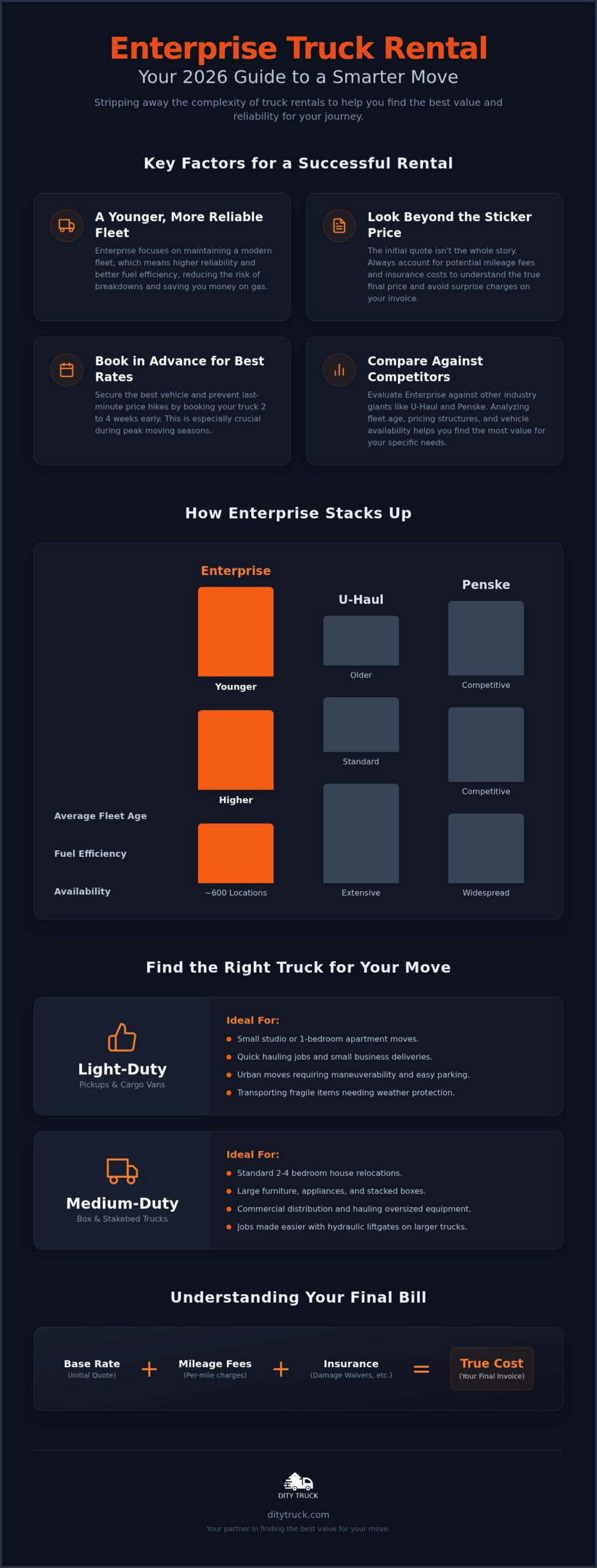
- Enterprise maintains a younger fleet than most competitors. This ensures higher reliability and better fuel efficiency for your move.
- Compare enterprise truck rental against industry giants like U-Haul and Penske to see where you get the most value.
- Look past the initial sticker price. Account for mileage fees and insurance costs to avoid surprises on your final invoice.
- Book your vehicle 2 to 4 weeks early. This secures the best inventory and prevents last-minute price hikes.
What is Enterprise Truck Rental?
Most people recognize the brand from airport terminals or neighborhood car lots. However, enterprise truck rental is a distinct, specialized arm of the global brand. It focuses exclusively on light and medium-duty vehicles designed for labor rather than leisure. While the car rental side gets you to a meeting, the truck division gets your inventory or household goods to their destination. The Enterprise Rent-A-Car history shows a steady expansion from passenger vehicles into the specialized logistics market. This division now handles a massive range of equipment. You can book anything from a 3/4-ton pickup truck for a quick hauling job to a 26-foot box truck for a full household relocation.
The service operates with a focus on reliability and fleet freshness. This isn’t a secondary service. It is a dedicated logistics solution with its own staff and infrastructure. The goal is to strip away the complexity of renting large vehicles. You get a modern truck that is well-maintained and ready for heavy lifting. With nearly 600 locations across the United States and Canada, the geographic reach is extensive. This makes it a powerful option for local projects where proximity to a rental hub saves time and fuel. You want a solution that is close, reliable, and transparent. Enterprise aims to check all three boxes.
Personal vs. Commercial Use: Which Are You?
Your rental category dictates your entire experience. Personal rentals are tailored for residential moves. These are often one-time DIY projects like moving to a new apartment or transporting a large furniture purchase. Commercial accounts are built for business efficiency. They offer custom programs for seasonal business peaks, long-term projects, or fleet replacement needs. Choosing the right category is vital for your bottom line. It changes your insurance options. It also impacts tax requirements and the specific documentation you need at the counter. Being clear about your intent ensures you get the right protection and the correct billing structure from the start.
Enterprise Locations and National Reach
Enterprise operates through dedicated truck-specific facilities. These aren’t your typical airport counters. Most locations sit near industrial hubs or major transit corridors. This placement ensures easy access for large vehicles. It also means the staff understands the specific needs of truck drivers and movers. It’s important to remember that not every Enterprise Rent-A-Car branch stocks box trucks. You need to look for the specific enterprise truck rental signage or use a comparison tool to find the nearest heavy-duty inventory. Finding the right location means less time driving to the lot and more time completing your move. This strategic network allows for efficient local logistics across the country.
The Enterprise Fleet: From Pickups to Box Trucks
Success in moving depends entirely on the quality of your vehicle. Enterprise maintains a fleet that is younger than the industry average. This focus on newer models prioritizes reliability and fuel efficiency. Most trucks come equipped with automatic transmissions and air conditioning. These features make driving a large vehicle less intimidating for DIY movers. You get a modern machine that handles well on the highway. Even for personal moves, understanding federal trucking regulations is helpful for staying safe and compliant on the road.
Efficiency starts with choosing the right size. An oversized truck wastes fuel. An undersized truck requires multiple trips. Both scenarios cost you time and money. The enterprise truck rental lineup covers everything from small 1/2-ton pickups to heavy-duty straight trucks. This variety ensures you only pay for the space you actually need. Having access to a well-maintained fleet means you can focus on the move itself rather than worrying about mechanical failures or poor performance.
Light-Duty Options: Pickups and Cargo Vans
Pickup trucks are ideal for towing or small studio apartment moves. They offer flexibility for 1-bedroom setups where a full box truck is overkill. Cargo vans provide better protection from weather and road debris. They are perfect for urban environments where parking is tight and maneuverability is essential. Standard 2026 cargo van models typically offer between 235 and 300 cubic feet of storage capacity. These vehicles are the smart choice for quick deliveries or transporting fragile items that need a climate-controlled environment.
Medium-Duty Options: Box and Stakebed Trucks
Box trucks ranging from 16 to 26 feet are the gold standard for 2-4 bedroom house moves. These vehicles offer the volume needed for large furniture and stacked boxes. The 26-foot straight truck is the largest option available, designed for massive hauls and commercial distribution. Stakebed trucks are also available for commercial needs. They are essential for hauling oversized or irregularly shaped equipment that won’t fit in a standard box. A major benefit of an enterprise truck rental is the inclusion of liftgates on larger units. These hydraulic platforms reduce physical strain and speed up the loading process. Don’t guess which size you need. You can compare moving truck rental rates across all these sizes instantly to find the right fit. It’s the fastest way to see how Enterprise prices against others. Visit ditytruck.com to start your search and lock in your vehicle today.
Enterprise vs. The Competition: Penske, Budget, and U-Haul
Enterprise often stands out as the premium choice in a crowded market. While competitors like Budget might lead with a lower base price, the total value often shifts when you consider vehicle quality. Most users find that an enterprise truck rental offers a more professional experience. Unlike U-Haul, which frequently operates out of third-party gas stations or hardware stores, Enterprise uses dedicated truck centers. This specialization ensures the staff knows the equipment inside and out. You aren’t just getting a key from a cashier; you’re working with a logistics expert. This Forbes review of truck rental companies highlights how these operational differences impact the consumer experience.
Choosing the right provider depends on your specific priorities. If your only goal is the absolute lowest sticker price for a local haul, you might look elsewhere. However, if you value a truck that is less likely to break down, Enterprise is a strong contender. You can use DityTruck to see a U-Haul vs. Budget truck rental comparison to see how those two stack up against the Enterprise data we provide. It’s about finding the balance between cost and confidence. We aggregate these details so you can make a decision in minutes rather than hours.
Reliability and Vehicle Age
Maintenance standards set the leaders apart from the pack. Enterprise rotates their fleet frequently to ensure newer models are always on the lot. This strategy results in fewer mechanical failures. It also provides better fuel economy for your trip. When you compare Enterprise’s maintenance standards to smaller local providers, the difference is clear. Corporate-backed maintenance schedules are rigorous and documented. You don’t have to worry if the previous renter abused the transmission. Every unit is inspected to meet high performance benchmarks before it reaches your hands. Newer trucks mean fewer worries.
One-Way vs. Local Rental Availability
Route planning is where Enterprise differs most from Penske or U-Haul. Enterprise is an exceptional choice for local “in-town” moves. If you are picking up and dropping off at the same location, their system is seamless. However, one-way availability for personal moves is often more restricted. It is not always an option at every branch. You must check real-time inventory to confirm if a cross-country drop-off is allowed. For those situations, DityTruck specializes in finding one way truck rentals for moving when inventory is tight. We do the heavy lifting of checking multiple providers so you don’t have to waste time on dead-end searches.
Understanding Costs: Fees, Insurance, and Age Limits
The daily rate you see online is rarely the final number on your receipt. Total box truck rental prices include several variables that can double your expected cost. An enterprise truck rental usually features a competitive base rate, but the final bill depends on how far you drive and how you protect the vehicle. Transparency is key here. Understanding these line items before you arrive at the counter prevents budget-breaking surprises. We do the heavy lifting of identifying these costs so you can plan with precision.
Mileage is the biggest variable for local moves. An enterprise truck rental typically carries a per-mile fee ranging from $0.20 to $0.99. These cents add up quickly on a cross-town trip. Age requirements also impact your bottom line. You must be at least 21 years old to rent in most states. If you are under 25, expect a daily young renter surcharge. New York and Michigan allow 18-year-old renters, but the fees are often higher. Always factor in environmental fees and potential refueling charges if you return the truck with less than a full tank.
Protection Plans and Insurance
Optional coverage provides peace of mind for high-stakes hauls. Damage Waivers (DW) and Personal Accident Insurance (PAI) are common add-ons. Don’t assume your personal auto policy covers you. Most standard insurance and credit cards exclude “commercial” sized trucks or vehicles over a certain weight. Enterprise also offers Supplemental Liability Protection (SLP). This provides up to $1,000,000 in coverage for third-party claims. It is a smart move to verify your existing coverage limits before paying for duplicates.
The Hidden Cost of Fuel and Mileage
Fuel expenses vary wildly by truck size. Enterprise box trucks run on either diesel or gasoline. You must know your specific fuel type to avoid catastrophic engine damage. Calculating the cost to rent a 26 foot moving truck requires a realistic fuel estimate based on the vehicle’s lower MPG. I recommend taking a clear photo of the fuel gauge at both pickup and drop-off. This simple step provides undeniable proof of your usage. To skip the manual math and see total estimates, compare real-time rates at ditytruck.com and book with total clarity.
How to Book the Best Truck Rental Rate in 2026
Securing a low rate requires a proactive strategy. Don’t wait until the week of your move to start looking. Start your search at least 2 to 4 weeks before your move date. This window ensures you get the best inventory and current pricing. Weekends are the busiest times for enterprise truck rental. If your schedule allows, look for mid-week discounts. Booking on a Tuesday or Wednesday often yields lower rates than a Saturday morning. Demand is lower during the week. This gives you more leverage. Better vehicle choices. Lower costs.
Finalizing your reservation online is the safest way to lock in your price. It guarantees your truck size and prevents on-site availability issues. Walk-in customers often face higher prices or limited fleet options. A confirmed digital reservation acts as your contract. It provides a clear record of the agreed-upon rate and mileage terms. This simple step eliminates the stress of arrival. You know exactly what truck is waiting for you and what the final cost will be.
The DityTruck Advantage
We designed our platform to act as your smart assistant for logistics. Instead of checking ten different websites, you see everything in one place. Our system aggregates real-time data from enterprise truck rental, Penske, and Budget simultaneously. We prioritize financial honesty. You see the terms and conditions before you click reserve. Efficiency is our primary goal. You can find, compare, and book your vehicle in under five minutes. We do the heavy lifting of price checking so you can focus on your transition. It is the shortest path between your problem and a solution.
Final Checklist Before You Drive Away
Preparation doesn’t end with the booking. Before you drive away, perform a thorough inspection of the truck. A few minutes of diligence at the lot saves hours of stress at the end of your journey. Follow this simple checklist to ensure a successful start:
- Inspect for damage: Check the vehicle for existing scratches or dents. Ensure every mark is noted on your contract to avoid false claims later.
- Confirm return policies: Ask the agent about after-hours drop-offs. Know if the lot is locked on weekends or if there is a secure key box.
- Verify documentation: You must have a valid driver’s license and a credit card in the renter’s name. Ensure the names match exactly.
- Check fuel levels: Take a photo of the fuel gauge before leaving. Confirm the fuel type (diesel or gasoline) to avoid engine damage.
You want a move that is fast, clear, and successful. Following these steps guarantees you start your trip on the right foot. Clear communication at the counter leads to a friction-free return. Get your quote, lock in your rate, and get moving with total confidence.
Take Control of Your 2026 Move
Choosing the right vehicle is the foundation of a successful relocation. You now understand that Enterprise offers a younger, more reliable fleet than many budget competitors. This focus on newer models reduces the risk of mechanical failures during your trip. You also know how to navigate the complexities of mileage fees and insurance options. Transparency is your greatest tool. By booking mid-week and verifying your specific fuel requirements, you can significantly lower your total expenses. An enterprise truck rental provides the professional-grade equipment needed for a smooth, predictable transition.
We make the comparison process effortless. You can Compare Enterprise rates and book your moving truck today at DityTruck.com. Our platform provides real-time price transparency with no hidden booking fees. You can compare top-rated national carriers instantly to find the perfect fit for your specific route and budget. Your next move doesn’t have to be a source of stress. With the right data and a reliable truck, you are ready to hit the road with total confidence.
Frequently Asked Questions
Do I need a CDL to rent an Enterprise box truck?
No, you do not need a Commercial Driver’s License (CDL) to rent standard moving trucks for personal use. Most box trucks in the fleet fall below the 26,001-pound weight threshold that requires specialized licensing. You only need a valid, standard driver’s license to operate these vehicles.
What is the minimum age to rent a truck from Enterprise?
The minimum age to rent a truck is 21 in most states. Residents of New York and Michigan can rent at age 18. Drivers under the age of 25 should expect an additional daily surcharge on top of the standard rental rate.
Does Enterprise offer unlimited mileage on moving trucks?
Unlimited mileage is not standard for a personal enterprise truck rental. Most quotes include a per-mile fee that averages around $0.33 per mile, though rates can range from $0.20 to $0.99. Some specific local promotions or commercial accounts may offer unlimited options, so always verify your quote details.
Can I rent a pickup truck from Enterprise for a one-way move?
One-way rentals for pickup trucks and cargo vans are often restricted. Enterprise focuses primarily on local, round-trip logistics for their light-duty fleet. If you need to drop off a vehicle at a different location, you must confirm availability with the specific branch during the booking process.
What happens if I return the truck late to Enterprise?
Returning a truck late typically results in additional hourly or daily charges. Most locations allow a small grace period, but exceeding it will trigger a full day’s rental fee. Contact the branch as soon as you realize a delay is likely to avoid unauthorized use penalties.
Are Enterprise trucks diesel or gas-powered?
The fleet includes both gasoline and diesel engines depending on the truck size. Smaller pickups and cargo vans usually run on gasoline, while larger 26-foot box trucks often require diesel. Always check the fuel cap label to ensure you use the correct fuel type for your specific vehicle.
Does Enterprise provide moving supplies like boxes and dollies?
Enterprise does not typically sell packing supplies like boxes or tape at their truck centers. They do offer moving dollies and furniture pads for rent to help with heavy lifting. It is a smart move to purchase your cardboard boxes and packing materials before your scheduled pickup date.
How do Enterprise truck rental rates compare to U-Haul?
An enterprise truck rental often has a higher daily base rate but lower per-mile fees than U-Haul. U-Haul frequently advertises low daily rates starting at $19.95, but their mileage fees can reach $1.29 per mile. Enterprise is often the more cost-effective choice for longer local moves where you need a newer, more reliable vehicle.
Leave a Reply