The $19.95 sticker on a rental truck is often a decoy. By the time you add mileage, environmental fees, and insurance, that “cheap” local move can easily triple in price. Finding the best moving truck rental isn’t about the lowest advertised rate. It’s about total transparency. You’re likely worried about hidden costs at pickup or a mechanical failure on a long haul. We get it. Logistics should be simple. You want a truck that fits your life without the fear of a breakdown or a surprise bill at the counter.
This 2026 comparison guide clarifies the confusion. You’ll discover which providers offer the best value for your specific route and load size. We analyze real-world data from industry leaders, such as Penske’s unlimited mileage options for long hauls and Budget’s competitive $0.47 per mile local rates. This article provides a clear path to a seamless reservation so you get the right truck at a fair price. No surprises. No stress.
Key Takeaways
- Define the “best” rental as the intersection of route, price, and vehicle reliability.
- Discover the best moving truck rental by comparing real-time rates from U-Haul, Penske, and Budget in one view.
- Avoid the “two-trip” trap. Learn how to select the right size truck for everything from a studio apartment to a five-bedroom home.
- Protect your budget from hidden costs. We break down the environmental fees and insurance coverage types you actually need.
- Simplify your logistics. Use a smart assistant approach to secure a seamless reservation without the 10-tab research headache.
Why the “Best” Moving Truck Rental Depends on Your Route
The best moving truck rental isn’t a fixed winner. It’s a calculation. You need to find where availability, price, and vehicle reliability meet for your specific zip code. According to this moving industry overview, DIY moves rely heavily on the logistics of the rental fleet. If a truck is cheap but 50 miles away, you’ve already lost time and money. Reliability matters too. A breakdown on a local street is a nuisance. A breakdown on a desert highway is a crisis. You want a provider that matches your specific path.
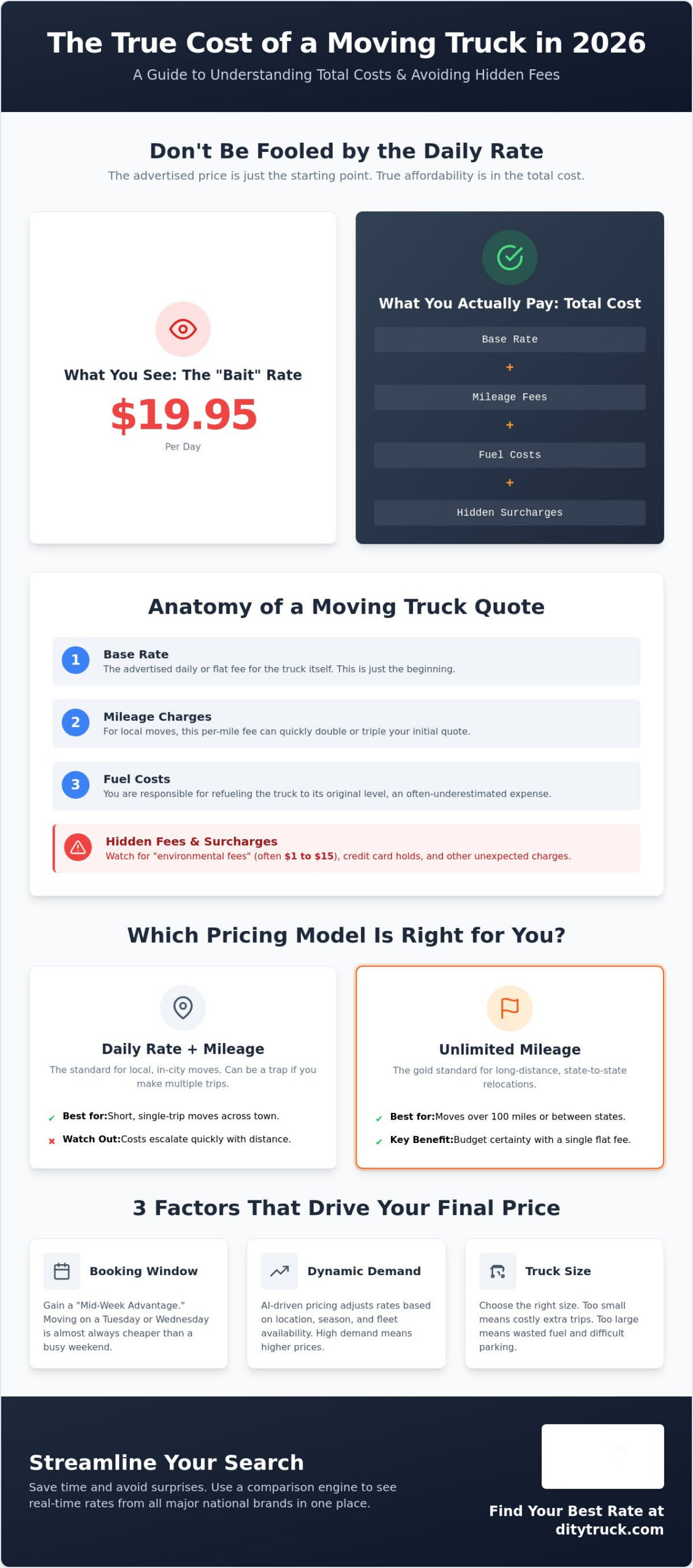
Think about the Total Cost of Ownership (TCO) for your trip. Don’t just look at the daily rate. TCO includes fuel, mileage fees, insurance, and environmental surcharges. A $20 rental with a high per-mile fee is often more expensive than a $100 rental with unlimited miles if you’re driving a long distance. You have to do the math before you click reserve. Some brands dominate local markets with sheer volume. Others win long-distance hauls with better maintenance and flexible drop-off points.
Local Moves: Prioritizing Low Daily Rates
Local moves are usually round trips. You pick up and drop off at the same spot. In this scenario, mileage fees are the silent budget killer. Providers often advertise low base rates to get you in the door. If you’re only moving five miles, these rates are unbeatable. Local availability is your primary factor here. You don’t want to spend two hours of your moving day driving to a distant rental hub. For small apartments or quick hauls, cargo vans and pickups are the heroes. They’re easier to park and usually have the lowest base rates in the local market. Just watch the odometer. Those small fees add up fast.
One-Way Relocations: Focus on Drop-off Flexibility
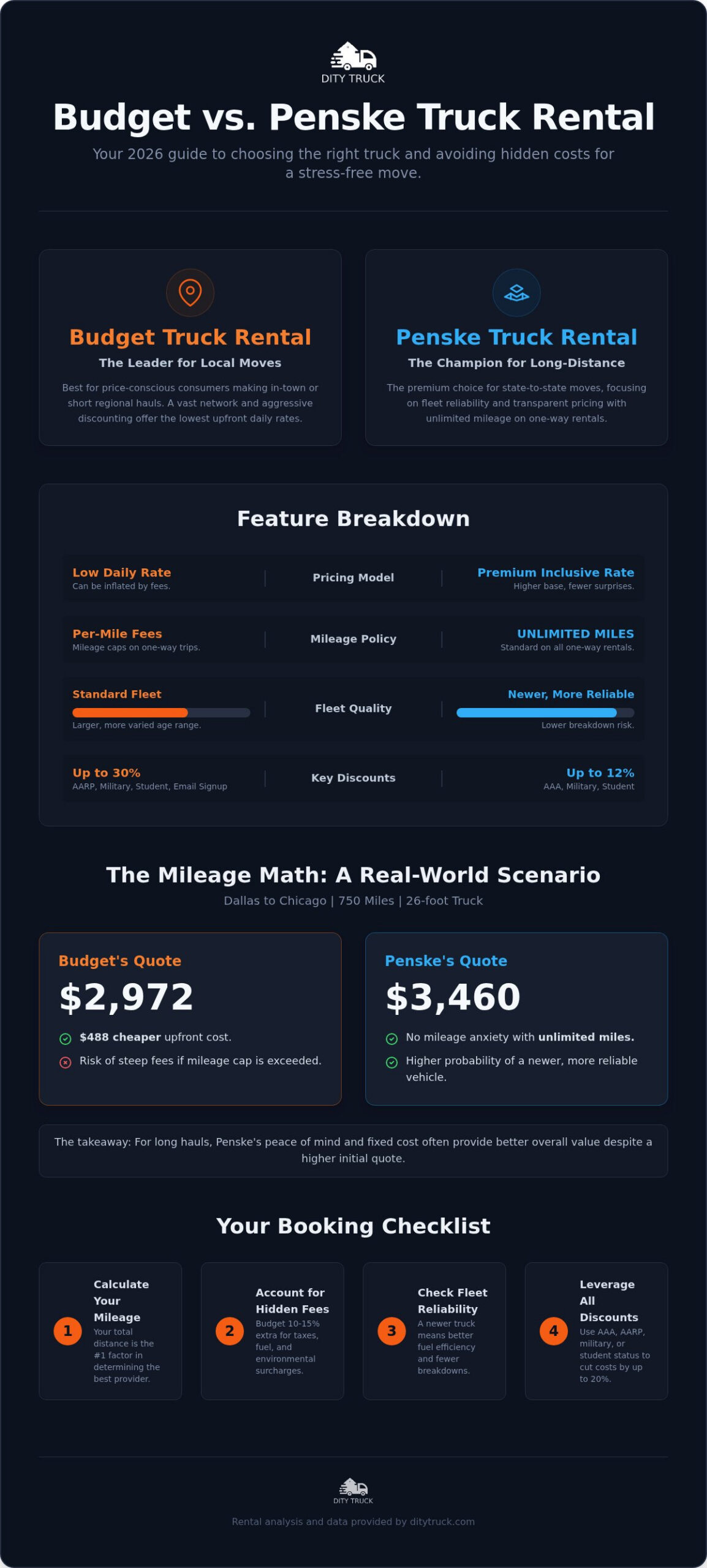
Moving across state lines changes the rules. You need one way truck rentals for moving that offer flat-rate pricing. These packages typically include a set number of days and miles. It simplifies your budget. Brands like Penske often win here by offering unlimited mileage on certain one-way routes. It removes the anxiety of taking a wrong turn or hitting traffic. A massive national drop-off network is essential. You don’t want to drive two hours out of your way just to return the keys at the end of an exhausting move. Focus on companies that prioritize long-distance fleet health to avoid mid-move repairs.
The Top Moving Truck Companies of 2026 Compared
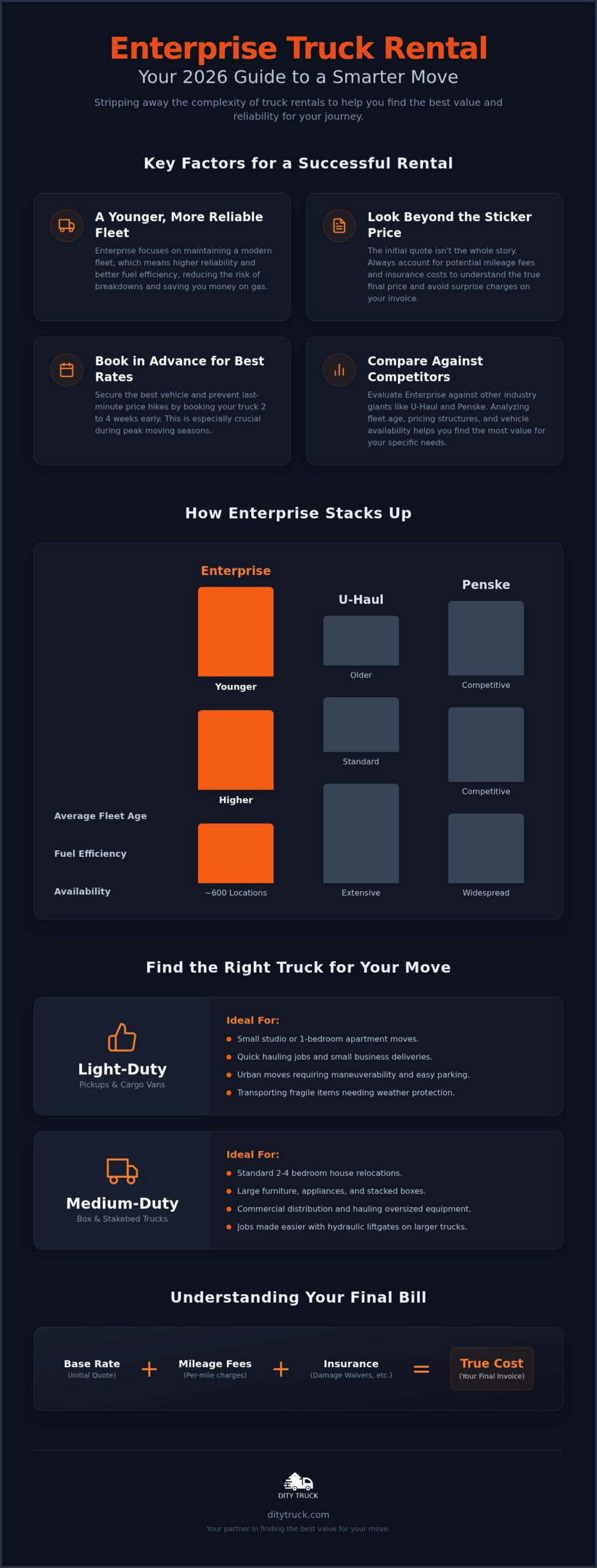
Selecting the best moving truck rental requires more than just looking at the logo on the side of the van. The market is led by three national giants, but their service models differ. U-Haul, Budget, and Penske each cater to different moving styles. For those with specialized needs, Enterprise Truck Rental provides commercial-grade vehicles that handle heavier loads than standard consumer box trucks. These are ideal for DIYers moving large workshops or dense equipment. Modern logistics have also introduced 24/7 roadside assistance and mobile check-in as industry standards. You no longer have to wait for a counter agent to open the shop. You can unlock your truck with a smartphone and start your journey on your own schedule.
Fleet age and maintenance are the invisible factors in your rental experience. A newer truck isn’t just about aesthetics. It means better fuel efficiency and a lower risk of mechanical failure during a 1,000-mile haul. Penske typically maintains a younger fleet, which appeals to long-distance movers. Budget and U-Haul focus on high-volume availability. They ensure a truck is ready when you need it, even if it has a few more miles on the odometer. Understanding these nuances helps you choose a provider that matches your risk tolerance and budget.
U-Haul: The King of Availability
U-Haul is the most accessible name in the industry. They operate over 21,000 locations across North America. This massive footprint means you can usually find a pickup point within 10 minutes of your home. They excel at specialized equipment. If you need to tow a car or rent a motorcycle trailer alongside your box truck, U-Haul has the inventory. The trade-off is variability. Their fleet size makes it difficult to guarantee a brand-new vehicle every time. You might encounter older trucks in rural areas. However, their sheer volume makes them the primary choice for short, local moves where convenience is the deciding factor.
Penske and Budget: Reliability vs. Value
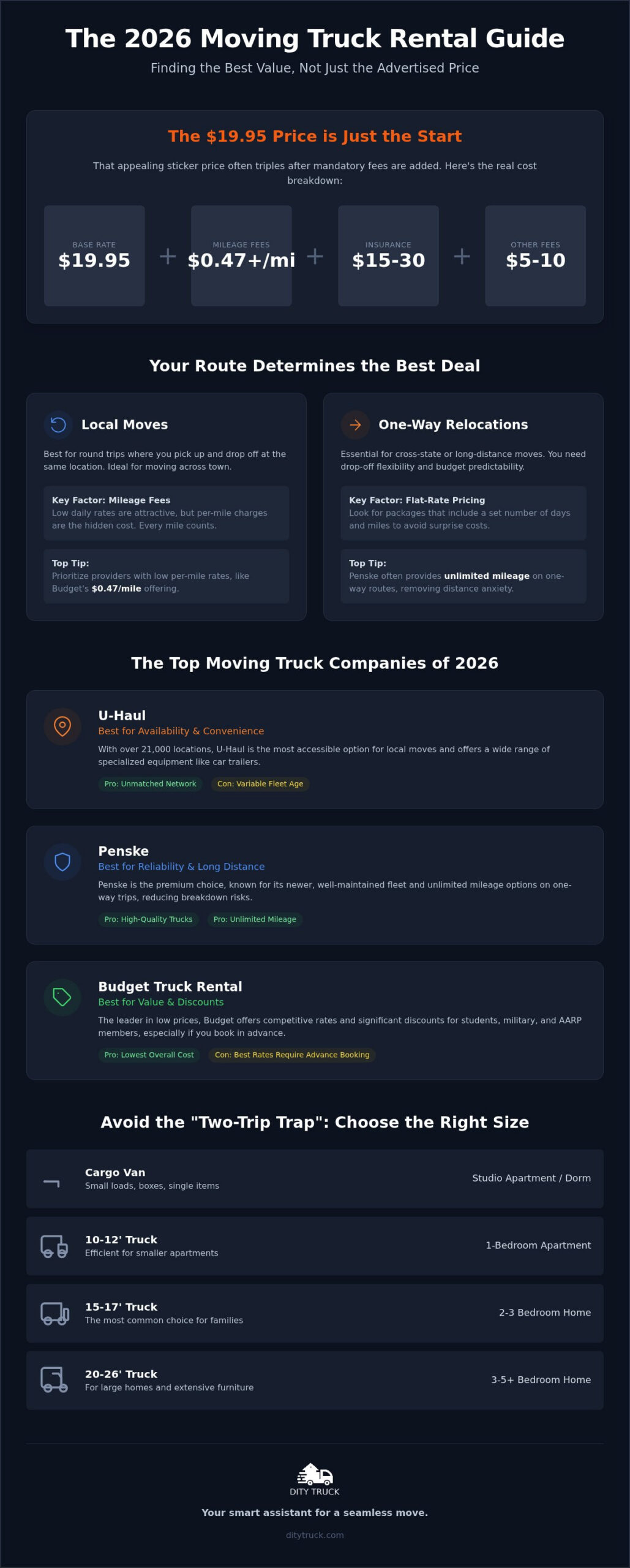
Penske positions itself as the premium choice for reliability. Their maintenance standards are rigorous. This focus pays off for one-way moves, where they often include unlimited mileage in their flat-rate quotes. This eliminates the stress of tracking every mile on a cross-country trip. Budget Truck Rental competes on price. They are the discount leaders, offering significant savings for students, military personnel, and AARP members. If you book your rental several weeks in advance, Budget often provides the lowest total cost. Comparing uhaul vs budget truck rental is a smart move for any mid-sized relocation. Budget’s average local rate of $0.47 per mile is often much lower than the industry standard. To get the most accurate picture, you should compare real-time quotes from all these providers at once to see who offers the best value for your specific moving date.
Choosing the Right Size: From Cargo Vans to 26-Foot Trucks
Selecting the wrong size is the fastest way to ruin a moving day. You want the best moving truck rental to fit your belongings in one trip. Underestimating space leads to high-stakes decisions at the last minute. If you’re moving locally, a second trip doubles your mileage fees and fuel costs. If you’re moving across the country, you simply don’t have the option of a second trip. Overestimating by 10 or 15 percent is the safer bet. It gives you room for odd-shaped items like floor lamps or bicycles that don’t stack perfectly. A little “breathing room” in the back of the truck prevents you from having to force heavy furniture against fragile boxes.
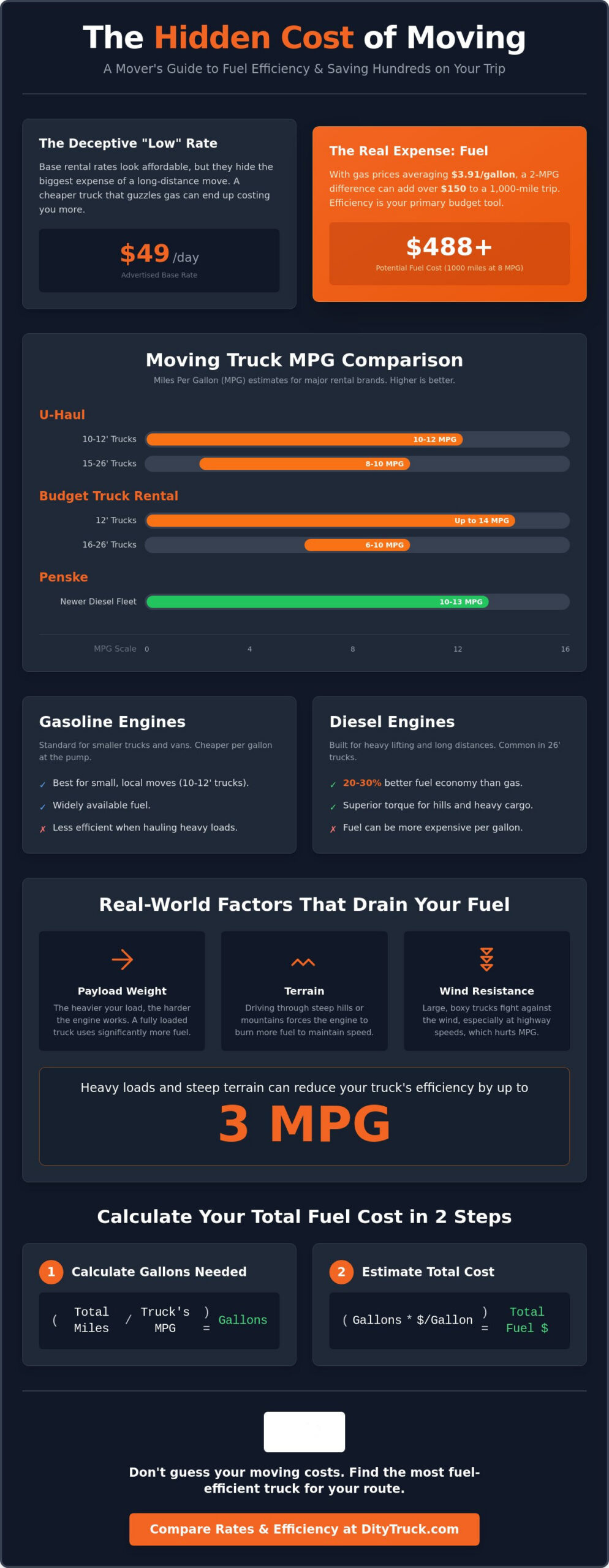
Size impacts every part of your drive. A cargo van feels like a standard SUV. A 26-foot box truck feels like a house on wheels. Larger vehicles have massive blind spots and require significantly wider turning radiuses. They also catch the wind on open highways, which can be startling for first-time drivers. Fuel consumption is another major factor in your total cost. A fully loaded 26-footer might only get 8 to 10 miles per gallon. Smaller vans can see nearly double that efficiency. For a detailed look at how these dimensions affect your wallet, check our guide on box truck rental prices. It breaks down the math so you don’t overpay for air.
The 16-foot truck is often the “sweet spot” for many renters. It’s the middle ground for one or two-bedroom apartments. It offers enough length for most couches and dining tables without being as intimidating to drive as the larger units. However, always check the interior wheel well intrusions. Some truck models have wheels that take up floor space inside the box. This can make packing large, flat items like mattresses or dressers more difficult than you expect. Knowing these small details helps you secure the best moving truck rental for your specific inventory.
Small Moves: Cargo Vans and 10-Foot Trucks
These units are perfect for studio apartments, dorm rooms, or single-item deliveries. Cargo vans offer car-like handling and fit into standard parking spaces. This is a huge relief in dense city environments. However, they have strict height limits. A king-sized mattress or a large sectional sofa likely won’t fit in a van. The 10-foot truck is the smallest true box truck. It offers more vertical space while remaining easy to maneuver for beginners. It’s the ideal choice for those moving out of a small apartment who want the protection of a hard-sided vehicle.
Large Scale Relocations: 22 to 26-Foot Box Trucks
Moving a 3 to 5-bedroom home requires serious volume. These are the largest vehicles you can drive without a commercial driver’s license. When calculating the cost to rent a 26 foot moving truck, remember that these are designed for weight. They often feature wide loading ramps or hydraulic lift gates to save your back. Safety is paramount here. Always check your height clearance before entering a drive-thru or passing under low bridges. Take turns slowly. Give yourself triple the normal braking distance. It’s about getting your life to the new home safely, not quickly.
Navigating Hidden Fees: How to Get an Accurate Quote
The price you see online is rarely the price you pay at the counter. Finding the best moving truck rental requires looking past the bold numbers. Hidden fees can turn a budget move into a financial headache. You deserve transparency. Understanding the fine print is the only way to protect your wallet from late-stage surprises. To avoid these surprises, you should get a transparent price comparison that includes these variables before you commit to a provider.
The environmental fee is a fixed cost. It usually ranges from $1 to $5. It pays for the disposal of hazardous materials like oil and tires. Rental taxes are separate. They vary by state. Expect them to add a significant percentage to your final bill. The “Refueling Trap” is another common hurdle. Rental companies charge a premium for missing gas. This fee is often double the local pump price. It is an avoidable expense. Always snap a photo of the fuel gauge before you leave the lot. Ensure the level matches your contract exactly.
Before you drive away, perform a thorough inspection. Note every scratch. Check the tire tread. Look for cracks in the mirrors. These five minutes protect you from “existing damage” claims when you return the keys. Snap photos of all four sides of the vehicle. This is your digital proof of the truck’s condition at pickup.
Mileage and Fuel: The Variable Costs
Estimating mileage for local moves is simple math. Map your route from the rental lot to your old home, then to the new house, and back to the lot. Add 10 percent for unexpected hardware store runs or detours. In 2026, the average cost-per-mile for local truck rentals typically ranges from $0.47 to $1.39 depending on the provider and vehicle size. Most companies follow a “Return Full” policy. Prepaying for fuel is rarely a good deal. You often pay for a full tank even if you only use half. Fill up at a local station just before drop-off to keep costs low.
Equipment and Protection Plans
Furniture pads and dollies are not included. A set of 12 pads usually costs around $10. A utility dolly might add another $7 to $12 to your daily rate. These small additions add up. You should also verify your insurance. Collision Damage Waiver (CDW) protects the truck. Supplemental Liability Insurance (SLI) covers third-party claims. Personal Accident Insurance (PAI) covers your medical costs. Your personal car insurance likely excludes box trucks. Most credit cards do too. Buying the rental protection is often the safest path for high-stakes moves, especially for one-way hauls where the risks are higher.
Find Your Best Rate: The DityTruck Advantage
Finding the best moving truck rental doesn’t have to involve ten browser tabs and a manual spreadsheet. The rental market moves fast. Prices fluctuate based on demand, location, and equipment availability. DityTruck acts as your smart assistant. It aggregates real-time data from major national providers into one streamlined view. This eliminates the guesswork. You see the true market value of your move instantly. It is the shortest path between your logistics problem and a confirmed solution.
We’ve already discussed the impact of hidden fees and size requirements. DityTruck brings that complexity into a single interface. Instead of hunting for the environmental fee or mileage rate on multiple websites, you see them side-by-side. This transparency is the key to a stress-free move. Whether you are planning a local haul or a cross-country relocation, moving truck rental comparison ensures you never overpay. You get the facts without the marketing fluff.
Compare Real-Time Rates in Seconds
The comparison engine is built for speed. You can filter results by truck size, specific pickup location, and your preferred dates. This is critical during peak moving seasons. Summer weekends and holiday breaks often see fleet shortages. DityTruck shows you who actually has a 16-foot box truck available in your zip code. You don’t have to call different neighborhood dealers to confirm inventory. The platform does the heavy lifting. You get a clear, objective view of your options in seconds. This allows you to make a data-driven decision without the time-consuming research.
Book with Confidence
Once you find the right fit, the reservation process is seamless. Booking through a specialized national platform provides an extra layer of security. You aren’t just sending a request into a void. You get immediate confirmation. If your plans change, DityTruck provides access to specialized customer support to handle adjustments. This replaces the frustration of waiting on hold with a general corporate hotline. You can finalize your logistics with total clarity. Your move is high-stakes. Your booking tool should be high-performance. Compare moving truck rates now to secure your 2026 relocation at the best possible price.
Secure Your 2026 Move Today
Your move is a high-stakes transition. It shouldn’t be a gamble. You now know that the best moving truck rental depends on your specific route and load size. Choosing the right vehicle prevents mid-move logistics crises. Understanding fuel policies and inspecting your truck keeps your budget intact. You have the knowledge to avoid hidden fees and mechanical headaches. These small steps ensure a seamless journey from your old front door to your new one. You’re ready to move with confidence.
DityTruck simplifies the final step. We provide national coverage across all 50 states. You get real-time pricing from Penske, Budget, U-Haul, and other top providers instantly. Our platform eliminates the research headache by offering zero hidden fees in our comparison tool. It’s the shortest, most logical path to a successful relocation. You deserve a move that is fast, transparent, and entirely within your control. Take the first step toward a friction-free moving day right now. Your new home is waiting.
Compare Real-Time Moving Truck Rates Now
Frequently Asked Questions
Which moving truck rental company is the cheapest?
Budget Truck Rental is frequently the cheapest option for local moves due to their lower than average mileage rates. For very short hauls, U-Haul’s $19.95 base rate for small vehicles is difficult to beat. The best moving truck rental for your wallet depends on the total distance. You should always calculate the mileage and insurance fees before making a final decision.
What is the most reliable moving truck rental company in 2026?
Penske Truck Rental is generally considered the most reliable provider in 2026. They maintain a younger fleet compared to their national competitors. Newer trucks mean better fuel economy and a lower risk of mechanical issues on the road. This makes them a top choice for long distance relocations where vehicle health is your primary concern.
Do I need a special license to drive a 26-foot moving truck?
You don’t need a Commercial Driver’s License (CDL) to drive a 26-foot moving truck. These vehicles are designed for consumer use and fall under standard licensing requirements. However, you should familiarize yourself with the height and weight limits. Always give yourself extra braking room and avoid low clearance bridges or drive-thrus.
Is Penske or U-Haul better for one-way moves?
Penske is often better for one-way moves because they offer unlimited mileage on many long distance routes. This removes the stress of tracking your distance or paying overage fees. U-Haul is a strong alternative if you’re moving to a remote area. Their network of 21,000 locations ensures there is almost always a drop-off point near your destination.
How much does it cost to rent a moving truck for a local move?
A local move under 100 miles typically costs between $30 and $150 before fuel and insurance. Budget’s average local rate is approximately $27.60 with a $0.47 per mile fee. U-Haul averages around $138 for a local move when including all standard fees. Your final price varies based on the truck size and the day of the week you move.
What happens if the rental truck breaks down during my move?
All major rental companies provide 24/7 roadside assistance for mechanical failures. If the truck breaks down, you should call the emergency number provided in your rental agreement immediately. They will either repair the vehicle on-site or provide a replacement truck. Ensure you understand the roadside assistance terms and any potential costs before leaving the rental lot.
Can I tow my personal car behind a rental moving truck?
Yes, you can tow your personal car using a tow dolly or an auto transport trailer. Most 15-foot to 26-foot trucks come equipped with a hitch for this purpose. You must ensure the truck’s towing capacity matches your car’s weight. Rental agents can help you select the correct towing equipment to ensure a safe trip for both vehicles.
How far in advance should I book my moving truck rental?
You should book your best moving truck rental at least two to four weeks in advance. Demand spikes at the end of the month and during the summer moving season. Booking early locks in a lower rate and guarantees the specific truck size you need for your move. If you’re moving during a holiday weekend, consider reserving even earlier to avoid shortages.