That $19.95 sticker price on the side of a truck is almost never what you actually pay at checkout. Between hidden mileage fees and confusing insurance add-ons, securing a pickup truck rental can quickly turn into an expensive logistical headache. You’re likely tired of wasting hours jumping between tabs just to see if a truck is available or if it can actually handle your specific towing needs. It’s frustrating to realize the “cheap” option doesn’t even have the payload capacity required for the job.
It’s time to stop overpaying for oversized box trucks and start getting exactly what you need. This guide shows you how to find the most affordable and capable truck for any task by comparing top national providers in seconds. You’ll get a clear look at 2026 rates, technical specs, and those sneaky fees that usually stay buried in the fine print. We’ll compare the latest offerings from major players like U-Haul, Home Depot, and Penske so you can secure a quick online reservation with total confidence.
Key Takeaways
- Match your cargo to the right bed size and payload capacity. This ensures you have enough space without overpaying for a box truck.
- Calculate the true cost of a pickup truck rental by accounting for mileage fees and insurance. Avoid hidden charges on longer trips.
- Compare top national providers to find the best fit for your specific task. Some favor local moves while others excel at towing.
- Learn why pickups are the most versatile choice for landscaping and small apartment moves. They offer more flexibility than standard vans.
- Use a comparison platform to view real-time rates and availability. Secure your reservation in seconds without checking multiple websites.
Understanding Pickup Truck Rental: When and Why to Choose One
A Pickup truck is the ultimate tool for local logistics. It bridges the gap between a standard car and a massive box truck. While cargo vans protect items from rain, they struggle with tall furniture or bulky landscaping materials. A pickup truck rental provides the vertical space you need for a refrigerator or a load of topsoil. It’s the most practical choice for small apartment moves. You get enough payload for your mattress and dresser without the stress of driving a vehicle that feels like a bus. It’s easier to navigate tight city streets and park in standard driveways.
Efficiency is the primary driver for many renters in 2026. Light-duty trucks are projected to account for 100% of certain rental segments because they offer lower maintenance and fuel costs. If you’re moving a light load, a smaller truck saves you money at the pump. It’s also the perfect solution when your own truck is in the shop for repairs. You don’t have to cancel your weekend plans or delay a project. You can rent a reliable replacement and keep your momentum. It’s about maintaining your lifestyle or business operations without a single day of downtime.
DIY Home Projects and Local Hauling
Retail delivery fees can be surprisingly high. Avoiding these extra costs is easy when you handle the transport yourself. Use a pickup to haul lumber, mulch, or appliances safely. The open bed allows for odd-shaped items that simply won’t fit inside a van’s enclosed walls. You can secure your load with tie-downs and head home immediately. It’s a straightforward way to finish your home projects on your own schedule. You won’t have to wait around for a four-hour delivery window.
Temporary Business and Commercial Needs
Businesses often need extra wheels during busy months. Supplementing your fleet with a pickup truck rental avoids the burden of a long-term lease. You can project a professional image by using clean, late-model vehicles for client deliveries. Comparing commercial rates against personal ones ensures you’re getting the best deal for your company. It’s a flexible, low-risk way to manage growth. This approach lets you scale your operations up or down based on real-time demand without the heavy overhead of ownership.
Technical Specifications: Towing Capacity, Payload, and Dimensions
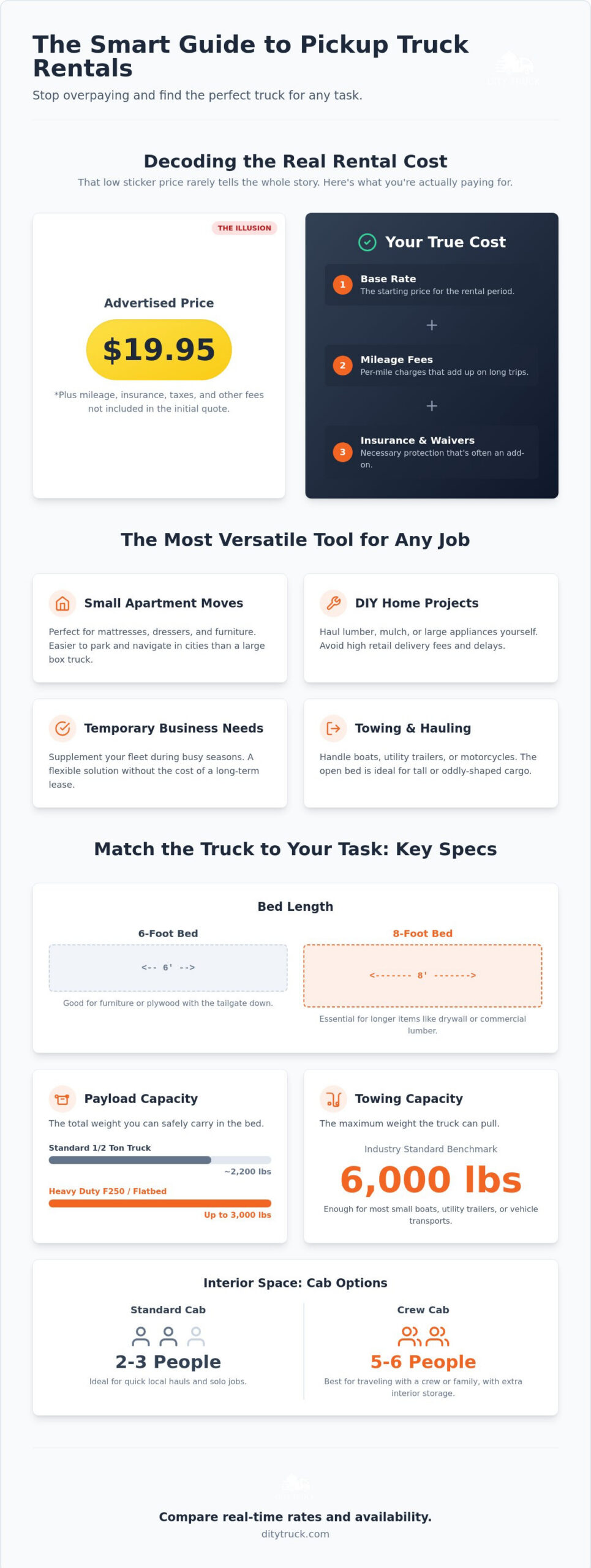
Choosing the right pickup truck rental requires looking past the brand name and diving into the raw numbers. Most providers offer two main bed lengths: 6-foot and 8-foot options. A 6-foot bed is standard for many 1/2 ton trucks. It provides enough room for furniture or plywood with the tailgate down. If you’re hauling longer items like drywall or commercial lumber, an 8-foot bed is essential to prevent overhang. Payload capacity is equally critical. This is the total weight you can safely carry in the bed. For example, a standard 8-foot pickup can typically handle about 2,200 lbs. Heavier duty flat-beds like the F250 can reach up to 3,000 lbs of payload capacity.
Towing capacity is another vital metric. In the rental industry, 6,000 lbs has become the standard benchmark. This limit allows you to pull most small boats, utility trailers, or even a vehicle transport trailer. However, you must always verify the Gross Vehicle Weight Rating (GVWR) before hitting the road. The GVWR is the maximum weight of the vehicle plus all its cargo and passengers. Staying within these limits isn’t just about performance. It ensures compliance with FMCSA regulations for safe operation on public highways. Overloading a truck compromises its braking and steering. It turns a simple move into a serious hazard. If you want to compare real-time specs and availability, checking multiple providers at once is the fastest way to find a truck with the right limits.
Towing Boats, Trailers, and Motorcycles
Check your rental agreement for hitch requirements before you arrive at the lot. Most 1/2 ton rentals come with a 2-inch receiver. You’ll also need a compatible wiring harness for trailer lights. If you’re hauling motorcycles, focus on the tie-down points in the bed. High-quality trucks offer multiple anchor spots to keep your bike upright and secure. Always double-check that your specific rental allows for towing, as some providers restrict this on their base models.
Interior Space and Crew Cab Options
The cab configuration determines who and what can ride up front. A standard cab usually seats 2 to 3 people. This is fine for quick local hauls. If you’re traveling with a crew or family, look for a Crew Cab. These models seat 5 to 6 people comfortably. They also provide extra floor space behind the front seats. This is the best place for sensitive items like electronics or fragile tools that shouldn’t sit in an open bed. Modern rentals also feature comfort upgrades like Bluetooth and climate control to make multi-day trips more manageable.
Comparing the Best Pickup Truck Rental Companies
Finding the right pickup truck rental requires looking beyond the flashy advertisements. Every provider has a specific niche. Some major national chains are the household name for local tasks. They often offer a low base rate for in-town rentals. This is perfect for a quick cross-town haul. However, the cost to rent a moving truck can skyrocket if you ignore mileage. Fees typically add up for every mile you drive. For longer trips, these pennies turn into significant expenses. It’s often better for a two-hour job than a two-day journey.
Business-grade rental agencies serve a different crowd. They specialize in durability and heavy-duty performance. You’ll find a wider range of 1/2 ton, 3/4 ton, and 1-ton pickups with these providers. These are ideal for heavy towing or commercial supplementation. Big-box home improvement stores offer a unique short-term service. It’s unbeatable for picking up a new appliance or a stack of plywood. You don’t have to deal with complex contracts. Just grab the keys and go. Other national competitors provide deep discounts for students or military members. While they offer pickups, they also suggest cargo vans as an alternative. Vans offer more protection from the weather. Pickups offer more versatility for height. It’s a trade-off based on your cargo and the forecast.
Local vs. Long-Distance Availability
Not every company supports one-way trips. Some national brands are generally more flexible with drop-off locations. Local retailers often require you to return the truck to the starting point. This makes them better for local loops. If you need to move across state lines, check out our One Way Truck Rentals for Moving: 2026 Comparison Guide. Rental availability also varies by geography. You’ll find certain providers in almost every rural town. Business-focused agencies are more common in urban hubs and industrial areas.
The Pros and Cons of Each Provider
Ease of booking is a major differentiator. Modern mobile apps allow for 24/7 pickup and drop-off. This is a huge time-saver for early morning projects. Traditional agencies usually require a face-to-face counter interaction. Maintenance standards also vary across brands. Top-tier companies are known for maintaining newer fleets. This means better fuel economy and fewer mechanical issues during your trip. For a deeper dive into these service models, read our Moving Truck Rental: The Complete 2026 Comparison & Booking Guide. Choosing the right partner ensures your job stays on track and under budget.
Calculating the Real Cost: Base Rates, Mileage, and Insurance
The advertised price for a pickup truck rental is just the starting line. Most people see a low daily rate and assume that is the final bill. It rarely is. The daily base rate only covers the vehicle sitting in your driveway. Once you turn the key, the actual expenses begin to stack up. You need to account for every mile, every gallon of gas, and every local tax before you sign the agreement. This transparency prevents a “bill shock” when you return the keys. Total clarity is the only way to stay under budget.
The “Mileage Trap” is where most budgets fail. For a local 20-mile trip, a $0.99 per-mile fee adds roughly $20 to your total. On a 100-mile haul, that same fee adds nearly $100. This is why a low base rate can be deceptive. If you are driving a long distance, a provider with a higher base rate but unlimited mileage might actually be cheaper. Always calculate your estimated distance before booking. You can compare total costs across national brands instantly to see which pricing structure fits your route best.
Fuel and environmental fees also impact the final invoice. You must return the truck with a full tank or face high per-gallon refueling charges. These convenience fees are significantly higher than local gas station prices. Additionally, many companies add an environmental fee of $1 to $5 per rental to cover fluid disposal and fleet maintenance. Local taxes vary by city and state. Do not be surprised if your final quote is 10 to 15 percent higher than the initial estimate once these regulatory costs are added.
Understanding Rental Protection and Insurance
Rental protection is a common point of confusion. Collision Damage Waivers (CDW) or Loss Damage Waivers (LDW) usually cost between $10 and $30 per day. Do not assume your personal auto insurance covers a rental truck. Many personal policies exclude commercial-grade vehicles or trucks used for moving. If you are towing a third-party trailer, you likely need additional liability coverage. Checking your policy beforehand saves you from paying for redundant protection at the counter. It provides peace of mind for a small daily fee.
Hidden Fees and How to Avoid Them
Late return penalties are strictly enforced to keep fleets moving. Some providers charge $100 for an extra day. Others charge by the hour. Always schedule a two-hour buffer to avoid these spikes. Cleaning fees are another surprise. If the truck bed is excessively dirty from mulch or construction debris, you will pay a detailing fee. If you realize a pickup is not enough space for your haul, check our guide on Box Truck Rental Prices: The 2026 Guide to Sizes, Rates & Savings to see if a larger vehicle offers better value for your specific job.
How to Secure the Best Rate with DityTruck
Finding a cheap pickup truck rental isn’t about luck. It’s about data. Prices fluctuate constantly based on local demand, seasonal peaks, and fleet availability. Checking one provider gives you a single price. Checking five different websites gives you a headache. DityTruck solves this by aggregating real-time rates into one streamlined interface. You see the total cost without the manual labor. It’s the shortest path from a logistics problem to a confirmed reservation. We act as your savvy consumer advocate, stripping away the complexity of price shopping.
High demand means the best vehicles go fast. Since light-duty trucks are the most popular segment in the current market, availability for pickups can be tight during weekends or month-end moves. Booking in advance is your best defense against surge pricing. While last-minute rentals are possible, they often come with limited choices and higher daily fees. Securing your vehicle at least 7 to 10 days out ensures you get the payload and towing capacity you actually need. It provides the peace of mind that your project won’t be delayed by an empty lot.
The Comparison Advantage
DityTruck lets you see multiple national brands side-by-side. You can filter results by specific bed sizes or towing capabilities. This removes the guesswork. You won’t waste time on a site that doesn’t have a 3/4 ton pickup available for your trailer. One search replaces hours of manual research. You can compare local and long-distance options simultaneously. It’s a friction-free solution for a high-stakes task. You get the clarity you need to make a fast, confident decision.
Final Steps to a Stress-Free Rental
Before you drive off the lot, perform a quick but thorough inspection. Document any pre-existing scratches, dents, or stains in the truck bed with your phone camera. Confirm the drop-off location and the exact time the truck is due back. Verify the fuel level matches the paperwork. These small steps prevent disputes and hidden fees later. Once you’ve checked the boxes, you’re ready to hit the road. If you’re ready to find the best deal, you can Compare pickup truck rental rates now at DityTruck and finish your booking in minutes.
Start Your Project with the Right Truck
Securing a pickup truck rental shouldn’t be the hardest part of your day. You now have the tools to look past deceptive base rates and calculate the true cost of your move. Remember that bed dimensions and payload limits are just as critical as the price on the sticker. Choosing a vehicle that fits your cargo perfectly prevents unnecessary trips and saves you money on fuel. It’s about working smarter, not harder.
Comparison is the only way to find real value in a crowded market. DityTruck lets you compare top national brands instantly with real-time availability across the US. You can view rates side-by-side with no hidden booking fees. This transparency puts you back in control of your logistics. It’s the shortest, most logical path between a problem and its resolution. Stop wasting time on multiple websites and get the clarity you deserve.
Find the Lowest Pickup Truck Rental Rates Today. Your next haul is waiting. Let’s get moving.
Frequently Asked Questions
How much does it typically cost to rent a pickup truck for a day?
Daily rates vary significantly based on the provider and the duration of your trip. Local in-town rentals often start with a low base rate of about $20. Full-day rates for larger national providers typically range from $130 to $250. These numbers exclude mileage, fuel, and insurance costs. Always compare total estimates rather than just the daily base price to find the best value for your project.
Can I use a rental pickup truck to tow my own trailer or boat?
Many national providers allow towing with a 1/2 ton pickup truck rental. U-Haul trucks, for example, can tow up to 6,000 pounds. However, some companies restrict towing on their base models or require specific insurance add-ons. Always check for a 2-inch receiver and verify the company’s specific towing policy before you book your reservation to ensure your trailer is compatible.
Do I need a special license to drive a rental pickup truck?
You don’t need a Commercial Driver’s License (CDL) for most personal truck rentals. A standard, valid driver’s license is sufficient for driving light-duty pickups and most box trucks used for household moves. Ensure your license is current and has not expired. The rental counter will verify your credentials and age before handing over the keys for any vehicle in their fleet.
What is the average gas mileage for a rental pickup truck?
Modern rental pickups usually achieve between 15 and 20 miles per gallon. This efficiency varies based on the payload weight and whether you’re towing a trailer. Fuel costs are a major factor in your total budget. Always return the truck with a full tank to avoid the high refueling fees that rental companies charge for convenience.
Are one-way rentals available for pickup trucks?
One-way rentals are available through major national chains like U-Haul, Penske, and Budget. These are ideal for long-distance moves where you don’t want to return the truck to the starting point. Prices for one-way trips are usually higher and include a set number of miles in the flat rate. Home Depot typically focuses on local, round-trip rentals for store-to-home hauling.
Does my personal car insurance cover a rental pickup truck?
Your personal auto insurance may not cover a commercial-sized rental vehicle. Many policies exclude trucks over a certain weight or those used specifically for moving. Check with your provider before declining the rental company’s coverage. Purchasing a Collision Damage Waiver (CDW) provides immediate protection and prevents your personal rates from rising if an accident occurs during your move.
What is the minimum age to rent a pickup truck in the US?
Most rental companies require drivers to be at least 21 years old. Some providers allow 18-year-olds to rent for specific local moves, but this often comes with additional “young driver” fees. You’ll need to present a valid driver’s license and a credit card in your name. These requirements ensure the driver meets the strict insurance standards for the rental fleet.
How do mileage fees work for pickup truck rentals?
Mileage fees are typically charged on a per-mile basis for local rentals. Rates often range from $0.59 to $1.29 per mile depending on the company and the day of the week. Long-distance contracts usually include a specific mileage allowance in the total price. If you exceed that limit, you’ll pay a set fee for every extra mile driven beyond the agreement.
Leave a Reply