Tag: rental rates

  • Ryder Truck Rental: 2026 Rates, Fleet Options, and How to Compare

    Ryder Truck Rental: 2026 Rates, Fleet Options, and How to Compare

    The obvious choice for a heavy-duty move might seem like a standard consumer van, but the pro-grade reliability of a ryder truck rental is often the superior option. It’s true that commercial requirements can feel intimidating. Most people worry about the lack of transparent pricing or the anxiety of driving a massive 26-foot straight truck. You want a vehicle that works as hard as you do without the stress of unexpected mechanical failures.

    We’re here to replace that confusion with confident simplicity. You’ll master the complexities of the 2026 rental market, from specific commercial insurance needs to securing the best rates through smart comparison. This article breaks down the latest fleet specs for over 41,500 vehicles, explains how to navigate business-only registration, and highlights promotional discounts like the $200 savings on box trucks. You’ll get a clear path to a well-maintained vehicle at a price that beats the consumer brands. Let’s get your move started on the right track.

    Key Takeaways

    • Learn the 2026 commercial registration requirements. You must have a registered business account to access Ryder’s professional fleet.
    • Select the ideal vehicle for your specific load. We compare standard 16-foot and 26-foot box trucks to help you maximize utility.
    • Understand the total cost of ownership approach to pricing. See how daily rates and mileage fees balance out for a more predictable budget.
    • Benchmark a ryder truck rental against national consumer brands. Use smart comparison to find the best balance of reliability and price in your zip code.
    • Simplify the booking process with modern digital tools. Learn how to use app-based platforms to skip the counter and save time.

    The Ryder Truck Rental Landscape in 2026

    Ryder operates as a massive commercial-first powerhouse. With over 41,500 rental vehicles across 425 North American locations, they dominate the professional logistics space. A quick look at the Ryder System company history shows their evolution into a global leader in fleet management. In 2026, their strategy centers on vehicle uptime. They use advanced telematics to predict maintenance needs before a breakdown occurs. This reliability is exactly why savvy DIY movers are looking at a ryder truck rental for high-stakes relocations. They want the peace of mind that comes with a pro-grade fleet.

    Commercial vs. Consumer: What Sets Ryder Apart?

    Ryder trucks are built for the grind. Unlike consumer-grade fleets that might sit for weeks, these vehicles are the lifeblood of professional carriers. Every truck undergoes rigorous commercial inspections that far exceed standard consumer requirements. Reliability isn’t just a perk here; it’s the core product. For 2026 movers, Ryder is the professional-grade choice that prioritizes mechanical performance over flashy decals. You’re getting a tool designed for businesses where every minute of downtime equals lost revenue. The fleet is generally newer and better maintained than what you’ll find at a typical consumer rental lot. Comparing a ryder truck rental to consumer options reveals a significant gap in vehicle age and technology.

    Availability for Individual Renters

    Accessing these trucks requires a specific approach. Ryder is exclusively focused on the commercial market. You need a registered Ryder Business Account to make a reservation. This means personal, one-way rentals are not available. However, many individual movers who operate small businesses or side hustles find they easily qualify for these business-class vehicles. While Ryder has 425 locations, they aren’t standard retail storefronts. They are commercial hubs. You won’t find the typical retail vibe of a neighborhood dealer. Instead, you’ll find a streamlined facility built for rapid fleet turnover.

    The 2026 booking process is now entirely digital. You manage everything through their online platform. It’s faster, cleaner, and removes the friction of old-school rental counters. DityTruck helps you navigate this by making these commercial rates transparent alongside residential options. This gives you the full picture of the market before you commit to a specific provider. This digital-first shift ensures your reservation is handled before you arrive, keeping your move on schedule.

    Ryder Fleet Analysis: Choosing Your Professional Vehicle

    Ryder organizes its fleet by gross vehicle weight (GVW). This system ensures every truck is matched to a specific cargo utility. According to trucking industry data, medium-duty vehicles are the backbone of local distribution. A ryder truck rental puts these professional-grade specifications in your hands. Most 2026 models run on diesel for better torque and fuel efficiency. You’ll also find automatic transmissions are now the fleet standard. This makes driving a commercial vehicle much less intimidating for non-professional drivers. The focus is on simplicity and power.

    Box Truck Options for Large Moves

    The 16-foot box truck is the workhorse for mid-sized relocations. It’s perfect for 2-3 bedroom apartments or homes with heavy appliances. If you’re moving a 4+ bedroom home, the 26-foot model is the necessary heavy-lifter. These larger trucks provide the volume needed for massive inventory. One massive advantage of choosing a ryder truck rental is the hydraulic liftgate. This technology eliminates the back-breaking work of pushing heavy furniture up a narrow ramp. It’s a professional feature that many consumer-grade rental brands simply don’t offer. It turns a grueling loading process into a manageable, efficient task. You save time and physical energy.

    Specialty Vehicles: Vans and Reefers

    Urban moves often require a smaller footprint. High-roof cargo vans are ideal for city streets and tight parking spots. They offer significant vertical space without the bulk of a full box truck. You might also encounter refrigerated trucks, or “reefers,” in the fleet. These are rare for DIY moves but essential for businesses transporting temperature-sensitive goods. Regardless of the size you choose, height clearance is your primary concern. Commercial trucks are much taller than standard SUVs. Always check for low bridges, tree branches, and parking garage overhangs. It’s a simple safety step that prevents costly accidents. If you aren’t sure which vehicle size fits your budget, you can compare commercial and residential rates to find the best value for your route.

    Decoding Ryder Rental Prices and Fees

    Ryder’s pricing model is built on business logic. It prioritizes transparency over low-ball introductory rates. When you book a ryder truck rental, you pay for professional-grade reliability. This often means a higher daily base rate than consumer brands, but the total cost of ownership is frequently lower. You avoid the hidden fees often found at neighborhood dealers. The commercial model uses a simple formula: a daily rate plus a per-mile charge. This structure rewards efficiency and predictable scheduling. It’s a clean approach for high-stakes moves where budget surprises are not an option.

    The Commercial Pricing Structure

    Daily rates fluctuate based on seasonal demand and fleet availability. In 2026, the average daily cost for a 16-foot box truck is $107.00. If you need the massive 26-foot straight truck, expect a daily rate of $172.95. These figures are the starting point. Mileage fees are added on top and vary by vehicle class. For long-distance hauls exceeding 100 miles, the impact of these fees grows quickly. Savvy renters ask about mileage tiers. High-volume business accounts can often negotiate better per-mile rates for consistent routes. Fuel replenishment is another factor. Most Ryder vehicles require diesel. Commercial diesel rates at the rental hub are often competitive, but returning the truck empty triggers steep service fees. Fill up at a high-flow commercial station before drop-off to keep your costs down.

    Insurance and Liability

    Standard personal insurance rarely covers a commercial vehicle. Most personal credit card policies exclude trucks with a gross vehicle weight over 10,000 pounds. A 26-foot Ryder truck far exceeds this limit. You need specialized protection. Ryder offers Physical Damage Protection (PDP) and various liability options to bridge this gap. These professional-grade policies are designed for the unique risks of heavy-duty transport. While this adds to the daily cost, it removes the financial anxiety of a potential accident. It is helpful to compare these insurance premiums and base rates against other box truck rental prices from national consumer brands. You’ll often find that Ryder’s comprehensive package offers better value for large-scale relocations. Clarity on insurance is the shortest path to a stress-free rental experience.

    How to Book a Ryder Truck: A 2026 Checklist

    Booking a ryder truck rental is not a walk-up process. It requires deliberate preparation. In 2026, the process is heavily digitized to maximize efficiency. You should start by creating a business account on the Ryder platform. This is the primary hurdle for individual renters who are used to consumer-style bookings. It’s a one-time setup that validates your status as a commercial user. Once registered, the app becomes your central hub for managing the reservation. It eliminates the need for long waits at the rental counter. You get in, get the keys, and get moving. This speed is a major benefit for tight moving schedules.

    Documentation and Requirements

    Verification is rigorous. You need a valid driver’s license. For standard 16-foot and 26-foot box trucks, a Commercial Driver’s License (CDL) is usually not required. However, you must be at least 21 years old. You also need proof of insurance that meets Ryder’s commercial standards. If you are operating as a sole proprietor, have your business tax ID ready. This documentation ensures you are treated as a professional entity when securing a ryder truck rental. It’s the key to unlocking their pro-grade fleet without the usual rental hurdles.

    • Valid Driver’s License: Standard Class D is usually sufficient for box trucks.
    • Proof of Insurance: Must meet commercial liability requirements.
    • Business Tax ID: Required for account verification.
    • Age: Minimum 21 years old for all drivers.

    The Pickup and Inspection Process

    The “Pro-Mover” checklist starts before you leave the lot. Use the Ryder app for a digital walk-around. Take clear photos of every side of the vehicle. Document any existing scratches or dents immediately. This protects you from liability during the return process. Pay close attention to the tires and lights. A commercial vehicle must be road-ready to avoid DOT inspections on the highway. Even if you aren’t a professional driver, you are operating a professional vehicle. You are responsible for its condition.

    Test the liftgate before you drive away. This is a critical piece of machinery. Ensure it moves smoothly and holds weight. Check the fuel levels and the odometer reading against your digital contract. Billing accuracy depends on these numbers. If anything seems off, flag it in the app before exiting the facility. This attention to detail prevents friction later. To simplify this entire process, you can compare and book your truck through a platform that aggregates the best available commercial options for you.

    Why Savvy Movers Compare Ryder with National Brands

    Ryder is a powerhouse. It isn’t always the cheapest for every zip code. Availability fluctuates based on local commercial demand. Some regions have a surplus of trucks, which drives rates down. The “Fleet Age” factor is a massive differentiator. Comparing a ryder truck rental with other robust rental options reveals that while many services cater to commercial needs, Ryder’s specific fleet availability for DIY movers differs. Ryder’s focus on 2026 telematics keeps their fleet exceptionally fresh. You pay for that reliability.

    Ryder vs. The Consumer Giants

    Most local movers default to household names. However, comparing Ryder against common consumer fleets for local moves often reveals a gap in vehicle quality. Ryder trucks are built for business uptime. They don’t have the high-mileage wear often seen in consumer-only fleets. There is a catch. If you need one way truck rentals for moving, Ryder is likely not your solution. They focus on local, round-trip commercial use. The savvy mover verdict is simple. Choose Ryder when you have a large, local load and you cannot afford a mechanical delay. It’s the professional choice for high-stakes relocations.

    Final Steps: Secure Your 2026 Rate

    Commercial fleets operate on a different calendar. Businesses often reserve blocks of trucks months in advance. This means you should book your ryder truck rental as soon as your dates are firm. Waiting until the last minute often leads to “sold out” notices at commercial hubs. Use a comparison tool to find hidden availability in your area. DityTruck allows you to see these commercial rates side-by-side with consumer brands. This transparency ensures you aren’t overpaying for a pro-grade vehicle. You get the reliability of a commercial fleet with the price clarity of a consumer app. It’s the shortest path to a friction-free move. Ready to see the difference? Compare Ryder rates with various options on DityTruck now!

    Secure Your Professional Fleet Today

    Choosing a ryder truck rental means opting for professional reliability. You’ve learned how to navigate the 2026 commercial landscape, from verifying your business account to selecting a heavy-duty vehicle with a hydraulic liftgate. These pro-grade trucks offer a level of mechanical uptime that consumer brands rarely match. By understanding the daily rates and mileage fees, you can budget with absolute clarity. You now have the checklist needed to skip the counter and start your move without the usual friction.

    The final step is ensuring you get the most competitive rate for your specific route. DityTruck simplifies this process by aggregating data across the market. You can compare commercial and consumer rates in seconds. This tool provides transparent pricing with no hidden commercial fees and offers national coverage for local or long-distance moves. It’s the shortest path between your logistical problem and a successful resolution.

    Find the Best Ryder Rental Rates Today and take the stress out of your 2026 relocation. Your high-stakes move deserves a high-performance tool. We’re here to help you find it.

    Frequently Asked Questions

    Do I need a CDL to rent a 26-foot Ryder box truck?

    You don’t need a Commercial Driver’s License (CDL) for a standard 26-foot box truck. These vehicles are designed to stay under the 26,001-pound Gross Vehicle Weight Rating limit. This allows any driver over 21 with a standard license to operate them safely. Always verify the specific weight rating of your assigned vehicle during pickup. Staying compliant with Department of Transportation regulations is your responsibility once you leave the lot.

    Does Ryder offer one-way truck rentals for residential moves?

    Ryder does not offer one-way rentals for residential or personal moves. Their business model focuses on local, round-trip commercial use. You must return the vehicle to the same location where you picked it up. If your relocation requires a one-way drop-off, a consumer brand like U-Haul or Penske is a better fit. Ryder prioritizes fleet consistency for their business partners and does not support one-way residential logistics.

    How does Ryder truck rental pricing compare to U-Haul?

    A ryder truck rental typically carries a higher daily base rate than a standard U-Haul. However, the total cost often balances out for heavy-duty tasks. You get a newer, better-maintained vehicle with professional features like hydraulic liftgates. Consumer brands often have lower entry prices but add various fees that can surprise you. Ryder’s commercial model is built for transparency and reliability rather than the lowest possible local rate.

    What insurance coverage is required for a Ryder rental?

    You must have commercial-grade liability and physical damage protection. Personal auto insurance and credit card coverage almost never extend to commercial trucks over 10,000 pounds. Ryder offers their own Physical Damage Protection (PDP) and liability options at the time of booking. This ensures you are fully covered for the unique risks of operating a large straight truck. Skipping this coverage leaves you personally liable for expensive repairs.

    Can I rent a Ryder truck for a personal move without a business?

    You cannot rent a Ryder truck without a registered business account. The company shifted exclusively to the commercial market to better serve professional carriers and businesses. If you are an individual mover, you must look toward consumer-grade rental providers. Some small business owners use their existing Ryder accounts for personal relocations, but a valid business tax ID is a hard requirement for the initial setup.

    What happens if a Ryder rental truck breaks down during my move?

    Ryder provides 24/7 roadside assistance for every vehicle in their fleet. Their obsession with vehicle uptime means they have a massive network of service centers across North America. If a mechanical failure occurs, their team works to repair the truck or provide a replacement immediately. This rapid response is a core benefit of the commercial rental model. It keeps your high-stakes move on schedule even when the unexpected happens.

    Are there unlimited mileage options for Ryder rentals in 2026?

    Unlimited mileage is generally not available for standard ryder truck rental contracts. Most agreements follow a daily rate plus mileage structure. This ensures you only pay for the distance you actually travel. High-volume commercial accounts may be able to negotiate custom mileage tiers for consistent routes. For most users, calculating your total distance ahead of time is the best way to predict your final billing accurately.

    How much gas does a Ryder box truck typically use?

    Most Ryder box trucks use diesel fuel rather than standard gasoline. Fuel efficiency depends on the vehicle size and the weight of your cargo. You can generally expect between 8 and 13 miles per gallon. A fully loaded 26-foot truck will sit on the lower end of that range. Always plan your fuel stops at high-flow commercial stations to ensure the pumps fit these larger professional vehicles.
  • Pickup Truck Rental Guide: Compare Rates, Sizes, and Top Providers (2026)

    Pickup Truck Rental Guide: Compare Rates, Sizes, and Top Providers (2026)

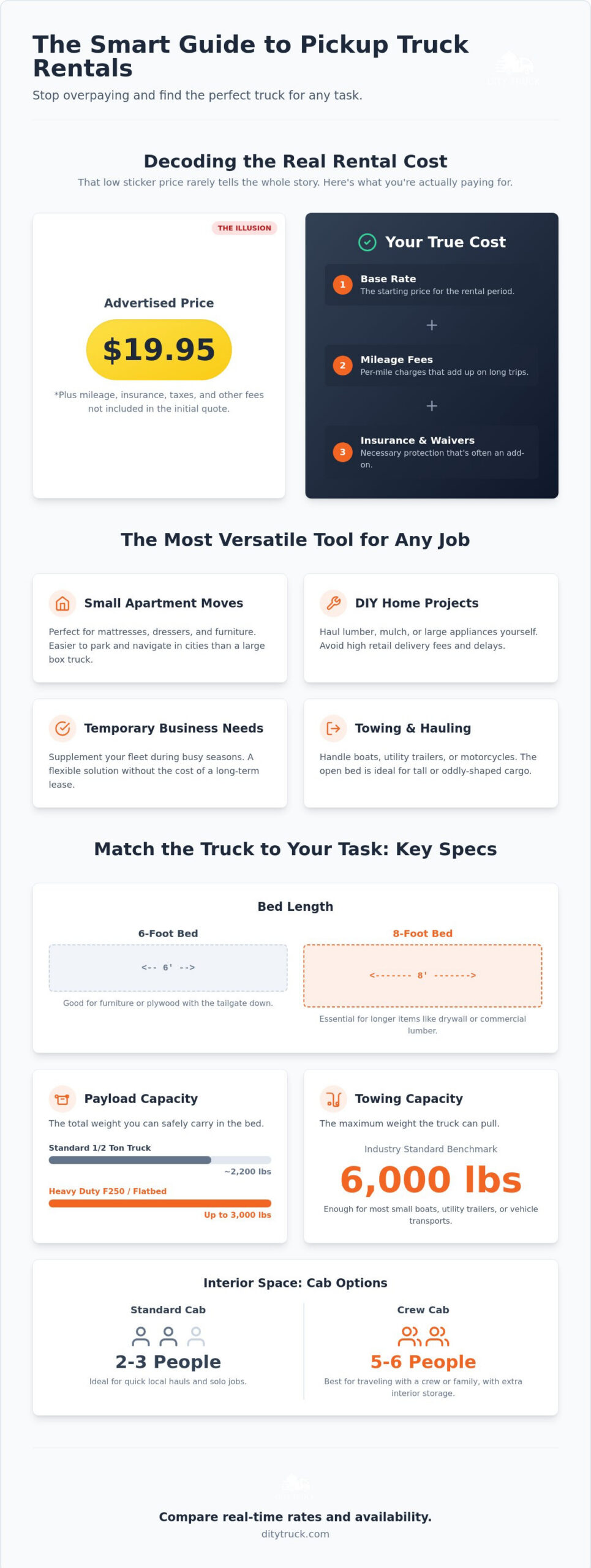
    That $19.95 sticker price on the side of a truck is almost never what you actually pay at checkout. Between hidden mileage fees and confusing insurance add-ons, securing a pickup truck rental can quickly turn into an expensive logistical headache. You’re likely tired of wasting hours jumping between tabs just to see if a truck is available or if it can actually handle your specific towing needs. It’s frustrating to realize the “cheap” option doesn’t even have the payload capacity required for the job.

    It’s time to stop overpaying for oversized box trucks and start getting exactly what you need. This guide shows you how to find the most affordable and capable truck for any task by comparing top national providers in seconds. You’ll get a clear look at 2026 rates, technical specs, and those sneaky fees that usually stay buried in the fine print. We’ll compare the latest offerings from major players like U-Haul, Home Depot, and Penske so you can secure a quick online reservation with total confidence.

    Key Takeaways

    • Match your cargo to the right bed size and payload capacity. This ensures you have enough space without overpaying for a box truck.
    • Calculate the true cost of a pickup truck rental by accounting for mileage fees and insurance. Avoid hidden charges on longer trips.
    • Compare top national providers to find the best fit for your specific task. Some favor local moves while others excel at towing.
    • Learn why pickups are the most versatile choice for landscaping and small apartment moves. They offer more flexibility than standard vans.
    • Use a comparison platform to view real-time rates and availability. Secure your reservation in seconds without checking multiple websites.

    Understanding Pickup Truck Rental: When and Why to Choose One

    A Pickup truck is the ultimate tool for local logistics. It bridges the gap between a standard car and a massive box truck. While cargo vans protect items from rain, they struggle with tall furniture or bulky landscaping materials. A pickup truck rental provides the vertical space you need for a refrigerator or a load of topsoil. It’s the most practical choice for small apartment moves. You get enough payload for your mattress and dresser without the stress of driving a vehicle that feels like a bus. It’s easier to navigate tight city streets and park in standard driveways.

    Efficiency is the primary driver for many renters in 2026. Light-duty trucks are projected to account for 100% of certain rental segments because they offer lower maintenance and fuel costs. If you’re moving a light load, a smaller truck saves you money at the pump. It’s also the perfect solution when your own truck is in the shop for repairs. You don’t have to cancel your weekend plans or delay a project. You can rent a reliable replacement and keep your momentum. It’s about maintaining your lifestyle or business operations without a single day of downtime.

    DIY Home Projects and Local Hauling

    Retail delivery fees can be surprisingly high. Avoiding these extra costs is easy when you handle the transport yourself. Use a pickup to haul lumber, mulch, or appliances safely. The open bed allows for odd-shaped items that simply won’t fit inside a van’s enclosed walls. You can secure your load with tie-downs and head home immediately. It’s a straightforward way to finish your home projects on your own schedule. You won’t have to wait around for a four-hour delivery window.

    Temporary Business and Commercial Needs

    Businesses often need extra wheels during busy months. Supplementing your fleet with a pickup truck rental avoids the burden of a long-term lease. You can project a professional image by using clean, late-model vehicles for client deliveries. Comparing commercial rates against personal ones ensures you’re getting the best deal for your company. It’s a flexible, low-risk way to manage growth. This approach lets you scale your operations up or down based on real-time demand without the heavy overhead of ownership.

    Technical Specifications: Towing Capacity, Payload, and Dimensions

    Choosing the right pickup truck rental requires looking past the brand name and diving into the raw numbers. Most providers offer two main bed lengths: 6-foot and 8-foot options. A 6-foot bed is standard for many 1/2 ton trucks. It provides enough room for furniture or plywood with the tailgate down. If you’re hauling longer items like drywall or commercial lumber, an 8-foot bed is essential to prevent overhang. Payload capacity is equally critical. This is the total weight you can safely carry in the bed. For example, a standard 8-foot pickup can typically handle about 2,200 lbs. Heavier duty flat-beds like the F250 can reach up to 3,000 lbs of payload capacity.

    Towing capacity is another vital metric. In the rental industry, 6,000 lbs has become the standard benchmark. This limit allows you to pull most small boats, utility trailers, or even a vehicle transport trailer. However, you must always verify the Gross Vehicle Weight Rating (GVWR) before hitting the road. The GVWR is the maximum weight of the vehicle plus all its cargo and passengers. Staying within these limits isn’t just about performance. It ensures compliance with FMCSA regulations for safe operation on public highways. Overloading a truck compromises its braking and steering. It turns a simple move into a serious hazard. If you want to compare real-time specs and availability, checking multiple providers at once is the fastest way to find a truck with the right limits.

    Towing Boats, Trailers, and Motorcycles

    Check your rental agreement for hitch requirements before you arrive at the lot. Most 1/2 ton rentals come with a 2-inch receiver. You’ll also need a compatible wiring harness for trailer lights. If you’re hauling motorcycles, focus on the tie-down points in the bed. High-quality trucks offer multiple anchor spots to keep your bike upright and secure. Always double-check that your specific rental allows for towing, as some providers restrict this on their base models.

    Interior Space and Crew Cab Options

    The cab configuration determines who and what can ride up front. A standard cab usually seats 2 to 3 people. This is fine for quick local hauls. If you’re traveling with a crew or family, look for a Crew Cab. These models seat 5 to 6 people comfortably. They also provide extra floor space behind the front seats. This is the best place for sensitive items like electronics or fragile tools that shouldn’t sit in an open bed. Modern rentals also feature comfort upgrades like Bluetooth and climate control to make multi-day trips more manageable.

    Pickup Truck Rental Guide: Compare Rates, Sizes, and Top Providers (2026)

    Comparing the Best Pickup Truck Rental Companies

    Finding the right pickup truck rental requires looking beyond the flashy advertisements. Every provider has a specific niche. Some major national chains are the household name for local tasks. They often offer a low base rate for in-town rentals. This is perfect for a quick cross-town haul. However, the cost to rent a moving truck can skyrocket if you ignore mileage. Fees typically add up for every mile you drive. For longer trips, these pennies turn into significant expenses. It’s often better for a two-hour job than a two-day journey.

    Business-grade rental agencies serve a different crowd. They specialize in durability and heavy-duty performance. You’ll find a wider range of 1/2 ton, 3/4 ton, and 1-ton pickups with these providers. These are ideal for heavy towing or commercial supplementation. Big-box home improvement stores offer a unique short-term service. It’s unbeatable for picking up a new appliance or a stack of plywood. You don’t have to deal with complex contracts. Just grab the keys and go. Other national competitors provide deep discounts for students or military members. While they offer pickups, they also suggest cargo vans as an alternative. Vans offer more protection from the weather. Pickups offer more versatility for height. It’s a trade-off based on your cargo and the forecast.

    Local vs. Long-Distance Availability

    Not every company supports one-way trips. Some national brands are generally more flexible with drop-off locations. Local retailers often require you to return the truck to the starting point. This makes them better for local loops. If you need to move across state lines, check out our One Way Truck Rentals for Moving: 2026 Comparison Guide. Rental availability also varies by geography. You’ll find certain providers in almost every rural town. Business-focused agencies are more common in urban hubs and industrial areas.

    The Pros and Cons of Each Provider

    Ease of booking is a major differentiator. Modern mobile apps allow for 24/7 pickup and drop-off. This is a huge time-saver for early morning projects. Traditional agencies usually require a face-to-face counter interaction. Maintenance standards also vary across brands. Top-tier companies are known for maintaining newer fleets. This means better fuel economy and fewer mechanical issues during your trip. For a deeper dive into these service models, read our Moving Truck Rental: The Complete 2026 Comparison & Booking Guide. Choosing the right partner ensures your job stays on track and under budget.

    Calculating the Real Cost: Base Rates, Mileage, and Insurance

    The advertised price for a pickup truck rental is just the starting line. Most people see a low daily rate and assume that is the final bill. It rarely is. The daily base rate only covers the vehicle sitting in your driveway. Once you turn the key, the actual expenses begin to stack up. You need to account for every mile, every gallon of gas, and every local tax before you sign the agreement. This transparency prevents a “bill shock” when you return the keys. Total clarity is the only way to stay under budget.

    The “Mileage Trap” is where most budgets fail. For a local 20-mile trip, a $0.99 per-mile fee adds roughly $20 to your total. On a 100-mile haul, that same fee adds nearly $100. This is why a low base rate can be deceptive. If you are driving a long distance, a provider with a higher base rate but unlimited mileage might actually be cheaper. Always calculate your estimated distance before booking. You can compare total costs across national brands instantly to see which pricing structure fits your route best.

    Fuel and environmental fees also impact the final invoice. You must return the truck with a full tank or face high per-gallon refueling charges. These convenience fees are significantly higher than local gas station prices. Additionally, many companies add an environmental fee of $1 to $5 per rental to cover fluid disposal and fleet maintenance. Local taxes vary by city and state. Do not be surprised if your final quote is 10 to 15 percent higher than the initial estimate once these regulatory costs are added.

    Understanding Rental Protection and Insurance

    Rental protection is a common point of confusion. Collision Damage Waivers (CDW) or Loss Damage Waivers (LDW) usually cost between $10 and $30 per day. Do not assume your personal auto insurance covers a rental truck. Many personal policies exclude commercial-grade vehicles or trucks used for moving. If you are towing a third-party trailer, you likely need additional liability coverage. Checking your policy beforehand saves you from paying for redundant protection at the counter. It provides peace of mind for a small daily fee.

    Hidden Fees and How to Avoid Them

    Late return penalties are strictly enforced to keep fleets moving. Some providers charge $100 for an extra day. Others charge by the hour. Always schedule a two-hour buffer to avoid these spikes. Cleaning fees are another surprise. If the truck bed is excessively dirty from mulch or construction debris, you will pay a detailing fee. If you realize a pickup is not enough space for your haul, check our guide on Box Truck Rental Prices: The 2026 Guide to Sizes, Rates & Savings to see if a larger vehicle offers better value for your specific job.

    How to Secure the Best Rate with DityTruck

    Finding a cheap pickup truck rental isn’t about luck. It’s about data. Prices fluctuate constantly based on local demand, seasonal peaks, and fleet availability. Checking one provider gives you a single price. Checking five different websites gives you a headache. DityTruck solves this by aggregating real-time rates into one streamlined interface. You see the total cost without the manual labor. It’s the shortest path from a logistics problem to a confirmed reservation. We act as your savvy consumer advocate, stripping away the complexity of price shopping.

    High demand means the best vehicles go fast. Since light-duty trucks are the most popular segment in the current market, availability for pickups can be tight during weekends or month-end moves. Booking in advance is your best defense against surge pricing. While last-minute rentals are possible, they often come with limited choices and higher daily fees. Securing your vehicle at least 7 to 10 days out ensures you get the payload and towing capacity you actually need. It provides the peace of mind that your project won’t be delayed by an empty lot.

    The Comparison Advantage

    DityTruck lets you see multiple national brands side-by-side. You can filter results by specific bed sizes or towing capabilities. This removes the guesswork. You won’t waste time on a site that doesn’t have a 3/4 ton pickup available for your trailer. One search replaces hours of manual research. You can compare local and long-distance options simultaneously. It’s a friction-free solution for a high-stakes task. You get the clarity you need to make a fast, confident decision.

    Final Steps to a Stress-Free Rental

    Before you drive off the lot, perform a quick but thorough inspection. Document any pre-existing scratches, dents, or stains in the truck bed with your phone camera. Confirm the drop-off location and the exact time the truck is due back. Verify the fuel level matches the paperwork. These small steps prevent disputes and hidden fees later. Once you’ve checked the boxes, you’re ready to hit the road. If you’re ready to find the best deal, you can Compare pickup truck rental rates now at DityTruck and finish your booking in minutes.

    Start Your Project with the Right Truck

    Securing a pickup truck rental shouldn’t be the hardest part of your day. You now have the tools to look past deceptive base rates and calculate the true cost of your move. Remember that bed dimensions and payload limits are just as critical as the price on the sticker. Choosing a vehicle that fits your cargo perfectly prevents unnecessary trips and saves you money on fuel. It’s about working smarter, not harder.

    Comparison is the only way to find real value in a crowded market. DityTruck lets you compare top national brands instantly with real-time availability across the US. You can view rates side-by-side with no hidden booking fees. This transparency puts you back in control of your logistics. It’s the shortest, most logical path between a problem and its resolution. Stop wasting time on multiple websites and get the clarity you deserve.

    Find the Lowest Pickup Truck Rental Rates Today. Your next haul is waiting. Let’s get moving.

    Frequently Asked Questions

    How much does it typically cost to rent a pickup truck for a day?

    Daily rates vary significantly based on the provider and the duration of your trip. Local in-town rentals often start with a low base rate of about $20. Full-day rates for larger national providers typically range from $130 to $250. These numbers exclude mileage, fuel, and insurance costs. Always compare total estimates rather than just the daily base price to find the best value for your project.

    Can I use a rental pickup truck to tow my own trailer or boat?

    Many national providers allow towing with a 1/2 ton pickup truck rental. U-Haul trucks, for example, can tow up to 6,000 pounds. However, some companies restrict towing on their base models or require specific insurance add-ons. Always check for a 2-inch receiver and verify the company’s specific towing policy before you book your reservation to ensure your trailer is compatible.

    Do I need a special license to drive a rental pickup truck?

    You don’t need a Commercial Driver’s License (CDL) for most personal truck rentals. A standard, valid driver’s license is sufficient for driving light-duty pickups and most box trucks used for household moves. Ensure your license is current and has not expired. The rental counter will verify your credentials and age before handing over the keys for any vehicle in their fleet.

    What is the average gas mileage for a rental pickup truck?

    Modern rental pickups usually achieve between 15 and 20 miles per gallon. This efficiency varies based on the payload weight and whether you’re towing a trailer. Fuel costs are a major factor in your total budget. Always return the truck with a full tank to avoid the high refueling fees that rental companies charge for convenience.

    Are one-way rentals available for pickup trucks?

    One-way rentals are available through major national chains like U-Haul, Penske, and Budget. These are ideal for long-distance moves where you don’t want to return the truck to the starting point. Prices for one-way trips are usually higher and include a set number of miles in the flat rate. Home Depot typically focuses on local, round-trip rentals for store-to-home hauling.

    Does my personal car insurance cover a rental pickup truck?

    Your personal auto insurance may not cover a commercial-sized rental vehicle. Many policies exclude trucks over a certain weight or those used specifically for moving. Check with your provider before declining the rental company’s coverage. Purchasing a Collision Damage Waiver (CDW) provides immediate protection and prevents your personal rates from rising if an accident occurs during your move.

    What is the minimum age to rent a pickup truck in the US?

    Most rental companies require drivers to be at least 21 years old. Some providers allow 18-year-olds to rent for specific local moves, but this often comes with additional “young driver” fees. You’ll need to present a valid driver’s license and a credit card in your name. These requirements ensure the driver meets the strict insurance standards for the rental fleet.

    How do mileage fees work for pickup truck rentals?

    Mileage fees are typically charged on a per-mile basis for local rentals. Rates often range from $0.59 to $1.29 per mile depending on the company and the day of the week. Long-distance contracts usually include a specific mileage allowance in the total price. If you exceed that limit, you’ll pay a set fee for every extra mile driven beyond the agreement.