
Renting a massive box truck for a studio apartment move is often a costly mistake. You don’t need a twenty-foot behemoth to transport a bed and some boxes, especially when a cargo van rental for small move tasks offers better fuel economy and easier parking. It’s natural to feel anxious about driving a large vehicle or getting blindsided by hidden insurance fees at the counter. You want a solution that fits your gear and your budget without the traditional rental friction.
Discover how to find the most efficient cargo van for your move while comparing the best national rates in seconds. This guide simplifies the process by stripping away the complexity of 2026 logistics. You’ll learn about the latest federal liability coverage mandates that are now included in every agreement at no extra charge. We also break down how to read the new one-page data privacy summaries so you know exactly what is being tracked during your trip. From verifying interior dimensions to navigating the latest young renter fee changes, we provide the clarity you need for a fast and confident booking experience.
Key Takeaways
- Choose a cargo van to maximize maneuverability and fuel savings during local relocations. It’s the most efficient way to handle furniture without the bulk of a full-sized truck.
- Compare standard and high-roof dimensions to guarantee your belongings fit. Selecting the right cargo van rental for small move projects prevents the stress of making multiple trips.
- Evaluate your inventory for items longer than nine feet or those requiring a loading ramp. This simple check helps you decide if a van or a small box truck is your best tool.
- Spot hidden mileage and refueling fees before you book. Knowing these extra costs upfront ensures the rate you see is the total price you actually pay.
- Use comparison tools to scan national rates in seconds. This approach strips away the complexity of logistics and puts the lowest prices at your fingertips.
Why a Cargo Van is the Smart Choice for Small Moves
Selecting a cargo van rental for small move tasks is about finding the perfect balance between volume and agility. You don’t need a massive commercial truck to move a studio apartment. You need a tool that handles like a family vehicle but carries like a pro. These vans offer enough floor space for your essentials without the intimidation factor of a 15-foot box truck. They are specifically designed for “micro-moves” where efficiency is the priority. Whether you’re upgrading a single room or clearing out a college dorm, the cargo van is your most logical path. It strips away the anxiety of navigating narrow streets while keeping your costs low.
What Actually Fits in a Cargo Van?
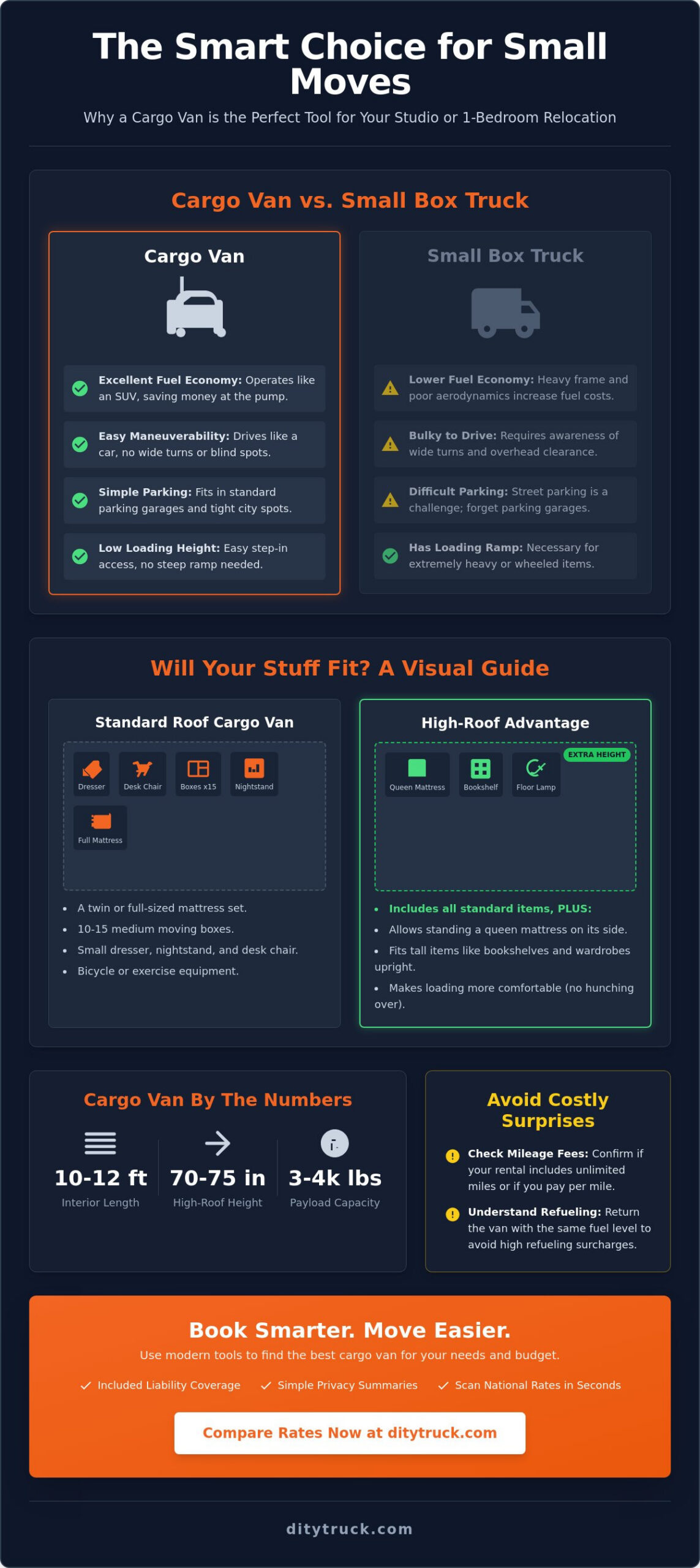
Understanding the capacity of different types of vans is the first step toward a friction-free move. You want to confirm your inventory fits before you arrive at the rental counter. A standard cargo van typically accommodates:
- A twin or full-sized mattress set.
- Approximately 10 to 15 medium-sized moving boxes.
- A small dresser, a nightstand, and a desk chair.
- A bicycle or a few pieces of exercise equipment.
If you have a queen-sized mattress, you should specifically look for a high-roof model. This extra vertical space allows you to stand the mattress on its side; this leaves more floor room for your boxes. Most of these vehicles include built-in tie-down points along the interior walls. Use these to secure fragile items like mirrors or televisions. It’s a simple step that prevents damage during sudden stops.
Fuel Efficiency and Driving Ease
The financial benefit of choosing a cargo van over a box truck is immediate. A 10-foot box truck often struggles with fuel economy due to its heavy frame and poor aerodynamics. In contrast, a cargo van operates much more like a standard SUV. You’ll spend significantly less at the pump, especially on local trips with frequent stops. The savings add up quickly when you’re making multiple runs across town.
Driving stress is also lower. The “van-like” handling makes lane changes and turns feel natural. You won’t need to learn how to use massive commercial side-view mirrors or account for a wide turning radius. You don’t have to worry about overhead clearance in most residential areas. Many cargo vans even fit inside standard parking garages. This is a massive advantage in dense city centers where street parking is a gamble. It’s the shortest path between your old front door and your new one.
Comparing Cargo Van Dimensions and Capabilities
Choosing the right vehicle isn’t just about the daily rate. It’s about the dimensions. A cargo van rental for small move projects succeeds when you match your inventory to the vehicle’s interior volume. Most standard cargo vans offer an interior length between 10 and 12 feet. This is usually enough space for a standard three-person sofa and several stacks of boxes. You should also consider the payload capacity. Most modern vans handle between 3,000 and 4,000 lbs. Since furniture is often bulky but not incredibly heavy, you’ll likely run out of floor space long before you hit the weight limit. This capacity ensures the vehicle remains stable and safe even when fully loaded with your belongings.
Loading height is another factor that often gets overlooked. Unlike box trucks, cargo vans sit much closer to the pavement. You don’t need to navigate a steep, narrow ramp while carrying a heavy dresser. You simply step into the back. This lower entry point speeds up the process and reduces physical strain. If you want to see how different brands compare on these specific measurements, you can view real-time specs and rates to find the best fit for your gear.
The High-Roof Advantage for Furniture
Standard vans are great, but standing items often require more vertical clearance. High-roof models provide an interior standing height of approximately 70 to 75 inches. This is a game-changer for tall bookshelves, floor lamps, or wardrobes that shouldn’t be laid flat. It also makes the loading process much more comfortable. You can walk around inside the van without hunching over. This extra height is highly sought after; check availability at your local rental hub early in the planning process. Some national brands keep fewer high-roof models in their fleet compared to standard versions.
Compact Cargo Vans for City Deliveries
Sometimes a full-sized van is still too much. If you’re only moving a few electronics, some luggage, and twenty small boxes, a compact van like the Ford Transit Connect is the most efficient tool. These vehicles are built for dense urban environments where every inch of parking space matters. They offer incredible fuel economy and fit into almost any parking structure. However, don’t expect to fit a mattress or a large dining table inside. Always verify the specific model during your booking to ensure a cargo van rental for small move tasks doesn’t leave your largest items on the sidewalk. Precision in your choice leads to a faster, cheaper move.
Cargo Van vs. Small Box Truck: Which One Do You Need?
Deciding between a cargo van rental for small move projects and a 10-foot box truck comes down to three factors: length, lifting, and location. Start by measuring your largest piece of furniture. If your sofa exceeds nine feet in length, it likely won’t fit in a standard van. You shouldn’t try to force it. This leads to damage or an unsecured load. Also, consider your physical strength. Cargo vans lack loading ramps. You must lift every item directly into the back. If you’re moving heavy appliances or solid wood furniture, the ramp on a box truck is a safer choice for your back. It’s about choosing the tool that protects your body and your belongings.
Your driving route matters just as much as your gear. Box trucks are taller and wider. They are often prohibited from certain parkways and may not clear low-hanging trees or old apartment awnings. A cargo van navigates narrow alleys and tight city corners with ease. It’s the smart choice for urban environments where parking a box truck is a logistical nightmare. You can pull right up to the curb or into a driveway without blocking the entire street. This accessibility saves you time and reduces the distance you have to carry heavy boxes.
When to Upgrade to a 10-Foot Box Truck
The “sofa rule” is your best guide. If your couch is too long for the van’s interior floor, upgrade immediately. Don’t risk driving with the back doors open or items hanging out. Heavy appliances like washers or refrigerators are also easier to manage with a box truck. The integrated ramp saves your spine and makes the loading process much faster. If you realize your inventory is too large for a van, check out our moving truck rental guide for larger options. It helps you determine exactly when more cubic footage becomes a necessity rather than a luxury.
Cost Implications of the Size Choice
Vans usually offer the lowest entry price for any motorized moving vehicle. Their daily base rates are consistently lower than those of box trucks. You’ll also see a difference in insurance costs. Many personal auto insurance policies extend coverage to cargo vans because they are classified as light-duty vehicles. Box trucks often require specialized, more expensive rental insurance. As of 2026, federal mandates require state-minimum liability to be included in all agreements at no extra charge, but you still need to consider damage waivers. A van’s superior fuel economy means you pay less at the pump on top of the per-mile fee. It’s the most cost-effective path for a light load when every dollar counts.
The 2026 Guide to Booking the Best Cargo Van Rate
Avoid the Single-Site Trap. Prices for a cargo van rental for small move projects fluctuate constantly across different national brands. One provider might have a surplus of vans in your neighborhood while another is completely sold out. This local imbalance creates massive price gaps for the same vehicle type. Comparison is your only tool for financial honesty. You need to see the total cost before you provide any credit card details. Seeing every available option at once ensures you don’t overpay for a simple task.
Timing your reservation is the most effective way to slash your bill. Booking your rental for a Tuesday, Wednesday, or Thursday often results in significantly lower base rates. Rental hubs are usually crowded on weekends; this drives prices up. If your schedule allows a mid-week transition, you’ll find more vehicle choices and shorter lines. Always watch for hidden fees that can inflate a quote. Environmental fees, refueling surcharges, and vehicle licensing recovery fees are common industry standards. You can compare all national cargo van rates in seconds to see exactly what you’ll pay at the counter.
Understanding Mileage and Insurance
Pricing models usually split into flat rates or per-mile charges. Local moves often use a low base rate plus a fee for every mile driven. These charges in 2026 typically range from $0.59 to $1.99 per mile. Before you buy extra protection, verify your credit card benefits. Many premium cards offer secondary coverage for cargo vans. This can save you $15 to $40 per day on damage waivers. One-way moves use a different structure; they often combine costs into a single total price rather than a daily rate plus mileage.
How to Compare National Providers Fast
Checking every major brand website individually is a poor use of your time. Every site uses different steps and hidden menus to show the final price. The most efficient method is viewing every available option on one screen. This helps you spot the best value without managing five different browser tabs. If you’re moving across state lines, the logistics change. Review our one way truck rentals guide to see how pricing shifts for long-distance trips. Modern booking should be about speed and clarity.
Why DityTruck is Your Best Tool for a Stress-Free Move
DityTruck exists to solve the complexity of modern moving logistics. We act as your savvy consumer advocate by performing the heavy lifting behind the scenes. Instead of opening multiple tabs and manually comparing quotes, you get instant access to aggregated real-time data. This ensures you find the most efficient cargo van rental for small move needs without the traditional stress. We prioritize your time and your budget by stripping away the noise. You see the inventory. You see the rates. You make a decision based on clarity. It is the most direct path to a successful relocation.
Financial honesty is our core principle. The rental industry is often plagued by hidden fees and shifting prices. We combat this by providing transparent pricing from the start. You won’t face surprises at the rental counter because the data is verified and current. This level of transparency offers immediate relief for a high-stakes task. It transforms a confusing process into a simple, logical progression. You are no longer guessing if you got the best deal; you are confirming it. Our platform ensures that the rate you see is the rate you can trust. We don’t believe in fine-print traps.
Efficiency is the primary driver of our platform. Our streamlined interface allows you to find, compare, and reserve your vehicle in under three minutes. This speed mirrors the physical momentum of your move. We move as fast as you do. By consolidating the best national providers into one view, we eliminate the friction of traditional booking. You skip the manual research; you get the results instantly. We remove the hurdles so you can focus on your new home. It is about confident simplicity in a crowded marketplace.
The Smart Assistant for Logistics
Our platform functions as a smart assistant that never stops working for you. The process follows a clear action-result flow. You enter your moving details; we scan national databases. You receive the lowest aggregated rates; you save money instantly. It is a friction-free solution designed for the modern renter. We replace confusion with a grounded, helpful experience. DityTruck is the shortest path between a moving problem and its resolution. We handle the data so you can handle the boxes.
Ready to Book Your Cargo Van?
You’ve done the research. You understand the dimensions, the fuel savings, and the 2026 mandated liability requirements. Now is the time to lock in your rate before availability shifts. Our reservation process is designed to be quick and simple. Every step is logical and direct. Experience the relief of a confirmed booking with a provider you trust. There is no need for further searching or second-guessing. Compare cargo van rates and book your rental today.
Get Moving with Confidence
You now possess the roadmap for a streamlined relocation. Selecting a cargo van rental for small move tasks means you’ve chosen agility over unnecessary bulk. By utilizing the insights on vehicle dimensions and strategic booking times, you’ve already bypassed the most common moving hurdles. You’re no longer guessing about payload capacities or hidden mileage fees. You’re making a data-driven decision that protects both your belongings and your budget. The 2026 moving landscape is complex, but you’ve simplified it through careful research.
Don’t let the noise of the rental market stall your progress. DityTruck provides access to real-time rates from major national providers in seconds. Our platform offers comprehensive coverage across the United States with a focus on total transparency and no hidden booking fees. This is the most direct path to a friction-free reservation. Compare Real-Time Cargo Van Rates and Save on Your Move today. Your transition to a new space should be defined by relief, not stress. You’re ready to lock in your rate and start your journey.
Frequently Asked Questions
How much does it cost to rent a cargo van for a day?
Typical local rates involve a small daily base fee combined with a per-mile charge. Industry data shows mileage fees often range from $0.59 to $1.99 depending on the rental company and location. These costs change frequently based on demand and vehicle availability in your specific city. You should also account for fuel expenses and any supplemental insurance coverage you choose at the counter.
Do I need a special license to drive a rental cargo van?
You only need a standard, valid driver’s license to rent and operate a cargo van. These vehicles are classified for light-duty use and don’t require a commercial driver’s license or special certifications. Just ensure you meet the provider’s age requirements. Renters under 25 may face additional daily fees that vary significantly by state, particularly in New York where fees recently increased.
Will a queen-sized mattress fit inside a standard cargo van?
A queen-sized mattress fits inside most standard cargo vans if the interior is clear of other large furniture. However, choosing a high-roof model for a cargo van rental for small move tasks is the most efficient choice. The extra vertical space allows you to stand the mattress on its side. This clears valuable floor room for your boxes and prevents you from having to stack heavy items on top of your bed.
Is insurance included in the cargo van rental price?
As of January 1, 2026, all rental agreements must include state-minimum liability coverage at no extra charge due to a federal mandate. While this provides basic protection, it often doesn’t cover damage to the rental vehicle itself. Supplemental damage waivers typically cost between $15 and $40 per day. You should check if your personal auto insurance or credit card provides secondary coverage before paying for these extras.
Can I rent a cargo van for a one-way move?
One-way rentals are widely available from national providers, though they use a different pricing structure than local returns. Industry estimates for a cross-country trip, such as California to North Carolina, can reach around $3,000 for a cargo van. These moves are usually quoted as a flat rate rather than a daily fee plus mileage. This pricing model provides more certainty for long-distance logistics and budget planning.
What is the difference between a cargo van and a high-roof van?
The primary difference is the interior standing height and total cubic volume. Standard vans have a lower ceiling that requires most adults to crouch while loading. High-roof models offer approximately 70 to 75 inches of vertical space, allowing you to walk upright inside the vehicle. This extra height is critical for transporting tall items like floor lamps or wardrobes that cannot be laid flat during transit.
Are cargo vans more fuel-efficient than box trucks?
Cargo vans are much more fuel-efficient than even the smallest box trucks because they are lighter and more aerodynamic. They operate like a standard passenger SUV, which translates to lower costs at the pump. This efficiency is a major advantage for local moves involving multiple trips or heavy stop-and-go traffic. You’ll save money on fuel while enjoying a vehicle that is much easier to park and maneuver.
How far in advance should I book my van for a weekend move?
You should book your vehicle at least two to three weeks in advance to guarantee availability for a weekend move. Weekends are the peak period for rental hubs and inventory often sells out quickly. Securing a cargo van rental for small move projects early ensures you get the specific high-roof or standard model you need. If your schedule is flexible, booking mid-week can often lead to better rates and more vehicle choices.
Leave a Reply