Tag: 2026 moving guide

  • Moving Truck Rental with Liftgate: The 2026 Comparison Guide

    Moving Truck Rental with Liftgate: The 2026 Comparison Guide

    You’re standing at the base of a steep loading ramp with a 400-pound refrigerator, wondering if your spine can handle the climb. It is the moment every DIY mover dreads. Choosing a moving truck rental with liftgate isn’t just a luxury; it is a safety strategy that keeps you out of the doctor’s office. You want the savings of a self-move without the physical toll of a professional powerlifter. We understand the frustration of calling five different rental lots only to find they don’t actually have the equipment you need in stock.

    This guide simplifies your search for the right hydraulic help. You’ll learn which national providers actually stock liftgates for residential customers and how to navigate weight requirements without needing a commercial driver’s license. We’ve broken down the 2026 inventory landscape to help you compare rates and secure a truck that does the heavy lifting for you. Stop guessing about availability and start planning a move that protects your back and your budget. We’ve compiled everything you need to find the best equipment at the lowest price.

    Key Takeaways

    • Eliminate the physical strain of steep loading ramps. Learn how a hydraulic liftgate does the heavy lifting for you.
    • Navigate the 2026 rental market with ease. Find out which providers offer 26-foot trucks you can drive without a CDL.
    • Compare the true costs of a moving truck rental with liftgate against traditional ramp models to maximize your budget.
    • Protect your crew and your cargo. Master essential safety checks and the “Crush Zone” concept before operating the machinery.
    • Skip the endless phone calls. Use smart aggregation tools to find real-time liftgate inventory and the best rates in your area.

    Why a Moving Truck Rental with Liftgate is a Game-Changer

    A moving truck rental with liftgate is the ultimate shortcut for heavy logistics. It is a hydraulic platform that moves items from the pavement to the truck bed at the touch of a button. If you are curious about the technical history or global terminology of these systems, you can read more about what a tail lift is on Wikipedia. This mechanical assist replaces the traditional loading ramp, which often feels like a high-wire act when you are pushing a loaded dolly. By choosing a truck with this equipment, you eliminate the incline entirely.

    Ramps are dangerous. They are steep. They get slippery in the rain. A liftgate removes these variables. You roll your heaviest items onto the platform, press a lever, and watch the cargo rise level with the deck. It is about control. You aren’t fighting gravity; you’re letting physics work for you. This efficiency speeds up your loading time significantly, especially when you have a high volume of heavy boxes or equipment.

    Certain items aren’t just heavy; they’re impossible to move safely on a ramp. Think about gun safes, industrial-grade appliances, or palletized furniture. These objects require a level surface during the entire loading process. The “Back-Saving ROI” is simple math. A truck with a liftgate might cost a few extra dollars per day. Compare that to the thousands you’ll spend on physical therapy or lost wages if you strain a disc. It is the cheapest insurance policy you can buy for your body during a move.

    Who Needs a Liftgate Truck?

    • Residential Movers: If you have “impossible” items like a grand piano, a cast-iron clawfoot tub, or a massive tool chest, a ramp is a liability.
    • Small Businesses: Companies moving warehouse inventory without a dedicated loading dock can turn any parking lot into a functional shipping bay.
    • Solo Movers: If you are working alone or with limited physical help, the hydraulic system acts as your extra set of hands. It makes heavy lifting a one-person job.

    Liftgate Capacity vs. Payload Capacity

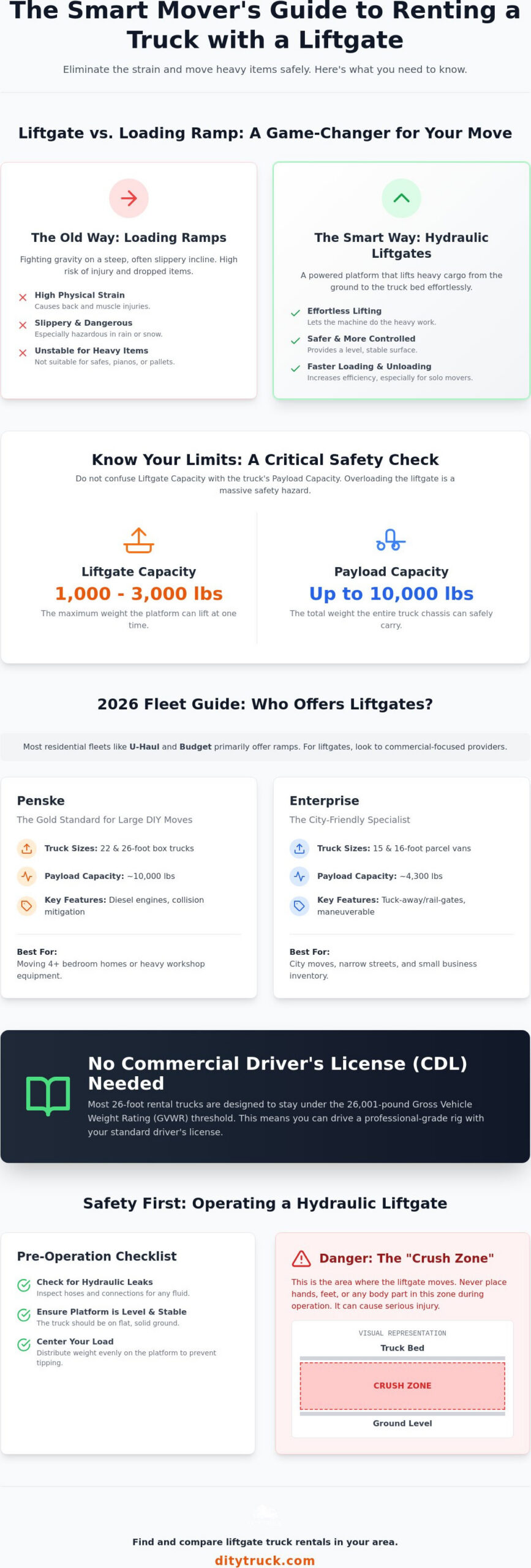
    Don’t confuse these two numbers. A liftgate usually handles between 1,000 and 3,000 pounds. Payload capacity is the total weight the truck’s chassis can safely carry. If you try to lift a 4,000-pound machine on a 2,000-pound gate, you risk immediate mechanical failure. This isn’t just a repair bill. It is a massive safety hazard that could void your insurance and cause serious injury. Always check the specific gate rating before you start loading your moving truck rental with liftgate to ensure your cargo stays within safe limits.

    Comparing National Fleets: Who Offers Liftgates?

    If you are searching for a moving truck rental with liftgate, you’ll quickly realize that not all fleets are created equal. Most DIY movers start their search with U-Haul or Budget because of their visibility. However, these brands focus on ramps for their residential fleets. If you need a mechanical lift, you’ll likely need to look at commercial-focused providers. Penske and Enterprise dominate this specialized space by offering professional-grade equipment to residential customers.

    You don’t need a Commercial Driver’s License (CDL) to operate most 26-foot trucks. These vehicles are designed to stay under the 26,001-pound Gross Vehicle Weight Rating (GVWR) threshold. This allows you to drive a massive truck with professional-grade equipment using a standard driver’s license. It is a huge win for those moving a four-bedroom house or heavy workshop equipment. You get the power of a professional rig without the regulatory hurdles.

    Penske’s Medium-Duty Options

    Penske is the gold standard for large DIY moves. Their 22 and 26-foot box trucks are frequently equipped with hydraulic gates. These trucks offer roughly 1,700 cubic feet of space and a 10,000-pound payload capacity. Many models feature diesel engines for better fuel efficiency and collision mitigation technology for added safety. Some even feature walk-ramps alongside the moving truck rental with liftgate, giving you two ways to load depending on the item’s weight. To see which specific locations have these units available, you can compare real-time inventory and rates across the national network.

    Enterprise Commercial Straight Trucks

    Enterprise takes a different approach by excelling in the 15 to 16-foot “parcel van” category. These are perfect for city moves where a 26-foot truck is too bulky for narrow streets. Despite their smaller size, these trucks often boast a 4,300-pound payload capacity. You’ll encounter two main gate styles: “tuck-away” gates that fold under the chassis and “rail-gates” that remain vertical against the rear. Understanding these differences is key to Liftgate Safety for Carriers and residential users alike. Enterprise is often the best choice for dense, heavy commercial loads that don’t require the massive volume of a box truck.

    Budget and U-Haul rarely offer liftgates on their standard consumer trucks. You might find them in their commercial divisions, but availability for a one-way residential move is limited. If your move requires a mechanical lift, Penske or Enterprise are your most reliable bets. Always confirm the equipment at the time of booking to avoid a ramp-only surprise on moving day.
    Moving Truck Rental with Liftgate: The 2026 Comparison Guide

    Liftgate vs. Loading Ramp: Which is Right for Your Move?

    Choosing between a ramp and a hydraulic platform is a decision about physical risk and logistical speed. Most standard rentals come with a pull-out aluminum ramp. This is fine for a few boxes. It is not fine for a 500 pound lathe or a solid oak armoire. The “Steepness Factor” is the most overlooked safety risk in DIY moving. A ramp creates a 20 to 30 degree incline. Pushing a heavy dolly up that slope requires immense core strength. If the ramp is wet from a morning drizzle, your traction disappears. A moving truck rental with liftgate eliminates the incline entirely. You stay on level ground.

    Cost is the secondary factor. A truck with a mechanical lift usually carries a higher daily base rate. You are paying for the maintenance and complexity of the hydraulic system. You must weigh this against the cost of hiring extra helpers. If the liftgate allows you to move heavy items solo or with one friend, the equipment pays for itself in labor savings. It is a trade-off between equipment fees and human effort.

    Consider your parking environment. Ramps require about 10 to 12 feet of clearance behind the truck to reach a safe angle. Liftgates are more compact in their footprint but still require a flat “landing zone” to operate. If you are parking on a steep hill, a liftgate might not be able to level out properly. Space and slope dictate your equipment choice as much as the weight of your furniture does.

    When a Ramp is Sufficient

    A ramp is often the faster choice for a house full of medium sized boxes. It allows for a continuous flow of people moving in and out of the truck. If your inventory consists of standard plastic bins, light mattresses, and disassembled furniture, the ramp is sufficient. It is also the better option for tight urban parking where you don’t have the luxury of extra clearance for the platform to drop. If you have three or more able-bodied helpers, the physical load is distributed enough that a ramp is manageable.

    When a Liftgate is Mandatory

    Some items make a moving truck rental with liftgate a non-negotiable requirement. Any single object over 400 pounds is a candidate for a mechanical lift. This includes gun safes, commercial refrigerators, and cast-iron machinery. If you are loading from a street with no curb access, the liftgate bridges the gap between the asphalt and the truck bed effortlessly. It is also the only way to utilize a pallet jack. You cannot roll a pallet jack up a standard moving ramp. If your move involves palletized goods, the liftgate is your only viable path forward.

    Safety and Operation: How to Use a Hydraulic Liftgate

    Operating a hydraulic system is straightforward, but it demands your full attention. These are powerful mechanical tools. They don’t have sensors to detect a stray hand or foot. Before you touch the controls, ensure the truck is parked on level ground. This is non-negotiable for safety. If the truck is at an angle, the hydraulic fluid may not distribute evenly. This causes the platform to jerk or tilt. Always set the emergency brake before beginning your loading process. Level ground is mandatory. Set the brake. Don’t skip these steps.

    Respect the “Crush Zone.” This is the area where the heavy steel platform meets the truck frame or the pavement. A common injury occurs when a user stands too close and the gate catches the toe of their boot. Keep your feet well back from the edge. Never reach under the platform while it is in motion to adjust a load. If something shifts, stop the gate completely before intervening. Safety is about maintaining a perimeter between your body and the moving parts. They don’t have sensors. You are the safety mechanism.

    Weight distribution is the key to mechanical longevity. Always center your cargo on the platform. If you place a heavy item on one corner, the hydraulic pistons experience uneven pressure. This can lead to a permanent tilt or a blown seal. During rain or ice, treat the metal surface like a skating rink. Steel becomes incredibly slick when wet. Use sand or grip mats if necessary. Always wear boots with high-traction rubber soles to prevent slips while you’re positioning cargo on your moving truck rental with liftgate.

    Step-by-Step Operation Guide

    • Step 1: Deploy. For a tuck-away gate, unlatch the safety hook and carefully unfold the platform. For a rail gate, ensure the vertical tracks are clear before lowering it from the travel position.
    • Step 2: Toggle. Use the up/down switch while standing to the side of the vehicle. Maintain a clear line of sight to the platform at all times.
    • Step 3: Secure. Once the item is on the gate, use wheel chocks for dollies or straps for upright items. Never assume the cargo will stay still during the rise to the deck.
    • Step 4: Stow. After loading, fold the gate back into its housing. Ensure the locking pins are fully engaged. A loose gate is a major road hazard.

    Common Pitfalls to Avoid

    Never ride the liftgate. It is designed for cargo, not people. Using it as a personnel elevator is a leading cause of rental-related accidents. Avoid “dead-heading” the motor. This happens when you continue to hold the “up” button after the gate has already reached the truck bed. You’ll hear the motor strain; release the switch immediately to prevent the pump from burning out. Finally, check your dashboard. Most modern rentals have a warning light that stays on if the gate isn’t properly stowed. Don’t put the truck in gear until that light is off.

    Knowing how to use the equipment keeps your move on track and your body safe. If you haven’t secured your vehicle yet, you can compare rates and equipment availability to find a truck that fits your needs.

    How to Find the Best Rates on Liftgate Truck Rentals

    Finding a moving truck rental with liftgate at a fair price requires a different strategy than booking a standard cargo van. Most major rental websites prioritize their residential ramp-only inventory. Specialized trucks with hydraulic lifts are often tucked away in commercial divisions. If you only search the consumer-facing portals, you’ll see “unavailable” or “no trucks found.” This doesn’t mean the equipment isn’t there. It just means it’s hidden behind a commercial paywall that most DIY movers don’t know how to access.

    You want to avoid the trap of calling ten different lots to check availability. Inventory for specialized equipment changes by the hour. A truck that was available in a commercial fleet this morning might be booked by a local contractor by noon. To get the best rate, you need a bird’s-eye view of every fleet in your area simultaneously. This transparency allows you to spot price gaps between brands that aren’t obvious when looking at individual sites.

    Using DityTruck for Comparison

    Efficiency is everything when you’re planning a move. Instead of opening twenty tabs, you can use DityTruck to aggregate specialized equipment rates in one place. This tool acts as your smart assistant. It filters out the noise and shows you which brands actually have liftgate inventory in your zip code. For a broader look at the market, check out our moving truck rental comparison guide. Focus your search on trucks 15 feet and larger. Smaller units rarely come with hydraulic platforms. Using a comparison engine ensures you don’t overpay for a feature that should be saving you money, not draining it.

    Booking Tips for 2026

    Timing is your best leverage for lower rates. Rental prices fluctuate based on demand. Mid-week and mid-month dates are significantly cheaper than weekends or the first of the month. Because liftgate trucks are in lower supply than standard box trucks, you should book at least three weeks in advance. Don’t assume you aren’t eligible for commercial rates. Many providers offer business pricing to anyone moving heavy equipment, even for personal use. You can review box truck rental prices to see how base costs compare across different sizes before you commit to a specific model.

    Verification is the final, critical step. Once you’ve found a competitive rate for a moving truck rental with liftgate, call the local pickup lot. Confirm that the specific unit assigned to your reservation has the hydraulic gate. Mistakes happen in national booking systems. A five-minute phone call prevents a massive headache on moving morning. Ask the local agent if the gate is a tuck-away or rail-style so you can plan your parking clearance accordingly. This extra layer of transparency ensures your move starts without friction.

    Take the Strain Out of Your 2026 Move

    Your move doesn’t have to be a test of physical endurance. Securing a moving truck rental with liftgate turns a dangerous loading ramp into a simple, hydraulic process. You’ve seen how the right equipment protects your body and your most valuable items. By looking beyond standard residential fleets and into commercial-grade options, you gain access to the power and safety your project deserves. The 2026 market offers more transparency than ever before. You just need the right tool to find it.

    Don’t waste hours calling local lots or navigating confusing booking portals. You can access national commercial and residential fleets with real-time price transparency. We’ve stripped away the complexity so you can see exactly what is available in your area. There are no hidden booking fees; just straightforward data to help you make a smart decision. Compare Liftgate Truck Rental Rates Now and take the first step toward a friction-free moving day. You’ve got the plan. Now get the truck that does the heavy lifting for you. You’ve worked hard to organize this transition, and you deserve a logistics partner that respects your time and your budget.

    Frequently Asked Questions

    Do I need a CDL to rent a 26-foot truck with a liftgate?

    No. You don’t need a Commercial Driver’s License for most 26-foot rentals. These trucks are specifically rated under the 26,001-pound threshold. This allows residential movers to operate heavy equipment with a standard driver’s license. Always verify the Gross Vehicle Weight Rating on your specific rental agreement. It ensures you stay within legal limits for non-commercial use.

    Which moving truck companies have liftgates on their trucks?

    Penske and Enterprise are the primary national providers for this equipment. Penske offers hydraulic lifts on their 22-foot and 26-foot medium-duty trucks. Enterprise provides them on 15-foot parcel vans and larger straight trucks. Most other brands focus on ramps for their residential fleets. If you need a moving truck rental with liftgate, start your search with these two providers.

    How much extra does it cost to rent a truck with a liftgate?

    Expect a higher daily base rate compared to trucks with standard ramps. The added cost reflects the maintenance and complexity of the hydraulic system. Prices fluctuate based on your location and the time of year. While the equipment fee is higher, it often offsets the cost of hiring professional movers for heavy items. It’s a trade-off between equipment cost and manual labor.

    Can I use a pallet jack on a rental truck liftgate?

    Yes. A pallet jack is compatible with most liftgates, provided the total weight stays within the platform’s capacity. This is the only way to move palletized cargo into a truck without a loading dock. Ensure the platform is level with the ground before rolling the jack on. Use the gate’s safety chocks to prevent the pallet from rolling during the lifting process.

    What is the weight limit for a standard rental truck liftgate?

    Most rental liftgates handle between 1,000 and 3,000 pounds. You can find the exact limit printed on a safety decal near the operating switch. Never guess the weight of your cargo. Exceeding this limit can cause the hydraulic seals to fail instantly. This creates a dangerous situation for both the operator and the cargo. Always stay well under the maximum rating for safety.

    Are liftgates available on small 10-foot or 12-foot rental trucks?

    Rarely. Most companies reserve hydraulic lifts for trucks 15 feet and larger. Small 10-foot trucks usually feature a low deck height for easier step-in loading. If you need a smaller vehicle with a mechanical lift, look at Enterprise’s 15-foot parcel vans. They offer a compact footprint with the power of a professional gate. Most standard DIY fleets won’t have this option for small trucks.

    What should I do if the hydraulic liftgate gets stuck?

    Stop the motor immediately. Check the rails and the area under the platform for physical obstructions or debris. If the gate moves slowly, the truck’s battery might be low; try running the engine while operating the lift. If it remains stuck, don’t attempt a DIY repair. Call the rental provider’s 24/7 roadside assistance. They’ll send a technician to handle the high-pressure hydraulic system safely.

    Does U-Haul rent trucks with liftgates for residential moves?

    Generally, no. U-Haul prioritizes “Low Decks” and pull-out ramps to make loading easier for the average customer. Their standard residential fleet does not include liftgates. You might find them in their commercial division, but availability for a one-way move is extremely limited. For a moving truck rental with liftgate, you’ll have better success checking Penske or Enterprise inventory through a comparison tool.

  • Cross Country Moving Truck Rental Deals: The 2026 Comparison Guide

    Cross Country Moving Truck Rental Deals: The 2026 Comparison Guide

    The cheapest quote on a rental website is almost never the final price you pay at the drop-off location. It’s a frustrating reality for anyone trying to secure cross country moving truck rental deals while managing a tight budget. You’ve likely spent hours toggling between tabs, only to find that mileage fees and environmental surcharges change the math every time you refresh. We know that finding a reliable truck shouldn’t feel like a gamble.

    We agree that transparency is the only way to move. You deserve a locked-in rate and a vehicle that won’t leave you stranded on the side of the interstate. This 2026 comparison guide promises to find you the absolute lowest rates by analyzing real-time deals across every major provider in one place. We’ll preview how to navigate one-way versus round-trip value, highlight specific 2026 promotional codes like Penske’s SUNNY26, and expose the surprise fees that usually hide in the fine print. It’s time to get your move started with total clarity and confidence.

    Key Takeaways

    • Understand why standard daily rates don’t apply to state-to-state moves. Learn to calculate the base, mileage, and fee structure to avoid sticker shock at the counter.
    • Decode the “unlimited mileage” myth. We break down how different providers structure their long-distance fees so you can choose the most cost-effective option for your specific route.
    • Find the absolute lowest cross country moving truck rental deals by comparing real-time inventory in one place. Use live data to secure a locked-in rate before you hit the road.
    • Identify the “Golden Window” for booking your truck. Strategic timing helps you avoid seasonal price hikes and surge pricing that often doubles the cost of summer moves.
    • Simplify the booking process with a transparent comparison of major providers. Focus on total value and vehicle reliability rather than just the initial sticker price.

    The Reality of Cross Country Moving Truck Rental Deals in 2026

    Moving across state lines in 2026 requires more than a map and a driver’s license. It requires a strategy to navigate the complex world of cross country moving truck rental deals. For rental providers, “cross-country” refers specifically to one-way agreements. You pick up a truck in one city and drop it off in another. This is a fundamentally different product than the local rental you use for a quick furniture pickup across town.

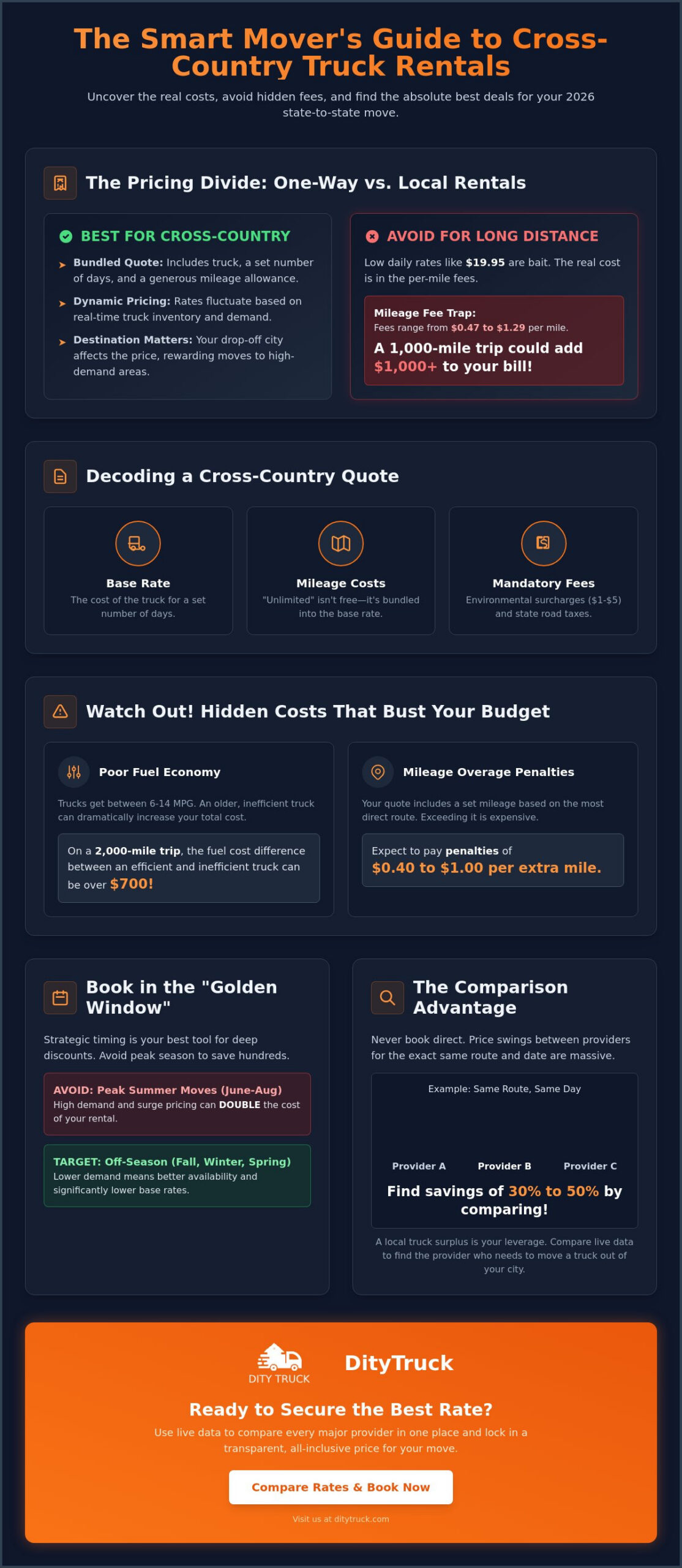
    Standard daily rates do not apply to these long-distance trips. For local moves, you might see a low base rate like $19.95. For state-to-state moves, companies bundle the truck, a specific number of days, and a mileage allowance into one flat quote. In 2026, these quotes are governed by aggressive dynamic pricing models. These models track truck inventory in real-time. If a city has too many trucks, prices drop to encourage rentals. If trucks are scarce, prices spike instantly.

    You also need to understand “deadhead” miles. This term describes the cost of moving empty trucks back to high-demand areas. If you are moving to a popular destination, the rental company knows that truck will be easy to rent again. If you are moving to a remote area, they may increase your rate to cover the cost of relocating that vehicle later. Your quote reflects the company’s need to balance its fleet across the country.

    One-Way vs. Local: The Pricing Divide

    Choosing a one-way rental is the only logical path for long distances. These contracts include set mileage and day limits based on your specific route. Your drop-off location is the primary factor in the initial deal you receive. Returning a truck to a high-demand hub often results in a lower overall cost. Finding the best cross country moving truck rental deals starts with acknowledging that your destination city matters as much as your pickup city. Avoid the temptation to use a local truck for a long trip. Local mileage fees range from $0.47 to $1.29 per mile. On a 1,000-mile move, those fees alone could exceed $1,000.

    Why Comparison is Non-Negotiable for Long-Distance

    Price swings between major brands are common. You might see a 30% to 50% difference for the exact same route on the same day. This happens because inventory is localized. A surplus in your origin city is your biggest leverage point. One brand might be desperate to move inventory out of your neighborhood while another is already sold out. This moving industry overview highlights that while DIY moving saves money, success depends on timing. The Comparison Advantage for 2026 movers is the tactical use of real-time inventory data to secure a lower rate when a provider has a surplus of trucks in your pickup city.

    Decoding Long-Distance Rates: Miles, Days, and Hidden Costs

    A cross-country quote consists of three main pillars: the base rate, mileage costs, and mandatory fees. These elements combine to create the final price you see at checkout. Understanding your consumer rights and responsibilities is the first step toward avoiding overpayment. Many providers advertise “unlimited mileage” for one-way moves. This isn’t exactly a gift. The cost of those miles is usually bundled into a higher base rate. You pay for the flexibility whether you use it or not. Companies also adjust these fees based on “Drop-off Demand.” If you leave a truck in a city where inventory is already high, expect a surplus fee to appear in the breakdown.

    Fuel economy is the largest variable in your total budget. Rental trucks typically get between 6 and 14 miles per gallon. On a 2,000-mile trip, the difference between a fuel-efficient late-model truck and an older gas-guzzler can cost you hundreds of dollars. Beyond gas, look for small surcharges that add up. Most companies charge an environmental fee between $1 and $5. State road taxes also apply based on your route. Finding the best cross country moving truck rental deals requires looking past the sticker price to see these operational costs.

    The Mileage Trap: When “Free” Isn’t Free

    Companies calculate “allowed” mileage by mapping the most direct route between your zip codes. They usually add a small buffer for detours or fuel stops. If you exceed this limit, expect per-mile penalties. These charges can range from $0.40 to nearly $1.00 per extra mile. Some brands offer capped mileage with a lower base rate. This works well if your route is straightforward. If you plan on taking scenic detours, the unlimited option provides better peace of mind. You can compare these mileage structures side-by-side to see which fits your specific itinerary.

    Insurance and Protection Plans

    Standard auto insurance rarely covers large commercial rental trucks. Credit card protection plans often exclude them too. Long-distance moves involve higher risks like highway fatigue and unfamiliar terrain. This makes a Collision Damage Waiver (CDW) or a similar protection plan essential. Some deals include basic liability in the quote. Others wait until the final booking screen to add it. Check the fine print early. Knowing exactly what is protected helps you avoid high-pressure sales tactics at the rental counter. Securing the right level of coverage ensures your cross country moving truck rental deals don’t turn into financial liabilities if an accident occurs.

    Cross Country Moving Truck Rental Deals: The 2026 Comparison Guide

    Top Providers for Cross-Country Moves: Who Offers the Best Value?

    Finding the best cross country moving truck rental deals requires looking past the first number you see on a brand’s homepage. Most websites only show their own inventory. They want you to believe their rate is the market standard. In reality, the “best” provider changes based on your specific route and the time of year. Total value isn’t just a low sticker price. It’s the combination of fuel efficiency, truck reliability, and location convenience. A cheap truck that breaks down in a remote area will cost you thousands in lost time and emergency labor.

    Evaluating the major players involves comparing Penske, Budget, and U-Haul against your specific needs. Each brand has a different strategy for interstate moves. Some focus on fleet reliability. Others prioritize having a drop-off location in every small town. You can find a deeper dive into these logistics in our One Way Truck Rentals for Moving: 2026 Comparison Guide. For 2026, the gap between the highest and lowest quotes for a 1,000-mile move remains significant. Comparison is the only way to force these brands to compete for your business.

    Penske: The Reliability Leader?

    Penske is often the top choice for long-haul reliability. Their fleet is generally newer than the competition. This leads to better fuel economy, averaging 12 to 13 miles per gallon. High-mileage maintenance standards mean fewer mechanical failures on the road. If you are renting a 26-foot truck for a large home, Penske frequently offers the most competitive total value. Use the promotional code SUNNY26 through June 2026 to secure 10% or more off your one-way rental. They also offer consistent discounts for AAA members and military personnel, which can drop the final price further than a standard coupon.

    Budget and U-Haul: The Price-Aggressive Options

    Budget and U-Haul use different tactics to attract movers. Budget relies on aggressive percentage-based coupons. You can often find deals for 20% off if you book between Sunday and Thursday. This makes them a strong contender for mid-week moves. However, their fuel efficiency varies widely from 6 to 14 miles per gallon depending on truck age. U-Haul wins on pure convenience. With over 21,000 locations, they have the most extensive network in the country. Their base rates for local moves start low, but for cross-country trips, the total cost often climbs due to equipment age and varying maintenance quality. Always check the truck’s odometer and tire tread before leaving the lot to ensure your cross country moving truck rental deals don’t come with hidden mechanical risks.

    Strategic Timing: How to Unlock the Deepest Rental Discounts

    Timing determines your final price. In the moving industry, demand peaks when residential leases end. This creates a predictable cycle of price hikes at the end of every month. To find the best cross country moving truck rental deals, you must move mid-month. The 48-hour window around the 15th often yields the lowest rates because truck availability is at its peak. Seasonal shifts are equally dramatic. Summer moves can cost twice as much as winter rentals. Moving in January or February allows you to capitalize on low demand and high inventory. You should also consider “Reverse Migration” patterns. Moving toward a city where trucks are currently leaving can slash your quote by 30% or more. Providers want their equipment moved back to high-demand hubs and will discount your trip to make it happen.

    The 14-Day Rule for Long-Distance Booking

    Booking 14 days in advance is the sweet spot for long-distance logistics. At this two-week mark, rental companies have a clear view of their upcoming inventory. They’re often willing to lower rates to ensure trucks aren’t sitting idle on the lot. Last-minute reservations are dangerous for cross-country trips. You risk high surge pricing or, worse, no truck availability in your size. This scarcity forces you into a larger, more expensive vehicle you don’t actually need. Most major providers allow you to reserve a vehicle online without an immediate deposit. This lets you lock in a baseline rate while you continue to monitor the market for better cross country moving truck rental deals. If a lower rate appears elsewhere, you can simply cancel and re-book.

    Mid-Week Savings and Holiday Surges

    Pick your pickup day carefully to maximize savings. A Tuesday pickup is significantly cheaper than a Friday start. Budget, for example, offers up to 20% off for rentals between Sunday and Thursday. This mid-week strategy avoids the weekend rush when local and long-distance demand collide. Holiday weekends like Memorial Day or Labor Day are the most expensive times to move. Availability drops to near zero, and prices skyrocket to reflect the scarcity. You should aim to move at least three days before or after a major holiday. You can compare real-time rates across a 7-day period to identify the exact moment prices dip. This data-driven approach removes the guesswork from your moving budget and keeps your costs transparent.

    Securing Your Deal: Why Comparison Booking Wins

    Securing the best cross country moving truck rental deals is the final step in your DIY journey. You’ve already learned about dynamic pricing, fleet reliability, and the importance of timing. Now, you need a smart assistant to execute the plan. Comparison booking works because it forces brands to compete for your specific route in real-time. Instead of visiting three different websites and losing track of your quotes, you see every available truck in one view. This centralized approach simplifies tracking. If you need to change your pickup date or add a trailer, you manage it from one organized dashboard.

    For a deeper look at the logistics of your trip, read our Moving Truck Rental: The Complete 2026 Comparison & Booking Guide. This resource helps you master every detail of the process. In 2026, transparency is your best tool. You shouldn’t have to hunt for environmental fees or mileage caps. A reliable comparison tool strips away the complexity. It presents the total cost upfront. This clarity allows you to book with confidence and focus on the road ahead. You can move forward knowing you haven’t left money on the table.

    Final Checklist Before You Click Book

    Accuracy is the key to avoiding surprise charges. Verify your drop-off location before finalizing. U-Haul, for example, may charge a “wrong destination” fee if you return the truck to a different lot than specified in your contract. This fee can be significant. Confirm that your equipment add-ons are included in the quote. If you need furniture pads or a utility dolly, add them now. Prices for these items are often higher if you wait until the morning of your move. Finally, double-check driver age requirements. Most companies allow 18-year-olds to drive smaller trucks, but larger 26-foot vehicles sometimes require the driver to be at least 24 years old. Verifying these details now prevents friction later.

    Take the Stress Out of Long-Distance Logistics

    Transparency transforms a high-stakes task into a manageable process. A successful move depends on honest pricing and reliable equipment. DityTruck simplifies the 2026 rental market by doing the heavy lifting for you. We aggregate data from the industry’s top providers to ensure you never miss a discount. You get a direct path to the most cost-effective solution without the usual friction. No hidden obstacles. No surprise fees at the drop-off lot. Just a straightforward booking that respects your time and your budget. You can compare cross country moving truck rental deals now and lock in your rate today.

    Take Control of Your Long-Distance Move

    You now have a complete blueprint for a smarter, more affordable relocation. Success starts with looking past the initial sticker price. True value comes from weighing fuel efficiency against base rates and understanding how inventory affects your specific route. Remember to leverage the 14-day booking window and target mid-month dates to bypass the most aggressive surge pricing. These strategies transform a complex logistical puzzle into a series of simple, manageable decisions.

    Finding the absolute lowest cross country moving truck rental deals shouldn’t be a source of stress. We offer real-time rate comparisons from the industry’s top providers. You get transparent pricing with no hidden surprises and dedicated support designed specifically for DIY movers. This friction-free approach ensures you spend less time on spreadsheets and more time preparing for your new home. It’s time to simplify your logistics and secure a rate you can trust.

    Find and Book the Best Cross Country Moving Truck Deals

    Your cross-country journey is a significant milestone. With a reliable truck and a locked-in rate, you can focus on the road ahead and the excitement of your new destination. Safe travels on the interstate.

    Frequently Asked Questions

    How much does it typically cost to rent a moving truck cross country?

    The cost typically ranges from $1,200 to $3,000 depending on the distance and truck size. For example, a 1,000-mile move for a medium-sized home often averages around $1,800. These rates generally include the vehicle rental for a set number of days and a specific mileage allowance. Your final price will fluctuate based on seasonal demand and fuel costs.

    Is it cheaper to rent a truck one-way or return it to the same location?

    One-way rentals are the most cost-effective choice for long-distance moves. While the base rate might appear higher than a local rental, you save hundreds on fuel and avoid the time required for a return trip. Driving an empty truck back across the country is rarely a logical or affordable strategy. One-way agreements are designed specifically for these interstate routes.

    Do cross country truck rentals include unlimited mileage?

    Unlimited mileage is a standard feature for some providers, like Penske, on one-way contracts. Other companies provide a capped mileage limit based on the most direct route between your zip codes. If you go over this limit, you’ll face per-mile penalties. Comparing cross country moving truck rental deals helps you identify which brands offer the most flexibility for your specific itinerary.

    What is the best company for long distance moving truck rentals?

    The best company depends on whether you prioritize price, reliability, or convenience. Penske is often recognized for fleet reliability and newer trucks. Budget frequently wins on price for mid-week moves due to aggressive couponing. U-Haul offers the most locations, making it the most convenient option for picking up or dropping off in smaller towns or remote areas.

    Can I get a discount on a moving truck for a military or student move?

    Most major rental brands provide dedicated discounts for military members and students. Penske and Budget offer some of the most consistent programs for active-duty personnel and veterans. You’ll need to show a valid ID during pickup to verify your status. These savings often stack with existing promotional codes to reduce your total out-of-pocket expenses significantly.

    How far in advance should I book a cross country moving truck?

    You should book your truck at least 14 days before your move. This two-week window gives providers enough time to manage their inventory and lock in your rate. Booking at the last minute for a long-distance trip often leads to limited truck availability and higher surge pricing. Early reservations provide the most transparency and peace of mind for your budget.

    Are there hidden fees in “cheap” cross country moving truck quotes?

    Cheap quotes often omit essential costs like environmental fees, state road taxes, and mandatory protection plans. You might also encounter surcharges for late returns or dropping the truck off at the wrong location. Reviewing the full breakdown of your cross country moving truck rental deals ensures you won’t face unexpected charges when you reach your final destination.

    What happens if the rental truck breaks down during a cross country trip?

    Major rental companies provide 24/7 roadside assistance for all long-distance rentals. If a mechanical failure occurs, the provider will coordinate repairs or send a replacement vehicle to your location. Some companies also offer reimbursement for lodging if the repair requires an overnight stay. Always keep your rental agreement and the roadside assistance contact number easily accessible in the truck cab.

  • Moving Truck Rental with Ramp: The 2026 Buyer’s Guide to Easier Loading

    Moving Truck Rental with Ramp: The 2026 Buyer’s Guide to Easier Loading

    Your choice of truck size matters, but the piece of metal tucked under the floorboard determines whether you finish your move in a recliner or an emergency room. Lifting a heavy sofa three feet into the air without assistance is a recipe for a permanent back injury. Finding a moving truck rental with ramp is the single most important step you can take to protect your health and your furniture. You’ve likely spent hours worrying about steep inclines or dropping an expensive appliance during the loading process. These fears are valid because the wrong equipment turns a simple task into a dangerous hurdle.

    We’re here to strip away that complexity and give you total clarity. You’ll learn exactly which truck sizes include built-in ramps, such as the 15-foot U-Haul or the 16-foot Budget models. This guide compares the safety differences between standard ramps and hydraulic liftgates so you can make a smart, informed choice. We’ll also walk through the 2026 fleet updates and show you how to use a comparison platform to book the best value for your specific route. Let’s get your move on the right track without the physical strain.

    Key Takeaways

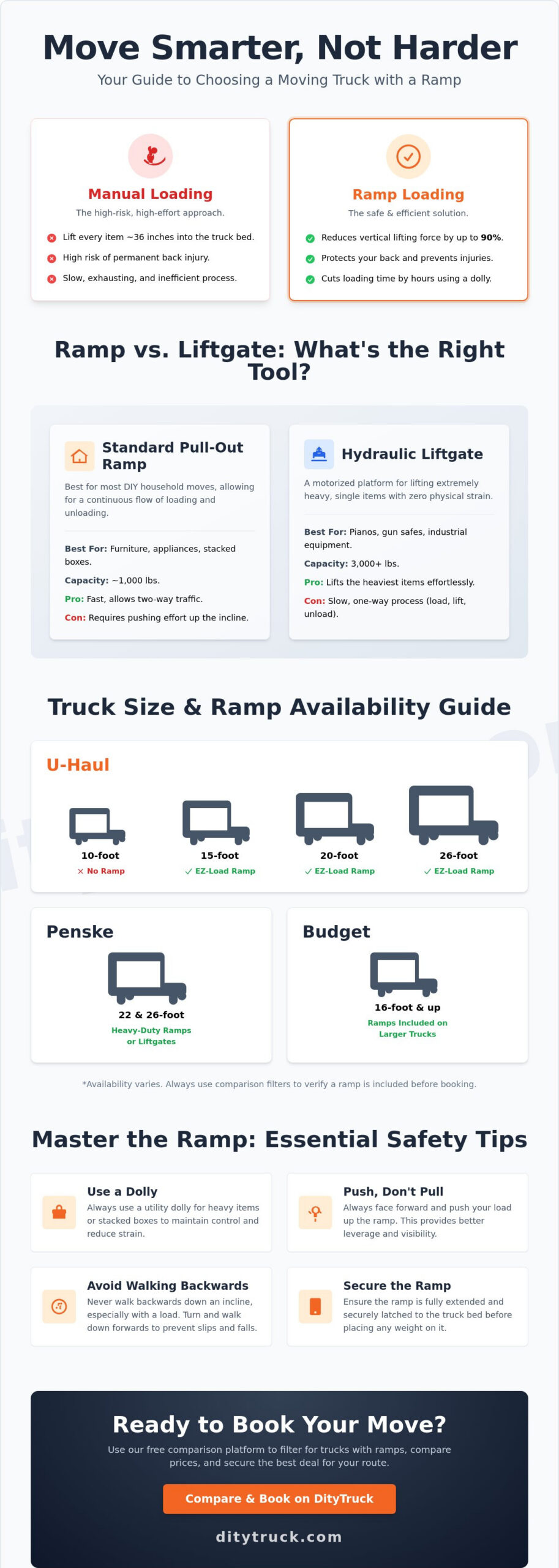
    • Protect your back and reduce vertical lifting by up to 90% by selecting a moving truck rental with ramp for your DIY move.
    • Identify the critical differences between standard pull-out ramps for furniture and hydraulic liftgates for industrial-strength heavy lifting.
    • Compare fleet-specific features like Penske’s wide aluminum ramps and U-Haul’s low-deck designs to find the easiest loading angle for your items.
    • Master essential safety protocols, including the dolly method, to prevent accidents and avoid the danger of walking backward on a steep incline.
    • Use comparison filters to verify that your specific truck size includes a ramp before you finalize your reservation.

    Why a Moving Truck Rental with Ramp is Essential for DIY Moves

    Lifting is the enemy of a successful move. A standard moving truck rental with ramp provides a retractable plane that bridges the gap between the ground and the truck bed. This simple incline transforms a high-risk physical challenge into a manageable logistical task. It’s the difference between a smooth afternoon and a trip to the chiropractor. By using a ramp, you eliminate the need to deadlift your entire life three feet into the air. This tool acts as a mechanical bridge, allowing you to roll items directly into the cargo area with minimal vertical effort.

    Efficiency is the immediate result of choosing the right equipment. Hand-carrying individual boxes or chairs up into a truck is slow and exhausting. You lose momentum. You get tired. Eventually, you start making mistakes. A ramp allows you to use a utility dolly to move multiple items at once. You can stack three or four boxes and roll them up the incline in seconds. This speeds up your loading process significantly, often cutting your total moving time by several hours. It also keeps your energy levels high for the driving portion of your journey.

    Ramp vs. Manual Loading: The Physical Toll

    Truck beds typically sit about 36 inches off the pavement. Lifting a 200-pound refrigerator or a solid wood dresser that distance is a recipe for a musculoskeletal injury. The physics of an incline change everything. A 10 or 12-foot ramp, which functions much like industrial loading dock components, stretches that vertical climb over a long horizontal space. This reduces the force required to move heavy objects by up to 90%. Instead of a dangerous vertical lift, you perform a controlled push. The cost of a moving truck rental with ramp is a tiny fraction of the potential medical bills or lost wages resulting from a back injury.

    Who Needs a Ramp Truck?

    Certain moves simply cannot happen safely without an incline. If your inventory includes large appliances like washers, dryers, or refrigerators, a ramp is mandatory. These items are too heavy and awkward for manual lifting by a small team. You also need a ramp if you’re moving a multi-bedroom household. The sheer volume of heavy furniture, like bed frames and dining tables, will eventually wear down even the strongest helpers. Solo movers or small teams of two benefit the most from this mechanical advantage. It levels the playing field, allowing a smaller crew to handle a large-scale move with professional-grade efficiency and safety.

    Understanding Ramp Types and Truck Size Availability

    Not all trucks are built equal. While smaller cargo vans or 10-foot trucks often lack loading equipment, a moving truck rental with ramp becomes standard as you move into larger fleet sizes. Understanding the specific hardware attached to your vehicle is the only way to avoid a loading day surprise. Standard pull-out ramps are the most common choice. These aluminum or steel planks slide out from a compartment under the truck bed. They usually support around 1,000 pounds, which is plenty for household furniture and most appliances.

    Width is a factor many movers overlook. A 2-foot wide ramp feels narrow when you’re balancing a heavy dresser on a dolly. Newer fleet models often feature 3-foot wide ramps to provide extra stability and room for error. When you’re following safe loading procedures, that extra foot of width makes a massive difference in preventing dolly wheels from slipping off the edge.

    Ramp vs. Liftgate: Which Should You Choose?

    Choosing between a ramp and a hydraulic liftgate depends on your specific inventory. Ramps allow for a continuous flow of traffic. One person can go up while another comes down, keeping the momentum high. Liftgates are motorized platforms that level with the ground. They are perfect for extremely heavy single items like gun safes or pianos. However, liftgates are slow. You have to wait for the motor to cycle for every single load. Most DIY movers prefer a ramp because it keeps the process moving faster.

    Truck Sizes That Typically Include Ramps

    Size availability varies by brand. A 10-foot truck is the cutoff point. Most companies exclude ramps on this size to save weight, meaning you’ll be lifting everything manually. The 15-foot to 20-foot range is the sweet spot. U-Haul’s 15-foot and 20-foot models come equipped with their EZ-Load ramps. Budget offers ramps starting at the 16-foot size. If you step up to a 26-foot truck, you are almost guaranteed a heavy-duty ramp or even a liftgate. Penske’s 22-foot and 26-foot trucks often feature liftgates or ramp combinations with a 3,000-pound capacity.

    Before you commit, verify the specific features of your local fleet. You can compare truck specifications and availability across multiple providers to ensure you get the right ramp for your needs.

    Moving Truck Rental with Ramp: The 2026 Buyer’s Guide to Easier Loading

    Comparing the Best Moving Truck Companies with Ramps

    Your choice of provider determines the quality of the hardware you’ll be using for ten hours straight. Not every moving truck rental with ramp offers the same user experience. Penske is often the top choice for those who value newer equipment. Their fleet is frequently updated, meaning their wide aluminum ramps are less likely to have the dents or warping found in older trucks. This stability is vital when you’re balancing a heavy appliance. Penske’s 22-foot and 26-foot models are particularly impressive. They feature high-capacity ramps or liftgates that support up to 3,000 pounds, making them the heavy-hitters of the DIY world.

    U-Haul takes a different approach with their proprietary EZ-Load ramps. Instead of a standard truck height, U-Haul designs their vehicles to sit lower to the ground. This creates a much shallower incline. A shorter, flatter ramp means you spend less energy fighting gravity. Budget Truck Rental provides a reliable, no-frills alternative. They offer standard ramps on their 16-foot and 26-foot models. While their hardware is basic, it’s consistent and functional for most household moves. DityTruck simplifies this entire selection process. It acts as a smart assistant, pulling data from these major players so you can compare ramp specs and vehicle ages side-by-side.

    Penske vs. U-Haul: The Ramp Showdown

    The battle between these two giants comes down to deck height versus ramp width. U-Haul’s low deck is a massive advantage for solo movers. It makes the walk up the ramp feel more like a gentle stroll than a steep climb. Penske counters this with superior ramp grip and material quality. Their aluminum surfaces provide excellent traction even in damp weather. If you are booking one way truck rentals for moving, both companies offer extensive drop-off networks. Your decision should rest on whether you prefer U-Haul’s easier angle or Penske’s heavy-duty stability.

    Budget and Enterprise: Reliable Alternatives

    Budget is often the winner for local moves due to their competitive pricing and standard equipment. Their 16-foot truck is a popular middle-ground option that always includes a ramp. Enterprise is the dark horse in the consumer market. They focus heavily on commercial-grade vehicles. This means their ramps are often wider and built to withstand more daily abuse than standard consumer rentals. Regardless of which company you choose, you must adhere to official Cargo Securement Rules once your items are inside. Proper securement ensures that the effort you spent using the ramp isn’t wasted by items shifting in transit. You can use DityTruck to find the best moving truck rental rates and confirm ramp availability for your specific dates in seconds.

    Safe Loading Techniques: Mastering the Ramp

    Securing a moving truck rental with ramp is only the first half of the battle. The second half is using that equipment without damaging your property or yourself. Most accidents happen at the transition points, where the ramp meets the ground or the truck bed. You must treat the ramp as a high-traffic zone that requires constant attention. Before you move a single box, ensure the ramp is fully extended. A partially deployed ramp can collapse under weight. Once extended, check that the locking pins are engaged. These small metal tabs are the only things keeping the ramp from sliding backward while you’re halfway up the incline.

    Weight distribution is critical for a safe drive. You should aim to place about 60% of your cargo weight in the front half of the truck, closest to the cab. This stabilizes the vehicle and prevents the front wheels from losing traction. Start by loading your heaviest appliances and solid wood furniture first. Use the ramp to roll these items into the very back of the cargo area. This strategy keeps the center of gravity low and forward, which is essential for highway handling. If you haven’t secured your vehicle yet, you can book a ramp-equipped truck now to ensure you have the right tools for a balanced load.

    The 3-Step Ramp Safety Check

    • Clear the Surface: Check for oil, water, or loose debris. A single pebble can jam a dolly wheel and cause a sudden, dangerous stop.
    • Flush Transition: Ensure the transition plate at the bottom sits flat against the pavement. If there is a gap, use a piece of plywood or a rubber mat to create a smooth entry point.
    • Locking Verification: Physically shake the ramp to confirm the locking pins are seated. If the ramp moves more than an inch, reset it.

    Using a Utility Dolly on an Incline

    Gravity is your biggest challenge on the ramp. When using a utility dolly, never walk backward down the incline. This is how most trips and falls occur. Instead, always keep the load on the uphill side of you. When going up, you push the dolly ahead of you. When coming down, you lead with your body while holding the dolly handles, letting the weight rest against your center of gravity. This gives you maximum leverage to act as a brake.

    Oversized items require a different approach. For sofas or mattresses, always use a spotter. One person guides the item from the top of the ramp while the other pushes from the bottom. Use a steady, walking pace to maintain momentum. If you stop halfway, it’s much harder to get the load moving again. If the weather turns and the ramp becomes slippery, stop immediately. Use sand, salt, or even a piece of old carpet to regain traction. Safety always takes priority over speed.

    How to Book Your Ramp-Equipped Truck with DityTruck

    Booking a moving truck rental with ramp shouldn’t be a guessing game. The process starts with your specific move date and distance. Local moves often have different fleet availability than long-distance hauls. Enter your zip codes into the DityTruck search tool to see what is currently sitting on the lots near you. This platform acts as your logistics filter. It strips away the noise and presents only the vehicles that meet your criteria. You won’t waste time looking at cargo vans that lack the loading equipment you need for heavy furniture. You get clear, actionable data immediately.

    Efficiency is the primary goal. Once you enter your details, use the feature filters to ensure your selected truck size includes a ramp. Remember that the 15-foot to 26-foot range is your best bet for built-in loading inclines. DityTruck pulls real-time rates from major providers like Penske, U-Haul, and Budget. You can compare these prices side-by-side in seconds. This prevents you from overpaying for a standard feature. You get the best value without the hassle of opening ten different browser tabs. The final reservation is a single, simple step that secures both your vehicle and your peace of mind.

    Avoiding Hidden Fees and Surprises

    Hidden costs are the enemy of a stress-free move. You’ll find that a ramp usually doesn’t cost extra. It is typically integrated into the rental price of larger box trucks. However, surprises often happen when a renter switches truck sizes at the last minute. If you downgrade to a 10-foot model to save money, you might lose your ramp entirely. DityTruck provides transparency by confirming ramp availability at your specific pickup location. This ensures the truck waiting for you on moving day actually has the hardware you need. You see the full picture before you commit any funds. No hidden hurdles. Just honest logistics.

    Final Checklist Before You Drive Away

    Your move starts the moment you arrive at the rental lot. Don’t just sign the paperwork and leave. Perform a physical inspection of the loading equipment. Test the ramp operation before you drive away. Pull it out to its full extension. Ensure the locking pins engage firmly. Check the weight rating sticker, usually located near the pull-handle, to verify it can handle your heaviest appliances. If the ramp is bent or difficult to slide, request a different truck immediately. It is much easier to swap vehicles at the lot than to deal with a broken ramp in your driveway. Ready to start? Compare moving truck rates now and lock in your equipment today.

    Secure Your Move with the Right Equipment

    You now have the blueprint for a safer and more efficient loading day. Choosing a moving truck rental with ramp isn’t just about convenience. It’s about protecting your body and your belongings from the physical risks of manual lifting. You understand which fleet sizes offer the best equipment. You’ve learned how to master the incline using the uphill dolly method and a proper safety check. Don’t leave your logistics to chance or settle for a vehicle that forces you to do all the heavy lifting yourself.

    DityTruck acts as your smart assistant by letting you compare Penske, Budget, and U-Haul in one place. We provide real-time pricing transparency so you can see exactly what you’re paying for. This is the most simplified booking experience available for 2026 moves. You can filter for the specific features that matter most to your health and your timeline. Find and Compare Moving Trucks with Ramps Today to lock in a vehicle that fits your specific needs. Your move is a high-stakes task, but it doesn’t have to be a high-stress one. You’re ready to tackle this transition with confidence and ease.

    Frequently Asked Questions

    Do all moving trucks come with a ramp?

    No, smaller vehicles like cargo vans, pickup trucks, and 10-foot box trucks typically lack this feature. Most companies exclude ramps on these sizes to reduce vehicle weight and maximize fuel efficiency. You’ll need to manually lift items into these smaller beds. Always verify the equipment list for your specific moving truck rental with ramp before you finalize your booking to avoid surprises on moving day.

    What is the smallest moving truck with a ramp?

    The 15-foot truck from U-Haul is currently the smallest standard model equipped with a built-in loading ramp. Budget typically starts offering ramps on their 16-foot models. If you opt for a smaller 10-foot or 12-foot truck from most providers, you should expect to lift your items manually. Always check the specific fleet details at your local pickup location because equipment can vary by region.

    Is a ramp or a liftgate better for moving furniture?

    A ramp is superior for general furniture because it allows for a continuous flow of traffic. You can walk up and down quickly without waiting for a motorized platform to cycle. Liftgates are better for single, extremely heavy items like gun safes or pianos that exceed 1,000 pounds. For a standard multi-room move, the speed and simplicity of a ramp usually provide the best experience.

    How wide are standard moving truck ramps?

    Standard ramps are typically between 24 and 36 inches wide. A 2-foot width is common on older or smaller fleet models, while newer 26-foot trucks often feature 3-foot wide aluminum ramps. This extra width is essential when you’re navigating a wide utility dolly or moving oversized items like sofas. The wider surface provides more stability and a larger margin for error during the loading process.

    Can I use a ramp if it is raining or snowing?

    You can use it, but you must take extreme caution because aluminum surfaces become incredibly slick when wet. Rain and ice significantly increase the risk of slips or the dolly losing traction. If you must load in bad weather, use sand or a specialized traction mat to improve your footing. It’s often safer to wait for the weather to clear before you tackle steep inclines with heavy furniture.

    What is the weight limit for a rental truck ramp?

    Most standard pull-out ramps have a weight capacity of approximately 1,000 pounds. This is sufficient for almost all household furniture and standard kitchen appliances. However, some heavy-duty trucks, such as the Penske 22-foot and 26-foot models, offer ramp and liftgate combinations rated for up to 3,000 pounds. Always check the capacity sticker located near the ramp handle to ensure you don’t exceed the safety limits of the metal.

    How do I stow the ramp after loading is finished?

    Slide the ramp back into its designated housing under the truck bed and secure the latch firmly. You must ensure the locking pins or safety hooks are fully engaged so the ramp doesn’t slide out during transit. A loose ramp is a major road hazard. Double-check the security of the handle and the latching mechanism before you start the engine and drive away from your home.

    Are there any extra charges for renting a truck with a ramp?

    There is typically no separate fee for the ramp itself. It is included in the base rate for the specific truck size you’ve selected. You’ll find that a moving truck rental with ramp is a standard offering for most vehicles 15 feet and larger. While the truck itself costs more than a small van, the ramp is a built-in feature designed to speed up your move and prevent injuries.

  • Unlimited Mileage Moving Truck Rental: The 2026 Comparison Guide

    Unlimited Mileage Moving Truck Rental: The 2026 Comparison Guide

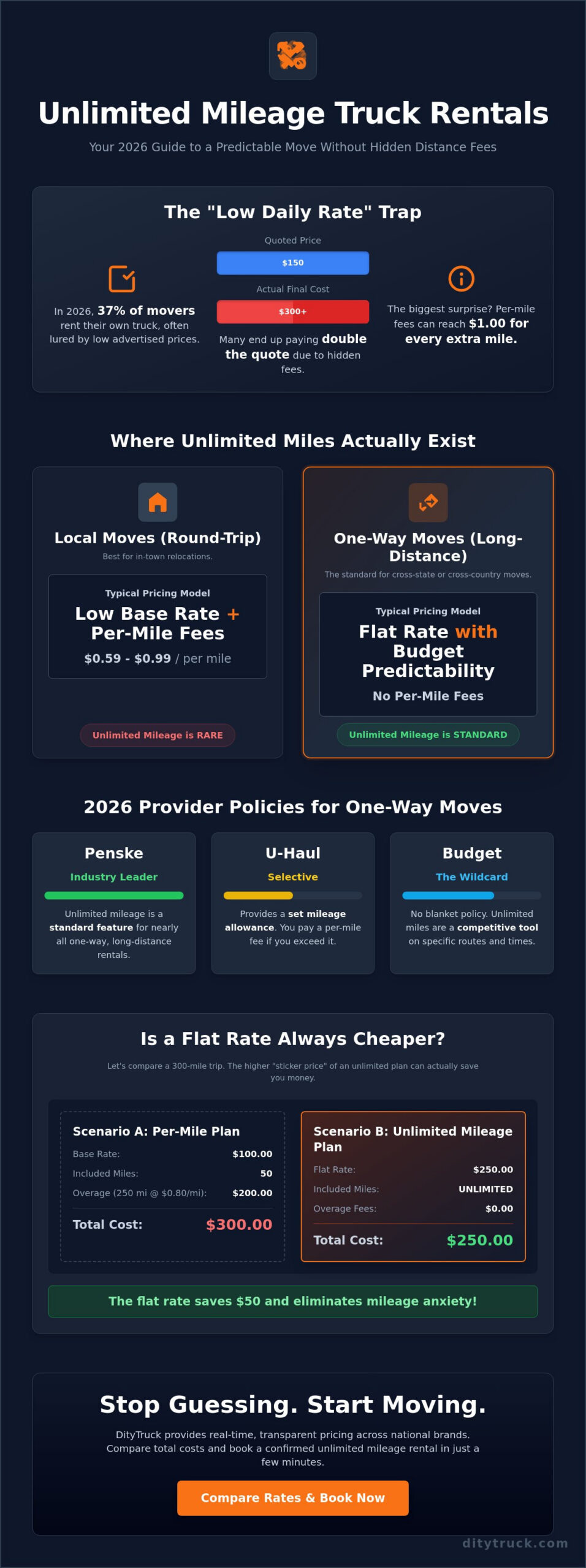
    The lowest daily rate on a rental sign is often a trap. In 2026, roughly 37% of movers prefer renting their own truck, but many end up paying double the quoted price because of distance penalties. If you’re crossing state lines, an unlimited mileage moving truck rental isn’t just a luxury. It’s the only way to protect your budget from unpredictable per-mile fees that can reach $1.00 for every extra mile driven.

    We know you’re looking for a simple, friction-free solution to a high-stakes task. You want to know the total cost upfront, without the fear of hidden charges lurking at the drop-off location. It’s frustrating to compare complex quotes when you just need a straight answer. This guide strips away the complexity of logistics. You’ll learn which national brands offer true unlimited miles and how to calculate if a flat rate actually beats a per-mile fee for your specific trip. We’ve compared the latest 2026 policies from Penske, U-Haul, and Budget to ensure you choose the cheapest total-cost option and enjoy a predictable, stress-free move.

    This guide provides the clarity you need to secure a predictable moving budget without hidden distance fees. We’ve analyzed the 2026 rental landscape to help you book your next move with absolute confidence.

    • Define the true meaning of an unlimited mileage moving truck rental. It’s a strategic flat-rate agreement that eliminates the risk of “mileage shock” when you return the keys.
    • Identify where these deals actually live. Unlimited miles are the gold standard for long-distance, one-way moves. Local rentals typically use a “low base plus per-mile” model instead.
    • Calculate your specific break-even point. You’ll learn how to determine if a higher flat rate actually saves you money compared to a cheap daily rate with added distance fees.
    • Secure your inventory and price by booking as early as possible. Flat-rate availability often fluctuates based on truck size, location, and seasonal demand.
    • Use DityTruck to simplify the entire process. Our platform provides real-time transparency across national brands so you can book a confirmed reservation in just a few minutes.

    The Reality of Unlimited Mileage Moving Truck Rentals

    An unlimited mileage moving truck rental is a flat-fee agreement. The base price includes all the distance you travel. There are no per-mile surcharges. This is a critical distinction for anyone planning a long-distance relocation. It eliminates the risk of “mileage shock” at the drop-off location. You won’t face surprise fees for taking a safer route or making an extra stop for supplies. You get total budget predictability. You know exactly what the distance costs before you even turn the key.

    According to a moving industry overview, DIY moves are a cornerstone of modern logistics. For these movers, financial honesty is a top priority. Choosing a flat rate helps you lock in your moving budget early. You trade the potential savings of a “pay as you go” model for the security of a fixed cost. It’s a trade-off that favors peace of mind. However, availability is specific. Unlimited miles are common for one-way moves but remain rare for local, round-trip rentals. Companies use these deals to incentivize drivers to move equipment to high-demand areas.

    How Unlimited Mileage Pricing Works

    Pricing follows a simple action-result logic. You pay a slightly higher daily base rate. You get total distance freedom. Standard contracts often include an “estimated mileage” trap. The provider calculates the shortest distance between your two zip codes and adds a small buffer. If you hit a detour or road construction, that buffer disappears. You end up paying up to $1.00 per mile for the difference. An unlimited mileage moving truck rental removes this stress. Just remember that fuel and insurance remain separate expenses. You’re still responsible for the gas you burn and the protection plan you choose. These costs aren’t part of the mileage fee.

    Major Providers Offering Unlimited Miles in 2026

    Penske remains the industry leader for one-way unlimited mileage. They offer it as a standard feature for almost all cross-country trips. U-Haul and Budget are more selective. U-Haul typically provides a set mileage allowance based on your destination. If you exceed it, you pay. Budget is the wildcard in the 2026 market. They don’t have a blanket policy, but they often use unlimited miles as a competitive tool. You might find it included in a quote for specific high-volume routes during off-peak months. DityTruck acts as your smart assistant here. We aggregate these dynamic terms into one transparent view. You don’t have to dig through fine print. We show you the total cost upfront so you can book with confidence. You compare the terms. You secure the rental. You move without the math.

    One-Way vs. Local: Where Unlimited Miles Actually Exist

    The choice between a one-way trip and a local rental changes the entire math of your move. If you’re moving across state lines, an unlimited mileage moving truck rental is often built right into the quote. For local relocations, the model shifts. Companies prefer a “Low Base + Per Mile” structure for city moves. This keeps the daily price looking attractive on a billboard. However, it can quickly exceed your budget if you make multiple trips across town. You need to know which category your move falls into before you start comparing prices.

    The One-Way Advantage

    Rental companies use unlimited miles as a strategic logistics tool. They need trucks in specific high-demand cities. By offering a flat rate, they incentivize you to move their inventory for them. It’s a win-win. You get a predictable bill. They get their equipment where it needs to be. Most one-way contracts include a set number of days. The miles are unrestricted. You can take the scenic route or detour around traffic without checking the odometer every ten minutes. Before booking, you should explore the one way truck rentals for moving guide to see which specific routes currently offer the best flat-rate terms.

    Navigating Local Move Mileage Fees

    Local moves are where the “unlimited” dream usually ends. In 2026, average per-mile rates for box trucks range from $0.59 to $0.99. Some providers even hit $1.00 during peak weekends. A $29.95 rental sounds cheap. It’s a marketing hook. Once you realize a 40-mile round trip adds another $40 to the bill, the value disappears. To ensure a safe and honest transaction, consult the Protect Your Move resources from the FMCSA. This helps you spot hidden fees before signing your contract.

    If your move spans several days but stays within the same city, you face a unique hurdle. Most providers won’t offer an unlimited mileage moving truck rental for these “local multi-day” rentals. You’ll pay the daily rate for each 24-hour period. Then, you’ll pay for every mile on top of that. This can lead to a massive bill if your new home is far away and you make four trips. In this case, renting a larger truck for a single day might be the smarter financial move. The easiest way to see these differences is to compare local and one-way quotes side-by-side.

    Equipment Limits and Truck Sizes

    Size matters for mileage availability. Cargo vans and pickup trucks are rarely eligible for unlimited mileage, even on one-way trips. These smaller vehicles are high-turnover assets. Companies want them back quickly for the next customer. Larger 16-foot and 26-foot box trucks are the primary candidates for flat-rate distance deals. If you’re moving a small apartment, you might actually save money by renting a larger truck with unlimited miles. It’s often cheaper than a small van with a high per-mile surcharge. Always check the equipment restrictions before you finalize your reservation.

    Crunching the Numbers: Is Unlimited Mileage Always Cheaper?

    Don’t assume the flat rate is your best friend. It’s a hedge against high costs. Sometimes the hedge costs more than the risk. An unlimited mileage moving truck rental usually carries a higher daily base price. You’re paying for the privilege of ignoring the odometer. To find the real value, you have to find your break-even point. This is the exact mileage where the total cost of a per-mile rental equals the flat-rate quote. If your move is shorter than this distance, you’re overpaying for “free” miles you won’t use.

    Finding this balance is common in professional logistics. For example, the U.S. Government Rental Truck Program often utilizes flat rates with unlimited mileage to ensure cost certainty for federal employees. It simplifies the reimbursement process. It prevents budget overruns caused by unexpected detours. For your move, the same logic applies. You want a predictable total. But you don’t want to pay a premium for a benefit that doesn’t save you money in the end.

    Consider a case study of two different moves. If you’re moving 1,500 miles, a per-mile fee of $0.90 adds $1,350 to your bill. In this scenario, the benefit of an unlimited mileage moving truck rental becomes undeniable. The flat rate will almost certainly be lower than that massive surcharge. However, if your move is only 300 miles, that same fee is only $270. If the unlimited option’s base rate is $300 higher than the standard rate, you’re better off paying per mile. Route efficiency also plays a role. GPS errors or missed exits can add 20 to 50 miles to a long trip. A flat rate absorbs those mistakes. A per-mile rate charges you for them.

    The Calculation Framework

    • Step 1: Get two quotes via DityTruck. One for a per-mile rate and one for a flat-rate unlimited option.
    • Step 2: Add 10% to your estimated mileage. This accounts for fuel stops, hotel detours, and road construction.
    • Step 3: Multiply your buffered mileage by the per-mile rate. Add the base fee. Compare this total to the flat-rate quote.

    When to Choose the Per-Mile Rate

    Per-mile rates win in specific scenarios. Short-distance one-way moves under 200 miles often don’t justify a high flat-rate premium. If the base rate difference is significantly higher for the unlimited option, stick to the standard contract. Per-mile is also better for quick local tasks. If you only need the truck for a few hours to move a single large item across town, the mileage fee will be negligible. Always run the numbers before you commit. Clarity leads to savings.

    Unlimited Mileage Moving Truck Rental: The 2026 Comparison Guide

    Selection Guide: Finding the Best Value for Your Distance

    Securing the right truck is about timing and inventory. In the 2026 rental market, availability fluctuates based on seasonal demand and fleet location. If you wait until the last minute, the unlimited mileage moving truck rental you need might be sold out. Reserving your vehicle at least three to four weeks in advance is critical. This locks in the flat-rate price and ensures the specific truck size you require is waiting at your pickup location. Booking early is the simplest way to avoid the stress of limited options.

    Verification is your final safeguard. Never assume a “one-way” quote automatically includes unlimited miles. Some providers use confusing terminology like “Mileage Included.” This often means you have a set allowance, not an unrestricted one. Check the digital contract before you submit your payment. Look for the specific word “Unlimited” in the mileage section. If it lists a specific number of miles, you are on a restricted plan. This transparency prevents surprise charges at the end of your trip.

    Matching Truck Size to Mileage Needs

    Truck size directly impacts your mileage terms. Larger box trucks, specifically those in the 22-foot to 26-foot range, are designed for long-haul moves. Companies often prioritize these for unlimited mileage deals to keep their heavy inventory moving between major hubs. Conversely, cargo vans and pickup trucks are rarely eligible for these plans. They are typically reserved for local, short-term tasks. If you aren’t sure which vehicle fits your inventory, consult the Moving Truck Rental: The Complete 2026 Comparison & Booking Guide for detailed sizing advice. Choosing a slightly larger truck might actually unlock a better mileage deal.

    The DityTruck Comparison Checklist

    Comparing national brands shouldn’t be a chore. DityTruck acts as your smart assistant by pulling real-time data from leaders like Penske and Budget. You can layer promo codes for military or student discounts directly on top of your unlimited mileage quotes. This ensures you aren’t just getting a flat rate, but the lowest possible version of that rate. Our platform strips away the industry jargon. You see the total cost and the mileage terms side-by-side. It’s the shortest path to a confident booking. You can compare real-time rental rates now to see which provider has the best inventory for your route.

    Compare and Book Unlimited Mileage Rentals with DityTruck

    Logistics shouldn’t be a guessing game. DityTruck strips away the stress. We provide the friction-free path you need for a high-stakes move. Our platform acts as your smart assistant. It performs the heavy lifting behind the scenes so you don’t have to. You get immediate clarity on your total costs. No more digging through fine print. No more hidden per-mile traps. We bring the data to you.

    Transparency is our priority. Many booking sites wait until the final checkout screen to reveal environmental fees or mandatory surcharges. We pull those costs forward. You see the honest price from the very first click. This creates relief and builds confidence. You know your budget is safe. You’re choosing the shortest, most logical path to a successful relocation.

    Why Compare with DityTruck?

    We aggregate the top national providers into a single, efficient view. You see Penske, Budget, and other industry leaders side-by-side. Our system specifically highlights which quotes include an unlimited mileage moving truck rental automatically. This saves you hours of manual research. You don’t need to visit five different websites. You don’t need to manage a dozen browser tabs. We present the facts clearly. You make the decision quickly. It’s about valuing your time as much as your money.

    • Real-time inventory: See what’s actually available at your local branches for 2026.
    • Fee transparency: We highlight the costs that competitors try to hide.
    • Efficiency: Move from comparison to a confirmed reservation in minutes.

    Ready to Start Your Move?

    Securing your 2026 move is a simple, three-step process. First, enter your pickup and drop-off zip codes along with your moving date. Our tool immediately scans the national database for available equipment. Second, use the filter to select “Unlimited Mileage.” This isolates the best long-distance options and removes any quotes with restrictive distance caps. Finally, review the total cost and confirm your booking. The result is a guaranteed rate and total peace of mind. You won’t face “mileage shock” at the end of your trip. You won’t have to worry about detour costs. You just drive.

    Take control of your moving budget right now. Use our comparison tool to find the perfect fit for your distance and truck size. Book your rental truck today and lock in your flat rate.

    Secure Your Predictable Moving Budget Today

    Your move doesn’t have to be a source of financial stress. You now have the tools to identify true value. You know that one-way trips offer the best chance for an unlimited mileage moving truck rental. You understand how to calculate your personal break-even point to avoid overpaying for distance you won’t use. These insights protect your wallet and your peace of mind. You are no longer guessing. You are planning with precision.

    DityTruck simplifies this entire search process. Our streamlined 2026 booking interface provides real-time rates from Penske and Budget in seconds. We prioritize financial honesty above all else. You get a clear view of the terms without hidden mileage fees on one-way moves. This creates the confidence you need for a high-stakes task. No more digging through fine print. No more worrying about odometer readings during your drive. We handle the complexity so you can focus on the destination.

    It’s time to move from planning to action. Compare unlimited mileage rates and book your truck now. Secure your equipment today and lock in a rate that stays flat. You’ve done the research and found the smartest path forward. Now, enjoy the relief of a predictable budget and a friction-free transition. Safe travels to your new home.

    Frequently Asked Questions

    Does U-Haul offer unlimited mileage for local moves?

    No, U-Haul does not offer unlimited mileage for local or in-town rentals. You pay a base daily rate plus a per-mile fee that typically ranges from $0.59 to $0.99. For one-way moves, they provide a pre-determined mileage allowance based on your destination. If you exceed this limit, they charge $1.00 for every additional mile driven.

    Which truck rental company is best for long-distance moves with unlimited miles?

    Penske is the clear leader for long-distance moves. They are the only national company that offers free unlimited mileage on all one-way truck rentals across the United States. This policy applies to all their truck sizes. It provides the most financial certainty for cross-country relocations where distance costs can otherwise spiral out of control.

    Is there a limit to “unlimited” mileage in moving truck contracts?

    True unlimited mileage has no distance cap, but it is always tied to a specific time limit. Your contract will specify a set number of days to complete your trip. While you can drive as many miles as you want during that window, you must return the vehicle to the agreed drop-off location by the deadline to avoid late fees.

    How much does it cost if I go over my estimated mileage on a standard rental?

    Overages typically cost between $0.80 and $1.00 per mile. U-Haul charges a flat $1.00 per mile for one-way overages in 2026. Budget usually ranges from $0.80 to $1.00. These fees are calculated at the drop-off point. Choosing an unlimited mileage moving truck rental is the only way to guarantee you won’t face these high surprise charges at the end of your move.

    Does unlimited mileage include the cost of fuel?

    No, unlimited mileage only waives the fee for the distance traveled. You are still responsible for all fuel costs. Moving trucks are not fuel-efficient and typically get between 8 and 14 miles per gallon. You should always budget for gas as a separate expense based on your expected route, even if your mileage rate is flat.

    Can I get unlimited mileage on a cargo van rental?

    Unlimited mileage is rarely offered for cargo vans because they are high-turnover local assets. Most major brands apply a per-mile surcharge to these smaller vehicles. Home Depot is a notable exception for local use. For one-way moves, you will likely need to rent a larger box truck to qualify for a flat-rate distance agreement.

    What happens if I change my destination on an unlimited mileage one-way rental?

    Changing your drop-off location usually invalidates your original contract and triggers extra fees. An unlimited mileage moving truck rental is a specific agreement between two points. If you change your destination, the company will recalculate your rate based on current demand in the new city. Always call the provider before diverting from your planned route to avoid massive penalties.

    Is Penske the only company with unlimited miles?

    Penske is the only national brand with a universal unlimited mileage policy for one-way moves. However, Budget often offers unlimited miles as a promotion for specific high-volume routes. These deals aren’t always advertised on the main site. DityTruck aggregates these dynamic terms in one place so you can find every available flat-rate option for your specific move date.

  • Cargo Van Rental for Small Moves: The 2026 Comparison Guide

    Cargo Van Rental for Small Moves: The 2026 Comparison Guide

    Renting a massive box truck for a studio apartment move is often a costly mistake. You don’t need a twenty-foot behemoth to transport a bed and some boxes, especially when a cargo van rental for small move tasks offers better fuel economy and easier parking. It’s natural to feel anxious about driving a large vehicle or getting blindsided by hidden insurance fees at the counter. You want a solution that fits your gear and your budget without the traditional rental friction.

    Discover how to find the most efficient cargo van for your move while comparing the best national rates in seconds. This guide simplifies the process by stripping away the complexity of 2026 logistics. You’ll learn about the latest federal liability coverage mandates that are now included in every agreement at no extra charge. We also break down how to read the new one-page data privacy summaries so you know exactly what is being tracked during your trip. From verifying interior dimensions to navigating the latest young renter fee changes, we provide the clarity you need for a fast and confident booking experience.

    Key Takeaways

    • Choose a cargo van to maximize maneuverability and fuel savings during local relocations. It’s the most efficient way to handle furniture without the bulk of a full-sized truck.
    • Compare standard and high-roof dimensions to guarantee your belongings fit. Selecting the right cargo van rental for small move projects prevents the stress of making multiple trips.
    • Evaluate your inventory for items longer than nine feet or those requiring a loading ramp. This simple check helps you decide if a van or a small box truck is your best tool.
    • Spot hidden mileage and refueling fees before you book. Knowing these extra costs upfront ensures the rate you see is the total price you actually pay.
    • Use comparison tools to scan national rates in seconds. This approach strips away the complexity of logistics and puts the lowest prices at your fingertips.

    Why a Cargo Van is the Smart Choice for Small Moves

    Selecting a cargo van rental for small move tasks is about finding the perfect balance between volume and agility. You don’t need a massive commercial truck to move a studio apartment. You need a tool that handles like a family vehicle but carries like a pro. These vans offer enough floor space for your essentials without the intimidation factor of a 15-foot box truck. They are specifically designed for “micro-moves” where efficiency is the priority. Whether you’re upgrading a single room or clearing out a college dorm, the cargo van is your most logical path. It strips away the anxiety of navigating narrow streets while keeping your costs low.

    What Actually Fits in a Cargo Van?

    Understanding the capacity of different types of vans is the first step toward a friction-free move. You want to confirm your inventory fits before you arrive at the rental counter. A standard cargo van typically accommodates:

    • A twin or full-sized mattress set.
    • Approximately 10 to 15 medium-sized moving boxes.
    • A small dresser, a nightstand, and a desk chair.
    • A bicycle or a few pieces of exercise equipment.

    If you have a queen-sized mattress, you should specifically look for a high-roof model. This extra vertical space allows you to stand the mattress on its side; this leaves more floor room for your boxes. Most of these vehicles include built-in tie-down points along the interior walls. Use these to secure fragile items like mirrors or televisions. It’s a simple step that prevents damage during sudden stops.

    Fuel Efficiency and Driving Ease

    The financial benefit of choosing a cargo van over a box truck is immediate. A 10-foot box truck often struggles with fuel economy due to its heavy frame and poor aerodynamics. In contrast, a cargo van operates much more like a standard SUV. You’ll spend significantly less at the pump, especially on local trips with frequent stops. The savings add up quickly when you’re making multiple runs across town.

    Driving stress is also lower. The “van-like” handling makes lane changes and turns feel natural. You won’t need to learn how to use massive commercial side-view mirrors or account for a wide turning radius. You don’t have to worry about overhead clearance in most residential areas. Many cargo vans even fit inside standard parking garages. This is a massive advantage in dense city centers where street parking is a gamble. It’s the shortest path between your old front door and your new one.

    Comparing Cargo Van Dimensions and Capabilities

    Choosing the right vehicle isn’t just about the daily rate. It’s about the dimensions. A cargo van rental for small move projects succeeds when you match your inventory to the vehicle’s interior volume. Most standard cargo vans offer an interior length between 10 and 12 feet. This is usually enough space for a standard three-person sofa and several stacks of boxes. You should also consider the payload capacity. Most modern vans handle between 3,000 and 4,000 lbs. Since furniture is often bulky but not incredibly heavy, you’ll likely run out of floor space long before you hit the weight limit. This capacity ensures the vehicle remains stable and safe even when fully loaded with your belongings.

    Loading height is another factor that often gets overlooked. Unlike box trucks, cargo vans sit much closer to the pavement. You don’t need to navigate a steep, narrow ramp while carrying a heavy dresser. You simply step into the back. This lower entry point speeds up the process and reduces physical strain. If you want to see how different brands compare on these specific measurements, you can view real-time specs and rates to find the best fit for your gear.

    The High-Roof Advantage for Furniture

    Standard vans are great, but standing items often require more vertical clearance. High-roof models provide an interior standing height of approximately 70 to 75 inches. This is a game-changer for tall bookshelves, floor lamps, or wardrobes that shouldn’t be laid flat. It also makes the loading process much more comfortable. You can walk around inside the van without hunching over. This extra height is highly sought after; check availability at your local rental hub early in the planning process. Some national brands keep fewer high-roof models in their fleet compared to standard versions.

    Compact Cargo Vans for City Deliveries

    Sometimes a full-sized van is still too much. If you’re only moving a few electronics, some luggage, and twenty small boxes, a compact van like the Ford Transit Connect is the most efficient tool. These vehicles are built for dense urban environments where every inch of parking space matters. They offer incredible fuel economy and fit into almost any parking structure. However, don’t expect to fit a mattress or a large dining table inside. Always verify the specific model during your booking to ensure a cargo van rental for small move tasks doesn’t leave your largest items on the sidewalk. Precision in your choice leads to a faster, cheaper move.

    Cargo Van Rental for Small Moves: The 2026 Comparison Guide

    Cargo Van vs. Small Box Truck: Which One Do You Need?

    Deciding between a cargo van rental for small move projects and a 10-foot box truck comes down to three factors: length, lifting, and location. Start by measuring your largest piece of furniture. If your sofa exceeds nine feet in length, it likely won’t fit in a standard van. You shouldn’t try to force it. This leads to damage or an unsecured load. Also, consider your physical strength. Cargo vans lack loading ramps. You must lift every item directly into the back. If you’re moving heavy appliances or solid wood furniture, the ramp on a box truck is a safer choice for your back. It’s about choosing the tool that protects your body and your belongings.

    Your driving route matters just as much as your gear. Box trucks are taller and wider. They are often prohibited from certain parkways and may not clear low-hanging trees or old apartment awnings. A cargo van navigates narrow alleys and tight city corners with ease. It’s the smart choice for urban environments where parking a box truck is a logistical nightmare. You can pull right up to the curb or into a driveway without blocking the entire street. This accessibility saves you time and reduces the distance you have to carry heavy boxes.

    When to Upgrade to a 10-Foot Box Truck

    The “sofa rule” is your best guide. If your couch is too long for the van’s interior floor, upgrade immediately. Don’t risk driving with the back doors open or items hanging out. Heavy appliances like washers or refrigerators are also easier to manage with a box truck. The integrated ramp saves your spine and makes the loading process much faster. If you realize your inventory is too large for a van, check out our moving truck rental guide for larger options. It helps you determine exactly when more cubic footage becomes a necessity rather than a luxury.

    Cost Implications of the Size Choice

    Vans usually offer the lowest entry price for any motorized moving vehicle. Their daily base rates are consistently lower than those of box trucks. You’ll also see a difference in insurance costs. Many personal auto insurance policies extend coverage to cargo vans because they are classified as light-duty vehicles. Box trucks often require specialized, more expensive rental insurance. As of 2026, federal mandates require state-minimum liability to be included in all agreements at no extra charge, but you still need to consider damage waivers. A van’s superior fuel economy means you pay less at the pump on top of the per-mile fee. It’s the most cost-effective path for a light load when every dollar counts.

    The 2026 Guide to Booking the Best Cargo Van Rate

    Avoid the Single-Site Trap. Prices for a cargo van rental for small move projects fluctuate constantly across different national brands. One provider might have a surplus of vans in your neighborhood while another is completely sold out. This local imbalance creates massive price gaps for the same vehicle type. Comparison is your only tool for financial honesty. You need to see the total cost before you provide any credit card details. Seeing every available option at once ensures you don’t overpay for a simple task.

    Timing your reservation is the most effective way to slash your bill. Booking your rental for a Tuesday, Wednesday, or Thursday often results in significantly lower base rates. Rental hubs are usually crowded on weekends; this drives prices up. If your schedule allows a mid-week transition, you’ll find more vehicle choices and shorter lines. Always watch for hidden fees that can inflate a quote. Environmental fees, refueling surcharges, and vehicle licensing recovery fees are common industry standards. You can compare all national cargo van rates in seconds to see exactly what you’ll pay at the counter.

    Understanding Mileage and Insurance

    Pricing models usually split into flat rates or per-mile charges. Local moves often use a low base rate plus a fee for every mile driven. These charges in 2026 typically range from $0.59 to $1.99 per mile. Before you buy extra protection, verify your credit card benefits. Many premium cards offer secondary coverage for cargo vans. This can save you $15 to $40 per day on damage waivers. One-way moves use a different structure; they often combine costs into a single total price rather than a daily rate plus mileage.

    How to Compare National Providers Fast

    Checking every major brand website individually is a poor use of your time. Every site uses different steps and hidden menus to show the final price. The most efficient method is viewing every available option on one screen. This helps you spot the best value without managing five different browser tabs. If you’re moving across state lines, the logistics change. Review our one way truck rentals guide to see how pricing shifts for long-distance trips. Modern booking should be about speed and clarity.

    Why DityTruck is Your Best Tool for a Stress-Free Move

    DityTruck exists to solve the complexity of modern moving logistics. We act as your savvy consumer advocate by performing the heavy lifting behind the scenes. Instead of opening multiple tabs and manually comparing quotes, you get instant access to aggregated real-time data. This ensures you find the most efficient cargo van rental for small move needs without the traditional stress. We prioritize your time and your budget by stripping away the noise. You see the inventory. You see the rates. You make a decision based on clarity. It is the most direct path to a successful relocation.

    Financial honesty is our core principle. The rental industry is often plagued by hidden fees and shifting prices. We combat this by providing transparent pricing from the start. You won’t face surprises at the rental counter because the data is verified and current. This level of transparency offers immediate relief for a high-stakes task. It transforms a confusing process into a simple, logical progression. You are no longer guessing if you got the best deal; you are confirming it. Our platform ensures that the rate you see is the rate you can trust. We don’t believe in fine-print traps.

    Efficiency is the primary driver of our platform. Our streamlined interface allows you to find, compare, and reserve your vehicle in under three minutes. This speed mirrors the physical momentum of your move. We move as fast as you do. By consolidating the best national providers into one view, we eliminate the friction of traditional booking. You skip the manual research; you get the results instantly. We remove the hurdles so you can focus on your new home. It is about confident simplicity in a crowded marketplace.

    The Smart Assistant for Logistics

    Our platform functions as a smart assistant that never stops working for you. The process follows a clear action-result flow. You enter your moving details; we scan national databases. You receive the lowest aggregated rates; you save money instantly. It is a friction-free solution designed for the modern renter. We replace confusion with a grounded, helpful experience. DityTruck is the shortest path between a moving problem and its resolution. We handle the data so you can handle the boxes.

    Ready to Book Your Cargo Van?

    You’ve done the research. You understand the dimensions, the fuel savings, and the 2026 mandated liability requirements. Now is the time to lock in your rate before availability shifts. Our reservation process is designed to be quick and simple. Every step is logical and direct. Experience the relief of a confirmed booking with a provider you trust. There is no need for further searching or second-guessing. Compare cargo van rates and book your rental today.

    Get Moving with Confidence

    You now possess the roadmap for a streamlined relocation. Selecting a cargo van rental for small move tasks means you’ve chosen agility over unnecessary bulk. By utilizing the insights on vehicle dimensions and strategic booking times, you’ve already bypassed the most common moving hurdles. You’re no longer guessing about payload capacities or hidden mileage fees. You’re making a data-driven decision that protects both your belongings and your budget. The 2026 moving landscape is complex, but you’ve simplified it through careful research.

    Don’t let the noise of the rental market stall your progress. DityTruck provides access to real-time rates from major national providers in seconds. Our platform offers comprehensive coverage across the United States with a focus on total transparency and no hidden booking fees. This is the most direct path to a friction-free reservation. Compare Real-Time Cargo Van Rates and Save on Your Move today. Your transition to a new space should be defined by relief, not stress. You’re ready to lock in your rate and start your journey.

    Frequently Asked Questions

    How much does it cost to rent a cargo van for a day?

    Typical local rates involve a small daily base fee combined with a per-mile charge. Industry data shows mileage fees often range from $0.59 to $1.99 depending on the rental company and location. These costs change frequently based on demand and vehicle availability in your specific city. You should also account for fuel expenses and any supplemental insurance coverage you choose at the counter.

    Do I need a special license to drive a rental cargo van?

    You only need a standard, valid driver’s license to rent and operate a cargo van. These vehicles are classified for light-duty use and don’t require a commercial driver’s license or special certifications. Just ensure you meet the provider’s age requirements. Renters under 25 may face additional daily fees that vary significantly by state, particularly in New York where fees recently increased.

    Will a queen-sized mattress fit inside a standard cargo van?

    A queen-sized mattress fits inside most standard cargo vans if the interior is clear of other large furniture. However, choosing a high-roof model for a cargo van rental for small move tasks is the most efficient choice. The extra vertical space allows you to stand the mattress on its side. This clears valuable floor room for your boxes and prevents you from having to stack heavy items on top of your bed.

    Is insurance included in the cargo van rental price?

    As of January 1, 2026, all rental agreements must include state-minimum liability coverage at no extra charge due to a federal mandate. While this provides basic protection, it often doesn’t cover damage to the rental vehicle itself. Supplemental damage waivers typically cost between $15 and $40 per day. You should check if your personal auto insurance or credit card provides secondary coverage before paying for these extras.

    Can I rent a cargo van for a one-way move?

    One-way rentals are widely available from national providers, though they use a different pricing structure than local returns. Industry estimates for a cross-country trip, such as California to North Carolina, can reach around $3,000 for a cargo van. These moves are usually quoted as a flat rate rather than a daily fee plus mileage. This pricing model provides more certainty for long-distance logistics and budget planning.

    What is the difference between a cargo van and a high-roof van?

    The primary difference is the interior standing height and total cubic volume. Standard vans have a lower ceiling that requires most adults to crouch while loading. High-roof models offer approximately 70 to 75 inches of vertical space, allowing you to walk upright inside the vehicle. This extra height is critical for transporting tall items like floor lamps or wardrobes that cannot be laid flat during transit.

    Are cargo vans more fuel-efficient than box trucks?

    Cargo vans are much more fuel-efficient than even the smallest box trucks because they are lighter and more aerodynamic. They operate like a standard passenger SUV, which translates to lower costs at the pump. This efficiency is a major advantage for local moves involving multiple trips or heavy stop-and-go traffic. You’ll save money on fuel while enjoying a vehicle that is much easier to park and maneuver.

    How far in advance should I book my van for a weekend move?

    You should book your vehicle at least two to three weeks in advance to guarantee availability for a weekend move. Weekends are the peak period for rental hubs and inventory often sells out quickly. Securing a cargo van rental for small move projects early ensures you get the specific high-roof or standard model you need. If your schedule is flexible, booking mid-week can often lead to better rates and more vehicle choices.