Tag: Small Moves

  • Cargo Van Rental for Small Moves: The 2026 Comparison Guide

    Cargo Van Rental for Small Moves: The 2026 Comparison Guide

    Renting a massive box truck for a studio apartment move is often a costly mistake. You don’t need a twenty-foot behemoth to transport a bed and some boxes, especially when a cargo van rental for small move tasks offers better fuel economy and easier parking. It’s natural to feel anxious about driving a large vehicle or getting blindsided by hidden insurance fees at the counter. You want a solution that fits your gear and your budget without the traditional rental friction.

    Discover how to find the most efficient cargo van for your move while comparing the best national rates in seconds. This guide simplifies the process by stripping away the complexity of 2026 logistics. You’ll learn about the latest federal liability coverage mandates that are now included in every agreement at no extra charge. We also break down how to read the new one-page data privacy summaries so you know exactly what is being tracked during your trip. From verifying interior dimensions to navigating the latest young renter fee changes, we provide the clarity you need for a fast and confident booking experience.

    Key Takeaways

    • Choose a cargo van to maximize maneuverability and fuel savings during local relocations. It’s the most efficient way to handle furniture without the bulk of a full-sized truck.
    • Compare standard and high-roof dimensions to guarantee your belongings fit. Selecting the right cargo van rental for small move projects prevents the stress of making multiple trips.
    • Evaluate your inventory for items longer than nine feet or those requiring a loading ramp. This simple check helps you decide if a van or a small box truck is your best tool.
    • Spot hidden mileage and refueling fees before you book. Knowing these extra costs upfront ensures the rate you see is the total price you actually pay.
    • Use comparison tools to scan national rates in seconds. This approach strips away the complexity of logistics and puts the lowest prices at your fingertips.

    Why a Cargo Van is the Smart Choice for Small Moves

    Selecting a cargo van rental for small move tasks is about finding the perfect balance between volume and agility. You don’t need a massive commercial truck to move a studio apartment. You need a tool that handles like a family vehicle but carries like a pro. These vans offer enough floor space for your essentials without the intimidation factor of a 15-foot box truck. They are specifically designed for “micro-moves” where efficiency is the priority. Whether you’re upgrading a single room or clearing out a college dorm, the cargo van is your most logical path. It strips away the anxiety of navigating narrow streets while keeping your costs low.

    What Actually Fits in a Cargo Van?

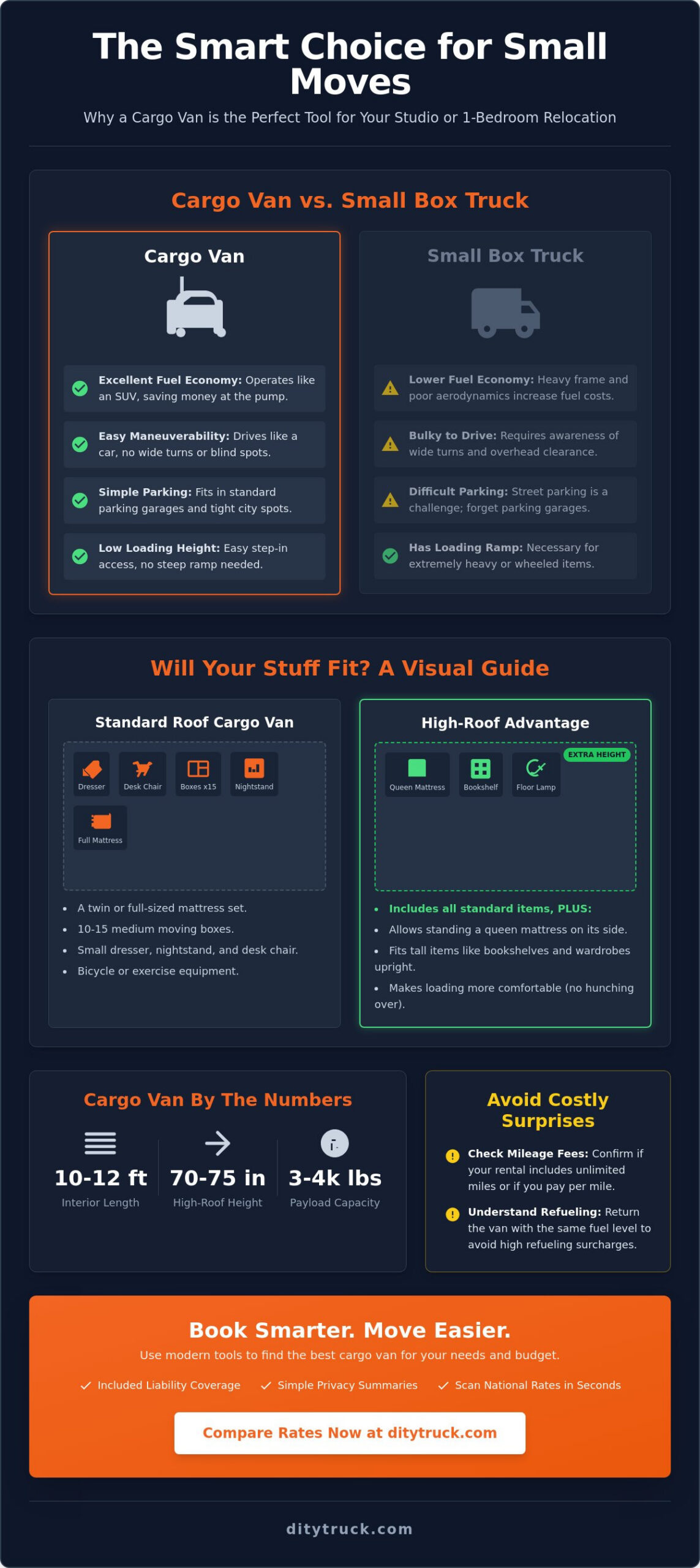
    Understanding the capacity of different types of vans is the first step toward a friction-free move. You want to confirm your inventory fits before you arrive at the rental counter. A standard cargo van typically accommodates:

    • A twin or full-sized mattress set.
    • Approximately 10 to 15 medium-sized moving boxes.
    • A small dresser, a nightstand, and a desk chair.
    • A bicycle or a few pieces of exercise equipment.

    If you have a queen-sized mattress, you should specifically look for a high-roof model. This extra vertical space allows you to stand the mattress on its side; this leaves more floor room for your boxes. Most of these vehicles include built-in tie-down points along the interior walls. Use these to secure fragile items like mirrors or televisions. It’s a simple step that prevents damage during sudden stops.

    Fuel Efficiency and Driving Ease

    The financial benefit of choosing a cargo van over a box truck is immediate. A 10-foot box truck often struggles with fuel economy due to its heavy frame and poor aerodynamics. In contrast, a cargo van operates much more like a standard SUV. You’ll spend significantly less at the pump, especially on local trips with frequent stops. The savings add up quickly when you’re making multiple runs across town.

    Driving stress is also lower. The “van-like” handling makes lane changes and turns feel natural. You won’t need to learn how to use massive commercial side-view mirrors or account for a wide turning radius. You don’t have to worry about overhead clearance in most residential areas. Many cargo vans even fit inside standard parking garages. This is a massive advantage in dense city centers where street parking is a gamble. It’s the shortest path between your old front door and your new one.

    Comparing Cargo Van Dimensions and Capabilities

    Choosing the right vehicle isn’t just about the daily rate. It’s about the dimensions. A cargo van rental for small move projects succeeds when you match your inventory to the vehicle’s interior volume. Most standard cargo vans offer an interior length between 10 and 12 feet. This is usually enough space for a standard three-person sofa and several stacks of boxes. You should also consider the payload capacity. Most modern vans handle between 3,000 and 4,000 lbs. Since furniture is often bulky but not incredibly heavy, you’ll likely run out of floor space long before you hit the weight limit. This capacity ensures the vehicle remains stable and safe even when fully loaded with your belongings.

    Loading height is another factor that often gets overlooked. Unlike box trucks, cargo vans sit much closer to the pavement. You don’t need to navigate a steep, narrow ramp while carrying a heavy dresser. You simply step into the back. This lower entry point speeds up the process and reduces physical strain. If you want to see how different brands compare on these specific measurements, you can view real-time specs and rates to find the best fit for your gear.

    The High-Roof Advantage for Furniture

    Standard vans are great, but standing items often require more vertical clearance. High-roof models provide an interior standing height of approximately 70 to 75 inches. This is a game-changer for tall bookshelves, floor lamps, or wardrobes that shouldn’t be laid flat. It also makes the loading process much more comfortable. You can walk around inside the van without hunching over. This extra height is highly sought after; check availability at your local rental hub early in the planning process. Some national brands keep fewer high-roof models in their fleet compared to standard versions.

    Compact Cargo Vans for City Deliveries

    Sometimes a full-sized van is still too much. If you’re only moving a few electronics, some luggage, and twenty small boxes, a compact van like the Ford Transit Connect is the most efficient tool. These vehicles are built for dense urban environments where every inch of parking space matters. They offer incredible fuel economy and fit into almost any parking structure. However, don’t expect to fit a mattress or a large dining table inside. Always verify the specific model during your booking to ensure a cargo van rental for small move tasks doesn’t leave your largest items on the sidewalk. Precision in your choice leads to a faster, cheaper move.
    Cargo Van Rental for Small Moves: The 2026 Comparison Guide

    Cargo Van vs. Small Box Truck: Which One Do You Need?

    Deciding between a cargo van rental for small move projects and a 10-foot box truck comes down to three factors: length, lifting, and location. Start by measuring your largest piece of furniture. If your sofa exceeds nine feet in length, it likely won’t fit in a standard van. You shouldn’t try to force it. This leads to damage or an unsecured load. Also, consider your physical strength. Cargo vans lack loading ramps. You must lift every item directly into the back. If you’re moving heavy appliances or solid wood furniture, the ramp on a box truck is a safer choice for your back. It’s about choosing the tool that protects your body and your belongings.

    Your driving route matters just as much as your gear. Box trucks are taller and wider. They are often prohibited from certain parkways and may not clear low-hanging trees or old apartment awnings. A cargo van navigates narrow alleys and tight city corners with ease. It’s the smart choice for urban environments where parking a box truck is a logistical nightmare. You can pull right up to the curb or into a driveway without blocking the entire street. This accessibility saves you time and reduces the distance you have to carry heavy boxes.

    When to Upgrade to a 10-Foot Box Truck

    The “sofa rule” is your best guide. If your couch is too long for the van’s interior floor, upgrade immediately. Don’t risk driving with the back doors open or items hanging out. Heavy appliances like washers or refrigerators are also easier to manage with a box truck. The integrated ramp saves your spine and makes the loading process much faster. If you realize your inventory is too large for a van, check out our moving truck rental guide for larger options. It helps you determine exactly when more cubic footage becomes a necessity rather than a luxury.

    Cost Implications of the Size Choice

    Vans usually offer the lowest entry price for any motorized moving vehicle. Their daily base rates are consistently lower than those of box trucks. You’ll also see a difference in insurance costs. Many personal auto insurance policies extend coverage to cargo vans because they are classified as light-duty vehicles. Box trucks often require specialized, more expensive rental insurance. As of 2026, federal mandates require state-minimum liability to be included in all agreements at no extra charge, but you still need to consider damage waivers. A van’s superior fuel economy means you pay less at the pump on top of the per-mile fee. It’s the most cost-effective path for a light load when every dollar counts.

    The 2026 Guide to Booking the Best Cargo Van Rate

    Avoid the Single-Site Trap. Prices for a cargo van rental for small move projects fluctuate constantly across different national brands. One provider might have a surplus of vans in your neighborhood while another is completely sold out. This local imbalance creates massive price gaps for the same vehicle type. Comparison is your only tool for financial honesty. You need to see the total cost before you provide any credit card details. Seeing every available option at once ensures you don’t overpay for a simple task.

    Timing your reservation is the most effective way to slash your bill. Booking your rental for a Tuesday, Wednesday, or Thursday often results in significantly lower base rates. Rental hubs are usually crowded on weekends; this drives prices up. If your schedule allows a mid-week transition, you’ll find more vehicle choices and shorter lines. Always watch for hidden fees that can inflate a quote. Environmental fees, refueling surcharges, and vehicle licensing recovery fees are common industry standards. You can compare all national cargo van rates in seconds to see exactly what you’ll pay at the counter.

    Understanding Mileage and Insurance

    Pricing models usually split into flat rates or per-mile charges. Local moves often use a low base rate plus a fee for every mile driven. These charges in 2026 typically range from $0.59 to $1.99 per mile. Before you buy extra protection, verify your credit card benefits. Many premium cards offer secondary coverage for cargo vans. This can save you $15 to $40 per day on damage waivers. One-way moves use a different structure; they often combine costs into a single total price rather than a daily rate plus mileage.

    How to Compare National Providers Fast

    Checking every major brand website individually is a poor use of your time. Every site uses different steps and hidden menus to show the final price. The most efficient method is viewing every available option on one screen. This helps you spot the best value without managing five different browser tabs. If you’re moving across state lines, the logistics change. Review our one way truck rentals guide to see how pricing shifts for long-distance trips. Modern booking should be about speed and clarity.

    Why DityTruck is Your Best Tool for a Stress-Free Move

    DityTruck exists to solve the complexity of modern moving logistics. We act as your savvy consumer advocate by performing the heavy lifting behind the scenes. Instead of opening multiple tabs and manually comparing quotes, you get instant access to aggregated real-time data. This ensures you find the most efficient cargo van rental for small move needs without the traditional stress. We prioritize your time and your budget by stripping away the noise. You see the inventory. You see the rates. You make a decision based on clarity. It is the most direct path to a successful relocation.

    Financial honesty is our core principle. The rental industry is often plagued by hidden fees and shifting prices. We combat this by providing transparent pricing from the start. You won’t face surprises at the rental counter because the data is verified and current. This level of transparency offers immediate relief for a high-stakes task. It transforms a confusing process into a simple, logical progression. You are no longer guessing if you got the best deal; you are confirming it. Our platform ensures that the rate you see is the rate you can trust. We don’t believe in fine-print traps.

    Efficiency is the primary driver of our platform. Our streamlined interface allows you to find, compare, and reserve your vehicle in under three minutes. This speed mirrors the physical momentum of your move. We move as fast as you do. By consolidating the best national providers into one view, we eliminate the friction of traditional booking. You skip the manual research; you get the results instantly. We remove the hurdles so you can focus on your new home. It is about confident simplicity in a crowded marketplace.

    The Smart Assistant for Logistics

    Our platform functions as a smart assistant that never stops working for you. The process follows a clear action-result flow. You enter your moving details; we scan national databases. You receive the lowest aggregated rates; you save money instantly. It is a friction-free solution designed for the modern renter. We replace confusion with a grounded, helpful experience. DityTruck is the shortest path between a moving problem and its resolution. We handle the data so you can handle the boxes.

    Ready to Book Your Cargo Van?

    You’ve done the research. You understand the dimensions, the fuel savings, and the 2026 mandated liability requirements. Now is the time to lock in your rate before availability shifts. Our reservation process is designed to be quick and simple. Every step is logical and direct. Experience the relief of a confirmed booking with a provider you trust. There is no need for further searching or second-guessing. Compare cargo van rates and book your rental today.

    Get Moving with Confidence

    You now possess the roadmap for a streamlined relocation. Selecting a cargo van rental for small move tasks means you’ve chosen agility over unnecessary bulk. By utilizing the insights on vehicle dimensions and strategic booking times, you’ve already bypassed the most common moving hurdles. You’re no longer guessing about payload capacities or hidden mileage fees. You’re making a data-driven decision that protects both your belongings and your budget. The 2026 moving landscape is complex, but you’ve simplified it through careful research.

    Don’t let the noise of the rental market stall your progress. DityTruck provides access to real-time rates from major national providers in seconds. Our platform offers comprehensive coverage across the United States with a focus on total transparency and no hidden booking fees. This is the most direct path to a friction-free reservation. Compare Real-Time Cargo Van Rates and Save on Your Move today. Your transition to a new space should be defined by relief, not stress. You’re ready to lock in your rate and start your journey.

    Frequently Asked Questions

    How much does it cost to rent a cargo van for a day?

    Typical local rates involve a small daily base fee combined with a per-mile charge. Industry data shows mileage fees often range from $0.59 to $1.99 depending on the rental company and location. These costs change frequently based on demand and vehicle availability in your specific city. You should also account for fuel expenses and any supplemental insurance coverage you choose at the counter.

    Do I need a special license to drive a rental cargo van?

    You only need a standard, valid driver’s license to rent and operate a cargo van. These vehicles are classified for light-duty use and don’t require a commercial driver’s license or special certifications. Just ensure you meet the provider’s age requirements. Renters under 25 may face additional daily fees that vary significantly by state, particularly in New York where fees recently increased.

    Will a queen-sized mattress fit inside a standard cargo van?

    A queen-sized mattress fits inside most standard cargo vans if the interior is clear of other large furniture. However, choosing a high-roof model for a cargo van rental for small move tasks is the most efficient choice. The extra vertical space allows you to stand the mattress on its side. This clears valuable floor room for your boxes and prevents you from having to stack heavy items on top of your bed.

    Is insurance included in the cargo van rental price?

    As of January 1, 2026, all rental agreements must include state-minimum liability coverage at no extra charge due to a federal mandate. While this provides basic protection, it often doesn’t cover damage to the rental vehicle itself. Supplemental damage waivers typically cost between $15 and $40 per day. You should check if your personal auto insurance or credit card provides secondary coverage before paying for these extras.

    Can I rent a cargo van for a one-way move?

    One-way rentals are widely available from national providers, though they use a different pricing structure than local returns. Industry estimates for a cross-country trip, such as California to North Carolina, can reach around $3,000 for a cargo van. These moves are usually quoted as a flat rate rather than a daily fee plus mileage. This pricing model provides more certainty for long-distance logistics and budget planning.

    What is the difference between a cargo van and a high-roof van?

    The primary difference is the interior standing height and total cubic volume. Standard vans have a lower ceiling that requires most adults to crouch while loading. High-roof models offer approximately 70 to 75 inches of vertical space, allowing you to walk upright inside the vehicle. This extra height is critical for transporting tall items like floor lamps or wardrobes that cannot be laid flat during transit.

    Are cargo vans more fuel-efficient than box trucks?

    Cargo vans are much more fuel-efficient than even the smallest box trucks because they are lighter and more aerodynamic. They operate like a standard passenger SUV, which translates to lower costs at the pump. This efficiency is a major advantage for local moves involving multiple trips or heavy stop-and-go traffic. You’ll save money on fuel while enjoying a vehicle that is much easier to park and maneuver.

    How far in advance should I book my van for a weekend move?

    You should book your vehicle at least two to three weeks in advance to guarantee availability for a weekend move. Weekends are the peak period for rental hubs and inventory often sells out quickly. Securing a cargo van rental for small move projects early ensures you get the specific high-roof or standard model you need. If your schedule is flexible, booking mid-week can often lead to better rates and more vehicle choices.
  • Pickup Truck Rental for Moving: The 2026 Savvy Mover’s Guide

    Pickup Truck Rental for Moving: The 2026 Savvy Mover’s Guide

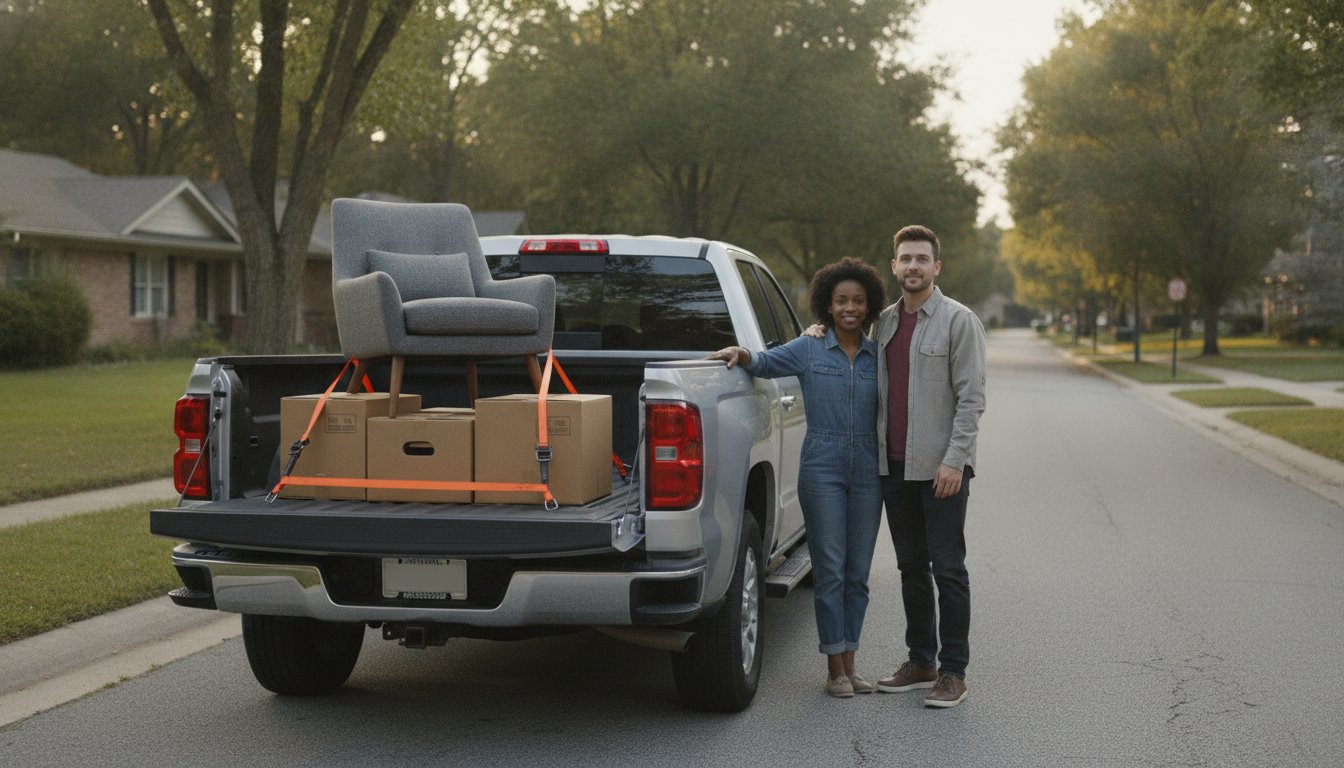
    The biggest truck on the lot is often the most expensive mistake you can make. It’s easy to assume you need a massive box truck for every relocation. In reality, about 62% of people handle their moves themselves, and many overpay for space they never use. If you’re moving a single room, hauling large appliances, or just grabbing a few pieces of furniture, a pickup truck rental for moving is the surgical tool you actually need. You want a solution that fits your cargo without the stress of navigating a heavy vehicle through tight city streets.

    You deserve a transparent process without hidden mileage fees doubling your bill at the last second. We understand the uncertainty of fitting gear into an open bed and the fear of overpaying for a vehicle that is too large. This guide shows you exactly when a pickup is the smartest choice for your budget. We’ll help you confirm your size needs and show you how to compare national providers to find the lowest rates today. From base prices to insurance requirements, we strip away the complexity so you can book with total confidence. It’s time to move faster and spend less.

    Key Takeaways

    • Identify specific scenarios, like studio apartments or single-appliance hauls, where a pickup is more efficient than a box truck.
    • Compare the benefits of open beds versus cargo vans to ensure your tallest items fit without height restrictions.
    • Calculate the true cost of a pickup truck rental for moving by factoring in mileage fees that often exceed the base daily rate.
    • Learn professional tie-down patterns and weatherproofing tricks to keep your cargo secure in an open truck bed.
    • Use a comparison tool to view real-time availability and national rates without switching between multiple browser tabs.

    When to Rent a Pickup Truck for Moving

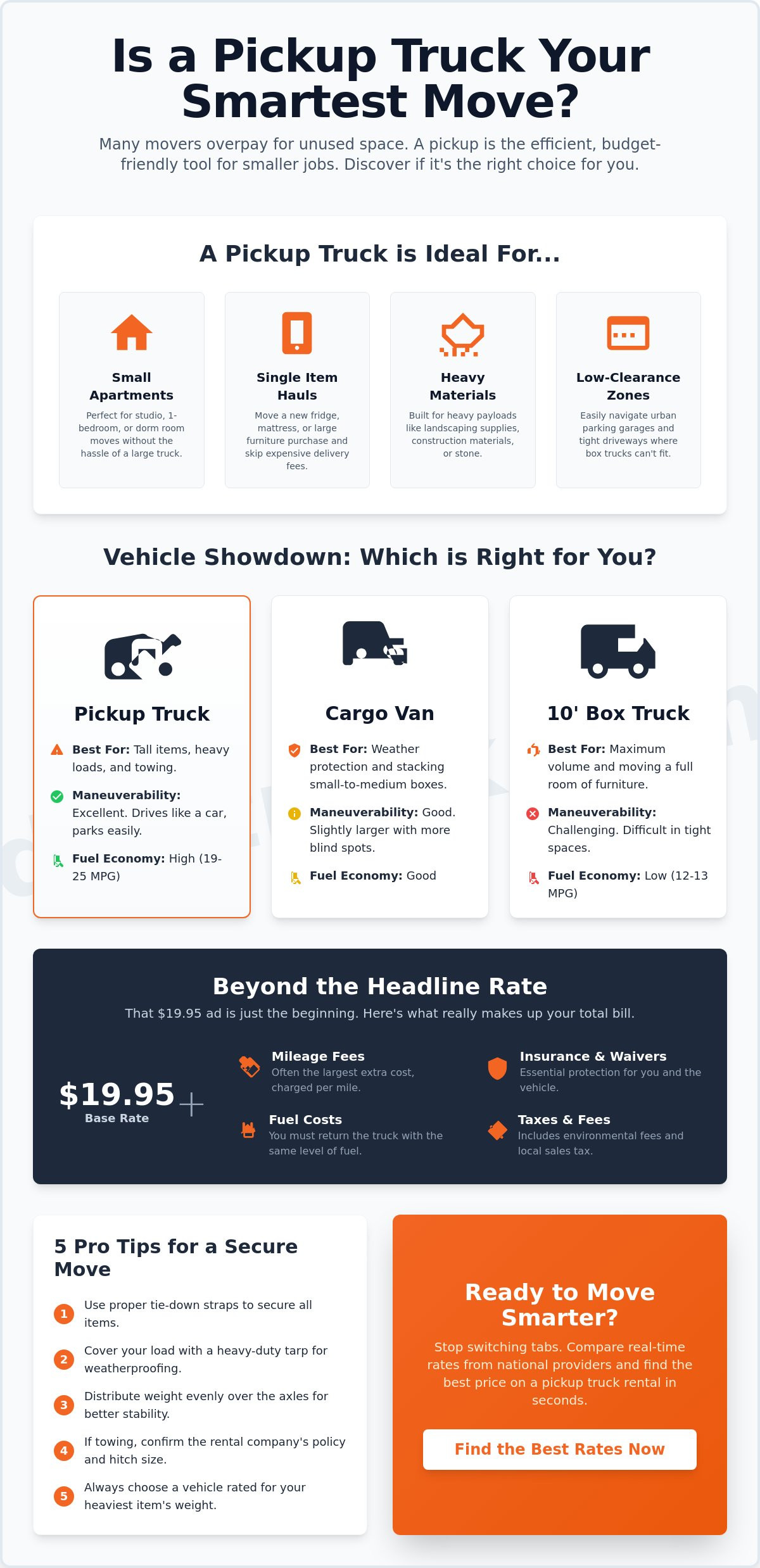
    Picking the right vehicle is about matching the tool to the task. A pickup truck rental for moving is the agile choice for small-scale relocations. It’s the most efficient option for studio apartments or dorm rooms. These smaller living spaces rarely justify the cost of a full-sized box truck. You get enough bed space for a mattress, several boxes, and a desk without the stress of driving a massive commercial vehicle. It’s a low-risk way to handle a move without the high average costs of larger rentals.

    Pickups are built for weight. If you’re hauling landscaping materials or heavy construction supplies, a standard van might exceed its weight limit. The open bed design allows for easy top-loading at supply yards. It’s also the best solution for low-clearance zones. Many urban parking garages have height limits around 7 feet. A box truck won’t fit. A pickup handles these tight spaces with ease. This versatility makes it the surgical tool of the moving industry.

    The “Single Item” Advantage

    Store delivery fees can be expensive. Choosing a pickup truck rental for moving for a single-item pickup is a savvy financial move. It’s the perfect solution for “item-only” moves like a new refrigerator or a mattress. Oddly shaped items that won’t fit in a cargo van are easy to secure in an open bed. You don’t have to struggle with narrow doors or heavy ramps. The process is fast. You load, tie down, and drive. It’s the ideal way to avoid the scheduling delays often found with retail delivery services.

    Towing Capabilities for Personal Use

    A pickup gives you the power to tow. You can attach a small utility trailer or even your own car. This effectively doubles your moving capacity. While the history of pickup trucks highlights their evolution as versatile tools, you must check rental rules first. Not every provider allows towing. Some companies lock the hitches for insurance reasons. Knowing the towing capacity of the specific model is vital for a safe DIY move. It prevents engine strain and keeps you stable at highway speeds. Always confirm the hitch size and weight limits before you leave the lot. This prevents mechanical issues and ensures your cargo stays where it belongs.

    Pickup Truck vs. Cargo Van vs. Small Box Truck

    Choosing between a pickup truck rental for moving and other small options depends on your specific load. A pickup is the go-to for height-unrestricted items. If you have a tall refrigerator or a large plant, the open top is essential. Cargo vans provide better weather protection for stacks of smaller boxes. Meanwhile, a 10-foot box truck offers the most cubic volume for stacking furniture. It’s about balancing weight against space. You don’t want to pay for a box truck if your items are few but heavy.

    Don’t confuse size with strength. Pickups often carry more weight than cargo vans. If your move involves heavy payloads like landscaping stone or large appliances, check the weight limits first. It’s smart to Protect Your Move by choosing a vehicle that handles your heaviest items safely. Overloading a cargo van can lead to poor braking and handling. Pickups are engineered for these heavy tasks. They offer a lower center of gravity when loaded, which improves stability on the highway.

    Standard Pickups vs. Flatbed Truck Rental for Personal Use

    Standard pickups are the most available option at national rental hubs. They provide side-wall protection that keeps loose items contained. This is vital for most DIY moves. Flatbed trucks are rarer for personal use but necessary for side-loading oversized machinery or wide furniture. Just remember that flatbeds offer zero protection for loose boxes. You’ll need extra straps and heavy-duty tarps. For most users, the standard bed is the safer and more accessible choice. You can compare truck rental rates to see which models are available near you right now.

    Fuel Economy and Maneuverability

    Fuel costs add up quickly. Pickups generally offer better MPG than box trucks. Modern pickups often achieve 19 to 25 MPG on the highway. In contrast, box trucks might drop to 12 or 13 MPG. This saves you money at the pump. Pickups also fit into residential driveways without blocking the whole street. The visibility is better. You have a standard rear-view mirror and a familiar seating position. It feels like driving a standard car. This reduces the stress of driving in tight city traffic or backing into narrow spots. You won’t need a spotter for every turn. It’s a faster, simpler way to get the job done.

    Pickup Truck Rental for Moving: The 2026 Savvy Mover’s Guide

    The Real Cost of a Pickup Rental: Beyond the Base Rate

    The $19.95 headline is a hook, not the total. Most people start their search for a pickup truck rental for moving attracted by a low base rate. This daily charge covers the vehicle itself, but the final invoice often tells a different story. You must account for mileage, taxes, and mandatory surcharges that providers rarely highlight in bold text. Transparency is the only way to avoid sticker shock at the drop-off counter. A cheap rental can quickly become an expensive mistake without a clear understanding of the fine print.

    Mileage fees are the primary driver of cost. For local moves, rates typically range from $0.59 to $0.99 per mile. A quick trip across town can easily add $40 to your bill. Environmental fees, usually between $1 and $5, and vehicle licensing recovery fees also pad the total. Then there is insurance. Many personal auto policies exclude vehicles used for commercial purposes or those over a certain weight class. Skipping the Collision Damage Waiver (CDW) might save $15 today but cost thousands if a fender bender occurs. These small daily savings aren’t worth the financial risk of an uncovered accident.

    Calculating Your Total Moving Cost

    Don’t guess. Use a simple formula to see the real price: (Daily Rate x Days) + (Estimated Miles x Rate per Mile) + Fuel. This provides a realistic budget. Unlimited mileage is a common myth for local pickup rentals. It’s almost exclusively reserved for one-way box truck moves. Fuel is another variable. Pickups are thirsty when hauling heavy payloads. Expect lower MPG than the window sticker suggests when the bed is full. Budgeting for a full tank upon return is safer than relying on the rental company’s inflated refueling rates.

    Avoiding Hidden Fees

    Small mistakes lead to large penalties. Rental companies charge cleaning fees if the truck bed is returned with debris or spills. A quick sweep takes two minutes and saves you a $25 charge. Refueling is another trap. Providers often charge double or triple the local gas price if you return the tank less than full. Always top off at a station within five miles of the rental hub to ensure the needle stays on “Full.” Finally, watch the clock. Late return fees are often calculated as a full extra day of rental plus insurance. Returning your pickup truck rental for moving just 30 minutes late can double your daily cost. Plan your route and loading time to ensure a prompt arrival.

    5 Pro Tips for Moving with an Open Truck Bed

    Securing a pickup truck rental for moving requires more than just tossing boxes in the back. Open beds leave your belongings vulnerable to wind, weather, and shifting. You need a strategy to ensure everything arrives in one piece. Success starts with the right gear and a smart loading plan. It’s about stripping away the risk so you can focus on the drive.

    Invest in high-quality ratchet straps. Bungee cords are not enough for highway speeds. They stretch and snap, which can lead to lost cargo or road hazards. Use the “X” pattern for tall items like refrigerators or wardrobes. This crossing method locks the item against the bed walls and prevents tipping during sharp turns. It creates a cage of tension that keeps heavy furniture upright and stable throughout the trip.

    Weatherproofing is a top priority. A sudden rain shower can ruin electronics or mattresses in minutes. Use heavy-duty tarps and secure them tightly to prevent flapping. Flapping tarps can tear or even obscure your vision in the side mirrors. Always tuck the edges under your ratchet straps for a wind-tight seal. This simple step protects your investment from unpredictable elements.

    Manage your weight distribution carefully. Place the heaviest items toward the cab. Keeping the weight in the front keeps the center of gravity stable. It also ensures your front tires maintain proper contact with the road for steering. Finally, never leave an open bed unattended at rest stops. Theft is a real risk when your possessions are visible and accessible. Park in well-lit areas or have a passenger stay with the vehicle during breaks.

    Essential Moving Gear for Pickups

    Moving blankets protect your furniture from scratches, but tarps protect them from the elements. You likely need both for a successful trip. Cargo nets are also highly effective for securing loose bags or light boxes that might catch the wind. You can often find these accessories at home improvement stores or rental hubs. To keep your budget in check, book your truck rental through a platform that lets you compare which providers include gear bundles in their base price.

    Driving a Loaded Pickup Safely

    A loaded truck handles differently than an empty one. Your braking distance increases significantly when the bed is full. Give yourself double the usual space between vehicles to allow for slow stops. Your rear-view mirror might be useless if you’ve stacked items high. Use your side mirrors and check blind spots twice before changing lanes. Most importantly, pull over after the first 10 miles of your trip. Loads often settle and shift once you hit highway speeds. Tightening your straps early prevents a disaster later in the drive. It’s the shortest path to a stress-free arrival.

    Find the Best Pickup Truck Rental Rates with DityTruck

    Stop hopping between browser tabs. It’s tedious. It’s inefficient. DityTruck brings national providers into one view. You see real-time availability for every pickup truck rental for moving without the typical research headache. It’s about clarity. We provide transparent pricing so you know the total before you click. No surprises. No hidden fees. Just the facts you need to make a smart choice. The 2026 market moves fast. You need a tool that moves faster. Our platform updates constantly to reflect current fleet status across the country. You get a friction-free experience from start to finish. It’s fast. It’s accurate. It’s the simplest way to find your vehicle.

    Why Comparison is the Key to Savings

    Rates aren’t static. One provider might have a low daily fee but high mileage costs. Another might be the opposite. DityTruck helps you spot these differences instantly. You can find the best mileage rates for your specific distance. This matters because a “cheap” truck can become expensive if you’re driving 50 miles. If your move grows beyond a few items, check our guide on moving truck rental for larger vehicle options. Comparing saves money. It’s that simple. We do the heavy lifting by scanning major brands so you don’t have to. You get a side-by-side breakdown that highlights the real value. It strips away the guesswork.

    Book Your Move with Confidence

    We act as your savvy consumer advocate. DityTruck streamlines the booking process so you can reserve your truck in seconds. No complex forms. No high-pressure sales tactics. We prioritize your time and your peace of mind. We believe in financial honesty. That means showing you the numbers that matter before you pull out your credit card. You deserve a move that stays on budget. If you’re planning a long-distance trip, explore one way truck rentals for moving to see how unlimited mileage options compare. We focus on stripping away the stress. You get the right truck at the right price. It’s the shortest path from a problem to a resolution. Logistics should be easy. We make sure they are. Ready to get started? Compare pickup truck rates on DityTruck now and secure your vehicle today.

    Take Control of Your Small-Scale Move

    Choosing the right vehicle saves more than just money. It prevents the unnecessary stress of navigating a massive box truck through tight city streets. You now have the tools to calculate the real cost by factoring in mileage fees and insurance. You have the pro tips to keep your cargo secure and dry in an open bed. A pickup truck rental for moving is the most efficient choice for DIY movers who value speed and simplicity. It’s the shortest path to a successful relocation.

    Stop guessing which provider has the best deal. Access real-time rate comparisons and national coverage across all major brands in one place. DityTruck strips away the complexity with no hidden booking fees and total price transparency. Compare Pickup Truck Rental Rates Now to lock in your savings today. You’ve done the research. Now it’s time to get moving with confidence. Your perfectly sized truck is just a few clicks away.

    Frequently Asked Questions

    Is a pickup truck big enough for a 1-bedroom apartment move?

    A pickup truck is generally too small for a full 1-bedroom apartment move. While it excels at hauling single large items or dorm room essentials, the average 1-bedroom contains more furniture than a standard truck bed can hold. You’ll likely need multiple trips. For a more efficient move, consider a cargo van or a small box truck to protect your belongings and save time.

    How much does it typically cost to rent a pickup truck for a day?

    Base rates often start as low as $19.95 per day for local rentals. However, your total cost includes mileage fees, insurance, and fuel. Mileage can range from $0.59 to $0.99 per mile. Most movers find their final bill is significantly higher than the advertised daily rate once these variables are added. Always get a transparent quote that includes these necessary extras before booking.

    Can I rent a pickup truck for a one-way move?

    Yes, you can rent a pickup truck for a one-way move through major national providers. These rentals are typically more expensive than local, round-trip options. Rates are calculated based on truck size, your origin, and your destination. One-way rentals often include a set number of days and miles in the price. Check availability early, as one-way inventory is more limited than local fleets.

    Do I need special insurance when renting a pickup for personal use?

    You should check your personal auto policy before declining rental coverage. Many personal insurance plans exclude vehicles over a certain weight class or those used for moving cargo. Rental companies offer optional Safemove or Collision Damage Waiver coverage. This provides peace of mind and protects you from high out-of-pocket costs if the vehicle is damaged during your move.

    What is the difference between a standard pickup and a flatbed rental?

    Standard pickups have fixed side walls that help contain loose boxes and smaller items. Flatbed trucks lack these walls, making them ideal for side-loading oversized equipment or wide machinery. While flatbeds offer more horizontal space, they require much more effort to secure your load safely. For most residential moves, a standard pickup truck rental for moving is the more practical and secure choice.

    Are there age requirements for renting a pickup truck for moving?

    Most national rental brands require you to be at least 21 years old to book a pickup truck, though some locations allow 18-year-olds with specific restrictions. You must provide a valid driver’s license and proof of current auto insurance at the time of pickup. Renters under the age of 25 often face additional daily surcharges. Always verify these age-related fees during the booking process to avoid unexpected costs on moving day.

    Does a rental pickup truck come with tie-down straps?

    Rental trucks rarely come equipped with tie-down straps as a standard feature. You’ll typically need to provide your own or rent them as an additional accessory. Investing in your own ratchet straps is a smart move for any pickup truck rental for moving. It ensures you have the right tools to secure your furniture and prevents items from shifting or flying out at highway speeds.

    Can I tow my own trailer with a rental pickup truck?

    Towing depends entirely on the specific rental location and their hitch policy. Many local rental pickups have locked or disabled hitches for insurance reasons. However, dedicated truck rental locations often allow towing if the vehicle is properly equipped. You must confirm towing permissions before you book. Unauthorized towing can void your insurance coverage and lead to significant mechanical penalties upon return.

  • How to Use a Cargo Van Rental for Moving Furniture: 2026 Guide

    How to Use a Cargo Van Rental for Moving Furniture: 2026 Guide

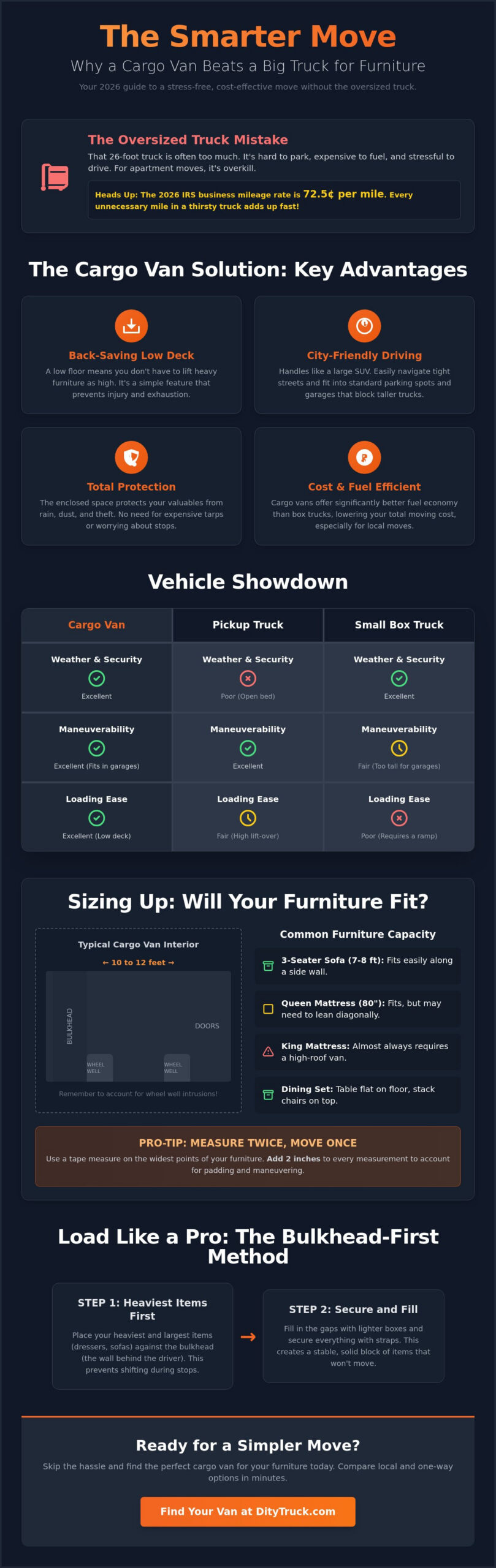
    That massive 26-foot box truck might be the biggest mistake of your move. It’s hard to park. It’s expensive to fuel. For many apartment dwellers or DIYers, a cargo van rental for moving furniture is the smarter, faster choice. It offers the capacity you need with the drivability of a standard SUV. With the 2026 IRS business mileage rate at 72.5 cents per mile, every unnecessary mile in an oversized, thirsty truck adds up fast.

    You probably have two major concerns. Will your expensive sectional actually fit? Will it survive the trip without a single scratch? It’s frustrating to pay for a giant truck that stays half-empty. It’s even worse to realize your gear won’t fit in the van you just booked. We understand that stress. You want a solution that’s simple, honest, and effective.

    This 2026 guide simplifies the process. You’ll master the art of the small-scale move. We’ll help you confirm dimensions, secure your items like a pro, and ensure a damage-free arrival. We’ll break down how to choose the right van size and load it efficiently to maximize every inch of space. Let’s get your furniture moved without the typical logistics headache.

    Key Takeaways

    • Discover why the low deck height of a cargo van simplifies loading heavy dressers and sofas. This design saves your back and speeds up the move.
    • Measure your items against standard 10 to 12-foot floor lengths. Remember to account for wheel well intrusions to ensure everything fits perfectly.
    • Find the most affordable cargo van rental for moving furniture by comparing mileage rates and local versus one-way options.
    • Master the bulkhead-first loading technique to secure your heaviest items. This strategy prevents shifting and protects your furniture from damage.
    • Skip the rental counter hassle by using a streamlined booking service. Compare national providers quickly to find a van that matches your schedule.

    Why Cargo Van Rental is the Smartest Choice for Furniture

    A cargo van is a high-roof, windowless vehicle designed specifically for payload efficiency. It’s built to carry weight without the bulk of a semi-truck. For many, a cargo van rental for moving furniture is the smartest choice because it balances size and accessibility. Unlike larger vehicles, these vans sit lower to the ground. This low deck height makes loading heavy dressers and sofas much easier on your back. You don’t have to lift items nearly as high to get them inside. It’s a simple change that prevents injury and exhaustion during a long day of heavy lifting.

    These vehicles are also built for the city. They handle like a large SUV. You can navigate tight residential streets and fit into standard parking spots without the stress of a wider truck. It’s a friction-free way to handle a high-stakes task. You get the space you need without the anxiety of driving a massive commercial vehicle. The controls are intuitive, the visibility is manageable, and the parking process is straightforward. It’s the shortest path between your old home and your new one.

    Cargo Van vs. Pickup Truck for Furniture

    Pickups have open beds. This leaves your valuable wood furniture exposed to dust and sudden rain. A cargo van offers total climate and weather protection. Your belongings stay dry and clean throughout the trip. You don’t need to buy expensive tarps or messy tie-down nets. Security is another major win. The enclosed cargo area prevents theft during quick stops for gas or food. You can’t leave a sofa in an open pickup bed while you grab lunch. You also gain significant vertical space. High-roof models allow you to stand taller items like floor lamps or shelving units upright. This saves floor space and reduces the risk of items tipping over.

    Cargo Van vs. Small Box Truck

    Box trucks are often overkill for a single room or a few pieces of furniture. Cargo vans offer much better fuel efficiency. This lowers your overhead costs for local furniture deliveries. You also don’t need any special “truck” driving experience. Height clearance is the final advantage. Most cargo vans easily enter apartment complex parking garages. Box trucks are often too tall and get stuck outside. This forces you to carry furniture across a long parking lot. A cargo van gets you closer to the door. This saves time, energy, and money on every trip.

    Sizing Up: Will Your Furniture Fit in a Cargo Van?

    Knowing exactly what will fit inside the vehicle prevents last-minute stress. Most standard cargo vans provide between 10 and 12 feet of floor length. This is typically enough for the contents of a studio apartment or a single large room. However, the floor is not a perfect rectangle. You must account for wheel well intrusions. These protrusions reduce the floor width between the wheels. Plan to place narrower items or boxes between them. If you are moving a tall wardrobe or an armoire, check the roof height. Low-roof models are common. High-roof versions offer the vertical clearance needed for standing furniture upright. This prevents you from having to lay delicate items on their side.

    Weight capacity is the final technical hurdle. A cargo van rental for moving furniture must handle the payload of your specific items. Solid oak dressers or heavy marble-top tables add up quickly. Exceeding the payload rating makes the van harder to stop and steer. It’s vital to follow regulations for Transporting Cargo Safely to keep your trip legal and secure. If you want to see which vehicles are available in your area, check current rental options to find the right fit for your load.

    Common Furniture vs. Van Capacity

    A standard three-seater sofa is usually about 7 to 8 feet long. It fits easily along the side wall. This leaves plenty of room for coffee tables and nightstands. Mattresses are trickier. A Queen mattress is 80 inches long. It might need to lean diagonally if the van floor is crowded. King mattresses almost always require a high-roof van if you want to stand them up. For dining sets, the table is your foundation. Place it flat on the floor. Stack chairs upside down on the tabletop with padding in between. This uses the vertical space that often goes to waste.

    Measuring Your Furniture the Right Way

    Don’t guess on dimensions. Use a tape measure on every large piece. Measure the absolute widest and longest points. Protruding handles, legs, and crown molding all count. You also need a packing buffer. Add at least 2 inches to every measurement to account for moving blankets and cardboard corner protectors. This ensures you don’t run out of room because of the padding. Look for detachable parts. Removing the legs from a sofa or the leaves from a dining table can save several inches. These small adjustments often make the difference between a one-trip move and a frustrating second journey.

    How to Use a Cargo Van Rental for Moving Furniture: 2026 Guide

    Comparing Top Cargo Van Rental Providers Side-by-Side

    Choosing a provider involves looking at service areas and return policies. Some companies limit vans to local, round-trip moves. Others support one-way routes for those relocating further away. Mileage fees vary based on the day of the week and the specific location. Rates can range from $0.20 to $1.39 per mile depending on the company. For longer trips, these costs often become the largest part of your budget. Use a Weekly Moving Checklist to time your booking so you don’t pay for extra days you don’t need.

    Age and insurance are critical filters. Some brands allow 18-year-old drivers for local rentals. Others require a minimum age of 21 or 24 for any vehicle. Always verify these rules before you arrive at the lot. Your personal car policy might not cover a cargo van rental for moving furniture. These vehicles are often classified differently than standard passenger cars. Check with your agent to avoid a gap in protection. Getting these details right ensures a friction-free start to your logistics task.

    What to Look for in a Furniture-Ready Rental

    Look for tie-down points along the interior walls. They are vital for using ratchet straps to lock heavy items in place. Without them, your furniture will slide during every turn. Rubberized floors are another advantage. They provide natural grip and protect wooden legs from scratches. Some high-roof vans include pull-out ramps. Smaller models usually don’t. Knowing the equipment level helps you plan for the physical lifting required on moving day.

    Using DityTruck to Filter the Best Rates

    DityTruck simplifies the search by acting as your smart assistant. We aggregate inventory from major national providers into a single view. You can see real-time availability without opening multiple tabs. This saves you hours of research and prevents financial surprises. You get a clear view of the market so you can Compare Moving Truck Rental Rates in One Simple Step. It is the shortest, most logical path to an affordable and efficient move.

    How to Pack and Secure Furniture in a Cargo Van

    Loading a cargo van rental for moving furniture requires a methodical approach. Start by clearing the van floor of any debris. Check the side walls for anchor points. These metal loops are your best friends for stabilization. Load the heaviest items first. Place them against the bulkhead, which is the wall directly behind the driver’s seat. This keeps the heaviest weight in the center of the vehicle. It prevents the van from becoming back-heavy. A balanced load ensures the van handles predictably during turns and sudden stops. It’s the shortest path to a safe, damage-free arrival.

    Surface protection is non-negotiable for high-stakes moves. Use professional-grade moving blankets for every wood or upholstered surface. Wrap them tightly with stretch wrap to keep the padding in place. Don’t apply stretch wrap directly to wood finishes, as it can trap moisture. Wrap the blanket first, then the plastic. Once your items are in, secure them with ratchet straps. Connect the straps to the anchor points you located earlier. Tighten them until the furniture doesn’t budge. Never rely on bungee cords. They stretch under pressure and won’t stop a heavy dresser from sliding.

    The final step is filling the gaps. Small spaces between furniture cause rattling and friction damage. Use soft items like sofa cushions, bagged linens, or pillows to plug these holes. This creates a solid block of cargo that moves as one unit. If one piece can’t move, nothing can move. This logic prevents the shifting that leads to scratches and dents. It’s a simple, honest way to protect your investment.

    The Art of the “Tight Pack”

    Keep the center of gravity low and balanced between the wheels. Place heavy bases of tables on the floor. Stack lighter boxes or chairs on top of sturdy dressers. This maximizes your vertical space and keeps the van stable. For mirrors and glass, follow the “edge rule.” Always stand glass items on their long edge. Never lay them flat. A flat piece of glass is far more likely to shatter when the van hits a bump. Secure these items between mattresses or flat sofa sections for extra cushioning.

    Essential Tools for a Van Move

    Don’t attempt this move without the right gear. Ratchet straps are mandatory for heavy loads. They provide the mechanical tension needed to lock items down. Cam straps are a good alternative for lighter boxes. Furniture dollies are equally important. They protect your floors and your back. Use them to wheel heavy items directly to the van’s low deck. Finally, stock up on moving blankets. They are the only real defense against friction damage during transit. Ready to get moving? Book your furniture-ready van now to ensure you have the right tools for a damage-free trip.

    Booking Your Furniture-Ready Cargo Van with DityTruck

    Reservations shouldn’t be a chore. Most people dread the rental counter. Long lines. Confusing paperwork. Unexpected upselling. We’ve removed those hurdles. You can secure a cargo van rental for moving furniture in minutes. Our system is built for speed. It’s designed for your peace of mind. We offer national coverage. This means you can find a van in nearly any city across the country. Local loops are easy. Long-distance trips are manageable. We act as your expert advocate. We navigate the complex fine print for you. We look for the hidden mileage fees. We check the insurance requirements. You get a transparent view of the total cost. No surprises at pickup. Just a clean, straightforward transaction.

    Flexibility is vital for a successful move. Every furniture inventory is different. You might be moving a single antique armoire. You might be clearing out a college dorm room. We provide access to various van sizes. You can find low-roof models for tight apartment garages. You can find high-roof models for standing lamps and tall wardrobes. You pick the vehicle that matches your specific inventory. This prevents you from overpaying for a truck that is too large. It ensures you don’t get stuck with a van that is too small. It’s a friction-free solution for a high-stakes task.

    Why DityTruck is the Smart Assistant for Your Move

    Our platform acts as a smart assistant. It performs the heavy lifting so you don’t have to. We aggregate the best current market rates from major providers. Our comparison engine is fast. It’s accurate. It’s honest. We prioritize your time. We value your budget. No-nonsense logistics are our specialty. We provide the shortest path between your problem and a resolution. We strip away the complexity of traditional rentals. You get clarity and relief. Enter your dates. Discover which vans are available right now. Experience the momentum of an organized move.

    Ready to Move Your Furniture?

    Measure your couch one last time. Double-check those wheel well dimensions. Once you are certain of your needs, use our search tool. We simplify the process of One Way Truck Rentals for Moving. You get the data you need to make a savvy decision. Stop clicking through endless tabs. Avoid the stress of price hunting. Get the relief of a confirmed, transparent booking. We are here to help you master the art of the furniture move. Find your perfect cargo van rental on DityTruck now.

    Get Your Furniture Moving with Confidence

    Mastering the logistics of a small move starts with the right vehicle choice. You now have the tools to verify interior dimensions and use the “tight pack” method to keep your items safe. Choosing a cargo van rental for moving furniture is the most logical way to balance capacity with driving ease. It strips away the complexity of larger trucks while providing the weather protection your valuable pieces deserve. You are ready to load efficiently and arrive without a single scratch. This approach turns a high-stakes task into a manageable, organized process.

    Efficiency doesn’t stop at packing. It extends to how you book your vehicle. Use our smart assistant to skip the long research phase. We aggregate inventory from top US providers so you can see every available option in one place. You get real-time rate comparisons and a transparent booking process with no hidden fees. It’s the shortest, most honest path to a successful moving day. Stop overpaying for space you don’t need and start your move the smart way.

    Compare Cargo Van Rental Rates Now and take the stress out of your furniture logistics. You have the plan. Now get the van. Your damage-free trip is just a few clicks away. We are here to ensure your move is simple, fast, and successful.

    Frequently Asked Questions

    Can a king-size mattress fit in a standard cargo van rental?

    A king-size mattress will not fit flat on the floor of a standard van. These mattresses are 76 inches wide, while the space between wheel wells is typically only 50 to 55 inches. You can often fit one by leaning it on its side, but check the door opening height first. High-roof models are usually required to stand a mattress upright without bending it significantly.

    Do I need a special license to rent a cargo van for moving furniture?

    You only need a standard, valid driver’s license to operate these vehicles. No commercial license is required because they fall under the same weight class as large SUVs. Most national rental brands require drivers to be at least 21 or 24 years old. Always bring a major credit card for the security deposit to ensure a friction-free pickup experience.

    Is it cheaper to rent a cargo van or a small box truck?

    A cargo van is almost always the more affordable choice for smaller loads. You save money on the base daily rate and significantly reduce your fuel expenses. These vans are also easier to park, which helps you avoid costly urban parking tickets. It is the most logical financial path for apartment moves or single-room furniture deliveries.

    How many ratchet straps do I need for a typical furniture move?

    Plan on using four to six ratchet straps for a standard move. Use two straps per large item, like a sofa or heavy dresser, to lock them against the interior anchor points. This prevents the cargo from shifting during sudden stops. Having extra straps allows you to secure smaller boxes or chairs on top of your primary load for a safer, tighter pack.

    Can I rent a cargo van for a one-way furniture delivery?

    One-way availability depends on the specific provider and their current inventory needs. Some brands only offer cargo vans for local, round-trip moves to keep their fleets balanced. Other national providers allow one-way routes between major cities. Using a comparison tool is the fastest way to find a cargo van rental for moving furniture that supports your specific start and end points.

    Does a cargo van rental come with a loading ramp?

    Most standard cargo vans do not include a loading ramp. They are designed with a low deck height that allows you to step directly into the vehicle from the ground. For extremely heavy items, you may need to use a furniture dolly or rent a portable ramp separately. Verify the equipment specs of your specific van model before you arrive at the lot.

    What happens if the furniture I bought doesn’t fit in the van I rented?

    You may need to upgrade to a high-roof model or a small box truck if your items exceed the van’s capacity. This is why measuring your furniture at the widest points is critical before booking. If you are at a furniture store and realize the fit is too tight, check real-time availability for a larger vehicle immediately. It is better to switch vehicles than to risk damaging your furniture or the van.

    Will my personal car insurance cover a rental cargo van?

    Many personal auto policies exclude commercial-style vehicles like cargo vans. These policies often have weight limits or usage restrictions that don’t apply to rental trucks. Call your insurance agent to verify your specific coverage before you decline the rental protection plan. Ensuring you have the right coverage is a smart, no-nonsense way to protect your peace of mind during a high-stakes move.

  • 10-Foot Truck Rental: The Complete 2026 Buying & Comparison Guide

    10-Foot Truck Rental: The Complete 2026 Buying & Comparison Guide

    Will your king-sized bed actually fit in a 10 foot truck rental, or are you about to pay for a massive vehicle you don’t need? It’s the “Goldilocks” dilemma of moving. You want enough space for your life. You don’t want to pay for empty air or surprise mileage fees. Most DIY movers feel that same anxiety when staring at a 10-foot box. Small move. High stakes. No room for error.

    We agree that logistics should be simple and transparent. You deserve to know exactly what fits before you swipe your card. This guide helps you master the logistics of small moves by finding the best 10 foot truck rental rates and specs in seconds. We provide a side-by-side price comparison and a clear breakdown of internal dimensions for studio and one-bedroom apartments. You will gain a firm understanding of cargo capacity and learn how to avoid hidden fees. You’ll finish this article with the clarity needed to secure a confirmed reservation at the best possible rate for your 2026 move.

    Key Takeaways

    • Confirm your furniture fits by mastering the 400 cubic foot capacity of these entry-level box trucks.
    • See why the square walls of a 10 foot truck rental provide better stacking space than the curved interior of a cargo van.
    • Spot hidden costs like mileage fees and insurance surcharges early to avoid budget surprises on moving day.
    • Compare real-time rates from top rental companies in seconds to find the best deal for your specific route.
    • Master the weight limits and loading heights to ensure your DIY move stays fast and stress-free.

    What is a 10-Foot Truck Rental and Why Choose It?

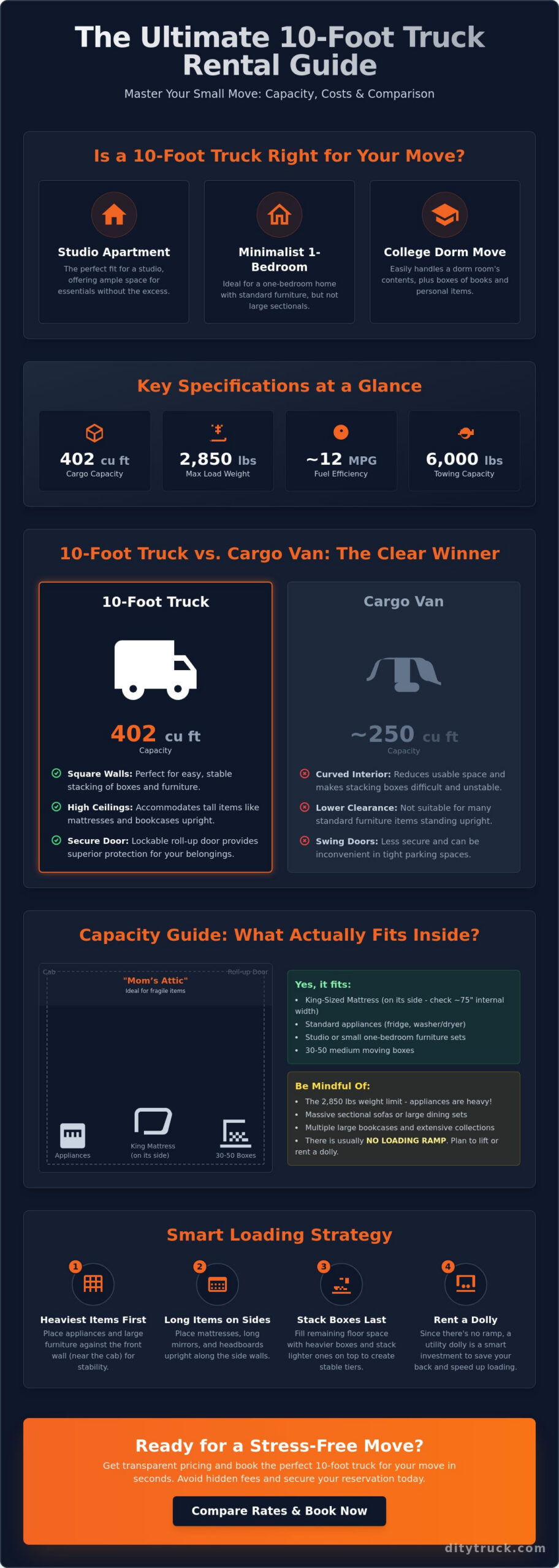
    A 10 foot truck rental is the primary choice for anyone moving a studio apartment or a college dorm. It is technically a small box truck. This design features a dedicated cargo area that is completely separate from the driver’s cab. This separation is the key advantage over a standard cargo van. You get a square, high-ceiling space that makes every inch of the 402 cubic feet usable. It’s the smallest vehicle in the rental fleet that feels like a real moving truck.

    Driving one isn’t intimidating. It handles much like a large SUV or a heavy-duty pickup. You can pull into most standard parking spots without blocking traffic. This makes it the go-to option for urban office equipment transfers or quick residential hops. It’s nimble. It’s fast to load. It’s the shortest path from “packed” to “moved.” If you are worried about navigating city streets, this size offers the best balance of capacity and control.

    The Small Move Specialist

    Most urban relocations rely on this model because of its footprint. It navigates narrow alleys where a 26-foot truck would get stuck. Security is a major factor here. These trucks usually come with a lockable roll-up door. This provides a tighter seal and better protection than the swing doors on a van. For a fully loaded trip, expect around 12 miles per gallon. It’s efficient enough for a cross-town trip without breaking the bank at the pump. It’s the smart choice for those who want to avoid overpaying for unused space.

    Standard Features and Equipment

    The cab is built for comfort during a stressful day. You’ll find cold air conditioning, an automatic transmission, and high-visibility mirrors. These mirrors are critical for managing the blind spots created by the box. The cargo area is where the real work happens. Most 10-foot trucks feature low-deck designs. This means the floor is closer to the ground. You won’t need a ramp for most items. You’ll also find non-slip flooring and multiple tie-down points to secure your furniture during transit.

    Don’t let the small size fool you. A 10 foot truck rental is often the smallest vehicle capable of towing a car trailer. Most models can handle up to 6,000 lbs of towing capacity. This allows you to move your apartment and your vehicle in a single trip. It’s a versatile tool for a high-stakes task. It simplifies your move by keeping everything in one place.

    Capacity Guide: What Actually Fits in a 10-Foot Rental?

    A 10 foot truck rental typically provides 402 cubic feet of usable space. This volume is nearly double that of a standard cargo van, giving you the vertical clearance needed for taller furniture. The weight limit is equally critical for your planning. Most 10-foot models support a maximum load capacity of approximately 2,850 lbs. Exceeding this limit can compromise vehicle handling and safety. It is helpful to review driver safety training concepts to understand how a heavy load changes your braking distance and turn radius.

    Industry experts often call this the “One-Bedroom” truck, but that label comes with a caveat. It is the perfect fit for a studio or a minimalist one-bedroom apartment. If your home includes a massive sectional sofa, a full dining set, and several bookcases, you will likely run out of floor space. While a standard cargo van offers roughly 250 cubic feet, a 10 foot truck rental provides up to 450 cubic feet of dedicated, square-walled storage depending on the specific fleet provider.

    The Furniture Checklist

    Can you fit a king-sized mattress? Yes, but dimensions matter. A standard king mattress is 76 inches wide, while the interior width of a common 10-foot truck is about 75 inches. You will need to stand the mattress on its side to make it fit. Large appliances like a refrigerator or a washer and dryer set are also manageable. Just be mindful of the 2,850 lb weight limit. Heavy appliances eat into your capacity quickly. For smaller items, you can safely stack between 30 and 50 medium-sized moving boxes if you utilize the full height of the cargo area. Before you start packing, check current availability to ensure you get the right size for your move date.

    Optimizing the Cargo Space

    Efficiency starts with your loading strategy. Place your heaviest items, like dressers or appliances, on the floor near the cab. This keeps the center of gravity stable. Use soft items like bags of clothes or pillows to fill the gaps and prevent shifting. Some 10-foot models include an overhead compartment known as “Mom’s Attic.” This space is ideal for fragile electronics or mirrors that need to stay away from heavier stacks.

    Prepare for the loading height. Most 10-foot trucks do not include a pull-out loading ramp. Instead, they feature a low-deck design that sits closer to the curb. This makes it easy to step in and out, but it requires more physical lifting for heavy items. Renting a utility dolly is a smart investment to bridge the gap between the ground and the truck floor. It saves your back and speeds up the process significantly.

    10-Foot Truck Rental: The Complete 2026 Buying & Comparison Guide

    10-Foot Truck vs. Cargo Van: Which One Wins?

    Choosing between a cargo van and a 10 foot truck rental often comes down to the shape of your cargo. A van has a curved interior and protruding wheel wells. This creates awkward gaps and wasted space. A 10-foot truck uses square walls and a flat floor. You can stack boxes flush against the sides. This maximizes every cubic foot of the interior. It’s the difference between a puzzle that fits perfectly and a pile of items that shifts during every turn.

    The loading threshold is another major factor for your physical energy. Most 10-foot trucks use a low-deck design. This sits significantly lower than a standard cargo van bumper. It makes stepping in and out with heavy boxes much easier. However, the driving experience varies. A cargo van feels like a large car. A 10-foot truck feels like a piece of machinery. You sit higher and rely more on your side mirrors. Reviewing consumer protection resources can help you stay informed about your rights and safety while operating these rental vehicles.

    Don’t let the base rate fool you. Both vehicles often start at a similar daily price point. The divergence happens with mileage and insurance costs. Vans usually get better gas mileage, which saves money on long-distance trips. Trucks carry more weight but cost more at the pump. Check the fine print on mileage fees before you book. Some companies charge a higher per-mile rate for the box truck than the van. It’s a trade-off between fuel economy and usable volume.

    When to Choose a Cargo Van

    A cargo van is the right tool for a single-item pickup. Think of a new sofa or a desk from a local store. It’s also the best choice if you need to park in a height-restricted garage. City alleys and tight parking spots are easier to navigate in a van. If you’re driving 500 miles with just a few boxes, the fuel savings and car-like handling make the van a winner for long-haul comfort.

    When the 10-Foot Truck is Essential

    A 10 foot truck rental is non-negotiable for mattresses. Anything larger than a twin mattress won’t fit comfortably in most vans without bending the frame. It’s also essential if you have more than 20 boxes. Stacking to the ceiling is only possible with the truck’s flat roof. One-way moves also favor the truck. Rental companies have massive fleets of 10-foot trucks for one-way trips, while vans are often restricted to local, “in-town” use only.

    Estimating Your 10-Foot Truck Rental Cost & Savings

    Understanding the total bill for a 10 foot truck rental requires looking past the advertised sticker price. While the base fee for a local move often stays low, the mileage and surcharges drive the final cost. Most companies charge a per-mile rate for local moves. These cents add up quickly if you are making multiple trips across town. For long-distance moves, mileage is usually bundled into a higher flat rate. This provides a sense of relief because it protects you from unpredictable costs during a cross-country journey.

    Drop-off locations create the biggest price swing in the industry. A local rental assumes you return the vehicle to the same branch. A one-way rental allows for a different destination but usually triggers a destination fee. This fee covers the logistics of getting the truck back to its home fleet. You should also consider protection plans. Most personal auto insurance policies exclude commercial box trucks. Paying for a damage waiver is often a smart move to replace high-stakes anxiety with simple clarity. It ensures you aren’t liable for expensive repairs after a minor scrape.

    Hidden Costs to Watch Out For

    Small charges can clutter your invoice at checkout if you aren’t prepared. Expect an environmental fee and local taxes to be added to your total. Fuel is the most common trap for DIY movers. If you return the truck with less gas than you started with, the rental company will charge a premium price per gallon to refill it. Always refill the tank to the exact level marked on your contract before you pull into the lot. Late returns are equally punishing. Being even one hour late can trigger a full extra day of rental fees plus additional insurance costs.

    How to Get the Best Rate

    Timing is your most powerful tool for financial honesty. Booking at least 14 days in advance is the standard rule for securing the lowest rates in 2026. Moving mid-week can save you up to 30% compared to a Saturday or Sunday. Demand peaks at the end of the month when leases expire. If you can move on a Tuesday in the middle of the month, you’ll see the most significant savings. The most effective way to find a deal is to compare real-time rates on DityTruck. Checking multiple brands side-by-side ensures you don’t overpay for the same 10-foot capacity.

    Compare and Book Your 10-Foot Truck with DityTruck

    DityTruck acts as your logistics shortcut. Finding a 10 foot truck rental shouldn’t require opening ten different browser tabs and entering the same data repeatedly. We aggregate real-time rates from major national providers into a single, clean view. You see every available option in seconds. This speed allows you to make decisions based on current data. No more guessing which provider has the best fleet capacity for your specific moving dates.

    We prioritize financial honesty through transparent pricing. Hidden fees are the primary source of stress for DIY movers. While many booking sites bury environmental charges or mileage surcharges in the fine print, DityTruck brings those costs to the surface immediately. You see the total impact on your wallet before you ever provide payment info. This clarity eliminates the “sticker shock” that often occurs at the rental counter. You get a side-by-side comparison that focuses on your bottom line.

    Our platform offers simplified booking for a high-stakes task. You can reserve your vehicle in minutes without the usual friction. We provide nationwide coverage across the entire United States. Whether you are navigating a dense urban center or a quiet rural town, we find the 10-foot availability you need. We track thousands of locations to ensure you aren’t left stranded because a local branch overbooked their inventory. It’s a reliable tool designed to save you time.

    Why Use a Comparison Service?

    Think of DityTruck as your smart assistant. We perform the heavy lifting of rate-checking so you can focus on packing. Using a comparison service helps you avoid brand bias. Rental providers often have internal quotas to fill for specific truck classes. We don’t. Our only goal is to find the truck that fits your cargo and your budget. For a broader view of your options, read our Moving Truck Rental: The Complete 2026 Comparison & Booking Guide.

    Ready to Move?

    Your move starts with a simple zip code. Enter your location and your dates to see 10 foot truck rental availability instantly. Locking in your 2026 rate today is the most effective way to avoid seasonal price hikes. Moving demand changes fast, and prices often climb as your date approaches. Secure your reservation now to ensure your moving budget stays exactly where you want it. Compare 10-Foot Truck Rental Rates Now and experience a friction-free path to your new home.

    Secure Your 2026 Move Today

    A successful move depends on choosing the right tools for the job. You now know that a 10 foot truck rental offers the square walls and low deck height needed to load a studio apartment with ease. You understand how to navigate the “One-Bedroom” rule. You are prepared to avoid the hidden traps of mileage fees and fuel surcharges that often clutter final invoices. Stripping away the complexity of logistics starts with having the right data at your fingertips before you ever sign a contract.

    Stop jumping between tabs and wasting time on brand-specific quotas. You can see real-time 2026 pricing and compare major brands side-by-side without any hidden booking fees. This level of transparency gives you the relief of a friction-free solution for your high-stakes task. Confident simplicity is possible when you act as your own savvy advocate. You deserve to know that you secured the best possible rate before the first box is even taped shut.

    Ready to simplify your logistics and move with clarity? Compare 10-Foot Truck Rental Rates in One Simple Step. Your move is manageable. Your budget is protected. Let’s get you on the road with confidence.

    Frequently Asked Questions

    Is a 10-foot truck big enough for a 1-bedroom apartment?

    It depends on your total inventory. A 10 foot truck rental is the standard choice for studio apartments or minimalist one-bedroom homes. If you own a large sectional sofa, a full dining set, and dozens of boxes, you might find the 402 cubic feet of space too restrictive. It’s best to measure your largest items before booking.

    Do 10-foot rental trucks have loading ramps?

    Most models in this class do not include a pull-out loading ramp. Instead, they utilize a low-deck design that sits much closer to the ground than larger freight trucks. This allows you to step directly into the cargo area. While this simplifies loading small boxes, you will need to lift heavy appliances manually or use a utility dolly.

    What is the gas mileage for a 10-foot moving truck?

    You can expect approximately 12 miles per gallon under normal driving conditions. This estimate changes based on the total weight of your cargo and whether you are driving in a city or on the highway. A fully loaded truck will always be less fuel-efficient than an empty one, so plan your fuel budget accordingly.

    Can I drive a 10-foot rental truck with a standard driver’s license?

    Yes, a standard Class D driver’s license is all you need. You don’t need a Commercial Driver’s License (CDL) to operate a 10 foot truck rental for personal use. Most rental companies require the primary driver to be at least 18 or 21 years old, so always verify age requirements during the booking process.

    Will a king-size bed fit in a 10-foot truck?

    A king-size mattress will fit if you stand it on its side. The interior width of these trucks is usually just under 80 inches, which accommodates the 76-inch width of a standard king mattress. Placing the mattress against the side wall is a smart way to save floor space for your bed frame and dresser.

    Is it cheaper to rent a 10-foot truck or a cargo van?

    The daily base rates are often very similar. A cargo van is usually cheaper for long-distance trips because it offers better fuel economy and lower mileage fees. However, the 10-foot truck is a better financial choice if you have tall furniture that won’t fit in a van’s curved interior, as it prevents the need for multiple trips.

    Do I need special insurance to rent a 10-foot moving truck?

    Your personal car insurance policy likely excludes commercial box trucks. It’s a common gap that catches many movers off guard. Purchasing a protection plan from the rental provider is the most efficient way to ensure you aren’t liable for accidental damage. Always call your insurance agent to confirm your specific coverage limits first.

    Can I tow my car behind a 10-foot rental truck?

    Yes, these trucks are designed for towing. Most 10-foot models feature a hitch capable of pulling up to 6,000 lbs. This allows you to attach a car carrier or a tow dolly for your personal vehicle. It is the smallest truck in most fleets that still offers the power needed to haul a car behind your cargo.