Tag: relocation guide

  • How to Pack a Moving Truck to Maximize Space: The 2026 Pro Guide

    How to Pack a Moving Truck to Maximize Space: The 2026 Pro Guide

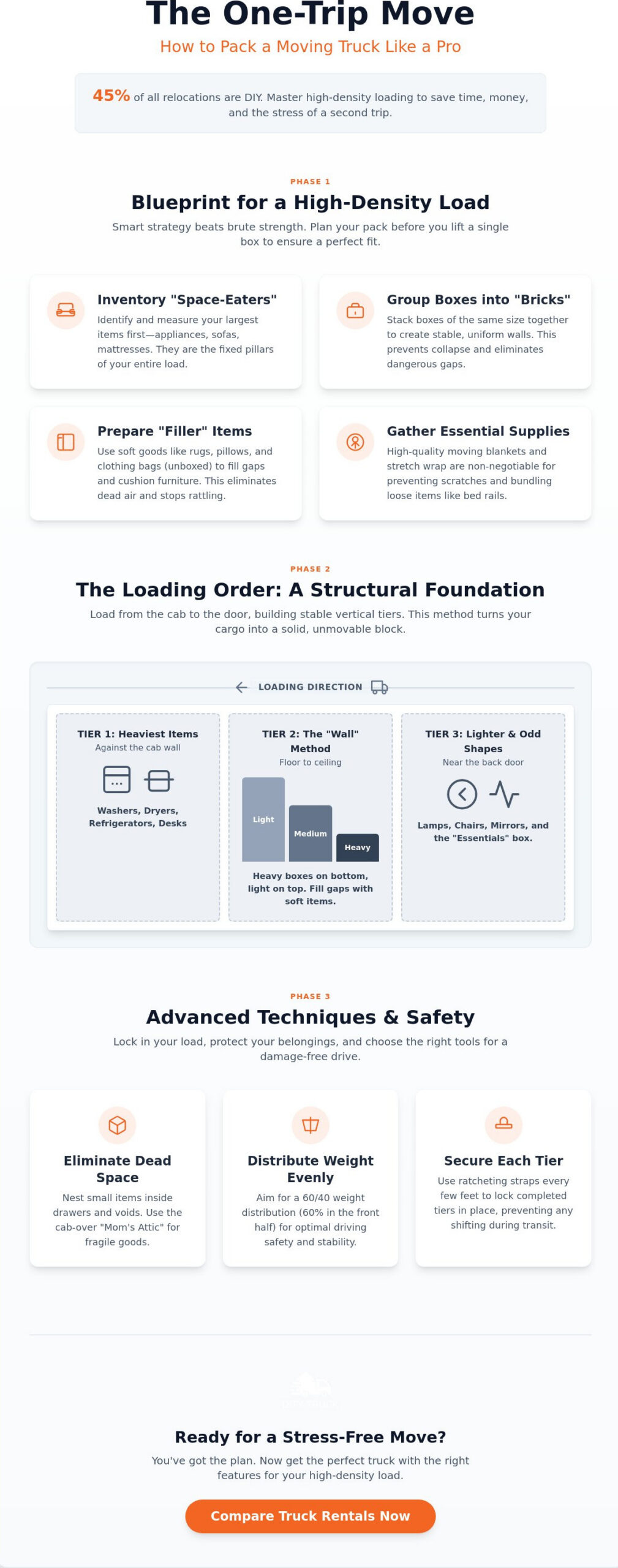
    What if the difference between a one-trip move and a midnight return to your old house wasn’t the size of the truck, but the way you stacked your boxes? Learning how to pack a moving truck to maximize space is the best way to avoid the mid-move panic of running out of room. With DIY moves making up 45% of all relocations, many people struggle with the same fear of damaging expensive furniture or facing the physical exhaustion of a second trip. You deserve a process that is simple, efficient, and cost-effective.

    This guide reveals the high-density loading secrets that professional movers use to create structural stability. You’ll learn how to build “cells” of cargo that utilize every vertical inch. This strategy allows you to rent a smaller truck and slash your total costs without leaving anything behind. We’ve stripped away the complexity to give you a clear, action-oriented plan. You’ll discover exactly how to secure your heaviest items and protect your valuables for a damage-free, single-trip move.

    Key Takeaways

    • Identify bulky appliances first. Group boxes by size to create uniform “bricks” for a solid foundation.
    • Master how to pack a moving truck to maximize space by building vertical “walls.” Work from the cab toward the back door to prevent shifting.
    • Eliminate dead space. Nest small items inside furniture drawers and use the cab-over compartment for fragile goods.
    • Distribute weight evenly. Use ratcheting straps every few feet to lock your progress and protect your belongings.
    • Compare truck features like low-loading decks. The right tools make high-density loading faster and much safer.

    Strategy First: The Blueprint for a High-Density Load

    Planning is the foundation of a successful move. It’s not about brute strength; it’s about smart geometry. If you want to know how to pack a moving truck to maximize space, you must start with a blueprint. This isn’t a suggestion. It’s a requirement for a single-trip move. A disorganized truck is a dangerous truck. Proper planning prevents damage and saves you from the exhaustion of reloading halfway through the day.

    First, inventory your “space-eaters.” These are the large, heavy items like appliances, mattresses, and sofas. They are the fixed points in your truck. You cannot change their shape, so you must plan the rest of the load around them. Think of them as the pillars of a building. They provide the stability needed for everything else to rest against safely.

    Boxes are your building blocks. Don’t just throw them in. Group them by size before you start loading. This allows you to create uniform “bricks” for your cargo walls. When boxes match in size, they distribute weight evenly. This prevents the bottom layers from collapsing under pressure. It also eliminates the small gaps that lead to load shifting during transit.

    Don’t forget your filler items. Soft goods like rugs, pillows, and bags of clothing shouldn’t be boxed. They are your secret gap-fillers. Use them to plug holes between furniture legs or on top of uneven stacks. This eliminates dead air and stops items from rattling. Every cubic inch counts when you’re trying to fit a whole life into one vehicle.

    Finally, get the right supplies. High-quality moving blankets and professional-grade stretch wrap are essential. Wrap your furniture to prevent scratches and dings. Use the wrap to bundle loose items like bed rails or curtain rods. This keeps your inventory organized and easy to stack. Without these tools, you’ll find yourself leaving gaps to avoid friction damage.

    The Home Inventory Audit

    Precision matters. Measure your widest and tallest items now. Knowing if a sofa needs to stand on end or lay flat changes your entire strategy. Label every box by its weight. This helps the loader place heavy items at the base and lighter ones on top. Always keep an “essentials” box. This should be the last thing loaded and the first thing out. It contains the items you’ll need the moment you arrive.

    Choosing the Correct Truck Capacity

    Picking the right size is a financial and safety decision. Many people choose a truck that is too large. This is a mistake. Empty space allows cargo to shift, which leads to broken glass and dented wood. Look for the actual usable cubic feet rather than just the nominal length. Use a moving truck rental comparison tool to see specific dimensions. This ensures you get a tight, secure fit for your belongings.

    The Loading Order: Building a Structural Foundation

    Loading a truck is like building a house. You need a solid foundation before you can add the roof. The most effective way to master how to pack a moving truck to maximize space is to treat the cargo area as a series of vertical zones. You don’t just toss things in. You build from the front wall, near the driver’s cab, and work your way to the back door. This front-to-back approach ensures that the center of gravity stays low and forward. It’s safer for driving and much better for your belongings.

    Place your heaviest appliances against the front wall. Washers, dryers, and refrigerators should be the first items loaded. This centralizes the weight over the truck’s axles. It prevents the back of the truck from sagging or swaying. When you follow official moving safety guidelines, you realize that weight distribution is about more than just space. It’s about road safety. A balanced truck is easier to handle on the highway and less likely to tip during sharp turns.

    Once the heavy items are in place, start building your walls. Think of each section of the truck as a vertical “tier.” You want to finish one wall from floor to ceiling before moving backward toward the door. This method is the secret to high-density loading. It turns your cargo into a solid block that resists movement. If you aren’t sure which vehicle has the best dimensions for this strategy, you can compare truck rentals to find a model with a high ceiling and plenty of floor space.

    The “Wall” Method Explained

    Think of this as a game of high-stakes Tetris. Stack heavy, sturdy boxes at the bottom to create a level base. These boxes act as the foundation for the entire tier. Place lighter, more fragile boxes on top to prevent crushing. If there’s a gap at the ceiling, use soft items like bags of bedding or pillows to “lock” the wall in place. This prevents the stack from toppling during a sudden stop. It also ensures you are using every cubic inch of available height.

    Handling Large Furniture and Appliances

    Always keep appliances upright. Never lay a refrigerator or washer on its side. Doing so can cause permanent damage to the mechanical components. Use furniture pads between every finished surface. Friction is your enemy during a long drive. Load long items like mattresses and sofas vertically along the side walls. This saves floor space for more boxes. Secure each tier with ratcheting straps as you go. This keeps the load tight and prevents the “domino effect” if one item shifts.
    How to Pack a Moving Truck to Maximize Space: The 2026 Pro Guide

    Advanced Tetris Techniques to Eliminate Dead Space

    Mastering how to pack a moving truck to maximize space requires looking beyond the obvious floor area. Professional loaders view the truck as a series of “loading cells.” These are small, self-contained units of cargo that lock together to prevent movement. To achieve high-density loading, you must eliminate every pocket of air. This process turns your belongings into a single, cohesive unit that won’t budge on the road.

    Start with the “Mom’s Attic.” This is the small compartment located directly over the truck’s cab. It’s the ideal spot for fragile items, electronics, or oddly shaped goods that don’t fit into standard box walls. By keeping these items separate from the main load, you protect them from being crushed by heavier furniture. It also frees up valuable floor space for your largest “space-eater” items discussed earlier.

    Nesting is your best tool for internal efficiency. Don’t move empty furniture. Place small, sturdy boxes inside wardrobes or dresser drawers. This utilizes volume that is already being transported. Similarly, you should disassemble whatever you can. Remove the legs from dining tables and desks. This transforms bulky, awkward furniture into flat panels. You can then slide these panels vertically against the side walls or between mattresses to save massive amounts of horizontal room.

    Area rugs are perfect gap-fillers. Roll them tightly and secure them with stretch wrap. These long, narrow cylinders fit perfectly into the “dead space” between the tops of sofas and the truck walls. Dead space is the primary cause of load shifting. If an item has room to move, it will. Filling these gaps ensures everything stays exactly where you put it. This attention to detail is the secret to a damage-free move.

    Utilizing Vertical Voids

    Look for “holes” throughout your load. There is often usable space under chair legs, inside trash cans, or within large decorative pots. Stuff these voids with soft goods. Linens, towels, and plush toys packed in garbage bags work best. This adds a layer of padding while simultaneously increasing your cargo density. It’s a simple way to fit more items into a smaller rental truck without needing a second trip.

    High-Density Stacking Rules

    Stability comes from consistency. Always stack “like with like.” Square boxes of the same size create the most stable columns. This prevents leaning and potential collapses. For delicate items like heavy mirrors or large paintings, place them vertically between mattresses or box springs. This provides a soft, pressurized environment that keeps them upright. Finally, never leave more than a 2-inch gap between the top of your load and the ceiling. A tight fit at the top locks the entire tier in place.

    Safety and Stability: Protecting Your Cargo and Your Drive

    Safety is the silent partner of efficiency. When you master how to pack a moving truck to maximize space, you aren’t just saving money. You’re protecting your life and your property. A high-density load only works if it stays put. If your “walls” crumble during a highway lane change, you’ve failed. Use ratcheting tie-down straps every 3 to 5 feet of progress. Bungee cords are insufficient for heavy furniture because they stretch under pressure. Straps lock the load to the truck’s internal rails. This ensures that a bump in the road doesn’t turn your boxes into projectiles. Every strap creates a checkpoint that prevents a small shift from becoming a total collapse.

    Balance is critical for more than just the cargo. Distribute weight evenly from side to side. An off-center load makes the truck lean during turns. This increases the risk of tipping and puts uneven wear on the tires. Keep the center of gravity low. Place your densest items, like book boxes, tool chests, and appliances, directly on the floor. Lighter items belong on top. This prevents the truck from feeling “top-heavy” at high speeds. Before you pull out of the driveway, double-check the clearance height of your rental truck. Most trucks have the height printed on the dashboard or near the side mirror. Knowing this number prevents catastrophic collisions with low bridges or gas station awnings.

    Weight Distribution and Axle Safety

    Aim for 60% of the total weight in the front half of the truck. This puts the burden on the steering axle and improves overall handling. Improperly balanced loads cause “trailer sway.” This is a dangerous fishtailing motion that can lead to a total loss of steering control. Check your rear tires before you leave. If they are squatting significantly more than the front tires, you need to redistribute the weight forward. A balanced truck is a predictable truck. It responds better to braking and stays stable in windy conditions.

    Securing the Final Tier

    The back of the truck is the most vulnerable area during transit. Use a cargo net or an X-pattern of heavy-duty straps for the very last wall of items. This prevents cargo from falling against the roll-up door. If items lean on the door, it can jam or even burst open when you arrive at your destination. Verify that nothing can slide forward toward the cab during sudden braking. This is why the structural integrity of your tiers is so important. Once your load is secure, you can book a moving truck with confidence, knowing you have a plan for a safe arrival.

    Streamlining the Move with the Right Rental Tools

    Your packing strategy is only as good as the vehicle you use. Choosing a truck with the right features makes the physical labor easier and the packing more efficient. When you understand how to pack a moving truck to maximize space, you realize that small details like deck height matter. A low-deck design reduces the angle of the ramp. This saves your legs when carrying heavy appliances and prevents items from tipping during the loading process. Wide ramps provide a more stable platform for dollies, allowing you to move larger stacks of boxes at once.

    Look for internal tie-down rails. These are essential for the “Wall” method we discussed earlier. Without these rails, you cannot properly secure your vertical tiers with ratcheting straps. You should also evaluate the cost-to-space ratio. A cargo van might seem cheaper, but if it forces you to make three trips, a box truck is the smarter financial choice. A single-trip move reduces fuel costs and saves hours of your time. Book your rental early. This ensures the specific size you planned for is actually available on moving day.

    Comparing Rental Features

    Check if the provider offers a loading ramp or a liftgate. A liftgate is a mechanical platform that does the heavy lifting for you. It’s perfect for heavy refrigerators or gun safes. You should also consider one way truck rentals for moving to avoid the stress of a return trip. This is especially helpful for long-distance relocations where mileage fees can add up quickly. Use DityTruck to filter for companies that include basic moving equipment like dollies and blankets in their base price.

    The Final Walkthrough

    Before you lock the door, do a final sweep. Check the “Mom’s Attic” one last time for forgotten small items or tools. Ensure all cabinet doors and dresser drawers are taped or wrapped shut to prevent them from swinging open. Double-check your ratcheting straps to make sure nothing loosened during the final packing stages. Secure the latch, lock the door, and drive with confidence. You’ve mastered how to pack a moving truck to maximize space, and your belongings are ready for the journey.

    Take Command of Your Moving Day

    Smart logistics build a successful move. You’ve mastered the wall method. You’ve centralized weight over the axles. These actions prevent cargo damage and keep your drive safe. Disassembling furniture and nesting boxes eliminates dead air. Mastering how to pack a moving truck to maximize space ensures a single-trip arrival with lower rental costs. You’ve replaced move-day stress with a professional blueprint. Every cubic inch now works for you.

    Your plan needs the right vehicle at an honest price. Skip the hidden fees and the endless phone calls. Compare real-time rates and book your moving truck on DityTruck today. Our platform provides transparent pricing from top national providers for both local and long-distance moves. It’s the fastest, most logical path to your new destination. Streamlined booking means you spend less time on logistics and more time on your new beginning.

    Move with confidence and clarity. You have the guide, the techniques, and the tools to make this your most efficient relocation yet. Your new space is waiting. You’ve got this.

    Frequently Asked Questions

    How do I calculate what size moving truck I actually need?

    You should base your truck size on the number of rooms you’re moving. A 10-foot truck typically handles a studio apartment, while a 26-foot truck is needed for a four-bedroom home. Don’t just look at the length. Compare the usable cubic feet to ensure your largest items fit. Choosing a slightly larger truck is often safer than trying to force a high-density load into a vehicle that’s too small.

    What is the most common mistake when packing a rental truck?

    The most frequent error is leaving air gaps between boxes and furniture. These empty pockets allow your belongings to rattle and shift during the drive. This movement is the primary cause of broken glassware and scratched wood. You must fill every void with “filler” items like pillows or rolled rugs to create a solid, immovable block of cargo. This is a critical step in the moving process.

    Is it better to stack boxes vertically or spread them across the floor?

    Vertical stacking is the only way to go. Spreading items across the floor wastes valuable height and leaves your cargo vulnerable to tipping. When you learn how to pack a moving truck to maximize space, you focus on building floor-to-ceiling tiers. This strategy uses the weight of the boxes to lock the lower layers in place, which increases overall stability and protects your fragile items.

    How do I protect my mattress and sofa from dirt and damage during the move?

    Use heavy-duty plastic mattress bags and professional furniture pads. Slide the mattress into the bag before it leaves the bedroom to prevent stains. For sofas, wrap the entire piece in moving blankets and secure them with stretch wrap. This creates a protective shell that resists friction damage and keeps dust out during the transition to your new home. Never skip this step for finished surfaces.

    Can I pack items inside my dresser drawers to save space?

    You can pack lightweight items like linens or clothing inside dresser drawers. This is a great way to use “nested” space that would otherwise be empty. However, don’t fill them with books or heavy electronics. Excessive weight can warp the drawer tracks or make the furniture dangerous to carry up the loading ramp. Keep the weight manageable to ensure the safety of the loaders.

    What should I do if I have leftover space at the end of the truck?

    Use ratcheting straps to create a “false wall” at the end of your load. Even if the truck isn’t full, your cargo must be tightly secured. If you leave items loose, they will slide toward the back door during acceleration. This can jam the roll-up door or cause items to fall out the moment you open the truck at your destination. A secure load is a safe load.

    How do I secure a load if the truck doesn’t have built-in tie-down rails?

    Check for floor-mounted D-rings if the walls lack rails. You can use these points to anchor heavy-duty rope or cargo nets over your tiers. If no anchors exist, build a “bulkhead” using your heaviest, most stable furniture. Pack everything else tightly against this bulkhead to minimize the room for movement. A tight, high-density load often stays in place through friction and smart geometry alone.

    What is the “60/40 rule” in moving truck weight distribution?

    The 60/40 rule dictates that 60% of the cargo weight should be in the front half of the truck, near the cab. Proper weight distribution is essential for highway safety. It prevents the back of the truck from fishtailing and ensures your front tires maintain enough grip for reliable steering. Following this rule is the best way to maintain control of the vehicle during your move.

  • Moving Truck Rental Age Requirements: The 2026 Essential Driver Guide

    Moving Truck Rental Age Requirements: The 2026 Essential Driver Guide

    What if your birth year is the most expensive part of your move? Many drivers assume a valid license is the only thing they need to get behind the wheel of a box truck. It’s frustrating to reach the rental counter only to discover you’re too young or owe hundreds in unexpected fees. Understanding moving truck rental age requirements is the first step to a stress-free relocation. You deserve clarity before you start packing the first box.

    This guide provides the definitive breakdown of age limits, daily surcharges, and the documentation you need in 2026. You’ll get clear cut-offs for major brands like U-Haul, Penske, and Budget. We also explain how to calculate your total cost including young driver fees and which forms of ID are mandatory. This article strips away the complexity of rental logistics so you can move with total confidence. We have organized the facts so you can find the best deal and avoid hidden hurdles at the pickup window.

    Key Takeaways

    • Most major providers set the minimum age at 18. Understanding moving truck rental age requirements helps you avoid being turned away at the counter.
    • Renters under 25 should prepare for daily “young driver” surcharges. These fees vary by brand and can significantly impact your total moving budget.
    • A valid, non-provisional driver’s license is non-negotiable. Using a major credit card in your name simplifies the process and bypasses stricter debit card hurdles.
    • Policies aren’t universal; some brands allow 16-year-olds to rent trailers while others require drivers to be 24 for specific truck sizes.
    • Use comparison tools to find real-time rates that include age-related fees. This ensures total price transparency before you book your rental.

    What is the Minimum Age for Moving Truck Rentals?

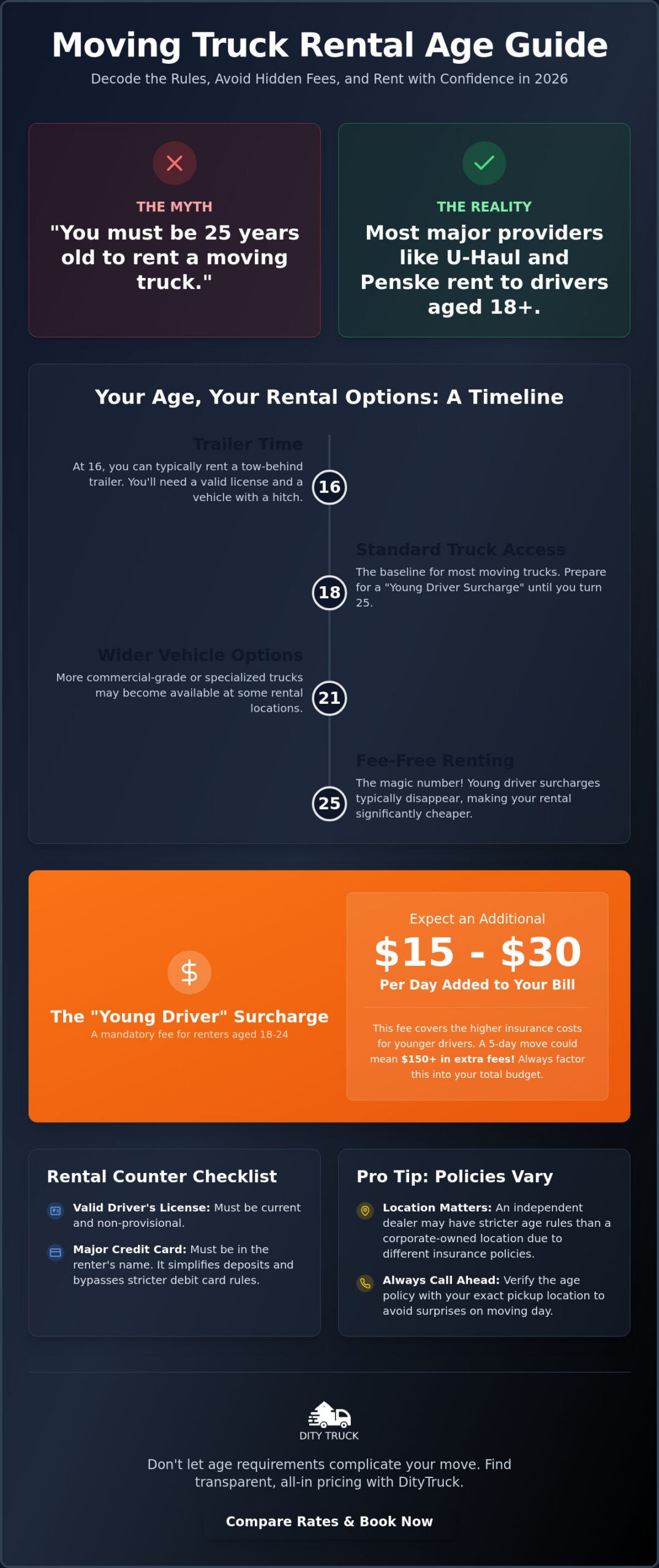
    Most people assume you must be 25 to rent any large vehicle. That is a myth. In reality, the moving truck rental age requirements for most major US providers start much lower. Standard companies like U-Haul and Penske allow 18-year-olds to book a truck. This lower barrier exists because moving is a critical necessity for college students and young adults. You don’t need to wait until your mid-twenties to handle a DIY relocation. However, you do need to understand the fine print before you arrive at the lot.

    These limits are built around risk management. Driving a heavy box truck requires more skill than steering a compact sedan. Insurance providers set these age floors to balance accessibility with safety. A quick look at a Car rental industry overview shows that while passenger car agencies often have strict age limits, the moving sector remains more flexible. This flexibility allows younger drivers to manage their own moves without hiring expensive full-service crews. It’s a practical solution for a high-stakes task.

    You might see variations between a corporate-owned hub and an independent dealer. Local shops sometimes have stricter policies. This happens if their specific insurance carrier demands it. It’s a common point of confusion. One location might say yes while another a few miles away says no. Always verify the policy with your exact pickup location. It’s the only way to ensure your reservation is honored when you show up with your boxes.

    The 18 vs. 21 vs. 25 Rule

    Age 18 is the baseline for standard moves. You can get a truck and get moving immediately. Once you hit 21, more commercial-grade options often become available. At 25, the logistical hurdles thin out completely. This is the magic number where “Young Driver Fees” typically disappear. It’s the age where your rental becomes significantly cheaper. If you’re under 25, you can still rent, but you’ll likely pay for the privilege.

    Trailers vs. Trucks: Different Age Floors

    Trailers are the exception to the rule. You can often rent a trailer at age 16. You just need a valid license and a vehicle equipped with a hitch. Rental companies view trailers as lower risk because you aren’t operating their engine or transmission. Trucks require more significant liability coverage. They are more expensive to repair and harder to maneuver. Because of this, the age floor for trucks stays firmly at 18. If you’re 16 or 17, a trailer is your only DIY option.

    The “Young Driver” Surcharge: Fees for Renters Under 25

    The base rate you see on a rental website is rarely the final price for younger drivers. If you are between 18 and 24, you will likely face a daily young driver surcharge. This fee is a standard part of moving truck rental age requirements across the industry. It is not a penalty for your driving record. It is a reflection of the increased insurance costs the rental company pays to cover younger operators. Expect to see these charges added to your bill every single day the truck is in your possession.

    Daily fees typically range from $15 to $30. While this might seem small, it adds up quickly on a multi-day cross-country move. These fees can significantly alter the cost to rent a 26 foot moving truck. A five-day rental could easily see an extra $150 in charges before you even turn the key. Transparency is key here. Knowing these fees in advance prevents sticker shock when you sign the contract.

    Why Do Rental Companies Charge Extra?

    Actuarial data drives these pricing decisions. Statistically, drivers under 25 have a higher risk profile for accidents and property damage. Rental companies pass these higher insurance premiums directly to the specific user group. There are exceptions for specific groups. For example, the U.S. Government Truck Rental Agreement often outlines different rules for military personnel on official orders. For most civilians, the fee is a non-negotiable part of the business model. It shifts the liability cost to the people most likely to use the insurance coverage.

    Calculating the Total Cost of a Student Move

    Don’t just look at the daily rental rate. A student move requires a more detailed math equation. Your actual daily total is the base rate plus mileage plus the young driver fee. A company with a low base rate might end up being more expensive than a competitor if the latter has a lower surcharge. Always calculate the full price for your specific age and duration. You can compare total costs side-by-side to see which brand offers the best value for your age group.

    There are a few ways to bypass these costs. Some corporate accounts or university partnerships include fee waivers. AAA memberships occasionally offer discounts that offset the surcharge. Always ask the rental agent if they have any active promotions for students or young professionals. Every dollar saved on fees is a dollar you can spend on your new home. Efficiency in planning leads to honesty in budgeting.

    Moving Truck Rental Age Requirements: The 2026 Essential Driver Guide

    Moving Truck Age Requirements by Major Brand

    Every rental company operates under its own set of rules. While the industry floor is generally 18, the specific moving truck rental age requirements vary significantly between household names. Choosing the wrong provider could result in a canceled reservation or a massive bill you didn’t expect. Efficiency starts with knowing which brands welcome younger drivers and which ones make you jump through extra hoops. These policies exist because insurance companies track teen driver crash statistics closely. Higher risk leads to stricter rental gates.

    Here is how the major players break down their age limits for 2026:

    • U-Haul: You can rent a truck at 18. If you only need a trailer, the age limit drops to 16. This makes them the most accessible option for students and very young movers.
    • Penske Truck Rental: The minimum age is 18. They are known for high-quality fleets, but they require more verification than their competitors.
    • Budget Truck Rental: In most states, Budget requires you to be 24. Some locations allow renters aged 18 to 23, but you should expect a daily surcharge of approximately $25.
    • Enterprise: They often reserve their larger commercial trucks for drivers 21 and older. Policies vary by branch, so calling ahead is mandatory.

    Brand-Specific Nuances for 2026

    Penske maintains a strict documentation policy for younger drivers. You cannot just show up with a license. You need two forms of government-issued ID to secure the keys. U-Haul remains a favorite for 18-year-olds because they rarely add a separate “young driver” daily fee to the base rate. They bake their risk into their standard protection plans instead. Budget’s approach is the most fragmented. Because many Budget locations are franchises, the fees and age cut-offs can change the moment you cross a state line. Always confirm your specific pickup location’s rules before you start packing.

    Selecting the Right Brand for Your Age

    If you are 18, U-Haul is your best bet. They have the lowest barriers and the most flexible trailer options. For those who are 21, Penske is often the superior choice. Their trucks are frequently newer and better maintained, which provides peace of mind for longer trips. If you are 24, look at Budget. You are just one year away from their major fee drop, and they often provide aggressive mid-week discounts to compete with the larger brands. Matching your age to the right brand’s sweet spot saves you time and money.

    Essential Documentation for Young Renters

    Showing up at the rental counter without the right paperwork is a fast way to stall your move. Meeting the basic moving truck rental age requirements is only half the battle. You need a specific set of documents to prove your identity and secure the vehicle. Companies use these records to verify your eligibility and manage their liability. Being organized at this stage ensures you get the keys without a headache. It turns a high-stakes task into a simple transaction.

    Prepare a folder with these mandatory items before you leave the house:

    • Valid Driver’s License: It must be a non-provisional, government-issued license. Learners’ permits are never accepted.
    • Secondary Identification: Bring a backup like a Passport, State ID, or Military ID. Many brands require two forms of ID for renters under 25.
    • Payment Method: You need a card that matches the name on your license. This ensures the person driving is the person paying.

    The Credit Card vs. Debit Card Hurdle

    Rental companies prefer credit cards for drivers under 25. It provides them with an easier path to handle potential damage claims or late fees. If you are 18 and using a debit card, expect higher hurdles. Most providers will hold a significantly larger deposit on your account. This can tie up hundreds of dollars you might need for gas or equipment. Debit cards may trigger a credit check for young renters. This extra step can slow down your pickup process or lead to a denial if your credit history is thin. Using a credit card is the shortest, most logical path to a quick checkout.

    Insurance Needs for Under-25 Drivers

    Your personal auto policy likely stops at the bumper of your own car. Most standard insurance plans do not cover a 26-foot box truck. These vehicles are classified differently than passenger cars. This gap in coverage makes the rental company’s damage waiver a smart investment. You should also consider Supplemental Liability Insurance (SLI). It protects you against third-party claims if an accident occurs. Adding Personal Accident and Cargo Protection provides extra peace of mind for your belongings. It ensures a single mistake doesn’t result in a total financial loss. Book your rental truck now to view the specific insurance options and document requirements for your age group.

    Compare Rates and Age Policies with DityTruck

    Finding the right vehicle shouldn’t feel like a part-time job. DityTruck strips away the stress of researching moving truck rental age requirements across dozens of websites. We aggregate real-time data from the biggest names in the business. This allows you to see every option in one clean interface. It turns a complex logistics puzzle into a simple, friction-free decision. You get the clarity you need to move forward with confidence. No more digging through fine print on outdated corporate pages.

    Our platform prioritizes financial honesty. We don’t just show you base rates that disappear at the counter. We include potential surcharges based on your specific profile. This transparency ensures there are no “young driver” surprises when you go to pick up your keys. Every fee is visible from the start. You can also dive deeper into specific trip types with our one way truck rentals for moving 2026 comparison guide. It’s the smartest assistant for your upcoming relocation. We do the heavy lifting behind the scenes so you don’t have to.

    Why Use a Comparison Tool?

    Manual searches take too much time. Checking five different brand websites leads to confusion and missed details. You might miss a location-specific surcharge or an age-based restriction. A centralized tool lets you see the total price, including all fees, before you commit any money. This is the only way to find the moving truck rental that actually fits your specific age bracket. You compare, you discover, and you save. It’s the shortest, most logical path to a successful booking. Efficiency is our obsession.

    A comparison tool also acts as a savvy consumer advocate. It highlights which companies are student-friendly and which ones impose the heaviest penalties. By seeing these policies side-by-side, you gain immediate leverage. You can choose the brand that values your business without overcharging for your birth year. This level of transparency is rare in the logistics industry. Understanding moving truck rental age requirements becomes effortless when the data is organized for you. We provide the tools. You make the smart choice.

    Booking Your 2026 Move Today

    Our interface is designed for speed. You enter your age, location, and dates. We provide instant results from Penske, Budget, and other major providers. There is no unnecessary fluff or decorative filler. You get direct, high-impact data that guides you through the process. The flow is methodical and logical. It prevents you from feeling overwhelmed by too many choices. We filter the noise so you only see what matters.

    Use DityTruck to find the most affordable truck for your age, fast. Your move starts with a single click, not a mountain of paperwork. We help you skip the line and the hidden fees. Secure your rental today and focus on the packing. We handle the numbers. You handle the move. It’s a friction-free solution for a high-stakes task.

    Secure Your Keys with Confidence

    Age shouldn’t be a barrier to your next chapter. You now have the facts on moving truck rental age requirements across all major 2026 providers. Remember that while 18 is the industry floor, the “magic number” for lower rates remains 25. Organizing your documentation early ensures a smooth experience at the rental counter. Bringing two forms of ID and a major credit card prevents unnecessary delays or high deposits. You are ready to take control of your move without the stress of hidden fees.

    Don’t waste hours clicking through individual brand websites. Efficiency is the key to a successful relocation. You can Compare Moving Truck Rates and Age Policies on DityTruck to see real-time rate aggregation. Our platform offers national coverage across all major brands with no hidden booking fees. We strip away the complexity so you can focus on your new destination. Get started today and find the most affordable truck for your specific age group. You’ve got this.

    Frequently Asked Questions

    Can an 18-year-old rent a U-Haul truck?

    Yes, an 18-year-old can rent a U-Haul truck with a valid driver’s license. U-Haul is the most flexible brand for young movers. They even allow 16-year-olds to rent trailers. You won’t face a separate daily surcharge for being under 25 at most locations. This makes them a top choice for student relocations. Always bring your license and a secondary form of ID to the counter to keep the pickup process simple.

    Does Penske charge a young driver fee for those under 25?

    No, Penske generally does not charge a daily young driver fee for renters aged 18 to 24. They focus on accessibility for all adult drivers. However, they are stricter with documentation than some competitors. You must provide two forms of government-issued identification. This ensures you meet all moving truck rental age requirements without the extra daily cost. It is a transparent approach that saves you money on long-distance moves.

    What documents do I need to rent a moving truck at 21?

    You need a valid driver’s license, a secondary ID, and a major credit card in your name. A passport or state-issued ID card works perfectly as your second document. If you use a debit card, be prepared for a higher deposit and a possible credit check. Having everything ready in a single folder speeds up the process. It gets you on the road faster and removes the stress of the rental counter.

    Can I rent a moving truck with a permit or provisional license?

    No, you cannot rent a truck with a permit or provisional license. Every major rental company requires a full, unrestricted driver’s license. This policy is non-negotiable for insurance reasons. If your license has “provisional” or “junior” printed on it, the agent will deny the rental. Wait until you have your permanent license before booking your vehicle. It is the only way to secure a legal contract and valid insurance coverage.

    Are there any rental truck companies that do not charge an under-25 fee?

    U-Haul and Penske are the primary companies that do not charge a daily under-25 fee for standard trucks. Budget and other franchise-based brands often add a surcharge of $25 or more per day. These fees can drastically change your total move budget. Always verify the total cost during the booking process. Using a comparison tool helps you identify these costs before you commit. It ensures financial honesty from the start of your journey.

    Can my parents rent the truck for me if I am under 18?

    No, your parents cannot rent a truck in their name for you to drive if you are under 18. The person who signs the contract must be the primary driver. They must meet the minimum age requirement of 18 for trucks. If you are under 18, you cannot legally operate these vehicles under a standard rental agreement. A parent can rent the truck and drive it for you. This is the safest and only legal path available.

    Is a CDL required to rent a large 26-foot box truck?

    No, a Commercial Driver’s License (CDL) is not required for a 26-foot box truck used for personal moves. These vehicles stay below the weight threshold for commercial regulations. You only need a standard Class D license to operate them. This applies to all major brands like Penske and Budget. Knowing the moving truck rental age requirements is more important than worrying about special licenses. Just focus on safe driving and wide turns.

  • Cost to Rent a 26 Foot Moving Truck: 2026 Pricing & Comparison Guide

    Cost to Rent a 26 Foot Moving Truck: 2026 Pricing & Comparison Guide

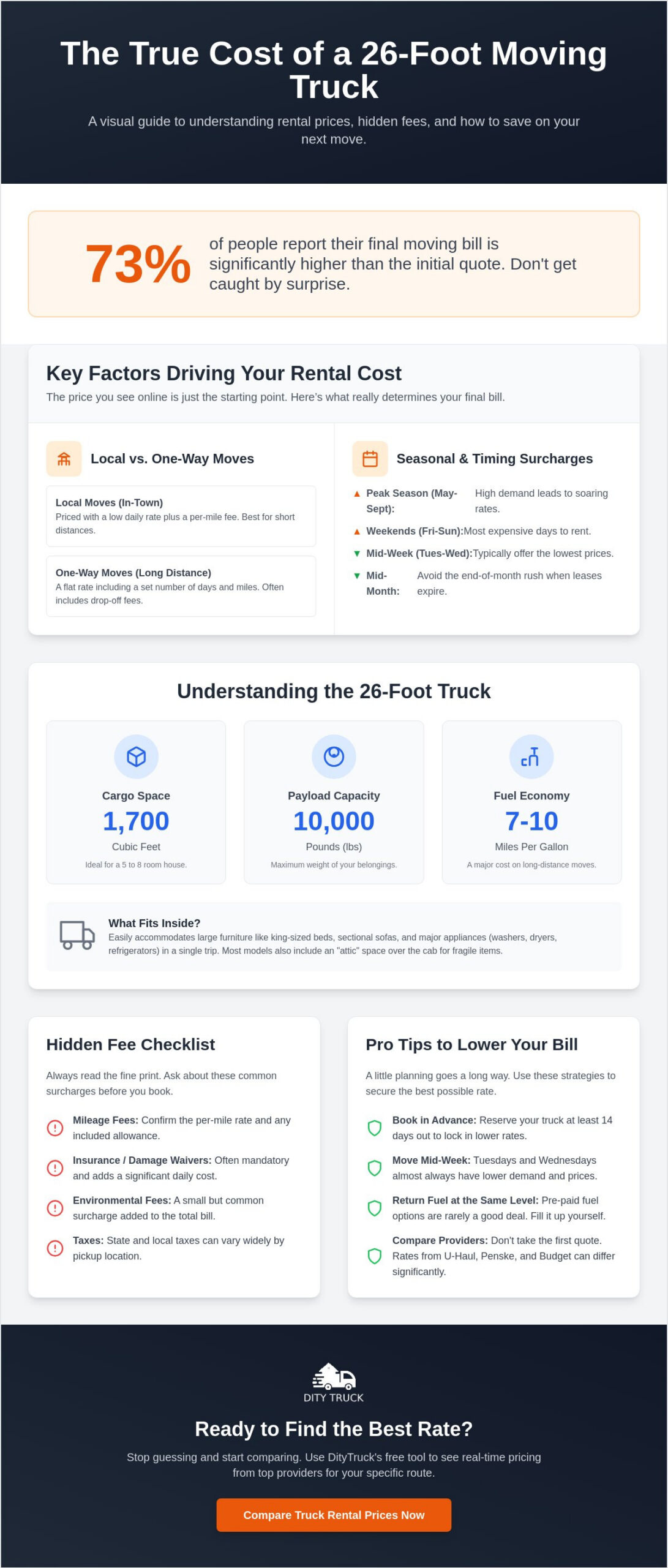
    Did you know that 73% of people find their final moving bill is significantly higher than they originally expected? It’s a common trap. You see a low daily rate online and think you’ve found a bargain. Then the mileage, insurance, and environmental fees start piling up. Understanding the true cost to rent a 26 foot moving truck requires looking past the base price. You need clarity on what you’re actually paying for before you sign the contract. We believe logistics should be simple and transparent.

    We know the frustration of hidden surcharges and the uncertainty of whether a truck is large enough for your belongings. This guide simplifies the math for you. We’ve analyzed the 2026 pricing models for top providers like U-Haul, Penske, and Budget to show you the real numbers. You’ll learn how to compare total costs, identify sneaky fees, and secure the best rate for your specific route. We’ve done the heavy lifting so you don’t have to. Let’s get your move on the road without the financial stress.

    Key Takeaways

    • Understand how local and long-distance pricing models fundamentally change your final bill.
    • Verify if 1,700 cubic feet of space is right for your home to ensure a smooth, single-trip move.
    • Calculate the total cost to rent a 26 foot moving truck by factoring in mileage, insurance, and fuel.
    • Use our hidden fee checklist to identify environmental surcharges and taxes before you commit.
    • Compare real-time data from top national providers to find the most efficient path to a low-cost booking.

    Factors Influencing the Cost to Rent a 26 Foot Moving Truck

    The sticker price on a rental website is just the beginning. Several variables shift the final numbers behind the scenes. Understanding how these factors interact helps you avoid overpaying. The cost to rent a 26 foot moving truck depends heavily on your route, your timing, and the current market demand. It is rarely a fixed number. Instead, it is a dynamic calculation based on how and when you move. We strip away the complexity to show you what actually drives the price.

    Local vs. One-Way Moving Rates

    Local moves follow a simple formula. You pay a small daily base fee. Every mile you drive adds to that total. This works well for short distances within the same city. However, if you are crossing state lines, you switch to a one-way model. This usually includes a flat rate for a specific number of days and a set mileage limit. One-way moves often include a drop-off fee. This fee covers the logistics of getting the vehicle back to a high-demand area. Checking an overview of the moving industry shows that these pricing structures vary significantly between providers. One-way pricing is generally more predictable, but local moves can become expensive quickly if you have a long drive between your old and new homes.

    Seasonal and Timing Surcharges

    Timing is everything. Moving during the summer months is almost always more expensive. High demand causes rates to spike between May and September. Availability also drops for the larger 26-foot inventory during this window. If you book last minute during peak season, expect a significant price penalty. Planning ahead is the best way to secure a reasonable rate.

    The day of the month also impacts your bottom line. Most leases end on the 30th or 31st. This creates a massive surge in demand at the end of every month. Moving on the 15th of the month can save you a substantial amount of money. Mid-week rentals are also cheaper than weekend bookings. Friday and Saturday are the most expensive days to pick up a truck. Demand drives price. Consider these timing factors to lower your expenses:

    • Mid-week pick-ups: Tuesday and Wednesday usually offer the lowest rates.
    • Mid-month moves: Avoiding the first and last days of the month reduces competition for vehicles.
    • Advance booking: Reserving your truck at least 14 days out helps lock in lower base rates.

    Duration also affects your daily average cost. Renting a truck for three days might cost less per day than a single-day rental. Companies prefer to keep their fleet moving. A longer booking ensures the truck is generating revenue consistently. However, always calculate the total cost. A lower daily average doesn’t help if you are paying for extra days you don’t actually need. Calculating the total cost to rent a 26 foot moving truck requires looking at all these variables simultaneously.

    Understanding the 26 Foot Truck: Capacity and Specs

    The 26-foot truck is the heavy hitter of the DIY logistics world. It is the largest standard vehicle you can operate without a commercial driver’s license. This size is designed for high-volume relocations. It typically offers between 1,600 and 1,700 cubic feet of internal storage space. This massive volume allows you to move an entire large household in a single trip. Efficiency starts with choosing the right tool for the job. Selecting a truck that is too small leads to multiple trips and doubled fuel costs. Choosing the 26-foot model ensures you have the headroom needed for a complex move.

    Weight limits are just as important as volume. Most 26-foot rental trucks have a payload capacity of approximately 10,000 lbs. Exceeding this threshold strains the engine and reduces safety. It also creates a massive drag on your fuel economy. You can expect a fully loaded medium-duty chassis to get between 7 and 10 miles per gallon. Fuel is a significant variable in the total cost to rent a 26 foot moving truck. If you are moving across the country, those gallons add up quickly. Knowing your consumer rights and responsibilities regarding weight and liability is essential before you hit the road.

    What Fits Inside a 26-Foot Truck?

    Visualize the contents of a five to eight-room house. This truck easily accommodates large sectional sofas, king-sized bedroom sets, and major appliances like washers and dryers. Most models feature an overhead compartment above the cab. Use this “attic” space for fragile items, electronics, or small boxes that need to stay away from heavy furniture. Before you book, check current availability to ensure a truck with these specific dimensions is ready for your move date.

    Technical Specs for the Driver

    Driving a vehicle of this size requires a different mindset. Clearance height is your primary concern. These trucks often stand 13 feet tall or higher. You must actively watch for low-hanging trees and bridge clearances. Loading features also vary by provider. You will typically find either a low-profile deck with a pull-out ramp or a hydraulic lift gate. Lift gates are superior for heavy appliances, while ramps are faster for box-heavy moves. Most 26-foot trucks use large fuel tanks, often holding 50 to 60 gallons. Be prepared for the cost of filling a tank of this size, especially if the truck requires diesel fuel for better torque. Calculating these technical needs helps you understand the true cost to rent a 26 foot moving truck beyond just the daily rate.

    Cost to Rent a 26 Foot Moving Truck: 2026 Pricing & Comparison Guide

    Comparing Major Providers: Side-by-Side Cost Structures

    Every major brand uses a different math equation to calculate your final bill. One provider might look cheap on the landing page but cost double by the time you return the keys. Comparing the total cost to rent a 26 foot moving truck requires a side-by-side look at how these companies actually structure their fees. We prioritize transparency so you can make a decision based on the bottom line, not just the advertised rate. Each provider targets a specific type of mover, and finding your match is the fastest way to save money. To accurately compare moving truck rental prices across all major brands, you need to look at the total cost of ownership rather than just the base quote.

    Price Models by Brand

    U-Haul markets their 26-foot vehicle as the “Super Mover” for large families. Their strategy relies on a very low daily base rate for local moves. However, their variable mileage costs are often higher than the industry average. If you are driving more than a few dozen miles, that low base rate disappears. It’s a model built for speed and short-distance efficiency. If your new home is just across town, they are hard to beat.

    Penske takes the opposite approach. They focus on fleet reliability and transparent pricing for long-distance relocations. Their base rates are typically higher for local use, but the advantage comes during one-way moves. Penske frequently includes unlimited mileage on these rentals. This makes them a top choice for cross-country trips where per-mile fees would otherwise spiral out of control. Their trucks are also generally newer, which offers peace of mind for long hauls.

    Budget Truck Rental occupies the middle ground. They are often the best choice for medium-distance moves. They offer frequent promotional codes and “Pay Now” discounts that reduce the total significantly. It’s always worth checking for active coupons before you commit to a reservation. Their pricing is aggressive, but inventory can be tighter in certain regions compared to the larger competitors. For a detailed breakdown of how these two major brands stack up on fees, availability, and per-mile value, our U-Haul vs Budget truck rental comparison guide walks you through every key difference.

    Inventory Availability Issues

    The 26-foot truck is the first to disappear from rental lots. Families with three to four bedrooms rely on this specific size to avoid making multiple trips. During peak moving season, demand often exceeds supply. This creates a risk for your move day. Many providers offer “guaranteed” reservations, but these are often subject to local availability. If a previous renter returns a truck late, your reservation might not be honored. This is a common pain point that many DIY movers don’t anticipate.

    Protect yourself by checking consumer protection from moving fraud resources to understand your rights when a company fails to deliver. You should also use current moving truck rental prices to benchmark any quote you receive. If a price seems too good to be true, it likely lacks the inventory backing to support it. Always get at least three quotes to see the full market range. This ensures you find the most reliable path for the actual cost to rent a 26 foot moving truck.

    Avoiding Hidden Fees and Reducing Your Total Bill

    The advertised price is a placeholder. The real math happens in the fine print. To find the true cost to rent a 26 foot moving truck, you must look beyond the base rate. Environmental fees, license recovery charges, and local taxes can inflate your bill by 15% or more instantly. These aren’t optional. They are standard industry surcharges that many movers overlook until the final checkout screen. We help you spot these costs early so you can budget with total confidence.

    Insurance is another major variable. Most personal auto policies exclude vehicles over a certain weight. A 26-foot truck almost always exceeds this limit. Protection plans are essential for peace of mind. Expect to pay for supplemental coverage to avoid massive out-of-pocket costs in the event of an accident. It’s a necessary expense that protects your bank account from high-stakes risks. Always verify your existing coverage before saying yes to the rental counter’s most expensive plan.

    Fuel and equipment rentals also add up. These trucks have massive fuel tanks. Returning the vehicle even slightly under the original fuel level triggers a high-premium refilling fee. Companies often charge double the local gas price per gallon. Similarly, dollies and furniture pads are rarely included. These small additions can easily add $50 to your total. Plan your loading strategy ahead of time to avoid last-minute equipment rentals at the counter. Efficient planning is the shortest path to a lower bill.

    Decoding the Fine Print

    Cleaning fees are avoidable. A 10-minute sweep of the cargo area saves you a $50 penalty. Late returns are even more punishing. Many providers follow a strict “one-hour-equals-one-day” rule. If you are 65 minutes late, you pay for a full extra 24 hours. Manage your time carefully to keep your budget intact. These small operational details determine whether your move stays affordable or becomes a financial burden.

    Pro Tips for Lowering the Cost

    Strategy is your best tool for savings. Booking 4 to 6 weeks in advance allows you to lock in lower rates before inventory tightens. Use our moving truck rental cost guide to benchmark your quotes against industry averages. If your schedule is flexible, use the “Flex Date” strategy. Moving your reservation by just 48 hours can save hundreds of dollars by avoiding peak weekend demand. Leveraging AAA, military, or student discounts can also shave another 10% off the total cost to rent a 26 foot moving truck. Ready to find the most honest price? Compare rates and book your truck today to ensure you get the best possible deal without the hidden surprises.

    Finding the Best Rates with DityTruck’s Comparison Tool

    Manual searching is the slowest way to find a cheap moving truck rental. You shouldn’t spend your afternoon jumping between five different browser tabs. Each provider has a different interface and a different way of hiding fees until the final screen. This traditional approach is frustrating and inefficient. We’ve built a better path. Our tool aggregates real-time data from top national providers into one simple view. You see the total cost to rent a 26 foot moving truck before you enter any credit card information. It is about transparency and speed. We act as your smart assistant, doing the heavy lifting behind the scenes so you can focus on the move itself.

    Our platform is designed for quick scanning and rapid decision-making. You get a direct look at the same 26-foot inventory offered by major brands, but without the marketing fluff. We prioritize financial honesty. By seeing every quote side-by-side, you can immediately identify which brand offers the best value for your specific route. There is no guesswork involved. You get the facts, you make the choice, and you move forward with confidence. It is the shortest, most logical path between your problem and a resolution.

    The DityTruck Advantage

    Efficiency is our obsession. Our streamlined interface is built specifically for fast-paced move planning. You don’t have to worry about missing a better deal because you didn’t check a specific site. We provide a friction-free solution for a high-stakes task. You get direct access to the latest pricing models and availability. This is essential for large vehicles like the 26-foot truck, which often sells out weeks in advance. Securing your inventory quickly is the only way to ensure your move stays on schedule. We provide the clarity you need to act fast.

    Secure Your 26-Foot Truck Today

    2026 is the year of the smart mover. You can use technology to beat inflation and avoid the “last-minute booking” penalties we discussed earlier. Our “One Click” reservation process saves you time and protects your budget. The steps are simple. Enter your zip code, compare the verified rates, and book the best option. You’ll see the cost to rent a 26 foot moving truck laid out clearly with no hidden surprises. It’s a reliable way to manage your logistics without the typical stress. Compare 26-foot truck rates now on DityTruck and lock in your vehicle today. Don’t leave your move day to chance. Use the tool that prioritizes your time and your peace of mind.

    Take Control of Your Moving Budget

    Planning a large-scale relocation doesn’t have to be a financial mystery. You now understand that the true cost to rent a 26 foot moving truck depends on more than just a daily rate. Success comes from accounting for mileage, timing your booking to avoid peak surcharges, and verifying your insurance coverage before you arrive at the lot. These small steps eliminate the friction and high-stakes stress of moving day. You have the tools to avoid hidden fees and secure a vehicle that fits your entire home in one trip.

    We provide real-time rates from Penske, Budget, and U-Haul to ensure you never overpay. Our platform offers no-nonsense pricing transparency that is trusted by thousands of DIY movers annually. Stop jumping between tabs and start making informed decisions. Compare 26-Foot Truck Rental Rates in Seconds to find the most efficient path for your journey. Your move is a major milestone. We are here to make sure the logistics are the easiest part of the process. You’ve got this.

    Frequently Asked Questions

    How much does it cost to rent a 26-foot truck for a local move?

    Local rentals often start with a low base daily rate plus a per-mile charge. While a base rate might look like a bargain, the final bill includes mileage, taxes, and environmental fees. For a typical cross-town move, the total expense usually ranges between $150 and $450 depending on the distance driven and fuel consumed. Always calculate the total cost to rent a 26 foot moving truck by adding these variables to the initial quote.

    Do I need a special license (CDL) to drive a 26-foot moving truck?

    You don’t need a special Commercial Driver’s License (CDL) to operate a 26-foot moving truck. These vehicles are classified as medium-duty and are designed for personal use by anyone with a standard driver’s license. However, you must be at least 18 or 21 years old depending on the rental provider’s specific policy. Always verify the age requirements and have a valid license ready at pick-up to ensure a smooth start to your move.

    What is the gas mileage of a 26-foot moving truck when fully loaded?

    A fully loaded 26-foot moving truck typically gets between 7 and 10 miles per gallon. This low fuel economy is due to the vehicle’s heavy-duty chassis and the weight of your belongings. If you are driving through mountainous terrain or facing heavy winds, your mileage may drop further. Plan your fuel budget accordingly, especially for long-distance trips where you will need to refuel several times. It is a major factor in your total budget.

    Can a 26-foot truck tow my car behind it?

    Yes, most 26-foot trucks are equipped with a hitch and can tow a car trailer or a tow dolly. This is a popular option for families moving long distances who need to transport a personal vehicle alongside their household goods. Keep in mind that towing increases your fuel consumption and requires more careful maneuvering. You will also pay an additional daily fee for the trailer or dolly rental itself, which adds to the bottom line.

    How many rooms of furniture will a 26-foot truck actually hold?

    A 26-foot truck is designed to hold the contents of a 5 to 8-room house. This includes large appliances, multiple bedroom sets, and dozens of boxes. With approximately 1,600 to 1,700 cubic feet of space, it is the largest standard DIY option available. If you have a 4-bedroom home with a garage or basement, this is usually the only size that allows for a single trip without leaving items behind.

    Is insurance mandatory when renting a 26-foot truck?

    While rental companies don’t always mandate their specific insurance, having coverage is essential. Most personal auto policies and credit card benefits do not cover large commercial-style trucks. If you decline the provider’s protection plan, you are personally liable for any damage to the vehicle or third-party property. Buying a basic protection plan is the safest way to avoid high-stakes financial risks during your move. It provides clarity and peace of mind.

    Are there any hidden fees I should look for in a 26-foot truck quote?

    Look for environmental fees, license recovery charges, and road safety surcharges in the fine print. These costs are standard in the industry but are rarely featured in the bolded daily rate. You should also check for cleaning fees and equipment rental costs for dollies or furniture pads. Understanding these extras helps you determine the actual cost to rent a 26 foot moving truck before you reach the checkout counter for payment.

    What happens if I return the 26-foot truck late?

    Returning a truck late usually triggers a full extra day’s charge. Most companies follow a strict schedule because another customer likely has the vehicle reserved immediately after you. If you are even an hour past your deadline, expect to pay for another 24-hour period plus any applicable insurance and tax fees. Contact the rental office immediately if you anticipate a delay. Some locations might offer a small grace period if you communicate early.