
Did you know that 73% of people find their final moving bill is significantly higher than they originally expected? It’s a common trap. You see a low daily rate online and think you’ve found a bargain. Then the mileage, insurance, and environmental fees start piling up. Understanding the true cost to rent a 26 foot moving truck requires looking past the base price. You need clarity on what you’re actually paying for before you sign the contract. We believe logistics should be simple and transparent.
We know the frustration of hidden surcharges and the uncertainty of whether a truck is large enough for your belongings. This guide simplifies the math for you. We’ve analyzed the 2026 pricing models for top providers like U-Haul, Penske, and Budget to show you the real numbers. You’ll learn how to compare total costs, identify sneaky fees, and secure the best rate for your specific route. We’ve done the heavy lifting so you don’t have to. Let’s get your move on the road without the financial stress.
Key Takeaways
- Understand how local and long-distance pricing models fundamentally change your final bill.
- Verify if 1,700 cubic feet of space is right for your home to ensure a smooth, single-trip move.
- Calculate the total cost to rent a 26 foot moving truck by factoring in mileage, insurance, and fuel.
- Use our hidden fee checklist to identify environmental surcharges and taxes before you commit.
- Compare real-time data from top national providers to find the most efficient path to a low-cost booking.
Factors Influencing the Cost to Rent a 26 Foot Moving Truck
The sticker price on a rental website is just the beginning. Several variables shift the final numbers behind the scenes. Understanding how these factors interact helps you avoid overpaying. The cost to rent a 26 foot moving truck depends heavily on your route, your timing, and the current market demand. It is rarely a fixed number. Instead, it is a dynamic calculation based on how and when you move. We strip away the complexity to show you what actually drives the price.
Local vs. One-Way Moving Rates
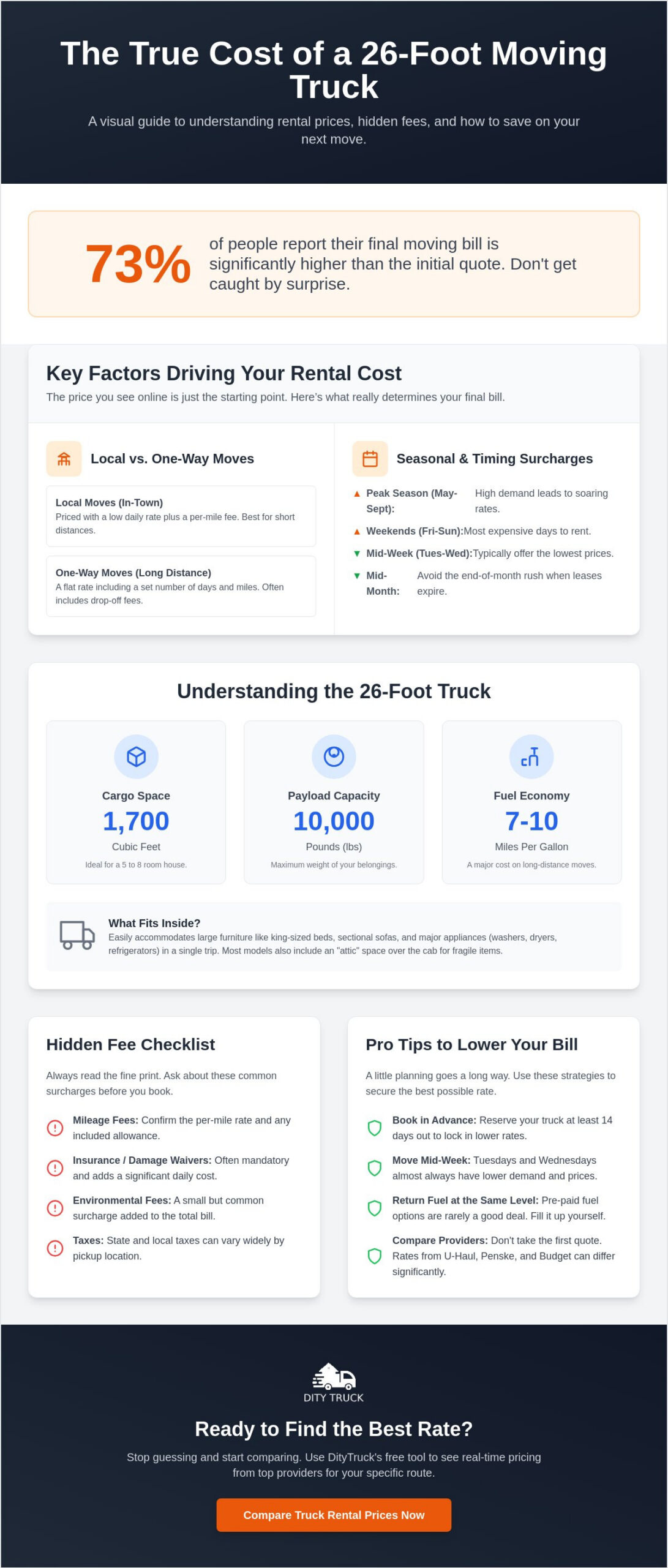
Local moves follow a simple formula. You pay a small daily base fee. Every mile you drive adds to that total. This works well for short distances within the same city. However, if you are crossing state lines, you switch to a one-way model. This usually includes a flat rate for a specific number of days and a set mileage limit. One-way moves often include a drop-off fee. This fee covers the logistics of getting the vehicle back to a high-demand area. Checking an overview of the moving industry shows that these pricing structures vary significantly between providers. One-way pricing is generally more predictable, but local moves can become expensive quickly if you have a long drive between your old and new homes.
Seasonal and Timing Surcharges
Timing is everything. Moving during the summer months is almost always more expensive. High demand causes rates to spike between May and September. Availability also drops for the larger 26-foot inventory during this window. If you book last minute during peak season, expect a significant price penalty. Planning ahead is the best way to secure a reasonable rate.
The day of the month also impacts your bottom line. Most leases end on the 30th or 31st. This creates a massive surge in demand at the end of every month. Moving on the 15th of the month can save you a substantial amount of money. Mid-week rentals are also cheaper than weekend bookings. Friday and Saturday are the most expensive days to pick up a truck. Demand drives price. Consider these timing factors to lower your expenses:
- Mid-week pick-ups: Tuesday and Wednesday usually offer the lowest rates.
- Mid-month moves: Avoiding the first and last days of the month reduces competition for vehicles.
- Advance booking: Reserving your truck at least 14 days out helps lock in lower base rates.
Duration also affects your daily average cost. Renting a truck for three days might cost less per day than a single-day rental. Companies prefer to keep their fleet moving. A longer booking ensures the truck is generating revenue consistently. However, always calculate the total cost. A lower daily average doesn’t help if you are paying for extra days you don’t actually need. Calculating the total cost to rent a 26 foot moving truck requires looking at all these variables simultaneously.
Understanding the 26 Foot Truck: Capacity and Specs
The 26-foot truck is the heavy hitter of the DIY logistics world. It is the largest standard vehicle you can operate without a commercial driver’s license. This size is designed for high-volume relocations. It typically offers between 1,600 and 1,700 cubic feet of internal storage space. This massive volume allows you to move an entire large household in a single trip. Efficiency starts with choosing the right tool for the job. Selecting a truck that is too small leads to multiple trips and doubled fuel costs. Choosing the 26-foot model ensures you have the headroom needed for a complex move.
Weight limits are just as important as volume. Most 26-foot rental trucks have a payload capacity of approximately 10,000 lbs. Exceeding this threshold strains the engine and reduces safety. It also creates a massive drag on your fuel economy. You can expect a fully loaded medium-duty chassis to get between 7 and 10 miles per gallon. Fuel is a significant variable in the total cost to rent a 26 foot moving truck. If you are moving across the country, those gallons add up quickly. Knowing your consumer rights and responsibilities regarding weight and liability is essential before you hit the road.
What Fits Inside a 26-Foot Truck?
Visualize the contents of a five to eight-room house. This truck easily accommodates large sectional sofas, king-sized bedroom sets, and major appliances like washers and dryers. Most models feature an overhead compartment above the cab. Use this “attic” space for fragile items, electronics, or small boxes that need to stay away from heavy furniture. Before you book, check current availability to ensure a truck with these specific dimensions is ready for your move date.
Technical Specs for the Driver
Driving a vehicle of this size requires a different mindset. Clearance height is your primary concern. These trucks often stand 13 feet tall or higher. You must actively watch for low-hanging trees and bridge clearances. Loading features also vary by provider. You will typically find either a low-profile deck with a pull-out ramp or a hydraulic lift gate. Lift gates are superior for heavy appliances, while ramps are faster for box-heavy moves. Most 26-foot trucks use large fuel tanks, often holding 50 to 60 gallons. Be prepared for the cost of filling a tank of this size, especially if the truck requires diesel fuel for better torque. Calculating these technical needs helps you understand the true cost to rent a 26 foot moving truck beyond just the daily rate.
Comparing Major Providers: Side-by-Side Cost Structures
Every major brand uses a different math equation to calculate your final bill. One provider might look cheap on the landing page but cost double by the time you return the keys. Comparing the total cost to rent a 26 foot moving truck requires a side-by-side look at how these companies actually structure their fees. We prioritize transparency so you can make a decision based on the bottom line, not just the advertised rate. Each provider targets a specific type of mover, and finding your match is the fastest way to save money. To accurately compare moving truck rental prices across all major brands, you need to look at the total cost of ownership rather than just the base quote.
Price Models by Brand
U-Haul markets their 26-foot vehicle as the “Super Mover” for large families. Their strategy relies on a very low daily base rate for local moves. However, their variable mileage costs are often higher than the industry average. If you are driving more than a few dozen miles, that low base rate disappears. It’s a model built for speed and short-distance efficiency. If your new home is just across town, they are hard to beat.
Penske takes the opposite approach. They focus on fleet reliability and transparent pricing for long-distance relocations. Their base rates are typically higher for local use, but the advantage comes during one-way moves. Penske frequently includes unlimited mileage on these rentals. This makes them a top choice for cross-country trips where per-mile fees would otherwise spiral out of control. Their trucks are also generally newer, which offers peace of mind for long hauls.
Budget Truck Rental occupies the middle ground. They are often the best choice for medium-distance moves. They offer frequent promotional codes and “Pay Now” discounts that reduce the total significantly. It’s always worth checking for active coupons before you commit to a reservation. Their pricing is aggressive, but inventory can be tighter in certain regions compared to the larger competitors. For a detailed breakdown of how these two major brands stack up on fees, availability, and per-mile value, our U-Haul vs Budget truck rental comparison guide walks you through every key difference.
Inventory Availability Issues
The 26-foot truck is the first to disappear from rental lots. Families with three to four bedrooms rely on this specific size to avoid making multiple trips. During peak moving season, demand often exceeds supply. This creates a risk for your move day. Many providers offer “guaranteed” reservations, but these are often subject to local availability. If a previous renter returns a truck late, your reservation might not be honored. This is a common pain point that many DIY movers don’t anticipate.
Protect yourself by checking consumer protection from moving fraud resources to understand your rights when a company fails to deliver. You should also use current moving truck rental prices to benchmark any quote you receive. If a price seems too good to be true, it likely lacks the inventory backing to support it. Always get at least three quotes to see the full market range. This ensures you find the most reliable path for the actual cost to rent a 26 foot moving truck.
Avoiding Hidden Fees and Reducing Your Total Bill
The advertised price is a placeholder. The real math happens in the fine print. To find the true cost to rent a 26 foot moving truck, you must look beyond the base rate. Environmental fees, license recovery charges, and local taxes can inflate your bill by 15% or more instantly. These aren’t optional. They are standard industry surcharges that many movers overlook until the final checkout screen. We help you spot these costs early so you can budget with total confidence.
Insurance is another major variable. Most personal auto policies exclude vehicles over a certain weight. A 26-foot truck almost always exceeds this limit. Protection plans are essential for peace of mind. Expect to pay for supplemental coverage to avoid massive out-of-pocket costs in the event of an accident. It’s a necessary expense that protects your bank account from high-stakes risks. Always verify your existing coverage before saying yes to the rental counter’s most expensive plan.
Fuel and equipment rentals also add up. These trucks have massive fuel tanks. Returning the vehicle even slightly under the original fuel level triggers a high-premium refilling fee. Companies often charge double the local gas price per gallon. Similarly, dollies and furniture pads are rarely included. These small additions can easily add $50 to your total. Plan your loading strategy ahead of time to avoid last-minute equipment rentals at the counter. Efficient planning is the shortest path to a lower bill.
Decoding the Fine Print
Cleaning fees are avoidable. A 10-minute sweep of the cargo area saves you a $50 penalty. Late returns are even more punishing. Many providers follow a strict “one-hour-equals-one-day” rule. If you are 65 minutes late, you pay for a full extra 24 hours. Manage your time carefully to keep your budget intact. These small operational details determine whether your move stays affordable or becomes a financial burden.
Pro Tips for Lowering the Cost
Strategy is your best tool for savings. Booking 4 to 6 weeks in advance allows you to lock in lower rates before inventory tightens. Use our moving truck rental cost guide to benchmark your quotes against industry averages. If your schedule is flexible, use the “Flex Date” strategy. Moving your reservation by just 48 hours can save hundreds of dollars by avoiding peak weekend demand. Leveraging AAA, military, or student discounts can also shave another 10% off the total cost to rent a 26 foot moving truck. Ready to find the most honest price? Compare rates and book your truck today to ensure you get the best possible deal without the hidden surprises.
Finding the Best Rates with DityTruck’s Comparison Tool
Manual searching is the slowest way to find a cheap moving truck rental. You shouldn’t spend your afternoon jumping between five different browser tabs. Each provider has a different interface and a different way of hiding fees until the final screen. This traditional approach is frustrating and inefficient. We’ve built a better path. Our tool aggregates real-time data from top national providers into one simple view. You see the total cost to rent a 26 foot moving truck before you enter any credit card information. It is about transparency and speed. We act as your smart assistant, doing the heavy lifting behind the scenes so you can focus on the move itself.
Our platform is designed for quick scanning and rapid decision-making. You get a direct look at the same 26-foot inventory offered by major brands, but without the marketing fluff. We prioritize financial honesty. By seeing every quote side-by-side, you can immediately identify which brand offers the best value for your specific route. There is no guesswork involved. You get the facts, you make the choice, and you move forward with confidence. It is the shortest, most logical path between your problem and a resolution.
The DityTruck Advantage
Efficiency is our obsession. Our streamlined interface is built specifically for fast-paced move planning. You don’t have to worry about missing a better deal because you didn’t check a specific site. We provide a friction-free solution for a high-stakes task. You get direct access to the latest pricing models and availability. This is essential for large vehicles like the 26-foot truck, which often sells out weeks in advance. Securing your inventory quickly is the only way to ensure your move stays on schedule. We provide the clarity you need to act fast.
Secure Your 26-Foot Truck Today
2026 is the year of the smart mover. You can use technology to beat inflation and avoid the “last-minute booking” penalties we discussed earlier. Our “One Click” reservation process saves you time and protects your budget. The steps are simple. Enter your zip code, compare the verified rates, and book the best option. You’ll see the cost to rent a 26 foot moving truck laid out clearly with no hidden surprises. It’s a reliable way to manage your logistics without the typical stress. Compare 26-foot truck rates now on DityTruck and lock in your vehicle today. Don’t leave your move day to chance. Use the tool that prioritizes your time and your peace of mind.
Take Control of Your Moving Budget
Planning a large-scale relocation doesn’t have to be a financial mystery. You now understand that the true cost to rent a 26 foot moving truck depends on more than just a daily rate. Success comes from accounting for mileage, timing your booking to avoid peak surcharges, and verifying your insurance coverage before you arrive at the lot. These small steps eliminate the friction and high-stakes stress of moving day. You have the tools to avoid hidden fees and secure a vehicle that fits your entire home in one trip.
We provide real-time rates from Penske, Budget, and U-Haul to ensure you never overpay. Our platform offers no-nonsense pricing transparency that is trusted by thousands of DIY movers annually. Stop jumping between tabs and start making informed decisions. Compare 26-Foot Truck Rental Rates in Seconds to find the most efficient path for your journey. Your move is a major milestone. We are here to make sure the logistics are the easiest part of the process. You’ve got this.
Frequently Asked Questions
How much does it cost to rent a 26-foot truck for a local move?
Local rentals often start with a low base daily rate plus a per-mile charge. While a base rate might look like a bargain, the final bill includes mileage, taxes, and environmental fees. For a typical cross-town move, the total expense usually ranges between $150 and $450 depending on the distance driven and fuel consumed. Always calculate the total cost to rent a 26 foot moving truck by adding these variables to the initial quote.
Do I need a special license (CDL) to drive a 26-foot moving truck?
You don’t need a special Commercial Driver’s License (CDL) to operate a 26-foot moving truck. These vehicles are classified as medium-duty and are designed for personal use by anyone with a standard driver’s license. However, you must be at least 18 or 21 years old depending on the rental provider’s specific policy. Always verify the age requirements and have a valid license ready at pick-up to ensure a smooth start to your move.
What is the gas mileage of a 26-foot moving truck when fully loaded?
A fully loaded 26-foot moving truck typically gets between 7 and 10 miles per gallon. This low fuel economy is due to the vehicle’s heavy-duty chassis and the weight of your belongings. If you are driving through mountainous terrain or facing heavy winds, your mileage may drop further. Plan your fuel budget accordingly, especially for long-distance trips where you will need to refuel several times. It is a major factor in your total budget.
Can a 26-foot truck tow my car behind it?
Yes, most 26-foot trucks are equipped with a hitch and can tow a car trailer or a tow dolly. This is a popular option for families moving long distances who need to transport a personal vehicle alongside their household goods. Keep in mind that towing increases your fuel consumption and requires more careful maneuvering. You will also pay an additional daily fee for the trailer or dolly rental itself, which adds to the bottom line.
How many rooms of furniture will a 26-foot truck actually hold?
A 26-foot truck is designed to hold the contents of a 5 to 8-room house. This includes large appliances, multiple bedroom sets, and dozens of boxes. With approximately 1,600 to 1,700 cubic feet of space, it is the largest standard DIY option available. If you have a 4-bedroom home with a garage or basement, this is usually the only size that allows for a single trip without leaving items behind.
Is insurance mandatory when renting a 26-foot truck?
While rental companies don’t always mandate their specific insurance, having coverage is essential. Most personal auto policies and credit card benefits do not cover large commercial-style trucks. If you decline the provider’s protection plan, you are personally liable for any damage to the vehicle or third-party property. Buying a basic protection plan is the safest way to avoid high-stakes financial risks during your move. It provides clarity and peace of mind.
Are there any hidden fees I should look for in a 26-foot truck quote?
Look for environmental fees, license recovery charges, and road safety surcharges in the fine print. These costs are standard in the industry but are rarely featured in the bolded daily rate. You should also check for cleaning fees and equipment rental costs for dollies or furniture pads. Understanding these extras helps you determine the actual cost to rent a 26 foot moving truck before you reach the checkout counter for payment.
What happens if I return the 26-foot truck late?
Returning a truck late usually triggers a full extra day’s charge. Most companies follow a strict schedule because another customer likely has the vehicle reserved immediately after you. If you are even an hour past your deadline, expect to pay for another 24-hour period plus any applicable insurance and tax fees. Contact the rental office immediately if you anticipate a delay. Some locations might offer a small grace period if you communicate early.