
The lowest advertised daily rate for a moving truck rental is often the most expensive way to move. It’s a frustrating reality for DIY movers. You see a “starting at” price on a billboard, but by the time you add mileage, insurance, and environmental fees, the total cost has doubled. It’s a logistics game that most people lose because they’re stuck managing a dozen browser tabs just to find the truth.
We know the stress of wondering if your truck will actually be there on moving day or if it’s even the right size for your furniture. You deserve a plan that strips away the complexity. This guide simplifies your decision. We compare real-time rates, truck capacities, and provider reputations to ensure you secure the best value for your 2026 move.
We’ll walk you through a transparent side-by-side comparison of major players like Penske, Budget, and U-Haul. You’ll learn about specific 2026 regulations, including why seven states like California and Florida require rental trucks to stop at weigh stations. By the end, you’ll have the confidence to book the right truck at the lowest possible total cost.
Key Takeaways
- Stop falling for the base rate trap. Learn to calculate the true cost of your move by factoring in mileage and 2026 surcharges before you book.
- Avoid the stress of double trips. Discover why going one size larger is the most cost-effective way to manage your payload and timeline.
- Save hours of manual research. Use automated tools to compare every major moving truck rental provider in a single, transparent interface.
- Secure your vehicle with confidence. Follow our guide to verify real-time inventory and lock in the best rates for local or one-way moves.
- Stay compliant on the road. Identify the specific states that require personal rental trucks to stop at weigh stations in 2026.
What Is a Moving Truck Rental and Why Compare Options?
A moving truck rental is a temporary vehicle lease designed for self-service relocation. It’s the engine of the DIY move. You pay a fee to use a specialized vehicle, then return it when the job is done. Simple. In 2026, this process has evolved. It’s no longer just about picking the truck with the most recognizable logo. It’s about data. Smart movers now treat their rental like a logistics puzzle where the right choice can save hundreds of dollars.
Many people fall into the trap of brand loyalty. They stick to one provider because they’ve used them before. This often leads to overpaying. Rates in the moving industry fluctuate based on regional demand and local inventory levels. A provider that’s affordable in one city might be the most expensive option in the next. Comparison is the only way to ensure you aren’t paying a “loyalty tax” for a identical piece of equipment.
The core benefit of a modern comparison strategy is balance. You need to find the sweet spot between vehicle availability and the lowest regional mileage rates. In 2026, automated platforms do this heavy lifting for you. They scan local lots to find the exact size you need at a price that fits your specific route.
The Evolution of DIY Moving Logistics
Looking at the history of moving truck rentals shows a massive shift from phone reservations to real-time digital tracking. Digital marketplaces have forced a new era of price transparency. You no longer have to guess about availability. Aggregators now pull data directly from provider databases. This helps find “hidden” inventory that might not appear on a single brand’s landing page. It turns a stressful search into a high-speed discovery process.
Local vs. One-Way Truck Rentals
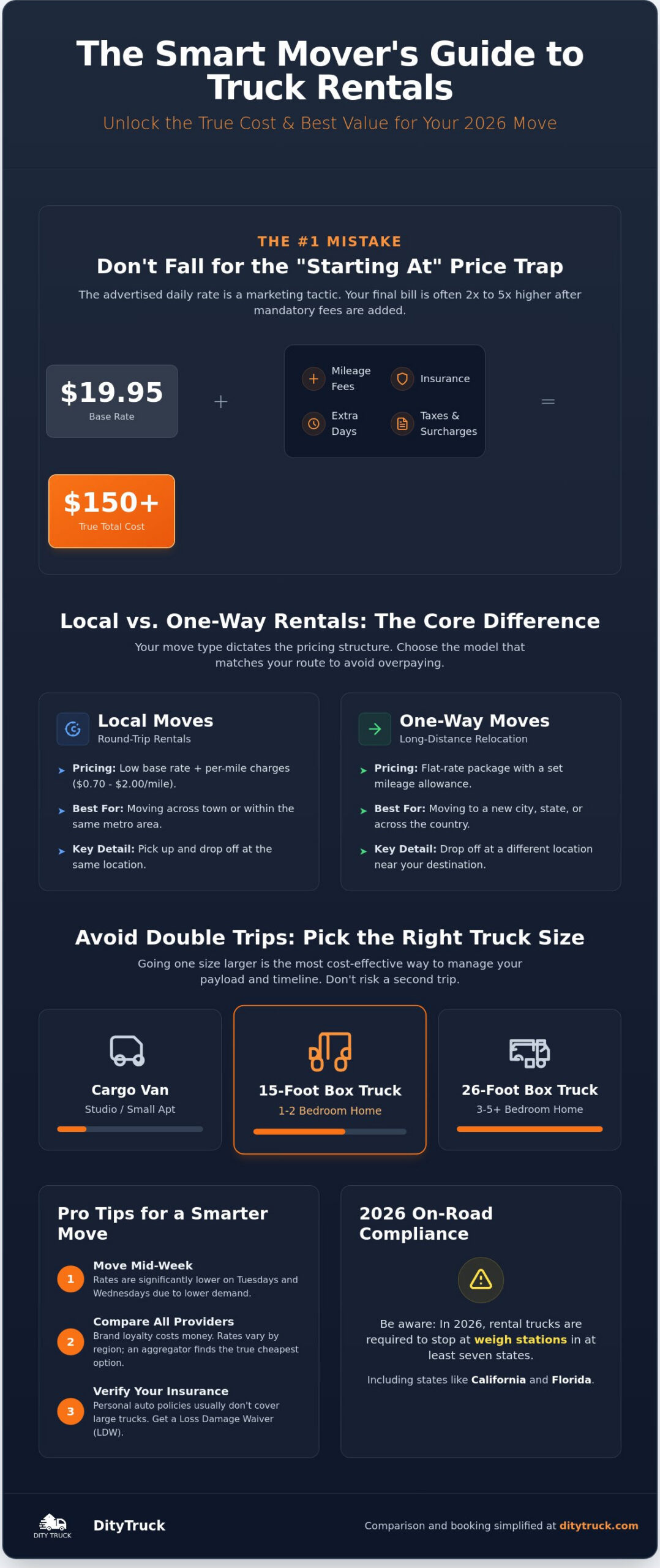
Understanding rental structures is vital for your budget. Local moves are round-trip. You pick up and drop off the vehicle at the same location. These rentals usually feature a low base rate but include per-mile charges that can add up quickly. One-way moves are different. They use flat-rate pricing for state-to-state or long-distance relocations. You drop the truck off at a destination hub near your new home. DityTruck simplifies this choice by showing both structures in one interface. You can see instantly if a local rental with high mileage fees is actually more expensive than a one-way flat rate. This clarity allows you to choose the path that offers the lowest total cost of ownership for your move.
Understanding Moving Truck Rental Prices and Hidden Costs
The $19.95 price tag on the side of a moving truck rental is a marketing tool. It’s rarely the final price you pay. This base rate usually covers the vehicle lease for a 24-hour period, but it doesn’t include the essentials. You need to account for taxes, local surcharges, and the “rental tax” that many municipalities apply. To avoid surprises, you should Know Your Rights and Responsibilities when dealing with interstate and local moves. Clear communication with the provider is your best defense against a ballooning bill.
For local moves, mileage is the biggest variable. Rates typically range from $0.70 to $2.00 per mile. A short trip across town can quickly add $50 to your total. Long-distance moves usually include a set mileage limit in a flat-rate package. If you go over that limit, expect a hefty per-mile penalty. There are also fees for extra time. For instance, a one-way U-Haul rental charges $40 per day for additional time. Planning your route and schedule precisely is the only way to keep the total cost of your moving truck rental under control.
Timing changes everything. Rental companies use dynamic pricing. Demand peaks on weekends and at the end of the month. Moving on a Tuesday or Wednesday can significantly lower your base rate. You also gain better vehicle availability. If you want to see how these variables impact your specific dates, it helps to compare real-time quotes across major providers like Penske and Budget before committing.
Insurance and Liability Coverage Options
Your personal car insurance probably won’t cover a commercial-sized rental truck. Most policies exclude vehicles over a certain weight threshold. Loss Damage Waivers (LDW) protect you from repair costs if the truck is damaged. Supplemental Liability Insurance (SLI) covers third-party claims. For your belongings, cargo insurance is the smart choice. U-Haul’s SafeMove insurance typically costs between $14 and $30 per day. It’s a small price for peace of mind during a high-stakes transition.
Fuel Costs and Refilling Requirements
Large trucks are thirsty. A 26-foot box truck might only get 8 to 10 miles per gallon. Cargo vans do better, but fuel is still a major expense. Most providers use the “Full-to-Full” rule. You receive the truck with a full tank and must return it the same way. If you don’t, the rental office will charge a premium rate for fuel. This can be double the local pump price. Use an app to find the cheapest gas along your route. Avoid the gas stations right next to the rental drop-off lot. They usually have the highest prices in the area.
Choosing the Right Size: From Cargo Vans to 26-Foot Box Trucks
Sizing is the most critical decision in a moving truck rental. Most people underestimate their payload. The golden rule is simple: when in doubt, always go one size larger. A truck that is 80% full is easy to unload. A truck that is 110% full requires a second trip. That second trip doubles your mileage fees and fuel costs. It’s a waste of time and money that you can easily avoid with a bit of foresight.
Small moves don’t need massive box trucks. Cargo vans and pickups are perfect for studio apartments or dorm rooms. They are easier to park and usually have better fuel economy. For a standard 1-bedroom apartment, the 10-12 foot small box truck is the sweet spot. It offers enough height for mattresses and tall dressers without the intimidating footprint of a commercial vehicle. These smaller units are also more available for last-minute bookings in urban areas.
If you are moving a 3-5 bedroom family home, the 26-foot “Jumbo” truck is your only real option. These vehicles can hold upwards of 1,600 cubic feet of goods. They are designed for heavy payloads and long distances. However, driving a vehicle this large requires focus. You need to be aware of clearance heights and wider turn radiuses. It is the heavy lifter of the DIY world, built to handle an entire household in one go.
Capacity vs. Cubic Feet: Making Sense of the Numbers
Numbers on a screen can be hard to visualize. Providers list capacity in cubic feet, but you live in rooms and boxes. A 10-foot truck holds about 400 cubic feet, which equals roughly 50 standard boxes. If you have heavy appliances like a refrigerator or a washing machine, volume isn’t your only concern. You must consider weight limits. Overloading a truck can lead to safety issues and mechanical failure. For a deeper look at how dimensions impact your bill, check out this guide on box truck rental prices to match your inventory with the right budget.
Special Features: Ramps, Liftgates, and Towing
Don’t overlook the hardware. A loading ramp is a necessity for anything heavier than a suitcase. Walking a sofa up a ramp is much safer than lifting it into the cargo hold. For extremely heavy items, some commercial-grade rentals offer hydraulic liftgates. These are rare in standard DIY fleets but invaluable for specialty moves. If you need to move your personal vehicle as well, ask about towing capabilities. Most large trucks can pull a car trailer or dolly. Before signing your contract, review these consumer protection tips for moving to ensure you understand the equipment standards and your liability.
How to Rent a Truck for Moving: A Step-by-Step Booking Guide
Booking a moving truck rental should be the easiest part of your transition. It starts with a real-time inventory check. Don’t rely on general availability. National locations manage their fleets based on local demand. A truck that is available in Chicago might be sold out in Phoenix. You need a platform that pulls live data from the source. This ensures the vehicle you see is the vehicle you get.
Comparison is your next move. Viewing quotes from Penske, Budget, and U-Haul side-by-side stops the stress of managing multiple browser tabs. It reveals the true market rate for your specific dates. Once you find the best value, move to the reservation stage immediately. Secure your rate with a credit card. Many providers offer significant “pay now” discounts that are unavailable if you wait to pay at the counter. These savings often outweigh the flexibility of paying later. Finally, verify everything. Call the pickup location 24 hours before your move. Confirm the truck size and the office hours to avoid a wasted trip on moving morning.
The smartest way to handle this process is to use a dedicated assistant. You can book your moving truck rental through a platform that handles the comparison for you. It saves time and eliminates the guesswork.
Required Documentation for Rental Pick-up
You don’t need a Commercial Driver’s License (CDL) for a standard 26-foot rental truck. These are classified as personal-use vehicles. Your standard driver’s license is sufficient. However, your payment method matters. Most rental offices prefer credit cards. If you use a debit card, expect a large security deposit hold on your account. This can tie up hundreds of dollars you might need for other moving expenses. Also, be aware of age restrictions. While many companies allow rentals at 18 or 21, drivers under 25 often face daily surcharges or limitations on the largest truck sizes.
The Pre-Drive Inspection Checklist
Never drive off the lot without a thorough inspection. Your smartphone is your best tool. Take clear photos or a video of the entire vehicle. Document every existing scratch, dent, or paint chip. This is your proof that the damage wasn’t yours. Check the fluid levels and tire pressure before you hit the highway. Low tire pressure on a loaded truck is a safety hazard and kills your fuel economy. Test the lights, brakes, and the loading ramp mechanism. If the ramp is stuck or the turn signals don’t work, ask for a different vehicle immediately. It’s much easier to swap trucks at the lot than on the side of a highway.
Why DityTruck Is the Smartest Path to a Rental Truck
DityTruck changes how you approach a moving truck rental. Most people waste hours on multiple sites. We stop that. Our platform aggregates the entire market into one interface. You see Penske, Budget, and U-Haul all at once. This transparency is vital. You shouldn’t have to hunt for the lowest rate. We bring the data to you. It’s about efficiency. You can resolve your uhaul vs budget truck rental dilemma in seconds rather than spending an afternoon on research. We perform the heavy lifting. You reap the rewards of a faster, cheaper booking process.
The DIY moving space is crowded. Every brand claims to be the cheapest. Without an aggregator, you’re just guessing. We provide a neutral environment for discovery. We don’t push one brand over another. We push for the best fit for your specific payload and route. This advocate-first approach ensures you aren’t just booking a truck. You’re booking the most logical logistics solution for your family. It’s a friction-free experience designed for high-stakes tasks. We prioritize your peace of mind by stripping away the traditional hurdles of the industry.
Real-Time Rate Comparison for 2026
Our platform pulls live data. This ensures you see the current best price for 2026. We eliminate the “hidden fee” surprise. You get a detailed cost breakdown before you commit. This includes the mileage and environmental fees we discussed earlier. It’s especially helpful for one way truck rentals for moving. These cross-country trips are expensive. Seeing every major player’s flat rate side-by-side ensures you don’t overpay for the journey. We scan the market so you don’t have to. You get instant access to real-time inventory across the nation.
Streamlined DIY Logistics
Focus on your move. We handle the data. DityTruck acts as your savvy assistant for truck rental reservations. We strip away the complexity. You get clarity and relief. The logistics are handled. The price is verified. Your truck is waiting. It’s the shortest path from a problem to a resolution. We value your time above all else. No unnecessary preamble. No sales pressure. Just a reliable tool that works as hard as you do. Compare and book your moving truck now.
Secure Your 2026 Move with Confidence
You now have the logistics blueprint for a successful DIY move. Remember that sizing up is the most effective way to protect your schedule and your budget. Avoid the base rate trap by factoring in mileage and insurance before you sign. A smart move isn’t about luck. It’s about having the right data at the right time. You’ve learned how to navigate the 2026 landscape, from weigh station requirements to peak-timing savings.
Securing a moving truck rental doesn’t have to be a multi-hour ordeal of browser tabs and hidden fees. You can compare Penske, Budget, and other major providers in seconds. Get transparent pricing and national coverage with one simple tool that works across the entire United States. We’ve handled the data aggregation so you can focus on the transition itself. No more guesswork. Just a clear path to the best value for your specific route.
Find the best rates for your move today. Take control of your transition. You’ve done the research. Now it’s time to execute the plan and start your next chapter with total clarity. Your friction-free move starts with a single click.
Frequently Asked Questions
How much does it typically cost to rent a moving truck?
Industry averages for a local move range from $20 to $130 per day plus mileage fees between $0.70 and $2.00 per mile. Long-distance one-way rentals typically cost between $1,500 and $3,500 for a week-long trip. These prices fluctuate based on your route and the specific vehicle size you select. Total costs often include gas and insurance which can add several hundred dollars to the final bill.
Can I rent a moving truck one-way for a cross-country move?
Yes, you can easily arrange a one-way rental for cross-country relocations. Major providers like Penske and Budget offer flat-rate packages that include a specific number of days and miles for your journey. This allows you to drop the vehicle off at a destination hub near your new home. It eliminates the need for a return trip and is the standard choice for state-to-state moves.
Do I need a special driver’s license to drive a 26-foot box truck?
You do not need a Commercial Driver’s License (CDL) to drive a 26-foot truck for personal use. A standard valid driver’s license is sufficient for household moves. These vehicles are classified as personal rentals rather than commercial transport. Just ensure you are comfortable with the larger turn radius and height clearances before starting your trip.
What is the cheapest day of the week to rent a moving truck?
Mid-week days like Tuesday and Wednesday are the most affordable times to rent. Demand peaks on Fridays and Saturdays. You can often find lower base rates and better vehicle availability by scheduling your move during the middle of the week. Avoid the beginning and end of the month when most leases expire and demand is at its highest.
Is insurance mandatory when renting a truck for moving?
While rental companies may not legally mandate insurance, your personal auto policy likely excludes large trucks. Skipping coverage is a high financial risk. Options like U-Haul’s SafeMove cost between $14 and $30 per day. This protects you from repair costs and liability claims that your standard insurance won’t cover during a move.
What happens if I return the rental truck with less fuel than I started with?
You will face significant refueling penalties if you return the truck with less fuel than you received. Rental offices charge a premium per-gallon rate that is often double the local pump price. It’s always cheaper to refill the tank at a local gas station just before you return the vehicle to the lot. Most providers follow a full-to-full policy.
Are there age requirements for renting a large moving truck?
Most companies allow drivers who are at least 18 or 21 years old to rent. However, drivers under the age of 25 often face daily surcharges. Some providers also limit the largest truck sizes to older drivers. Always check the specific age policy of your chosen provider before finalizing your reservation to avoid surprises at the counter.
How far in advance should I book my moving truck rental?
You should book your moving truck rental at least two to four weeks in advance. If you are moving during the peak summer season, aim for six to eight weeks of lead time. Early booking guarantees that the specific size you need is available at your preferred location. It also helps you lock in lower rates before regional demand increases.