Tag: one way rental

  • One Way Cargo Van Rental: The 2026 Comparison & Booking Guide

    One Way Cargo Van Rental: The 2026 Comparison & Booking Guide

    That $19.95 daily rate you see on a billboard is rarely what you actually pay when dropping off in another city. Most people assume a one way cargo van rental is a simple transaction. Then the drop-off fees and mileage overages start appearing on the final bill. It’s frustrating to plan a budget only to watch it vanish at the rental counter. You need a vehicle that fits your furniture and a price that stays fixed.

    We understand that logistics should be the easiest part of your move. This 2026 comparison guide strips away the complexity of long-distance rentals. You’ll learn how to find guaranteed one-way rates while avoiding the common traps that inflate your costs. We cover exact van dimensions for top providers like Penske and U-Haul to ensure your items actually fit. From understanding payload capacities to booking a reliable van in under five minutes, this guide provides the shortest path to a stress-free move. We focus on transparency so you can move with confidence and keep your budget intact.

    Key Takeaways

    • Compare top-tier providers side-by-side to find the most affordable one way cargo van rental for your specific route.
    • Master the 4,000-pound payload limits and interior dimensions to avoid dangerous overloading or last-minute space issues.
    • Identify the “one-way premium” and mileage overage traps that often inflate your final bill at the drop-off counter.
    • Streamline your booking process by verifying destination facilities and securing a guaranteed rate in under five minutes.

    What is a One Way Cargo Van Rental and When Do You Need It?

    A one way cargo van rental is a logistics agreement where you pick up a vehicle at one location and return it to a different authorized facility. It’s built for linear travel. You don’t have to double back. This service is the standard for state-to-state moves, college dorm relocations, and long-distance equipment deliveries. It streamlines the entire process by focusing on your destination rather than your origin.

    In 2026, the market has shifted toward better accessibility. Rental companies have expanded their fleets and optimized their tracking systems. This means availability for a one way cargo van rental is higher than ever before. You no longer have to settle for a massive box truck just because a van isn’t available for a cross-country trip. Choosing a one-way agreement eliminates the chore of driving an empty van back to your starting point. You save hours of time. You slash your fuel expenses. It’s the most logical path for a move that doesn’t involve a return trip.

    One-Way vs. Local Rentals: The Key Differences

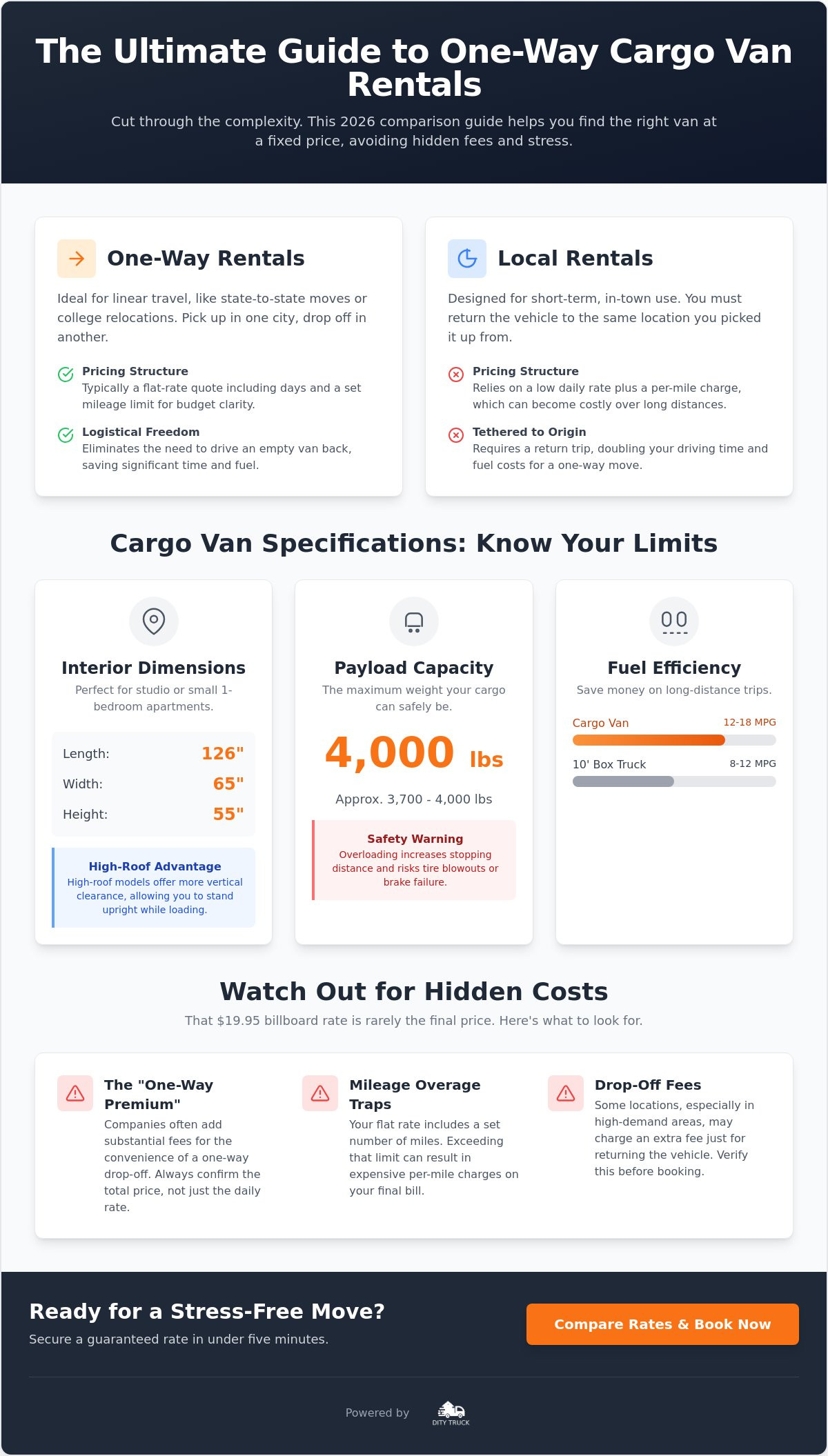
    Pricing structures differ significantly between these two options. Local rentals usually rely on a low daily rate paired with a per-mile charge. This works for across-town errands. A one-way rental typically uses a flat-rate quote. This quote includes a specific number of days and a set mileage limit. It provides financial clarity from the start. You know what you’ll pay before you even turn the key.

    Logistical freedom is the biggest advantage. Local rentals tether you to your starting point. One-way rentals let you move forward. Some rental hubs restrict their vans to local use only to keep inventory stable. You need to verify that your chosen branch supports one-way drop-offs before you arrive. This ensures you aren’t hit with unexpected return-to-origin requirements.

    Ideal Move Sizes for a Cargo Van

    A cargo van is the perfect fit for small apartments and studio dwellers. Using a 10-foot box truck for a few dozen boxes and a mattress is often overkill. It’s harder to park and uses more fuel. Vans are also ideal for specialty items. If you need to transport a single large appliance, a motorcycle, or a collection of high-value electronics, the van provides a secure, enclosed environment. For those looking to upgrade their digital setup during a move, SuggestMeTech provides detailed reviews and comparisons of the latest technology products.

    Since a van is technically a Commercial vehicle, it’s designed to handle heavy loads without the bulk of a freight truck. You get the protection of an enclosed space with the drivability of a standard car. The cargo van acts as a functional bridge between a standard SUV and a large box truck for high payload efficiency.

    For travelers who do not need the full capacity of a cargo van and are looking for standard passenger vehicles, Drive NZ Rental Cars offers a practical fleet of compact hatchbacks and SUVs that provide a similar level of drivability for any journey.

    Cargo Van Specs: Dimensions, Payload, and Fuel Efficiency

    Choosing a one way cargo van rental requires more than just looking at the daily price. You need to know if your tallest dresser will stand upright. You need to know if your collection of books will blow past the weight limit. A standard cargo van typically offers an interior space of 126 inches long, 65 inches wide, and 55 inches high. These dimensions are ideal for studio apartments or small 1-bedroom moves. Unlike box trucks, vans feature rear swing-out doors and side sliding doors. This makes loading in tight urban zones or narrow driveways significantly easier.

    Efficiency is where the cargo van truly wins. Most modern models average between 12 and 18 MPG. Compare that to the 8 to 12 MPG you’ll get with a traditional box truck. Over a 500-mile trip, that difference keeps a substantial amount of cash in your pocket. Before signing your contract, check the FTC consumer advice on car rentals to ensure you understand the insurance and fee structure. It’s about maximizing your budget while maintaining total transparency. This approach strips away the complexity of long-distance logistics.

    The High-Roof Advantage

    Standard vans are great. High-roof models like the Ford Transit or Mercedes Sprinter change the game. They offer significantly more vertical clearance. This is essential if you have upright furniture or need to walk inside the van while loading. Crawling on your knees in a standard van is exhausting. Walking upright saves your back. It speeds up the loading process. If you’re debating between sizes, see our guide on Cargo Van vs. Box Truck: Which Rental Is Right for Your Move? to see which fits your inventory best.

    Weight Limits and Safety

    Payload capacity is a critical safety metric. Most cargo vans are rated for 3,700 to 4,000 lbs. It’s easy to underestimate weight. A few dozen boxes of books or heavy power tools can push you toward the limit quickly. Overloading isn’t just a technicality. It’s dangerous. An over-capacity van takes longer to stop. It puts extreme stress on the tires. On a long-distance trip, this increases the risk of a blowout or brake failure.

    Safety starts with smart planning. You should calculate your estimated payload before you book. If you aren’t sure about the total weight of your items, consult our What Size Moving Truck Do I Need? The 2026 Sizing & Comparison Guide for detailed volume-to-weight estimates. Once you have your specs ready, you can compare rental rates to find the best vehicle for your specific load. Staying within these limits ensures a smooth ride from pickup to drop-off.
    One Way Cargo Van Rental: The 2026 Comparison & Booking Guide

    Top Providers for One Way Van Rentals: A 2026 Comparison

    Selecting a provider for a one way cargo van rental requires balancing upfront costs against vehicle reliability. Not every brand treats its one-way inventory with the same priority. In 2026, four major players dominate the market, each offering a distinct advantage for your long-distance move. Penske stands out for its commitment to newer fleets. Their vans are frequently updated; this provides better fuel efficiency and a lower risk of mechanical issues during 500-plus mile trips. Their one-way availability is generally high across most major corridors.

    Budget often takes the lead as the price leader for those on a strict budget. They frequently release promotional codes that can significantly reduce the “one-way premium” often found in long-distance quotes. U-Haul offers the most expansive network with the largest number of drop-off locations in the country. This makes them a convenient choice for rural destinations. However, be aware that their cargo van availability for one-way trips can be highly location-dependent. Enterprise remains a strong contender for those with commercial needs, though their one-way policies can vary between specific franchise locations. You should always verify the drop-off terms before you arrive at the pickup counter.

    Which Brand Offers the Best One-Way Rates?

    The total price you pay depends heavily on the “Drop-Off” factor. Rental brands adjust their rates based on equipment demand at your destination. If you are moving to a city where inventory is already high, the company might charge a premium to accept another van there. Conversely, moving to a low-demand area can sometimes trigger a lower rate as you are essentially helping them relocate their fleet. For a deeper dive into specific pricing for one of the top providers, read our Budget Cargo Van Rental: 2026 Comparison & Savings Guide. It breaks down the hidden costs that often surprise first-time renters.

    Discounts and Savings Strategies

    Membership perks are your most effective tool for slashing one-way costs. AAA, military, and student discounts often provide 10% to 20% savings. These are rarely applied automatically. You must enter the specific discount code during the online booking process or mention it to the agent. Reserving your vehicle at least 14 days in advance is critical for one-way trips. One-way inventory is limited compared to local-use vans. Waiting until the final week often results in a “no availability” message or a significant price hike.

    Reviewing tips for renting a moving truck helps you understand the nuances of the entire rental process. It’s about more than just finding a low daily rate; it’s about managing the total journey. For a broader look at all your vehicle options, check out our Moving Truck Rental: The Complete 2026 Comparison & Booking Guide. This ensures you aren’t overlooking a larger vehicle that might actually offer better value for your specific route.

    The “One-Way Premium” isn’t a random tax. It represents the logistical cost of rebalancing a fleet. When you pick up a van in one state and drop it in another, the rental company eventually has to move that asset back to a high-demand area. You pay for that flexibility. Most one way cargo van rental agreements bundle the rental days and estimated mileage into a single, upfront price. This differs from local rentals where you pay a small daily fee plus a charge for every single mile you drive. It provides a predictable budget, but only if you stay within the agreed limits.

    Mileage inclusions are the backbone of your quote. Most providers calculate the distance between your pickup and drop-off zip codes and add a small buffer. If your trip is 400 miles, they might grant you 500. “Unlimited Mileage” is rarely truly unlimited for one-way cargo van rentals. Most contracts provide a generous cap based on the most direct route. If you take a long detour to visit family or haul extra loads, you will likely face heavy per-mile fees upon return. Always verify the exact mileage allowance before you drive off the lot.

    Decoding the One-Way Quote

    Base rates are often used as bait. The total cost is the only number that matters for your move. A low daily price is irrelevant if the drop-off surcharge is massive. These surcharges fluctuate daily based on destination demand. Moving to a high-demand city might actually lower your rate because the company needs more vans in that specific location. It’s a complex game of supply and demand. To see how these costs compare across different vehicle types, consult our One Way Truck Rentals for Moving: 2026 Comparison Guide. It breaks down the math behind the surcharges.

    How to Avoid Extra Charges

    Fuel return policies are the easiest way to lose money at the end of your trip. Most companies operate on a “Full-to-Full” basis. If you return the van with even a slightly lower fuel level, you’ll be charged a premium rate per gallon. This rate is often three times the local pump price. Fill up the tank within five miles of the drop-off center and keep your receipt as proof. Cleaning fees are another common trap. A quick five-minute sweep of the cargo area prevents a $50 penalty. It’s a small effort that protects your budget. You can compare current one-way rates and fee structures side-by-side to ensure you’re getting the most transparent deal available.

    Insurance is your final consideration. Small charges like environmental fees or vehicle licensing recovery fees usually add $5 to $20 to your final invoice. They are small but consistent. However, damage waivers are a larger investment. A Collision Damage Waiver (CDW) relieves you of financial responsibility if the van is damaged. Supplemental liability protects you against third-party claims. Check your personal auto policy first. Many personal plans don’t cover commercial cargo vans, making the rental company’s protection a necessary safeguard for a long-distance trip. If your move requires more capacity than a van can provide, understanding box truck rental prices for 2026 will help you budget accurately before upgrading to a larger vehicle.

    How to Compare and Book Your One Way Cargo Van Rental Today

    Checking rental sites one by one is a waste of your time. It is inefficient. You enter your zip codes on five different tabs and get five different results. This manual process makes it impossible to see the full market. A one way cargo van rental requires a comparison-first strategy. You need to see how Penske, Budget, and U-Haul stack up for your specific route at the same time. Prices for one-way trips fluctuate based on fleet balance. One provider might be desperate to move a van out of your city. Another might be overstocked at your destination. You only find these savings by looking at everything at once.

    Before you click the reserve button, verify your drop-off location. This is a critical step that many renters skip. Some smaller franchises or independent dealers only accept local returns. They don’t have the space or the staff to process one-way arrivals. Call the destination facility directly. Confirm their hours. Ensure they are authorized to accept the specific van model you are booking. This five-minute call prevents a massive logistical headache on your moving day. It guarantees a smooth hand-off when you arrive tired at your new home.

    Read the fine print on mileage caps. Some “unlimited” offers come with geographic restrictions. Others have hidden daily limits that only appear in the final contract. If your route involves significant detours, those extra miles can cost between $0.59 and $0.99 each. Secure your rate as early as possible. As your moving date approaches, inventory drops. Prices surge. Booking at least 14 days in advance is the smartest way to lock in a lower rate and ensure a vehicle is actually waiting for you on the lot.

    The DityTruck Comparison Advantage

    Our platform is built for speed. We provide real-time rates from the industry’s top providers instantly. You see what Penske and Budget are charging for your exact route without jumping between websites. We prioritize transparency. We highlight the fees that other sites hide in the fine print. You see the total cost upfront. There are no surprises at the rental counter. Our interface is designed for quick scanning. You can go from searching to reserved in under three minutes. It is the shortest path between your problem and a reliable solution.

    Ready to Move? Let’s Find Your Van

    Logistics should be simple. Start by inputting your pickup and destination zip codes into our tool. You will get instant one-way availability for your route. Don’t just look at the daily rate. Compare the bottom line. Look at the total cost including the estimated mileage and fees. This is the only way to protect your moving budget. Once you find the right fit, finalize the booking immediately. Rates change fast. Securing your one way cargo van rental today ensures you have the right tool for the job at the best possible price.

    Secure Your Move with Confidence

    Moving across state lines doesn’t have to be a gamble with your bank account. You now have the technical knowledge to verify interior van dimensions and payload limits before you ever touch a steering wheel. By understanding the specific logic behind drop-off surcharges and fuel return policies, you can bypass the common traps that typically inflate moving costs. A successful one way cargo van rental starts with a clear plan and ends with a transparent receipt. You are no longer at the mercy of unpredictable pricing or confusing mileage caps.

    We provide a no-nonsense path to your next vehicle. Our platform offers real-time price comparison across major brands, aggregating data from Penske, Budget, and other top providers. You get to see the total cost upfront. This strips away the complexity and replaces it with confident simplicity. It is the fastest way to turn a high-stakes logistics task into a simple, three-minute reservation. Stop jumping between tabs and start moving with clarity. Compare One Way Cargo Van Rental Rates in One Step. Your stress-free move is just a few clicks away.

    Frequently Asked Questions

    Can I rent a cargo van for a one-way trip?

    Yes, major providers like Penske, Budget, and U-Haul offer one-way agreements for cargo vans. These agreements allow you to pick up the vehicle in one city and drop it off at a different authorized facility. This is the standard choice for long-distance relocations where returning the van to the origin is impractical. Availability often depends on the specific branch and current fleet balance in 2026.

    How much does a one-way cargo van rental cost on average?

    One-way rental costs vary significantly based on distance and destination demand rather than a simple daily rate. Industry data from 2026 shows that long-distance moves can range from $600 to over $1,300 depending on the route. These quotes usually bundle a set number of days and miles. Moving to a high-demand area often results in a lower rate because you help the company relocate their inventory.

    Do one-way cargo van rentals include unlimited mileage?

    Truly unlimited mileage is rare for a one way cargo van rental on a long-distance route. Most providers offer a set mileage allowance based on the most direct path between your pickup and drop-off zip codes. You are usually granted a small buffer of extra miles. If you exceed this limit, expect to pay per-mile overage charges. These charges typically range from $0.59 to $0.99 per mile in 2026.

    What size of move can fit into a standard cargo van?

    A standard cargo van is ideal for studio apartments, small one-bedroom moves, or dorm rooms. With approximately 245 to 400 cubic feet of space, it can hold a queen-sized mattress, several large boxes, and small pieces of furniture. It is the most efficient choice for specialty items like motorcycles or single large appliances. If you have more than 20 medium boxes plus furniture, a box truck might be necessary. For those who need additional space to store items during a transition, check out JOIN ME self storage for flexible and secure options.

    Is it cheaper to rent a cargo van one-way or round-trip?

    Round-trip rentals are usually cheaper if you are moving within a 50-mile radius of your starting point. However, for long-distance trips, the one-way option is more cost-effective. Driving an empty van back to the origin wastes fuel and time. A one-way agreement eliminates these return costs. It allows you to focus your budget on the actual move rather than the return journey.

    What documents do I need for a one-way cargo van rental?

    You need a valid driver’s license and a major credit card in your name to secure the rental. Most companies require drivers to be at least 18 or 21 years old. Drivers under 25 often face a “Young Renter” surcharge. You should also bring proof of insurance if you plan to decline the rental company’s protection plan. Always verify that your personal policy covers commercial cargo vehicles before you arrive at the counter.

    Are there hidden fees for dropping off a van at a different location?

    Most “hidden” fees are actually surcharges for returning a van to an unauthorized location. If you drop off at a facility not listed on your contract, you could face a wrong location fee of several hundred dollars. Other common charges include cleaning fees if the cargo area is left dirty and refueling penalties. Returning the van with a full tank and a swept interior is the best way to avoid these extra costs.

    Which companies offer the best one-way cargo van rentals?

    Penske and Budget are often cited as the top choices for a one way cargo van rental due to their reliable fleets and transparent pricing. Penske is known for newer vehicles and high-roof options that simplify upright loading. Budget frequently offers the most competitive rates for long-distance routes through promotional codes. U-Haul provides the largest network of drop-off locations, which is helpful for moves into rural or remote areas.

  • Penske Truck Rental Cost Guide 2026: Real Pricing and Fees

    Penske Truck Rental Cost Guide 2026: Real Pricing and Fees

    The cheapest truck rental quote often becomes the most expensive one by the time you reach your new home. Hidden fees and mechanical delays turn a bargain into a logistical nightmare. You’ve likely felt that familiar anxiety when looking at a quote. You wonder if the final bill will match the estimate. You worry if the truck will handle a long-distance haul without a hitch. It’s a high-stakes task that demands total clarity.

    We’re here to provide that relief. This guide breaks down the penske truck rental cost for 2026 to help you budget with absolute precision. You’ll discover exactly how Penske calculates its rates, why their reliability justifies the premium, and how to spot every mandatory fee before you sign. We’ll cover everything from unlimited mileage benefits on one-way trips to the specific discounts available for military personnel. You’ll find a clear, logical path to a friction-free move without the usual surcharges or stress. It is time to stop guessing and start planning with confidence.

    What You Will Learn

    • Compare local per-mile rates against one-way moves. Secure the unlimited mileage advantage for your specific route.
    • Navigate the variables affecting your penske truck rental cost. Balance truck size selection with seasonal demand shifts.
    • Identify mandatory 2026 surcharges. Spot environmental fees and damage protection costs before they hit your bill.
    • Stack AAA, military, and student discounts. Use location-based hacks to reduce your final rental bill.
    • Evaluate cost-effectiveness across four truck sizes. Pick the right capacity for your home to avoid paying for empty space.

    The Penske Pricing Architecture: Local vs. One-Way Moves

    Every rental quote starts with a fundamental choice between two distinct pricing structures. Local moves follow a traditional utility model. One-way moves function as a comprehensive package deal. Your penske truck rental cost depends entirely on which path your logistics require. Understanding the math behind these models is the only way to avoid a budget collapse on moving day.

    Inventory levels in 2026 play a massive role in your initial quote. Penske uses dynamic pricing that fluctuates based on truck availability in your specific zip code. If a location has an oversupply of 22-foot trucks but a shortage of 16-foot models, you might find the larger truck is actually cheaper. You also have control over the final price through payment tiers. The “Pay Now” option is the most efficient choice for savvy movers. It rewards your commitment with a lower rate compared to the “Pay Later” tier. This simple decision can shave a significant percentage off your total bill immediately.

    Local Rentals: Managing the Per-Mile Variable

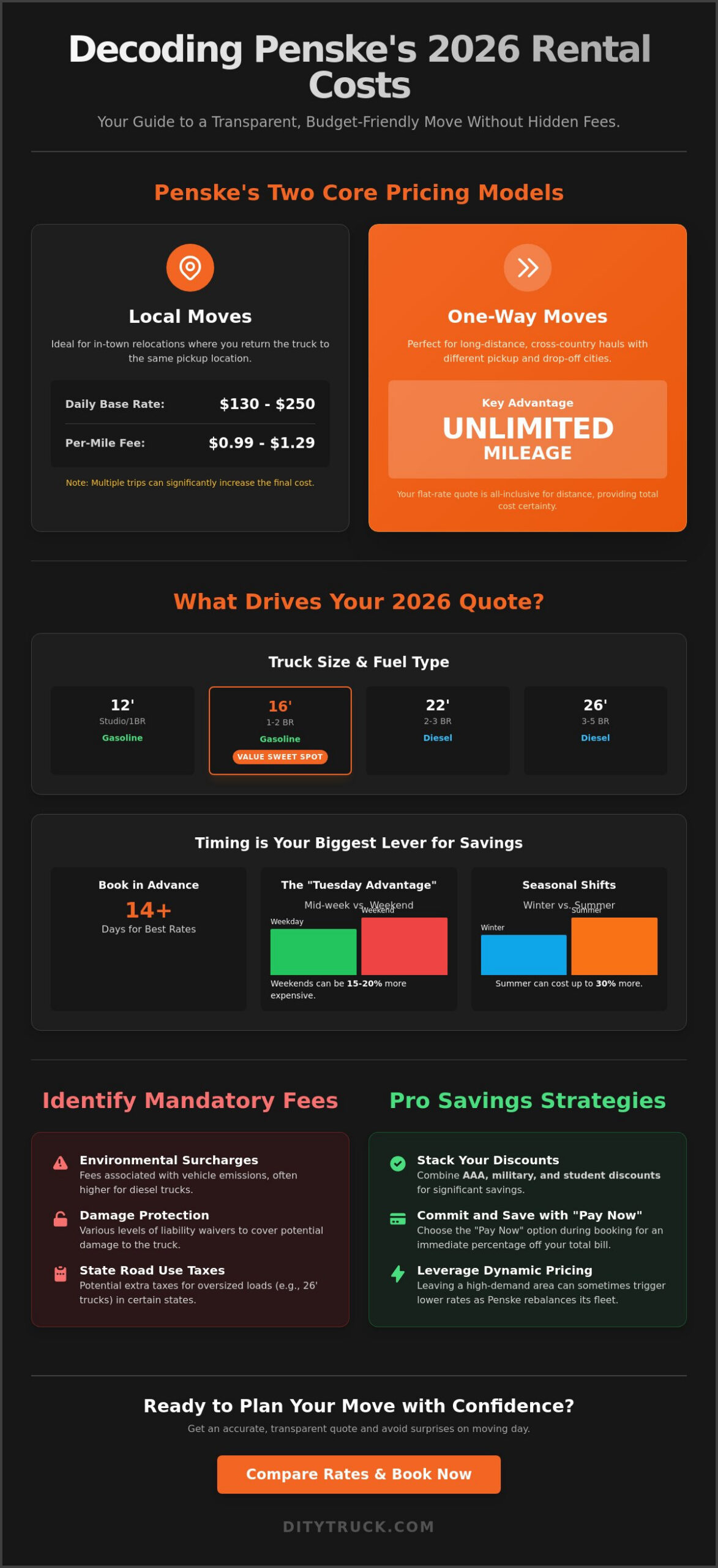
    For local moves where you return the truck to the same location, you pay a daily base rate plus a fee for every mile driven. In 2026, base rates for popular 12-foot and 16-foot trucks typically range from $130 to $250 per day. The mileage fee is the variable that usually catches people off guard. These surcharges often sit between $0.99 and $1.29 per mile. A local move across town looks affordable on paper. However, the costs compound quickly if you make three or four trips. Total clarity requires you to map your route and estimate your total mileage before booking. This prevents the “short” move from becoming a major financial hurdle.

    One-Way Moves: The Unlimited Mileage Benefit

    Long-distance moves operate on a flat-rate model that includes unlimited mileage. This is a significant competitive advantage in the 2026 market. While other companies track every mile on a cross-country haul, Penske allows you to focus on the drive. Your quote is based on the truck size, the distance between cities, and current demand at your destination. Penske Truck Leasing manages one of the largest fleets in North America to keep these rates stable, but moving to a high-demand city will always cost more. This model provides a sense of confident simplicity. You know the price of the journey before you turn the key. It eliminates the anxiety of watching the odometer and allows for a friction-free transition to your new home.

    Factors That Drive Your 2026 Penske Rental Quote

    Your penske truck rental cost fluctuates based on more than just distance. It is a live calculation. National inventory shifts in 2026 mean that prices in one metropolitan area might look nothing like prices in another. Logistics software now tracks truck concentrations in real-time. If everyone is moving to a popular destination region, the price to take a truck there rises. Conversely, leaving a high-demand area can sometimes trigger a lower rate as Penske seeks to rebalance its fleet. Understanding these market forces allows you to move with confident simplicity.

    Truck Size and Fuel Type Impact

    Choosing the right size is about more than fitting your couch. It dictates your fuel economy and mandatory fees. Penske’s 12-foot and 16-foot trucks typically run on gasoline. These are easier for casual drivers to handle. The 22-foot and 26-foot models often utilize diesel engines. Diesel provides better torque for heavy loads but comes with different pump prices and higher environmental surcharges. The 16-foot truck remains the sweet spot for value. It offers enough space for a two-bedroom home without the heavy-duty fees associated with the largest chassis. Oversized loads in 26-foot trucks may also trigger additional road use taxes in certain states. You should understand your rights and responsibilities when you move to ensure your estimate accurately reflects these state-level variables.

    Timing Your Reservation for Savings

    Timing is the most effective tool for budget control. Booking at least 14 days in advance in 2026 secures the best available inventory rates. If you wait until the week of your move, you’re competing for whatever is left on the lot. Demand spikes significantly at the end of the month when leases expire. This creates a price premium that can easily be avoided by moving mid-month. Moving during the week also provides a clear advantage. The “Tuesday Advantage” is a real strategy to reduce your bill. Mid-week rentals often bypass the heavy demand of weekend warriors. Weekend rentals often see a 15-20% price hike compared to a Tuesday or Wednesday pickup.

    Seasonal shifts are even more dramatic. Summer moves in 2026 can cost 30% more than the exact same route in January. If your schedule allows for a winter move on a Tuesday, you’ve found the most efficient path to savings. You can compare truck rental rates across different dates to find these specific windows of opportunity. This proactive approach turns a high-stakes task into a manageable process. It ensures your penske truck rental cost stays within your original budget without any unpleasant surprises at the counter.

    The True Cost of a Penske Move: Fees and Surcharges

    A base quote is rarely the final number you pay at the counter. Calculating the total penske truck rental cost requires looking past the daily rate to identify mandatory fees and optional protections. These line items transform a simple estimate into a realistic moving budget. You need to account for specific factors that drive your rental quote to avoid budget creep on moving day. Most users prioritize the truck itself, but the supporting equipment and regulatory fees often dictate the final balance.

    Mandatory environmental fees are a standard part of the 2026 landscape. Recent quotes for long-distance moves show a consistent $15 environmental fee applied to the total. You also need to budget for physical tools. Dollies, furniture blankets, and loading ramps are available for a fee. Adding these to your reservation ensures a safer move; however, they do increase the bottom line. Fuel is the largest variable. Penske trucks average 12 to 13 miles per gallon. Returning the truck with less fuel than you started with triggers a significant per-gallon penalty. This surcharge is always higher than local pump prices. Fill the tank at a station near the drop-off center to protect your budget.

    Insurance and Protection Plan Tiers

    Standard personal auto insurance and credit cards almost never cover commercial box trucks. This creates a coverage gap you must fill. Penske offers several tiers, including Limited Damage Waiver (LDW) and Supplemental Liability Insurance (SLI). LDW releases you from financial responsibility if the truck is damaged. SLI provides protection against third-party claims. In one verified 2026 quote for an eight-day rental, damage coverage added approximately $666 to the total cost. While optional, these protections provide the relief of knowing a single accident won’t lead to financial ruin.

    Avoidable Post-Move Charges

    You can keep your penske truck rental cost down by following basic return protocols. A simple sweep of the truck bed prevents a cleaning fee that often starts at $50. Timing is equally critical. Late returns on one-way rentals can result in a $100 daily penalty. Missing your window by even a few hours can disrupt the next customer’s reservation and your own finances. You can see how these fees stack up against other providers in our U-Haul vs. Penske Truck Rental: The Complete 2026 Comparison Guide. Staying organized and returning the equipment in its original condition is the shortest path to a friction-free experience.

    Penske Truck Rental Cost Guide 2026: Real Pricing and Fees

    Penske Truck Sizes and Their Cost-Effectiveness

    Choosing the right truck size is a critical financial decision. If the truck is too small, you face the high cost of multiple trips or a second rental. If it is too large, you pay for unused space and extra fuel. Your penske truck rental cost is directly tied to the chassis you select. Penske maintains a modern fleet to ensure mechanical reliability, but the efficiency of that fleet depends on your load planning. Matching the truck to your inventory creates a friction-free moving day with no wasted budget.

    Small Scale Moves: 12ft and 16ft Units

    The 12-foot truck is the entry point for college students and studio dwellers. It handles small apartments with ease and fits into tighter urban parking spots. For those moving a one or two-bedroom home, the 16-foot truck is the standard choice. It provides the necessary clearance for larger furniture items without the intimidating footprint of a commercial freighter. Both of these smaller box trucks typically run on gasoline. Average fuel economy across the fleet sits at 12 to 13 miles per gallon. These units are ideal for local, high-mileage moves where agility and ease of refueling are priorities. You can see how these dimensions compare to other providers in our Moving Truck Rental: The Complete 2026 Comparison & Booking Guide. Selecting the right small-scale unit ensures you don’t overpay for capacity you don’t need.

    Large Scale Moves: 22ft and 26ft Units

    Heavy-duty moves require the 22-foot or 26-foot behemoths. These trucks are designed for families with three to five rooms of furniture. While the daily rate is higher, these large trucks offer superior cost-per-room efficiency. One trip in a 26-foot truck is significantly cheaper than two trips in a smaller unit when you factor in mileage fees and time. 26-foot trucks often require diesel fuel, so you must budget accordingly for different pump prices. These models also come with a higher Gross Vehicle Weight Rating (GVWR). You must stay aware of weight limits to avoid potential scale fees or safety issues on the road. A fully loaded 26-foot truck handles differently than a standard van. It requires a focused driver and a clear understanding of your route’s clearance.

    Maximizing your penske truck rental cost means picking the largest size you can comfortably drive that fits your entire home in one pass. This strategy eliminates the variable of extra mileage and keeps your logistics simple. If you are ready to secure your vehicle, you can book your 2026 truck rental today to lock in current inventory rates. This proactive step removes the uncertainty of last-minute price hikes and ensures the right size is waiting for you on the lot.

    How to Lower Your Penske Rental Cost in 2026

    Reducing your penske truck rental cost does not require complex negotiation. It requires strategy. Savvy movers use the “One-Way Hack” to exploit inventory imbalances. If a primary rental center is low on stock, prices climb. Checking a location just ten miles away can often reveal a surplus of trucks and a lower flat rate. This simple search turns a logistical hurdle into a financial win. You should also lock in your rate at least 14 days before your move to avoid the peak-season surges that define the 2026 market. Early action guarantees availability and the most competitive pricing tiers.

    DityTruck acts as your savvy consumer advocate. Use it to verify if other providers beat your initial Penske quote. While Penske offers newer trucks, exploring all options might reveal a better rate for your specific route. For a deeper look at how competing brands stack up on price and features, our U-Haul vs. Budget truck rental 2026 price and feature comparison breaks down the real cost differences beyond the sticker price. Comparison is the only way to ensure you aren’t overpaying for a brand name. It provides the clarity needed for a friction-free decision. This proactive approach strips away the stress of overspending.

    Stacking Discounts and Promotions

    Applying multiple promo codes is the most efficient way to maximize your 2026 savings. Penske often allows you to combine specific group discounts with seasonal promotional codes. Military personnel and AAA members typically receive a 15% discount. Students can often secure 10% off their total bill. These aren’t just marketing fluff; they are direct paths to a more manageable budget. You should also check your employer’s portal for corporate partner benefits. Many large companies have pre-negotiated rates that bypass standard public pricing. If you are considering other options, use a reliable rental cost calculator to see how the numbers stack up. A side-by-side view removes the guesswork from your logistics.

    The Smart Mover’s Final Checklist

    A final review of the fine print prevents unexpected surcharges at the counter. Verify that your quote includes the mandatory environmental fees and any selected protection plans. Using a comparison tool is essential for 2026 DIY logistics because it strips away the complexity of dynamic pricing. It organizes the chaos of truck rental math into a single, logical decision. Once you have identified the best value, finalize your reservation through DityTruck. This ensures you have a reliable record of your rate and a clear path to a successful move. You are now ready to execute your plan with total confidence and a protected budget.

    Secure Your 2026 Moving Budget Today

    Moving involves high stakes and complex logistics. Your budget shouldn’t be a source of constant stress or confusion. You now have the practical tools to decode your penske truck rental cost with total clarity. You understand the fundamental difference between local mileage fees and the unlimited mileage advantage of one-way trips. You know exactly which hidden surcharges to expect at the counter. You’ve learned how to stack specific discounts and time your booking for maximum efficiency.

    DityTruck acts as your no-nonsense logistics assistant to simplify the entire process. We provide real-time comparison across major brands so you never have to guess if you’re getting the best deal. Our platform ensures transparent pricing with no hidden surprises or last-minute hurdles. Compare 2026 Penske rates and book your truck with DityTruck to finalize your plans with confident simplicity. Your next home is waiting. Take the shortest, most logical path to get there and enjoy the relief of a friction-free move.

    Frequently Asked Questions

    How much does a Penske truck rental cost per day in 2026?

    Daily rates for local rentals typically range from $130 to $250 depending on the truck size and location. This base rate does not include mileage fees or fuel costs. One-way rentals operate on a different flat-rate model that covers a set number of days rather than a standard daily fee. This structure helps you build a predictable budget for your move.

    Does Penske really offer unlimited mileage on one-way moves?

    Yes. Penske provides unlimited mileage for one-way, long-distance rentals in 2026. This feature eliminates the stress of watching the odometer during a cross-country journey. It is a significant advantage for those moving between states. Local rentals still utilize a per-mile fee model, so you should calculate your total distance for shorter trips.

    What is the cheapest day of the week to rent a Penske truck?

    Tuesday and Wednesday are consistently the most affordable days to pick up a rental. Mid-week demand is lower than the weekend rush. Booking during these windows can lower your penske truck rental cost by 15% to 20%. Avoiding the end-of-month peak also helps you secure a better rate from available inventory.

    Do I need special insurance to rent a 26-foot Penske truck?

    You do not need a commercial driver’s license, but your personal auto policy likely excludes large box trucks. Most standard credit card protections also stop at 12-foot vans. Penske offers optional protection plans like Limited Damage Waiver (LDW) to bridge this gap. Verifying your current coverage before you arrive at the counter provides essential peace of mind.

    Does Penske require a deposit for a truck rental?

    A deposit is usually required for local moves, often starting at $150 when paying with a credit card. This amount serves as a hold on your funds until the truck is returned. One-way rentals booked with a credit card may have different requirements. Always check your specific reservation details to ensure you have the necessary funds available.

    How much are the typical taxes and environmental fees for Penske?

    Environmental fees are a mandatory surcharge, typically costing around $15 per rental in 2026. Taxes vary based on the state and city where you pick up the vehicle. These fees are added to your base quote and are not negotiable. Understanding these fixed costs helps you calculate a realistic bottom-line total for your moving expenses.

    Is Penske more expensive than U-Haul for local moves?

    Penske often carries a higher daily rate than U-Haul for local tasks. This premium pricing reflects their commitment to a newer fleet and guaranteed reservations. While the initial penske truck rental cost might be higher, the reliability of the equipment can prevent expensive delays. Comparing both options for your specific zip code is the smartest move.

    What happens if I return my Penske truck with a dirty cargo area?

    Returning a truck with debris or dirt in the cargo area results in a cleaning fee that often starts at $50. A simple sweep of the floor before drop-off is the easiest way to avoid this charge. Maintaining the equipment’s condition ensures a friction-free return process and protects your budget from avoidable post-move surcharges.

  • Unlimited Mileage Moving Truck Rental: The 2026 Comparison Guide

    Unlimited Mileage Moving Truck Rental: The 2026 Comparison Guide

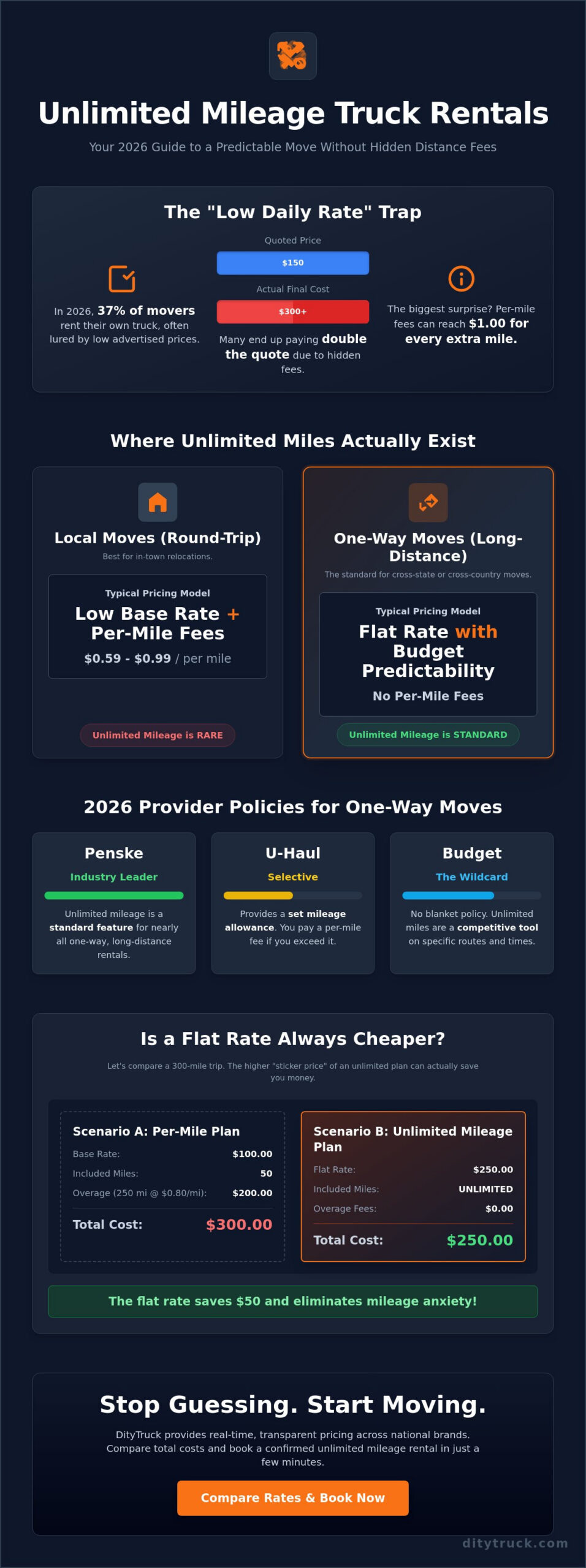
    The lowest daily rate on a rental sign is often a trap. In 2026, roughly 37% of movers prefer renting their own truck, but many end up paying double the quoted price because of distance penalties. If you’re crossing state lines, an unlimited mileage moving truck rental isn’t just a luxury. It’s the only way to protect your budget from unpredictable per-mile fees that can reach $1.00 for every extra mile driven.

    We know you’re looking for a simple, friction-free solution to a high-stakes task. You want to know the total cost upfront, without the fear of hidden charges lurking at the drop-off location. It’s frustrating to compare complex quotes when you just need a straight answer. This guide strips away the complexity of logistics. You’ll learn which national brands offer true unlimited miles and how to calculate if a flat rate actually beats a per-mile fee for your specific trip. We’ve compared the latest 2026 policies from Penske, U-Haul, and Budget to ensure you choose the cheapest total-cost option and enjoy a predictable, stress-free move.

    This guide provides the clarity you need to secure a predictable moving budget without hidden distance fees. We’ve analyzed the 2026 rental landscape to help you book your next move with absolute confidence.

    • Define the true meaning of an unlimited mileage moving truck rental. It’s a strategic flat-rate agreement that eliminates the risk of “mileage shock” when you return the keys.
    • Identify where these deals actually live. Unlimited miles are the gold standard for long-distance, one-way moves. Local rentals typically use a “low base plus per-mile” model instead.
    • Calculate your specific break-even point. You’ll learn how to determine if a higher flat rate actually saves you money compared to a cheap daily rate with added distance fees.
    • Secure your inventory and price by booking as early as possible. Flat-rate availability often fluctuates based on truck size, location, and seasonal demand.
    • Use DityTruck to simplify the entire process. Our platform provides real-time transparency across national brands so you can book a confirmed reservation in just a few minutes.

    The Reality of Unlimited Mileage Moving Truck Rentals

    An unlimited mileage moving truck rental is a flat-fee agreement. The base price includes all the distance you travel. There are no per-mile surcharges. This is a critical distinction for anyone planning a long-distance relocation. It eliminates the risk of “mileage shock” at the drop-off location. You won’t face surprise fees for taking a safer route or making an extra stop for supplies. You get total budget predictability. You know exactly what the distance costs before you even turn the key.

    According to a moving industry overview, DIY moves are a cornerstone of modern logistics. For these movers, financial honesty is a top priority. Choosing a flat rate helps you lock in your moving budget early. You trade the potential savings of a “pay as you go” model for the security of a fixed cost. It’s a trade-off that favors peace of mind. However, availability is specific. Unlimited miles are common for one-way moves but remain rare for local, round-trip rentals. Companies use these deals to incentivize drivers to move equipment to high-demand areas.

    How Unlimited Mileage Pricing Works

    Pricing follows a simple action-result logic. You pay a slightly higher daily base rate. You get total distance freedom. Standard contracts often include an “estimated mileage” trap. The provider calculates the shortest distance between your two zip codes and adds a small buffer. If you hit a detour or road construction, that buffer disappears. You end up paying up to $1.00 per mile for the difference. An unlimited mileage moving truck rental removes this stress. Just remember that fuel and insurance remain separate expenses. You’re still responsible for the gas you burn and the protection plan you choose. These costs aren’t part of the mileage fee.

    Major Providers Offering Unlimited Miles in 2026

    Penske remains the industry leader for one-way unlimited mileage. They offer it as a standard feature for almost all cross-country trips. U-Haul and Budget are more selective. U-Haul typically provides a set mileage allowance based on your destination. If you exceed it, you pay. Budget is the wildcard in the 2026 market. They don’t have a blanket policy, but they often use unlimited miles as a competitive tool. You might find it included in a quote for specific high-volume routes during off-peak months. DityTruck acts as your smart assistant here. We aggregate these dynamic terms into one transparent view. You don’t have to dig through fine print. We show you the total cost upfront so you can book with confidence. You compare the terms. You secure the rental. You move without the math.

    One-Way vs. Local: Where Unlimited Miles Actually Exist

    The choice between a one-way trip and a local rental changes the entire math of your move. If you’re moving across state lines, an unlimited mileage moving truck rental is often built right into the quote. For local relocations, the model shifts. Companies prefer a “Low Base + Per Mile” structure for city moves. This keeps the daily price looking attractive on a billboard. However, it can quickly exceed your budget if you make multiple trips across town. You need to know which category your move falls into before you start comparing prices.

    The One-Way Advantage

    Rental companies use unlimited miles as a strategic logistics tool. They need trucks in specific high-demand cities. By offering a flat rate, they incentivize you to move their inventory for them. It’s a win-win. You get a predictable bill. They get their equipment where it needs to be. Most one-way contracts include a set number of days. The miles are unrestricted. You can take the scenic route or detour around traffic without checking the odometer every ten minutes. Before booking, you should explore the one way truck rentals for moving guide to see which specific routes currently offer the best flat-rate terms.

    Navigating Local Move Mileage Fees

    Local moves are where the “unlimited” dream usually ends. In 2026, average per-mile rates for box trucks range from $0.59 to $0.99. Some providers even hit $1.00 during peak weekends. A $29.95 rental sounds cheap. It’s a marketing hook. Once you realize a 40-mile round trip adds another $40 to the bill, the value disappears. To ensure a safe and honest transaction, consult the Protect Your Move resources from the FMCSA. This helps you spot hidden fees before signing your contract.

    If your move spans several days but stays within the same city, you face a unique hurdle. Most providers won’t offer an unlimited mileage moving truck rental for these “local multi-day” rentals. You’ll pay the daily rate for each 24-hour period. Then, you’ll pay for every mile on top of that. This can lead to a massive bill if your new home is far away and you make four trips. In this case, renting a larger truck for a single day might be the smarter financial move. The easiest way to see these differences is to compare local and one-way quotes side-by-side.

    Equipment Limits and Truck Sizes

    Size matters for mileage availability. Cargo vans and pickup trucks are rarely eligible for unlimited mileage, even on one-way trips. These smaller vehicles are high-turnover assets. Companies want them back quickly for the next customer. Larger 16-foot and 26-foot box trucks are the primary candidates for flat-rate distance deals. If you’re moving a small apartment, you might actually save money by renting a larger truck with unlimited miles. It’s often cheaper than a small van with a high per-mile surcharge. Always check the equipment restrictions before you finalize your reservation.

    Crunching the Numbers: Is Unlimited Mileage Always Cheaper?

    Don’t assume the flat rate is your best friend. It’s a hedge against high costs. Sometimes the hedge costs more than the risk. An unlimited mileage moving truck rental usually carries a higher daily base price. You’re paying for the privilege of ignoring the odometer. To find the real value, you have to find your break-even point. This is the exact mileage where the total cost of a per-mile rental equals the flat-rate quote. If your move is shorter than this distance, you’re overpaying for “free” miles you won’t use.

    Finding this balance is common in professional logistics. For example, the U.S. Government Rental Truck Program often utilizes flat rates with unlimited mileage to ensure cost certainty for federal employees. It simplifies the reimbursement process. It prevents budget overruns caused by unexpected detours. For your move, the same logic applies. You want a predictable total. But you don’t want to pay a premium for a benefit that doesn’t save you money in the end.

    Consider a case study of two different moves. If you’re moving 1,500 miles, a per-mile fee of $0.90 adds $1,350 to your bill. In this scenario, the benefit of an unlimited mileage moving truck rental becomes undeniable. The flat rate will almost certainly be lower than that massive surcharge. However, if your move is only 300 miles, that same fee is only $270. If the unlimited option’s base rate is $300 higher than the standard rate, you’re better off paying per mile. Route efficiency also plays a role. GPS errors or missed exits can add 20 to 50 miles to a long trip. A flat rate absorbs those mistakes. A per-mile rate charges you for them.

    The Calculation Framework

    • Step 1: Get two quotes via DityTruck. One for a per-mile rate and one for a flat-rate unlimited option.
    • Step 2: Add 10% to your estimated mileage. This accounts for fuel stops, hotel detours, and road construction.
    • Step 3: Multiply your buffered mileage by the per-mile rate. Add the base fee. Compare this total to the flat-rate quote.

    When to Choose the Per-Mile Rate

    Per-mile rates win in specific scenarios. Short-distance one-way moves under 200 miles often don’t justify a high flat-rate premium. If the base rate difference is significantly higher for the unlimited option, stick to the standard contract. Per-mile is also better for quick local tasks. If you only need the truck for a few hours to move a single large item across town, the mileage fee will be negligible. Always run the numbers before you commit. Clarity leads to savings.

    Unlimited Mileage Moving Truck Rental: The 2026 Comparison Guide

    Selection Guide: Finding the Best Value for Your Distance

    Securing the right truck is about timing and inventory. In the 2026 rental market, availability fluctuates based on seasonal demand and fleet location. If you wait until the last minute, the unlimited mileage moving truck rental you need might be sold out. Reserving your vehicle at least three to four weeks in advance is critical. This locks in the flat-rate price and ensures the specific truck size you require is waiting at your pickup location. Booking early is the simplest way to avoid the stress of limited options.

    Verification is your final safeguard. Never assume a “one-way” quote automatically includes unlimited miles. Some providers use confusing terminology like “Mileage Included.” This often means you have a set allowance, not an unrestricted one. Check the digital contract before you submit your payment. Look for the specific word “Unlimited” in the mileage section. If it lists a specific number of miles, you are on a restricted plan. This transparency prevents surprise charges at the end of your trip.

    Matching Truck Size to Mileage Needs

    Truck size directly impacts your mileage terms. Larger box trucks, specifically those in the 22-foot to 26-foot range, are designed for long-haul moves. Companies often prioritize these for unlimited mileage deals to keep their heavy inventory moving between major hubs. Conversely, cargo vans and pickup trucks are rarely eligible for these plans. They are typically reserved for local, short-term tasks. If you aren’t sure which vehicle fits your inventory, consult the Moving Truck Rental: The Complete 2026 Comparison & Booking Guide for detailed sizing advice. Choosing a slightly larger truck might actually unlock a better mileage deal.

    The DityTruck Comparison Checklist

    Comparing national brands shouldn’t be a chore. DityTruck acts as your smart assistant by pulling real-time data from leaders like Penske and Budget. You can layer promo codes for military or student discounts directly on top of your unlimited mileage quotes. This ensures you aren’t just getting a flat rate, but the lowest possible version of that rate. Our platform strips away the industry jargon. You see the total cost and the mileage terms side-by-side. It’s the shortest path to a confident booking. You can compare real-time rental rates now to see which provider has the best inventory for your route.

    Compare and Book Unlimited Mileage Rentals with DityTruck

    Logistics shouldn’t be a guessing game. DityTruck strips away the stress. We provide the friction-free path you need for a high-stakes move. Our platform acts as your smart assistant. It performs the heavy lifting behind the scenes so you don’t have to. You get immediate clarity on your total costs. No more digging through fine print. No more hidden per-mile traps. We bring the data to you.

    Transparency is our priority. Many booking sites wait until the final checkout screen to reveal environmental fees or mandatory surcharges. We pull those costs forward. You see the honest price from the very first click. This creates relief and builds confidence. You know your budget is safe. You’re choosing the shortest, most logical path to a successful relocation.

    Why Compare with DityTruck?

    We aggregate the top national providers into a single, efficient view. You see Penske, Budget, and other industry leaders side-by-side. Our system specifically highlights which quotes include an unlimited mileage moving truck rental automatically. This saves you hours of manual research. You don’t need to visit five different websites. You don’t need to manage a dozen browser tabs. We present the facts clearly. You make the decision quickly. It’s about valuing your time as much as your money.

    • Real-time inventory: See what’s actually available at your local branches for 2026.
    • Fee transparency: We highlight the costs that competitors try to hide.
    • Efficiency: Move from comparison to a confirmed reservation in minutes.

    Ready to Start Your Move?

    Securing your 2026 move is a simple, three-step process. First, enter your pickup and drop-off zip codes along with your moving date. Our tool immediately scans the national database for available equipment. Second, use the filter to select “Unlimited Mileage.” This isolates the best long-distance options and removes any quotes with restrictive distance caps. Finally, review the total cost and confirm your booking. The result is a guaranteed rate and total peace of mind. You won’t face “mileage shock” at the end of your trip. You won’t have to worry about detour costs. You just drive.

    Take control of your moving budget right now. Use our comparison tool to find the perfect fit for your distance and truck size. Book your rental truck today and lock in your flat rate.

    Secure Your Predictable Moving Budget Today

    Your move doesn’t have to be a source of financial stress. You now have the tools to identify true value. You know that one-way trips offer the best chance for an unlimited mileage moving truck rental. You understand how to calculate your personal break-even point to avoid overpaying for distance you won’t use. These insights protect your wallet and your peace of mind. You are no longer guessing. You are planning with precision.

    DityTruck simplifies this entire search process. Our streamlined 2026 booking interface provides real-time rates from Penske and Budget in seconds. We prioritize financial honesty above all else. You get a clear view of the terms without hidden mileage fees on one-way moves. This creates the confidence you need for a high-stakes task. No more digging through fine print. No more worrying about odometer readings during your drive. We handle the complexity so you can focus on the destination.

    It’s time to move from planning to action. Compare unlimited mileage rates and book your truck now. Secure your equipment today and lock in a rate that stays flat. You’ve done the research and found the smartest path forward. Now, enjoy the relief of a predictable budget and a friction-free transition. Safe travels to your new home.

    Frequently Asked Questions

    Does U-Haul offer unlimited mileage for local moves?

    No, U-Haul does not offer unlimited mileage for local or in-town rentals. You pay a base daily rate plus a per-mile fee that typically ranges from $0.59 to $0.99. For one-way moves, they provide a pre-determined mileage allowance based on your destination. If you exceed this limit, they charge $1.00 for every additional mile driven.

    Which truck rental company is best for long-distance moves with unlimited miles?

    Penske is the clear leader for long-distance moves. They are the only national company that offers free unlimited mileage on all one-way truck rentals across the United States. This policy applies to all their truck sizes. It provides the most financial certainty for cross-country relocations where distance costs can otherwise spiral out of control.

    Is there a limit to “unlimited” mileage in moving truck contracts?

    True unlimited mileage has no distance cap, but it is always tied to a specific time limit. Your contract will specify a set number of days to complete your trip. While you can drive as many miles as you want during that window, you must return the vehicle to the agreed drop-off location by the deadline to avoid late fees.

    How much does it cost if I go over my estimated mileage on a standard rental?

    Overages typically cost between $0.80 and $1.00 per mile. U-Haul charges a flat $1.00 per mile for one-way overages in 2026. Budget usually ranges from $0.80 to $1.00. These fees are calculated at the drop-off point. Choosing an unlimited mileage moving truck rental is the only way to guarantee you won’t face these high surprise charges at the end of your move.

    Does unlimited mileage include the cost of fuel?

    No, unlimited mileage only waives the fee for the distance traveled. You are still responsible for all fuel costs. Moving trucks are not fuel-efficient and typically get between 8 and 14 miles per gallon. You should always budget for gas as a separate expense based on your expected route, even if your mileage rate is flat.

    Can I get unlimited mileage on a cargo van rental?

    Unlimited mileage is rarely offered for cargo vans because they are high-turnover local assets. Most major brands apply a per-mile surcharge to these smaller vehicles. Home Depot is a notable exception for local use. For one-way moves, you will likely need to rent a larger box truck to qualify for a flat-rate distance agreement.

    What happens if I change my destination on an unlimited mileage one-way rental?

    Changing your drop-off location usually invalidates your original contract and triggers extra fees. An unlimited mileage moving truck rental is a specific agreement between two points. If you change your destination, the company will recalculate your rate based on current demand in the new city. Always call the provider before diverting from your planned route to avoid massive penalties.

    Is Penske the only company with unlimited miles?

    Penske is the only national brand with a universal unlimited mileage policy for one-way moves. However, Budget often offers unlimited miles as a promotion for specific high-volume routes. These deals aren’t always advertised on the main site. DityTruck aggregates these dynamic terms in one place so you can find every available flat-rate option for your specific move date.