Your professional moving quote is likely a mirage. It looks solid on paper, but moving day often brings a wave of expensive surprises. Many homeowners don’t realize the hidden costs of hiring movers can inflate a bill by 25% or more before the truck even leaves the driveway. From stair fees to fuel surcharges, the final total rarely matches the initial handshake. It’s a high-stakes task made unnecessarily complex by a lack of transparency.
We agree that logistics should be simple and predictable. You deserve a moving process that prioritizes your time and your budget. This guide exposes the secret fees professional companies hide in the fine print. You’ll learn how a DIY truck rental provides the cost-clarity and control your move requires. We provide a clear breakdown of common mover surcharges and a framework to compare professional services against the honesty of a rental truck. You’ll gain the confidence to choose the most cost-effective path without the fear of your belongings being held hostage by an unexpected final bill.
Key Takeaways
- Identify the “low-ball quote” trap used by rogue movers—learn why initial estimates rarely reflect the final price you pay on moving day.
- Uncover the hidden costs of hiring movers, including specific surcharges for stairs, elevators, and long driveways that often stay hidden in the fine print.
- Apply the DIY Savings Framework to eliminate labor-related fees—renting a truck offers fixed pricing and total control over your final bill.
- Master a two-step budgeting strategy to audit professional quotes for exclusions and secure the best available rates through real-time comparison.
- Simplify your logistics by using a comparison platform to view truck rental options side-by-side—replacing industry opacity with confident simplicity.
The Baseline Mirage: Why Your Moving Quote Isn’t the Final Price
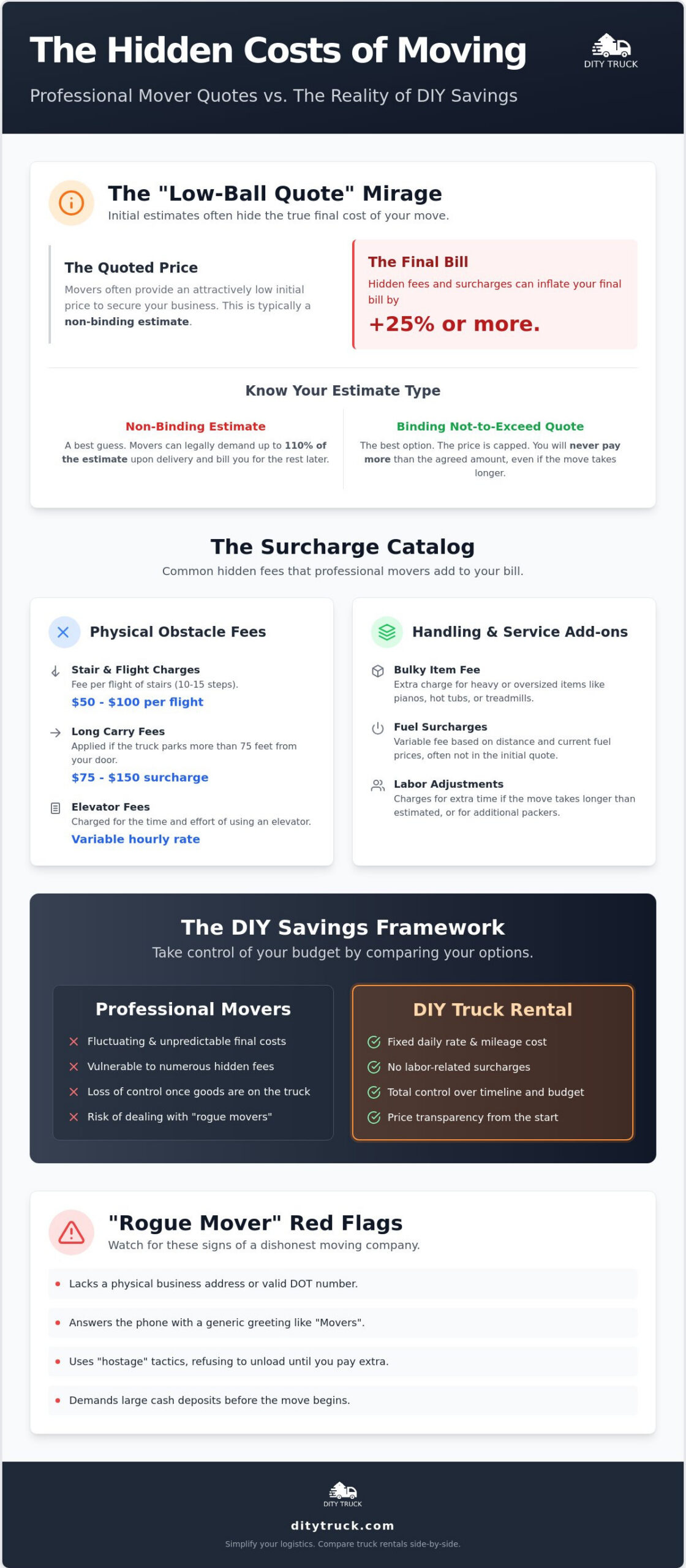
Your initial estimate is rarely the final bill. In the logistics world, a quote is often just a starting point. We define the hidden costs of hiring movers as any expense not explicitly detailed in that first hourly or flat-rate number. These costs usually hide in the fine print of your Bill of Lading. This document is the legal contract between you and the moving company. It often contains clauses for fuel, labor adjustments, and equipment fees that trigger only when the work begins. It’s a baseline mirage that creates a false sense of financial security.
Rogue movers frequently use the “Low-Ball Quote” trap to secure your booking. They offer a price significantly lower than competitors. You see the savings and sign. Once your belongings are on the truck, the price shifts. The movers might claim the inventory was underestimated or the walk to the truck was too long. This action-result progression leads to a final bill that can be double the original estimate. This is why the hidden costs of hiring movers are so damaging to a strict budget. You lose control of the transaction the moment the ramp hits the pavement.
There is a distinct psychological relief in having a locked-in rental rate. When you rent a truck yourself, you trade a fluctuating service bill for a fixed equipment cost. You aren’t paying for a crew’s coffee breaks or slow pace. The transparency of a rental agreement provides the clarity your budget needs. You know the daily rate. You know the mileage cost. There are no surprises waiting at your new front door.
Binding vs. Non-Binding Estimates
A non-binding estimate is essentially a best guess. It is not a legal guarantee of the final price. If the move takes longer than expected, the price climbs. Under federal law, movers can demand 110% of a non-binding quote at the time of delivery. They can then bill you for the remaining balance later. To protect yourself, always demand a “Binding Not-to-Exceed” quote. This specific contract type ensures you never pay more than the agreed cap, even if the move proves more difficult than the estimator predicted.
The “Rogue Mover” Red Flags
Identifying a dishonest company early saves thousands. Watch for movers who lack a physical business address or a valid DOT number. Be wary if they answer the phone with a generic greeting like “Movers” instead of a specific company name. Some use “hostage” tactics, where they refuse to unload your goods until you pay an unquoted surcharge. The FMCSA database is the primary tool for verifying the legitimacy and safety records of interstate movers.
The Surcharge Catalog: Hidden Fees That Professional Movers Charge
Accessorial charges are the industry’s way of billing for effort rather than distance. If a task isn’t strictly driving the truck, it’s likely a surcharge. These line items transform a simple move into a financial puzzle. Understanding the hidden costs of hiring movers requires a deep dive into the surcharge catalog. Most people expect to pay for labor. Few expect to pay for the specific way their furniture moves through a door. These fees aren’t always disclosed during a phone estimate; they often appear once the crew assesses the physical layout on moving day.
Professional crews apply logistical surcharges based on your home’s architecture. If you live in an apartment or a house with a steep driveway, your bill will grow. Service-based additions like furniture disassembly also add up quickly. You might also face the stress of overlapping leases, delayed move-ins, and last-minute scrambles that drive costs even higher. To avoid these service-based surprises, many savvy movers choose to compare rental truck rates instead.
Physical Obstacle Fees (Stairs, Elevators, Long Carries)
Flight charges are a standard industry addition. Movers typically charge per floor or for every 10 to 15 steps. Current 2026 research shows these fees often range from $50 to $100 per flight. Long carry fees apply when the truck cannot park close to your entrance. If the crew must walk more than 75 feet from the ramp to your door, expect a surcharge between $75 and $150. Elevator fees are equally common. You pay for the time spent padding the interior or waiting for the lift to arrive. These physical hurdles turn a standard quote into a high-cost project.
Special Handling and Labor Add-ons
Bulky items require specialized equipment and extra manpower. Treadmills, hot tubs, and pool tables usually carry separate line-item fees. Appliance servicing is another common addition. You’ll pay for the crew to disconnect and secure your washer or refrigerator. Packing supplies purchased directly through movers often have a 200% markup compared to retail stores. These service additions ensure the hidden costs of hiring movers remain a significant part of your final bill.
Post-move expenses add a final layer of complexity. Fuel surcharges are now standard due to diesel prices averaging $4.15 per gallon in early 2026. These surcharges typically range from $50 to $150 depending on the distance. You also need to budget for travel time from the warehouse to your door. Tipping is a final, unwritten cost. It’s recommended to provide $20 to $50 per worker per day. These variables make it difficult to predict your total spend until the move is complete.
Cost of Movers vs. Renting a Truck: The DIY Savings Framework
Professional labor rates are a moving target. Current 2026 data shows that hiring two movers and a truck for a local move costs between $108 and $125 per hour. This creates a “ticking clock” anxiety. Every minute spent navigating traffic or waiting for a slow elevator increases your final bill. By contrast, box truck rental prices are fixed equipment expenses. You pay for the tool, not the time it takes to use it. This transparency allows for a multi-day move without the threat of expensive overtime rates.
The “Zero Labor Surcharge” benefit is the most significant advantage of the DIY path. As we explored in the previous section, the hidden costs of hiring movers often include fees for every flight of stairs or every 75 feet of walking distance. When you rent a truck, these surcharges vanish. You don’t pay extra for your home’s architecture. You also gain clarity on fuel costs. Movers often charge a fuel surcharge as a percentage of the total bill, which can range from $50 to $150. With a rental, you simply refill the tank at the current average rate of $4.15 per gallon. You pay for what you actually use; nothing more.
Eliminating the “Middleman” Markup
Professional movers often act as retailers for secondary services. They profit from a 200% markup on packing supplies and sell valuation coverage that mimics insurance. You can bypass these markups entirely. Sourcing your own boxes and checking your personal auto insurance for rental coverage can save hundreds. This level of oversight is a key recommendation within the Federal Motor Carrier Safety Administration’s Protect Your Move guidance. Managing these details yourself replaces industry opacity with confident simplicity.
Transparency in Long Distance Moving
Interstate moves with professional companies are typically weight-based. You receive an estimate, but the final price depends on a scale at a truck stop. This makes budgeting a guessing game. Switching to one way truck rentals for moving shifts the cost to a mileage-based model. Mileage is a known variable. You can calculate your exact spend before you even turn the key. You also avoid “storage-in-transit” fees. These occur when movers cannot deliver on your schedule and charge to hold your items in a warehouse. DIY keeps your belongings under your control and on your timeline.
Strategic Budgeting: How to Outsmart Moving Day Expenses
Outsmarting moving day expenses requires a side-by-side audit of your options. Start by getting a baseline professional quote. Scrutinize the fine print for exclusions immediately. We’ve already identified the hidden costs of hiring movers, such as long carry fees and stair surcharges, that rarely appear in a phone estimate. Once you have that number, use a comparison platform to view real-time uhaul vs budget truck rental rates. This gives you a market-accurate baseline for equipment costs before you commit to a service contract.
The next step is calculating your “Real DIY Total.” This sum includes the rental rate, estimated fuel, insurance, and even the cost of pizza for friends. Compare this total against the “Mover Quote + 25%.” This 25% buffer represents the typical hidden fee margin in the professional industry. It accounts for the unforeseen labor spikes and logistical surcharges that frequently appear on the final bill after your goods are loaded. This comparison replaces guesswork with financial honesty.
The 25% Buffer Rule
Always add 25% to a professional mover’s estimate to protect your budget. This isn’t pessimism; it’s practical logistics. Professional quotes are often non-binding guesses that can shift once the work begins. By contrast, DIY moves rarely exceed their initial estimate by more than 5 to 10 percent. Fuel is the only major variable in a DIY move, which is easily calculated. Since you know your route and the early 2026 diesel average of $4.15 per gallon, you can predict your pump costs with high accuracy before you even turn the key.
Vetting Your Rental Options
Comparing local vs. national rental brands is essential for securing the best rate. Equipment availability and seasonal demand cause rates to fluctuate daily. Booking early is the best way to avoid the “hidden” cost of rental truck unavailability. Last-minute rentals often carry a premium or force you into a larger, more expensive vehicle than you actually need. DIY moving makes you the manager. You aren’t vetting a company’s reputation; you are vetting the data to ensure the shortest path to a cost-effective move. You can compare truck rental rates now to lock in your baseline and take control of your budget.
Simplify Your Logistics: Compare and Save with DityTruck
DityTruck acts as your savvy consumer advocate. It replaces the traditional fog of moving logistics with a sense of confident simplicity. The hidden costs of hiring movers often stem from a lack of accessible market data. Our platform solves this problem by aggregating real-time rates from top providers in one place. You can see moving truck rental options side-by-side. This ensures you never settle for a high-pressure quote out of desperation or a lack of alternatives.
We provide a “No Hidden Fees” promise. The rate you see on our platform is the provider’s actual rate. There are no surprise logistical surcharges added at the end of the process. Our streamlined booking system allows you to move from comparison to reserved in just a few minutes; it is the shortest and most logical path to a successful move. By stripping away the complexity, we provide the friction-free solution your high-stakes task requires.
The Power of Choice
You remain the manager of your move throughout the entire process. Our platform allows you to filter by specific truck size. This ensures you don’t pay for space you don’t actually need. You can instantly compare local pickup rates against one-way drop-off options to find the most efficient route. The process is entirely digital and highly functional. It offers a reassuring level of control and immediate comprehension that professional service bills simply cannot match. You see the result of your choices in real-time.
Ready to Move? Start Here
DIY moving is defined by financial honesty. When you view your options through the DityTruck lens, you see the full financial picture immediately. We’ve shown how professional quotes can be mirages that hide expensive surcharges for stairs, fuel, and labor. You don’t have to accept that uncertainty. We encourage you to take just 60 seconds to compare rates before you sign any professional mover contract. It is the most effective way to protect your budget and ensure a stress-free transition to your new home.
Find your perfectly priced moving truck on DityTruck today.
Take Control of Your Moving Budget
Moving doesn’t have to be a financial guessing game. You now understand that initial professional quotes are often just starting points. We’ve exposed the hidden costs of hiring movers; these surcharges and fine-print fees don’t have to dictate your budget. By applying the DIY Savings Framework and the 25% buffer rule, you can protect your hard-earned money. Choosing a rental truck replaces industry opacity with total control over your timeline and your expenses.
Clarity is just a few clicks away. You can access real-time rates from major national providers and use our transparent pricing comparison to find the best deal. Our streamlined online booking moves you from search to reservation in minutes.
Compare moving truck rates and avoid hidden fees on DityTruck
You have the tools to outsmart moving day surprises. Step into your new home with your budget intact and your peace of mind secured.
Frequently Asked Questions
Is it always cheaper to rent a truck than to hire movers?
Renting a truck is almost always more cost-effective for local moves because it eliminates the hourly labor rates that drive up professional bills. While the equipment fee is lower, you must account for fuel and insurance. For long-distance moves, the savings increase as you avoid weight-based pricing. You trade your physical labor for financial transparency and a lower final bill that stays within your control.
What is a “long carry” fee and how much does it cost?
A long carry fee is a surcharge applied when movers cannot park the truck within 75 feet of your entrance. This fee typically ranges from $75 to $150 depending on the total distance. It compensates the crew for the extra time and effort required to transport your items manually. You can avoid this specific expense by renting a truck and parking it exactly where you need it.
Do moving companies charge extra for stairs and elevators?
Most professional companies charge extra for stairs and elevators to account for the increased difficulty of the move. These “flight charges” often range from $50 to $100 per floor or per 10 to 15 steps. Elevator fees are similarly common and cover the time spent waiting for or padding the lift. These are major hidden costs of hiring movers that stay buried in the fine print until moving day.
How much should I tip professional movers if there are hidden fees?
Tipping is recommended at $20 to $50 per worker per day regardless of any surcharges on your bill. Tips are separate from the company’s service fees and go directly to the labor crew. Since 61 percent of customers report tipping their movers, it is a standard expense to include in your budget. DIY moves eliminate this cost entirely, allowing you to keep that cash in your pocket.
Does my car insurance cover a rental moving truck?
Most standard personal auto insurance policies do not cover large rental trucks because they are classified as commercial vehicles. You should contact your insurance provider to verify your specific coverage before booking. If your policy excludes trucks, rental companies offer supplemental insurance. This is a fixed, transparent cost that you can calculate and approve before you drive the vehicle off the lot.
What happens if a mover demands more money than the quote?
Your rights depend on whether you have a binding or non-binding estimate. If you have a non-binding quote, movers can legally demand 110 percent of the estimate at the time of delivery. They can then bill you for the remaining balance later. If a mover refuses to unload your goods for more than the 110 percent limit, they may be violating federal consumer protection regulations.
How do I calculate the fuel cost for a DIY moving truck?
Calculate fuel costs by dividing your total trip mileage by the truck’s estimated miles per gallon and multiplying by the current fuel price. With diesel prices averaging $4.15 per gallon in early 2026, a 100 mile trip in a truck getting 10 MPG would cost approximately $41.50. This calculation provides the financial honesty that professional fuel surcharges often lack. You pay for the fuel you actually use.
Are packing supplies included in professional moving quotes?
Packing supplies are rarely included in a standard moving quote and often carry a 200 percent markup when purchased through the company. Hiring professional packing services can add an additional $350 to $600 to your total move. You can reduce the hidden costs of hiring movers by sourcing your own boxes and packing your items yourself. This simple step keeps your budget focused on transportation rather than cardboard.