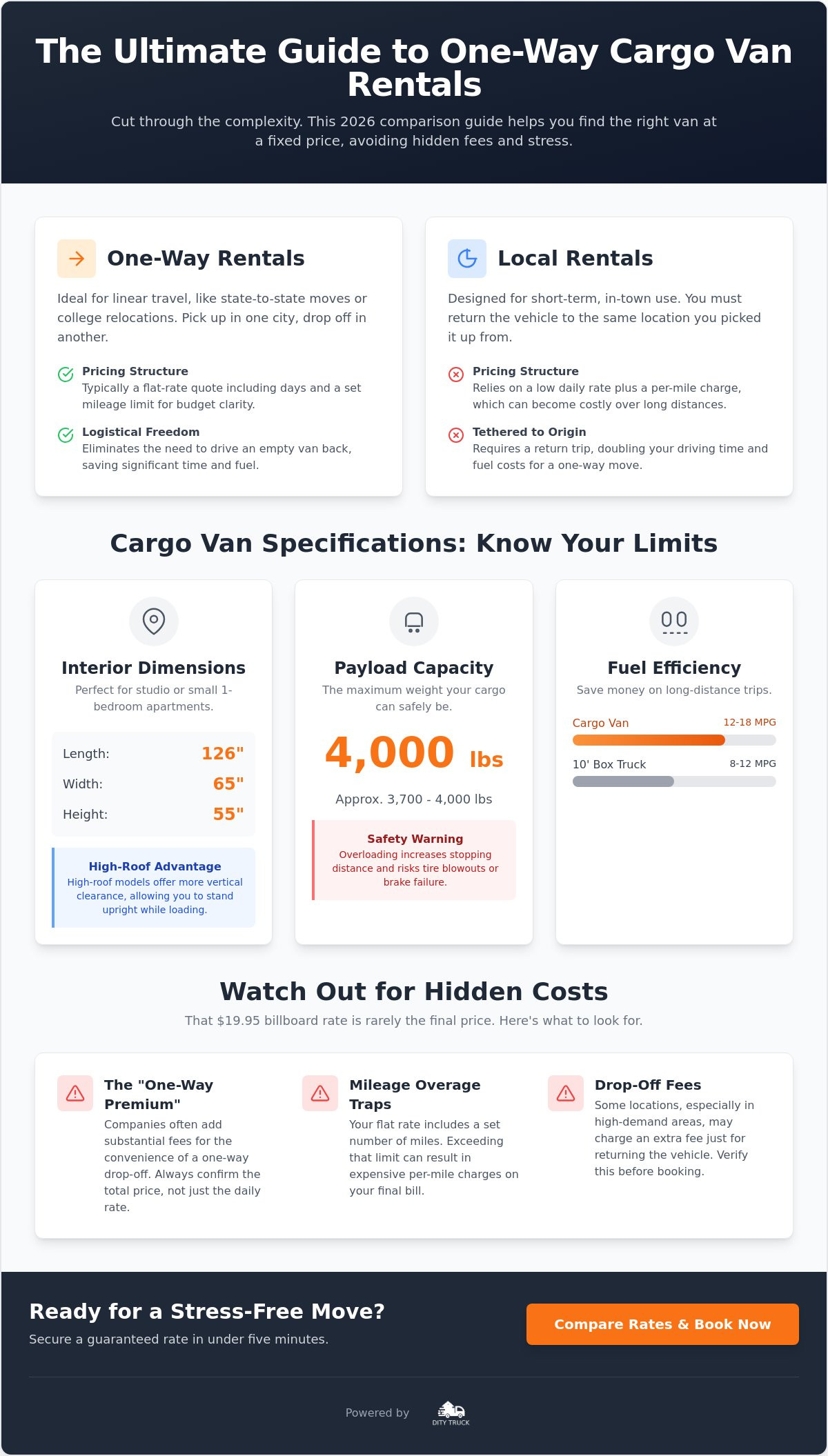
The advertised price for a cargo van rental is rarely the price you actually pay. Between surprise mileage fees and insurance add-ons that your personal policy likely won’t cover, a simple move can quickly turn into a financial headache. You’re likely tired of jumping between five different browser tabs just to figure out if your furniture will fit or if you’re being overcharged for every mile. Wasting hours on manual research isn’t just frustrating; it’s inefficient.
We agree that logistics should be straightforward, not a scavenger hunt for hidden costs. You deserve a clear view of the market without the traditional hurdles. This guide simplifies your search by bringing every major provider’s rates and vehicle dimensions into one place. Our goal is to give you the confidence that your items will fit and the peace of mind that you’ve secured the best possible deal for your specific route.
We will break down how to avoid common mileage traps, compare the cargo volume of the top 2026 models, and show you how to finalize a reservation in minutes. We also cover critical updates like the 2026 IRS mileage rate and how new tax laws like the OBBB Act affect your business rental. This is the shortest path to a successful move.
Key Takeaways
- Identify the best scenarios for small-scale moves. Cargo vans are often the most efficient choice for studio apartments or dorm rooms.
- Compare standard and high-roof dimensions before you book. Ensure your wardrobes and tall furniture actually fit the interior clearance.
- Calculate the true cost of a cargo van rental. Factor in 2026 mileage fees that typically range between $0.69 and $1.29 per mile.
- Avoid weekend price surges. Time your reservation for mid-week to secure better rates and higher vehicle availability.
- View real-time rates from major providers side-by-side. Stop wasting time checking five different websites and see every option in one place.
What is a Cargo Van Rental and Why Choose One?
A cargo van rental is the secret weapon for small-scale DIY logistics. It’s a specialized commercial vehicle designed with a single, open cargo area accessible through wide rear doors and a sliding side door. If you’re wondering what is a cargo van exactly, think of it as a heavy-duty frame wrapped in a protective metal shell. These vehicles provide a versatile, fuel-efficient alternative to larger trucks. They’re perfect for moving a studio apartment, a college dorm room, or a single-room relocation involving bulky items like a queen-sized mattress or a large dresser.
Efficiency is the core benefit. You get the protection of a box truck with the drivability of a standard SUV. This maneuverability makes vans the clear winner in tight urban environments. You can navigate narrow streets, squeeze into parallel parking spots, and enter standard parking garages without the stress of overhead clearance issues. Most vans don’t require the wide turning radius of a 10-foot or 15-foot truck. Additionally, the improved fuel economy keeps your overhead costs significantly lower than typical box truck rental prices.
Cargo Van vs. Pickup Truck: Which is Better?
A pickup truck might look easier to load, but it leaves your belongings exposed to the elements. A cargo van rental provides total weather protection. Your furniture stays dry during a sudden rainstorm and secure from road dust. Security is another major factor. An enclosed van protects your items from theft during overnight stops or lunch breaks. It keeps your valuables out of sight. Inside, you’ll find integrated tie-down points. These are essential for securing fragile furniture and preventing shifting during transit. You can’t get that level of stability in an open truck bed.
The Limitations of a Cargo Van
Vans are efficient, but they have limits. You must understand the balance between weight capacity and volume. While the interior might look spacious, heavy items like gym equipment, large appliances, or dense boxes of books can quickly hit the payload limit. Overloading a van affects braking distance and handling. Passenger limits are also strict. Most rental vans only seat two people in the front. If you have a larger moving crew, they’ll need a separate ride. Finally, check your rental agreement for towing restrictions. Most major providers don’t allow you to pull a trailer with a standard rental van; doing so could void your insurance coverage.
Dimensions and Capacity: Will Your Stuff Fit?
Selecting the right cargo van rental depends entirely on your tallest item. A standard van works perfectly for stacks of boxes and small furniture. However, if you’re moving a standing armoire or a tall bookshelf, you need a high-roof model. High-roof vans, like the popular RAM ProMaster 2500, provide the vertical clearance that standard models lack. While standard vans usually offer around 4 to 5 feet of interior height, high-roof versions can accommodate much more. This makes them the better choice for upright loading.
Average interior lengths range from 9 to 11 feet. This translates to roughly 245 to 300 cubic feet of usable space. To visualize this, imagine a small walk-in closet. It is enough room for a studio apartment but tight for a one-bedroom home. You can compare specific van dimensions from different providers to ensure your longest item clears the doors before you commit to a reservation.
Weight is just as important as volume. Every vehicle has a specific payload rating. You cannot fill a van to the ceiling with heavy books or bricks without exceeding these limits. Overloading compromises your safety and violates certain federal safety regulations for cargo vans regarding commercial vehicle operation. Always prioritize weight distribution over total volume to maintain proper braking and handling on the road.
Measuring Your Move: The 2026 Checklist
Don’t just measure the interior floor. Measure the rear-door clearance. The door frame is often narrower and shorter than the actual cargo area. Account for wheel well intrusions too. These humps on the floor reduce the width available for flat items like plywood or mattresses. Also, consider the deck height. A lower deck makes loading heavy appliances much easier on your back. It reduces the angle of your loading ramp or the height you have to lift heavy objects.
Common Items That Fit in a Cargo Van
A queen-sized mattress is the most common test. In most standard vans, it will fit but must lean against the wall. It rarely lays perfectly flat on the floor due to the wheel wells. Standard appliances like washing machines and refrigerators fit easily, provided they are secured upright. For the “Dorm Room” test, a typical van holds a twin bed, a desk, a chair, and approximately 15 to 20 medium boxes. It is the ideal size for students or anyone moving a single large room.
Cargo Van Rental Rates: Comparing the Total Cost
The $19.95 sticker price is a marketing hook. It is rarely the final number on your receipt. For a cargo van rental in major cities like Los Angeles, realistic daily rates often land between $80 and $150. This base price only covers the vehicle sitting in your driveway. The real cost accumulation starts when you turn the key. You need to look past the advertised minimum to find the actual value.
Mileage fees are the primary driver of your final bill. In 2026, these rates typically fluctuate between $0.69 and $1.29 per mile for local moves. If you drive 50 miles, you might see an extra $34 to $64 added to your total. Long-distance trips often bundle miles into a flat fee, but overages still apply. Always calculate your estimated distance before signing the agreement to avoid a shock at drop-off.
Protection plans and government fees add another layer to the cost. Personal auto insurance frequently excludes commercial vehicles; check your policy before declining coverage. You will likely need to evaluate Collision Damage Waiver (CDW) and Supplemental Liability Insurance (SLI) options. Additionally, expect environmental fees ranging from $5 to $15 and local taxes between 7% and 12%. These costs are standard across the industry but often left out of initial quotes.
Calculating Your Total Rental Price
To find your real cost, use this simple formula: (Base Rate x Days) + (Mileage x Miles) + Fuel + Insurance. This gives you a transparent view of your budget. Pricing structures shift significantly between local and long-distance hauls. For moves crossing state lines, comparing one way truck rentals for moving is essential. One-way rentals often include a set mileage cap, which can be cheaper than paying per-mile rates on a round trip.
Brand Comparison: U-Haul vs. Penske vs. Budget
U-Haul remains the most accessible option for ultra-local, short-duration trips. Their massive network of pickup points makes them convenient for quick errands. Penske is the preferred choice for those who value newer vehicles and high-roof specifications. Their fleet is generally better maintained for longer hauls. Budget provides a solid middle ground. They balance competitive pricing with decent availability for mid-range distances, often serving as the best alternative when the other two are booked out.
How to Book and Save: The Actionable Guide
Don’t book on a Friday afternoon. Weekend demand drives prices up. Secure your cargo van rental for a Tuesday or Wednesday instead. You will find better availability and lower rates. It is the simplest way to save without sacrificing quality. Timing is the most effective tool in your budget strategy.
Bring the right documentation to the counter. You need a valid driver’s license and a credit card in your name. Some providers require proof of insurance if you decline their coverage. Verify these requirements before you arrive. It prevents delays and keeps the process moving. Efficiency at the start saves time at the end.
Look for the “Pay Now” option during the reservation process. Pre-paying online often secures a discount of up to 15%. It locks in your rate and protects you from price fluctuations. It also speeds up the pickup process. You spend less time at the desk and more time on the road.
Protect your deposit with a thorough inspection protocol. Use your phone to take clear photos of the van before leaving the lot. Check the roof, the bumpers, and the interior walls. Document every scratch or dent. This evidence is your best defense against unfair damage claims when you return the vehicle.
Booking Steps for a Stress-Free Move
Step 1: Use a comparison tool. Compare cargo van rental rates across all national providers in one place. This stops you from wasting time on five different websites. Step 2: Reserve early. Aim for at least 7 days in advance during the peak moving season of May through September. Step 3: Confirm the details. Double-check the pickup location and their hours of operation. Some satellite locations have limited weekend hours that could disrupt your schedule.
Fuel and Loading Tips
Choose the “Full-to-Full” fuel policy. Pre-paying for a full tank is rarely a good deal. You often pay for fuel you do not use. Refill the tank yourself at a local station just before returning the vehicle. This ensures you only pay for what you actually consumed.
Loading requires a specific strategy. Keep the center of gravity low. Place your heaviest items, such as appliances or toolboxes, on the floor between the axles. This improves vehicle stability and handling. Use moving blankets to prevent furniture from rubbing against the metal walls. Secure everything with ratcheting straps to prevent shifting during sudden stops. Proper loading is a safety requirement, not just a suggestion.
Why Use DityTruck for Your Cargo Van Rental?
Searching for a cargo van rental shouldn’t feel like a part-time job. Most people spend hours jumping between five or more browser tabs just to find a vehicle that fits their budget and location. This manual approach is inefficient. DityTruck acts as your smart assistant by doing the heavy lifting behind the scenes. We strip away the complexity of logistics and replace it with a single, clear view of the market. You get the shortest path between your moving problem and a confirmed reservation.
Transparency is our priority. You shouldn’t have to wait until the final checkout screen to see the real costs. We present rates from Penske, Budget, and other major providers side-by-side. This allows you to compare base prices, mileage fees, and vehicle specifications at a glance. Our platform offers national reach, meaning you can find and book a van anywhere in the United States instantly. We provide the clarity you need to move forward with confidence.
Real-Time Rate Aggregation
DityTruck pulls the latest 2026 pricing data directly into one interface. This eliminates the hassle of manual quote requests. You no longer need to enter your move details into multiple websites repeatedly. Our system aggregates real-time availability so you know exactly what is on the lot right now. Whether you need a small van for a dorm move or a larger moving truck rental for a bigger project, we show you the most accurate figures available. Financial honesty is built into every search result.
Streamlined Reservation Process
Our interface is designed for quick scanning and rapid decisions. We avoid decorative fluff and long-winded explanations. Every element of the booking process is action-oriented. You identify your need, compare the options, and secure your vehicle in minutes. This speed mirrors the physical act of moving; we keep you in motion. By prioritizing your time and peace of mind, we ensure that the logistics of your move are the easiest part of the day. Stop the browser tab chaos and take control of your move today.
Secure Your Move with Total Price Transparency
Finding the right cargo van rental shouldn’t be a guessing game. You now have the tools to choose between standard and high-roof models based on your tallest items. Real mileage math makes the difference. This knowledge protects you from surprise fees at the rental counter. It ensures your budget stays on track while your belongings stay secure.
DityTruck simplifies the final step of your journey. Our platform lets you compare Penske, Budget, and U-Haul in seconds. We provide national availability across the US with no hidden booking fees. You get the clarity of side-by-side rates without the stress of manual research. It’s the most efficient path to a confirmed reservation.
Compare Cargo Van Rental Rates and Book Now
Your move is within reach. Take the guesswork out of logistics and get on the road today. We’re here to make your transition as smooth and friction-free as possible.
Frequently Asked Questions
How much does it cost to rent a cargo van for a day?
Expect to pay between $80 and $150 per day for a cargo van rental in major metropolitan areas. While many companies advertise base rates as low as $19.95 for local rentals, these figures don’t include mileage, insurance, or local taxes. Your final cost depends on the total distance driven and the specific protection plan you choose for your trip.
Do I need a special license to drive a rental cargo van?
No, a standard driver’s license is sufficient for driving most rental cargo vans. These vehicles fall under the weight category for personal use and don’t require a Commercial Driver’s License (CDL). You must be at least 18 or 21 years old depending on the rental company’s specific policy and the state where you are picking up the vehicle.
What is the average gas mileage for a cargo van rental?
Most cargo vans average between 15 and 20 miles per gallon. Newer models like the RAM ProMaster often achieve better efficiency than older, heavy-duty box trucks. Fuel consumption varies based on the weight of your cargo and whether you are driving in heavy city traffic or on open highways. Plan for a “Full-to-Full” fuel return to keep your costs predictable.
Is insurance required when renting a cargo van?
Yes, you must have valid insurance coverage to operate the vehicle. Many personal auto insurance policies and credit card benefits specifically exclude commercial vehicles like cargo vans. It’s vital to verify your existing coverage before you arrive at the counter. If your policy is insufficient, you should purchase a Collision Damage Waiver (CDW) directly from the rental provider.
Can I rent a cargo van for a one-way move?
One-way rentals are available from major national providers like Penske and U-Haul. These rentals typically use an all-inclusive pricing model that bundles a set number of days and miles into a single upfront price. This is often more cost-effective for long-distance relocations than paying a daily rate plus a high per-mile fee for a round-trip return.
What fits in a 9-foot cargo van?
A 9-foot cargo van is ideal for moving a studio apartment or a single large room. It comfortably fits a queen-sized mattress, several large appliances, and approximately 15 to 20 medium boxes. If you have tall furniture like a wardrobe or a standing refrigerator, consider upgrading to a high-roof model to ensure you have the necessary vertical clearance for upright loading.
Are there age requirements for renting a cargo van?
You must generally be at least 18 or 21 years old to rent. While some companies allow 18-year-olds to book for personal moves, most providers apply a “Young Renter Surcharge” for anyone under the age of 25. This daily fee can increase your total cost significantly, so check the specific age policies of each brand before you finalize your reservation.
How do I find the cheapest cargo van rental near me?
The most efficient way to secure a cheap cargo van rental is by using a real-time comparison tool. Instead of checking multiple websites manually, you can view side-by-side pricing from all major national brands in one search. This ensures you see the total cost, including mileage and fees, before you commit to a booking, saving you both time and money.