
The lowest daily rate on a truck rental often leads to the most expensive move. It sounds backward, but hidden mileage fees and insurance add-ons can quickly double your initial quote. You’re looking for a budget truck rental that actually stays within your budget. Finding that price shouldn’t feel like a full-time job. It should be the easiest part of your move.
We know the frustration of clicking through endless screens only to find the price has jumped at checkout. You want transparency, not a math project. This guide simplifies the process by stripping away the complexity of 2026 pricing structures. You’ll learn how to compare total costs across major providers and identify which discounts actually apply to your specific route.
We’ll cover everything from the 2026 IRS moving mileage rates to the specific codes that slash retail prices. You’ll see how to navigate different truck sizes and protection plans without the headache. By the end, you’ll have a clear strategy for comparing brands and the confidence to book the lowest total price for your move.
Key Takeaways
- Decode the difference between the brand name and actual budget-friendly pricing models. Understand how base rates and mileage math impact your final bill.
- Compare the top national providers to see where each excels in the value chain. Inventory availability often dictates your total savings more than the daily rate.
- Master move timing by targeting mid-week or mid-month dates. These specific windows offer the most significant price drops for any route.
- Secure a budget truck rental by using a centralized comparison dashboard. Eliminate the stress of checking multiple websites and see real-time rates instantly.
- Identify the ideal booking window to maximize your savings. Lock in your rate during the “sweet spot” before seasonal demand drives prices higher.
What Defines a Budget Truck Rental in 2026?
Moving in 2026 requires a sharp eye for value. A true budget truck rental isn’t just about the number on the billboard. It’s the final total after fuel, mileage, and protection plans. DIY moving remains the most effective way to slash relocation costs. You trade your own labor for significant savings. The 2026 rental market is fast-paced. Prices fluctuate based on real-time demand and location. Success starts with understanding that the lowest headline price might hide the highest total expense. DIY moving is about control. You choose the timeline. You pack the items. You drive the route. This elimination of professional labor costs is the primary driver of savings. In 2026, savvy movers use comparison tools to ensure they aren’t overpaying for that control.
The “Budget” Brand vs. Budget-Friendly Options
The term “budget” often refers to the specific Budget Truck Rental company history as a value-oriented provider. They’ve built a reputation on being a cost-effective alternative to full-service movers. With over 2,800 locations nationwide, accessibility is a key part of their value proposition. But budget is also a category. Competitors like Penske and U-Haul fight for this space with different pricing models. DityTruck simplifies this by pulling these competing rates into one view. It bridges the gap between searching for a specific brand and finding the actual lowest price for your dates. Don’t confuse a brand name with a price point. While one company bears the name, others might offer a better total package for your specific zip code.
Standard Features of Value-Tier Rentals
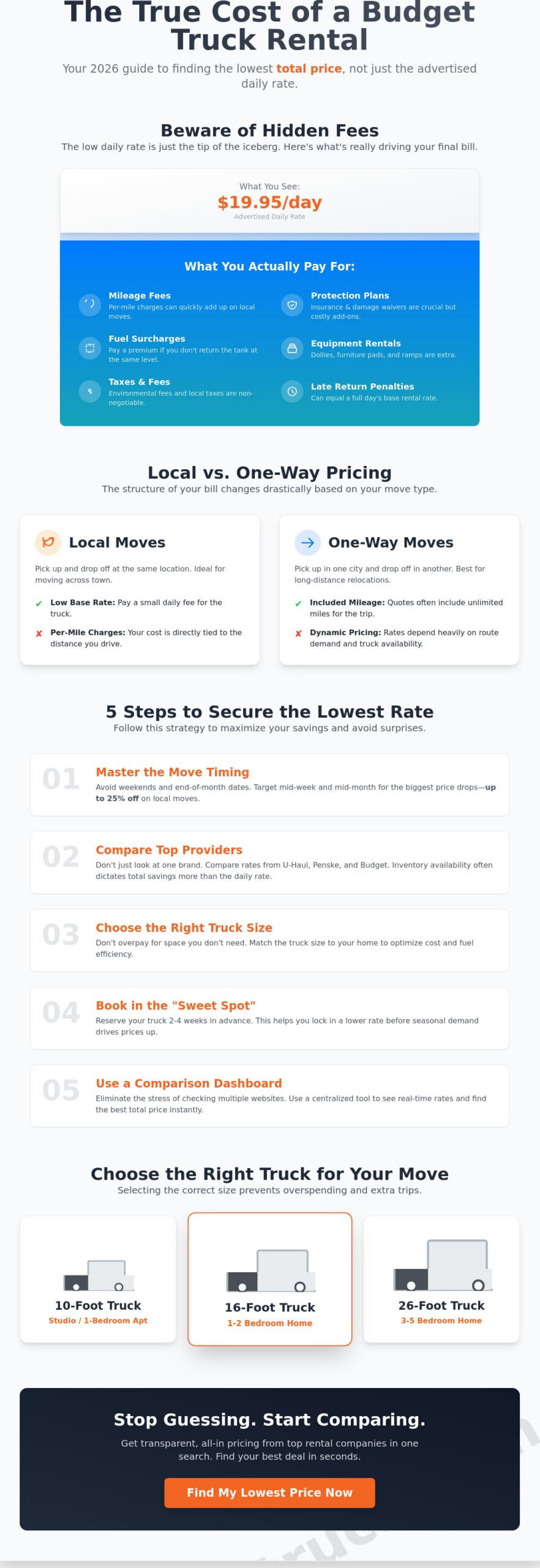
Budget-conscious movers usually look at three main truck sizes. Small 10-foot trucks work for studios. Medium 16-foot trucks handle small houses. Large 26-foot trucks are for family homes. Most value-tier rentals include the vehicle and basic maintenance. Items like loading ramps, furniture dollies, and moving pads are typically paid add-ons. You might also find that budget rates apply to slightly older fleets. A truck with higher mileage costs less than a brand-new one. This trade-off is often worth it for local moves where the daily rate is the priority. Timing also plays a role. Rentals from Sunday to Thursday often come with significant discounts, sometimes as high as 25% for local moves. Always check the fine print for late return penalties. These can equal a full day’s base rental rate. Balancing these factors is how you secure a true budget truck rental deal.
The Mechanics of Moving Truck Pricing and Rates
Pricing isn’t static. It’s a moving target. Rental companies use dynamic pricing models that shift based on demand. This means the budget truck rental you see on a Tuesday might cost significantly more by Friday. Base rates are just the starting point. They cover the vehicle for a specific time window, usually 24 hours. If you return the truck late, you’ll likely pay for an entire extra day. High demand during the summer months or the last weekend of any month drives prices up. Rates are typically lowest during the middle of the week when fewer people are moving.
Mileage math varies by move type. For local moves, you pay a low base rate plus a fee for every mile driven. For long-distance moves, companies like Budget or Penske often provide unlimited mileage for one-way trips over 400 miles. Don’t forget about fuel. You must return the tank at the same level you started. If you don’t, the company charges a premium for “fuel recovery.” Environmental fees are also standard. These cover the cost of disposing of oil and tires used during the fleet’s operation. They’re small but non-negotiable.
Protection plans add another layer of cost. You can choose basic damage waivers or full liability coverage. Budget offers a Complete Protection Package. This includes a Physical Damage Waiver and Supplemental Liability Insurance. This insurance can protect against claims up to $1,000,000. It’s about balancing risk against your upfront budget. The Federal government provides resources for protecting your move to help you understand your rights and responsibilities. Taking the time to understand these tiers prevents expensive surprises at the rental counter.
Local vs. One-Way Pricing Models
Local moves are straightforward. You pick up and drop off at the same location. These rely heavily on per-mile charges. One-way moves are more complex. Rates depend on where the trucks are needed most. If a specific city has a truck shortage, the cost to drop a truck there might be lower. One-way quotes usually include a set number of miles and days based on the distance between your zip codes. To get the best deal, compare real-time pricing across multiple providers before you book.
Taxes, Surcharges, and Deposits
Your quote isn’t the final bill. State taxes and vehicle licensing recovery fees apply to every rental. Security deposits also impact your immediate cash flow. Most companies hold these on your credit card at the time of pickup. You get the funds back after a clean, on-time return. You can avoid “convenience fees” by booking online. Digital reservations are almost always cheaper than walk-in or phone bookings. Always review the itemized list for optional surcharges like roadside assistance that you might not need.
Comparing the Big Three: Budget, Penske, and U-Haul
Choosing the right provider is a strategic decision. You need to balance availability with your total budget. The industry is dominated by three major names. Each occupies a specific niche in the market. Understanding these differences saves you money and time. A budget truck rental that works for a local studio move might be the wrong choice for a cross-country relocation. You’re looking for the intersection of reliability and cost. This requires looking past the brand name to the actual service provided.
Inventory levels dictate local pricing. U-Haul maintains the largest presence with over 20,000 locations. This massive footprint means you can almost always find a truck nearby. However, Budget and Penske often lead on price transparency for longer trips. Budget has approximately 2,800 locations. Penske operates more than 2,000. While U-Haul is everywhere, the other two compete heavily on high-demand one-way routes. Expert reviews like Forbes’ best truck rental companies highlight how these brands stack up against each other in terms of value and service. Fleet size directly impacts your options. If one brand is low on stock, their rates will climb. Checking all three ensures you don’t pay a scarcity premium.
Customer service ratings often mirror the price point. Penske typically scores highest for reliability and truck condition. You pay a bit more for that peace of mind. Budget strikes a middle ground. They offer a modern fleet with consistent support. U-Haul’s service varies by location because many are independent dealers. This creates a trade-off. You might get a better price at a local shop but less consistent vehicle quality. Finding the sweet spot means identifying which factor matters most for your specific trip.
Budget Truck Rental: The Value Specialist
Budget focuses on the price-sensitive mover. They offer frequent promotional codes to lower the base rate. For example, local rentals from Sunday to Thursday can be up to 25% cheaper with codes like MID25. They also provide a 25% discount for Costco members. Their fleet ranges from small 12-foot trucks to large 26-foot box trucks. This variety makes them ideal for mid-sized households on a strict timeline. You get a reliable vehicle without the premium price tag. It’s a functional solution for those who prioritize the bottom line.
Penske and U-Haul: The Primary Alternatives
Penske positions itself as a high-quality alternative. Their base rates are often higher, but they provide newer trucks. They also offer a 15% discount for military personnel and 10% for students. This can make them a budget truck rental winner for specific groups. U-Haul remains the most accessible option. Their Safemove and Safemove Plus packages offer tiered protection, but the add-on costs can be complex. Use these brand differences to negotiate. If you show a lower quote from a competitor, some locations may match it to earn your business. Real-time comparison is the only way to catch these fluctuations and secure the best deal.
How to Secure the Lowest Rental Rate: A 5-Step Strategy
Finding a low rate isn’t about luck. It’s about outsmarting the pricing algorithm. Most renters wait until the last minute and pay a premium for convenience. You can avoid this by following a structured approach. A budget truck rental becomes truly affordable when you stack timing, size, and discounts correctly. This five-step strategy ensures you never pay more than necessary for your equipment.
- Target mid-week and mid-month dates to avoid peak demand.
- Book during the 14 to 30-day “sweet spot” window.
- Select the exact size you need based on your inventory list.
- Apply all eligible member discounts like AAA, student, or military status.
- Use a comparison platform to view all local rates at once.
Timing Your Move for Maximum Savings
Timing is the biggest lever you can pull. Most people move on weekends or the last day of the month. Rental companies know this. They apply a “Weekend Surcharge” that can spike base rates by 20% or more. Moving on a Tuesday or Wednesday is almost always cheaper. If your timeline is flexible, aim for a winter move. Rental demand drops between November and February. This leads to lower base rates and more available inventory. Mid-month dates are also superior. Most leases end on the 30th or 1st. Booking for the 15th bypasses the end-of-month rush.
Optimizing Your Truck Size
Choosing the wrong truck size creates unnecessary costs. An undersized truck forces you to make multiple trips. This doubles your fuel and mileage expenses. A 10-foot truck is perfect for a studio. A 26-foot truck handles a large family home. However, “sizing up” can sometimes be cheaper. If a location has a surplus of large trucks but no small vans, they often lower the price of the larger vehicle to keep it moving. Check the inventory lists carefully. If the price difference between a 16-foot and 26-foot truck is negligible, take the extra space. It prevents the stress of a tight pack and saves time on moving day.
Discounts are your final line of defense. Penske offers 15% off for military personnel and 10% for students. Budget provides up to 25% off for Costco members and local mid-week moves using codes like MID25. Don’t leave this money on the table. Instead of manually visiting every brand site, search all rental rates now to see which provider offers the best total package for your specific route. Centralizing your search eliminates “tab-fatigue” and ensures you catch limited-time promotional codes like SUNNY26 for one-way moves.
Simplify Your Search with DityTruck Comparison
Logistics are often a source of friction. Finding a budget truck rental shouldn’t add to that stress. Most movers fall into the trap of “tab-fatigue.” They open ten different websites and try to track fluctuating rates on a notepad. It’s inefficient and confusing. DityTruck solves this by acting as your practical facilitator. We strip away the complexity of the 2026 rental market. You get a single, streamlined dashboard that does the heavy lifting for you. It’s the most logical path to a cost-effective move.
How DityTruck Aggregates Value
Our platform aggregates value by scanning the entire industry instantly. We connect directly with national providers to show real-time availability. You can compare a 16-foot Budget truck against a similar Penske model in seconds. Filtering options allow you to sort by the lowest price or the closest pick-up location. This technology ensures you never miss a specialized budget truck rental discount. Whether it’s a student special or a mid-week promotion, the savings are front and center. You get the benefit of a professional search without the industry jargon. We provide the data. You make the decision.
Booking Your Move with Confidence
Booking with us means booking with clarity. We prioritize your time and peace of mind. Every quote includes a transparent breakdown of potential fees. You see the total cost before you ever commit. This prevents the “checkout shock” common on brand-specific sites. The transition from discovery to confirmation is seamless. We act as a neutral advocate for your wallet. Our goal is a friction-free experience that gets you on the road faster. You stay in control of the process from start to finish. It’s a simple, action-oriented approach to a high-stakes task.
You’ve already learned how to time your move and pick the right size. Now, put that strategy into action. Don’t waste another hour on manual searches across multiple platforms. Take the final step toward an affordable and organized relocation. Compare Moving Truck Rental Rates in One Simple Step and start saving today.
Master Your 2026 Moving Strategy
Securing a budget truck rental requires a blend of smart timing and the right technology. You’ve learned that the lowest total cost comes from avoiding weekend surcharges and selecting the exact vehicle size for your specific inventory. By applying member discounts and sticking to mid-week schedules, you eliminate the common financial hurdles of a DIY move. You’re no longer guessing at rates; you’re following a proven strategy for savings.
DityTruck simplifies the final step of your journey. We provide real-time rates from top national providers in one centralized dashboard. You get transparent pricing with no hidden surprises or last-minute fees. Our fast, efficient booking interface removes the friction from your logistics planning. It’s the shortest, most logical path to a stress-free moving day. You don’t have to handle the heavy lifting of price comparison alone.
Find the Lowest Budget Truck Rental Rates Now and start your move with total confidence. Your affordable, organized relocation is just a few clicks away.
Frequently Asked Questions
Is Budget Truck Rental generally the cheapest option?
Budget Truck Rental often leads the market on base rates for local rentals. However, the final price depends on your specific zip code and vehicle availability. Checking multiple brands ensures you aren’t paying a premium just because one fleet is low on stock.
How far in advance should I book to get a budget rate?
Aim for a booking window of two to four weeks before your move date. This timeframe allows you to lock in lower rates before dynamic pricing algorithms respond to high demand. Waiting until the final week often results in significantly higher costs.
What is the cheapest day of the week to rent a moving truck?
Tuesday and Wednesday are the most cost-effective days to rent. Most people schedule moves for Friday or Saturday; which drives up weekend prices. Shifting your schedule by just 48 hours can result in substantial savings on your base rate.
Are there hidden fees I should look for in a “budget” quote?
Watch for environmental fees and vehicle licensing recovery charges. These are standard industry costs but aren’t always highlighted in the initial headline price. Always check the fuel policy to avoid expensive per-gallon recovery fees upon return.
Can I get a budget truck rental for a one-way move?
You can absolutely secure a budget truck rental for one-way trips. These rentals typically include a set number of days and miles based on your destination. Prices fluctuate based on where the company needs to relocate its equipment.
Do I need to purchase the extra insurance for a rental truck?
Most personal car insurance policies do not cover large box trucks. Check your existing coverage before declining the rental company’s protection plan. Supplemental Liability Insurance provides peace of mind for high-stakes hauls and protects your personal finances from accident-related claims.
How does DityTruck help me find a cheaper rental than going direct?
DityTruck eliminates the need to visit multiple websites to track price changes. Our dashboard displays real-time inventory and rates from all national providers simultaneously. This transparency allows you to spot the lowest total price for a budget truck rental without manual searching.
What is the best truck size for a 1-bedroom apartment move?
A 10-foot or 12-foot box truck is usually sufficient for a 1-bedroom apartment. These smaller vehicles are easier to navigate in urban areas and offer the best fuel economy. If you have a large sofa or multiple heavy appliances, consider stepping up to a 16-foot model to avoid tight packing issues.
Leave a Reply