The lowest daily rate for one way truck rentals for moving is often the most expensive way to relocate. It sounds backward. However, those small upfront numbers usually hide massive drop-off fees and strict mileage caps that can wreck your budget. You deserve a move that stays on track without the financial surprises. We know that planning a long-distance relocation is a high-stakes task. You need a solution that simplifies the logistics and respects your time. Most movers just want a clear price and a reliable truck that doesn’t come with a mountain of fine print.
We’ve analyzed the current market to ensure you don’t overpay for your journey. This 2026 comparison guide cuts through the noise to find you the best one-way rental rates and policies available today. We’ve done the heavy lifting by reviewing the latest industry data to help you save hundreds on your haul. You’ll discover which providers offer unlimited mileage, where to find flat-rate deals, and how to handle your booking online in minutes. This breakdown gives you the shortest, most logical path to a successful move.
Key Takeaways
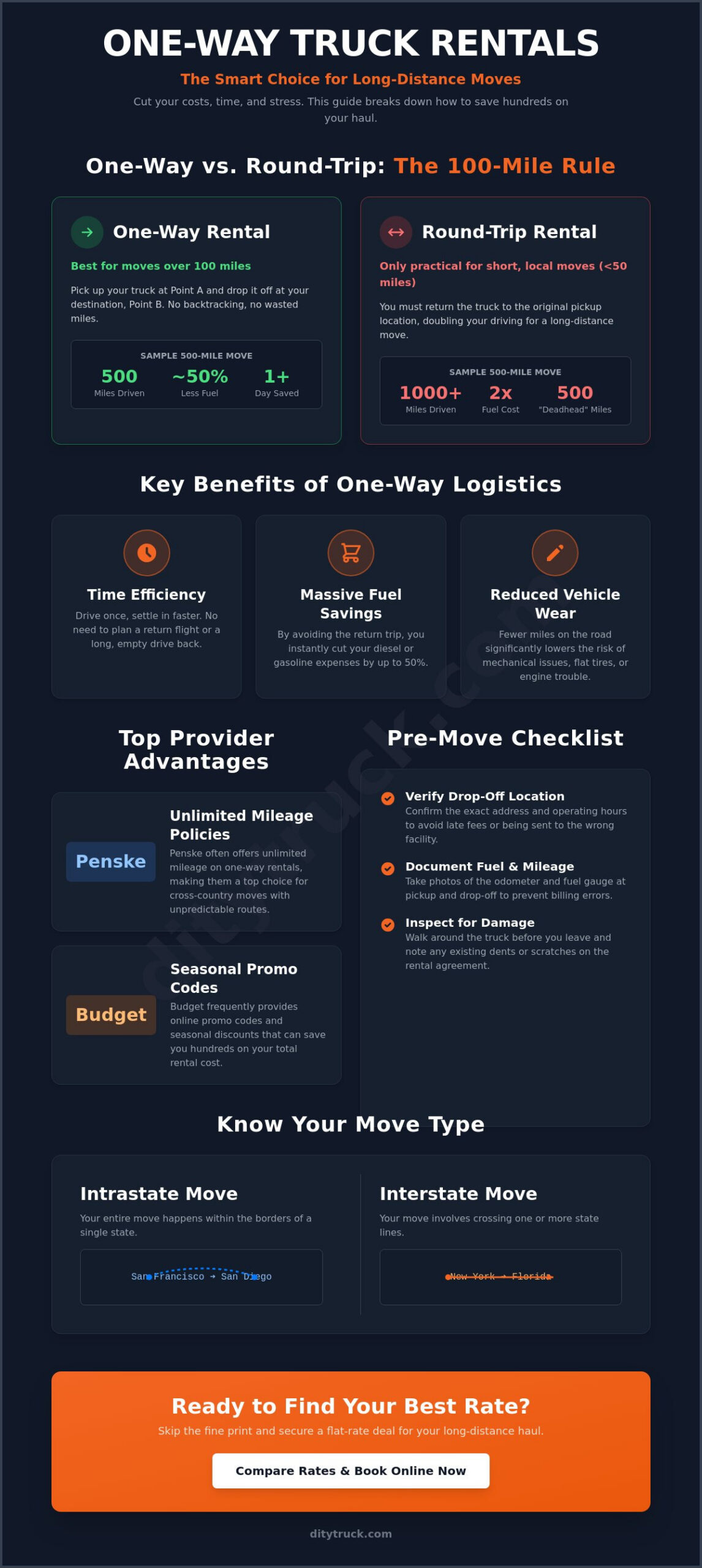
- Learn the 100-mile rule. Identify the exact distance where one-way rentals become cheaper than driving a return trip.
- Compare the top one way truck rentals for moving. Focus on Penske’s unlimited mileage policies and Budget’s seasonal promo codes to save hundreds.
- Use a pre-move checklist. Document fuel levels and verify drop-off addresses to avoid common billing errors.
- Access transparent pricing instantly. Aggregated rates help you skip the fine print and secure a flat-rate deal for your long-distance haul.
Understanding One Way Truck Rentals for Long Distance Moving
One way truck rentals for moving allow you to pick up a vehicle at your current location and drop it off at a facility near your new home. This eliminates the need for a return trip. It is a simple, linear process that prioritizes your time and energy. You aren’t just renting a vehicle. You’re buying back hours of your life that would otherwise be spent driving an empty truck back to where you started. This strategy is the gold standard for long distance relocations because it focuses on a single goal. Getting you from point A to point B without backtracking.
Prices for these rentals aren’t static. They change based on inventory dynamics. Rental companies manage massive fleets across thousands of locations and they need to keep those fleets balanced. If a specific city has a shortage of vehicles, the cost to rent one from that location might rise. Conversely, if a branch has a surplus of trucks, they often offer lower rates to movers willing to take them elsewhere. Understanding these inventory shifts helps you find the best deal. It is why you might see different rates for the same distance depending on your direction. It’s a system built on supply and demand.
Most people choose one way truck rentals for moving when they are facing a cross-country move or a state-to-state relocation. It is also a practical choice for one-way business deliveries or students moving to a distant university. If your destination is your final stop, a one-way rental is the most logical path forward. It turns a multi-day logistical nightmare into a straightforward drive.
The Core Benefits of One-Way Logistics
- Time efficiency: You drive once and settle into your new home faster. There’s no need to plan for a return flight or a long drive back in a second car.
- Fuel savings: By avoiding the return leg of the trip, you cut your gasoline or diesel expenses by roughly 50 percent. This is a massive win for your moving budget.
- Reduced vehicle wear: Spending less time on the road reduces the risk of mechanical issues. Fewer miles mean a lower chance of a flat tire or engine trouble during your journey.
Intrastate vs. Interstate One-Way Moves
Intrastate moves happen between cities within the same state borders. Think of a move from San Francisco to San Diego. These are often governed by local tax laws and straightforward mileage policies. Interstate moves involve crossing state lines. These can be more complex due to varying state regulations and potential environmental fees. Identifying your move type early ensures your online booking reflects the true final cost. It prevents hidden fees from appearing on your final bill. Knowing these categories helps you compare one way truck rentals for moving with total confidence.
One Way vs. Round Trip: Which Rental Strategy Saves More?
The 100-mile rule is a simple benchmark for any relocation. If your new home is more than 100 miles away, one way truck rentals for moving are almost always the smarter financial choice. Round-trip rentals often tempt you with a lower daily rate. They force you to pay for the entire return journey, though. This includes fuel, mileage fees, and your own valuable time. You also need to consider the legal side of interstate relocations. Reviewing consumer protection regulations for moving can help you understand your rights when crossing state lines.
Driving an empty truck back to its origin is a major expense. These are known as deadhead miles. You are paying for a heavy, fuel-hungry vehicle to transport nothing but air. It doubles the wear on the vehicle and increases your risk of an accident. Insurance costs often reflect this extended time on the road. A round trip also impacts your personal expenses. You might need an extra night in a hotel or three more meals on the road. These costs add up fast. They often exceed the premium price of a one-way contract.
Crunching the Numbers: A Sample Move
Imagine a 500-mile move. A one-way rental allows you to finish the drive and start unpacking immediately. A round trip requires 1,000 total miles of driving. You’ll spend twice as much on fuel. You’ll lose an entire day of your life just to return the keys. Deadhead miles are the primary profit-killer for DIY movers. You can quickly compare one-way rates to see how much you’ll save by skipping the return leg.
When Round-Trip Still Wins
Round-trip rentals aren’t always the wrong choice. They work best for short distances under 50 miles. If you’re moving across town, the local daily rate is significantly lower. You might also choose a round trip if you need the truck for local storage for several days while you clean. Some rural areas have limited drop-off locations. In these cases, driving the truck back to the original branch is the only logical option. Identifying the best one way truck rentals for moving depends on your specific mileage and destination.
Side-by-Side: Top Providers for One Way Moving Trucks
Choosing the right provider for one way truck rentals for moving depends on your specific priorities. Every major brand has a different strength. Some focus on the lowest possible price. Others prioritize vehicle reliability and customer support. You need to match the company to your route and load size to get the best value. We’ve broken down the top four contenders to simplify your decision.
- Penske: The king of long-distance moves. They are the only major provider offering unlimited mileage on one-way rentals. Their fleet is consistently newer and better maintained than the competition.
- Budget: Best for the price-conscious mover. They offer competitive base rates and frequently release “one-way” promo codes. It’s a solid choice if you want to keep costs as low as possible.
- U-Haul: Unmatched for convenience. With more locations than any other brand, you can find a drop-off point in almost any zip code. This density makes them the most flexible option for rural destinations.
- Enterprise: The specialist for smaller hauls. If you don’t need a massive box truck, Enterprise offers cargo vans and heavy-duty pickups. They provide a professional, car-like rental experience.
Mileage Policies Compared
Mileage is the most common source of hidden fees. Penske’s unlimited policy is a flat-rate win. It removes the stress of tracking every mile. U-Haul and Budget use a capped system. They calculate an “allowed” mileage based on the most direct route between your locations. If you take a detour or get lost, you’ll face over-mileage fees. This sticker shock can ruin a carefully planned budget. If your route includes multiple stops, try to negotiate for extra miles before you sign the contract. It’s often cheaper to pay for extra miles upfront than at the drop-off desk. For a thorough one way truck rental comparison that breaks down mileage policies and current provider deals, reviewing the latest rate analysis can save you hundreds before you book.
Fleet Quality and Reliability
Reliability is critical for hauls over 500 miles. A breakdown on a remote highway can derail your entire schedule. Newer trucks are more fuel-efficient and less likely to suffer mechanical failures. All major providers offer 24/7 roadside assistance that stays active across state lines. If a truck fails, they’ll dispatch help or provide a replacement. For a deeper look at fleet specs and mechanical details, check out the Moving Truck Rental: The Complete 2026 Comparison & Booking Guide. This resource helps you understand exactly what you’re driving before you pick up the keys.
Essential Checklist for Planning Your One Way Move
Success with one way truck rentals for moving depends on documentation. You are handing the keys to a different person than the one who gave them to you at the start. This handoff is where most disputes happen. You must be your own advocate. Start by verifying the drop-off address listed on your contract. Some franchise locations only handle local equipment. Showing up at the wrong lot can lead to “wrong location” fees that cost hundreds of dollars. It is a simple check that saves major headaches at the end of a long drive.
Documentation is your best friend. Take a clear photo of the odometer and the fuel gauge before you leave the parking lot. Do the same when you arrive at your destination. Inspect the box and the cab for any pre-existing damage. Look for roof scrapes, mirror cracks, and upholstery tears. Mark these on the digital or paper contract immediately. If you don’t, you might be held responsible for the previous driver’s mistakes. Finally, confirm your “Return by” time. Rental agencies often charge a full extra day even if you’re only an hour late. Precision here keeps your budget intact.
The Drop-Off Protocol
Many providers now offer self-checkout apps for after-hours returns. These are convenient and save time. They lack the immediate peace of mind of a human signature, though. If you use an app, take a video of the entire truck in the return lot. This is your primary defense against cleaning or damage claims. If the drop-off location is full or closed, don’t just leave the keys in a drop box and walk away. Call the customer service line immediately. Get a reference number to prove you attempted a timely return. This simple step prevents “abandoned equipment” fees from appearing on your statement.
Managing Fuel Costs on Long Hauls
Fuel is often the largest variable expense on a long-distance move. Always follow the “Return Full” rule. Never let the rental company refuel the truck for you. They often charge double or triple the local pump price for the service. Plan your budget around a 10-12 MPG average for most box trucks. This number drops if you are towing a car or driving through mountains. Most box trucks run on regular unleaded gasoline, but you should always verify the fuel type at the pump to avoid engine damage. You can book your one-way rental now to secure a truck from a reliable, well-maintained fleet.
How DityTruck Simplifies One Way Rental Comparisons
Finding one way truck rentals for moving shouldn’t feel like a part-time job. Most people spend hours jumping between websites. They enter the same zip codes, dates, and truck sizes over and over. DityTruck changes that. We act as your smart assistant by doing the heavy lifting behind the scenes. Our platform aggregates real-time rates from industry leaders like Penske and Budget into a single, clean view. You see the numbers side-by-side. No more guesswork. No more hidden fees buried in the fine print. We prioritize financial honesty so you can make a decision based on facts, not marketing fluff. This level of transparency is rare in the logistics world. It gives you the power to choose the best value for your specific route.
We understand that inventory levels shift constantly. One branch might have too many trucks while another has none. These fluctuations change your price. DityTruck tracks these movements in real-time. We help you find the provider that needs your truck at your destination. This often leads to lower rates that you wouldn’t find by searching a single brand’s site. It’s a smarter way to move. We focus on stripping away the complexity. You get relief and clarity instead of confusion. Our goal is to provide the shortest, most logical path between your old home and your new one.
One Search, Every Major Brand
Stop opening dozens of browser tabs. DityTruck eliminates repetitive data entry. You enter your moving details once and see every available option. You can filter the results by truck size, price, or mileage policy instantly. This allows you to find the best moving truck rental for your specific distance without the usual stress. Whether you need an unlimited mileage deal for a cross-country haul or a small van for a state-to-state trip, the data is right there. It’s efficient logistics for the savvy consumer. You can compare the policies of different brands without reading pages of legal text. We highlight what matters most to your wallet.
Book with Confidence
Our interface is built for speed. You can reserve your vehicle in minutes through a streamlined, mobile-friendly process. It works where you are. We also provide access to customer support that understands the unique challenges of one-way moves. We know that logistics can be high-stakes. That’s why we focus on friction-free solutions that respect your schedule. You aren’t just booking a truck. You’re securing a reliable tool for your life’s next chapter. Our system is designed for quick scanning and rapid decision-making. Compare one-way truck rental rates now and see how simple a long-distance move can actually be.
Secure Your Long-Distance Move Today
Choosing one way truck rentals for moving is the most logical path to a successful relocation. You’ve learned that the true value of a rental isn’t found in the daily rate alone. It’s found in unlimited mileage policies and the elimination of empty return trips. These factors keep your budget on track and your schedule moving forward. A smooth experience also relies on your own documentation. Taking photos at pickup and verifying your drop-off location are simple steps that prevent expensive billing disputes. You are now equipped with the data needed to outsmart the traditional hurdles of the moving industry.
DityTruck acts as your savvy advocate by performing the heavy lifting for you. We offer real-time price comparisons from top-rated providers like Penske and Budget. There are no hidden reservation fees or confusing fine print to navigate. Our platform allows for direct booking for 2026 moves with total transparency. You can find the best deal for your specific route in just a few clicks. Compare one-way truck rental rates and save today. Your new home is waiting. We’re here to ensure you get there without the unnecessary stress.
Frequently Asked Questions
Is mileage really unlimited on one-way truck rentals?
Penske is the only major provider offering truly unlimited mileage on one-way rentals. Other brands like U-Haul and Budget provide a specific mileage cap based on your destination. If you go over that limit, you’ll face a per-mile charge. It’s vital to confirm these details during the booking process. Knowing your limit helps you avoid expensive surprises at the drop-off desk.
Can I change my drop-off location after I’ve started my move?
You can change your drop-off location, but it usually comes with a price increase. Rental companies price one way truck rentals for moving based on where they need equipment. Moving the truck to a different city can disrupt their inventory. This often results in a “wrong destination” fee. Always call the rental agency to authorize the change before you arrive at a different lot.
What is the average cost of a one-way truck rental for a cross-country move?
A long-distance, one-way move typically costs between $1,500 and $3,500 for a 5 to 7-day rental. This range depends on the truck size and the total distance traveled. For example, a five-bedroom home move can reach the higher end of that scale. Moving during the busy summer months from May to August will also increase your total expenses. Before you finalize your budget, reviewing a dedicated long distance moving truck rental guide can help you identify the specific cost drivers that push your total bill beyond the base rate.
Do one-way rentals include insurance for long-distance driving?
Insurance is not included in the base rental rate. You’ll need to purchase a separate protection plan which often averages over $100 for a long-distance haul. These plans cover damage to the vehicle and your personal items. Don’t assume your personal car insurance covers a 26-foot box truck. Most policies exclude commercial vehicles, making the rental company’s coverage a necessary expense.
How do I avoid hidden drop-off fees with one-way rentals?
The best way to avoid hidden fees is to return the truck with a full tank of gas. Rental agencies charge significantly more than local gas stations for refueling. You should also verify the drop-off location address on your contract before you leave. Showing up at the wrong branch can trigger extra processing fees. Always take photos of the dashboard at both ends of your trip.
Are there discounts available for one-way moving truck rentals?
Many companies offer discounts for military personnel, students, and senior citizens. You can often find promo codes for one way truck rentals for moving on the provider’s official website. Penske and Budget are known for frequent seasonal offers. Booking your truck at least two weeks in advance is another reliable way to secure a lower rate before inventory gets tight.
Can I tow my personal car behind a one-way rental truck?
You can tow your vehicle using a tow dolly or a full car carrier. These are available as add-on rentals for most one-way trips. Towing increases the complexity of your drive and reduces your fuel efficiency. It’s a practical way to move your car without adding miles to its odometer. Just ensure your truck is rated for the total weight of the trailer and your vehicle.
What happens if the truck breaks down in another state?
All major rental brands offer 24/7 roadside assistance that stays active even when you cross state lines. If you experience a mechanical issue, call the emergency number provided in your rental packet. They’ll send a technician to your location or arrange for a replacement truck if the repairs take too long. This support is designed to get you back on the road with minimal delay.
Leave a Reply