
Why does a $19.95 daily rate often turn into a $300 bill by the time you reach your destination? Finding a reliable one way cargo van rental shouldn’t feel like a trap. You want to move your items across state lines without the anxiety of surprise drop-off fees or confusing mileage math. It’s a high-stakes task that deserves a friction-free solution. You need clarity, not a math project.
You already know that one-way rentals are the most efficient way to handle urban moves or long-distance deliveries. With one-way rentals projected to grow 9% this year, finding available inventory at a fair price is becoming more difficult. We promise to help you find the most efficient rental by comparing top providers side-by-side in seconds. You don’t have to guess if your gear will fit or if the price is actually final.
This guide provides a clear look at the best 2026 rates and policies. We’ll compare payload capacities, such as the 3,700 lbs found in standard cargo models, and break down the latest insurance bundles. You’ll get a simple way to book the right vehicle without visiting five different websites. Let’s find the shortest path between your current location and your new destination.
Key Takeaways
- Save time and reduce fuel costs by choosing a drop-off location at your destination rather than returning to your origin.
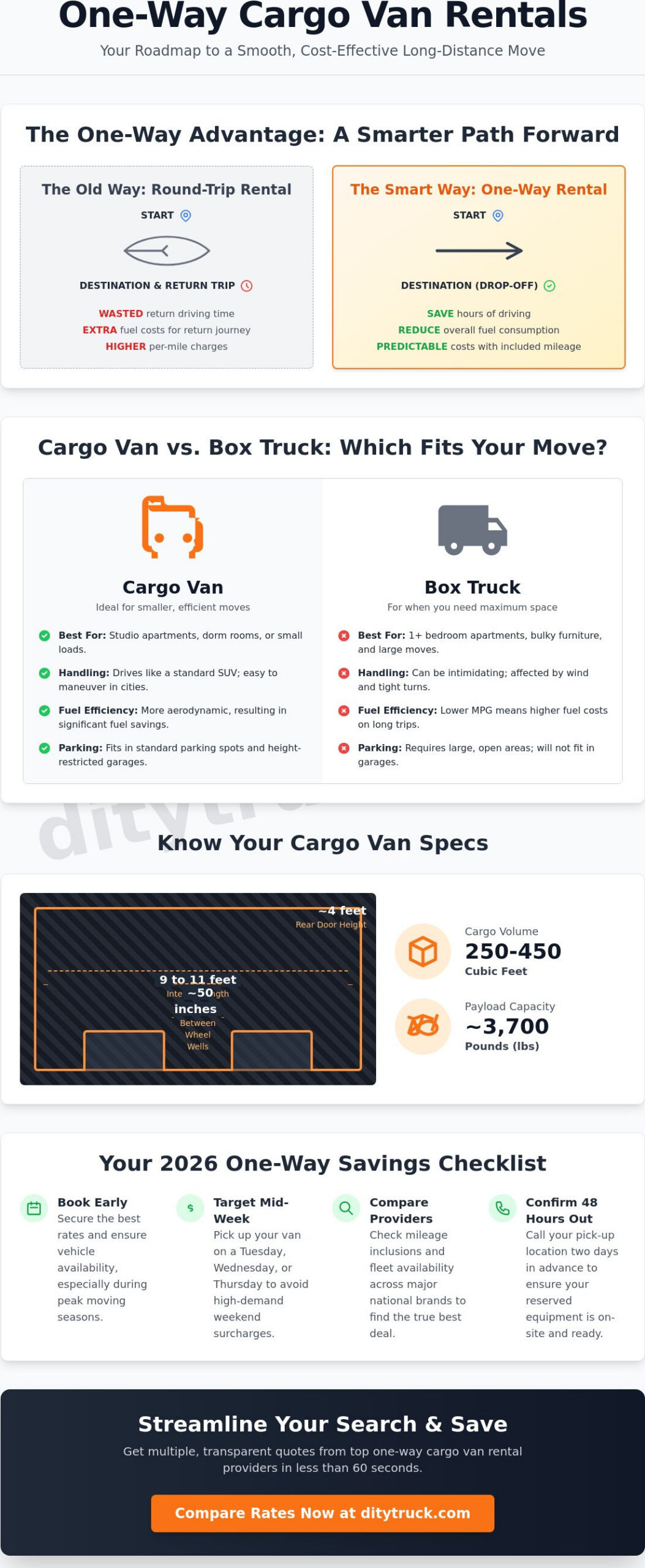
- Match your load to the right specs by evaluating payload capacity and standard cargo volumes between 250 and 450 cubic feet.
- Identify the best one way cargo van rental rates by comparing mileage inclusions and fleet availability across major national providers.
- Secure the lowest rates by booking your vehicle early and targeting mid-week pick-up dates to avoid high-demand surcharges.
- Streamline your search using comparison tools that deliver multiple transparent quotes in less than 60 seconds.
Defining the One Way Cargo Van Rental Advantage
Moving across state lines is complicated. Returning a rental vehicle to its origin makes it twice as hard. A one way cargo van rental removes this burden entirely. You pick up the van near your current home. You drop it off near your new one. This saves hours of driving. It eliminates the need for a “chase car” or a flight back to your starting point. It’s the shortest path to finishing your move. Think of it as a smart shortcut. You focus on your new home while the rental company handles the vehicle’s relocation.
Local rentals often look cheaper on paper. They usually charge by the mile. For a cross-country trip, those mileage fees accumulate quickly. One-way models typically include a set number of miles based on your route. You get flexibility. You get a predictable bill. You also save on fuel. Cargo vans are significantly more aerodynamic than box trucks. This means fewer stops at the gas station and more money in your pocket. It’s about financial honesty. You know the cost upfront without fear of a surprise bill at the end of the trip.
When to Choose a Van Over a Box Truck
Vans are the smart choice for smaller loads. If you’re moving a studio apartment or a college dorm room, a 10-foot or 16-foot truck is often unnecessary. You’re paying for empty space and burning extra fuel. Cargo vans offer between 250 and 450 cubic feet of room. They handle like a standard SUV. You won’t feel intimidated by highway winds or tight turns. This ease of use reduces the physical stress of the drive. Most importantly, vans fit in parking garages. If your new apartment has a height-restricted loading zone, a van is your only viable option. It allows you to park closer to the elevator and save your back.
The Logistics of Cross-Country Van Moves
The logistics are simple but require planning. You return the vehicle to a different franchise location within the same network. This system of one-way rentals relies on a massive infrastructure of drop-off points. Because a one way cargo van rental is popular for last-mile deliveries and small moves, inventory fluctuates. Booking early is essential to secure your preferred dates. For longer journeys, understanding the nuances of one way truck rentals for moving helps you compare rates effectively across different brands. High demand means you should confirm your pick-up location 48 hours in advance. This ensures the equipment is ready when you are. It’s a friction-free way to manage a high-stakes task.
Evaluating Cargo Van Specs: Dimensions and Weight Limits
Choosing a one way cargo van rental requires more than just looking at the price. You need to know if your belongings will actually fit inside the metal box. Most standard cargo vans offer between 250 and 450 cubic feet of storage space. This is plenty for a studio apartment, but it requires strategic packing. Unlike larger box trucks, vans have curved walls and wheel wells that eat into your floor space. Every inch counts when you’re moving long distances.
Accurate specifications help you avoid the stress of a last-minute vehicle swap. While companies provide general categories, the actual dimensions vary by make and model. This lack of transparency is a known issue. Understanding the federal oversight of the moving industry can help you stay informed about your rights as a consumer when rentals don’t match their advertised specs. Clarity is your best tool for a successful move.
Standard Dimensions You Need to Know
Floor space is your primary concern. Most cargo vans provide 9 to 11 feet of internal length. However, the width between the wheel wells is the real bottleneck. This space is usually around 50 inches. If you’re moving a queen-sized mattress, you’ll likely need to tilt it or rest it on top of the wells. Check the rear door opening height as well. A standard opening is about 4 feet high. If your dresser or armoire is taller than that, you’ll be forced to load it on its side.
Weight and Payload Considerations
Volume isn’t the only limit. Weight matters just as much. Every one way cargo van rental has a Gross Vehicle Weight (GVW) rating. This is the maximum legal weight of the van plus its cargo and passengers. Exceeding this limit is dangerous. It strains the brakes and tires. It can also lead to legal trouble at weigh stations.
Payload is the specific weight of the items you can put inside. For a standard van, this is often around 3,700 lbs. Don’t confuse payload with towing. Cargo vans are designed for internal storage. They aren’t meant for pulling heavy trailers across the country. A fully loaded van handles differently at highway speeds. Your braking distance increases. Your center of gravity shifts. To ensure you’re getting a van that meets these technical needs, you can compare specific vehicle capabilities before you book.
Fuel efficiency is another advantage. You can expect 12 to 18 MPG. This varies based on how heavy you load the vehicle. To keep your items safe during the drive, look for interior tie-downs. Most vans have D-rings or rails on the floor and walls. Use them. Securing your cargo prevents shifting. This protects your furniture and keeps the van stable on the road. It’s a simple step that provides massive peace of mind.
Comparing Top Providers for Long-Distance Van Moves
Finding the right one way cargo van rental often involves juggling three major names: U-Haul, Budget, and Penske. Each brand offers a different balance of availability, price, and vehicle quality. U-Haul dominates with the largest fleet in North America. You’ll find a pick-up point in almost every town. However, the age of their vans can vary significantly. You might get a modern vehicle or a high-mileage workhorse. Reliability is key for a long trip. You don’t want to deal with a breakdown when you’re 500 miles from home.
Budget Truck is a strong choice for the cost-conscious mover. They often include unlimited mileage on one-way cargo van rentals. This removes the stress of counting every mile on the odometer. Penske takes a different approach by focusing on newer fleets. Their vans are generally the most reliable in the industry. For reservations made through June 30, 2026, you can use the code “SUNNY26” to get 10% or more off your rental rate. They also provide free unlimited miles on one-way trips. This level of transparency makes budgeting simple. It’s a friction-free solution for a high-stakes task.
DityTruck simplifies this process. Instead of visiting three different sites, you see every rate on one screen. It’s a smart assistant that does the heavy lifting for you. You can compare the base prices and the fine print in seconds. Following the FMCSA moving guidelines ensures you stay protected throughout this process. It’s about making an informed choice without the headache. You get clarity. You get relief. You get moving.
Mileage Policies and One-Way Fees
One-way quotes are usually flat rates. They include a set number of days and miles deemed sufficient for your route. If you take a detour or need extra days, the costs can climb. Always check for excess mileage charges before you sign. Comparing moving truck rental rates across these national brands helps you spot the best value. Look for “unlimited mileage” labels to avoid the hidden cost of a longer route. It’s the most logical path to a lower bill.
Insurance and Protection Plans
Long-distance moves carry higher risks. Your personal car insurance rarely covers a commercial cargo van. Rental companies offer several tiers of protection. A Limited Damage Waiver (LDW) is often the most important. It clears you of financial responsibility if the van is damaged or stolen. Penske, for example, offers bundles like Basic, Standard, and Plus to simplify your choices. Roadside assistance is another essential. You want a provider that offers support if a tire blows or a battery dies in the middle of nowhere. It’s about peace of mind. You focus on the road; the provider handles the hardware.
The 2026 Booking Checklist for One-Way Savings
Timing is everything. One-way cargo vans represent a smaller portion of rental fleets compared to standard box trucks. This means inventory disappears fast. Booking your one way cargo van rental at least two to three weeks in advance is the best way to secure a vehicle. If you wait until the last minute, you might be forced into a larger, more expensive truck. Mid-week pick-ups are your secret weapon for savings. Rental demand peaks on Fridays and Saturdays. Shifting your move to a Tuesday or Wednesday can trigger significant discounts. It’s a simple change that leads to immediate relief for your wallet.
Verify your destination. Not every rental branch is equipped to receive every vehicle type. Confirm that your specific drop-off location accepts cargo vans before you finalize the contract. This prevents a logistical nightmare on moving day. Watch out for the “hidden” extras when finalizing a one way cargo van rental. Environmental fees, local taxes, and fuel surcharges can add 15% or more to your total. Ask for a line-item breakdown. Transparency is the only way to ensure you’re getting a fair deal.
How to Compare Rates Like a Pro
Comparison engines are the only logical way to book. Opening ten different browser tabs is a waste of your time. In 2023, 41% of truck rentals in the U.S. were booked online or through mobile apps. This trend is growing because it works. You can compare one-way rental rates instantly to find the best 2026 deals. Focus on the total cost. A low base rate doesn’t matter if the mileage fees are double the industry average. Remember seasonal trends. Summer is the busiest time for moves. If you can move in the spring or fall, you’ll find much better availability and lower prices.
Final Inspection Before the Drive
Do a final walk-around. Document every scratch or dent on the van before you leave the lot. Take high-resolution photos of the exterior and the interior cargo area. This is your insurance against false damage claims. Check the fuel level. Ensure the needle matches what is written on your rental agreement. Test the lights and check the tire pressure. Safety is paramount for a long-distance haul. A few minutes of inspection saves hours of stress on the highway. It’s the smart way to start your journey.
Streamline Your Move with DityTruck Comparison Tools
Finding a one way cargo van rental shouldn’t be a full-time job. The logistics market is often intentionally confusing. Rates change. Fees hide in the fine print. DityTruck was built to solve this. Our mission is total transparency. We strip away the complexity of cross-country moves. You get a sense of confident simplicity. We act as your savvy consumer advocate. We do the heavy lifting behind the scenes. You get the results. It is a smart way to handle a high-stakes task.
Speed is our priority. You can get multiple quotes in under 60 seconds. There is no unnecessary fluff. No long-winded forms. Just direct, high-impact data that guides your decision. We prioritize your time and peace of mind. This is a no-nonsense approach to financial honesty. You see the lowest rates first. You avoid the traditional hurdles of rental booking. It’s a friction-free solution. You focus on the destination while we find the vehicle.
Why Comparison Matters for One-Way Moves
One-way rates are dynamic. A single brand might charge $100 more than its competitor for the exact same route. These variances happen because of inventory imbalances. One provider may have too many vans in your destination city. Another might be sold out. Our comparison tool identifies these gaps instantly. We act as a smart assistant. We search the market so you don’t have to visit five different websites. This creates momentum for your move. It keeps you moving forward without the stress of overpaying.
Ready to Book Your Cargo Van?
Finalizing your reservation is simple. You select your route. You compare the 2026 rates. You book. It’s the most logical path between your problem and a resolution. DityTruck is your reliable guide. We value straightforwardness and honesty above all else. Start your search now to lock in the best prices for your upcoming journey. You can access our comparison tool here to find your one way cargo van rental in seconds. Relief is just a few clicks away. Don’t wait until inventory disappears. Secure your van today.
Secure Your 2026 Move Today
A cross-country move is a high-stakes task. You’ve learned that matching your payload to the right specs and booking mid-week are the smartest ways to save. Dropping your vehicle at your destination isn’t just a convenience. It’s a strategic choice that eliminates the stress of a return trip. Finding the right one way cargo van rental requires a tool that values your time as much as your budget. You need clarity to make the most logical decision for your journey.
DityTruck provides the shortest path to a friction-free move. Get real-time rates from Penske, Budget, and U-Haul on a single screen. We offer national coverage across the United States with absolutely no hidden booking fees. It’s the simplest way to see the total cost before you commit. You focus on the packing. We handle the market research. It’s about relief and honest pricing.
Ready to lock in your rate? Compare One-Way Cargo Van Rates Now and take the first step toward a successful move. Your new home is waiting. Let’s get you there with confident simplicity.
Frequently Asked Questions
Can I rent a cargo van one-way from U-Haul?
U-Haul typically limits cargo vans to local, in-town rentals. Their one-way service is usually reserved for larger box trucks. If you require a one way cargo van rental, brands like Penske or Budget are more likely to have available inventory. Always check with the specific branch to confirm their current relocation policies. This prevents a last-minute scramble on moving day. It is a smart way to ensure your move stays on schedule without unexpected vehicle changes.
Are one-way cargo van rentals more expensive than local rentals?
One-way rentals have higher base rates but often save you money on long trips. Local rentals charge a small daily fee plus a high per-mile rate. For moves over 100 miles, the mileage fees on a local rental will likely exceed the cost of a one-way flat rate. It is a matter of predictable pricing. You get a clear total before you even start the engine. This financial honesty helps you stay within your moving budget.
Do I need a special license to drive a rental cargo van?
A standard driver’s license is sufficient for driving a rental cargo van. You don’t need a commercial license or special certification. These vans are designed for ease of use. They handle much like a large SUV. This makes them a stress-free option for drivers who aren’t comfortable with the size of a 26-foot truck. It is a simple solution for a high-stakes task. You can focus on the road with confidence.
What is the average gas mileage for a one-way cargo van?
You can expect an average of 12 to 18 MPG from a modern cargo van. This is significantly better than the 8 to 10 MPG offered by most box trucks. Your fuel efficiency will fluctuate based on the total weight of your items. Maintaining a steady speed helps keep costs low. It is a practical way to manage your moving budget during a long haul. Fewer stops at the pump mean more time at your new home.
Can I drop off my rental van at a different location?
Dropping the van off at a different location is exactly how one-way rentals work. You return the vehicle to a designated branch at your destination. This saves you the time and fuel required for a return trip. It is the shortest path to finishing your move. The process is designed for maximum efficiency and total convenience. You pick it up in one city and leave it in another. It is that simple.
How much weight can a standard cargo van hold?
Standard cargo vans can generally hold up to 3,700 lbs of payload. This limit is crucial for your safety on the highway. Overloading the van strains the tires and increases your braking distance. Always estimate the weight of your heaviest items before booking your one way cargo van rental. Staying within the legal weight limit ensures a smooth and legal trip through weigh stations. It protects your belongings and the vehicle.
Does my personal insurance cover a one-way rental van?
Most personal auto insurance policies do not cover commercial rental vans. Your current coverage is likely limited to passenger vehicles under a certain weight. Purchasing a damage waiver from the rental company is the safest choice. It provides immediate relief from financial liability if the vehicle is damaged. It is a small price for total peace of mind. You avoid the risk of high out-of-pocket repair costs on your journey.
What happens if I go over my allotted mileage on a one-way rental?
Exceeding your mileage limit results in a per-mile surcharge. Your contract will specify the exact number of miles included in your flat rate. Any distance beyond that is billed at a fixed rate when you return the van. To avoid these fees, use a GPS to find the most direct route. It is the most logical way to keep your move on budget. Planning your route ahead of time prevents surprise charges at the drop-off desk.
Leave a Reply