
The $19.95 sticker on a truck looks like a steal until the final invoice hits your inbox. You might think the most famous brand is always the cheapest. The truth about u-haul vs budget truck rental depends entirely on your odometer. It’s frustrating to jump between websites just to find a straight answer on pricing. You want transparency. You need a truck that is reliable. You want a price that stays predictable without the “sticker price” shock.
Moving is a high-stakes task. You deserve a friction-free solution that prioritizes your time and your budget. We’ve done the heavy lifting for you by comparing the latest 2026 rates and features side-by-side. This guide promises to reveal which rental giant offers the best value for your specific move. We strip away the complexity of hidden fees to show you the real cost of your trip.
We provide a clear winner for local, regional, and cross-country hauls. You’ll get a full breakdown of mileage fees, insurance options, and truck availability. This is the shortest, most logical path to booking the right truck at the best possible rate.
Key Takeaways
- Identify the real cost beyond the advertised sticker price by comparing 2026 base rates and seasonal price fluctuations.
- See how a small difference in mileage fees impacts your final bill and learn to spot hidden environmental charges.
- Decide which provider fits your route by analyzing the u-haul vs budget truck rental trade-off between location convenience and discount codes.
- Match your move to the right vehicle size with a full breakdown of inventory from cargo vans to 26-foot box trucks.
- Save time by using real-time aggregation to compare quotes instantly instead of checking multiple websites manually.
Comparing Base Rental Rates: U-Haul vs. Budget
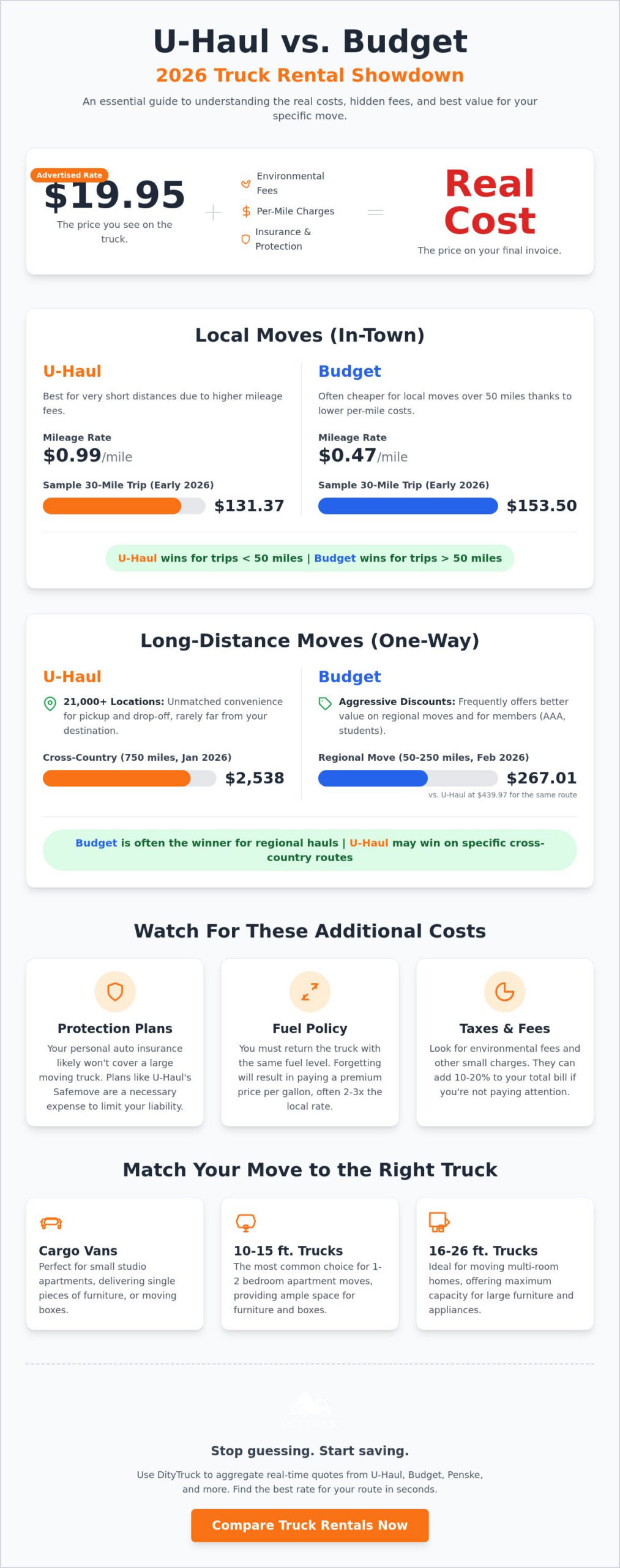
The advertised price on the side of a truck is rarely what you pay. It’s a marketing hook designed to get you in the door. When comparing u-haul vs budget truck rental, you must look past the $19.95 base rate. This sticker price trap often hides the true cost of your move. A low daily fee can quickly balloon once you add mileage, insurance, and environmental fees. You need a clear view of the total invoice before you hand over your credit card.
The U-Haul company history shows a brand built on local accessibility. They pioneered the low-cost local rental model. However, prices for u haul rental are highly sensitive to demand. If you book on a holiday weekend or the last day of the month, expect those rates to climb. Budget often counters this with more aggressive discount codes for AAA members, students, and military personnel. While U-Haul relies on its massive fleet size, Budget uses price as a primary tool to win over savvy shoppers.
Local Move Rate Structures
U-Haul typically advertises base rates of $19.95 or $29.95 for local “In-Town” moves. Budget often matches these rates or slightly exceeds them in the initial quote. The real difference appears in the per-mile charge. For a 30-mile move in early 2026, data shows U-Haul can be the cheaper option at $131.37 compared to Budget’s $153.50. However, for moves that cross the 50-mile threshold, Budget’s lower mileage fees often tip the scale in their favor. Reservation timing is critical. Booking your truck mid-week can save you significantly on the base quote compared to a Saturday morning pickup.
Long-Distance and One-Way Pricing
One-way moves follow a completely different pricing logic. These quotes are variable and depend on equipment supply. If many people are moving into a city but few are moving out, rates will drop for those willing to take a truck back. Budget often provides better value for regional moves between 50 and 250 miles. In February 2026, regional moves with Budget averaged $267.01 while U-Haul reached $439.97. This represents a substantial gap for a single day of driving.
For cross-country hauls, the winner changes based on the specific route. A 750-mile move from Dallas to Chicago in January 2026 showed U-Haul at $2,538 and Budget at $2,972. If you find these prices high, you might also consider a u-haul vs penske truck rental comparison to see if a third player offers better long-distance terms. Drop-off location availability plays a massive role here. U-Haul’s 21,000 locations mean you rarely have to drive far to return a truck. Budget has fewer spots, which can sometimes lead to higher one-way fees if your destination is remote.
The True Cost of Mileage and Protection Plans
The base rate is just the starting line. Your final bill is actually driven by the miles you drive and the protection you choose. Understanding the u-haul vs budget truck rental fee structure is the only way to avoid a surprise at the drop-off counter. Small fees like environmental taxes and fuel charges might seem minor. They aren’t. They can add 20% or more to your total cost if you aren’t careful. Financial honesty starts with looking at the per-mile cost and the protection plan fine print.
Mileage Rate Showdown
Mileage is the biggest variable in a local move. U-Haul often charges an average of $0.99 per mile for local rentals. Budget frequently cuts this rate significantly, sometimes as low as $0.47 per mile. This 52-cent gap adds up fast. On a 50-mile round trip, choosing Budget could save you over $25 in mileage alone. You can use a u haul cost calculator to project these expenses before you commit. To keep costs low, plan your route to minimize extra trips. One long haul is almost always cheaper than three short ones.
Fuel policies are another area where costs hide. Both companies require you to return the truck with the same amount of fuel it had at pickup. If you forget, you’ll pay a “convenience” fee and a premium price per gallon. These rates are often double or triple what you’ll find at a local gas station. Always stop at a pump within five miles of your drop-off location to save your budget.
Protection and Insurance Fees
Your personal auto insurance likely won’t cover a 26-foot box truck. Most policies exclude commercial vehicles over a certain weight class. This makes rental protection plans a necessary shield for your bank account. U-Haul offers Safemove, which covers the truck, your belongings, and medical costs. Budget provides Physical Damage Waivers (PDW) and supplemental liability. These plans provide essential consumer protection for movers by limiting your liability in case of an accident.
U-Haul often highlights their low-cost damage coverage starting around $15. Budget’s packages can be more comprehensive but sometimes carry a higher daily price. Always ask what the deductible is before signing. A “cheap” plan with a $1,000 deductible offers much less relief than a slightly pricier plan with zero out-of-pocket costs. To see the full picture of these protection costs, you can compare real-time quotes across both providers to see who offers the best total value.
Truck Inventory and Capacity Breakdown
Comparing u-haul vs budget truck rental requires looking closely at the physical hardware. A truck that is too small forces extra trips. A truck that is too big wastes fuel and increases your bill. You need the right fit for your specific inventory to ensure a smooth transition. Efficiency in loading saves time and physical strain on moving day.
Consider the loading height before you book. U-Haul uses a proprietary Low-Deck design on their box trucks. This lowers the cargo floor closer to the pavement. It creates a shorter, less steep ramp for your heavy items. Budget trucks typically use a standard chassis height. This results in a steeper climb into the cargo area. Your back will notice the difference after ten trips up the ramp with heavy furniture.
Small Move Options: Vans and Pickups
Cargo vans are the efficient choice for studio apartments or dorm rooms. They handle like a large SUV and offer the best fuel economy in the fleet. Pickup trucks are available at most local locations for quick tasks. These are ideal for moving a single couch or a new refrigerator across town. Most local branches keep a healthy stock of these smaller vehicles for immediate use. They provide a friction-free solution for small-scale logistics without the bulk of a box truck.
Large Move Capacity: 16ft to 26ft Trucks
For a 3-4 bedroom home, you need the maximum capacity of a 26-foot truck. U-Haul offers several intermediate sizes like the 10-foot and 20-foot models that Budget does not carry. This variety allows for a more precise match to your load size. Budget focuses its fleet on 12-foot, 16-foot, and 26-foot options. Choosing the wrong size can lead to shifting cargo or wasted space that you still have to pay for.
U-Haul trucks feature Mom’s Attic, which is a unique storage compartment located above the cab to protect fragile items from heavier furniture below. This feature serves as a smart assistant for your packing strategy. It keeps electronics and glassware away from the heavy lifting happening on the main deck.
- Tie-downs and Rails: Both fleets include interior rub rails and tie-down points to secure your straps.
- Weight Limits: 26-foot trucks are designed for heavy loads but always check the gross vehicle weight rating (GVWR) if you are moving heavy machinery or books.
- Towing Capabilities: Both brands offer hitches for car trailers, though U-Haul has a more extensive network of specialized towing equipment.
Inventory availability often dictates your choice. U-Haul has over 21,000 locations, making it easier to find a specific truck size near you. Budget has around 1,600 locations, so your preferred size might require a longer drive to the pickup point. Check availability early to secure the exact dimensions you need for your move.
Local vs. Long-Distance: Which Provider Wins?
Choosing between u-haul vs budget truck rental often comes down to a single question: Are you staying in town or crossing state lines? The winner shifts based on your destination. U-Haul offers unmatched convenience through its massive network. Budget counters this with aggressive pricing for specific long-haul routes. You need to weigh the ease of a local drop-off against the potential savings of a discounted regional rate. It’s a balance between time saved and dollars kept.
U-Haul operates over 21,000 locations across North America. This density is their greatest asset. You can likely find a U-Haul dealer within five miles of your home. This proximity saves time and fuel. Budget has roughly 1,600 locations. While fewer, these are often strategically placed near major highways. If your route is simple, Budget’s lower mileage fees can outweigh the inconvenience of a slightly longer drive to the rental office. Early 2026 data shows Budget’s mileage rates averaging $0.47 per mile, which is significantly lower than U-Haul’s $0.99 per mile for local hauls.
The Local Move Winner
U-Haul dominates the 24-hour local rental market. Their mobile pickup service allows you to bypass the counter entirely. This is a friction-free solution for quick moves. To avoid weekend price hikes, book your local move for a Tuesday or Wednesday. Rates are lower. Equipment is more plentiful. You’ll face less stress at the rental lot. Customer satisfaction scores for 2026 show U-Haul at 4.8/5, slightly ahead of Budget’s 4.5/5. Roadside assistance is responsive for both, but U-Haul’s larger network means a replacement truck is usually closer if a breakdown occurs.
The Long-Distance Value Play
Budget often wins on price for regional moves between 50 and 250 miles. Research from February 2026 shows Budget’s regional rates averaging $267.01, while U-Haul sits at $439.97. This is where Budget’s partnerships shine. You can stack discounts for AAA, AARP, or military service to lower your bill even further. U-Haul rarely offers percentage-off codes. They prefer value-adds like a free month of self-storage instead.
For cross-country hauls, inventory availability becomes the deciding factor. U-Haul’s reservation policy is a strong tool, but 2026 customer reviews suggest broken reservations happen more frequently with them than with Budget. You can explore one way truck rentals for moving to see how other players fit into this long-distance landscape. To secure the best rate for your specific route, book your truck rental comparison now and lock in current 2026 pricing.
Simplify Your Move with Real-Time Truck Comparisons
The search for the perfect truck often leads to “tab fatigue.” You open one window for U-Haul. You open another for Budget. You enter your zip code, dates, and truck size over and over. This repetition is the opposite of efficiency. It’s a high-stakes task that shouldn’t feel like a part-time job. You need a single source of truth to navigate the u-haul vs budget truck rental landscape. Manual comparison drains your energy and leaves room for error. You deserve a better way to manage your logistics. Our definitive 2026 uhaul vs budget truck rental comparison guide breaks down every fee, fleet option, and hidden charge so you can make a fully informed decision before you book.
DityTruck acts as your smart assistant. We perform the heavy lifting by aggregating real-time 2026 data into one streamlined view. Instead of chasing quotes across the internet, you see them side-by-side. This transparency ensures you aren’t surprised by a final bill that looks nothing like the initial estimate. You get a friction-free path from a problem to its resolution. We focus on stripping away the stress of hidden fees to provide a sense of confident simplicity.
Stop the Tab Fatigue
Comparing prices for u haul rental shouldn’t require a complex spreadsheet. Our platform allows you to see Budget and U-Haul options on a single screen. You can filter by specific truck sizes to ensure you aren’t paying for empty space. You can also compare pickup locations to find the one closest to your front door. This organized approach prevents you from feeling overwhelmed by moving logistics. You see the base rate, the estimated mileage, and the total projected cost in one place. It’s about financial honesty and your peace of mind.
- Instant Aggregation: See the latest 2026 rates without visiting multiple websites.
- Custom Filters: Sort by truck capacity, price, or pickup proximity.
- Transparent Costs: View estimated totals that include the mileage and fees discussed in earlier sections.
- Speed: Go from comparison to a confirmed booking in under five minutes.
Reserve Your 2026 Moving Truck Today
Securing your rate early is the smartest move you can make. Moving truck demand peaks on holiday weekends and at the end of every month. Booking ahead protects you from sudden price spikes and equipment shortages. Our streamlined interface lets you complete your reservation in minutes. You choose your truck. You verify the details. You book. It’s a logical progression that prioritizes your schedule. We provide the shortest path between your current home and your next destination.
Don’t let hidden fees or broken reservations ruin your moving day. Use a tool that values your time and provides a clear, honest comparison. Compare and book your moving truck now on DityTruck to lock in the best 2026 value for your specific route. Your move starts here.
Secure Your Best 2026 Moving Rate
Your moving day success depends on clarity. You now understand that the winner of u-haul vs budget truck rental shifts based on your specific mileage and destination. U-Haul offers unmatched location density for quick local trips. Budget provides significant savings for regional hauls through lower mileage rates and aggressive partner discounts. Choosing the right provider means looking past the sticker price to the total invoice.
Don’t let hidden fees or complex pricing models dictate your moving budget. You deserve a logistics experience that is simple, predictable, and honest. We help you strip away the complexity of checking multiple sites by putting all the data in one place. This smart approach saves you hours of frustration. It protects your bank account from surprise charges at the drop-off counter.
You can Find the Lowest Truck Rental Rates on DityTruck by comparing top national brands in seconds. Our platform provides transparent pricing with no hidden surprises and real-time 2026 availability. Take control of your move today. You have the facts. Now lock in the best rate for your journey.
Frequently Asked Questions
Is Budget Truck Rental cheaper than U-Haul?
Budget is typically the more affordable choice for local and regional moves under 250 miles. Data from early 2026 shows Budget offers lower total costs for these shorter distances. However, U-Haul becomes highly competitive on specific long-distance routes over 500 miles. You should always compare quotes for your specific route to see which brand currently holds the price advantage for your destination.
Does U-Haul or Budget have better mileage rates?
Budget generally offers significantly lower mileage rates for local moves. Their average per-mile fee is often less than half of the U-Haul average. This gap makes Budget a much stronger option for local round-trips where you return the truck to the same location. These savings keep your final bill manageable and prevent the “sticker price” shock often associated with high-mileage moving days.
What is the most common hidden fee in truck rentals?
Mileage fees are the most frequent surprise on a final rental invoice. The advertised daily rate only covers the truck itself. You must also pay for every mile driven, fuel used, and mandatory environmental fees. These costs can double your initial quote if you don’t account for them during the booking process. Financial honesty requires looking at the total projected cost rather than just the base rate.
Can I drive a 26-foot Budget or U-Haul truck with a standard license?
You can drive a 26-foot rental truck with a standard driver’s license in most states and provinces. These vehicles are classified for personal household use rather than commercial freight. You don’t need a CDL to operate them for a DIY move. However, these large trucks require extra caution for overhead clearances and wider turning radiuses. Always check local regulations if your move involves crossing international borders.
Which company is better for a one-way long-distance move?
U-Haul is often the superior choice for one-way moves because of their 21,000 locations. This massive network ensures that a drop-off point is almost always near your new home. Budget is a strong value play for regional one-way trips under 250 miles where their rates are often lower. When comparing u-haul vs budget truck rental for long distances, location proximity is just as important as the base rate.
Do U-Haul and Budget offer roadside assistance in 2026?
Both companies provide 24/7 roadside assistance for their fleets throughout 2026. You are covered for mechanical failures, flat tires, and other equipment issues during your trip. U-Haul’s larger network of dealers often results in faster response times if you need a replacement vehicle in a remote area. This reliable support system provides essential peace of mind for a high-stakes task like a cross-country move.
How much does insurance cost for a rental moving truck?
Protection plans typically start around $15 per day but vary based on the coverage level you select. Most personal auto insurance policies exclude large box trucks, making these plans a necessary shield for your bank account. You can choose from basic damage waivers to comprehensive coverage for your belongings and medical expenses. Always verify the deductible amount before you sign your rental agreement to avoid unexpected costs.
Are there discounts available for Budget or U-Haul rentals?
Budget is the industry leader for direct discounts for AAA, AARP, students, and military personnel. These percentage-off codes can take a significant bite out of your total bill. U-Haul rarely offers direct price cuts on their rentals. They prefer to offer value-added perks like a free month of self-storage instead. Checking for these deals is a smart way to find the best u-haul vs budget truck rental value for your move.