
Tag: moving truck comparison

  • U-Haul vs. Budget Truck Rental: 2026 Price and Feature Comparison

    U-Haul vs. Budget Truck Rental: 2026 Price and Feature Comparison

    The $19.95 sticker on a truck looks like a steal until the final invoice hits your inbox. You might think the most famous brand is always the cheapest. The truth about u-haul vs budget truck rental depends entirely on your odometer. It’s frustrating to jump between websites just to find a straight answer on pricing. You want transparency. You need a truck that is reliable. You want a price that stays predictable without the “sticker price” shock.

    Moving is a high-stakes task. You deserve a friction-free solution that prioritizes your time and your budget. We’ve done the heavy lifting for you by comparing the latest 2026 rates and features side-by-side. This guide promises to reveal which rental giant offers the best value for your specific move. We strip away the complexity of hidden fees to show you the real cost of your trip.

    We provide a clear winner for local, regional, and cross-country hauls. You’ll get a full breakdown of mileage fees, insurance options, and truck availability. This is the shortest, most logical path to booking the right truck at the best possible rate.

    Key Takeaways

    • Identify the real cost beyond the advertised sticker price by comparing 2026 base rates and seasonal price fluctuations.
    • See how a small difference in mileage fees impacts your final bill and learn to spot hidden environmental charges.
    • Decide which provider fits your route by analyzing the u-haul vs budget truck rental trade-off between location convenience and discount codes.
    • Match your move to the right vehicle size with a full breakdown of inventory from cargo vans to 26-foot box trucks.
    • Save time by using real-time aggregation to compare quotes instantly instead of checking multiple websites manually.

    Comparing Base Rental Rates: U-Haul vs. Budget

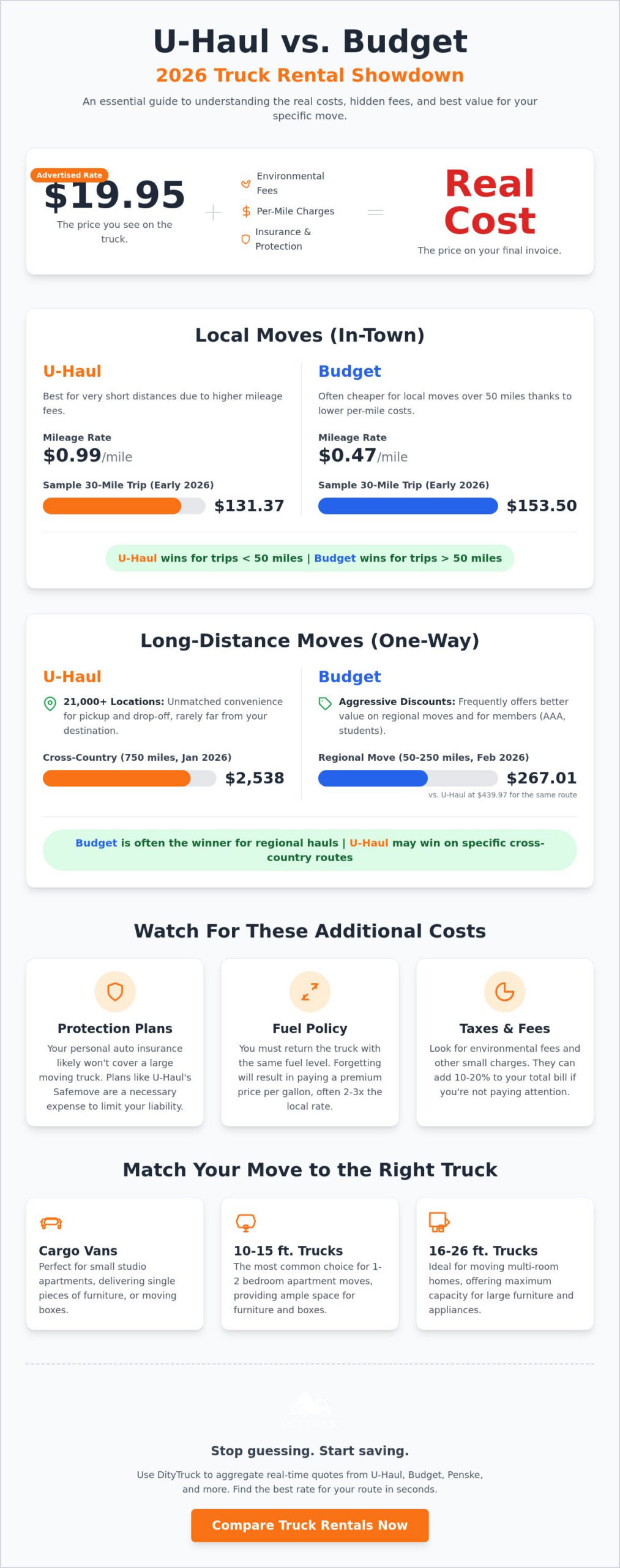
    The advertised price on the side of a truck is rarely what you pay. It’s a marketing hook designed to get you in the door. When comparing u-haul vs budget truck rental, you must look past the $19.95 base rate. This sticker price trap often hides the true cost of your move. A low daily fee can quickly balloon once you add mileage, insurance, and environmental fees. You need a clear view of the total invoice before you hand over your credit card.

    The U-Haul company history shows a brand built on local accessibility. They pioneered the low-cost local rental model. However, prices for u haul rental are highly sensitive to demand. If you book on a holiday weekend or the last day of the month, expect those rates to climb. Budget often counters this with more aggressive discount codes for AAA members, students, and military personnel. While U-Haul relies on its massive fleet size, Budget uses price as a primary tool to win over savvy shoppers.

    Local Move Rate Structures

    U-Haul typically advertises base rates of $19.95 or $29.95 for local “In-Town” moves. Budget often matches these rates or slightly exceeds them in the initial quote. The real difference appears in the per-mile charge. For a 30-mile move in early 2026, data shows U-Haul can be the cheaper option at $131.37 compared to Budget’s $153.50. However, for moves that cross the 50-mile threshold, Budget’s lower mileage fees often tip the scale in their favor. Reservation timing is critical. Booking your truck mid-week can save you significantly on the base quote compared to a Saturday morning pickup.

    Long-Distance and One-Way Pricing

    One-way moves follow a completely different pricing logic. These quotes are variable and depend on equipment supply. If many people are moving into a city but few are moving out, rates will drop for those willing to take a truck back. Budget often provides better value for regional moves between 50 and 250 miles. In February 2026, regional moves with Budget averaged $267.01 while U-Haul reached $439.97. This represents a substantial gap for a single day of driving.

    For cross-country hauls, the winner changes based on the specific route. A 750-mile move from Dallas to Chicago in January 2026 showed U-Haul at $2,538 and Budget at $2,972. If you find these prices high, you might also consider a u-haul vs penske truck rental comparison to see if a third player offers better long-distance terms. Drop-off location availability plays a massive role here. U-Haul’s 21,000 locations mean you rarely have to drive far to return a truck. Budget has fewer spots, which can sometimes lead to higher one-way fees if your destination is remote.

    The True Cost of Mileage and Protection Plans

    The base rate is just the starting line. Your final bill is actually driven by the miles you drive and the protection you choose. Understanding the u-haul vs budget truck rental fee structure is the only way to avoid a surprise at the drop-off counter. Small fees like environmental taxes and fuel charges might seem minor. They aren’t. They can add 20% or more to your total cost if you aren’t careful. Financial honesty starts with looking at the per-mile cost and the protection plan fine print.

    Mileage Rate Showdown

    Mileage is the biggest variable in a local move. U-Haul often charges an average of $0.99 per mile for local rentals. Budget frequently cuts this rate significantly, sometimes as low as $0.47 per mile. This 52-cent gap adds up fast. On a 50-mile round trip, choosing Budget could save you over $25 in mileage alone. You can use a u haul cost calculator to project these expenses before you commit. To keep costs low, plan your route to minimize extra trips. One long haul is almost always cheaper than three short ones.

    Fuel policies are another area where costs hide. Both companies require you to return the truck with the same amount of fuel it had at pickup. If you forget, you’ll pay a “convenience” fee and a premium price per gallon. These rates are often double or triple what you’ll find at a local gas station. Always stop at a pump within five miles of your drop-off location to save your budget.

    Protection and Insurance Fees

    Your personal auto insurance likely won’t cover a 26-foot box truck. Most policies exclude commercial vehicles over a certain weight class. This makes rental protection plans a necessary shield for your bank account. U-Haul offers Safemove, which covers the truck, your belongings, and medical costs. Budget provides Physical Damage Waivers (PDW) and supplemental liability. These plans provide essential consumer protection for movers by limiting your liability in case of an accident.

    U-Haul often highlights their low-cost damage coverage starting around $15. Budget’s packages can be more comprehensive but sometimes carry a higher daily price. Always ask what the deductible is before signing. A “cheap” plan with a $1,000 deductible offers much less relief than a slightly pricier plan with zero out-of-pocket costs. To see the full picture of these protection costs, you can compare real-time quotes across both providers to see who offers the best total value.
    U-Haul vs. Budget Truck Rental: 2026 Price and Feature Comparison

    Truck Inventory and Capacity Breakdown

    Comparing u-haul vs budget truck rental requires looking closely at the physical hardware. A truck that is too small forces extra trips. A truck that is too big wastes fuel and increases your bill. You need the right fit for your specific inventory to ensure a smooth transition. Efficiency in loading saves time and physical strain on moving day.

    Consider the loading height before you book. U-Haul uses a proprietary Low-Deck design on their box trucks. This lowers the cargo floor closer to the pavement. It creates a shorter, less steep ramp for your heavy items. Budget trucks typically use a standard chassis height. This results in a steeper climb into the cargo area. Your back will notice the difference after ten trips up the ramp with heavy furniture.

    Small Move Options: Vans and Pickups

    Cargo vans are the efficient choice for studio apartments or dorm rooms. They handle like a large SUV and offer the best fuel economy in the fleet. Pickup trucks are available at most local locations for quick tasks. These are ideal for moving a single couch or a new refrigerator across town. Most local branches keep a healthy stock of these smaller vehicles for immediate use. They provide a friction-free solution for small-scale logistics without the bulk of a box truck.

    Large Move Capacity: 16ft to 26ft Trucks

    For a 3-4 bedroom home, you need the maximum capacity of a 26-foot truck. U-Haul offers several intermediate sizes like the 10-foot and 20-foot models that Budget does not carry. This variety allows for a more precise match to your load size. Budget focuses its fleet on 12-foot, 16-foot, and 26-foot options. Choosing the wrong size can lead to shifting cargo or wasted space that you still have to pay for.

    U-Haul trucks feature Mom’s Attic, which is a unique storage compartment located above the cab to protect fragile items from heavier furniture below. This feature serves as a smart assistant for your packing strategy. It keeps electronics and glassware away from the heavy lifting happening on the main deck.

    • Tie-downs and Rails: Both fleets include interior rub rails and tie-down points to secure your straps.
    • Weight Limits: 26-foot trucks are designed for heavy loads but always check the gross vehicle weight rating (GVWR) if you are moving heavy machinery or books.
    • Towing Capabilities: Both brands offer hitches for car trailers, though U-Haul has a more extensive network of specialized towing equipment.

    Inventory availability often dictates your choice. U-Haul has over 21,000 locations, making it easier to find a specific truck size near you. Budget has around 1,600 locations, so your preferred size might require a longer drive to the pickup point. Check availability early to secure the exact dimensions you need for your move.

    Local vs. Long-Distance: Which Provider Wins?

    Choosing between u-haul vs budget truck rental often comes down to a single question: Are you staying in town or crossing state lines? The winner shifts based on your destination. U-Haul offers unmatched convenience through its massive network. Budget counters this with aggressive pricing for specific long-haul routes. You need to weigh the ease of a local drop-off against the potential savings of a discounted regional rate. It’s a balance between time saved and dollars kept.

    U-Haul operates over 21,000 locations across North America. This density is their greatest asset. You can likely find a U-Haul dealer within five miles of your home. This proximity saves time and fuel. Budget has roughly 1,600 locations. While fewer, these are often strategically placed near major highways. If your route is simple, Budget’s lower mileage fees can outweigh the inconvenience of a slightly longer drive to the rental office. Early 2026 data shows Budget’s mileage rates averaging $0.47 per mile, which is significantly lower than U-Haul’s $0.99 per mile for local hauls.

    The Local Move Winner

    U-Haul dominates the 24-hour local rental market. Their mobile pickup service allows you to bypass the counter entirely. This is a friction-free solution for quick moves. To avoid weekend price hikes, book your local move for a Tuesday or Wednesday. Rates are lower. Equipment is more plentiful. You’ll face less stress at the rental lot. Customer satisfaction scores for 2026 show U-Haul at 4.8/5, slightly ahead of Budget’s 4.5/5. Roadside assistance is responsive for both, but U-Haul’s larger network means a replacement truck is usually closer if a breakdown occurs.

    The Long-Distance Value Play

    Budget often wins on price for regional moves between 50 and 250 miles. Research from February 2026 shows Budget’s regional rates averaging $267.01, while U-Haul sits at $439.97. This is where Budget’s partnerships shine. You can stack discounts for AAA, AARP, or military service to lower your bill even further. U-Haul rarely offers percentage-off codes. They prefer value-adds like a free month of self-storage instead.

    For cross-country hauls, inventory availability becomes the deciding factor. U-Haul’s reservation policy is a strong tool, but 2026 customer reviews suggest broken reservations happen more frequently with them than with Budget. You can explore one way truck rentals for moving to see how other players fit into this long-distance landscape. To secure the best rate for your specific route, book your truck rental comparison now and lock in current 2026 pricing.

    Simplify Your Move with Real-Time Truck Comparisons

    The search for the perfect truck often leads to “tab fatigue.” You open one window for U-Haul. You open another for Budget. You enter your zip code, dates, and truck size over and over. This repetition is the opposite of efficiency. It’s a high-stakes task that shouldn’t feel like a part-time job. You need a single source of truth to navigate the u-haul vs budget truck rental landscape. Manual comparison drains your energy and leaves room for error. You deserve a better way to manage your logistics. Our definitive 2026 uhaul vs budget truck rental comparison guide breaks down every fee, fleet option, and hidden charge so you can make a fully informed decision before you book.

    DityTruck acts as your smart assistant. We perform the heavy lifting by aggregating real-time 2026 data into one streamlined view. Instead of chasing quotes across the internet, you see them side-by-side. This transparency ensures you aren’t surprised by a final bill that looks nothing like the initial estimate. You get a friction-free path from a problem to its resolution. We focus on stripping away the stress of hidden fees to provide a sense of confident simplicity.

    Stop the Tab Fatigue

    Comparing prices for u haul rental shouldn’t require a complex spreadsheet. Our platform allows you to see Budget and U-Haul options on a single screen. You can filter by specific truck sizes to ensure you aren’t paying for empty space. You can also compare pickup locations to find the one closest to your front door. This organized approach prevents you from feeling overwhelmed by moving logistics. You see the base rate, the estimated mileage, and the total projected cost in one place. It’s about financial honesty and your peace of mind.

    • Instant Aggregation: See the latest 2026 rates without visiting multiple websites.
    • Custom Filters: Sort by truck capacity, price, or pickup proximity.
    • Transparent Costs: View estimated totals that include the mileage and fees discussed in earlier sections.
    • Speed: Go from comparison to a confirmed booking in under five minutes.

    Reserve Your 2026 Moving Truck Today

    Securing your rate early is the smartest move you can make. Moving truck demand peaks on holiday weekends and at the end of every month. Booking ahead protects you from sudden price spikes and equipment shortages. Our streamlined interface lets you complete your reservation in minutes. You choose your truck. You verify the details. You book. It’s a logical progression that prioritizes your schedule. We provide the shortest path between your current home and your next destination.

    Don’t let hidden fees or broken reservations ruin your moving day. Use a tool that values your time and provides a clear, honest comparison. Compare and book your moving truck now on DityTruck to lock in the best 2026 value for your specific route. Your move starts here.

    Secure Your Best 2026 Moving Rate

    Your moving day success depends on clarity. You now understand that the winner of u-haul vs budget truck rental shifts based on your specific mileage and destination. U-Haul offers unmatched location density for quick local trips. Budget provides significant savings for regional hauls through lower mileage rates and aggressive partner discounts. Choosing the right provider means looking past the sticker price to the total invoice.

    Don’t let hidden fees or complex pricing models dictate your moving budget. You deserve a logistics experience that is simple, predictable, and honest. We help you strip away the complexity of checking multiple sites by putting all the data in one place. This smart approach saves you hours of frustration. It protects your bank account from surprise charges at the drop-off counter.

    You can Find the Lowest Truck Rental Rates on DityTruck by comparing top national brands in seconds. Our platform provides transparent pricing with no hidden surprises and real-time 2026 availability. Take control of your move today. You have the facts. Now lock in the best rate for your journey.

    Frequently Asked Questions

    Is Budget Truck Rental cheaper than U-Haul?

    Budget is typically the more affordable choice for local and regional moves under 250 miles. Data from early 2026 shows Budget offers lower total costs for these shorter distances. However, U-Haul becomes highly competitive on specific long-distance routes over 500 miles. You should always compare quotes for your specific route to see which brand currently holds the price advantage for your destination.

    Does U-Haul or Budget have better mileage rates?

    Budget generally offers significantly lower mileage rates for local moves. Their average per-mile fee is often less than half of the U-Haul average. This gap makes Budget a much stronger option for local round-trips where you return the truck to the same location. These savings keep your final bill manageable and prevent the “sticker price” shock often associated with high-mileage moving days.

    What is the most common hidden fee in truck rentals?

    Mileage fees are the most frequent surprise on a final rental invoice. The advertised daily rate only covers the truck itself. You must also pay for every mile driven, fuel used, and mandatory environmental fees. These costs can double your initial quote if you don’t account for them during the booking process. Financial honesty requires looking at the total projected cost rather than just the base rate.

    Can I drive a 26-foot Budget or U-Haul truck with a standard license?

    You can drive a 26-foot rental truck with a standard driver’s license in most states and provinces. These vehicles are classified for personal household use rather than commercial freight. You don’t need a CDL to operate them for a DIY move. However, these large trucks require extra caution for overhead clearances and wider turning radiuses. Always check local regulations if your move involves crossing international borders.

    Which company is better for a one-way long-distance move?

    U-Haul is often the superior choice for one-way moves because of their 21,000 locations. This massive network ensures that a drop-off point is almost always near your new home. Budget is a strong value play for regional one-way trips under 250 miles where their rates are often lower. When comparing u-haul vs budget truck rental for long distances, location proximity is just as important as the base rate.

    Do U-Haul and Budget offer roadside assistance in 2026?

    Both companies provide 24/7 roadside assistance for their fleets throughout 2026. You are covered for mechanical failures, flat tires, and other equipment issues during your trip. U-Haul’s larger network of dealers often results in faster response times if you need a replacement vehicle in a remote area. This reliable support system provides essential peace of mind for a high-stakes task like a cross-country move.

    How much does insurance cost for a rental moving truck?

    Protection plans typically start around $15 per day but vary based on the coverage level you select. Most personal auto insurance policies exclude large box trucks, making these plans a necessary shield for your bank account. You can choose from basic damage waivers to comprehensive coverage for your belongings and medical expenses. Always verify the deductible amount before you sign your rental agreement to avoid unexpected costs.

    Are there discounts available for Budget or U-Haul rentals?

    Budget is the industry leader for direct discounts for AAA, AARP, students, and military personnel. These percentage-off codes can take a significant bite out of your total bill. U-Haul rarely offers direct price cuts on their rentals. They prefer to offer value-added perks like a free month of self-storage instead. Checking for these deals is a smart way to find the best u-haul vs budget truck rental value for your move.

  • One Way Truck Rental Comparison: How to Find the Best Rates in 2026

    One Way Truck Rental Comparison: How to Find the Best Rates in 2026

    The lowest advertised daily rate is often the most expensive way to move across the country. It sounds backwards. But hidden mileage fees and complex insurance add-ons can double your final bill in an instant. You’ve likely spent hours toggling between browser tabs for a one way truck rental comparison. You’re trying to see if a budget-friendly base rate actually beats a provider offering unlimited miles. It’s frustrating. You want a straightforward answer. No math projects. No hidden surprises. Just a clear path to your new home.

    Our guide cuts through the noise to find you the best rates in 2026. We’ve done the heavy lifting. We analyzed real-time inventory shifts and current provider policies. You’ll discover how to secure a guaranteed low rate while avoiding the common traps that inflate moving costs. We’ll look at the latest deals, like Penske’s unlimited mileage or Costco member discounts, to ensure your booking process is fast and transparent. Stop guessing. Start saving hundreds on your long-distance move today.

    Key Takeaways

    • Understand dynamic pricing. Rates shift based on where companies need their trucks next.
    • Perfect your one way truck rental comparison. Prioritize unlimited mileage to keep your final bill predictable.
    • Spot the differences between major brands. Pick Penske for newer trucks or Budget for deep discount savings.
    • Follow a proven booking plan. Define your inventory size and map your route before you click reserve.
    • Skip the manual search. Use DityTruck to aggregate real-time, transparent quotes from national providers instantly.

    Understanding One-Way Truck Rental Logistics

    One-way rentals are the backbone of long-distance relocations. The concept is simple. You pick up a vehicle near your current home and drop it off at a location near your new destination. This eliminates the need to drive a large, fuel-hungry truck back to its starting point. While the process seems straightforward, the logistics behind the scenes are incredibly complex. This complexity is exactly what dictates the price you see on your screen. Pricing isn’t fixed. It’s dynamic. It fluctuates based on where a company needs its equipment to end up next. Performing a thorough one way truck rental comparison allows you to see which providers are currently balancing their fleets and offering better deals for your specific route.

    One-Way vs. Local Rentals: The Key Differences

    Most people are familiar with local rentals. You pay a small base fee and a set rate for every mile you drive. One-way moves operate on a different math equation. They typically use a flat-rate pricing model. This quote usually bundles a specific number of days with a set mileage limit based on the distance of your route. The most critical variable in this total cost is the “drop-off” fee. Rental brands calculate this fee by looking at the demand in your destination city. If you’re hiring a moving company for loading help but driving the truck yourself, you’ll find that these flat rates offer much better predictability for your budget than per-mile local rates. If you’re also planning a shorter in-town haul before your big move, our guide to the best local moving truck rental options for 2026 can help you avoid the same hidden fees that catch so many movers off guard.

    The Role of Inventory Management in Your Quote

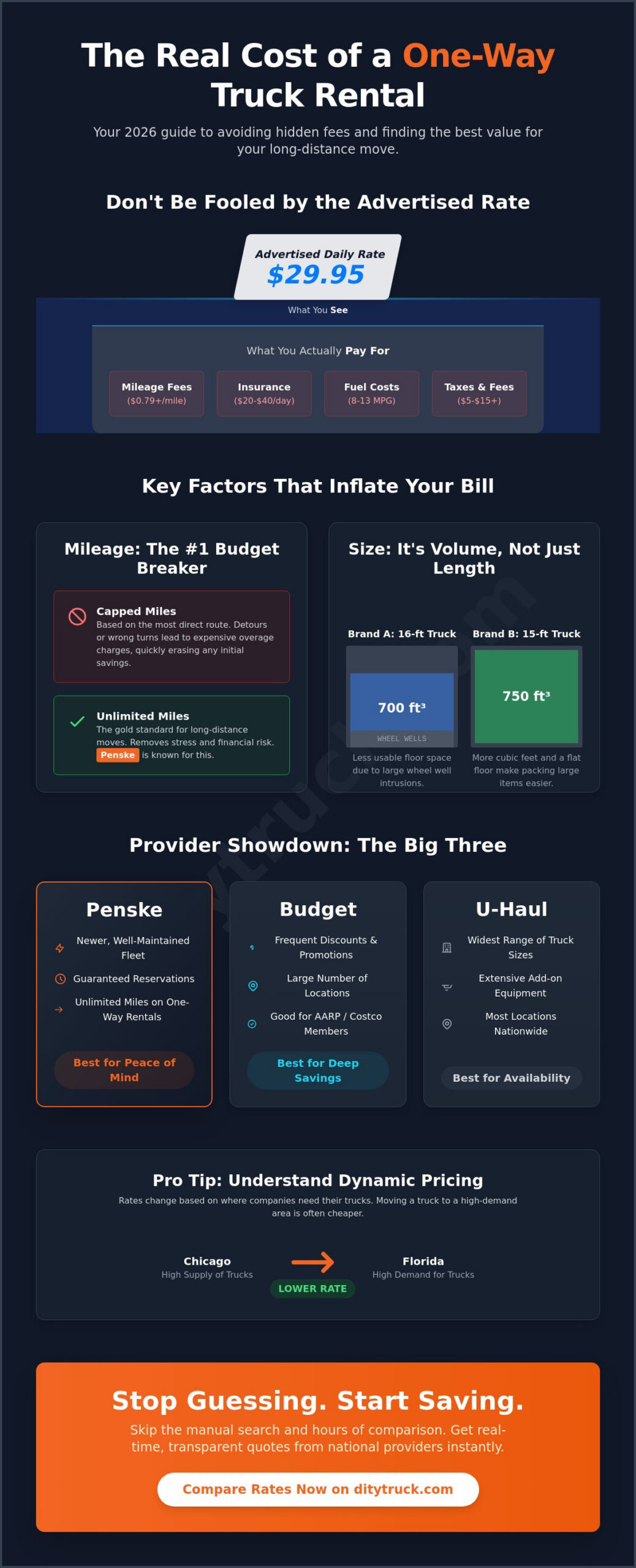
    Truck rental companies are essentially inventory managers. They want their trucks in cities where people are moving out, not where they are moving in. If a branch in a city like Chicago has too many 16-foot trucks, they’ll drop the price significantly to encourage someone to drive that truck to a high-demand area. This is why your destination choice impacts the price so heavily. Moving to popular southern states like Texas or Florida often costs more because trucks rarely leave those regions once they arrive. In 2026, booking early has become even more vital. With the global truck rental market valued at over $45 billion, availability for popular routes can vanish in days. A smart one way truck rental comparison helps you spot these inventory gaps before the cheaper trucks are gone.

    Key Factors in a One-Way Truck Rental Comparison

    The base price of a rental is rarely the price you actually pay. A true one way truck rental comparison requires you to look past the large numbers on the homepage. You have to dig into the variables that change based on your route and truck size. This includes everything from protection plans to specific equipment fees. Understanding these details now prevents a massive bill at the drop-off location. It turns a stressful move into a managed project.

    Mileage Policies: Unlimited vs. Capped

    Mileage is the biggest wild card in your moving budget. Some companies cap your miles based on the most direct route between your zip codes. If you take a wrong turn or a scenic detour, you pay for every extra mile. These overage charges can erase your savings in a single afternoon. Unlimited mileage is a massive win for cross-country moves. It removes the stress of tracking every exit. You should specifically check for Penske truck rental mileage offers. They are well known for including unlimited miles on one-way trips. It simplifies your journey. No math. No overage charges. Just drive.

    Comparing Cargo Volume and Dimensions

    Don’t trust the length alone. A 16-foot truck from one brand might have significantly less usable space than a 15-foot truck from another. You must compare the cubic feet of usable volume. Wheel well intrusions often eat up valuable floor space. This makes packing large furniture difficult. According to a report on the Best Truck Rental Moving Companies, interior height and width vary wildly across the major national brands. Sometimes, renting a slightly larger truck is actually cheaper. If a company has too many 26-foot trucks in stock, they might price them lower than the 16-foot models. It is an inventory game that pays to play.

    Protection plans also impact your final cost. Insurance for a moving truck typically costs between $20 and $40 per day. Don’t skip this. But do compare the levels of coverage provided. You also need to account for environmental fees. These generally range from $5 to $15 per rental. Then there is fuel. A 26-foot truck gets roughly 8 to 13 miles per gallon. On a 1,000-mile move, this is a significant expense. If you are towing a car, a tow dolly or auto transport carrier adds daily fees. These aren’t always shown in the initial search results. You can compare these total costs side-by-side to avoid surprises at the rental counter. This level of transparency is the only way to find the actual lowest rate for your move.

    One Way Truck Rental Comparison: How to Find the Best Rates in 2026

    Comparing the Big Three: Penske vs. Budget vs. U-Haul

    Choosing a provider is about matching your specific move to a company’s business model. All three major players get you from point A to point B. However, the experience and final invoice will look very different. A thorough one way truck rental comparison reveals that Penske often wins on reliability. Their fleet is younger on average. This means you are less likely to deal with a breakdown in the middle of a long-distance haul. They also offer 24/7 roadside assistance as a standard. It provides peace of mind when you are crossing state lines with everything you own.

    U-Haul is the king of accessibility. They have over 20,000 locations across North America. This makes drop-offs incredibly easy, even in remote or rural areas. If you are moving to a town with only one stoplight, U-Haul is likely your only local option. Budget targets the price-conscious mover. They frequently offer aggressive discounts, such as 25% off for Costco members. They are the go-to for shoppers who prioritize the bottom line over a brand-new vehicle.

    Pricing Structures Side-by-Side

    Budget truck rental utilizes a tiered pricing system for one-way moves. Rates fluctuate daily based on equipment demand in your destination city. It is a dynamic model. U-Haul often advertises low base rates, like $19.95 or $39.95 for local moves. For one-way trips, these shift into a flat-rate quote. This quote includes a set number of days and miles. You must watch for after-hours return fees, which can add $20 to your bill if you don’t use their mobile app. Deposit requirements also differ. Penske typically requires a credit card. U-Haul may allow cash rentals but requires a much higher upfront deposit to secure the truck.

    Equipment and Towing Capabilities

    Loading a truck is the hardest part of any DIY move. U-Haul trucks feature a “Low Deck” design. This keeps the loading ramp at a shallower angle. It saves your back when moving heavy appliances. Penske and Budget trucks often sit higher off the ground. They require more physical effort to navigate the ramp. If you are bringing a vehicle, all three providers offer tow dollies and car carriers. A car carrier is usually preferred for long distances. It keeps all four wheels off the ground to prevent transmission wear. Availability for these trailers is tighter than for the trucks themselves. Always perform a one way truck rental comparison for the full package, including your towing gear, to ensure everything is waiting for you on moving day.

    How to Compare and Book Your One-Way Rental (Step-by-Step)

    Finding the right rate is a methodical process. It requires organization. You can’t just click the first advertisement you see. A proper one way truck rental comparison follows a logical sequence. It moves from identifying internal needs to evaluating external options. This ensures you don’t overpay for empty space or get hit with emergency fees for a truck that’s too small. It’s about precision and timing.

    Step 1: Audit Your Inventory and Size Needs

    Start inside your home. Perform a room-by-room count of your belongings. Estimate your total cubic footage based on large furniture items and box counts. Most people underestimate their volume. Always size up by 10 to 15 percent for one-way moves. This buffer prevents you from leaving valuable items behind on the curb. Items like bicycles, floor lamps, and yard tools often take up more volume than their weight suggests. A 16-foot truck is often sufficient for a one-bedroom apartment. However, a two-bedroom home almost always requires a 22-foot or 26-foot model to avoid a logistical nightmare. Read our moving truck rental guide for detailed size charts that match house sizes to specific truck lengths.

    Step 2: Use a Comparison Tool for Real-Time Rates

    Efficiency is key. Don’t open twenty browser tabs. It leads to confusion and missed details. Use a centralized platform to see all rates at once. Filter by your specific pickup and drop-off dates. This helps you identify rental trucks for moving near me that offer the best one-way terms. Dynamic pricing means a rate you see at 10:00 AM might change by noon. Booking the moment you find a favorable quote locks in your rate against sudden inventory shifts. Mapping your route early also helps you stay within the capped mileage limits of providers like U-Haul or Budget. For a deeper look at how costs stack up across state lines, our long distance moving truck rental guide breaks down every major cost driver so you can plan with confidence.

    Step 3: Finalize the Reservation and Protection Plan

    The checkout screen is where hidden fees live. Audit the total price before entering your credit card info. Expect insurance to cost between $20 and $40 per day. Compare these Damage Waivers against your personal insurance coverage. Many personal policies don’t cover commercial trucks over a certain weight. Look for environmental fees, which usually range from $5 to $15. Verify the guaranteed status of your reservation. Some companies only guarantee a truck size, not the specific pickup location. Confirm your drop-off site to avoid wrong-site surcharges. Check for 24/7 roadside assistance inclusion in your contract. It’s a non-negotiable requirement for long-distance hauls.

    You can compare and book your truck in minutes using our streamlined tool. It strips away the complexity of logistics. You get clear, honest pricing instantly. No surprises. Just a straightforward move.

    Simplify Your Move with DityTruck Comparison Services

    Moving across the country is a high-stakes task. It often feels like a second job. You spend hours hunting for deals. You worry about hidden fees. DityTruck strips away this complexity. We replace stress with confident simplicity. Our platform acts as your savvy consumer advocate. We do the heavy lifting behind the scenes. You get the results. A thorough one way truck rental comparison shouldn’t be a math project. We aggregate real-time rates from the top national providers instantly. This gives you a friction-free solution for your logistics needs. No fluff. Just the data you need to make a move.

    Transparent pricing is our priority. The industry is famous for teaser rates. These prices look great until you reach the final checkout screen. We solve this. The quote you see on our platform is the price you pay. We include the variables that others hide. This includes environmental fees and basic protection costs. You gain financial honesty. You gain clarity. This is the shortest path between your current problem and a final resolution. Our tool is built for speed. It’s built for your peace of mind.

    Why Use a Comparison Platform?

    Individual rental sites are designed to sell you their specific inventory. They don’t want you to see a competitor’s better deal. We do. We provide access to exclusive rates. These discounts are often reserved for high-volume platforms. You won’t always find them on individual brand websites. You can view one way truck rentals for moving side-by-side. This allows you to spot the best value in seconds. You compare mileage policies. You compare equipment ages. You see the total cost. Everything is in one place. You get an instant booking confirmation. This removes the pickup day surprise that ruins so many moves. It’s a reliable tool for a modern relocation.

    Get Your One-Way Quote Today

    The booking process is streamlined. Start by entering your pickup and drop-off locations. Be specific with your dates. Select the truck size that fits your home. Our interface is designed for rapid decision-making. It works on your schedule. You can secure a reservation in minutes. This saves you hours of manual research. Our expert support team understands long-distance logistics. They help you navigate the specific hurdles of a cross-country haul. They act as your smart assistant. Use our one way truck rental comparison tool to lock in your 2026 rate today. Experience a move that is organized, reliable, and honest. Your new home is waiting, and if you are headed to the Detroit area, Detroit Furnished Rentals can make your transition seamless with their curated selection of move-in-ready lofts and apartments. Let’s get you there without the traditional hurdles.

    Secure Your Best One-Way Rate Today

    A successful long-distance move depends on clarity. You now know how dynamic pricing and inventory flow dictate your final bill. You understand that the lowest base rate isn’t always the cheapest option once mileage and insurance enter the equation. Finding the right truck requires looking at the total cost. It requires a strategy. Performing a final one way truck rental comparison is the only way to ensure you don’t overpay for your journey. You’ve identified the differences between major fleets. You’ve mapped your route. Now it’s time to lock in your savings.

    DityTruck simplifies this process. We provide real-time rate aggregation from major providers. You get direct booking access. We stand by our no hidden fee guarantee. You see the honest price immediately. No more jumping between tabs. No more math projects. Compare one-way truck rental rates and book your move now at DityTruck. Your move should be a fresh start, not a financial burden. We’re here to help you get there efficiently. Safe travels on the road ahead.

    Frequently Asked Questions

    Is it cheaper to do a one-way truck rental or a round trip?

    One-way rentals are almost always more cost-effective for long-distance moves. While the daily base rate for a round trip might look lower, you have to account for double the fuel and the time spent driving back. For a move across state lines, a one-way booking saves you hundreds in gas and lodging. It allows you to drop the truck and start unpacking immediately. You avoid the exhaustion of a return trip.

    Does Penske really offer unlimited mileage on all one-way rentals?

    Yes, Penske provides free unlimited mileage on all one-way truck rentals as of June 2026. This is a massive advantage for cross-country trips. It removes the stress of calculating the shortest route or paying for accidental detours. When you perform a one way truck rental comparison, this feature often makes Penske the most predictable choice for your total moving budget. You won’t have to worry about every exit you take.

    What are the most common hidden fees in one-way truck rentals?

    Environmental fees and after-hours return charges are the most frequent surprises. Environmental fees generally range from $5 to $15 per rental. If you return a U-Haul truck after hours without using their mobile app, expect a $20 convenience fee. Always check for cleaning charges as well. Returning a dirty truck can trigger a fee that wipes out your initial savings. These costs add up if you aren’t careful.

    Can I change my drop-off location after I’ve already started my move?

    You can change your destination, but it will cost you. Most companies will re-rate your entire contract based on the new location’s current demand. This often results in a significantly higher price or a “wrong-site” surcharge. Always call the rental company before you arrive at a different location. It’s better to negotiate the change early than to face a surprise bill at the counter. Transparency prevents expensive mistakes.

    What happens if I go over the mileage limit on a one-way rental?

    Going over your mileage limit results in a per-mile overage fee. These charges typically range from $0.40 to $1.00 for every extra mile driven. For long-distance moves, these small numbers add up fast. If your route is complex, look for providers with unlimited mileage. It’s the only way to guarantee your final price stays exactly where you planned. Don’t let a wrong turn break your moving budget.

    Do I need special insurance for a long-distance truck rental?

    Personal auto insurance policies often exclude commercial vehicles over a certain weight. You should check with your provider before you decline coverage. Supplemental insurance, like a Damage Waiver, usually costs between $20 and $40 per day. It protects you from high out-of-pocket costs if the truck is damaged. For a high-stakes move, this small daily cost provides essential peace of mind. It’s a friction-free way to protect your finances.

    How far in advance should I book a one-way truck rental for 2026?

    You should book at least two to four weeks in advance. During peak moving seasons like June or July, inventory disappears quickly. Booking early locks in your rate and ensures the specific truck size you need is available at your preferred location. If you wait until the last minute, you might be forced to drive a larger, more expensive truck or travel to a distant pickup site. Planning ahead saves money.

    Are there discounts for one-way moves for students or military members?

    Yes, most national providers offer specialized discounts. Penske frequently offers 10% or more off for college students and active-duty military. Budget provides a 25% discount for Costco members, which is a popular choice for one-way moves. Always mention your status during the one way truck rental comparison process to see which brand treats you best. These savings can easily cover the cost of your fuel or moving supplies.