Tag: how to move

  • How to Rent a Moving Truck: The Complete 2026 Step-by-Step Guide

    How to Rent a Moving Truck: The Complete 2026 Step-by-Step Guide

    Renting a moving truck isn’t just about finding a vehicle; it’s about executing a smart logistics strategy. Most people treat it like a simple errand. Getting it wrong leads to hundreds in hidden fees and unnecessary stress. You’ve likely spent hours worrying about how to rent a moving truck without getting hit with surprise mileage charges or size confusion. It’s exhausting to juggle pickup times while staring at a dozen different pricing tabs. We understand that frustration. You need clarity, speed, and a price that makes sense.

    This guide simplifies the entire process by stripping away the industry noise. We provide the exact steps to secure the right vehicle at the lowest possible rate. You’ll learn how to master the reservation process with our expert roadmap. We cover everything from choosing the perfect size to avoiding those common hidden fees that catch most renters off guard. Our goal is a friction-free experience that protects your time and your budget.

    We’ll walk you through sizing your inventory, decoding the fine print on mileage, and mastering the logistics for a seamless, one-trip move. You’ll gain the confidence to book a reliable truck without the typical headaches. It’s time to make your move simple.

    Key Takeaways

    • Inventory your home by counting large furniture and estimating box volume before starting your search.
    • Match vehicle dimensions to your living space. Cargo vans suit studios, while 12-foot trucks handle most one-bedroom apartments.
    • Master how to rent a moving truck by using a comparison tool to filter results by real-time price and location.
    • Look beyond the base rate. Identify hidden mileage charges and “unlimited” package traps before you commit.
    • Leverage regional truck availability instead of brand loyalty. This strategy secures the lowest rate for your specific route.

    Preparing for Your Move: What to Know Before You Rent

    Preparation is the antidote to moving day chaos. Before you search for a vehicle, you need a clear data set of what you actually own. Guessing your truck size leads to two expensive outcomes. You either pay for empty space or you end up making three trips in a truck that is too small. Start by creating a detailed inventory. Count every large furniture piece, from the sectional sofa to the dining table. Estimate your box volume by visualizing 10 to 15 medium boxes per room. This data allows you to compare rates with precision. Accuracy here prevents a logistical nightmare later.

    You also need to verify your credentials. Many people worry about special permits or commercial endorsements, but a standard driver’s license is sufficient for most trucks up to 26 feet. If you are hiring a professional moving company, they handle the heavy lifting and the liability. As a DIY renter, the responsibility is yours. Understanding how to rent a moving truck begins with knowing your own limits and your vehicle’s requirements. Double check your expiration date today. You don’t want a paperwork snag at the rental counter.

    Local vs. One-Way Rentals

    Your route dictates your price structure. Local “In-Town” moves are designed for round trips. You pick up and drop off at the same location. These usually feature a low base rate, but the per-mile fees can add up quickly. One-way rentals are different. They often include a higher flat fee but provide a set mileage allowance. This is the standard choice for long-distance relocations. Decide early if you have the time to drive the truck back to its origin. If you can’t, the one-way premium is worth the convenience. It saves you hours of return travel.

    Timing Your Reservation

    The calendar is your biggest tool for cost control. In 2026, demand remains high during summer months and holiday weekends. Booking at least 2 to 4 weeks in advance is the bare minimum for peak season. If your schedule allows, move on a Tuesday or Wednesday. Off-peak days can save you up to 20 percent compared to Friday or Saturday rates. Check for 2026 holiday surcharges specifically. These hidden spikes can inflate a “cheap” quote instantly. Learning how to rent a moving truck efficiently means outsmarting the peak demand cycles. Secure your date early to lock in the best available rate.

    Selecting the Right Truck Size: The Math of Moving

    Selecting a vehicle size is the most critical decision in your logistics chain. Pick a truck that is too small and you face the nightmare of multiple trips. Pick one that is too large and you waste money on unused air. Most people struggle with how to rent a moving truck because they rely on vague bedroom counts rather than actual volume. You need a data-driven approach to sizing. This ensures your belongings fit safely and your budget stays intact.

    Cargo vans are the agile choice for studio apartments or single-room deliveries. They park easily and offer excellent fuel economy. For a standard one-bedroom apartment without large appliances, 10 to 12 foot trucks are the industry standard. Once you move into two-bedroom homes, 15 to 16 foot trucks become the sweet spot. They balance maneuverability with enough depth for large sectionals. The 20 to 26 foot giants are reserved for three-plus bedroom houses and multi-story moves. These require careful driving but ensure you finish the job in one trip.

    Capacity and Cubic Feet

    Think in three dimensions. Cubic feet measurements include the space all the way to the roof. You must pack tall to maximize your value. Many brands offer a “Mom’s Attic” feature. This is a specialized compartment over the cab. Use this for fragile items or small boxes to keep them away from heavy furniture. If you are stuck between two sizes, always size up. The cost of a larger truck is minimal compared to the fuel and time lost on a second trip. You can find more details on how to rent a moving truck by reviewing expert capacity charts.

    Weight Limits and Payload

    Volume isn’t your only constraint. You must also monitor the Gross Vehicle Weight Rating (GVWR). This is the maximum weight the truck can safely carry. It includes the vehicle, fuel, and your belongings. Overloading a rental truck leads to mechanical failure or steep fines at highway weigh stations. Check the GVWR if you are moving heavy machinery, safes, or dense collections. It is a known fact that box truck rental prices vary significantly based on the payload capacity and engine power of the vehicle. If you want to see which size fits your budget today, you should view available truck sizes and compare real-time rates across all major carriers.

    The Step-by-Step Booking Process: Reserving Your Vehicle

    Once you know your size, the logistics begin. Learning how to rent a moving truck in 2026 means using technology to skip the line. Start by entering your pickup location, date, and move type into a comparison tool. This is the fastest way to aggregate real-time data from major providers. Don’t waste time on individual websites. A centralized search provides the clarity you need to make an informed choice. It puts the power back in your hands.

    Next, filter your results. Narrow the list by truck size and the total estimated price. This step ensures a smooth experience by removing options that don’t fit your budget or cargo needs. Look specifically for “all-in” pricing that includes base rates and estimated mileage. After picking a vehicle, select your essential add-ons. You’ll need dollies, furniture pads, and potentially towing equipment. These items are often significantly cheaper to rent than to buy for a single use.

    Insurance is your final hurdle before confirmation. Review the standard options carefully. Collision Damage Waiver (CDW) covers the truck itself. Personal Accident Insurance (PAI) protects you and your passengers. Supplemental Liability Insurance (SLI) covers third-party damage. Most 2026 rentals require a digital deposit via credit card. Confirming your reservation now locks in the current rate. It guarantees vehicle availability and prevents last-minute price spikes.

    Add-Ons and Equipment

    Your back will thank you for choosing the right tools. A utility dolly handles standard boxes, but an appliance dolly is necessary for heavy refrigerators or washers. Furniture pads are the cheapest way to prevent thousand-dollar scratches on your wood finishes. These thick blankets provide a critical buffer during transit. If you are towing a car, verify that your specific truck has a compatible hitch installed. Not every rental is tow-ready by default. Check these details before you arrive at the lot.

    The Digital Check-In Experience

    Modern logistics are moving toward contactless solutions. Many 2026 providers allow you to skip the rental counter entirely via smartphone apps. Prepare to upload a clear photo of your driver’s license and a “selfie” for identity verification. This process takes minutes and gets you on the road faster. It eliminates the friction of traditional paperwork. Read our guide on how to rent a truck for moving to master these mobile-first reservations. Digital keys and app-based check-ins are the new standard for efficient moves.

    Mastering Moving Costs: Avoiding Hidden Fees

    The price you see on the billboard is rarely the price you pay. Mastering how to rent a moving truck requires looking past the base rate. This number is just a starting point. It doesn’t include the variables that actually drive your total cost. You need to identify these surcharges before you hand over your credit card. Transparency is the only way to protect your budget.

    Mileage charges are the biggest variable in your final bill. Some providers offer a low base rate with a high per-mile fee. Others bundle “unlimited” packages for a higher flat rate. Calculate your total distance before you sign. If you are moving across town, the per-mile fee is manageable. For longer distances, an unlimited package is usually the smarter financial move. You should also expect environmental fees in 2026. These are standard industry surcharges for carbon offsets or tire disposal. They are usually small, but they add up quickly when combined with other costs.

    Refueling penalties are the easiest fees to avoid. Return the tank at the exact level you received it. Rental companies charge a premium per gallon if they have to fill it for you. It’s often double the local pump price. To avoid these surprises, you need a transparent breakdown of every cost. You can compare real-time rental rates to see exactly what is included in your quote before you book.

    Understanding Rental Insurance

    Your personal auto insurance likely excludes commercial vehicles. Most policies stop at a certain weight limit; a 26-foot truck falls into a different category. Damage Waivers are the solution. Paying for “zero-deductible” protection provides the ultimate peace of mind. It removes the financial risk of minor dings or major accidents. Cargo protection is equally important. It ensures your belongings are covered if a collision occurs during transit. Don’t assume you’re covered. Verify your policy details today.

    Late Fees and Cleaning Surcharges

    Don’t believe the “1-hour grace period” myth. Most companies charge a full day of rental for being even slightly late. Logistics rely on tight turnarounds. If you miss your window, you pay the price. Cleaning surcharges are another common trap. Sweep the truck out before you return it; a small amount of dirt or debris can trigger a cleaning fee of $50 or more. Companies also charge “Loss of Use” fees, which represent the daily revenue lost while a vehicle is being repaired following an accident. These daily charges can quickly exceed the cost of the actual repairs.

    Why Comparison is the Smartest Way to Rent a Truck

    Brand loyalty is an expensive habit in the logistics world. Most people stick to the provider they recognize, but rates fluctuate constantly based on regional truck availability. A company might have a surplus of vehicles in one city and a severe shortage in another. This imbalance creates massive price swings that change daily. If you only check one website, you miss the opportunity to save hundreds on your relocation. Learning how to rent a moving truck with a data-driven mindset means comparing the entire market before committing your budget.

    Some brands act as one-way move specialists. they offer better incentives for drop-offs in specific regions to rebalance their fleet. By using real-time data aggregation, you can spot these incentives instantly. You see the total cost, including all estimated fees, before you click the book button. This transparency removes the guesswork and the stress of hidden surcharges. It positions you as a savvy consumer rather than a victim of fluctuating market rates.

    The DityTruck Difference

    Stop opening 10 browser tabs and chasing individual quotes. You can see the entire market in 30 seconds using a streamlined interface. This efficiency allows you to filter by the features that actually matter for your specific cargo. Choose between a loading ramp for easy walking or a hydraulic liftgate for heavy appliances. Decide between diesel or gas engines based on your total distance. Check out our one way truck rentals for moving to see how we compare long-distance rates across major providers. We act as your smart assistant, doing the heavy lifting of price hunting so you don’t have to.

    Final Checklist Before You Drive Away

    Your reservation is confirmed and the price is locked. Now you need to protect yourself at the rental lot. Perform a thorough walk-around of the vehicle and photograph every existing scratch, dent, or upholstery tear. These timestamped photos are your evidence if a provider tries to charge you for pre-existing damage later. Test the headlights, turn signals, and brakes before you leave the property. Confirm the exact drop-off location and the specific hours of operation. Getting this wrong can lead to “wrong location” fees or an extra day of rental charges. Mastery of how to rent a moving truck ends with a successful, fee-free return. By following this roadmap, you’ve secured the best rate and a vehicle that fits your life perfectly.

    Execute Your Friction-Free Move

    Success on moving day depends on two factors: precision and transparency. You’ve learned how to inventory your home to avoid sizing errors. You know how to identify hidden mileage fees before they hit your final bill. Mastering how to rent a moving truck is no longer a guessing game. It is a strategic process that puts you in control of your budget and your timeline. You have the tools to avoid the common pitfalls of regional price spikes and cleaning surcharges.

    Don’t waste time opening multiple tabs to chase individual quotes. DityTruck acts as your smart assistant by aggregating the entire market into one clean interface. You can compare the top national rental brands in seconds. We provide real-time 2026 pricing and availability with absolutely no hidden booking fees. This is the shortest path to a stress-free reservation and a lower rate. It ensures you get the vehicle you need without the administrative headache.

    Compare Moving Truck Rates and Book Your Move Today. You are ready to handle the logistics with confidence. Your one-trip move starts here.

    Frequently Asked Questions

    Do I need a special license to rent a moving truck?

    No special license is required for standard rental vehicles. Most providers allow you to drive trucks up to 26 feet with a basic Class C license. If you’re moving a large household, a 26-foot truck is the largest size you can drive without a Commercial Driver’s License (CDL). Always verify that your license is current and not expired before you arrive at the rental lot. This ensures a friction-free pickup and keeps you legal on the road.

    What is the cheapest day of the week to rent a truck?

    Tuesday and Wednesday are typically the most affordable days for rentals. Demand spikes on weekends and at the end of the month. These peaks drive up base rates significantly. By avoiding the weekend rush, you gain more flexibility with pickup times. It also reduces the risk of the company running out of your preferred truck size. Choosing a mid-week date can save you significant money compared to a Friday or Saturday booking.

    Does my credit card insurance cover moving truck rentals?

    Most personal credit cards exclude cargo vehicles or trucks over a certain weight from their rental insurance benefits. You should call your provider to confirm their specific weight limits. It’s often safer to purchase the damage waiver directly from the rental company. Collision Damage Waivers (CDW) are the standard choice for DIY movers. They remove your financial liability if the truck is damaged in an accident or stolen during your move. This provides full protection for the vehicle.

    How much gas does a 26-foot moving truck use?

    A 26-foot truck generally averages between 8 and 10 miles per gallon. This figure varies based on the total weight of your cargo. Driving through mountainous terrain also impacts fuel efficiency. Factor this consumption into your total budget to avoid surprise expenses at the pump. Keep in mind that idling the engine for long periods also wastes fuel. Plan your route to avoid heavy traffic and minimize the number of stops you make along the way.

    Can I rent a moving truck for just a few hours?

    Yes, many companies offer hourly rates for local moves. However, most providers still charge a minimum base rate that covers the first few hours or a full day. Checking how to rent a moving truck for short durations often reveals that daily rates are more cost-effective than hourly ones. Some local hardware stores offer 90-minute rentals for small deliveries. For a full apartment move, the standard daily rental remains the most reliable option for your timeline.

    What happens if I return the rental truck late?

    Returning a truck late usually triggers a full day’s rental charge. Most companies don’t offer a grace period because they have other customers waiting for that vehicle. Logistics depend on tight schedules. Always plan to return the truck at least 30 minutes before your scheduled drop-off time. If you realize you’re running behind, call the rental office immediately. They might be able to extend your window for a smaller fee if the truck isn’t booked for another customer.

    Is it cheaper to rent a truck one-way or return it to the same location?

    Local rentals are cheaper for short distances because they have lower base rates. One-way rentals are designed for long-distance moves where returning the truck to the origin isn’t practical. The best choice depends on your total mileage. Consider the time and fuel required for a return trip. One-way moves often include a set number of days and miles in the flat fee. This simplifies your planning. Local moves require you to track every mile to stay within your budget.

    How do I calculate the total cost of a moving truck rental?

    Add your base rate to your estimated mileage costs and insurance premiums. Don’t forget to include environmental fees, taxes, and the cost of fuel. Using a comparison tool is the most efficient way to see an all-in price. This prevents surprise charges on your final bill. Mastering how to rent a moving truck requires looking at the bottom line. Don’t forget to account for the security deposit that most companies hold on your credit card until the return.
  • Renting Moving Blankets: The Complete Guide to Protecting Your Furniture in 2026

    Renting Moving Blankets: The Complete Guide to Protecting Your Furniture in 2026

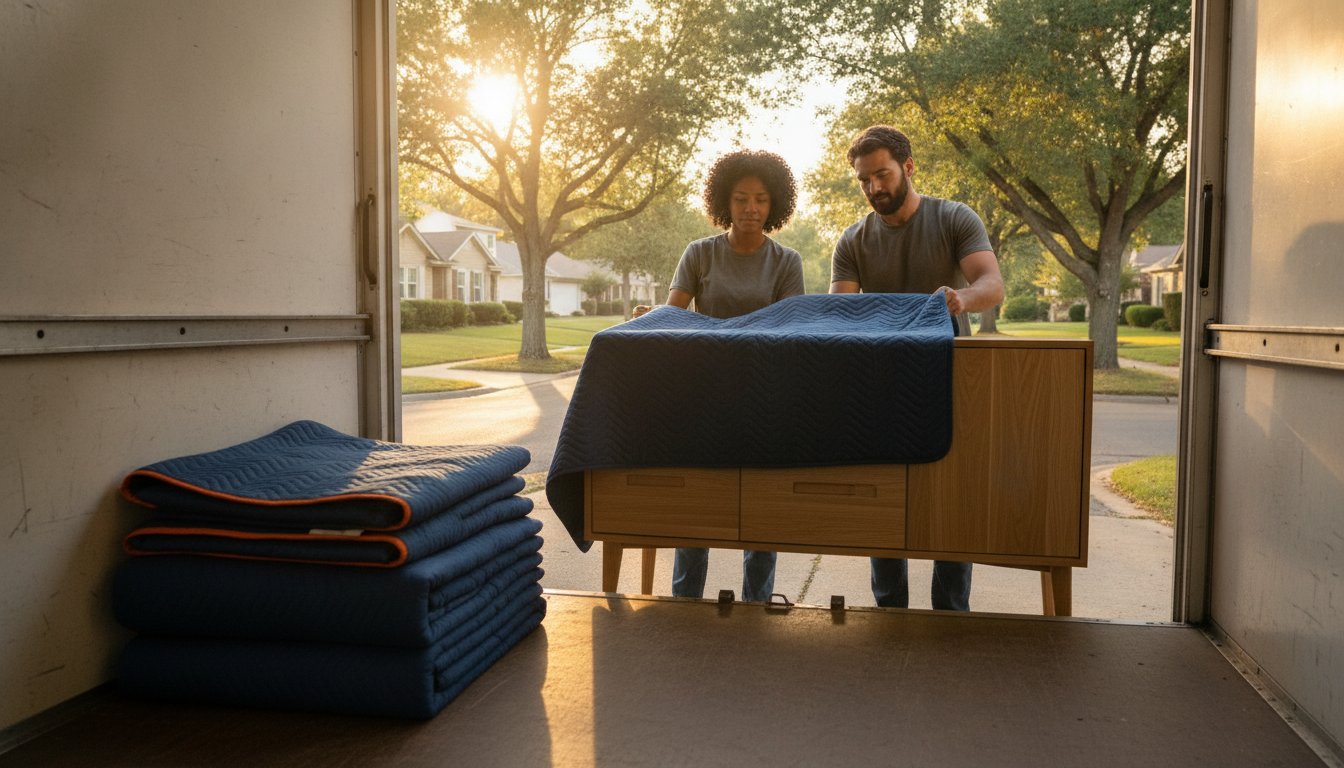
    A single unprotected corner can turn your $2,000 mahogany dresser into a piece of scrap wood in seconds. Most people realize too late that renting moving blankets is the cheapest insurance policy available for a DIY move. You don’t want to arrive at your new home only to find your dining table scratched or your leather sofa torn. It’s a common fear. It’s also entirely preventable with the right supplies and a clear plan. Professional movers don’t leave protection to chance, and you shouldn’t either.

    We understand the stress of keeping your belongings safe while managing a tight budget. This guide simplifies your logistics by showing you how to compare rental rates from major providers and calculate the exact number of pads for your specific truck size. You’ll learn the professional wrapping techniques that ensure your blankets stay secure during transit. We’ve broken down the math so you know whether to grab 12 or 24 pads for your reservation. This is the shortest, most logical path to a confident, damage-free move in 2026.

    Key Takeaways

    • Understand why heavy-duty quilted pads are vital for absorbing shock and preventing friction between your items during transit.
    • Compare the “Big Three” rental providers to find the best rates when renting moving blankets for your specific route.
    • Use the Inventory Method to calculate exactly how many pads you need for your truck size. This prevents overspending on supplies you won’t use.
    • Master professional “Burrito Wrap” techniques to keep blankets securely in place. You’ll protect your furniture surfaces from dust and scratches.
    • Analyze the cost difference between renting and buying to make the smartest financial decision for your one-way or local move.

    What Are Moving Blankets and Why Is Renting Them Essential?

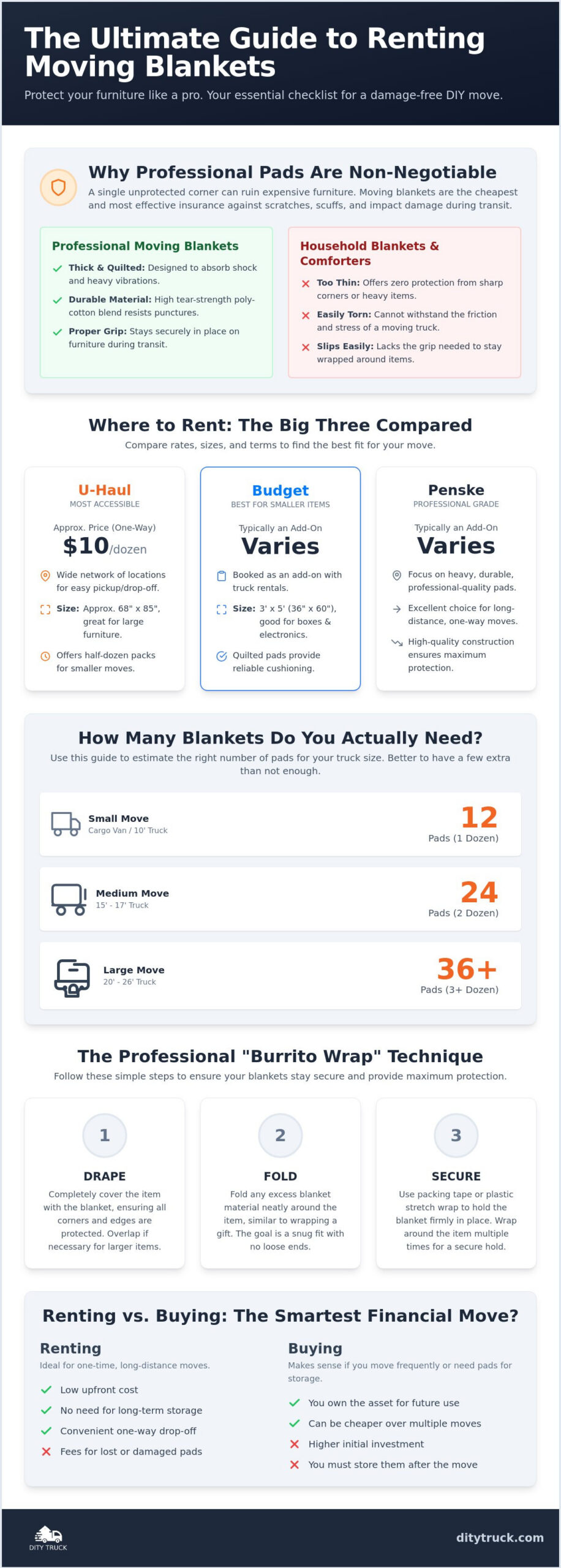
    Moving blankets are heavy duty quilted pads designed to absorb shock. They prevent friction between items in a moving truck. Every professional moving company uses these pads to ensure furniture arrives without a scratch. The anatomy of a professional pad is specific. It usually features a durable poly-cotton blend on the outside. Inside, you’ll find recycled textile fibers that provide bulk and cushion. This combination creates a high tear-strength that household linens simply can’t match.

    The reality of the road is that cargo shifts. Even on a smooth highway, your truck experiences constant micro-vibrations. Items lean against each other. Without thick padding, finished surfaces rub together. This creates permanent scuff marks or deep gouges. Renting moving blankets is a strategic move. It’s about more than just padding. These blankets act as a buffer that turns a high-stakes logistics task into a simple, safe process. They are the shortest path between a packed house and an undamaged delivery.

    Renting vs. Using Household Blankets

    Old comforters offer zero protection against heavy vibrations. They are often too thin to stop a sharp corner from piercing through. They also lack the grip needed to stay in place. Renting moving blankets is a small investment that protects high-value assets. Consider the math. A rental dozen costs a tiny fraction of the price of a new mahogany dresser. Beyond the money, there is a psychological benefit. Neighbors and hired helpers take more care with pro-wrapped items. A professional appearance signals that the contents are valuable and deserve respect.

    Key Terminology: Furniture Pads vs. Moving Skins

    You’ll encounter different terms when booking your supplies. Heavy-duty quilted blankets are the gold standard for furniture. These are often called furniture pads. They are thick, durable, and designed for multiple uses. Moving skins or textile pads are different. These are thinner, non-quilted options. They are usually made from compressed recycled fibers. Use skins for lighter items or to prevent dust. Use quilted furniture pads for anything made of wood, glass, or metal. Choosing the right material ensures your protection matches the risk level of each piece of furniture.

    Where to Rent Moving Blankets: Comparing U-Haul, Budget, and Penske

    Choosing your supplier is just as critical as choosing your vehicle. The “Big Three” rental companies offer different sizes and qualities. U-Haul remains the most accessible option. They rent furniture pads in dozens for approximately $10 on one-way moves. Their blankets measure roughly 68 inches by 85 inches. This size provides ample coverage for large appliances and dining tables. If you only need a few, they also offer half-dozen packs for $5. This flexibility makes renting moving blankets easy for small apartment moves.

    Budget Truck Rental provides a different product. Their quilted pads are smaller, measuring 3 feet by 5 feet. These are available as add-ons to your truck reservation. While smaller than U-Haul’s version, they work well for stacking between boxes or wrapping small electronics. Penske Truck Rental focuses on professional-grade quality. Their blankets are heavy and durable. They are a top choice for long-distance relocations because you can return them to any Penske location nationwide. Local equipment shops also offer rentals, but they often lack the “return anywhere” convenience of the national brands.

    Pricing and Rental Terms Comparison

    Rental costs vary based on your move distance. Local rentals usually charge a daily rate. One-way moves include a flat fee for the entire duration. You must return every pad to avoid extra costs. U-Haul, for example, charges a $6 replacement fee for each unreturned blanket. This fee does not mean you own the blanket; it is a penalty. Most companies require you to rent in packs of 6 or 12. This ensures you have enough material to protect a full room. For more advice on consumer safety during a move, visit the official Protect Your Move website.

    One-Way vs. Local Rental Logistics

    One-way logistics offer the most freedom. You pick up the gear at your starting point and drop it off at your destination. This eliminates the need for a return trip. To ensure availability, always add these items when you book your moving truck rental. Supplies can run low during peak moving weekends. Booking early guarantees your pads are waiting on the truck. If you want to find the best overall value for your trip, it is smart to compare moving truck rentals before you sign any paperwork. This simple step can save you hundreds of dollars in hidden fees and equipment costs.

    Renting Moving Blankets: The Complete Guide to Protecting Your Furniture in 2026

    How Many Moving Blankets Do You Actually Need?

    Underestimating your supply needs is a common mistake that leads to avoidable damage. You don’t want to realize you’re short on protection while the truck is half-full and the sun is setting. When renting moving blankets, you should choose between two calculation strategies. The ‘Rule of Thumb’ method relies on your truck’s total volume. It provides a safe estimate for most standard moves. The ‘Inventory Method’ requires more effort but offers total precision. You list every large item and assign a specific pad count. This ensures you aren’t paying for gear you won’t use while still maintaining a safety net.

    Professional movers always account for ‘filler’ pads. These blankets aren’t wrapped around specific items. Instead, they are folded and wedged into gaps between furniture stacks and the truck walls. This prevents the shifting that occurs during turns or sudden stops. It keeps your load tight and stable. For additional resources on managing your relocation safely, check the Protect Your Move website from the FMCSA. It is a great tool for understanding best practices and consumer rights during a transition.

    Blanket Count by Truck Size

    Your truck size dictates the maximum amount of gear you can realistically use. Use these ranges as your baseline:

    • 10-12 Foot Truck: Reserve 1 to 2 dozen blankets (12-24 pads). This quantity is perfect for studio apartments or small one-bedroom units with minimal furniture.
    • 15-20 Foot Truck: You will need 2 to 4 dozen blankets (24-48 pads). This range covers most two-to-three bedroom homes effectively.
    • 26 Foot Truck: Plan for 4 to 6 dozen blankets (48-72 pads). Large family homes have more surface area to protect and more vertical gaps to fill in the cargo area.

    Item-Specific Padding Guide

    Precision matters when you’re protecting specific surfaces. A standard dresser or buffet usually requires 2 to 3 blankets. This covers the top and wraps around the finished front and sides. Dining tables need one blanket for the surface. If you detach the legs, wrap them together in a second pad. Sofas and armchairs are bulky. They typically take 2 to 3 blankets to cover the upholstery completely and protect the feet. For high-value items like large mirrors, flat-screen TVs, or family antiques, use the ‘Double Pad’ rule. Wrap the item in one blanket first. Then, add a second layer for extra shock absorption. This creates a thick cushion that resists impacts and prevents piercing from other cargo.

    How to Use Moving Blankets: A Step-by-Step Wrapping Guide

    Applying protection correctly is just as important as renting moving blankets in the first place. A loose blanket offers little safety. It can slip during transit and leave your valuables exposed. Follow this structured process to wrap your furniture like a professional mover. It ensures every surface stays pristine from your old front door to your new living room.

    Step 1: Clean the furniture surface. Use a soft cloth to remove all dust and debris. If dust gets trapped between the blanket and the wood, it acts like sandpaper. The constant vibration of the truck will grind that grit into the finish. Step 2: The Burrito Wrap. Place the blanket over the center of the item. Drape the sides down and tuck the excess material underneath the base. This creates a complete envelope of padding that resists shifting.

    Step 3: Secure the pad. This is where most DIY movers fail. Use professional stretch wrap rather than packing tape. Wrap the plastic film tightly around the blanket multiple times to create a “shrink-fit” seal. Step 4: Corner protection. Corners are high-impact points. Fold the blanket over itself at these edges to create a double-thick buffer. Step 5: Stacking in the truck. Blankets are only effective if the load is tight. Pack items close together so they cannot move or vibrate against each other during the drive.

    The Golden Rule: Tape Never Touches Furniture

    Never apply adhesive tape directly to wood finishes or upholstery. Hot moving trucks cause the adhesive to melt and bond with the furniture. This often results in permanent staining or stripped lacquer. Use stretch wrap to secure your blankets instead. It sticks only to itself and leaves zero residue behind. For smaller items or quick adjustments, rubber moving bands are a smart alternative. They provide a secure hold and are much faster to apply than plastic film.

    Wrapping Large Appliances

    Refrigerators and washing machines are prone to “truck rub.” This occurs when the metal finish vibrates against the truck wall or other cargo. Always secure doors and power cords with stretch wrap before you apply the blanket. To protect adjacent items, wrap the refrigerator handle with a small piece of folded blanket and secure it tightly with tape or wrap to prevent it from denting nearby furniture. This simple step prevents one of the most common causes of accidental damage. Before you start wrapping your heavy gear, book your moving truck rental to ensure you have the right vehicle and equipment ready for your move date.

    Renting vs. Buying: Which Is the Smartest Financial Move?

    Deciding between renting and buying depends on your move duration and future storage capacity. For most people, renting moving blankets is the most logical financial choice. You pay roughly $15 per dozen for a rental. Purchasing that same dozen in professional-grade quality costs approximately $150. That is a 10x price difference. If you only need protection for a weekend, the rental keeps your overhead low. It also eliminates the hassle of storing bulky gear after you unpack.

    Cleanliness is another factor to consider. Rented pads are reused across hundreds of moves. They are often dusty or carry a specific industrial scent. If you are wrapping a brand new white velvet sofa, buying a few pristine blankets might be worth the premium. However, for standard wood furniture and appliances, the utility of a rented pad is hard to beat. You get professional-level protection without the long-term commitment or the high upfront cost.

    When to Rent

    Choose the rental option for local moves where the truck and gear return to the same lot. It is the most efficient path. You use the pads, return them with the truck, and walk away. This is ideal if you live in a small apartment and have no room for 48 bulky blankets. Many people find that booking through a box truck rental service allows them to bundle supplies for maximum savings. It simplifies your logistics by putting everything on one bill.

    When to Buy

    Long-distance moves change the math. If your cross-country trip lasts two weeks, the daily rental fees can quickly approach the purchase price. Buying is also smarter if you plan to store items in a long-term unit. You can’t return rented pads if they are sitting in a storage locker for six months. Purchased blankets also have post-move utility. Use them for soundproofing a home office, creating heavy-duty pet bedding, or protecting your trunk when hauling garden supplies. If you need to save, look for “economy” non-quilted skins for lighter items.

    Final Decision Framework

    Use this 3-question checklist to determine your best path:

    • Is your move local or one-way? Local moves favor renting. One-way moves require a cost comparison of daily fees.
    • Do you have storage space? A dozen pads take up as much room as a large suitcase.
    • Are you storing items long-term? If yes, buying is mandatory to avoid late return fees.

    Integrating your supply decision with your overall one-way truck rental strategy ensures you don’t overpay for logistics. Every dollar saved on blankets is a dollar you can spend on your new home. Ready to get started? Compare truck rental rates and add your supplies at DityTruck to find the most efficient solution for your move.

    Secure Your Move with Confidence

    Protecting your furniture doesn’t have to be a guessing game. You now have a clear roadmap for your logistics. You know that matching your blanket count to your truck size is the first step toward a damage-free arrival. You also understand that professional wrapping techniques, like the burrito wrap and using stretch wrap instead of tape, are non-negotiable for preserving wood finishes. Whether you are moving across town or across the country, renting moving blankets is a cost-effective way to secure your high-value assets without the long-term storage burden.

    Efficiency starts with having the right tools and the right information. We help you skip the complexity of calling multiple locations for quotes. You can access real-time rate comparisons from major providers and see transparent pricing with no hidden supply fees. Our national coverage ensures you find the best deal for both local and long-distance routes. Compare Moving Truck Rates and Supplies at DityTruck to finalize your plan today. You’ve done the research. Now it’s time to execute a smooth, stress-free move.

    Frequently Asked Questions

    Can I rent moving blankets without renting a truck?

    You can often rent moving blankets as standalone items from companies like U-Haul. Other providers, such as Budget or Penske, typically require a truck reservation to add equipment to your order. Always call your local branch ahead of time to confirm they have enough inventory for a supplies-only rental.

    Are moving blankets waterproof?

    Moving blankets are not waterproof. They are made of absorbent poly-cotton blends or recycled fibers designed for shock protection. If they get wet, they can trap moisture against your furniture and damage wood finishes. Use a layer of plastic stretch wrap over the blanket if you expect rain during your move.

    How do I keep moving blankets from sliding off furniture?

    The most efficient way to keep blankets secure is by using professional stretch wrap. Wrap the plastic film tightly around the padded item multiple times to lock the blanket in place. You can also use large rubber moving bands for a faster, reusable solution that doesn’t involve adhesive or plastic waste.

    Do I need to wash rented moving blankets before or after use?

    You don’t need to wash rented blankets at any point. Rental companies handle the cleaning and maintenance of their equipment between customers. Simply ensure the pads are dry and free of major debris before you return them to avoid potential cleaning or damage fees.

    How much does it cost to rent 12 moving blankets on average?

    When renting moving blankets, you can expect to pay between $10 and $15 per dozen for the duration of your move. This rate is usually a flat fee for one-way trips or a daily rate for local rentals. It is a significant saving compared to the $150 purchase price for a professional-grade dozen.

    What is the difference between a furniture pad and a moving blanket?

    These terms are used interchangeably by most rental companies. Furniture pads usually refer to the thicker, quilted blankets used for heavy-duty protection. Moving blankets can sometimes describe thinner, non-quilted textile skins designed for lighter items or dust protection. Quilted pads are the industry standard for wood and glass.

    Can moving blankets be used to protect floors?

    You can use moving blankets to protect hardwood or tile floors from scratches. They provide a soft buffer under heavy furniture legs or appliance dollies. Be aware that blankets can be slippery on smooth surfaces. Secure them with painter’s tape to the baseboards to prevent them from sliding as you walk.

    What happens if I lose a rented moving blanket?

    If a blanket is lost or not returned, you’ll be charged a replacement fee. This fee is typically around $6 per pad depending on the rental provider. Paying this fee does not mean you’ve purchased the blanket. It’s a penalty for the loss of rental inventory, so keep a close count during your move.

  • What to Load First in a Moving Truck: The Pro-Level Loading Order

    What to Load First in a Moving Truck: The Pro-Level Loading Order

    What if the difference between a smooth drive and a dangerous highway sway was just three heavy boxes placed in the wrong spot? You’ve spent weeks packing, and now you’re staring at an empty rental truck with a knot in your stomach. It’s a common fear. You’re likely worried about fitting your entire life into one vehicle and keeping your fragile items from shifting during transit. Knowing what to load first in a moving truck is the key to solving both problems. It’s about physics, safety, and saving your back from unnecessary exhaustion.

    You can master the exact sequence professionals use to maximize space and ensure a stable ride. We’ll help you follow the 60/40 weight distribution rule, placing the heaviest items toward the cab to keep your steering responsive. This guide breaks down the loading order from heavy appliances to light boxes. You’ll learn how to build a solid foundation and use vertical space so you can avoid the nightmare of a second trip. Let’s get your move packed right the first time.

    Key Takeaways

    • Learn exactly what to load first in a moving truck to establish a stable center of gravity and protect your heaviest appliances.
    • Maximize every cubic foot of your rental by building vertical “walls” of inventory from the floor to the ceiling.
    • Ensure a safe, controlled drive by following the 60/40 weight distribution rule to prevent dangerous vehicle sway.
    • Prevent transit damage by using soft items like blankets and pillows as protective bumpers between hard furniture surfaces.
    • Keep your “First Night” essentials accessible by loading them last, ensuring tools and toiletries are the first items you unload.

    The ‘Heavy Hitters’ First: Loading the Bulk and Weight

    Loading a moving truck isn’t just a game of Tetris. It’s a strategy for managing your physical stamina and vehicle safety. Most people start with small boxes because they are easy to grab, but this is a mistake. By the time you reach the heavy appliances, your energy is gone. Professional loaders prioritize the “heavy hitters” immediately. Knowing what to load first in a moving truck starts with identifying your most massive items and getting them onto the floor before fatigue sets in. This approach keeps the vehicle’s center of gravity stable and prevents you from struggling with a 300 pound refrigerator when you’re already exhausted.

    Placing weight at the front of the cargo area is essential for a safe drive. You want the bulk of your inventory directly behind the cab. This distribution ensures the front tires maintain a firm grip on the road, which is critical for steering and braking. If you load too much weight at the very back, the front of the truck can become “light,” making the vehicle difficult to control at highway speeds. Think of these heavy items as the anchor for your entire move.

    Appliances and the ‘Front Wall’

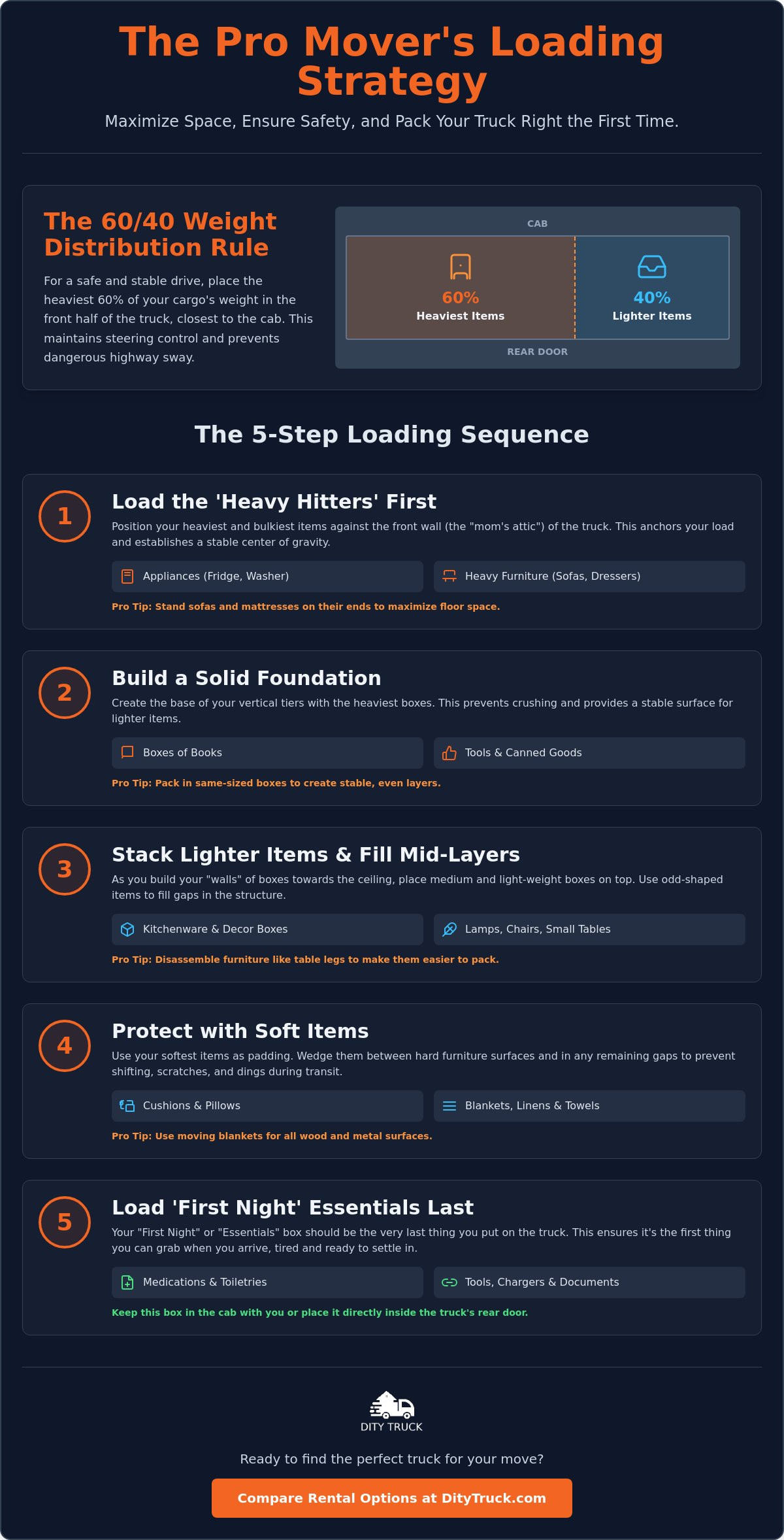
    Start by moving your large appliances against the far wall of the truck. This includes refrigerators, washing machines, and dryers. Always keep these items in their upright position. Laying a refrigerator on its side can cause cooling fluids to leak into the internal components, which leads to expensive repairs later. Use moving blankets between every metal surface. This creates a protective barrier that prevents scratches, dings, and the annoying sound of metal rubbing against metal during the trip. Secure these items with tie-down straps to the truck’s interior rails to ensure they don’t budge an inch.

    Managing Heavy Furniture

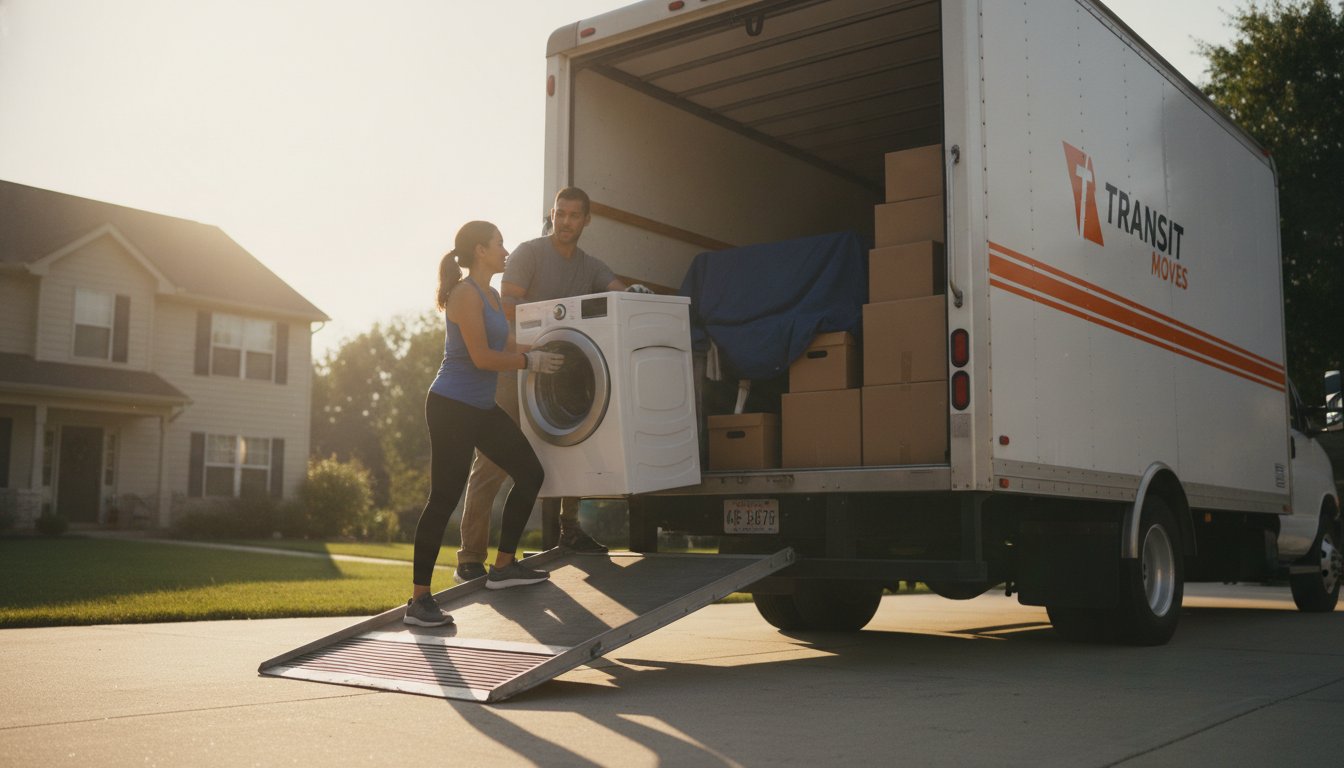
    Once the appliances are set, focus on your solid wood furniture. Items like heavy dressers, armoires, and sofas come next. You can often save massive amounts of floor space by loading sofas vertically on their ends. This “standing” position allows you to fit more items into a smaller footprint. For dressers and cabinets, place them against the side walls to act as stable anchors for the tiers of boxes you’ll add later. Don’t leave drawers loose. Either remove them entirely to lighten the load or use professional grade moving tape to keep them shut. This prevents unexpected shifts that could throw off the truck’s balance during sharp turns or sudden stops.

    • Stamina Tip: Tackle the fridge and washing machine in the first 30 minutes of the day.
    • Safety Tip: Use a dolly for everything over 50 pounds to prevent back strain.
    • Space Tip: Stand mattresses and sofas on their ends to open up floor space for boxes.

    Building the ‘Wall’: The Secret to Maximizing Vertical Space

    Once your heavy hitters are anchored against the front wall, the real work begins. Amateurs often make the mistake of spreading items across the floor like a carpet. Professionals use the Wall Method. You build your load in vertical tiers, working from the floor all the way to the ceiling. This approach maximizes every square inch of the cargo area. Empty air at the top of the truck is wasted money. Filling it ensures you won’t need a second trip. By following professional truck-packing procedures, you turn a chaotic pile into a stable, organized structure. It’s important to secure each completed wall with moving straps. This prevents a domino effect where the entire load shifts forward during hard braking. Deciding what to load first in a moving truck is only the first step; how you stack those items determines the safety of your drive.

    The Foundation: Heavy Boxes

    A solid wall requires a strong base. Place your heaviest and densest boxes at the very bottom of each tier. These are the boxes filled with books, canned goods, or heavy tools. Ensure every box is fully taped across all seams. This prevents the bottom layer from collapsing under the weight of the items stacked above. Try to match box sizes in each row. When your boxes are uniform, they create a perfectly level surface for the next layer. This stability is what keeps your belongings from toppling over when the truck hits a bump. Before you start stacking, you can compare rental options to find a vehicle with enough interior height for your tallest furniture.

    The Mid-Layer: Medium and Odd-Shaped Items

    Stack your medium weight boxes directly on top of the heavy foundation. As you move higher, the weight should decrease. This keeps the tier from becoming top-heavy. This middle section is also the perfect place for items that don’t fit into standard boxes. Insert chairs, small side tables, or floor lamps into the gaps. Think of it like a puzzle. Use fillers to stabilize these odd shaped pieces. Rolled up rugs or exercise mats work perfectly to bridge the space between a box and a furniture leg. This prevents movement and reduces the risk of friction damage. Each piece should feel snug. If you can wiggle a box, it needs more padding around it.

    • Efficiency Tip: Use the “H-tape” method on all box bottoms to prevent blowouts.
    • Organization Tip: Keep box labels facing outward so you can read them at a glance.
    • Safety Tip: Tighten your cargo straps every time you finish a three-foot section of the wall.

    What to Load First in a Moving Truck: The Pro-Level Loading Order

    Filling the Gaps: Fragile Items and the Cab-Over Space

    You have established the bulk of your load. Now you must address the remaining gaps. This phase is about protection and precision. While the heavy items were what to load first in a moving truck, your fragile goods require a different kind of care. Professional loaders don’t leave empty spaces. They use every nook to stabilize the inventory. This prevents items from sliding during turns or sudden stops. It also ensures you get the most value out of your rental. Every cubic foot you fill is space you don’t have to pay for in a second trip.

    Optimizing the Cab-Over Compartment

    The cab-over compartment is the space directly above the driver’s seat designed for delicate cargo. Many rental vehicles include this feature to keep fragile items away from the pressure of the main floor. Reserve this area for electronics, glass, and small antiques. It is the safest spot for your most valuable belongings. However, you must pack this area tightly. Movement here is exaggerated by the truck’s motion. If items are loose, they will bounce. Avoid putting heavy boxes in this overhead space. Keeping weight low is a core part of The 60/40 Rule for a Safe Drive. High weight makes the truck top-heavy. This increases the risk of tipping during sharp turns or high winds.

    The ‘Soft Filler’ Technique

    Soft goods are your best defense against shifting. Don’t waste space by packing every t-shirt into a cardboard box. Instead, use garbage bags filled with clothes as “plugs.” Stuff these bags into the gaps between furniture legs or between the top of a dresser and the truck’s ceiling. This technique prevents the domino effect. Use your couch cushions to protect table tops from the boxes stacked above. This creates a shock-absorbing layer. Every hole in your cargo wall is a potential point of failure. Plugging these holes with pillows and blankets ensures a snug fit. This “friction fit” is what professional movers use to guarantee a damage-free trip.

    • Mirror Placement: Load mirrors and paintings vertically along the side walls. Slide them behind a mattress for extra padding.
    • Weight Check: Never put more than 200 to 300 pounds in the cab-over space. Check your rental manual for specific limits.
    • Electronics: Keep TV screens facing the wall. Secure them with a soft “bumper” bag to prevent screen pressure.

    Understanding what to load first in a moving truck helps you build the base. These finishing touches protect the details. A well-packed truck should feel like a single, solid unit. If you can shake a box, it needs more filler. Use your linens and towels to bridge those final gaps. This simple step replaces expensive packing peanuts and provides better protection.

    Balancing the Load: The 60/40 Rule for a Safe Drive

    Physics doesn’t care about your packing skills. It only cares about weight. A poorly balanced rental vehicle is a safety hazard. It leads to fishtailing at highway speeds. This dangerous swaying makes the truck nearly impossible to control. To avoid this risk, you must follow the 60/40 rule. This means placing 60 percent of your total cargo weight in the front half of the truck. The remaining 40 percent stays toward the back. While some generic guides suggest distributing weight evenly, that is a mistake. You need more weight near the cab to keep the tires planted. Knowing what to load first in a moving truck is the foundation of this balance. You start with the heavy items at the front to create a stable anchor.

    A balanced load makes the difference between a stressful drive and a confident one. When the weight is distributed correctly, the truck handles more like a standard car. You won’t feel the cargo fighting you during every lane change. This stability is especially important if you are driving a larger 26 foot vehicle for the first time. Safety starts with the very first item you carry up the ramp. Each heavy piece of furniture acts as a ballast for the rest of your belongings.

    Front-to-Back Weight Distribution

    The front half of the cargo area needs the most pressure. This keeps the steering axle firmly engaged with the pavement. When the back of the truck is too heavy, it acts like a lever. It physically lifts the front end. This results in a “light” steering feel. You lose traction. Braking becomes less effective. The 60/40 rule is the industry standard for safe DIY truck loading. Understanding what to load first in a moving truck is the key to maintaining this split. If you haven’t secured your vehicle yet, you can compare and book a rental truck to ensure you have the right size for a safe weight distribution.

    Side-to-Side Symmetry

    Weight must also be balanced across the width of the vehicle. If you place a heavy refrigerator on the left side, you must place a heavy dresser or armoire on the right. An uneven load causes the truck to pull or lean in one direction. It makes a long distance drive physically exhausting. Check the truck’s “lean” before you close the door. The vehicle should look perfectly level from the back. Proper side-to-side balance does more than just improve safety. It reduces uneven tire wear. It also improves your fuel efficiency during your trip. A level truck cuts through the wind more effectively than one that is tilted to the side.

    • Steering: Proper front weight prevents the wheels from “floating” at high speeds.
    • Braking: Balanced weight ensures all four sets of brakes work together.
    • Safety: Correct loading prevents the cargo from shifting and tipping the truck on sharp off-ramps.

    The ‘Last-In’ Essentials and Final Securement

    You have conquered the heavy lifting and built your cargo walls. Now comes the most strategic part of the day. While knowing what to load first in a moving truck ensures a safe drive, knowing what to load last ensures a sane first night. These final items are your essentials. They stay at the very back of the truck, right against the door. This placement makes them the first things you grab when you arrive at your new home. You don’t want to be digging through a 20-foot cargo area at midnight looking for a toothbrush or a phone charger. This final layer is your survival kit for the first 24 hours.

    Don’t forget cleaning supplies in this final section. Your new home might look clean on the surface, but you’ll want to wipe down counters and sweep floors before the furniture goes in. Put a broom, all-purpose cleaner, and paper towels in this final layer. Having these within reach saves you from a frustrating trip to the store on an already exhausting moving day. It’s about maintaining momentum. Once the truck is empty, you can transition immediately to setting up your space rather than hunting for basic supplies. This logical progression is the hallmark of a professional-level move.

    The First-Night Box Checklist

    Your First-Night box should contain everything needed to function without opening another container. Pack bed linens and towels for every family member. Include a change of clothes and basic toiletries for everyone. A basic toolkit is also a requirement. You will need screwdrivers and pliers to reassemble bed frames, desks, or dining tables. Keep your important documents and phone chargers here as well. Losing your lease agreement or a birth certificate in a sea of brown boxes is a stress you can easily avoid with a bit of foresight.

    • Linens: Sheets, pillows, and blankets for the first night of sleep.
    • Tools: An Allen wrench set, a hammer, and a screwdriver.
    • Documents: IDs, rental contracts, and medical records.
    • Power: Chargers for every phone and laptop in the house.

    Final Security and the DityTruck Advantage

    Security is your final priority before hitting the road. Perform a “lock-and-roll” check. Give the last wall of boxes a firm shake. If anything moves or rattles, tighten your cargo straps immediately. Everything should be immobile. Check the track of the roll-up door. Ensure no loose items or stray packing blankets are blocking the path. A jammed door is a major headache during unloading. Finally, double-check the loading ramp. It must be fully stowed and locked into place. Driving with a loose ramp is dangerous and can damage the vehicle chassis. If you are still in the planning phase, you can compare rates for the perfect size truck on DityTruck to ensure you have exactly the space you need for a professional-level load.

    The final securement is a mental reset. Walk around the vehicle one last time. Check the tires and the lights. Inside the cargo area, the straps should be drum-tight. If you used the 60/40 rule and prioritized the heavy items as what to load first in a moving truck, the vehicle will sit level. This balance is your best defense against transit damage. A secure load doesn’t shift, which means your belongings arrive in the same condition they left. You’ve done the hard work. Now, drive safe and enjoy your new home.

    Master Your Moving Day

    Loading your rental truck doesn’t have to be a source of anxiety. By prioritizing your heaviest appliances and furniture as what to load first in a moving truck, you create a stable foundation for a safe trip. Remember to build your cargo in vertical tiers to maximize space and follow the 60/40 weight distribution rule to maintain control on the highway. These simple steps prevent damage and save you from the exhaustion of a disorganized move. You now have the exact sequence used by professionals to ensure everything fits and stays secure.

    Ready to get started? You can find the best rates on your rental truck today at DityTruck. Our platform lets you compare rates from Penske, Budget, and U-Haul in seconds. We provide real-time availability and transparent pricing so you don’t have to worry about hidden fees. It’s the fastest way to secure the best DIY moving deals for your specific needs.

    Take the stress out of your logistics. With the right truck and a solid loading plan, your transition to a new home will be smooth and efficient. You have the tools and the knowledge. Now, it’s time to get moving.

    Frequently Asked Questions

    What is the heaviest thing to load in a moving truck?

    Large appliances like refrigerators and washing machines are usually the heaviest items in any move. Place these directly against the front wall to keep the center of gravity low and forward. This prevents the truck from leaning and ensures your steering stays responsive throughout the trip. It also saves your back by getting the hardest work out of the way first.

    Should I load boxes or furniture first?

    Always load your heavy furniture and appliances before your boxes. Knowing what to load first in a moving truck is vital for your physical stamina. Tackle the heaviest pieces while your energy is high. Once the “heavy hitters” are in place, you can use medium and light boxes to build walls around them, filling the truck from front to back.

    How do I prevent my stuff from shifting in the truck?

    Tight packing is your primary defense against shifting cargo. Use the “Wall Method” to build vertical tiers from floor to ceiling. Secure each section with heavy duty moving straps hooked into the truck’s side rails. Fill every small gap with soft items like bags of clothing or pillows to act as bumpers. If you can’t wiggle a box, it won’t shift during a turn.

    Is it better to stack boxes high or spread them out?

    Stacking boxes high in vertical tiers is much more efficient than spreading them across the floor. Work in three foot sections, filling the space from the floor to the roof before moving toward the door. This method maximizes your rental space and keeps the load from toppling. High stacks also prevent heavy boxes from sliding and damaging smaller items during transit.

    Where should I put my mattress in a moving truck?

    Stand your mattress vertically against the side wall of the truck. This saves floor space and creates a protective, padded barrier for long items like mirrors or headboards. Always use a mattress bag to prevent stains. Secure the mattress to the side rails with straps to ensure it doesn’t tip over and crush other belongings when you hit a bump.

    What happens if I put too much weight in the back of the truck?

    Excessive weight in the back of the truck creates a lever effect that lifts the front wheels. This leads to a loss of steering traction and dangerous fishtailing at highway speeds. You should always aim for the 60/40 weight distribution. Placing 60 percent of the weight in the front half keeps the truck stable and ensures your brakes work effectively.

    How do I use moving straps correctly?

    Hook the strap ends into the interior tie down rails located along the side walls. Pull the straps tight across each vertical wall of cargo until nothing can move. Don’t wait until the end of the day to secure the load. Tighten your straps every time you finish a three foot section to prevent the “domino effect” if you have to brake suddenly.

    What size moving truck do I actually need for a 3-bedroom house?

    A 20 foot to 26 foot truck is standard for a 3 bedroom house. A 26 foot truck is the largest model you can drive without a Commercial Driver’s License (CDL). These vehicles are specifically rated at 26,000 pounds or less for personal use. Choosing the larger size provides extra room to build stable walls and avoids the frustration of a second trip.

  • How to Calculate Moving Truck Capacity: A 2026 Guide for Stress-Free Loading

    How to Calculate Moving Truck Capacity: A 2026 Guide for Stress-Free Loading

    What if the difference between a one-trip move and a midnight return to your old house is just three inches of vertical space? Most people guess their rental size based on bedroom count. That’s how you end up overpaying for a half-empty van or running out of room before the mattress is even loaded. You need to know how to translate your specific furniture and box count into a truck size that actually fits. Learning how to calculate moving truck capacity isn’t about complex geometry. It’s about matching your inventory to real-world dimensions so you can move with total confidence.

    It’s stressful to stare at a pile of boxes and wonder if they’ll actually fit. You deserve a process that’s fast, honest, and eliminates the guesswork. This guide promises to strip away the confusion of cubic feet versus linear feet. You’ll master a reliable formula to determine the exact truck size you need for your specific belongings. We’ll walk through the Tetris Factor of stacking, compare standard rental dimensions, and show you how to use a comparison platform to lock in the best rate without the typical logistics headache.

    Key Takeaways

    • Understand the difference between truck length and cubic feet. This ensures you measure total volume instead of just floor space.
    • Master a simple 3-step formula to discover how to calculate moving truck capacity. Use your furniture inventory and the 10-per-100 box rule for accuracy.
    • Maximize rental value by applying the “Tetris Factor.” This strategy involves stacking items to fill the entire vertical cargo area efficiently.
    • Avoid common pitfalls by accounting for vehicle weight limits. Don’t forget to utilize the “Mom’s Attic” compartment over the truck cab for extra space.
    • Use your final volume calculation to compare rates across multiple rental providers. Secure the most cost-effective truck size for your specific needs.

    What is Moving Truck Capacity? Understanding Cubic Feet vs. Dimensions

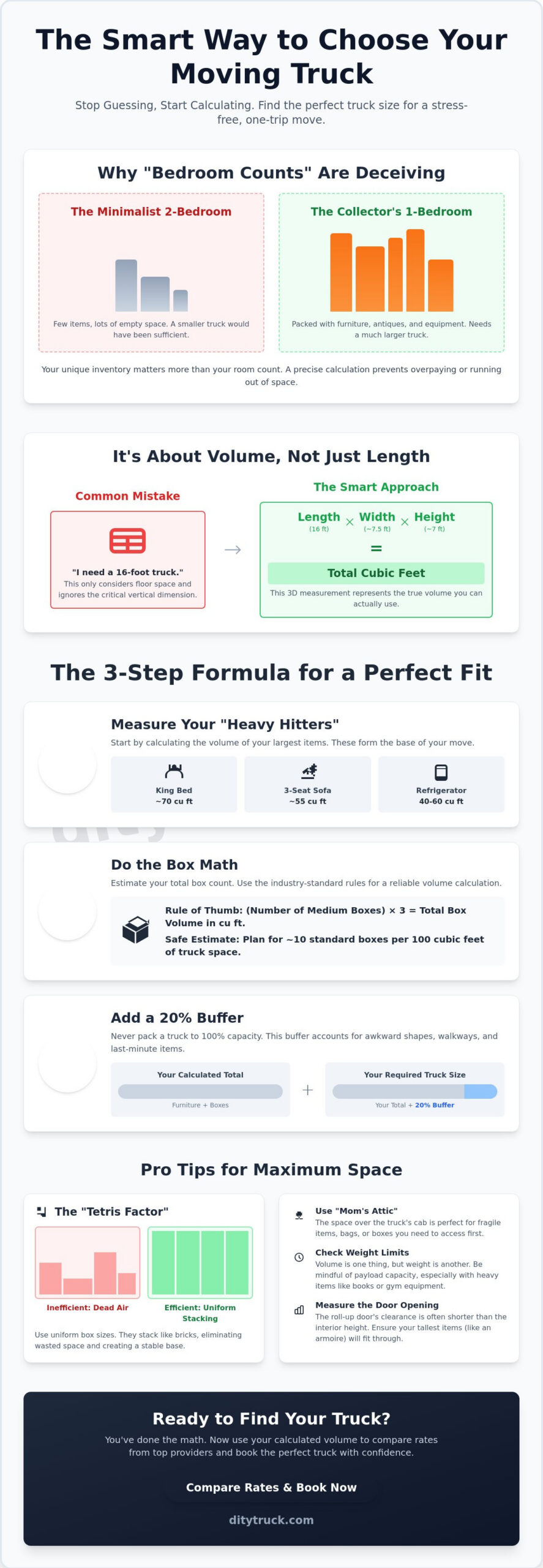
    Capacity is measured in cubic feet. This represents the total internal volume of the cargo area, providing a 3D view of what you can actually fit inside. While you often see a 10-foot or 16-foot label, that’s just a marketing shorthand for length. The real magic happens when you look at the height and width. Most common moving truck types feature an internal width of 7 to 8 feet. You can’t just measure the floor and call it a day. The vertical space is what separates a successful one-trip move from a logistical nightmare. Cubic capacity is the product of internal length, width, and height minus the space lost to wheel well intrusions.

    Don’t forget the door opening. Sometimes the internal height is 8 feet, but the roll-up door only clears 7 feet. This small detail can stop a tall armoire in its tracks. Measuring the actual clearance helps you visualize how to calculate moving truck capacity for your tallest items. It’s about more than just the numbers on the side of the truck. It’s about understanding the box you’re filling.

    The Box-to-Volume Conversion Chart

    Boxes are the hidden space-eaters of any move. A small box typically holds about 1.5 cubic feet. A large box jumps to 4.5 cubic feet. If you mix and match sizes without a plan, you create “dead air” that you can’t fill. Aim for 10 boxes per 100 cubic feet of truck space as a safe estimate for a standard household. Box uniformity is your best friend here. Identical boxes stack like bricks. This creates a solid foundation and improves your actual usable capacity. When boxes are the same size, you eliminate the gaps that usually swallow up valuable volume. It makes the math predictable and the loading process much faster.

    Why Bedroom Counts Often Fail

    Relying solely on bedroom counts is a common trap. Rental websites love this metric because it’s fast. It isn’t always accurate. A minimalist 2-bedroom home might have half the volume of a 1-bedroom home filled with heavy antiques and exercise equipment. These standard labels don’t account for the specific volume of your belongings. They assume you have “average” furniture. Use room counts to narrow your search at the start. Then, dive into the actual math of your inventory. Knowing how to calculate moving truck capacity for your unique items prevents you from overpaying for empty air or under-sizing your rental. It’s the difference between a guess and a plan.

    The 3-Step Formula to Calculate Your Required Truck Space

    Moving isn’t a guessing game. It’s a math problem. Most people look at their living room and pick a truck size based on a gut feeling. That leads to two outcomes: you pay for empty air or you leave the sofa on the sidewalk. You need a system that handles your actual belongings, from that oversized sectional to your collection of mountain bikes. This 3-step formula simplifies the process. It helps you understand how to calculate moving truck capacity based on your specific inventory rather than a generic room count. By the time you finish this calculation, you’ll be ready to look at a moving truck rental guide with total confidence.

    Step 1: Measuring the Heavy Hitters

    Start with your largest items. These “Big Three” (beds, couches, and tables) dictate your base volume. A King bed typically consumes about 70 cubic feet; a Queen bed takes up roughly 60. Don’t forget the appliances. A standard refrigerator requires 40 to 60 cubic feet, while a washing machine needs about 25. Modern movers often have “weird” gear that doesn’t stack well. Bicycles, floor lamps, and standing desks are notorious space-wasters. Treat these as solid blocks in your calculation. If a bicycle is 6 feet long and 4 feet high, budget 24 cubic feet for it even if it looks thin. This ensures you don’t underestimate the footprint of irregular items.

    Step 2: Doing the Box Math

    Boxes are the primary variable in any move. Counting your boxes before you book a rental is the most effective way to save money. Medium boxes are the industry standard for capacity planning. They usually offer about 3 cubic feet of space. Use the 10-per-100 rule as a benchmark; for every 100 cubic feet of truck space, you can comfortably fit about 10 standard boxes alongside your furniture. To get your total box volume, multiply your estimated box count by three. This simple step provides a concrete number to add to your furniture total, removing the mystery from how to calculate moving truck capacity.

    Step 3: The 20% Buffer Rule

    Never pack a truck to 100% of its theoretical capacity. Real-world loading involves “dead space.” This is the air between a rounded chair back and a flat box. Professional loaders call this the Tetris Factor. Add a 15 to 20% buffer to your total cubic foot requirement. If your math says you need 800 cubic feet, look for a truck with at least 960. This is your “Moment of Truth.” If your calculated total is within 50 cubic feet of a truck’s maximum, size up to the next class. It’s much cheaper to pay for a slightly larger truck than to realize you need a second trip on moving day. You can compare available truck sizes and their actual volumes to find the perfect match for your final number.

    How to Calculate Moving Truck Capacity: A 2026 Guide for Stress-Free Loading

    The Tetris Factor: Usable Space vs. Theoretical Volume

    Theoretical volume is just a starting point. A truck rated for 1,200 cubic feet doesn’t automatically swallow 1,200 cubic feet of gear. You have to earn that space through smart loading. Understanding how to calculate moving truck capacity means acknowledging the gap between a blueprint and a packed wall. If you leave a foot of air at the top of the truck, you’ve wasted 15% of your rental budget. Usable space relies on verticality. Stack to the ceiling or lose the gamble.

    Start with a solid foundation. Heavy appliances and dense boxes belong on the floor. This creates a stable platform for lighter items. Once the base is set, use soft goods as your secret weapon. Garbage bags of clothes, pillows, and blankets are perfect fillers. They plug the odd gaps between chair legs and headboards. This turns “dead air” into usable volume. It’s the most efficient way to ensure your calculation holds up in the real world.

    Safety dictates your final capacity. Don’t forget to leave room for the loading ramp and the interior tie-down tracks. If you pack items flush against the walls, you can’t use straps to secure the load. An unsecured load shifts during transit. This creates new gaps and can damage your belongings. A safe truck is a full truck, but it must be a secured one. Leave small pockets of space specifically for your tie-down points.

    The “Tier” Packing Method

    Visualize the truck in vertical sections called tiers. Build a wall from the floor to the ceiling. Secure it. Then start the next one. This method helps you track your remaining capacity in real-time. If you’ve used half the truck length but still have 70% of your inventory, you know you need to pack tighter. Long and flat items like mattresses or mirrors are the ultimate space-savers. Slide them along the side walls. This creates a smooth surface for other items to lean against and protects fragile surfaces.

    Managing Oddly Shaped Items

    Lawnmowers, grills, and exercise equipment are capacity killers. They have a large footprint but low stackability. You can’t put a heavy box on top of a gas grill without consequences. For these items, focus on the footprint rather than the volume. Budget the entire vertical column of space for that single item. If you have several “un-stackables,” you might need to size up. Using a comparison tool like DityTruck helps you find one way truck rentals for moving that offer wider cargo doors or lower decks. These features make it easier to load heavy machinery without wasting the surrounding space. Knowing how to calculate moving truck capacity for these outliers ensures you don’t run out of room at the last minute.

    Common Mistakes in Truck Capacity Estimation

    Calculating volume is only half the battle. Many movers spend hours measuring sofas but ignore the Gross Vehicle Weight Rating (GVWR). A full truck isn’t always a safe truck. If you load too much weight, you risk brake failure or tire blowouts. Weight capacity is just as vital as volume capacity. You must balance the physical space with the actual payload the vehicle can handle. This is the most common way people fail when learning how to calculate moving truck capacity effectively.

    Don’t forget the “Mom’s Attic.” This is the storage compartment located directly over the truck cab. It’s a prime spot for fragile electronics or small boxes. However, it’s often omitted from mental calculations. If you count it as standard floor space, you’ll struggle to load it. It requires a different packing strategy. Use it for the items you need to access first or things that can’t be crushed. It’s bonus volume, but only if you plan for it.

    The Weight vs. Volume Trap

    Density matters. Books and tools take up very little volume but carry massive weight. You might fill a 10-foot truck halfway and already exceed the legal weight limit. Always check the payload capacity on your rental agreement. If you have a home library or a full workshop, you might need a larger truck with a higher GVWR even if the cubic footage looks sufficient. This prevents dangerous handling issues on the highway. It also keeps you legal at weigh stations.

    The “Garage and Attic” Surprise

    The garage is where capacity estimates go to die. Hidden clutter adds up fast. Most garages require an extra 5 feet of truck length just to handle the “stuff” that isn’t in boxes. Outdoor furniture, patio sets, and gardening tools have awkward footprints. They don’t stack well. Don’t forget your closets and junk drawers. These small spaces can easily add 50 to 100 cubic feet to your total. Account for every corner of your home to avoid a last-minute crisis. If you’re worried about these variables, you can compare truck rental options to find a vehicle with the right payload and volume for your specific inventory.

    Ready to Rent? How to Use Your Calculation to Save

    You’ve done the math. Now it’s time to apply it. Take your total cubic foot requirement and head to DityTruck. This is where your preparation turns into actual savings. You can compare 16-foot versus 20-foot rates across multiple providers instantly. It eliminates the stress of visiting five different websites to find the best deal. By knowing exactly how to calculate moving truck capacity, you protect yourself from the “up-sell” at the rental counter. You won’t be talked into a massive truck you don’t need. You’ll book the smallest size that safely fits your volume. It’s about efficiency. It’s about financial honesty.

    Preparation is the ultimate stress-killer. When you walk into a rental office with a specific cubic foot requirement, you’re in control of the conversation. You aren’t guessing. You aren’t anxious. You’re simply executing a plan. The comparison tool acts as your smart assistant, performing the heavy lifting behind the scenes. It strips away the complexity of logistics. It leaves you with clear choices and transparent pricing. Use your math to lock in a rate that respects your budget and your time.

    Comparing Sizes Across Brands

    Labels are often deceptive in the rental world. One brand’s 20-foot truck may have significantly more cubic feet than another brand’s version. DityTruck streamlines the “Size vs. Price” comparison by providing the raw data behind the marketing names. You see the actual volume. You see the price. Then you decide. Booking early is your best defense against availability issues. It secures the specific size you calculated. This prevents a scenario where you’re forced to rent a larger, more expensive vehicle because your ideal choice is sold out. Secure your choice at least one month in advance for the best results.

    Final Checklist Before You Book

    Before you finalize your reservation, run through a quick checklist. Preparation prevents moving day disasters. Confirm the specific internal dimensions including the height, width, and door clearance. Ensure the vehicle includes a loading ramp or a liftgate. These tools are essential for maximizing your effort and protecting your furniture. Your math has given you the confidence to lead this move. Now, use that data to secure the best deal available. A few minutes of checking dimensions now saves hours of frustration later. It’s the final step toward a friction-free moving experience.

    Compare moving truck rates and sizes now on DityTruck

    Move with Total Confidence

    You’ve mastered the math. You know the “Big Three” furniture volumes. You’ve factored in the 20% Tetris buffer. Now, you can stop guessing and start booking. Understanding how to calculate moving truck capacity is the best way to protect your budget and your sanity. It ensures you never overpay for empty air or leave your favorite chair behind on the sidewalk.

    DityTruck simplifies the next step. Our platform offers real-time rate comparisons from major US providers. You get transparent pricing with no hidden reservation fees. This makes booking for local and long-distance DIY moves faster than ever. Use your inventory numbers to filter through options. Lock in the most efficient vehicle for your specific load requirements. Our tool does the heavy lifting so you don’t have to.

    Find the perfect truck size and rate on DityTruck

    You're ready for a friction-free moving day. Trust your numbers. Secure your rental. Get moving.

    Frequently Asked Questions

    How many cubic feet is a 16-foot moving truck?

    A 16-foot truck typically provides between 800 and 900 cubic feet of storage space. This volume varies slightly depending on the specific manufacturer and the presence of a “Mom’s Attic” compartment. It is the standard choice for moving a one to two-bedroom apartment. Always verify the internal dimensions on your rental agreement to confirm the exact capacity before you start loading.

    Is it better to get a truck that is too big or too small?

    It is always better to rent a truck that is slightly larger than you think you need. A bigger truck allows for a single trip and provides the extra space needed for secure, professional packing. If you rent a truck that is too small, you risk the stress of a second trip or leaving valuable items behind. This is why learning how to calculate moving truck capacity accurately is vital for a smooth move.

    How do I calculate how many boxes will fit in a rental truck?

    Use the 10-per-100 rule to estimate box volume alongside your furniture. This means budgeting for roughly 10 medium boxes for every 100 cubic feet of total truck space. To get a precise number, multiply your total box count by 3 to determine the total cubic footage required for your containers. This simple math prevents you from underestimating the footprint of your smaller belongings.

    What size truck do I need for a 3-bedroom house?

    A 22-foot to 26-foot truck is generally required to move a three-bedroom home. These larger vehicles offer between 1,200 and 1,600 cubic feet of internal volume. This size accommodates heavy appliances, multiple bedroom sets, and large dining tables. If you have a full garage or a basement, choose the 26-foot option to ensure everything fits in one trip.

    Does the “Mom’s Attic” space count toward the total cubic feet?

    Yes, the storage area located over the truck cab is included in the total cubic foot rating. This area is perfect for fragile electronics, mirrors, or small boxes that should not be crushed by heavier furniture. Keep in mind that this space has a lower ceiling height than the main cargo floor. Account for this height difference when you plan your loading sequence.

    Can I overload a moving truck if there is still physical space left?

    No, you must never exceed the Gross Vehicle Weight Rating regardless of how much empty space remains. Overloading a truck makes it dangerous to handle and can lead to tire blowouts or brake failure. Dense items like books, tools, or weight sets can reach the weight limit very quickly. Always check the payload capacity on your rental contract to ensure a safe journey.

    What is the most common moving truck size for a local move?

    The 10-foot and 15-foot trucks are the most popular choices for local DIY moves. These sizes are easy to drive through residential streets and offer enough volume for most small apartments. For local moves, making two quick trips with a smaller truck is sometimes more cost-effective than renting a massive 26-foot vehicle. It depends on your total volume and the distance between homes.

    How much extra space should I leave for padding and blankets?

    Budget roughly 5% of your total truck volume for moving blankets and protective padding. While blankets look thin, they add significant bulk when wrapped around multiple pieces of large furniture. This extra space ensures you can protect your belongings without running out of room at the end of the load. It’s a small but essential part of knowing how to calculate moving truck capacity for a damage-free move.