
With gas prices hitting a national average of $4.04 per gallon in June 2026, a single wrong assumption about fuel efficiency can blow your moving budget before you even leave the driveway. You want a smooth transition without any expensive surprises at the pump. The average mpg for a 15 foot moving truck typically hovers around 10 miles per gallon, but that number fluctuates based on the brand you choose and the weight of your belongings. It’s frustrating to plan for one cost only to see the total climb during every fuel stop.
We’re here to strip away that uncertainty. This guide provides the exact fuel economy estimates for 15-foot trucks and a reliable formula to calculate your total trip spend. You’ll discover how weight impacts your mileage and learn simple ways to keep your costs down. We’ll preview the differences between major rental fleets and help you choose the most efficient path forward. Let’s get your budget back on track with clear, actionable data.
Key Takeaways
- Expect the average mpg for a 15 foot moving truck to vary between 8 and 12 MPG—load weight is the primary factor in your final efficiency.
- Identify fuel performance differences between national providers—newer chassis designs often result in better savings than older V8 models.
- Master a simple calculation formula for total trip costs—budgeting for 9 MPG protects your wallet from unexpected price spikes.
- Boost economy with small driving adjustments—steady highway speeds and proper tire pressure lead to immediate fuel savings.
- Compare total rental rates and estimated fuel costs simultaneously—find the most transparent and cost-effective path for your move.
What is the Real-World Average MPG for a 15-Foot Moving Truck?
Getting your numbers right is the first step toward a stress-free move. The average mpg for a 15 foot moving truck generally ranges from 8 to 12 miles per gallon. This is the baseline you should use for your initial calculations. It’s a wide range for a reason. Real-world conditions like stop-and-go city traffic, steep mountain passes, and long periods of idling will pull your efficiency toward the lower end. Most trucks in this size class feature fuel tanks that hold between 30 and 40 gallons. If you’re hitting a 10 MPG average, you’ll need to look for a gas station every 300 to 350 miles to keep a safe reserve.
Understanding fuel economy helps you avoid a budget drain at the pump. These vehicles aren’t built for speed or sleekness; they’re built for volume and durability. Every extra pound you load and every mile per hour over the speed limit changes how much you’ll eventually pay.
Gasoline vs. Diesel Efficiency
In 2026, the vast majority of 15-foot rental trucks utilize unleaded gasoline to ensure customers can refuel easily at any standard station. While diesel engines are known for providing better torque and slightly higher MPG under heavy loads, they’re becoming less common in this specific rental size. Gasoline engines are easier for the average driver to manage. They provide enough power for a standard two-bedroom apartment move without the complexity of finding diesel pumps or managing exhaust fluids.
Empty vs. Loaded Fuel Consumption
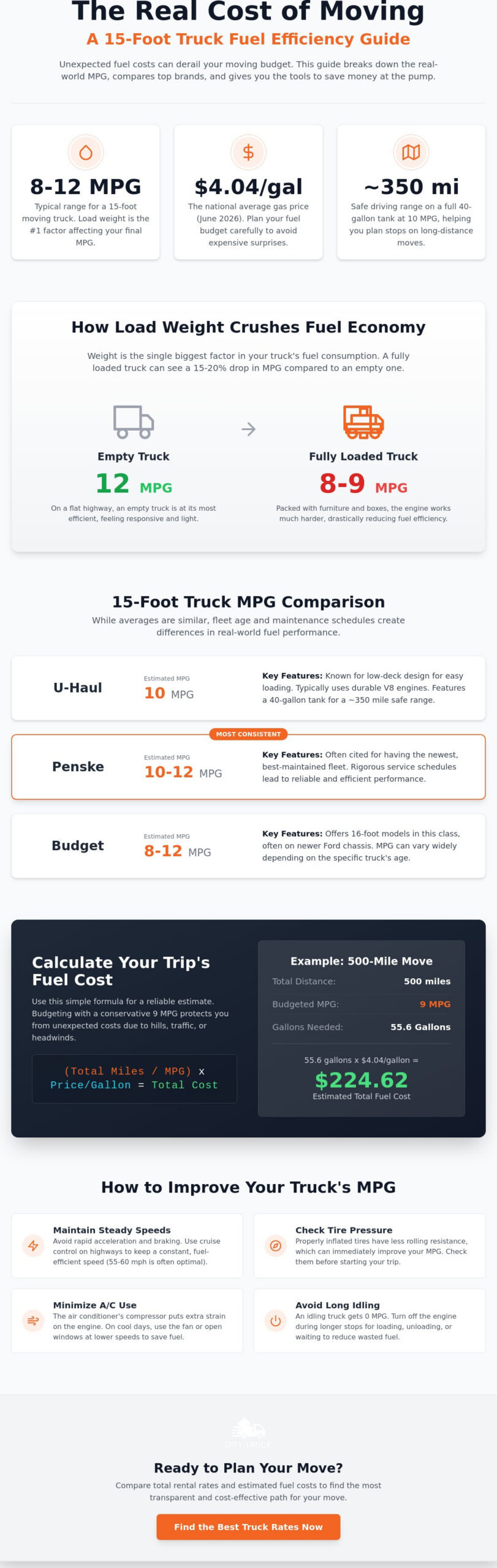
Weight is the primary factor that degrades your fuel performance during a move. When the truck is empty, it feels more responsive and hits higher efficiency peaks. You might see 12 MPG on a flat, clear highway. Once you pack your heavy furniture, appliances, and stacked boxes, the engine demands significantly more power to maintain speed. Expect a 15 to 20 percent drop in efficiency once the cargo area is fully packed. This usually brings your average mpg for a 15 foot moving truck down to the 8 or 9 MPG range.
Aerodynamics also fight against your wallet. These trucks have the wind resistance of a large brick. At highway speeds, the air pressure creates massive drag. This forces the fuel system to work overtime just to keep the truck moving forward. Driving into a strong headwind or traveling at high speeds can push your efficiency even lower than the 8 MPG floor. Keeping a steady, moderate pace is the most effective way to combat these physics.
15-Foot Truck MPG Comparison: U-Haul vs. Budget vs. Penske
The logo on the side of your rental truck does more than identify the company. It often dictates the age of the engine and the technology under the hood. While the average mpg for a 15 foot moving truck stays within a predictable range, brand-specific fleet choices create subtle shifts in your total fuel spend. U-Haul focuses on accessibility and ease of loading. Their 15-foot models feature a low-deck design. This makes walking heavy items into the box much simpler. However, these trucks typically rely on standard V8 engines that prioritize durability over extreme fuel efficiency.
Budget and Penske offer different advantages. Budget often uses 16-foot trucks as their mid-size option. Many of these vehicles sit on newer Ford chassis designed for better fuel management. Penske is frequently recognized for its rigorous maintenance schedules. A clean engine with fresh filters and tuned components performs more reliably. This consistency helps you avoid the sudden MPG drops common in older, poorly maintained rental units. Comparing these brands allows you to balance the daily rental rate against the projected cost at the pump.
Brand-Specific Fuel Estimates
Estimates vary based on the specific unit you receive at the lot. Use these benchmarks for your planning:
- U-Haul: Typically averages 10 MPG. These trucks usually come with a 40-gallon tank, giving you a safe range of roughly 350 miles between fill-ups.
- Budget: Expect 8 to 12 MPG. Their 16-foot models vary in age, so your efficiency depends heavily on the specific model year provided at pickup.
- Penske: Often cited for the most consistent performance, yielding 10 to 12 MPG. Their fleet is generally newer and well-maintained.
Which Brand Offers the Best Fuel Economy?
Fleet age is the most reliable indicator of efficiency. Newer trucks benefit from recent automotive engineering. The U.S. Department of Transportation recently finalized new fuel economy standards to push for better performance across all vehicle classes. When you rent a truck from a newer fleet, you are essentially benefiting from these updated manufacturing requirements. Modern engines and transmissions are tuned to squeeze every possible mile out of a gallon of gas.
Maintenance records also play a critical role. A truck with clogged air filters or old spark plugs will struggle to maintain the average mpg for a 15 foot moving truck. If you want a deeper look at how these companies stack up beyond just fuel, read our U-Haul vs. Budget Truck Rental: The Definitive 2026 Comparison Guide. Before you sign a contract, you should compare total rental costs across all providers to see which brand offers the best overall value for your specific route.
Calculating Your Total Fuel Costs for a 15-Foot Rental
Budgeting for a move is about more than just the daily rental rate. Fuel costs can easily become the second largest expense on your invoice. To avoid surprises at the pump, you need a clear, reliable formula. Take your total estimated mileage and divide it by the average mpg for a 15 foot moving truck. Multiply that result by the current price per gallon in your area. This gives you a baseline for your trip. Accuracy here means peace of mind later.
Always use a conservative 9 MPG for your calculations. While some trucks might hit 12 MPG under perfect conditions, you should plan for the worst case. This protects your wallet from underestimation. These vehicles must meet specific federal fuel efficiency standards, but real-world driving often falls short of lab tests. A fully loaded truck fighting wind resistance rarely hits peak efficiency. Budgeting for 9 MPG ensures you have extra cash if the trip proves more demanding than expected.
Example Calculation for a 500-Mile Move
Let’s look at the math for a regional move. If you are traveling 500 miles and assume a standard 10 MPG, you will need 50 gallons of fuel. At an estimated price of $3.50 per gallon, your total fuel cost is $175. If your route includes steep mountain passes or heavy elevation changes, reduce your expected efficiency to 7 or 8 MPG to account for the extra engine strain. This simple adjustment prevents a mid-trip budget crisis.
Hidden Factors in Fuel Budgeting
Your odometer doesn’t tell the whole story. Idling is a major fuel drain. If you leave the engine running while loading or unloading heavy items, you are burning gas without moving an inch. City driving also hurts your wallet. Frequent stops and starts in urban traffic significantly lower the average mpg for a 15 foot moving truck compared to steady highway cruising. Traffic congestion and construction detours add even more variability to your final bill.
Add a 10 percent buffer to your final fuel estimate. This “lost efficiency” account covers unexpected idling, wrong turns, and heavy traffic. Finally, remember the “return to full” requirement. Most rental companies charge a massive premium if you bring the truck back with less gas than you started with. Plan your final fill-up at a station within five miles of the drop-off lot. This small step saves you from high refueling fees and keeps your move on budget.
How to Improve Your Moving Truck MPG and Save Money
Your driving behavior is the most powerful variable in your moving budget. Even if the average mpg for a 15 foot moving truck is rated at 10, your habits can push that number up or down. High speeds are the biggest enemy of efficiency. Box trucks have poor aerodynamics. Driving at 70 MPH instead of 60 MPH can drop your mileage by as much as 20 percent. Stick to a steady highway speed between 55 and 60 MPH. It feels slower. It saves significant cash over a long trip.
Preparation starts before you leave the rental lot. Check the tire pressure on all six wheels. Underinflated tires create more rolling resistance. This forces the engine to burn more fuel to maintain momentum. Ask the rental agent for the recommended PSI and ensure the tires are properly filled. While you’re at the lot, focus on your loading strategy. Distribute the weight of your furniture and boxes evenly across the floor. Heavy items should be low and centered. An unbalanced load causes the suspension to drag and the engine to overwork.
Driving Habits for Better Mileage
Consistent fuel flow is the key to savings. Use cruise control on flat stretches of highway to prevent the surging that happens with manual pedal control. This keeps the engine in its most efficient power band. Avoid aggressive acceleration from a dead stop. Treat the gas pedal with respect. Practice gradual braking. When you see a red light or a slow-down ahead, let off the gas early. Coasting reduces the energy needed to regain speed later. In mild weather, skip the air conditioning. Running the compressor adds a noticeable load to the engine.
Route Planning and Logistics
Your GPS isn’t just for directions; it’s a budgeting tool. Avoid routes with significant elevation changes whenever possible. Climbing steep grades is the fastest way to ruin the average mpg for a 15 foot moving truck. Use fuel-tracking apps to find the cheapest gas stations along your route. Prices can vary by 30 cents or more between neighboring counties. Planning your stops avoids the need for sudden detours or idling in heavy traffic. For more detailed logistics tips, check out our Moving Truck Rental: The Complete 2026 Comparison & Booking Guide.
Every small adjustment adds up to a lighter bill at the pump. If you want to see which company offers the most efficient fleet for your specific dates and route, you can compare and book your rental today to lock in the best possible rate.
Find the Best 15-Foot Truck Rates and MPG with DityTruck
Managing the logistics of a move shouldn’t feel like a second job. DityTruck simplifies the entire process by bringing every major national rental provider into a single, easy-to-use platform. We act as your savvy consumer advocate by performing the heavy lifting behind the scenes. Instead of visiting multiple websites and keeping track of various tabs, you can see all available options in one view. This efficiency allows you to make a confident decision without the typical stress of comparison shopping. Finding the average mpg for a 15 foot moving truck is just one piece of the puzzle. We help you see how that fuel efficiency fits into your total budget.
Transparent pricing is the foundation of our service. We believe you deserve to know the full cost of your move before you ever reach the rental counter. Our platform allows you to compare total costs, including estimated fuel expenses based on your specific route. This clarity eliminates the fear of hidden fees or unexpected surcharges. You can book your 15-foot truck in minutes through our streamlined platform. It’s the shortest, most logical path between identifying a need and securing a solution. We prioritize your time and peace of mind above all else.
Why Comparison Matters for Your Budget
A lower daily rental rate can sometimes be a financial trap. If a company offers a cheap base price but provides an older vehicle with poor fuel economy, your total spend will climb quickly. A truck that falls below the average mpg for a 15 foot moving truck can cost you significantly more over a long-distance trip. DityTruck helps you see the full financial picture by weighing the rental rate against the projected fuel performance of different fleets. You also gain access to exclusive rates that aren’t always available on individual provider sites. These savings stay in your pocket where they belong.
Ready to Start Moving?
Taking control of your moving budget starts with a single search. Simply select your pickup and drop-off locations to see what is available in your area. You can easily filter by truck size to find the perfect 15-foot box truck for your belongings. Our organized system breaks down the multi-step booking process into bite-sized, manageable pieces. You won’t feel overwhelmed by jargon or complex sub-sentences. You’ll simply find the right tool for the job. You can compare moving truck rental rates in one simple step on DityTruck and lock in your vehicle today. Let us help you turn a high-stakes task into a friction-free success.
Lock in Your Moving Budget Today
Mastering your move means controlling the variables. You now know that the average mpg for a 15 foot moving truck stays between 8 and 12 miles per gallon, but your driving habits and weight distribution determine the final cost. By sticking to a steady speed and choosing a well-maintained fleet, you can avoid the common budget traps that catch many DIY movers. Planning ahead is the most effective way to keep your expenses predictable and your journey smooth.
Clarity is just a click away. DityTruck provides real-time price aggregation from trusted providers like Penske, Budget, and U-Haul. We offer national coverage across the United States with absolutely no hidden booking fees. You get the full financial picture before you ever pick up the keys. It’s the smartest way to ensure your transition is both efficient and affordable. Compare 15-Foot Moving Truck Rates and Book Now to secure the best value for your route. Your stress-free move starts with a clear plan and the right vehicle.
Frequently Asked Questions
Is a 15-foot moving truck gas or diesel?
Most 15-foot moving trucks run on regular unleaded gasoline. This choice makes refueling at standard gas stations easier for the driver. While larger box trucks often use diesel engines for heavy hauling, the 15-foot class is designed for consumer accessibility and typically features a gasoline engine. Always check the fuel cap or your rental agreement to confirm the specific fuel type before you start pumping.
How many gallons of gas does a 15-foot U-Haul hold?
A 15-foot U-Haul truck typically features a 40-gallon fuel tank. This capacity allows for a decent range between stops, though you should plan your refueling around the 300-mile mark to maintain a safe reserve. Knowing your tank size helps you estimate how many fill-ups you’ll need for a long-distance trip and prevents the stress of running low in remote areas.
Does towing a car behind a 15-foot truck affect MPG?
Towing a car or trailer will significantly reduce your fuel efficiency. The extra weight and increased aerodynamic drag force the engine to work harder at all speeds. You should expect your mileage to drop by 2 to 4 MPG when towing, depending on the weight of the vehicle and the trailer setup. Factor this decrease into your budget to avoid unexpected costs.
How much does it cost to fill up a 15-foot moving truck?
Filling a 40-gallon tank at a national average price of $4.04 per gallon costs approximately $161.60. Keep in mind that gas prices vary significantly by state and county. You should check local rates along your route using a fuel app to get a more precise estimate for your specific journey. Budgeting for the highest local price ensures you have enough cash for every stop.
Why is my moving truck getting worse mileage than advertised?
Advertised MPG figures often reflect ideal conditions with an empty cargo hold on flat ground. Real-world factors like heavy loads, aggressive driving, and steep hills quickly degrade performance. If you are seeing numbers lower than the average mpg for a 15 foot moving truck, it’s likely due to the total weight of your belongings or driving at speeds above 60 MPH.
Can I use E85 fuel in a 15-foot rental truck?
You should not use E85 fuel unless the truck is specifically labeled as a Flex-Fuel vehicle. Most rental trucks are designed to run on standard 87-octane unleaded gasoline. Using the wrong fuel type can damage the engine and result in expensive repair fees from the rental company. Stick to regular unleaded to ensure the truck runs reliably throughout your entire move.
Does the age of the truck affect its fuel efficiency?
Newer trucks generally offer better fuel efficiency than older models in the same fleet. Modern engines are built to meet stricter environmental standards and feature improved transmission technology. If you receive an older unit, your average mpg for a 15 foot moving truck may be slightly lower due to engine wear and outdated engineering. Check the odometer at pickup to set realistic expectations.
How can I calculate fuel costs for a one-way move?
Divide your total trip miles by a conservative 9 MPG to determine the number of gallons you will need. Multiply that gallon count by the average fuel price along your planned route. This method provides a realistic budget that accounts for the heavy load of a one-way move and potential traffic delays. Adding a small buffer to this total protects you from price spikes at the pump.