The lowest daily rate on a rental sign is often the most expensive way to move across town. While a twenty-dollar starting price looks great on a billboard, hidden mileage fees and insurance add-ons can quickly triple your final bill. Finding the best local moving truck rental requires looking past the teaser rates to see the total cost of the trip. You want a truck that fits your entire life without the stress of a complicated checkout process or surprise charges on your receipt.
We know that moving is already a high-stakes task. You need a reliable vehicle that’s ready when you are, and you don’t have time to decode fine print about per-mile costs or equipment availability. This guide simplifies your search by comparing the most reliable and cost-effective options side-by-side. We’ve analyzed the 2026 offerings from top providers like Penske, Home Depot, and Budget to give you a clear path to a friction-free move. You’ll discover which companies offer unlimited mileage for local hauls, how to secure the best discounts, and which booking platforms get you on the road the fastest.
Key Takeaways
- Define your move as a same-day, round-trip rental—knowing this distinction prevents paying for more expensive one-way pricing structures.
- Compare top national providers side-by-side—locate the best local moving truck rental by balancing fleet reliability with local neighborhood availability.
- Match your inventory to the correct vehicle size—cargo vans for small studios or 12ft box trucks for apartments—to ensure you never pay for unused space.
- Identify hidden mileage and environmental fees before you book—protecting your budget from unexpected cost spikes at the rental counter.
- Utilize real-time rate aggregation to bypass deceptive teaser rates—uncovering the true total cost for a faster, more transparent booking experience.
Defining the Best Local Moving Truck Rental in 2026
Local moving isn’t just about the distance between two houses. It’s about the return. In 2026, a local rental is defined as a same-day or 24-hour booking where the vehicle returns to its original pickup point. This round-trip model is the backbone of DIY relocation. Finding the best local moving truck rental means looking past the flashy teaser rates on the side of the truck. You need to evaluate three core pillars: immediate availability, the true total cost, and vehicle reliability. If the truck isn’t there when you arrive, or if it breaks down halfway through your day, a low starting price won’t save your move.
The “Total Cost of Move” concept is your best tool for staying on budget. This calculation includes the base daily rental, mandatory taxes, and the per-mile fee. You also have to account for insurance costs. Most personal car insurance policies don’t cover commercial trucks. Before you book, spend time understanding box truck sizes to ensure you don’t rent more vehicle than you need. A truck that’s too large wastes gas; a truck that’s too small requires a second trip. Both scenarios can double your expected costs.
Local vs. One-Way: Which Structure Fits Your Move?
The pricing structures are fundamentally different. Local rentals favor short distances. They offer a low base price but charge for every mile you drive. One-way rentals work differently. They provide a higher flat rate that usually includes a set mileage limit based on the distance to your destination. A local rental becomes more expensive than a one-way option when your total mileage fees and fuel costs for the return trip surpass the flat-rate quote of a one-way contract. Always check your total round-trip distance before choosing. A thirty-mile move might seem short, but a sixty-mile round trip adds up quickly at a dollar per mile. If you’re weighing a longer relocation, a thorough one way truck rental comparison for long-distance moves can help you determine exactly when a flat-rate contract becomes the smarter financial choice.
The 2026 Local Rental Landscape
The industry has changed significantly over the last few years. Fleet availability is more stable now. Same-day bookings are easier to find than in previous seasons. Digital-first tools allow for contactless pickups. You can unlock a truck with your phone and start moving in minutes. This level of efficiency is why moving truck rental remains the preferred choice for people who want control over their schedule. Many providers now offer real-time GPS tracking and instant damage reporting via mobile apps. This transparency builds trust and speeds up the return process. You get in, you get out, and you get moved without the typical logistics headache.
Top-Rated Local Moving Truck Providers: A Side-by-Side Roundup
Finding the best local moving truck rental involves more than just picking the nearest store. You have to weigh the convenience of a neighborhood dealer against the reliability of a newer fleet. Each provider has a specific “sweet spot” where their pricing and service align perfectly with your needs. Comparing these brands side-by-side reveals that the cheapest base rate isn’t always the most cost-effective choice once you factor in mileage and equipment age. Selecting the best local moving truck rental requires a look at the total package, including maintenance and support.
U-Haul: The King of Local Availability
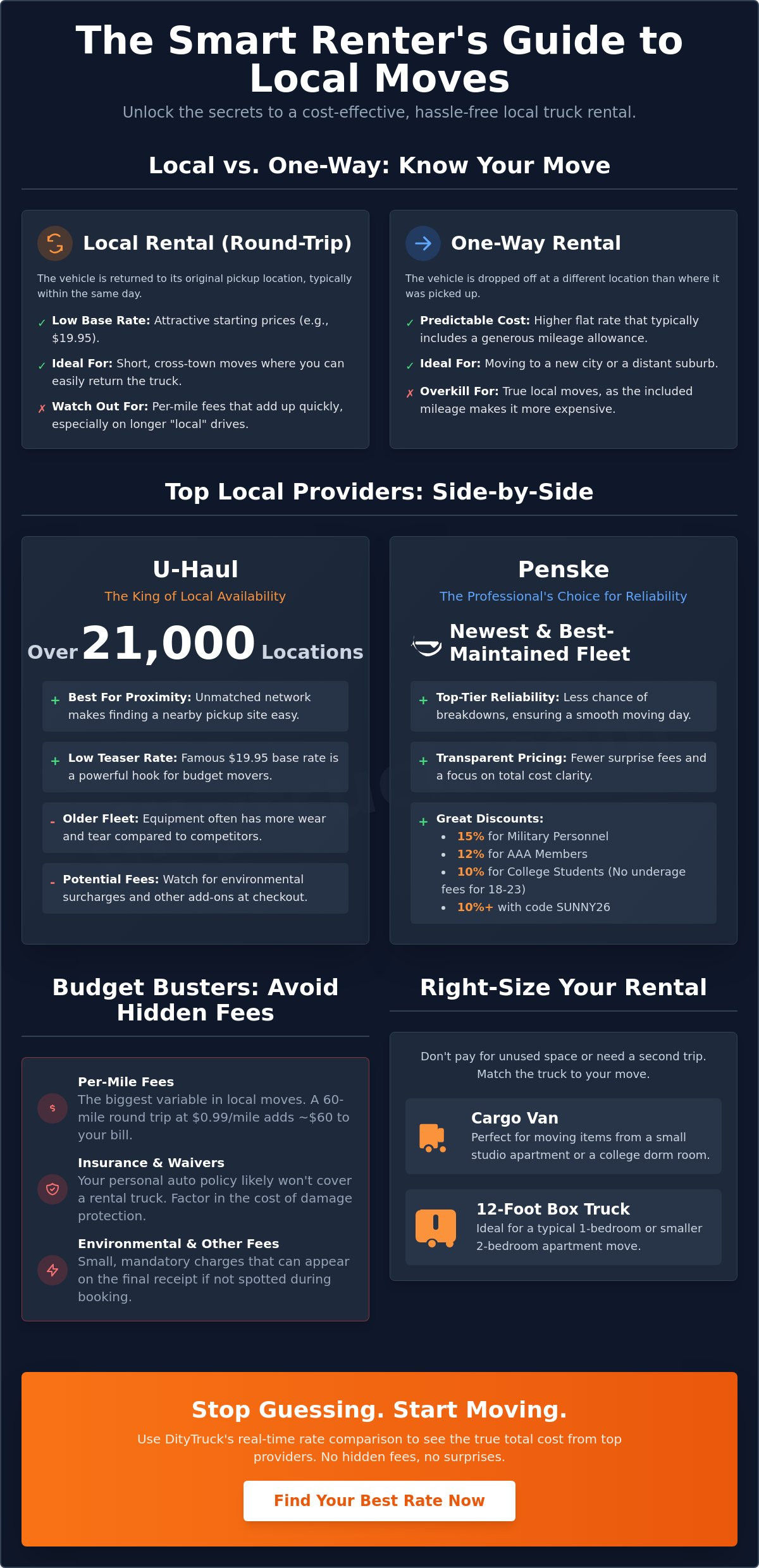
U-Haul dominates the market with a network of over 21,000 locations. This massive footprint makes them the easiest option for short, cross-town trips where you want to minimize travel to the pickup site. Their famous $19.95 base rate is a powerful hook for local movers. However, you must consider the trade-offs. U-Haul equipment often stays in the fleet longer than competitors, which can lead to a less refined driving experience. They do offer unique perks, such as one month of free storage at participating locations when you book a one-way rental. It’s essential to be proactive about avoiding hidden fees like environmental surcharges that appear at checkout. This provider is ideal for quick, high-volume moves where proximity is your top priority.
Penske and Budget: The Professional Alternatives
Penske operates over 2,500 rental locations and maintains a reputation for the newest, most reliable trucks in the industry. For June 2026, they’re offering 10% or more off rentals with code SUNNY26. They also provide specialized discounts, including 12% for AAA members and 15% for active duty or veteran military personnel. College students can save 10% and benefit from no underage surcharges for renters aged 18 to 23. This focus on transparent pricing and maintenance makes them a top choice for those who prioritize a friction-free day. To see how these discounts impact your total, you can compare real-time rates and availability across these national brands instantly.
Budget Truck Rental competes heavily on promotional value. Their current MID25 code offers up to 25% off local rentals from Sunday to Thursday. This makes them a strong contender for mid-week moves when demand is lower. Both Penske and Budget offer robust insurance packages that cover the vehicle and your belongings. These professional-grade options are often more comprehensive than the basic coverage found at smaller local shops.
Home Depot fills the gap for micro-moves with their Load ‘N Go service. Cargo vans and flatbeds start at $19 for the first 75 minutes, while box trucks begin at $29. These rentals include unlimited mileage. This fixed-cost approach is perfect for moving a single room or a new appliance without worrying about the odometer. You get a simple, utilitarian solution for tasks that don’t require a full-day commitment.
Selecting the Right Vehicle Size for Your Local Relocation
Choosing the wrong truck size is a common mistake that inflates your final bill. You don’t want to pay for empty air. You also can’t afford the time or cost of a second trip. The best local moving truck rental is the one that fits your entire inventory in a single pass. Most national providers categorize their fleets by room count to help you decide. However, your specific packing style and furniture bulk determine the actual space you need. Don’t just guess. Measure your largest items before you start the booking process.
- Cargo Vans: These are the best choice for “micro-moves.” Use them for dorm rooms, studio apartments with minimal furniture, or single-room relocations. They are easy to park and offer the best fuel economy.
- 10ft to 12ft Box Trucks: This is the “sweet spot” for 1-bedroom apartments. These vehicles provide enough height for mattresses and small couches while remaining easy to drive in city traffic.
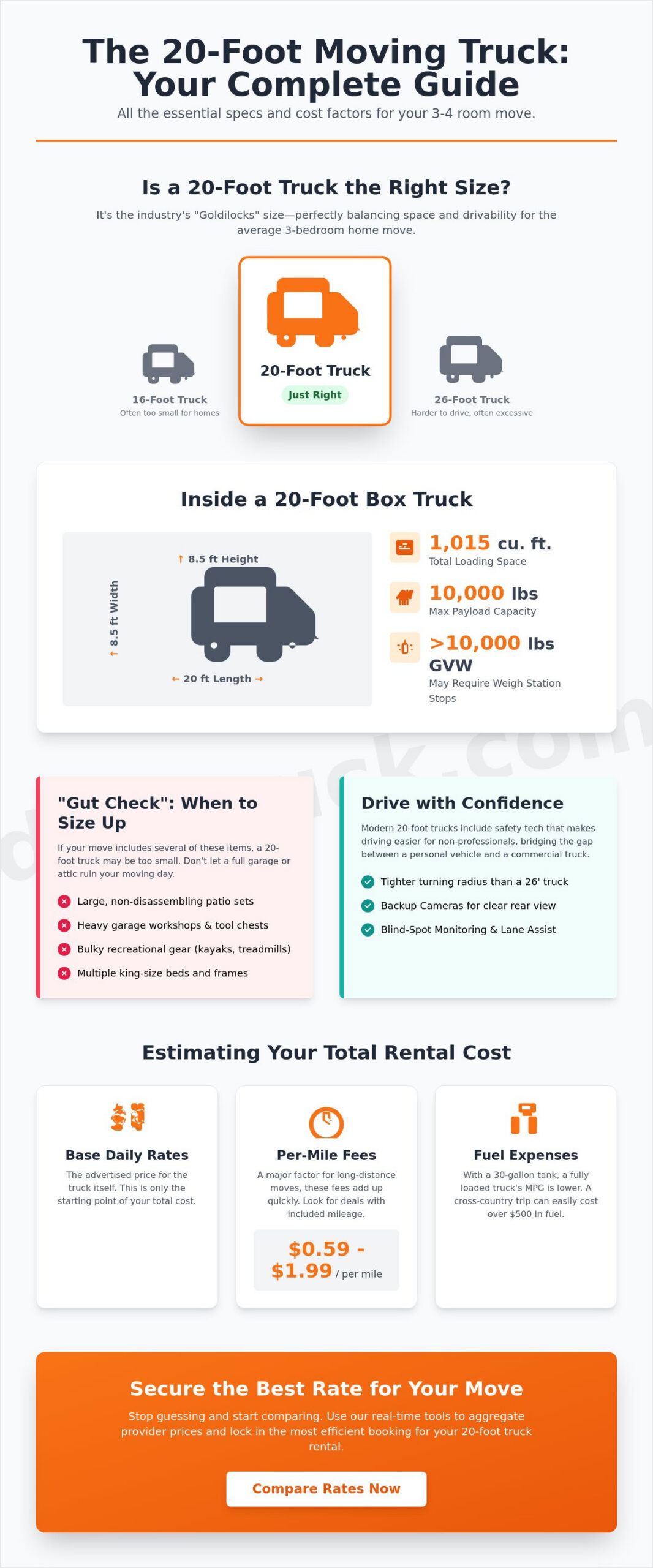
- 16ft to 22ft Trucks: You’ll need this mid-size range for 2-3 bedroom homes. These trucks often include specialized features like attic storage above the cab to maximize floor space.
- 26ft Trucks: This is the largest vehicle you can drive with a standard license. It’s designed for 4+ bedroom houses. These trucks are heavy and require wide turns, so plan your route carefully.
Why Size Accuracy Saves You Money
Efficiency is the primary driver of a low-cost move. If you rent a truck that’s too small, you’re forced into multiple trips. This doubles your mileage fees and fuel usage instantly. It also exhausts your moving help. Conversely, a truck that’s too large carries a higher base rate and consumes more gas per mile. You also face the risk of items shifting and breaking in an under-filled cargo area. Plan to use only 80% of the advertised space to allow for padding, odd-shaped furniture, and air gaps between boxes. This buffer ensures you don’t run out of room when you’re 90% finished with the load.
Standard Features to Look For
The best local moving truck rental should make the physical labor easier. Look for low-deck heights. These designs sit closer to the ground and reduce the angle of the loading ramp. This small detail saves significant energy when you’re moving heavy appliances. Always verify ramp availability for any truck 10ft or larger. Some budget-tier local rentals might exclude ramps to lower the price. Don’t skip this feature. Cabin comfort is another factor. If you have two friends helping, look for trucks with three-across seating. Bucket seats only accommodate two people, which might leave a member of your crew without a ride to the new house. Small details in the cab and the cargo hold make the difference between a stressful day and a smooth transition.
Navigating Local Rental Costs and Avoiding Hidden Fees
The advertised rate is just the starting line. Finding the best local moving truck rental requires looking at the bottom of the quote. Most local contracts rely on a base plus mileage model. This means a low daily rate can quickly balloon if your new home is more than a few miles away. You also need to account for environmental fees and local rental taxes. These are non-negotiable costs that providers often exclude from the big numbers on their trucks. Understanding these variables is the only way to get a transparent total cost estimate before you hand over your credit card.
The Math of Mileage
Mileage fees are the most volatile part of your quote. In 2026, these rates typically fluctuate based on the day of the week. Expect higher per-mile costs on Fridays and Saturdays when demand peaks. You hit a tipping point when your total mileage fees make a local rental more expensive than a flat-rate one-way option. To find this point, multiply your estimated round-trip distance by the per-mile rate and add it to the daily base. If that total exceeds a one-way quote for the same route, switch your booking type. Minimize odometer ticks by mapping your route before you leave the lot. Avoid unnecessary detours. Every mile counts toward your final bill.
Damage Protection: To Buy or Not to Buy?
The Damage Waiver is technically optional. It is also a smart investment. Your personal auto insurance likely excludes commercial box trucks. Credit card rental protections usually have similar gaps. A basic liability plan covers others. A physical damage waiver protects you from the cost of truck repairs. If you are moving a long distance, a one way truck rental comparison can show you how insurance rates differ between major providers. Choosing the right coverage replaces high-stakes uncertainty with peace of mind. It strips away the risk of a minor fender-bender turning into a multi-thousand-dollar expense.
Fuel policies also impact your final cost. Most companies use a full-to-full policy. You pick up the truck with a full tank and must return it the same way. Pre-paying for fuel is rarely a deal. You will likely pay a premium for the convenience. You also won’t get a refund for any gas left in the tank. Always keep your final gas receipt. It is your proof of compliance if a provider tries to charge a refueling fee later. For a faster experience, you can compare total costs across all major rental brands to see every fee upfront.
How DityTruck Simplifies Your Local Rental Search
Finding the best local moving truck rental shouldn’t feel like a part-time job. Most people waste hours opening multiple browser tabs and trying to compare inconsistent quotes. DityTruck acts as your smart assistant by performing the heavy lifting behind the scenes. Our platform aggregates real-time data from top national providers into a single, streamlined interface. You get a side-by-side view of availability and pricing without the traditional logistics headache. This transparency ensures you aren’t just seeing a teaser rate. You’re seeing the shortest path to a successful move.
We focus on financial honesty. Traditional rental sites often bury mileage fees and environmental surcharges deep in the checkout process. DityTruck strips away these complications. We present a clear estimate of the total cost upfront. You can filter options by specific truck sizes and pickup locations to find a vehicle that fits your inventory and your neighborhood. This methodical approach replaces uncertainty with confident simplicity. You know exactly what you’re paying for before you arrive at the rental counter. It’s about moving with clarity instead of crossing your fingers at the lot.
Compare and Book in Minutes
Efficiency is the core of our service. DityTruck eliminates the need to manually track discounts or verify equipment types across different brand websites. You can find the best moving truck rental based on user-verified data and current promotional codes. The process follows a logical progression. You compare rates, select your vehicle, and save money. This action-result flow gets you on the road faster. Our streamlined booking interface also improves reservation reliability. We connect you directly with the provider’s inventory to ensure the truck you see online is the truck waiting for you on moving day.
Your Next Steps for a Stress-Free Move
A successful move requires more than just a good price. It requires preparation. Before you head to the lot, double-check your driver’s license requirements. Most standard box trucks don’t require a special license, but you should verify this for the largest 26ft models. Ensure your credit card has enough available credit for the mandatory security hold. These holds vary by provider and are usually released after you return the vehicle. Timing is also critical. If you’re moving on a peak weekend, book your truck at least 7 to 10 days in advance. Early booking secures your preferred size and prevents last-minute price spikes. Ready to get started? You can compare local moving truck rates now and lock in your 2026 relocation plan today.
Take Control of Your 2026 Local Move
Securing the best local moving truck rental requires looking past the billboard prices. You’ve seen how total cost calculations, including mileage and environmental fees, determine your real budget. Accurate vehicle sizing prevents the exhaustion of multiple trips. It keeps your fuel costs low. Moving is a high-stakes task, but the logistics should be simple. You now have the tools to identify which provider offers the right balance of proximity and reliability for your specific neighborhood.
DityTruck acts as your smart assistant throughout this process. We offer real-time price comparisons and transparent fee breakdowns across major national brands. Our platform ensures national fleet availability is always visible. This strips away the stress of hidden charges. It replaces confusion with clarity. You can stop searching and start planning. Find and Compare the Best Local Moving Truck Rates Today. Your transition to a new home should be smooth and predictable. We’re here to make sure it is. Good luck with your move.
Frequently Asked Questions
What is the cheapest company for a local truck rental?
The cheapest provider depends on your total mileage and move duration. Home Depot offers flat rates with unlimited mileage for short windows; this makes them ideal for quick trips. U-Haul has a low daily base rate, but mileage fees can increase the total quickly. Budget Truck Rental is often the most affordable for mid-week moves when using promotional codes. Always calculate the full cost including fuel and fees to find the best local moving truck rental for your route.
Do I need a special license to drive a local rental truck?
You do not need a Commercial Driver’s License (CDL) for most local rental trucks. A standard, valid driver’s license is sufficient for vehicles under 26,000 pounds. This includes the largest 26ft trucks offered by national brands. Always check the specific age requirements of the provider. Most companies require you to be at least 21 years old. Some allow 18-year-old renters with additional fees or student status. This makes DIY moving accessible for almost any licensed driver.
How much does a local moving truck rental cost per mile?
Local mileage rates typically range between $0.69 and $1.50 per mile. These costs fluctuate based on the day of the week and local demand. High-demand periods like weekends often see higher per-mile charges. Some providers include unlimited mileage in their base hourly rate for specific vehicles. This makes them a predictable choice for short trips within a city. Always confirm the current rate at the time of booking to avoid surprises on your final receipt.
Can I rent a moving truck for just a few hours?
Yes, you can rent trucks for short windows. Home Depot’s Load ‘N Go program offers 75-minute rental blocks for cargo vans and box trucks. This is perfect for small moves or picking up large furniture. Most other national providers like Penske or U-Haul operate on 24-hour rental blocks. Even if you only use the truck for four hours, you will likely pay the full daily base rate. This is important to consider when planning your moving schedule.
Is it cheaper to rent a truck on a weekday or weekend?
Renting on a weekday is significantly cheaper than a weekend booking. Demand peaks on Fridays and Saturdays. This drives up base rates and mileage fees. Budget Truck Rental offers discounts of up to 25% for moves scheduled between Sunday and Thursday. If your schedule allows, a mid-week move provides better vehicle availability and lower total costs. This is a simple way to secure the best local moving truck rental without sacrificing service quality or truck size.
What happens if I return my local rental truck late?
Late returns usually result in an additional full day’s rental fee. Most companies do not offer a grace period. If you are even an hour late, you may be charged for a second 24-hour block plus insurance and taxes. Some providers may also charge a specific late fee if the truck was reserved for another customer. Always call the rental office if you encounter a delay. This communication can sometimes help you avoid the most expensive penalties.
Does my credit card provide insurance for a moving truck rental?
Most personal credit cards exclude cargo trucks and large box trucks from their rental insurance benefits. These policies are typically designed for passenger cars only. Your personal auto insurance policy may also have similar exclusions for commercial-sized vehicles. It is safer to purchase a physical damage waiver directly from the rental company. This ensures you are not personally liable for expensive repairs if an accident occurs. Always check your specific card’s fine print before declining coverage.
How do I know what size truck I need for a 2-bedroom apartment?
A 16ft to 22ft box truck is the standard recommendation for a 2-bedroom apartment. This size provides enough cubic footage for large furniture, appliances, and roughly 100 boxes. If you have a significant amount of bulky items, consider the 22ft option. Utilizing a slightly larger truck allows for better packing efficiency. It also prevents the need for a second trip. This is a critical factor in keeping your total mileage costs under control. For moves that span multiple states, reviewing a detailed one way truck rental comparison checklist for long-distance moves can help you choose the right vehicle size and contract type for the full journey.