That 16 foot truck looks like plenty of space until you are standing on the sidewalk with a sectional sofa and no room left to load it. The biggest mistake isn’t just picking a truck that is too small. It is often paying for a massive 26 foot rig when a smaller model would have done the job for a fraction of the cost. You want efficiency, not a bill for hauling empty air across state lines.
It’s natural to feel anxious about the math. You’re likely staring at your furniture and wondering “what size moving truck do i need” to avoid the dreaded two-trip nightmare. Nobody wants to be the person frantically calling rental agencies at 6:00 AM because the mattress doesn’t fit. We are here to strip away that complexity and replace it with a simple, data-driven plan.
This guide helps you master truck sizing to secure the best rental rate today. We will provide clear recommendations based on your room count and explain the cubic foot capacity of the latest 2026 fleets from U-Haul, Budget, and Penske. You’ll gain the confidence to book the perfect fit and keep your move on schedule.
Key Takeaways
- Avoid the “two-trip” nightmare by calculating your exact space needs before you book. This prevents doubled fuel costs and expensive mileage fees.
- Learn how to answer “what size moving truck do i need” by applying the industry standard of 150 to 200 cubic feet per room.
- Understand the critical differences between major brands. A 16 foot truck often has different internal dimensions depending on whether you choose Penske, Budget, or U-Haul.
- Identify “space vampires” like king mattresses and sectionals. These bulky items often dictate your truck size more than the total number of rooms.
- Use DityTruck to compare real-time rates from national providers in one place. Secure the lowest price for your specific size without the stress of manual searching.
Why Choosing the Right Moving Truck Size Is Your Biggest Cost Saver
Moving is expensive. Paying twice for the same move is worse. When you start planning, the question what size moving truck do i need is usually about fit. However, it should be about your budget. Choosing the wrong size creates a ripple effect of costs that can ruin your moving day. Sizing isn’t just a logistical detail; it is a financial strategy.
Underestimating your needs leads to the “Two-Trip” Trap. If you rent a 10 foot truck for a one bedroom apartment and it only holds 70% of your furniture, you are stuck. You’ll drive back to the old house, reload, and drive to the new one again. This doubles your fuel consumption. It also doubles your mileage fees, which often exceed the cost of the larger truck you should have rented initially. DityTruck helps you avoid this by letting you compare the prices of larger models instantly.
The “Empty Space” Tax is just as punishing. Renting a 26 foot truck for a studio apartment means you are paying for massive cubic footage you don’t use. You will also spend more on gas because heavy box trucks have poor fuel economy. DityTruck streamlines the transition from sizing to saving. Once you identify your required size, our platform aggregates real-time rates from major providers like Penske and Budget so you don’t overpay for unused capacity.
The Hidden Costs of Sizing Mistakes
The math of a second trip is brutal. Most rental companies charge a base day rate plus a fee for every mile driven. If your new home is 50 miles away, a second trip adds 100 miles to your bill. At 2026 average rates, mileage fees can range from $0.79 to $1.29 per mile. That is a significant expense just for one mistake in calculation.
- Late Return Penalties: If a one day move turns into two because of extra trips, you’ll likely face a second day of rental fees and insurance costs.
- Stress and Fatigue: Moving is physically demanding. Doubling the loading and unloading process leads to exhaustion and a higher risk of damaging your belongings.
- Fuel Efficiency: Larger trucks consume more fuel. If you don’t need the space, you are essentially throwing money out of the tailpipe.
Maneuverability vs. Capacity
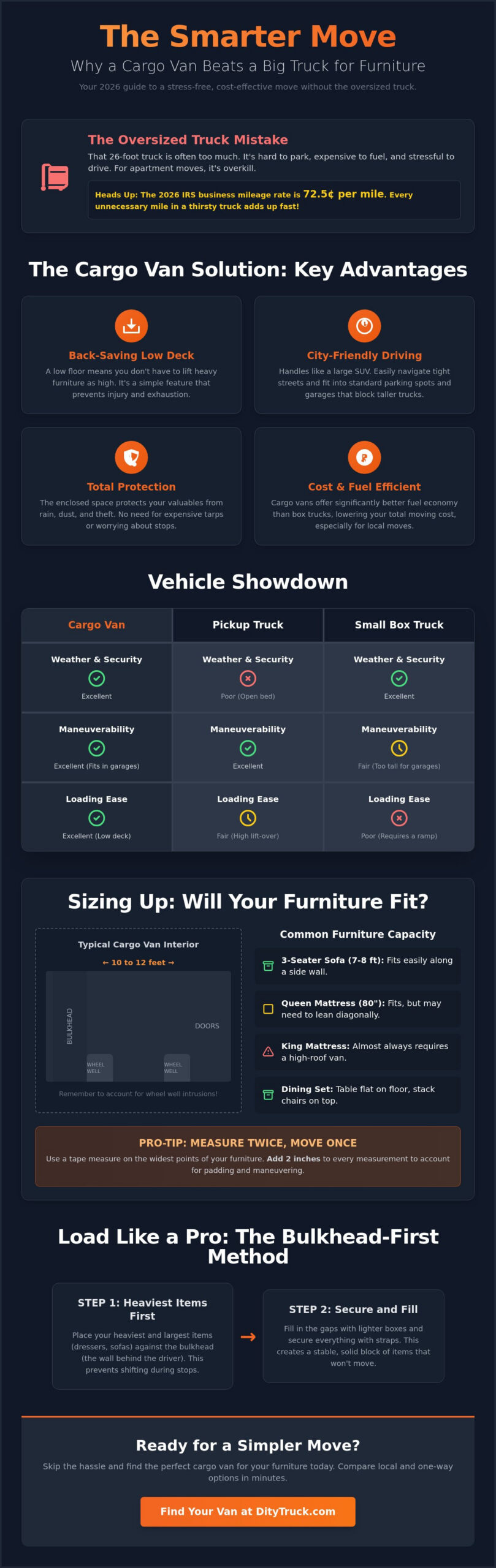
Size isn’t just about volume; it’s about your comfort behind the wheel. A 26 foot truck is nearly the size of a commercial bus. It requires wide turns, significant braking distance, and careful navigation through residential streets. If you aren’t comfortable driving a vehicle that large, you might prefer a slightly smaller truck even if it means packing more tightly. This is where knowing exactly what size moving truck do i need helps you balance capacity with safety.
Cargo vans and 10 foot trucks are the secret weapons for urban moves. They fit into standard parking spaces and handle more like a standard SUV. Balancing the need for space with your ability to park at your new apartment is key to a low-stress move. DityTruck lets you filter by these specific sizes so you can find the exact vehicle that fits your belongings and your driving skills.
The Universal Room-to-Truck Size Guide: From Studios to Large Homes
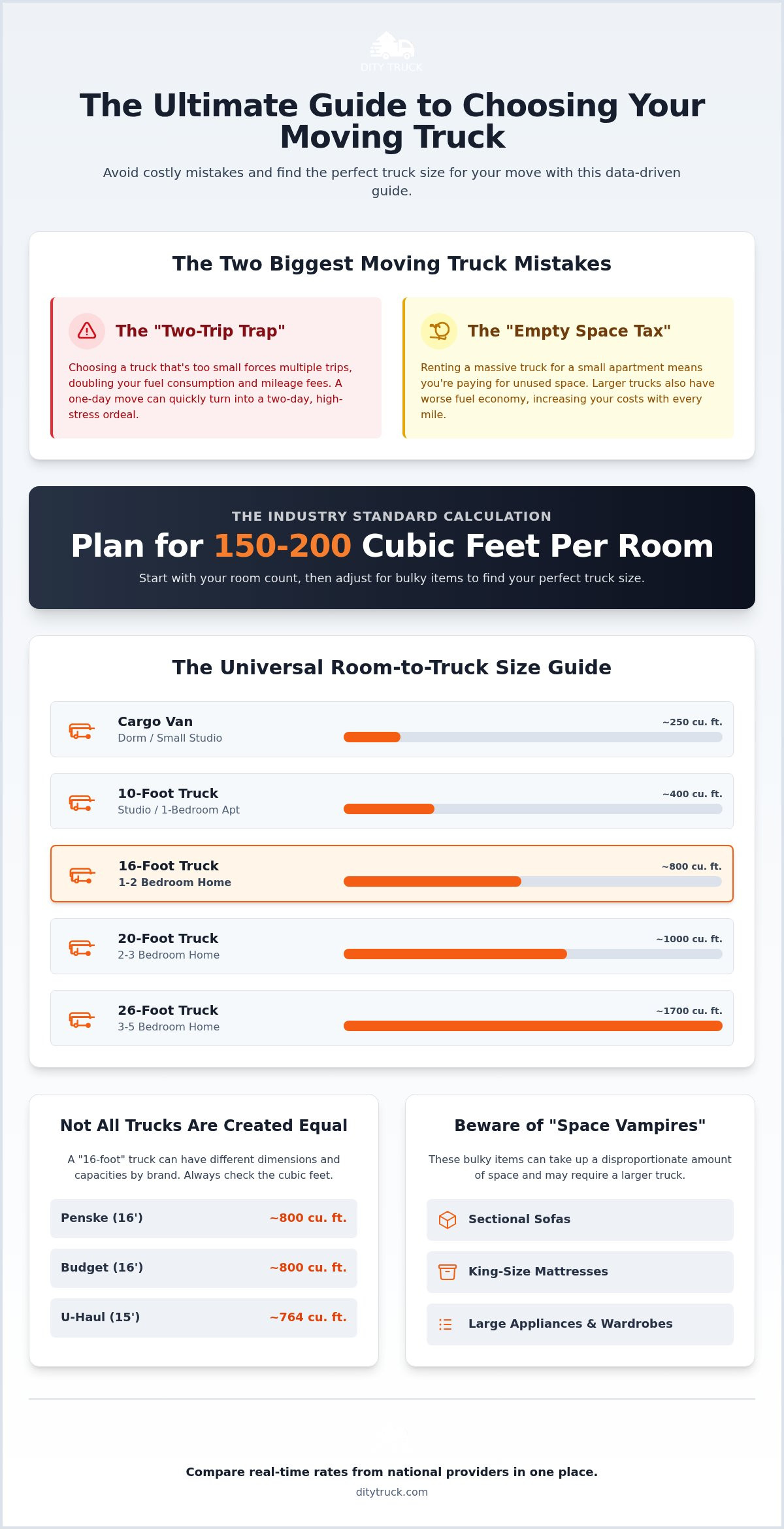
Sizing isn’t a guessing game. The industry follows a standard rule of 150 to 200 cubic feet of space for every room of furniture. This simple calculation helps you determine what size moving truck do i need without the stress of trial and error. A studio usually requires 300 to 500 cubic feet. A large four bedroom home can easily exceed 1,600 cubic feet. Start with your room count and then adjust for the density of your belongings.
Small Moves: Cargo Vans and 10-Foot Trucks
Cargo vans are the go-to for dorm rooms or small studio apartments with no large furniture. They typically offer about 250 cubic feet of space. They are perfect for local deliveries or moving out of a furnished room. If you have a mattress or a couch, move up to a 10 foot truck. This is the smallest vehicle with a standard cargo box. The square shape allows for efficient stacking. However, remember that most 10 foot trucks do not include loading ramps. You’ll need extra muscle to lift heavy items into the bed.
Medium Moves: 15 to 20-Foot Box Trucks
The 16 foot truck is the most popular rental in the U.S. market. It serves as the “sweet spot” for 1 to 2 bedroom apartments. It provides enough length for a standard sofa while leaving room for bedroom sets and dozens of boxes. If you are moving a 2 bedroom home, those extra five feet found in a 20 foot model prevent the need for a second trip. Longer distances often require the heavier chassis found in these mid-sized trucks for better road stability. Budget and Penske often have different sweet spots for pricing on these 16 foot models. You can compare real-time rates across major providers to see which brand offers the most value for these popular sizes.
Large Moves: 22 to 26-Foot Heavy Duty Trucks
A 26 foot truck is the largest vehicle you can legally drive with a standard driver’s license. It is a heavy duty machine designed for 3 to 4 bedroom houses. To fit everything, you must master the art of stacking to the ceiling. This means placing heavy furniture on the floor and filling every gap with smaller boxes. It is the only way to utilize the full 1,600 cubic feet of capacity. Be mindful of the Gross Vehicle Weight Rating (GVWR). A fully loaded 26 foot truck can weigh over 20,000 pounds. Staying within these limits ensures your brakes and suspension function correctly during the drive. Knowing what size moving truck do i need for a large home keeps your belongings safe and your legal liability low.
Comparing Truck Sizes Across Major Rental Brands: U-Haul, Budget, and Penske
A “15 foot” truck label is often just a marketing estimate. Real capacity varies wildly between brands. When you ask what size moving truck do i need, you are looking for usable space, not just the length of the exterior box. One brand might measure from the front bumper to the rear door. Another might only count the interior floor. These differences can leave you with a pile of boxes on the curb if you don’t look at the specific cubic footage.
Brand specific features also change how you pack. U-Haul trucks often feature “Mom’s Attic.” This is a specialized compartment that extends over the cab of the truck. It is perfect for fragile items or electronics that shouldn’t be crushed. Penske and Budget typically offer flat floors. Without the overhead compartment, you have a taller, more uniform space for stacking large furniture items like wardrobes or refrigerators. DityTruck lets you compare these fleet differences side by side. You can see which brand offers the specific layout that fits your inventory.
The Battle of the “Mid-Size” Truck
The mid-size category is the most competitive space in the industry. The Penske 16 foot truck and the Budget 16 foot model are direct rivals. They both offer a wide, high clearance box that is easy to stack. U-Haul counters with a 15 foot model that sits lower to the ground for easier loading. While the U-Haul is shorter on the outside, its “Mom’s Attic” can sometimes make it feel more spacious for certain loads. Cubic footage is the only reliable metric for comparison. Always check the total volume before you sign a rental agreement.
Loading Ramps and Deck Heights
Your back will feel the difference between truck brands before your wallet does. U-Haul designs its trucks with a “Low Deck.” This puts the floor of the truck closer to the pavement. It makes walking up the loading ramp much easier. Penske and Budget trucks often have higher decks. These require more ground clearance, which is great for driving on uneven terrain, but it makes the ramp steeper.
- The Ramp Rule: Most trucks 15 feet and larger include a pull out loading ramp. Smaller 10 foot models usually do not.
- Ramp Width: Penske ramps are known for being wide and sturdy. This is essential if you are using a heavy duty appliance dolly.
- Clearance: High clearance trucks from Budget and Penske are less likely to scrape on steep driveways.
Choosing the right brand depends on your physical comfort and your specific furniture. If you have heavy appliances, a wider ramp is a priority. If you are moving solo, a low deck height is a lifesaver. Use DityTruck to filter by these specific needs and find the best 2026 rates for the brand that fits your move. This ensures you get the right answer to what size moving truck do i need while keeping your costs transparent.
Beyond Room Counts: Factoring in Bulky Items and High-Volume Belongings
Room counts are a helpful baseline. They aren’t the final answer. One oversized item can instantly invalidate a standard sizing chart. If you’re asking what size moving truck do i need, start by looking at your “space vampires.” These are the bulky, non-stackable items that drain your cubic footage faster than you expect. A single king-sized bed or a deep-seated sectional can force you into a larger truck class regardless of how many rooms you have.
The King Mattress is a primary offender. It requires a significant amount of vertical or horizontal wall space. It cannot be folded. It cannot be compressed. If you have a California King, you often need to jump from a 10 foot truck to a 15 foot model just to accommodate the length. Sectionals are similarly difficult. They are often deep and L-shaped. They create “dead space,” which are pockets of air that you can’t fill with boxes because the furniture’s shape is irregular. Professional loaders can minimize these gaps, but most DIY movers cannot.
Always apply the 10% Buffer Rule. If your calculations suggest you need 1,000 cubic feet, rent a truck with at least 1,100. You will lose space between the tops of boxes and the ceiling. You will lose space around the wheel wells. This buffer prevents the “curbside crisis” where the last three boxes simply won’t fit. Before you commit to a size, compare real-time availability for trucks with that extra 10% margin to ensure a single-trip move.
Measuring Your Largest Items
Measure your sectional at its widest and deepest points. Don’t just trust the manufacturer’s specs. Account for the feet and the cushions. When loading, use the “First In, Last Out” rule for large appliances. Place heavy refrigerators and washers against the front wall of the truck. This keeps the weight balanced over the axles. Maximize vertical inches by nesting tables and stacking chairs upside down on top of each other. This turns air into usable storage.
The “Reddit” Advice: Real-World Packing Realities
Experienced movers know that box count is often more accurate than room count. A minimalist one bedroom and a collector’s one bedroom are two different projects. If you have more than 40 boxes for a single room, you’ve already outgrown the standard sizing guides. You should also consider the weight of your cargo. Every truck has a maximum payload capacity. Weight limits matter as much as space on long-distance moves because an overloaded truck is dangerous and consumes significantly more fuel.
- Payload vs. Volume: A truck can be half-empty but over its weight limit if you are moving books or tools.
- Stacking height: High-volume moves require stacking to the ceiling. Ensure you have enough moving blankets to protect the bottom layers.
- The “Walk-Through” check: Open every closet. Storage areas often hold 20% more items than the main living spaces.
Getting the right answer to what size moving truck do i need requires looking past the number of doors in your home. It requires a realistic look at your bulkiest possessions and your total box count. Once you have that number, DityTruck makes it easy to find the provider with the best price for that specific capacity.
How to Compare Rates and Book the Perfect Size with DityTruck
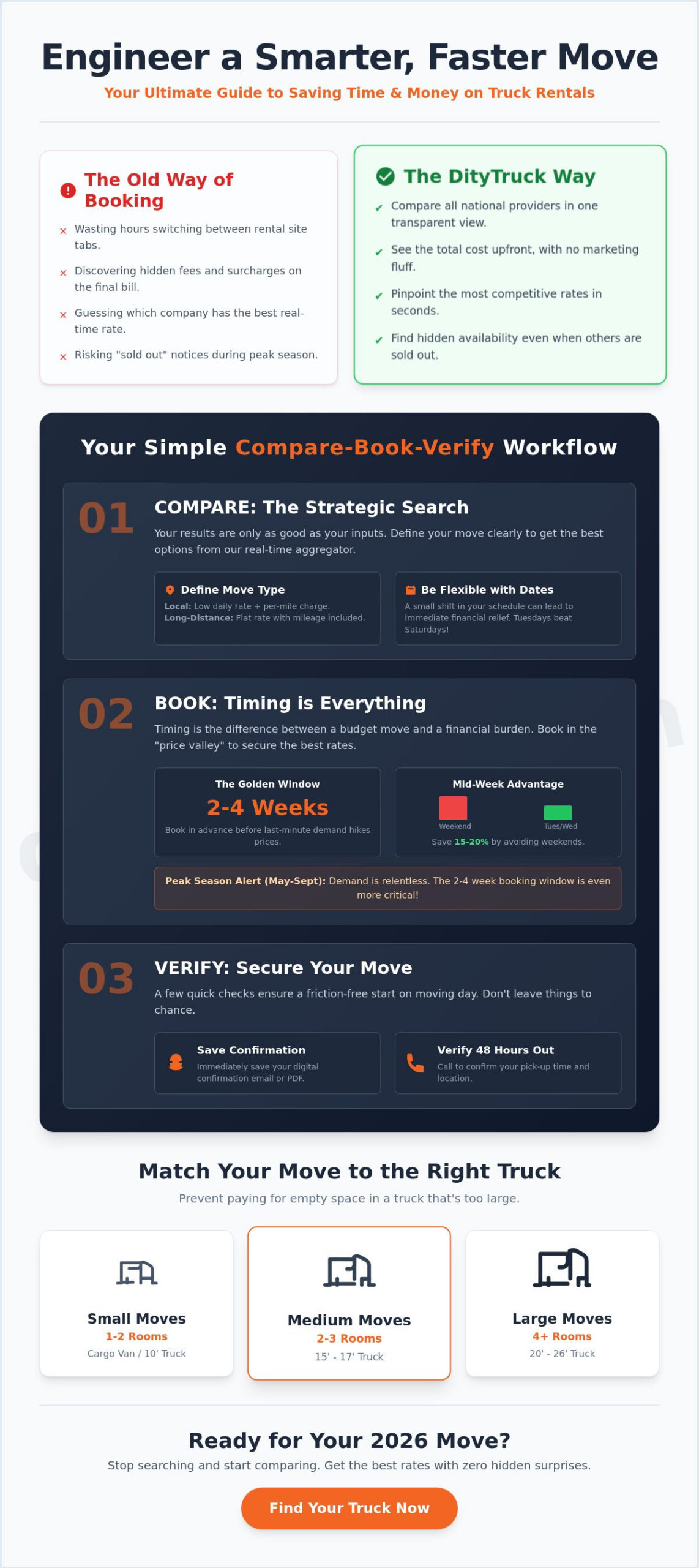
You’ve mastered the math. You’ve identified your “space vampires” and calculated your cubic footage. The hard part of planning is over. Now, you just need to find the vehicle at the right price. Most people waste hours visiting five different websites to compare Penske, Budget, and U-Haul. DityTruck strips away that complexity. We aggregate real-time data from major national providers into one simple interface. You can filter by truck size and price simultaneously to find the exact match for your inventory.
Transparency is our priority. We focus on financial honesty and stripping away the stress of hidden fees. When you search, you see the actual rates available in your area. Our platform acts as a smart assistant. It performs the heavy lifting by scanning dozens of options while you focus on packing. This no-nonsense approach to logistics ensures you find the shortest path to a successful move. Now that you’ve answered the question what size moving truck do i need, you can secure your reservation in minutes.
Finding the “Sweet Spot” in Your Area
Market demand changes daily. One brand might be significantly cheaper for a 16 foot truck in your city, while another wins on the 26 foot model. DityTruck shows you these “sweet spots” instantly. You also get the benefit of real-time availability. There is no point in sizing a move for a 22 foot truck if there isn’t one on the lot. You can Compare Moving Truck Rental Rates in One Simple Step using our comprehensive 2026 comparison and booking guide.
The Final Checklist Before You Click “Book”
Before you finalize your reservation, double check your logistics. Verify your pick up and drop off dates. Accuracy here prevents late fees and ensures the truck is ready when you are. Estimate your mileage generously. It’s better to over-budget for fuel and miles than to be surprised by the final bill at the drop-off location. You should also decide between One Way Truck Rentals for Moving or a local return. One-way rentals are often more expensive, but they save hours of driving time on long distance relocations.
Once your details are set, you’re ready to lock in your rate. Don’t let your preferred size disappear during peak moving season. Knowing what size moving truck do i need is only half the battle. The other half is securing it before someone else does. Find your perfect truck size on DityTruck now and take the final step toward a friction-free move.
Secure Your Move With the Perfect Fit
Sizing your move correctly is the difference between a smooth transition and a budget-draining disaster. You’ve learned how to account for bulky sectionals and why cubic volume is the only metric that truly matters. By looking beyond simple room counts and factoring in a 10% buffer, you’ve already saved yourself from the stress of a second trip. This level of preparation ensures your furniture stays off the curb and your budget stays intact.
Now you have the answer to what size moving truck do i need. The final step is finding that specific capacity at the lowest possible rate. Our platform provides national coverage across the United States. It allows you to compare Penske, Budget, and other major providers side-by-side. You get honest pricing with no hidden fees. It is the shortest, most logical path to a successful moving day.
Ready to finish the job? Compare Real-Time Rates for Every Truck Size on DityTruck and lock in your reservation today. You have the plan. You have the data. It’s time to get moving with total confidence.
Frequently Asked Questions
How do I know if I need a 10ft or 15ft moving truck?
Choose a 10 foot truck for studio apartments or dorm rooms with no large sofas. Upgrade to a 15 foot model if you have a full bedroom set and a living room. The 15 foot truck offers significantly more vertical height for stacking boxes and usually includes a loading ramp. Choosing between these models is a common hurdle when deciding what size moving truck do i need for your specific inventory.
Is it better to get a moving truck that is too big or too small?
Renting a truck that is slightly too big is the smarter financial move. You avoid the “two-trip” nightmare that doubles your fuel and mileage expenses. Paying for a bit of empty space is always cheaper than the late fees and exhaustion caused by a truck that cannot hold all your belongings in one go.
Can a king-size bed fit in a 10-foot moving truck?
A king-size bed fits in most 10 foot trucks, but it requires precise loading. You must stand the mattress on its side against the long wall of the cargo area. This configuration leaves very little floor space for other large furniture like dressers or desks. If you have a full household of furniture plus a king bed, move up to a 15 foot truck.
What is the most popular size for a 2-bedroom apartment move?
The 16 foot truck is the industry standard for a 2 bedroom apartment move. It provides the necessary length for a standard sofa while leaving room for roughly 60 to 80 boxes. Determining what size moving truck do i need for a 2 bedroom home usually leads to this mid-size sweet spot because it balances capacity with easy city driving.
Do I need a special license to drive a 26-foot rental truck?
You don’t need a Commercial Driver’s License (CDL) to drive a 26 foot rental truck for personal use. A standard driver’s license is sufficient for all major rental brands like U-Haul, Budget, and Penske. Just keep in mind that these vehicles have a much larger turning radius and require more braking distance than a standard SUV.
How much extra space should I leave in the truck for “dead space”?
You should leave a 10% buffer for “dead space” in your rental truck. This accounts for the unavoidable gaps between irregular items and the ceiling. If your inventory measures 1,000 cubic feet, rent a truck with at least 1,100 cubic feet of capacity to ensure a single-trip move without the stress of perfect Tetris-style packing.
What happens if I rent a truck that is too small for my furniture?
Renting a truck that is too small triggers a cascade of extra costs and logistical stress. You will likely spend twice as much on fuel and mileage fees for a second trip. You also risk physical exhaustion and late return penalties if the moving process takes twice as long as you originally planned.
Are loading ramps included with all moving truck sizes?
Loading ramps are typically included on trucks 15 feet and larger. Cargo vans and 10 foot trucks usually don’t have them because their deck height is lower to the ground. You will need to lift heavy items manually or rent a separate portable ramp if you choose a smaller vehicle for your move.