
Tag: Rental Requirements

  • License Requirements for Renting a Moving Truck: The 2026 Essential Guide

    License Requirements for Renting a Moving Truck: The 2026 Essential Guide

    What if the biggest obstacle to your DIY move isn’t the heavy lifting, but a single piece of plastic you already carry in your wallet? Many people assume they need a special commercial license to drive a large 26-foot vehicle. It’s a common fear. Nobody wants to face rejection at the rental counter after weeks of packing. You’re likely worried about confusing CDL laws or hidden young renter fees that could blow your budget at the last minute.

    It’s completely normal to feel uncertain about the license requirements for renting a moving truck. This 2026 guide is here to clear the air and provide the peace of mind you need. You’ll learn exactly which documents are mandatory, how to handle international permits, and which age limits apply to different rental companies. We’ll also confirm that your standard driver’s license is sufficient for almost every consumer truck on the road. We are stripping away the complexity so you can focus on the journey. Here is your checklist for a friction-free rental experience.

    Key Takeaways

    • Confirm standard license validity for trucks up to 26,000 pounds. Most DIY moves don’t require a commercial license.
    • Master the license requirements for renting a moving truck to avoid counter delays. Learn why physical, non-expired IDs are mandatory.
    • Identify age-based fees and specific restrictions for younger drivers. Some providers increase age minimums for larger vehicles or long-distance routes.
    • Verify insurance and payment options before booking. Using a credit card often removes the need for high security deposits.
    • Use DityTruck to compare provider requirements side-by-side. View all-in pricing, including young renter surcharges, in seconds.

    Do You Need a Commercial Driver’s License (CDL) for a Moving Truck?

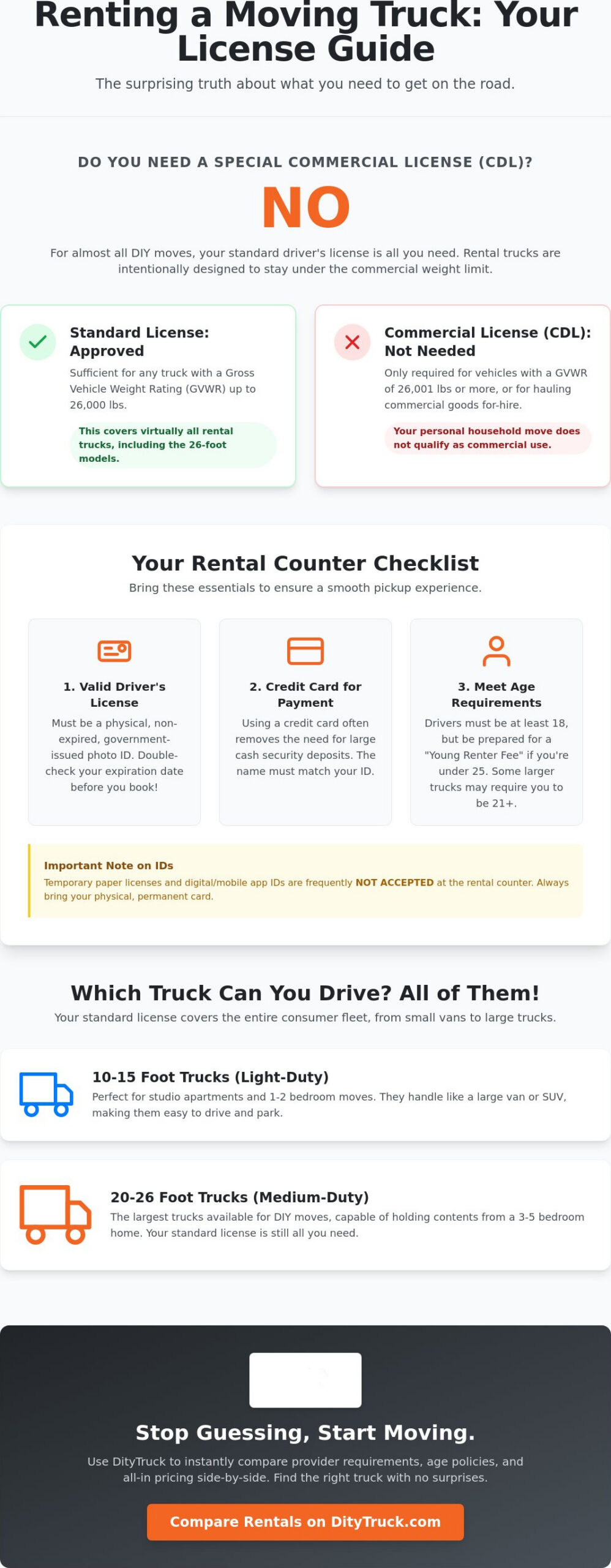
    You don’t need a Commercial Driver’s License (CDL) to handle your own DIY move. This is the most common concern for people planning a large relocation. For 99% of household moves, a standard Class D driver’s license is perfectly sufficient. Rental companies specifically build and rate their fleets to bypass these professional requirements. It makes the process faster and more accessible for everyone.

    Standard trucks ranging from 10-foot vans to 26-foot giants fall into the non-commercial category. This classification is intentional. It ensures that any licensed driver can operate the vehicle without specialized training. Understanding the license requirements for renting a moving truck starts with knowing how these vehicles are categorized by the law. Most people are surprised to learn that even the largest truck on the lot doesn’t require a special permit.

    Understanding GVWR and Rental Truck Classes

    GVWR stands for Gross Vehicle Weight Rating. It represents the maximum weight of the truck plus its full cargo load. Federal regulations state that a CDL is only mandatory if the GVWR is 26,001 pounds or more. Moving companies stay just under this limit. Most 26-foot moving trucks are rated at exactly 26,000 pounds. This is a strategic design choice. It allows you to maximize your packing space without facing commercial legal hurdles. You can usually find this rating on a sticker inside the driver’s side door or on your rental contract.

    • 10-15 Foot Trucks: These are light-duty vehicles. They handle like a large SUV or van.
    • 20-26 Foot Trucks: These are medium-duty vehicles. They are the largest trucks you can drive with a standard license.
    • Towing Equipment: Adding a car trailer or tow dolly typically does not change your license requirements.

    Personal vs. Commercial Use Restrictions

    The rules for your license depend heavily on what you are carrying. These simplified license requirements for renting a moving truck only apply to “household goods.” This means your personal furniture, clothing, and appliances. If you use the truck for business profit or “for-hire” transport, the legal landscape shifts. Commercial hauling often requires a CDL regardless of the truck’s size. It also involves different insurance liabilities and stricter roadside inspections.

    You might notice Department of Transportation (DOT) numbers on the side of your rental. These numbers help authorities track the safety record of the rental company’s fleet. As a DIY mover, you don’t need to worry about logging your driving hours or stopping at every highway weigh station. You are a private citizen moving personal property. As long as you aren’t hauling for a business, you can drive past those scales with confidence. It is a simple distinction that keeps your move moving forward.

    Essential Documentation: What to Bring to the Rental Counter

    You have confirmed you don’t need a CDL. Now you must prove you are a safe, legal driver. The license requirements for renting a moving truck are firm regarding expiration dates. If your license expires even one day before your rental ends, you’ll be rejected. Check your card today. A valid, government-issued photo ID is the non-negotiable baseline for every provider in the country. It’s the first thing the agent will ask to see.

    Consistency is your best friend at the rental counter. The name on your credit card must match the name on your driver’s license. It must also match the name on your booking. Discrepancies often trigger fraud alerts. If you recently renewed your license, be cautious. Many providers reject temporary paper documents. These papers lack the holograms and security strips found on permanent cards. Understanding the license requirements for renting a moving truck helps you avoid these last-minute headaches. Call your local branch ahead of time if you don’t have your hard copy yet.

    Liability drives these strict rules. Even though your truck is not a heavy hauler, rental agents treat verification with high stakes. They are often guided by the federal definition of a Commercial Motor Vehicle to ensure they aren’t handing keys to unqualified operators. This rigorous checking protects you and the company. You can compare rental options easily once you have your paperwork organized and ready to scan.

    Digital vs. Physical License Requirements

    Digital IDs are convenient but risky for rentals. Some states offer mobile license apps, but many rental desks aren’t equipped to scan them. Always bring your physical plastic card. If you use a 24/7 mobile pickup service, the app will require a clear photo of the physical ID. A screenshot of a digital app won’t pass the verification algorithm. Keep the plastic card handy to avoid a lockout at the lot.

    Secondary ID and Proof of Residency

    Agents often require a second form of identification. This is a standard backup for high-value assets like a 26-foot truck. A passport, military ID, or state-issued ID card are the best choices. If you are paying with a debit card, expect more scrutiny. You might need to show a utility bill or a signed lease agreement to prove your current address. Military personnel can use their military ID as secondary proof, but a valid civilian driver’s license remains the primary requirement for operation.
    License Requirements for Renting a Moving Truck: The 2026 Essential Guide

    Age Limits and Surcharge Policies for 2026 Moving

    Age is more than just a number at the rental counter. It’s a risk factor. While your license might be legally valid, rental companies often set their own internal age floors. Most major providers allow 18-year-olds to rent for local moves. However, the license requirements for renting a moving truck can shift once you cross state lines or request the largest vehicle in the fleet. For 26-foot trucks or one-way moves, some locations may require you to be 21 or even 24 years old. This isn’t a legal mandate. It’s a corporate policy designed to lower insurance liabilities.

    Companies often restrict younger drivers to specific vehicle classes. You might be eligible for a cargo van or a 10-foot truck, but barred from the heavy-duty 26-foot models. These restrictions are usually based on historical safety data. If you’re under 25, you’ll likely face the “Young Renter Fee.” This is a daily surcharge that covers the increased insurance risk associated with younger drivers. Understanding these license requirements for renting a moving truck before you arrive prevents budget-breaking surprises at the desk.

    The 18-21-24 Age Bracket Breakdown

    U-Haul is widely known for its accessibility. They maintain a minimum age of 18 for all truck rentals. Other providers like Budget and Penske also allow 18-year-olds but apply more frequent surcharges. The requirements often change based on the truck’s size. A small van might be available to an 18-year-old, while a 26-foot truck is reserved for those 21 and older. If you plan to have multiple people behind the wheel, every driver must meet the age requirement. Each additional driver must also present their license and pay any applicable age-related fees. There are no shortcuts here. The person holding the keys must be the person on the contract.

    Managing Young Renter Surcharges

    The cost of being a young driver adds up quickly. For example, Budget typically charges an additional $27.00 per day for renters aged 21-24. For those aged 18-23, the fee is often $25.00 per day. These fees are non-negotiable. One effective way to avoid this cost is to have an older individual act as the primary renter and driver. If they are the only one operating the vehicle, the surcharge disappears. You can use a moving truck rental comparison tool to see which companies offer the lowest young renter fees in your specific area. This transparency allows you to pick the provider that respects your budget and your age.

    Insurance, Payment, and International Requirements

    Securing the right truck is only half the battle. You also need to protect it and pay for it. The license requirements for renting a moving truck often extend into your financial profile. Rental agents will verify your ability to cover potential damages before they hand over the keys. Most people assume their everyday car insurance has them covered. This is a risky assumption that can lead to massive out of pocket costs. You need to know exactly where your personal coverage ends and where rental protection begins.

    Payment methods also dictate your experience at the counter. Credit cards are the industry gold standard. They allow for a simple “hold” on your funds. This hold is usually the estimated rental total plus a small buffer. If you use a debit card, the process is more invasive. Companies often “charge” the full amount plus a security deposit of $100 to $300 immediately. This can tie up your moving budget for days or even weeks. Having a clear payment strategy ensures a friction-free pickup.

    International movers face additional hurdles. If your license isn’t from the U.S. or Canada, preparation is vital. You don’t want to be stranded because of a translation issue. Verifying the license requirements for renting a moving truck for foreign nationals involves checking both your domestic license and your passport. It is about proving your identity and your legal right to drive a vehicle of that size. You can compare real-time rental rates and requirements to see which providers are most friendly to your specific situation.

    Does Your Personal Insurance Cover a Moving Truck?

    Most standard auto policies exclude vehicles with a GVWR over 10,000 pounds. A typical 26-foot moving truck weighs significantly more. Even credit card “rental insurance” perks usually exclude box trucks and cargo vans. You’ll likely need to purchase a Damage Waiver (CDW) or Supplemental Liability. As of June 2026, these plans typically cost between $14 and $50 per day. It is a small price for total peace of mind during a high-stakes move.

    International Driver Standards in the US

    Licenses from Canada and Mexico are generally accepted without extra paperwork. If your license is from another country and is not in English, you must obtain an International Driving Permit (IDP). This is a legal translation of your home license. You must present the IDP alongside your original license and a valid passport. Rental agents will not accept an IDP on its own. It is a secondary document that validates your primary license. This ensures you meet all legal standards for operation on U.S. roads.

    Comparing Provider Requirements with DityTruck

    Moving is a high-stakes task with enough variables to cause anyone stress. You shouldn’t have to hunt through fine print on five different websites just to see who will accept your license. DityTruck acts as your smart assistant by aggregating these details into one clear view. We strip away the complexity of brand-specific rules. You can see the license requirements for renting a moving truck for every major provider side by side. It’s about finding the shortest path to a confirmed booking without the typical logistics headache.

    Transparency is our priority. Most rental sites hide young renter fees or secondary ID requirements until the final checkout screen. DityTruck displays all-in pricing from the start. If you’re under 25, the daily surcharges we discussed earlier are already calculated in your quote. This prevents the “sticker shock” that 73% of movers report when they see their final bill. You can also filter for one way truck rentals for moving to find the providers with the most flexible cross-state licensing rules. We make sure you know the total cost before you ever reach the counter.

    Side-by-Side Requirement Comparison

    Every brand has a different personality. U-Haul is often the most accessible for 18-year-olds, while Penske and Budget might offer better rates for those with established credit and a secondary ID. DityTruck allows you to compare these brands instantly. You can filter results based on your specific license class and age. This helps you avoid the “No Trucks Available” trap. Sometimes a truck is physically on the lot, but the provider’s specific license requirements for renting a moving truck might disqualify you at the last second. Our platform flags these issues early so you can book with confidence.

    Final Checklist for a Stress-Free Pick-Up

    Preparation is the key to a friction-free move. Once you’ve used DityTruck to find your ideal vehicle, use this checklist to ensure your pick-up goes smoothly. Knowing the cost to rent a 26 foot moving truck is only part of the equation. You must also have your documentation ready to scan. Carry these items in a dedicated folder or “go-bag” for the rental office:

    • Primary License: A physical, non-expired, government-issued driver’s license.
    • Secondary ID: A passport, military ID, or a recent utility bill if paying with a debit card.
    • Payment Method: A credit card in the primary renter’s name to avoid high deposits.
    • Reservation Number: A digital or printed copy of your DityTruck confirmation.
    • Insurance Proof: Your personal policy details or a plan to purchase carrier protection.

    Don’t leave your move to chance. Compare rates and license requirements on DityTruck today to secure your truck without the delays.

    Secure Your Rental with Confidence

    Your move is within reach. You now know that a standard license covers almost every truck on the lot. You have a solid checklist for the rental counter. You understand how to avoid hidden fees and surcharges. This clarity is the first step toward a friction-free moving day. Stripping away the mystery makes the entire process faster and more efficient.

    Understanding the license requirements for renting a moving truck puts you in control. No more confusion over weight limits or CDL laws. No more surprises at the desk. You have the facts to secure your vehicle and protect your budget. You can focus on the journey ahead instead of worrying about paperwork delays. Knowledge is your best tool for a stress-free transition.

    Compare Moving Truck Rates and Requirements Now to access real-time rates from top providers. We offer transparent pricing with no hidden surprises and simplified booking for both local and long-distance moves. Logistics should be simple. You are prepared, informed, and ready to get moving. Good luck with the big day.

    Frequently Asked Questions

    Do I need a CDL to drive a 26-foot U-Haul or Penske truck?

    No, you don’t need a Commercial Driver’s License (CDL) to drive a 26-foot rental truck. These vehicles are specifically designed and rated to stay at or below 26,000 pounds Gross Vehicle Weight Rating (GVWR). Because they fall below this federal threshold, a standard Class D license is sufficient for personal moves. This applies to all major rental fleets across the United States.

    Can I rent a moving truck with a temporary or paper license?

    Most rental companies will not accept a temporary or paper license. These documents lack the essential security features, such as holograms and magnetic strips, required for identity verification. If you recently renewed your license, wait for the permanent plastic card to arrive before your pick-up date. Relying on a paper document often leads to rejection at the rental counter.

    What is the minimum age to rent a moving truck in the US?

    The minimum age is 18 with companies like U-Haul. However, many other providers require you to be at least 21 or 24 for larger trucks or long-distance moves. If you are under 25, you’ll likely face a “young renter” surcharge. This fee typically ranges from $25 to $27 per day. Always check the specific license requirements for renting a moving truck for your chosen provider before booking.

    Do moving truck companies accept debit cards for payment?

    Yes, most major companies accept debit cards, but they come with stricter requirements. You will likely need to provide two forms of identification and a larger security deposit, often between $100 and $300. Some companies also require a utility bill or lease agreement to prove residency. Credit cards remain the faster, simpler option because they only require a temporary hold on funds rather than an immediate charge.

    Will my personal car insurance cover a rental box truck?

    Your personal auto insurance likely does not cover a rental box truck. Most standard policies exclude vehicles with a GVWR over 10,000 pounds. Additionally, credit card insurance benefits rarely apply to large cargo vehicles. It’s safer to purchase supplemental coverage from the rental company. As of June 2026, these protection plans typically start around $14 per day for basic damage waivers and liability protection.

    Can I rent a moving truck with an out-of-state driver’s license?

    Yes, you can use a valid driver’s license from any U.S. state to rent a truck. The license requirements for renting a moving truck are standardized across the country for personal moves. As long as your license is current and includes a photo, it will be accepted at any rental counter. This makes it easy to pick up a truck in one state and drop it off in another.

    Do additional drivers need to be present at the time of rental?

    Every person who plans to drive the truck must be present at the time of rental. The agent needs to verify each driver’s license in person and have them sign the rental agreement. If an additional driver isn’t there, they cannot legally operate the vehicle. Note that adding drivers may incur extra daily fees. Each person must also meet the company’s age and licensing standards.

    Is an International Driving Permit required for non-US citizens?

    You only need an International Driving Permit (IDP) if your home country’s license is not in English. The IDP serves as a legal translation and must be presented alongside your original, valid license and a passport. If your license is from Canada or Mexico, it’s generally accepted on its own. Always bring the physical card from your home country. The IDP is not a standalone document and cannot be used alone.
  • Moving Truck Rental No Credit Check: Your 2026 Guide to Easy Booking

    Moving Truck Rental No Credit Check: Your 2026 Guide to Easy Booking

    You don’t need a high credit score or a premium credit card to get behind the wheel of a 26-foot box truck. Most people assume a credit check is a mandatory hurdle in the moving process, but that’s a common misconception. It’s stressful to worry about being turned away at the rental counter just because you prefer using your own funds. Finding a moving truck rental no credit check is actually about liquidity and having the right documentation ready before you arrive.

    We know the frustration of seeing a massive, unexplained hold on your bank account or dealing with confusing age requirements for debit users. You deserve a straightforward path to your new front door. This guide helps you discover how to secure a moving truck without a credit card by comparing the best debit-friendly options in minutes. We explore specific deposit rules for 2026, explain the difference between no-credit-check and no-credit-card rentals, and provide a clear roadmap for a successful booking. You’ll walk away knowing exactly which provider fits your budget and your bank account.

    Key Takeaways

    • Learn why securing a moving truck rental no credit check is really about having a valid debit card and enough liquidity in your account.
    • Compare the latest 2026 policies for major national brands to find out which companies allow you to book online without a credit card.
    • Discover the exact documents you need to bring to the counter to ensure your rental goes through smoothly.
    • Get clear details on how security deposits and bank holds work. This helps you plan your budget without any surprises.
    • Find out how to use comparison tools to aggregate real-time rates and locate the most debit-friendly providers in your area.

    Understanding No-Credit-Check Moving Truck Rentals

    In the moving world, the phrase “no credit check” is often shorthand for flexible payment options. It signals that a provider accepts debit cards or cash instead of requiring a traditional credit line. This shift is a major win for renters who prefer to manage their finances without debt. Finding a moving truck rental no credit check is simpler than it was five years ago. You just need to know which hoops to jump through before you arrive at the lot.

    Most providers rely on credit cards as a form of risk mitigation. A credit card serves as a pre-authorized safety net for the company. If the truck is returned late or with damage, they have an immediate way to recover costs. When you remove the credit card from the equation, the company loses that layer of protection. They compensate for this by requiring larger deposits or more rigorous identity verification. You must still present a valid driver’s license and proof of insurance. Skipping the credit check doesn’t mean skipping the identification process.

    A general moving industry overview shows that DIY options are becoming more accessible as companies adapt to consumer financial habits. In 2026, the rise of debit-friendly policies reflects a broader trend toward financial inclusivity. Companies are realizing that a credit score isn’t the only way to measure a customer’s reliability. They are now focusing on your current ability to pay rather than your past borrowing history.

    The Difference Between Credit and Debit Rentals

    Credit cards provide an automatic line of trust; debit cards require proof of funds. When you use credit, the bank essentially vouches for you. With a debit card, you’re on your own. Some companies use a soft pull to verify your identity. This is different from a hard credit check because it doesn’t impact your credit score. Your bank balance matters much more than your score for these transactions. You need enough cash to cover the rental fee plus a significant security deposit. If the funds aren’t there, the reservation won’t hold.

    Why Providers Are Moving Away from Strict Credit Checks

    Market demand is the primary driver for this change. A large portion of the population is either unbanked or simply credit-conscious. To stay competitive, rental brands have developed smarter ways to manage risk. Modern technology allows for instant background and fund verification. Debit verification is a real-time fund check rather than a history report. This process gives the provider peace of mind without digging into your financial past. It’s a faster, cleaner way to get you on the road.

    Comparing Major Providers: Who Allows Debit and Cash?

    Every major rental brand has a different appetite for risk. Navigating these policies requires a clear eye for detail. A moving truck rental no credit check is possible at most national chains, but the “how” varies wildly. You don’t want to show up on moving day only to find your card is declined because of an unexpected hold. Preparation is the only way to avoid a last-minute crisis at the counter.

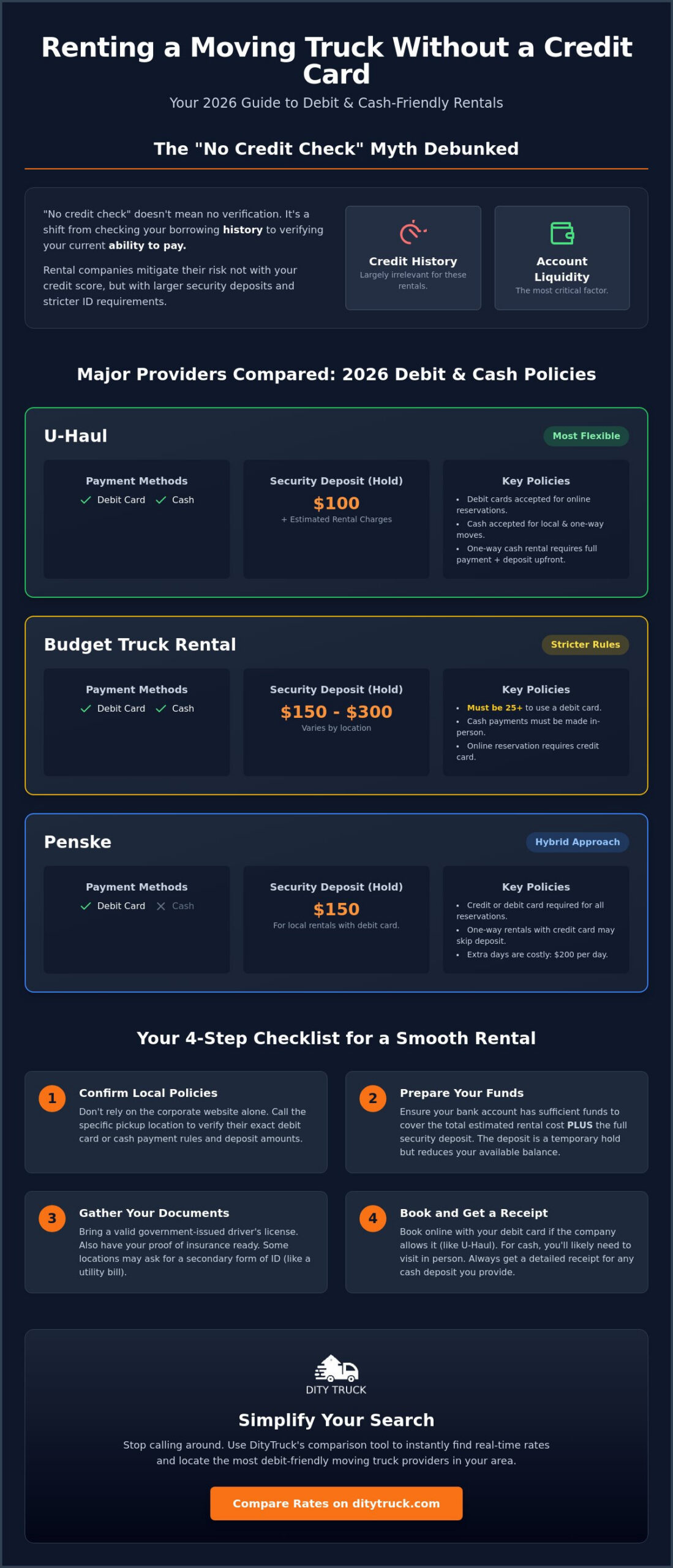
    U-Haul remains the most flexible option for 2026. They allow debit card payments for both online reservations and in-person pickups. If you use a debit card at pickup, expect a hold for the estimated rental charges plus a $100 deposit. Cash is also an option here. For local moves, the deposit is $100 or the estimated total, whichever is greater. One-way moves require the rental rate plus $100 upfront. This makes them a reliable choice for those avoiding credit entirely.

    Budget Truck Rental has stricter rules. You must be 25 or older to use a debit card. They also place a hold on your account that is usually $150. At some locations, this can jump to $300 or the estimated charges plus $80. They accept cash, but you have to handle the process in person. Understanding your consumer rights in moving protects you from unexpected policy shifts at the counter. Always ask for a receipt for any cash deposit provided.

    The Most Flexible Options for 2026

    Penske takes a hybrid approach. You need a valid credit or debit card just to make a reservation. While they accept debit at pickup, they typically require a $150 deposit for local rentals. One-way rentals booked with a credit card often skip the deposit. If you’re planning a long-haul trip, check our guide on Penske truck rental to see how they handle long-distance debit rentals. Be aware that extra days with Penske cost $200 each. This can add up quickly if your timeline shifts.

    What to Look for in the Fine Print

    The “In-Person Only” cash trap is a common hurdle. Most companies won’t let you reserve a truck online with cash. You have to visit a physical location to secure the vehicle. This adds a layer of complexity to your schedule. Local dealer participation also varies. A national policy might exist, but a small independent dealer might still insist on a credit card. Always call the specific lot ahead of time to verify their local rules. You can compare real-time rates and policies to find a location that fits your specific needs.

    Moving Truck Rental No Credit Check: Your 2026 Guide to Easy Booking

    Steps to Secure a Truck Without a Credit Card

    Securing a moving truck rental no credit check requires more than just showing up at the lot. It is a project of preparation. When you bypass the traditional credit path, you must prove your reliability through documentation and liquidity. Rental agents are trained to mitigate risk. Your job is to make their decision easy by arriving with a complete paper trail and a healthy bank balance. This proactive approach eliminates the friction often found at the rental counter.

    Don’t leave your move to chance. Call the specific pickup location 24 hours before your reservation. National policies are helpful, but local managers have the final say on vehicle releases. Confirm that they have your truck on-site and that they accept your specific form of payment. This quick call prevents the “no truck available” nightmare that can derail a moving schedule. It also establishes a rapport with the staff who will be inspecting your documents.

    The Essential Documentation Checklist

    Your driver’s license is just the starting point. When you skip the credit check, providers often require additional proof of stability. Bring a physical copy of a recent utility bill or a signed lease agreement. These documents must match the address on your ID. This “Proof of Residence” is a critical requirement that many competitors fail to mention. It serves as a secondary anchor for the rental company. Bring a backup form of identification too. A passport, social security card, or military ID can bridge the gap if the agent has questions about your primary license.

    Verifying Your Funds and Deposit

    Successful booking depends on your “Liquidity Buffer.” Never use a debit card that has exactly the amount of your quote. If your estimated rental is $150 and the deposit is $150, having $300 in your account is a recipe for failure. Banks often place temporary holds that can exceed the base quote. Aim for a buffer of at least 20 percent above the total expected hold. This ensures the transaction clears without triggering an overdraft or a declined card.

    The size of your deposit depends heavily on the type of move. Local round-trip rentals usually carry a smaller deposit, often around $100. One-way moves are higher stakes for the provider. They may require the full rental rate plus an additional flat fee upfront. Following FTC rental advice can help you understand how these holds impact your available cash. Remember that while a credit card hold just lowers a limit, a debit hold physically removes access to your cash. Plan your grocery and gas spending accordingly during the move.

    Managing the Security Deposit and Bank Holds

    When you swipe your debit card for a moving truck rental no credit check, the bank doesn’t just record a transaction. They trigger a hold. This mechanism keeps the money in your account but makes it inaccessible for other purchases. It is a digital safety net for the rental company. You need to account for this lack of liquidity when planning your moving day budget. If you have exactly enough for the rental but forget the deposit, your card will decline. This is a common point of friction that is easily avoided with a bit of foresight.

    Deposit ranges vary by distance and provider. For local moves, U-Haul typically requires a $100 deposit. Budget often asks for $150; however, this can climb to $300 depending on the specific location and estimated charges. Penske generally holds $150 for round-trip rentals. Long-distance moves are different. These often require the full estimated rental amount plus a flat deposit fee upfront. Always factor in these numbers before you arrive at the lot. The return process triggers the release of these funds, but the timing isn’t always instant.

    Ghost holds are a common frustration for many renters. This happens when the original authorization stays on your account even after the final charge is processed. It looks like you’ve been billed twice. This isn’t a double charge. It is simply the bank’s processing speed. Most ghost holds vanish within a few days, but they can be a major headache if you’re on a tight budget. Keeping a small buffer in your account prevents these temporary holds from causing overdraft fees.

    How Long Does a Refund Take?

    The rental company releases your funds the moment you return the keys and settle the bill. That is the easy part. The delay happens at your bank. Most major financial institutions take 3 to 10 business days to post the funds back to your available balance. This timeline is standard across the industry. If your deposit hasn’t appeared after 10 days, contact the rental lot first. Ask for the authorization release code. You can then give this code to your bank to speed up the process. It is a simple step that resolves most “missing” deposit issues.

    Hidden Costs of No-Credit Rentals

    Skipping the credit check sometimes comes with subtle expenses. Some locations may encourage higher-tier insurance packages for debit users to manage their risk. Also, don’t expect a cash refund if you paid with cash at the start. The “Cash Refund” myth is a frequent trap. Most national brands will mail a corporate check to your new address rather than handing back bills. This can take two weeks to arrive in your mailbox. Compare these potential delays and costs against a one way truck rental to see the full financial impact of your choice. You can find the most transparent rates and deposit rules by using an aggregation tool before you book.

    Simplify Your Search with DityTruck

    Searching for a moving truck rental no credit check usually involves hours of manual research. You have to verify local policies. You have to check deposit amounts. You have to compare mileage rates across multiple tabs. DityTruck changes this dynamic. Our platform aggregates real-time data from the industry’s biggest names into a single view. We do the heavy lifting behind the scenes. This allows you to focus on your packing list instead of rental fine print. It is the shortest path between your logistics problem and a confirmed reservation.

    Efficiency is our priority. Instead of navigating separate FAQs for Budget, Penske, and U-Haul, you see every option in one place. This transparency is vital for avoiding “Counter Shock.” This happens when you arrive at the lot and face fees or deposit requirements you didn’t see online. We prioritize clarity. You get a direct look at the total cost; this includes the estimated holds we discussed in previous sections. It is moving logistics simplified for the modern renter.

    Our “Smart Assistant” approach treats your time as a premium resource. You shouldn’t have to be an expert in rental contracts to get a fair deal. We provide the tools to filter for the best rates and the most flexible payment terms. This ensures you find a provider that respects your financial choices. We act as your advocate. We strip away the complexity of DIY moving and replace it with a streamlined, digital-first experience.

    Compare Rates in One Step

    You only need to input your move details once. Our system then fetches quotes from multiple providers simultaneously. You can easily visualize the cost to rent a 26 foot moving truck across different brands to see which one fits your budget best. This side-by-side view highlights the differences in base rates, mileage fees, and deposit requirements. You book with confidence. The requirements are visible upfront. No more guessing which lot will accept your debit card or how much they will hold.

    Ready to Move?

    A lack of a credit card should never stall your relocation. You have the documentation ready. You understand the bank holds. Now, you just need the right vehicle at the right price. Use our platform to find the most flexible providers in your area today. We help you skip the stress of the credit check. We get you straight to the move. Compare moving truck rates on DityTruck today and secure your rental in minutes.

    Take Control of Your 2026 Move Today

    Securing a moving truck rental no credit check is no longer a complicated process. It is a matter of preparation and knowing which providers offer the most flexibility. You have learned that a valid debit card, a clear paper trail, and a healthy bank buffer are your best tools for success. By understanding how bank holds work and which documents to bring, you eliminate the stress often found at the rental counter. You are ready to bypass the traditional credit hurdles and get on the road.

    DityTruck simplifies the final step. Our platform provides real-time rates from top-tier providers like Penske and Budget. We offer transparent pricing with no hidden comparison fees. Our streamlined booking process is designed specifically for 2026 moving standards. This ensures you find the most debit-friendly options in your area without visiting multiple websites. You get the clarity you need to make an informed decision in minutes.

    Find and Compare Moving Truck Rentals Now. Your next chapter is waiting. Take the shortest path to your new home with a rental process that respects your financial choices and your time. You have got this.

    Frequently Asked Questions

    Can I rent a moving truck with a debit card and no credit check?

    Yes, you can rent a truck without a traditional credit check by using a major debit card at providers like U-Haul and Budget. These companies focus on your bank balance and valid identification rather than your credit history. While a credit card is the industry standard for trust, a debit card serves as a functional alternative when backed by a security deposit. It’s the most reliable way to secure a moving truck rental no credit check in 2026.

    How much is the security deposit for a moving truck rental with a debit card?

    Deposit amounts vary significantly by provider and the type of move you’re planning. U-Haul typically requires a $100 deposit for both local and one-way rentals. Penske generally asks for a $150 deposit for local round-trip bookings. Budget’s requirements are more dynamic; they usually start at $150 but can reach $300 at specific locations. Always ensure these funds are available in your account before arriving at the rental counter to avoid a declined card.

    Do rental companies do a “soft pull” on my credit for debit rentals?

    Some companies perform a soft pull or identity verification when you use a debit card. This process confirms your personal details without impacting your credit score. It’s a standard risk management tool used to replace the automatic trust provided by a credit card. Other providers skip this step entirely and rely solely on a cash deposit. This approach ensures they have collateral if the vehicle is returned late or damaged during the moving process.

    What happens if I don’t have enough money for the deposit hold?

    Your reservation will be cancelled if your bank account can’t cover the total hold amount. The rental system attempts to authorize the estimated rental charges plus the security deposit in a single transaction. If the card is declined, the agent can’t release the keys to you. This is why maintaining a liquidity buffer is essential. It prevents a simple lack of funds from derailing your entire moving schedule on the day of the trip.

    Can I pay for a moving truck with cash at the end of the move?

    Most national brands allow you to settle your final bill with cash once the truck is returned. Penske accepts cash payments only at the end of the rental period. U-Haul is more flexible; they allow cash payments at both the start and the finish. If you pay a cash deposit upfront, remember that the company will likely mail you a refund check rather than handing back physical currency at the counter. This process can take up to two weeks.

    Which moving truck company is the most debit-card friendly?

    U-Haul is widely considered the most debit-friendly provider in the industry. They offer the lowest standard deposit of $100 and have the most inclusive policies for cash users. Their system is built to handle non-credit transactions efficiently across thousands of independent dealer locations. This makes them a top choice for renters who want a moving truck rental no credit check without navigating the stricter age or ID requirements found at other major chains.

    Do I need extra insurance if I am not using a credit card?

    Purchasing the rental company’s insurance is highly recommended when skipping a credit card. Most personal auto policies don’t cover large box trucks, and the secondary coverage provided by many credit cards is unavailable for debit users. Some locations may even require you to buy their basic protection plan if you aren’t using credit. This protects you from massive out-of-pocket costs if an accident occurs during your move. It’s a small price for peace of mind.

    Can someone else pay for my rental truck with their credit card?

    Generally, the person paying for the rental must be the primary driver listed on the contract. Rental companies require the name on the card to match the name on the driver’s license presented at the counter. If a friend or family member wants to pay, they must be present at pickup and sign the agreement as a responsible party. This policy prevents unauthorized use and ensures the company has a clear point of contact for the vehicle throughout the rental.