The lowest daily rate on a rental truck is often the most expensive way to move. It sounds backward, but a $19.95 sticker price rarely covers the actual cost of a local haul. You want a simple way to get from point A to point B without your budget exploding. It’s a common struggle. Opaque pricing structures and hidden mileage fees turn a quick task into a financial headache. You deserve total clarity before you hand over your credit card.
This guide helps you compare local moving truck rentals with absolute confidence. We’ve built a comprehensive checklist to reveal hidden costs and identify the best value for your 2026 move. You’ll learn how to spot reliable vehicles, choose the right size, and avoid those dreaded environmental surcharges. We are stripping away the complexity so you can focus on your new home. Here is exactly how to get a clear total cost estimate and a friction-free booking experience without any surprise charges.
Key Takeaways
- Inventory your furniture to determine cubic footage requirements. This ensures you choose a truck size that fits your move perfectly.
- Use a standardized checklist to compare local moving truck rentals. Focus on the total cost including mileage and mandatory fees rather than just the base rate.
- Perform a “hidden fee” audit to spot environmental surcharges and cleaning costs. This protects your budget from unexpected charges on moving day.
- Verify the reliability of major brands by checking fleet age and reservation guarantees. Newer vehicles provide peace of mind and reduce the risk of breakdowns.
- Finalize your choice by using a real-time booking platform. This locks in the best available rate and guarantees your vehicle is ready when you are.
Essential Pre-Comparison Checklist: Knowing Your Moving Needs
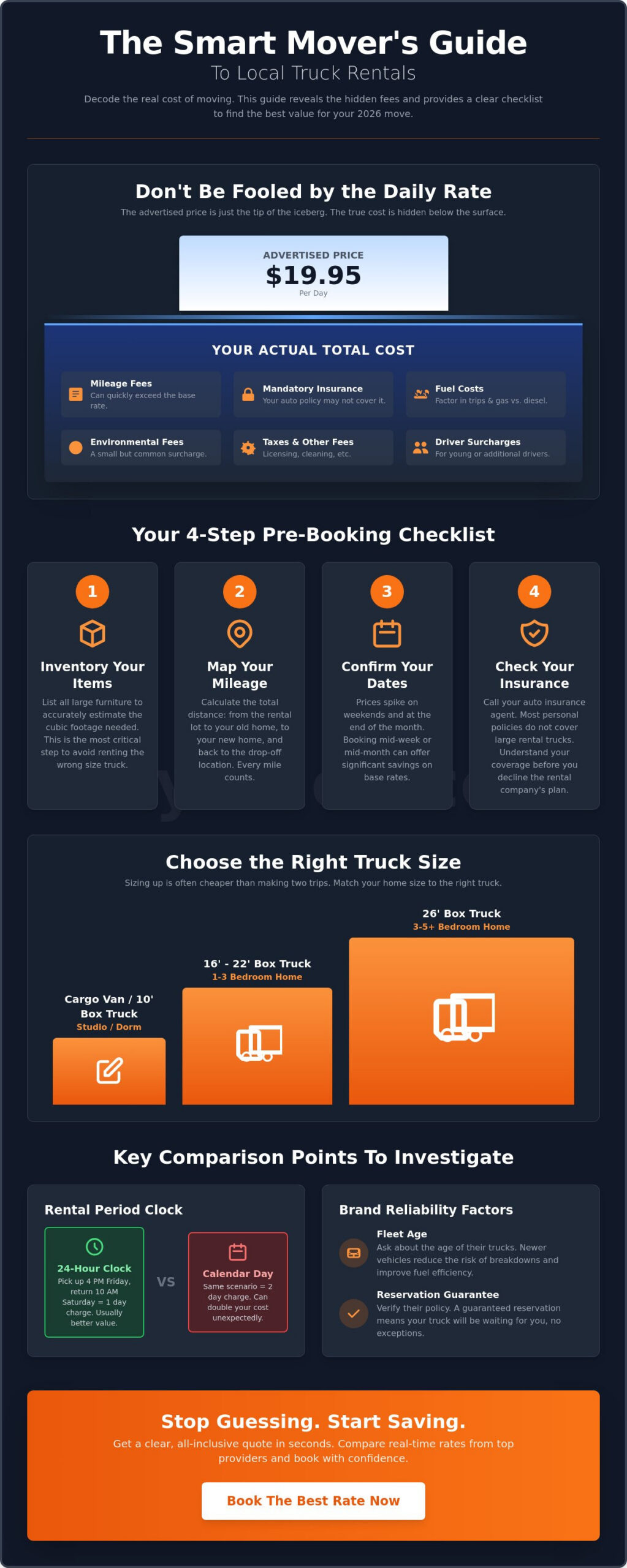
Success starts with an accurate inventory. Before you look for a vehicle, list every large furniture item you own. Couches, beds, and dining tables take up the most cubic footage. Getting this right prevents you from renting a truck that’s too small. You don’t want to realize your mistake when the ramp is down and the driveway is half-full. This step is the foundation of a successful moving industry overview approach to DIY relocation. Write everything down. A clear list makes the next steps much faster.
Count your rooms next. Most rental companies categorize their fleets by room count. When you prepare to compare local moving truck rentals, use this room count as your baseline. A studio usually fits in a cargo van, while a three-bedroom home requires a large box truck. Confirm your pickup and drop-off dates early. Prices often spike during weekends or at the end of the month. Booking mid-week can save you a significant amount. Also, call your insurance agent. Many personal auto policies exclude large commercial trucks. Knowing your coverage gaps helps you decide if the rental company’s protection plan is a necessity.
Determining Your Ideal Truck Size
Size matters for efficiency. A 10ft cargo van is perfect for small studio apartments or dorm moves. If you have a two-bedroom house, you will likely need a 16ft to 22ft truck. For large family homes, the 26ft model is the standard choice. It’s usually smarter to size up. Renting a slightly larger truck is often cheaper than making two local trips. You save on fuel and mileage fees. Watch out for height clearances. Local routes often have low bridges or overhanging trees. Check your route for restrictions before you drive away from the lot. A taller truck requires a different driving strategy.
Mapping Your Local Mileage
Total distance is more than just the gap between houses. You must include the trip from the rental lot to your current home and back again. These miles add up quickly. When you compare local moving truck rentals, look at the difference between round-trip and one-way local drop-off fees. Some companies charge a premium for different drop-off locations. Fuel is another major factor. Larger trucks often run on diesel. Diesel can be more expensive per gallon but offers better torque for heavy loads. Gas engines are common for smaller vans. Factor these differences into your total budget estimate to avoid surprises at the pump. Clarity on mileage prevents bill shock.
The Comparison Checklist: Evaluating Rental Terms Side-by-Side
Comparing rental options requires a level playing field. You can’t just look at the big number on a website. To accurately compare local moving truck rentals, you must ask for a breakdown of the base rate, mileage costs, and mandatory fees. Some companies advertise a low price but add a “vehicle licensing recovery fee” or an “environmental fee” at the final step. This guide to renting a moving truck highlights how these small additions inflate your bill. Always get the total number in writing. This transparency prevents stress when it’s time to pay the bill.
Timing is everything. Check if your rental uses a 24-hour clock or a set calendar day. If you pick up a truck at 4:00 PM on Friday and return it at 10:00 AM on Saturday, a 24-hour policy counts it as one day. A calendar-day policy might charge you for two. It’s an easy way to double your costs without realizing it. Deposit requirements also vary. Most major brands prefer credit cards. Using a debit card or cash often triggers a higher deposit or requires a more rigorous verification process. Don’t forget driver rules. Younger drivers often face daily surcharges. If you want a friend to help drive, expect an extra fee per person. You should compare local moving truck rentals with these specific policy differences in mind to find the actual best deal.
Daily Rates vs. Mileage Charges
Low daily rates are often a distraction. A cheap rental with a high per-mile fee is more expensive than a flat-rate rental if you have a long local route. In 2026, more companies are offering “local unlimited” packages to stay competitive. Calculate your break-even point by multiplying your estimated miles by the per-mile rate and adding the base fee. Comparing these totals side-by-side reveals the true winner. If you want to skip the math, you can compare real-time quotes to see these calculations instantly. This approach ensures you choose based on data rather than marketing.
Pickup and Drop-off Flexibility
Logistics don’t always follow a 9-to-5 schedule. Verify the lot hours before you book. Some local branches close on Sundays or late at night. If you need to return the truck when the office is closed, ask about the “after-hours” drop-off process. This usually involves a secure key box and a mobile check-in app. Be careful. You remain responsible for the vehicle until the staff inspects it the next morning. A brand with a wide local branch network offers more flexibility. It gives you more options for pickup locations near your current home and drop-off points near your new one. This convenience saves you time and reduces the total miles you pay for.
The “Hidden Fee” Audit: What Most Comparison Sites Miss
A low daily rate often hides a mountain of surcharges. You must look past the sticker price to see the true cost of your move. When you compare local moving truck rentals, the first thing to audit is the mandatory fee structure. Many companies charge a vehicle licensing recovery fee to cover their own registration costs. Others add a mandatory environmental fee. U-Haul, for example, typically charges between $1 and $5 per rental for this. These small amounts seem minor. They add up quickly when combined with mileage and fuel. Always ask for a line-item breakdown before you sign the contract.
Cleaning and fuel policies are common traps for the unwary. Most providers expect the truck back in the exact condition you received it. If there is dirt in the cab or debris in the cargo area, you might face a steep cleaning fee. The gas tank policy is even more critical. Some companies require you to return the truck with the same amount of fuel it had at pickup. Others charge a premium if they have to refill it for you. Checking the gas gauge and taking a photo of the odometer at both ends of the trip is essential. This documentation protects your $150 deposit from unfair claims. Knowing how to rent a moving truck correctly means auditing every potential charge before the keys are in your hand.
Insurance and Liability Coverage Options
Your personal auto insurance likely stops at the truck’s bumper. Most standard policies and credit card benefits do not cover commercial vehicles or large box trucks over a certain weight. You need to understand the difference between a Collision Damage Waiver (CDW) and Supplemental Liability Insurance (SLI). A CDW covers damage to the truck itself. SLI protects you against claims from other drivers. Cargo insurance is a separate add-on that protects your actual belongings inside the truck. U-Haul offers Safemove coverage starting at $15 per day. It’s a small price for peace of mind during a high-stakes task.
Mandatory vs. Optional Surcharges
The Environmental Fee is a non-negotiable industry standard in 2026 that helps companies comply with local emissions regulations. Beyond that, many add-ons are purely optional. You’ll often see prompts for “Moving Help” or labor assistance during the checkout process. These services can double your quote instantly. Decline them if you have friends helping. Be wary of “Peak Day” surcharges as well. Moving on the 1st or 15th of the month, or any Saturday, often triggers higher rates. Equipment like dollies and furniture blankets also carry daily rental fees. If you already own these items, bring your own to keep the total cost low. Every dollar saved on accessories is a dollar kept in your pocket.
Evaluating Brand Reliability: U-Haul, Penske, and Budget
Reliability is the invisible cost of a move. A cheap truck that breaks down on a Saturday morning is a disaster. When you compare local moving truck rentals, you must look at fleet age. Newer trucks mean better fuel efficiency and fewer mechanical failures. U-Haul offers a specific advantage with their “low-deck” design. This design keeps the cargo floor closer to the pavement. It makes walking heavy furniture into the truck much easier. It saves your back and speeds up the loading process. Penske, however, often wins on maintenance. They rotate their fleet frequently. You are more likely to get a truck with low mileage and a clean engine. For a data-driven breakdown of how these two giants compare on fleet reliability, pricing transparency, and mileage policies, see our Penske vs. U-Haul definitive 2026 moving truck comparison guide.
Roadside support is your safety net. U-Haul has over 21,000 locations. This ubiquitous presence means help is usually close. If your truck fails, they can often swap it quickly at a nearby branch. Penske and Budget also offer 24/7 assistance. Always verify the response time expectations. A breakdown mid-move can derail your entire schedule and lead to extra labor costs. Choosing a brand with a robust national network ensures you aren’t stranded for hours on the side of the road. Clarity on these support terms is just as important as the rental price.
Fleet Quality and Roadside Support
Penske focuses on commercial-grade vehicles. Their trucks are built for heavy use and undergo frequent, rigorous inspections. This leads to higher reliability for local hauls and fewer unexpected stops. U-Haul has a massive fleet, but equipment age varies significantly by location. You might get a brand-new van or a ten-year-old box truck with high mileage. Budget sits in the middle. They offer a balance of competitive pricing and decent vehicle quality. If a breakdown happens on a busy Saturday, you need a provider that prioritizes your recovery. For a detailed breakdown of how these three providers stack up on price, fleet quality, and availability, see our U-Haul vs. Budget vs. Penske comparison for 2026. Ask about their backup vehicle availability and specific local mechanic partnerships before you book.
The Reservation Guarantee Reality
A confirmation number is not a guarantee. This is the industry’s biggest secret. Many renters arrive at the lot only to find their truck hasn’t been returned by the previous user. It’s frustrating and stressful. You can avoid this by using a better tracking method. Book your rental through DityTruck to access providers with superior inventory management and more reliable booking systems. We help you find the most dependable options in your area.
Use the 24-hour check-in trick. Call the specific local branch one day before your move. Confirm the truck is physically on the lot or scheduled for return. This proactive step prevents morning-of surprises and gives you time to react. If the branch seems unsure, you still have time to find an alternative. Efficiency is about control. Taking these small steps ensures your moving day stays on track and your schedule remains intact.
Finalizing Your Choice: How to Book the Best Rate
The research phase is complete. You have identified your inventory. You understand the fee structures. Now you need to execute the plan. To accurately compare local moving truck rentals, you need real-time data from multiple providers simultaneously. Static quotes on individual websites are often outdated by the time you reach the checkout page. 2026 digital rates change based on local inventory and regional demand. Booking online is the only way to lock in these specific prices. It removes the risk of “walk-in” price hikes at the rental counter. You get the best deal when you act on live data.
Review your final quote one last time. Look for the flags identified in your hidden fee audit. Ensure the environmental fee and mileage rates match your expectations. Confirm the truck size fits the requirements you verified in section one. If everything aligns, proceed to the secure checkout. Digital booking creates a paper trail that protects your reservation. It provides a timestamped agreement that the rental company must honor. This transparency is the key to a stress-free moving day. Don’t leave your budget to chance at the physical rental office.
Using DityTruck for Real-Time Comparisons
DityTruck simplifies the final step. Our platform aggregates rates from Penske, Budget, and other major providers in a single view. You don’t have to jump between sites. The biggest benefit is seeing the total estimated price rather than just a base rate. We factor in the variables that others hide until the end. This allows for a true side-by-side evaluation of value. For a deeper look at the current market, read our Moving Truck Rental: The Complete 2026 Comparison & Booking Guide. It provides the context you need for a smart, data-driven decision.
Securing Your Reservation
Confidence comes from preparation. When you are ready to rent a truck for moving, have your documents ready. You will need a valid driver’s license and a major credit card. Most digital booking processes require these up front to verify your identity. Some providers may also ask for a secondary form of ID or proof of insurance coverage. Having these files ready prevents session timeouts and lost quotes.
Check your inbox immediately after booking. You must receive a reservation number and the specific lot address. Don’t rely on a “pending” screen. A confirmed reservation number is your leverage if the lot is busy on moving day. Print a copy or save the confirmation to your phone for quick access. Verify the pickup time and the return deadline one last time. Having this data at your fingertips ensures a friction-free pickup. Your move is now officially on the books. You have the right truck at the right price.
Take Control of Your 2026 Move
Moving doesn’t have to be a gamble. You have the tools. You know the traps. Success comes down to preparation. Audit your inventory. Uncover hidden surcharges. Protect your budget and your peace of mind. It’s time to act. You deserve a move that stays on schedule and stays within your financial limits.
When you compare local moving truck rentals, efficiency is your best asset. You’ve learned to spot the difference between a low sticker price and a true total cost. You know which brands offer the most reliable fleets. Now, see all those options in one place. No manual searching. No unnecessary stress. Just clear data for a smart move.
We make the final step effortless. Compare Real-Time Moving Truck Rates Now for live pricing from Penske, Budget, and other major providers. No hidden fees. See the total cost upfront. Secure your online booking in under 2 minutes. Get back to what matters. Your new home is waiting. You’ve got this.
Frequently Asked Questions
How do I find the cheapest local moving truck rental near me?
Use a real-time comparison tool to see current rates across all local branches. Prices fluctuate daily based on zip code demand and inventory levels. Booking your rental for a mid-week date like Tuesday or Wednesday typically yields the lowest rates. Always book online to lock in digital-only discounts that aren’t available for walk-in customers at the physical lot.
Is Penske better than U-Haul for local moves?
The choice depends on your specific priorities. Penske is widely recognized for maintaining a newer fleet of commercial-grade vehicles. This reduces the risk of mechanical issues. U-Haul provides significantly more pickup locations and a unique low-deck design for easier loading. You should compare local moving truck rentals based on your proximity to their lots and your comfort with driving older versus newer equipment.
What is the average cost of a local moving truck rental in 2026?
Total costs are determined by the base rate plus mileage and insurance. While a small van might have a low starting price, a standard move for a two-bedroom home usually totals between $110 and $210. This includes the per-mile fee and fuel. Regional demand and current fuel prices in 2026 will influence your final quote. Always calculate the total cost of ownership rather than just the daily rate.
Do I need special insurance when I compare local moving truck rentals?
Yes, because standard personal auto insurance policies and credit card benefits rarely cover large box trucks. You face significant financial risk if the vehicle is damaged or involved in an accident. Purchasing a damage waiver or supplemental liability coverage from the rental provider is the safest path. It ensures you aren’t held liable for expensive repairs to commercial-grade equipment.
Can I rent a moving truck with a debit card?
Most major rental brands accept debit cards, but they often require a larger upfront deposit. You may also need to show additional forms of identification or proof of a utility bill at the counter. Credit cards are preferred for a smoother transaction and faster deposit returns. If you use a debit card, ensure you have enough available balance to cover the hold amount for several days.
What happens if the rental company doesn’t have my truck on moving day?
You should immediately ask for a free upgrade to the next available size. Most companies have a reservation guarantee policy that pays you a set amount, such as $50, if your equipment isn’t ready. To prevent this, call the local lot 24 hours before your pickup time. Confirming the vehicle is physically on the lot gives you time to find an alternative if there is an inventory error.
Are there hidden fees when renting a truck for a local move?
Common fees include the environmental fee, vehicle licensing recovery fee, and cleaning surcharges. You will also pay for any equipment rentals like furniture pads or dollies. To compare local moving truck rentals accurately, always request a full line-item breakdown. This transparency allows you to see the true total before you provide your payment information. Checking the gas tank level at pickup also prevents unfair refueling charges.
Should I choose a cargo van or a small box truck for a studio apartment?
A cargo van works well if you only have boxes and small furniture. If your studio includes a bed, dresser, or sofa, choose a 10-foot box truck instead. Box trucks offer a wider interior and a lower deck height. This extra space prevents you from having to stack fragile items too high. It also ensures you can complete the move in a single trip, saving you time and mileage costs.