Tag: one way truck rental

  • One Way Moving Truck Rental Comparison: 2026 National Guide

    One Way Moving Truck Rental Comparison: 2026 National Guide

    The lowest daily rate on a rental truck rarely leads to the cheapest move. Most people choose the first big name they see, only to get hit with surprise mileage fees and drop-off penalties at the finish line. Finding true value requires a detailed one way moving truck rental comparison that looks past the sticker price. You need to know exactly what you’re paying for before you pick up the keys.

    Moving across the country is stressful enough. You shouldn’t have to worry about a breakdown in the middle of nowhere or a bill that doubles once you arrive. You want a truck that’s reliable and a price that’s final. This 2026 guide simplifies the logistics by comparing the top providers side-by-side. We’ll show you how to avoid hidden costs, choose the right fleet for your home size, and secure a guaranteed reservation without the usual headache.

    We analyze everything from Penske’s unlimited mileage policies to Budget’s base rates and U-Haul’s vast location network. You’ll get the clarity you need to make a fast, confident decision for your long-distance move.

    Key Takeaways

    • Stop focusing on daily rates. Total value includes mileage, insurance, and taxes that define your actual move cost.
    • Perform a one way moving truck rental comparison to find the best fit. Contrast Penske’s unlimited mileage with Budget’s discounts and U-Haul’s accessibility.
    • Identify hidden fees before they appear on your bill. Environmental surcharges and state-specific taxes can change your total significantly.
    • Book strategically to save hundreds. Mid-week and mid-month reservations offer the best chance for lower rates and better truck availability.
    • Use real-time aggregation to simplify the process. Get transparent pricing from multiple providers in one interface to skip the manual search.

    Mastering One-Way Moving Truck Rental Comparisons in 2026

    Moving across state lines isn’t just a longer version of a local move. It’s a different financial animal. According to a moving industry overview, one-way rentals involve complex logistics that local pickups never face. You aren’t just paying for time and fuel. You’re paying for the rental company to reposition that vehicle once you’re done with it. Understanding this structural difference is the first step toward a cheaper move.

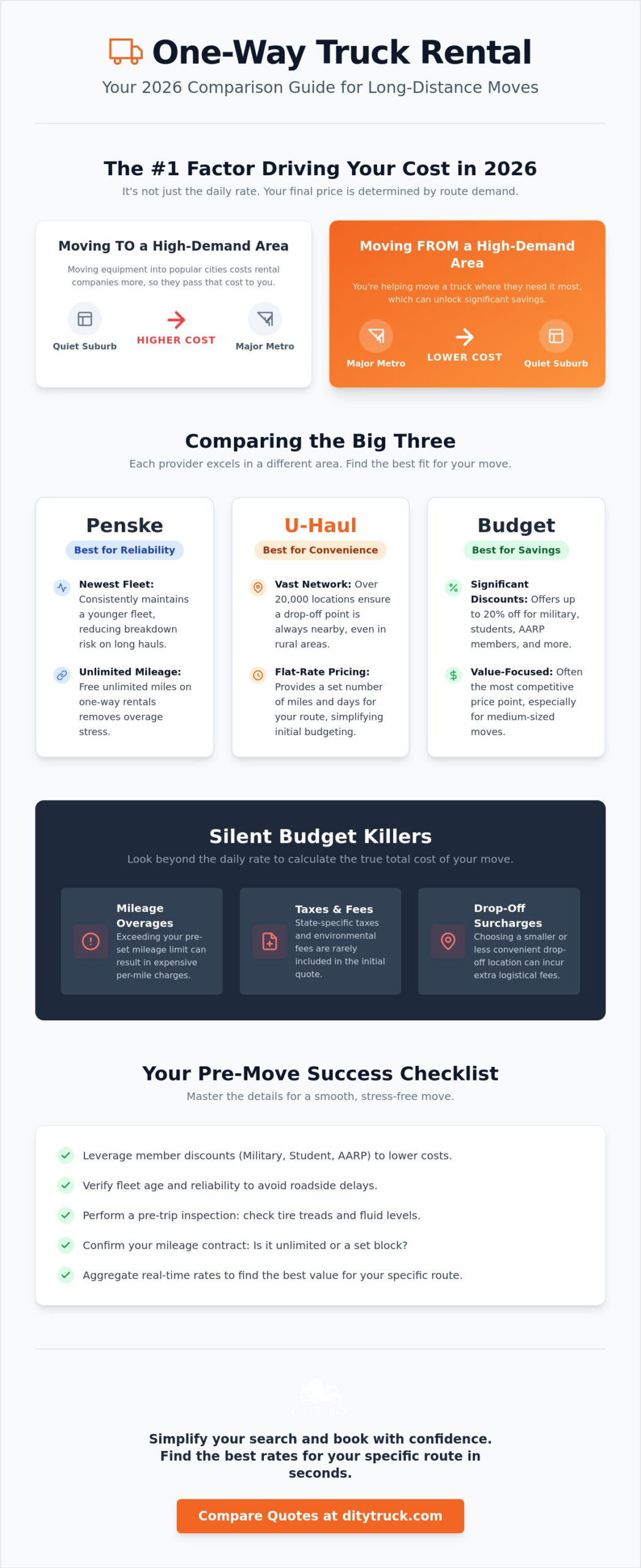
    In 2026, market shifts are rapid and unpredictable. Migration patterns toward specific regions create massive inventory imbalances. This makes a real-time one way moving truck rental comparison mandatory for anyone looking to save. Prices fluctuate daily based on where trucks are sitting and where they’re needed most. If a city is seeing a high volume of arrivals, taking a truck out of that city might be significantly cheaper than bringing one in.

    Three major providers dominate the national landscape: Penske, Budget, and U-Haul. They control the majority of the available fleet. However, searching each site individually is a waste of your time. A smart assistant approach uses automated discovery to pull these options into one place. This strips away the complexity. You get a clear path to the best rate without the manual labor of opening twenty browser tabs.

    Why One-Way Moves Require a Different Strategy

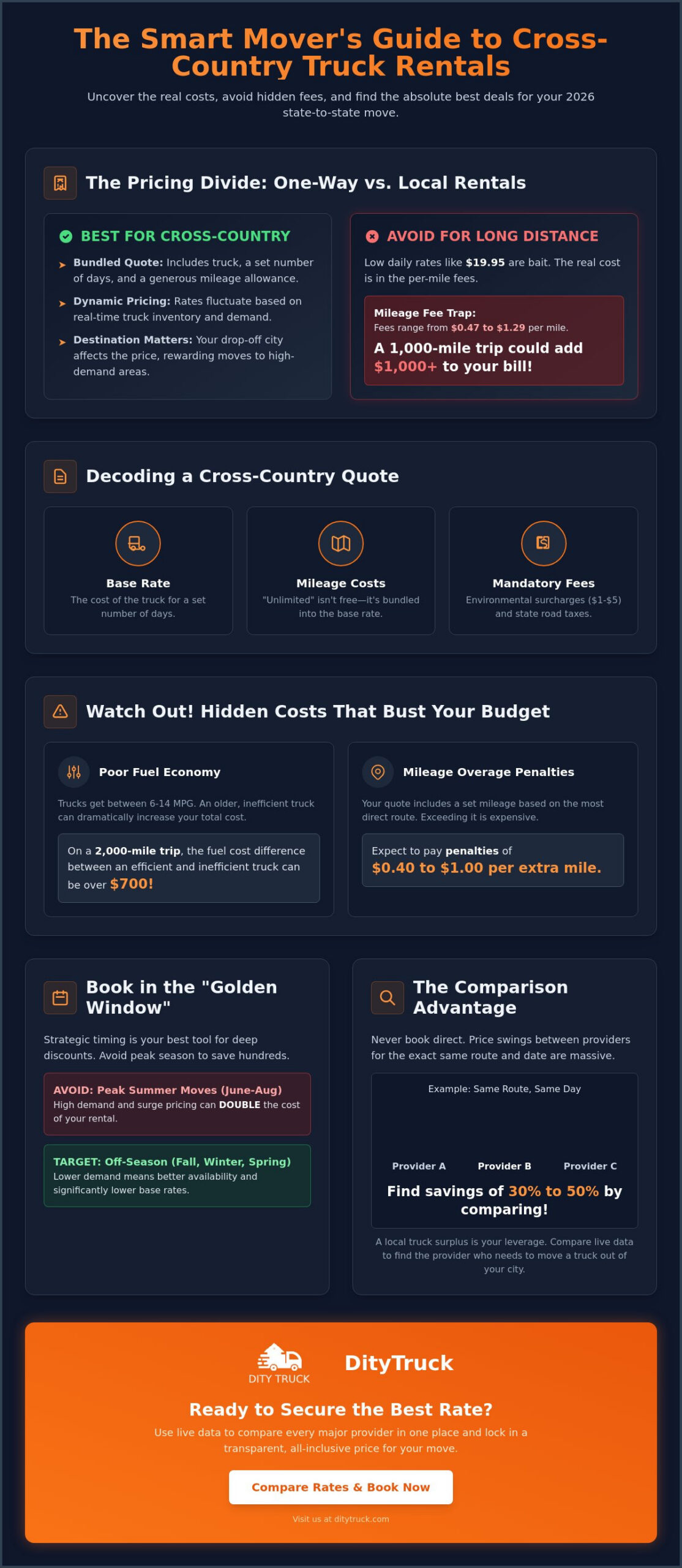
    Drop-off fees are the silent killer of moving budgets. They can double your initial quote if you aren’t careful. These fees exist because companies have to balance their fleets. If you leave a truck in a low-demand area, the company loses money until someone else rents it. Inventory imbalances drive these costs higher in 2026. Seasonal demand also plays a role. Summer moves often see lower availability and higher base rates across all national providers.

    The Core Metrics of a Successful Comparison

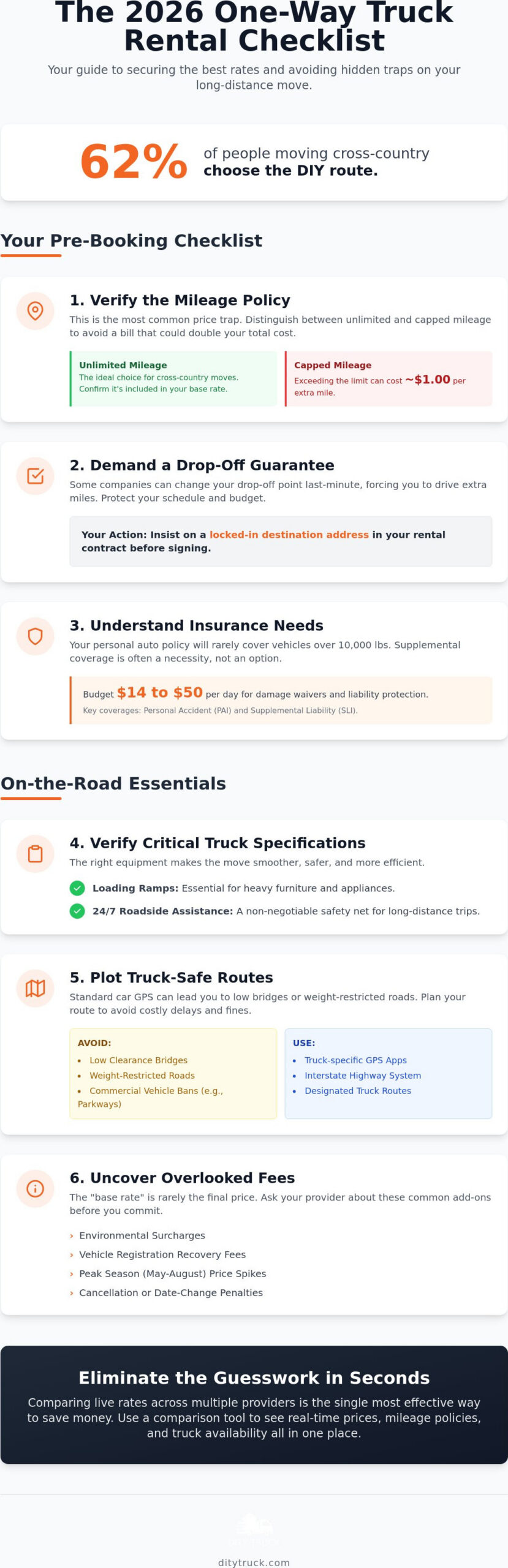
    The base rate is only one part of the equation. You must look at the mileage allowance. Some providers offer unlimited miles for one-way trips; others set a strict cap with high overage penalties. Reliability is the next priority. A newer fleet means a lower risk of a breakdown on a 1,000-mile haul. Interstate travel is stressful enough without a mechanical failure. Finally, check customer support. You need a provider with accessible help that spans every time zone you’ll cross during your journey.

    Comparing the Big Three: Penske vs. Budget vs. U-Haul for One-Way Moves

    Choosing the right provider is the most critical step in your one way moving truck rental comparison. While many local companies exist, only three truly dominate the national landscape. Penske, Budget, and U-Haul each offer distinct advantages depending on your distance and budget. Understanding their specific business models helps you avoid paying for services you don’t need or missing out on essential protections. You want a provider that matches your specific route and load size without adding unnecessary friction.

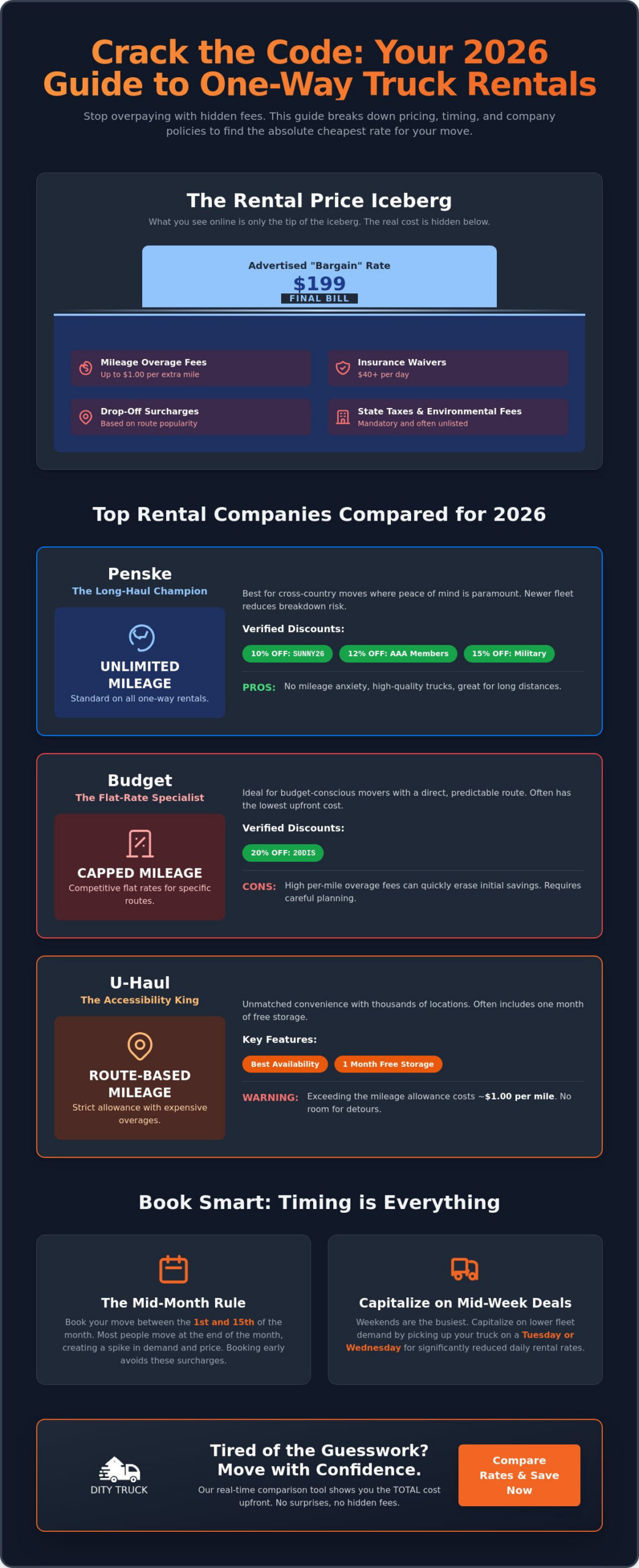
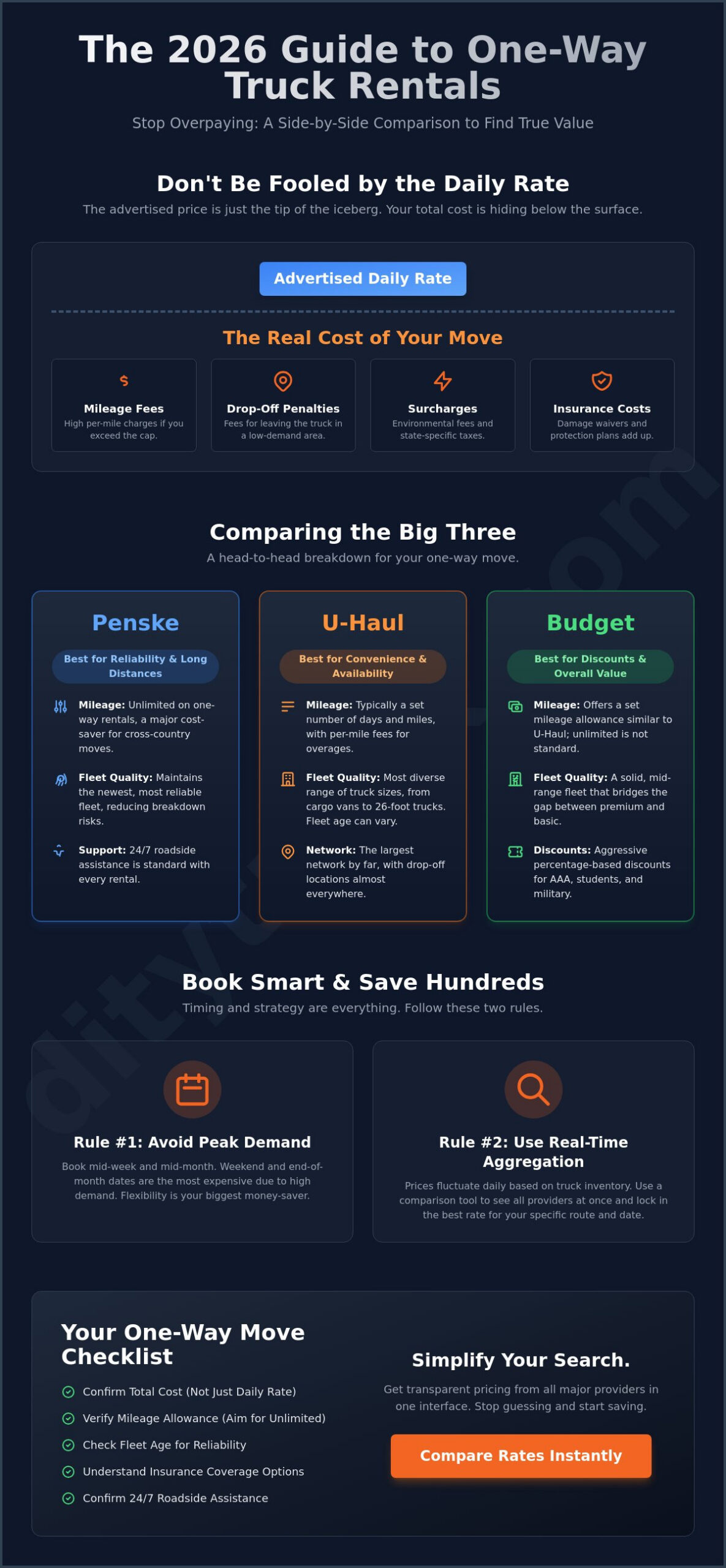
    Penske is widely considered the premium option for long-distance relocations. They prioritize a newer fleet. This reduces the fear of mechanical failure on the highway. Most of their one-way rentals include unlimited mileage, which is a massive benefit for moves spanning several states. Budget positions itself as the mid-range contender. They often lead the market with aggressive percentage-based discounts for AAA members, students, and military personnel. U-Haul remains the king of convenience. With the largest network in the country, you’ll almost always find a drop-off point near your new home.

    Secondary players like Enterprise and Home Depot often appear in searches. However, they usually focus on local rentals or cargo van needs. They rarely offer the infrastructure required for a cross-country one-way haul. When you’re crossing multiple state lines, sticking to the big three ensures you have a support network if something goes wrong. It’s also a good way to protect yourself from moving fraud by using established, regulated brands. For a fast look at what’s available for your specific route, you can compare real-time rates here to see which of the big three fits your budget.

    Fleet Quality and Reliability Breakdown

    Penske maintains a strict commitment to late-model trucks. This isn’t just about aesthetics. Newer engines typically offer better fuel economy and fewer breakdowns. If you’re driving 1,000 miles, those fuel savings add up quickly. U-Haul offers the most diverse size options. Their fleet ranges from small cargo vans to 26-foot giants capable of moving a large family home. Budget bridges the gap by offering specialized features like high-quality loading ramps and reliable towing capabilities for those bringing a personal vehicle along.

    National Coverage and Drop-Off Convenience

    Location density changes your total cost. U-Haul’s massive 20,000+ network dwarfs Penske’s 2,000 locations. If your destination is a rural town, a Penske drop-off might be an hour away. That extra drive time costs you fuel and stress. You can find a deeper dive into these logistics in our One Way Truck Rentals for Moving: 2026 Comparison Guide. Proximity to your final destination is a hidden savings factor that often outweighs a slightly higher base rate.

    One Way Moving Truck Rental Comparison: 2026 National Guide

    Beyond the Base Rate: Factoring in Mileage, Fees, and Insurance

    The advertised price is just the starting line. Real costs hide in the fine print. A thorough moving truck rental comparison reveals that mileage is the biggest variable. Some providers offer unlimited miles for one-way trips. Others give you a fixed estimate. If you go over that estimate, you pay by the mile. For a cross-country move, those extra miles can add hundreds to your final bill.

    Environmental fees and state taxes also vary by location. Every state has different regulations. Some charge flat fees for tire disposal or air quality. These appear at the final checkout, not in the initial search. Fuel policies add another layer of complexity. You usually have two choices: prepay for a full tank or return it at the same level you started. Refilling it yourself is almost always cheaper. Rental companies charge a premium for the convenience of doing it for you.

    Calculating the True Cost of Your Move

    Don’t rely on luck. Use a simple formula to find your real total: Base Rate + Mileage + Insurance = True Cost. If your move is over 500 miles, unlimited mileage is usually the safer, cheaper path. It removes the stress of taking a detour or getting lost. A Damage Waiver is a contractual agreement where the rental company waives its right to charge you for specific types of damage to the vehicle during your move. It’s essential because your personal car insurance or credit card rarely covers a commercial box truck.

    Avoiding Common One-Way Surcharges

    Timing is everything. Late return penalties are aggressive. Missing your drop-off window by even an hour can trigger a full day’s charge. You also need to factor in equipment rental fees that aren’t included in the truck price:

    • Utility Dollies: Essential for heavy appliances.
    • Furniture Pads: Prevents scratches during long-haul vibration.
    • Tow Dollies: Necessary if you’re bringing a personal car.

    Finally, check the cargo area before you leave the vehicle at the drop-off site. Cleaning fees are common if you leave behind trash or debris. Sweep the truck out to ensure you get your full deposit back. Performing a detailed one way moving truck rental comparison before you book helps you spot these line items early. It’s the only way to ensure your final bill matches your initial expectations.

    Strategic Booking: How to Lock in the Lowest One-Way Rates

    Timing your reservation is just as important as choosing the right truck. Most people wait until their move date is finalized to look for a vehicle. This is a mistake. Prices for one-way rentals are dynamic. They shift based on supply, demand, and how many trucks are currently sitting in your pickup city. Securing your rate early is the only way to protect your budget from last-minute spikes. A proactive one way moving truck rental comparison helps you spot these trends before they cost you money.

    The smartest movers target mid-week and mid-month windows. Demand peaks on weekends and during the final days of the month when most apartment leases end. By picking up your truck on a Tuesday or Wednesday, you can often save hundreds of dollars. You also get a better selection of the fleet. Rental companies are more likely to have the specific size you need when the lot isn’t picked over by weekend DIYers. If you have any flexibility in your schedule, use it to your financial advantage.

    Leveraging memberships is another quick win. AAA, military, student, and even certain corporate memberships can trigger significant discounts. These aren’t just small percentages. They often represent the difference between a premium rental and a budget-friendly one. In 2026, using a dedicated comparison platform is the most efficient way to bypass brand-specific price hikes. You can see every available discount and rate in one place without the manual labor of visiting multiple sites. Ready to find your best rate? Compare one-way rental prices now and lock in your savings.

    The 2026 Moving Calendar Strategy

    Seasonality dictates your final bill. A move in January is typically 30% cheaper than a move in July. Cold weather keeps demand low, which forces companies to drop their rates. Holiday weekends are the opposite. Memorial Day, Labor Day, and the Fourth of July see the highest prices of the year. If you must move during these peaks, set up price alerts. This allows you to jump on sudden rate drops the moment they happen. It’s about being faster and more informed than the average consumer.

    Stacking Discounts for Maximum Savings

    Don’t settle for a single discount. Many providers allow you to combine a membership perk with a seasonal promotion. Always check the fine print to see if your AAA discount can be stacked with a “Book Early” special. While negotiating at the counter rarely works for one-way hauls, being prepared with a competitor’s quote can sometimes help. You can find more expert tips in our Moving Truck Rental: The Complete 2026 Comparison & Booking Guide. Knowledge is your best tool for keeping costs down.

    Simplify Your Long-Distance Move with DityTruck

    Long-distance moves involve too many moving parts. You’ve already seen the differences in fleet quality. You understand the impact of hidden mileage fees and seasonal price hikes. Managing these variables manually is exhausting. DityTruck acts as your smart assistant. It strips away the complexity of logistics. We aggregate real-time data from Penske, Budget, and other national leaders. You get a clear, side-by-side view of your options. No fluff. No hidden agendas. Just the facts you need to move forward. We perform the heavy lifting behind the scenes so you can focus on your new destination.

    Our platform prioritizes financial honesty. We show you the rates as they are. This allows for a fast, accurate one way moving truck rental comparison. You move from searching to a confirmed reservation in seconds. It’s a friction-free process designed for the savvy consumer. We advocate for your time and your peace of mind. By presenting transparent pricing without the usual hurdles, we ensure you never face a surprise bill at the drop-off location. We are the shortest, most logical path between your logistics problem and a successful resolution.

    Why Compare with DityTruck?

    Forget the frustration of jumping between browser tabs. DityTruck puts every national rate on one screen. We perform the heavy lifting of data collection so you don’t have to. This is confident simplicity at its best. You identify the best value; you book it; you move on with your life. Our interface is built for speed and rapid decision-making. We strip away the unnecessary preamble found on individual brand sites. You get direct access to the inventory that fits your specific move size. It’s the shortest path between a logistics problem and a confirmed truck.

    We act as a consumer advocate in a crowded market. The truck rental industry is massive and often confusing. We bring clarity to the process by highlighting the actual costs involved. This includes the mileage inclusions and insurance options we discussed earlier. You gain the advantage of a professional tool without needing professional logistics experience. It’s about empowering you to make the smartest choice for your budget and your family.

    Get Your One-Way Quote Today

    Start your comparison right now. Locking in 2026’s best rates requires speed. Inventory moves fast during peak season. Don’t leave your move to chance. Experience the relief that comes with a vetted, organized plan. Our system is designed for quick scanning, allowing you to see the best rates for your route instantly. You deserve a move that is free of traditional hurdles and hidden obstacles. Compare Moving Truck Rental Rates Now to secure your truck and your budget today. Take the first step toward a simpler, more transparent moving experience.

    Secure Your 2026 Long-Distance Move

    The right choice for your relocation depends on more than just the lowest daily rate. True value comes from balancing mileage allowances, fleet reliability, and drop-off convenience. You can avoid the stress of hidden surcharges by booking mid-week and verifying your damage waiver coverage before you hit the road. A successful one way moving truck rental comparison is about finding the shortest path to a friction-free move. It’s about getting the details right before you ever pick up the keys.

    DityTruck strips away the complexity of logistics by acting as your smart assistant. You get real-time rates from Penske, Budget, and U-Haul in one transparent interface. There are no hidden obstacles. We provide a streamlined reservation process that puts you in control of your budget and your timeline. It’s the most efficient way to manage a high-stakes task without the usual headaches.

    Find the best one-way truck rental rates on DityTruck and lock in your savings today. Your cross-country journey is a major milestone. We are here to ensure the logistics are the easiest part of your story. Move with confidence and clarity.

    Frequently Asked Questions

    Is it cheaper to rent a truck one-way or return it to the same location?

    One-way rentals are generally more expensive than local round-trips due to repositioning logistics. However, for long-distance moves, a one-way rental is the most cost-effective path. Returning a truck to the starting point adds hundreds in fuel and hotel costs. It also wastes valuable time. A one-way rental allows you to drop the vehicle off near your new home and move on with your life immediately.

    Can I get unlimited mileage on a one-way truck rental?

    Yes, but it depends on the provider you choose. Penske is known for offering unlimited mileage on most one-way rentals. This removes the stress of tracking every mile on interstate hauls. Budget also offers unlimited mileage on many long-distance routes. U-Haul typically provides a set mileage allowance based on your route. Always confirm the mileage policy during your one way moving truck rental comparison to avoid overage fees.

    Which truck rental company is best for long-distance moves in 2026?

    The best provider depends on your priorities. Penske is the premium choice for reliability and unlimited mileage. Budget often provides the lowest rates for those with AAA or military discounts. U-Haul offers the most convenience with over 20,000 drop-off locations nationwide. Each company has unique strengths. Compare all three based on your specific route to find the right balance of price and support.

    How much does a one-way moving truck rental typically cost?

    Costs vary significantly based on distance and truck size. Research shows a 1,000-mile move for a medium home typically ranges between $1,200 and $1,800. These rates fluctuate based on seasonal demand and inventory levels in your pickup city. Moving during the winter or mid-week often results in lower quotes. Factor in fuel, insurance, and equipment fees to determine your total move budget.

    Do I need special insurance for a one-way truck rental?

    Most personal auto insurance policies don’t cover commercial box trucks. Credit card protections also rarely apply to large moving vehicles. Purchasing a Damage Waiver or supplemental insurance from the rental provider is highly recommended. This protects you from high repair costs in case of an accident. It provides peace of mind on long hauls where road hazards are more common. Always verify your current coverage limits before declining.

    What is the best way to compare one-way truck rental rates fast?

    Using an aggregation platform like DityTruck is the fastest method. It pulls real-time rates from major providers like Penske, Budget, and U-Haul into a single interface. This eliminates the need to jump between multiple websites. You can see every available discount and base rate side-by-side in seconds. This streamlined approach ensures you find the best deal for your specific route without the manual labor.

    What happens if I drop off my one-way rental at a different location than planned?

    Changing your drop-off location without prior approval results in heavy penalties. Rental companies use a “wrong destination” fee to cover the cost of relocating the truck. These fees can reach hundreds of dollars. If your plans change, call the provider immediately. They may be able to update your contract. However, sticking to the agreed-upon location is the only way to guarantee your initial quote stays final.

    Are there hidden fees in one-way truck rentals?

    Most fees aren’t hidden, but they are often overlooked. You should expect line items for environmental taxes, tire fees, and state-specific surcharges. Cleaning fees apply if the truck is returned with debris. Late return penalties are also high, often triggering an entire extra day of rental costs. Performing a detailed one way moving truck rental comparison helps you spot these variables early. Transparency is key to avoiding surprises at the counter.

  • One Way Truck Rental Comparison: How to Find the Best Rates in 2026

    One Way Truck Rental Comparison: How to Find the Best Rates in 2026

    The lowest advertised daily rate is often the most expensive way to move across the country. It sounds backwards. But hidden mileage fees and complex insurance add-ons can double your final bill in an instant. You’ve likely spent hours toggling between browser tabs for a one way truck rental comparison. You’re trying to see if a budget-friendly base rate actually beats a provider offering unlimited miles. It’s frustrating. You want a straightforward answer. No math projects. No hidden surprises. Just a clear path to your new home.

    Our guide cuts through the noise to find you the best rates in 2026. We’ve done the heavy lifting. We analyzed real-time inventory shifts and current provider policies. You’ll discover how to secure a guaranteed low rate while avoiding the common traps that inflate moving costs. We’ll look at the latest deals, like Penske’s unlimited mileage or Costco member discounts, to ensure your booking process is fast and transparent. Stop guessing. Start saving hundreds on your long-distance move today.

    Key Takeaways

    • Understand dynamic pricing. Rates shift based on where companies need their trucks next.
    • Perfect your one way truck rental comparison. Prioritize unlimited mileage to keep your final bill predictable.
    • Spot the differences between major brands. Pick Penske for newer trucks or Budget for deep discount savings.
    • Follow a proven booking plan. Define your inventory size and map your route before you click reserve.
    • Skip the manual search. Use DityTruck to aggregate real-time, transparent quotes from national providers instantly.

    Understanding One-Way Truck Rental Logistics

    One-way rentals are the backbone of long-distance relocations. The concept is simple. You pick up a vehicle near your current home and drop it off at a location near your new destination. This eliminates the need to drive a large, fuel-hungry truck back to its starting point. While the process seems straightforward, the logistics behind the scenes are incredibly complex. This complexity is exactly what dictates the price you see on your screen. Pricing isn’t fixed. It’s dynamic. It fluctuates based on where a company needs its equipment to end up next. Performing a thorough one way truck rental comparison allows you to see which providers are currently balancing their fleets and offering better deals for your specific route.

    One-Way vs. Local Rentals: The Key Differences

    Most people are familiar with local rentals. You pay a small base fee and a set rate for every mile you drive. One-way moves operate on a different math equation. They typically use a flat-rate pricing model. This quote usually bundles a specific number of days with a set mileage limit based on the distance of your route. The most critical variable in this total cost is the “drop-off” fee. Rental brands calculate this fee by looking at the demand in your destination city. If you’re hiring a moving company for loading help but driving the truck yourself, you’ll find that these flat rates offer much better predictability for your budget than per-mile local rates. If you’re also planning a shorter in-town haul before your big move, our guide to the best local moving truck rental options for 2026 can help you avoid the same hidden fees that catch so many movers off guard.

    The Role of Inventory Management in Your Quote

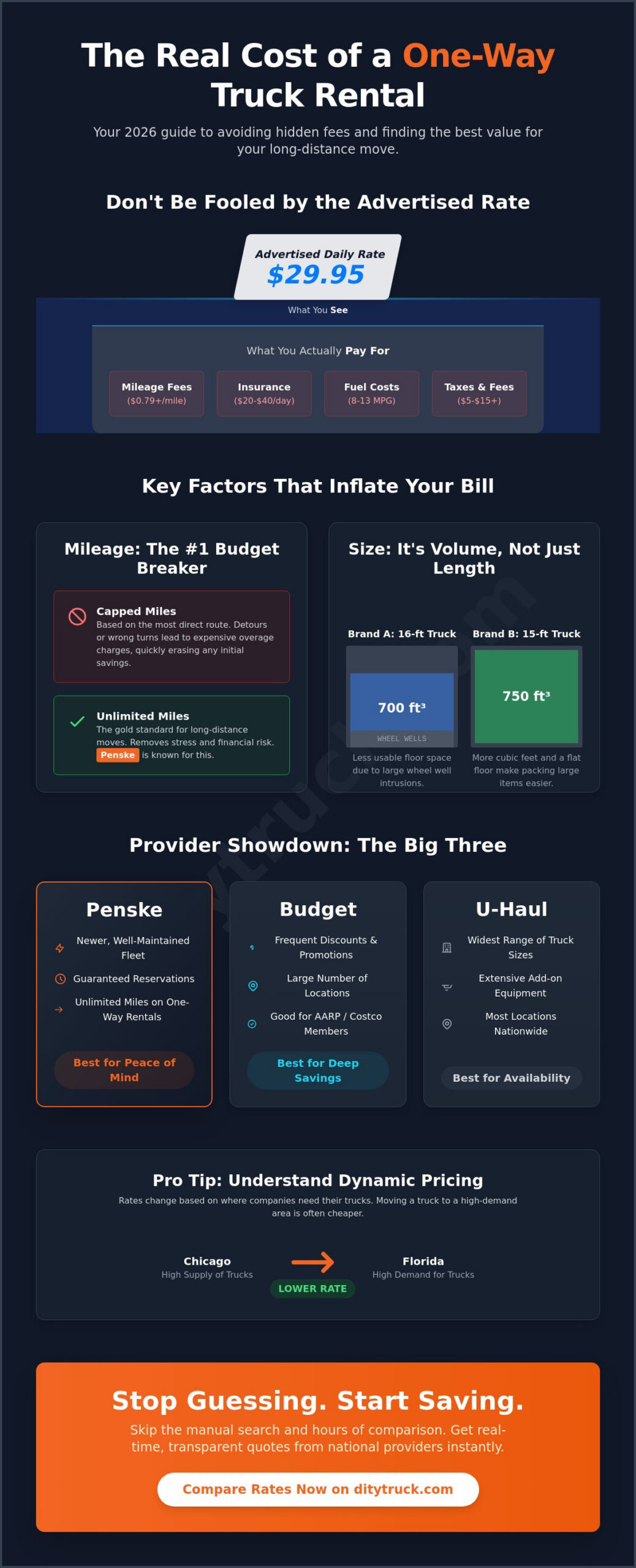
    Truck rental companies are essentially inventory managers. They want their trucks in cities where people are moving out, not where they are moving in. If a branch in a city like Chicago has too many 16-foot trucks, they’ll drop the price significantly to encourage someone to drive that truck to a high-demand area. This is why your destination choice impacts the price so heavily. Moving to popular southern states like Texas or Florida often costs more because trucks rarely leave those regions once they arrive. In 2026, booking early has become even more vital. With the global truck rental market valued at over $45 billion, availability for popular routes can vanish in days. A smart one way truck rental comparison helps you spot these inventory gaps before the cheaper trucks are gone.

    Key Factors in a One-Way Truck Rental Comparison

    The base price of a rental is rarely the price you actually pay. A true one way truck rental comparison requires you to look past the large numbers on the homepage. You have to dig into the variables that change based on your route and truck size. This includes everything from protection plans to specific equipment fees. Understanding these details now prevents a massive bill at the drop-off location. It turns a stressful move into a managed project.

    Mileage Policies: Unlimited vs. Capped

    Mileage is the biggest wild card in your moving budget. Some companies cap your miles based on the most direct route between your zip codes. If you take a wrong turn or a scenic detour, you pay for every extra mile. These overage charges can erase your savings in a single afternoon. Unlimited mileage is a massive win for cross-country moves. It removes the stress of tracking every exit. You should specifically check for Penske truck rental mileage offers. They are well known for including unlimited miles on one-way trips. It simplifies your journey. No math. No overage charges. Just drive.

    Comparing Cargo Volume and Dimensions

    Don’t trust the length alone. A 16-foot truck from one brand might have significantly less usable space than a 15-foot truck from another. You must compare the cubic feet of usable volume. Wheel well intrusions often eat up valuable floor space. This makes packing large furniture difficult. According to a report on the Best Truck Rental Moving Companies, interior height and width vary wildly across the major national brands. Sometimes, renting a slightly larger truck is actually cheaper. If a company has too many 26-foot trucks in stock, they might price them lower than the 16-foot models. It is an inventory game that pays to play.

    Protection plans also impact your final cost. Insurance for a moving truck typically costs between $20 and $40 per day. Don’t skip this. But do compare the levels of coverage provided. You also need to account for environmental fees. These generally range from $5 to $15 per rental. Then there is fuel. A 26-foot truck gets roughly 8 to 13 miles per gallon. On a 1,000-mile move, this is a significant expense. If you are towing a car, a tow dolly or auto transport carrier adds daily fees. These aren’t always shown in the initial search results. You can compare these total costs side-by-side to avoid surprises at the rental counter. This level of transparency is the only way to find the actual lowest rate for your move.

    One Way Truck Rental Comparison: How to Find the Best Rates in 2026

    Comparing the Big Three: Penske vs. Budget vs. U-Haul

    Choosing a provider is about matching your specific move to a company’s business model. All three major players get you from point A to point B. However, the experience and final invoice will look very different. A thorough one way truck rental comparison reveals that Penske often wins on reliability. Their fleet is younger on average. This means you are less likely to deal with a breakdown in the middle of a long-distance haul. They also offer 24/7 roadside assistance as a standard. It provides peace of mind when you are crossing state lines with everything you own.

    U-Haul is the king of accessibility. They have over 20,000 locations across North America. This makes drop-offs incredibly easy, even in remote or rural areas. If you are moving to a town with only one stoplight, U-Haul is likely your only local option. Budget targets the price-conscious mover. They frequently offer aggressive discounts, such as 25% off for Costco members. They are the go-to for shoppers who prioritize the bottom line over a brand-new vehicle.

    Pricing Structures Side-by-Side

    Budget truck rental utilizes a tiered pricing system for one-way moves. Rates fluctuate daily based on equipment demand in your destination city. It is a dynamic model. U-Haul often advertises low base rates, like $19.95 or $39.95 for local moves. For one-way trips, these shift into a flat-rate quote. This quote includes a set number of days and miles. You must watch for after-hours return fees, which can add $20 to your bill if you don’t use their mobile app. Deposit requirements also differ. Penske typically requires a credit card. U-Haul may allow cash rentals but requires a much higher upfront deposit to secure the truck.

    Equipment and Towing Capabilities

    Loading a truck is the hardest part of any DIY move. U-Haul trucks feature a “Low Deck” design. This keeps the loading ramp at a shallower angle. It saves your back when moving heavy appliances. Penske and Budget trucks often sit higher off the ground. They require more physical effort to navigate the ramp. If you are bringing a vehicle, all three providers offer tow dollies and car carriers. A car carrier is usually preferred for long distances. It keeps all four wheels off the ground to prevent transmission wear. Availability for these trailers is tighter than for the trucks themselves. Always perform a one way truck rental comparison for the full package, including your towing gear, to ensure everything is waiting for you on moving day.

    How to Compare and Book Your One-Way Rental (Step-by-Step)

    Finding the right rate is a methodical process. It requires organization. You can’t just click the first advertisement you see. A proper one way truck rental comparison follows a logical sequence. It moves from identifying internal needs to evaluating external options. This ensures you don’t overpay for empty space or get hit with emergency fees for a truck that’s too small. It’s about precision and timing.

    Step 1: Audit Your Inventory and Size Needs

    Start inside your home. Perform a room-by-room count of your belongings. Estimate your total cubic footage based on large furniture items and box counts. Most people underestimate their volume. Always size up by 10 to 15 percent for one-way moves. This buffer prevents you from leaving valuable items behind on the curb. Items like bicycles, floor lamps, and yard tools often take up more volume than their weight suggests. A 16-foot truck is often sufficient for a one-bedroom apartment. However, a two-bedroom home almost always requires a 22-foot or 26-foot model to avoid a logistical nightmare. Read our moving truck rental guide for detailed size charts that match house sizes to specific truck lengths.

    Step 2: Use a Comparison Tool for Real-Time Rates

    Efficiency is key. Don’t open twenty browser tabs. It leads to confusion and missed details. Use a centralized platform to see all rates at once. Filter by your specific pickup and drop-off dates. This helps you identify rental trucks for moving near me that offer the best one-way terms. Dynamic pricing means a rate you see at 10:00 AM might change by noon. Booking the moment you find a favorable quote locks in your rate against sudden inventory shifts. Mapping your route early also helps you stay within the capped mileage limits of providers like U-Haul or Budget. For a deeper look at how costs stack up across state lines, our long distance moving truck rental guide breaks down every major cost driver so you can plan with confidence.

    Step 3: Finalize the Reservation and Protection Plan

    The checkout screen is where hidden fees live. Audit the total price before entering your credit card info. Expect insurance to cost between $20 and $40 per day. Compare these Damage Waivers against your personal insurance coverage. Many personal policies don’t cover commercial trucks over a certain weight. Look for environmental fees, which usually range from $5 to $15. Verify the guaranteed status of your reservation. Some companies only guarantee a truck size, not the specific pickup location. Confirm your drop-off site to avoid wrong-site surcharges. Check for 24/7 roadside assistance inclusion in your contract. It’s a non-negotiable requirement for long-distance hauls.

    You can compare and book your truck in minutes using our streamlined tool. It strips away the complexity of logistics. You get clear, honest pricing instantly. No surprises. Just a straightforward move.

    Simplify Your Move with DityTruck Comparison Services

    Moving across the country is a high-stakes task. It often feels like a second job. You spend hours hunting for deals. You worry about hidden fees. DityTruck strips away this complexity. We replace stress with confident simplicity. Our platform acts as your savvy consumer advocate. We do the heavy lifting behind the scenes. You get the results. A thorough one way truck rental comparison shouldn’t be a math project. We aggregate real-time rates from the top national providers instantly. This gives you a friction-free solution for your logistics needs. No fluff. Just the data you need to make a move.

    Transparent pricing is our priority. The industry is famous for teaser rates. These prices look great until you reach the final checkout screen. We solve this. The quote you see on our platform is the price you pay. We include the variables that others hide. This includes environmental fees and basic protection costs. You gain financial honesty. You gain clarity. This is the shortest path between your current problem and a final resolution. Our tool is built for speed. It’s built for your peace of mind.

    Why Use a Comparison Platform?

    Individual rental sites are designed to sell you their specific inventory. They don’t want you to see a competitor’s better deal. We do. We provide access to exclusive rates. These discounts are often reserved for high-volume platforms. You won’t always find them on individual brand websites. You can view one way truck rentals for moving side-by-side. This allows you to spot the best value in seconds. You compare mileage policies. You compare equipment ages. You see the total cost. Everything is in one place. You get an instant booking confirmation. This removes the pickup day surprise that ruins so many moves. It’s a reliable tool for a modern relocation.

    Get Your One-Way Quote Today

    The booking process is streamlined. Start by entering your pickup and drop-off locations. Be specific with your dates. Select the truck size that fits your home. Our interface is designed for rapid decision-making. It works on your schedule. You can secure a reservation in minutes. This saves you hours of manual research. Our expert support team understands long-distance logistics. They help you navigate the specific hurdles of a cross-country haul. They act as your smart assistant. Use our one way truck rental comparison tool to lock in your 2026 rate today. Experience a move that is organized, reliable, and honest. Your new home is waiting, and if you are headed to the Detroit area, Detroit Furnished Rentals can make your transition seamless with their curated selection of move-in-ready lofts and apartments. Let’s get you there without the traditional hurdles.

    Secure Your Best One-Way Rate Today

    A successful long-distance move depends on clarity. You now know how dynamic pricing and inventory flow dictate your final bill. You understand that the lowest base rate isn’t always the cheapest option once mileage and insurance enter the equation. Finding the right truck requires looking at the total cost. It requires a strategy. Performing a final one way truck rental comparison is the only way to ensure you don’t overpay for your journey. You’ve identified the differences between major fleets. You’ve mapped your route. Now it’s time to lock in your savings.

    DityTruck simplifies this process. We provide real-time rate aggregation from major providers. You get direct booking access. We stand by our no hidden fee guarantee. You see the honest price immediately. No more jumping between tabs. No more math projects. Compare one-way truck rental rates and book your move now at DityTruck. Your move should be a fresh start, not a financial burden. We’re here to help you get there efficiently. Safe travels on the road ahead.

    Frequently Asked Questions

    Is it cheaper to do a one-way truck rental or a round trip?

    One-way rentals are almost always more cost-effective for long-distance moves. While the daily base rate for a round trip might look lower, you have to account for double the fuel and the time spent driving back. For a move across state lines, a one-way booking saves you hundreds in gas and lodging. It allows you to drop the truck and start unpacking immediately. You avoid the exhaustion of a return trip.

    Does Penske really offer unlimited mileage on all one-way rentals?

    Yes, Penske provides free unlimited mileage on all one-way truck rentals as of June 2026. This is a massive advantage for cross-country trips. It removes the stress of calculating the shortest route or paying for accidental detours. When you perform a one way truck rental comparison, this feature often makes Penske the most predictable choice for your total moving budget. You won’t have to worry about every exit you take.

    What are the most common hidden fees in one-way truck rentals?

    Environmental fees and after-hours return charges are the most frequent surprises. Environmental fees generally range from $5 to $15 per rental. If you return a U-Haul truck after hours without using their mobile app, expect a $20 convenience fee. Always check for cleaning charges as well. Returning a dirty truck can trigger a fee that wipes out your initial savings. These costs add up if you aren’t careful.

    Can I change my drop-off location after I’ve already started my move?

    You can change your destination, but it will cost you. Most companies will re-rate your entire contract based on the new location’s current demand. This often results in a significantly higher price or a “wrong-site” surcharge. Always call the rental company before you arrive at a different location. It’s better to negotiate the change early than to face a surprise bill at the counter. Transparency prevents expensive mistakes.

    What happens if I go over the mileage limit on a one-way rental?

    Going over your mileage limit results in a per-mile overage fee. These charges typically range from $0.40 to $1.00 for every extra mile driven. For long-distance moves, these small numbers add up fast. If your route is complex, look for providers with unlimited mileage. It’s the only way to guarantee your final price stays exactly where you planned. Don’t let a wrong turn break your moving budget.

    Do I need special insurance for a long-distance truck rental?

    Personal auto insurance policies often exclude commercial vehicles over a certain weight. You should check with your provider before you decline coverage. Supplemental insurance, like a Damage Waiver, usually costs between $20 and $40 per day. It protects you from high out-of-pocket costs if the truck is damaged. For a high-stakes move, this small daily cost provides essential peace of mind. It’s a friction-free way to protect your finances.

    How far in advance should I book a one-way truck rental for 2026?

    You should book at least two to four weeks in advance. During peak moving seasons like June or July, inventory disappears quickly. Booking early locks in your rate and ensures the specific truck size you need is available at your preferred location. If you wait until the last minute, you might be forced to drive a larger, more expensive truck or travel to a distant pickup site. Planning ahead saves money.

    Are there discounts for one-way moves for students or military members?

    Yes, most national providers offer specialized discounts. Penske frequently offers 10% or more off for college students and active-duty military. Budget provides a 25% discount for Costco members, which is a popular choice for one-way moves. Always mention your status during the one way truck rental comparison process to see which brand treats you best. These savings can easily cover the cost of your fuel or moving supplies.