Tag: moving truck sizes

  • 15 Foot Truck Rental: The Ultimate Size and Rate Comparison Guide for 2026

    15 Foot Truck Rental: The Ultimate Size and Rate Comparison Guide for 2026

    What if the difference between a smooth move and a total logistics nightmare is just three extra feet of cargo space? Most people fear renting a vehicle that is too small, only to find themselves stuck with a second trip or a sofa that simply won’t fit. You want a 15 foot truck rental that handles like a van but carries like a house. It is the Goldilocks choice for most two-bedroom moves. We understand the anxiety of staring at a driveway full of boxes and wondering if it will all actually fit inside the door.

    You deserve a clear path to the finish line without the headache of hidden mileage fees or confusing insurance add-ons. This guide provides a direct comparison of the best national rates and vehicle specs for 2026. We will help you confirm if this size is your perfect match, calculate the total cost including protection plans, and show you exactly how to secure a reliable truck from a top-tier provider. You can stop guessing and start moving with total confidence. Let’s find your truck.

    Key Takeaways

    • Confirm if the 750 to 850 cubic feet of space in a 15 foot truck rental fits your 1-2 bedroom home.
    • Get the precise interior dimensions to ensure your bulky furniture clears the 7-foot ceiling height.
    • Compare the strengths of top providers, like Penske’s fleet reliability versus Budget’s local pricing advantages.
    • Uncover the reality of mileage and insurance fees to avoid surprises when you see the final bill.
    • Learn how to use the DityTruck comparison tool to filter for medium trucks and secure your booking instantly.

    Is a 15-Foot Truck Rental the Right Size for Your Move?

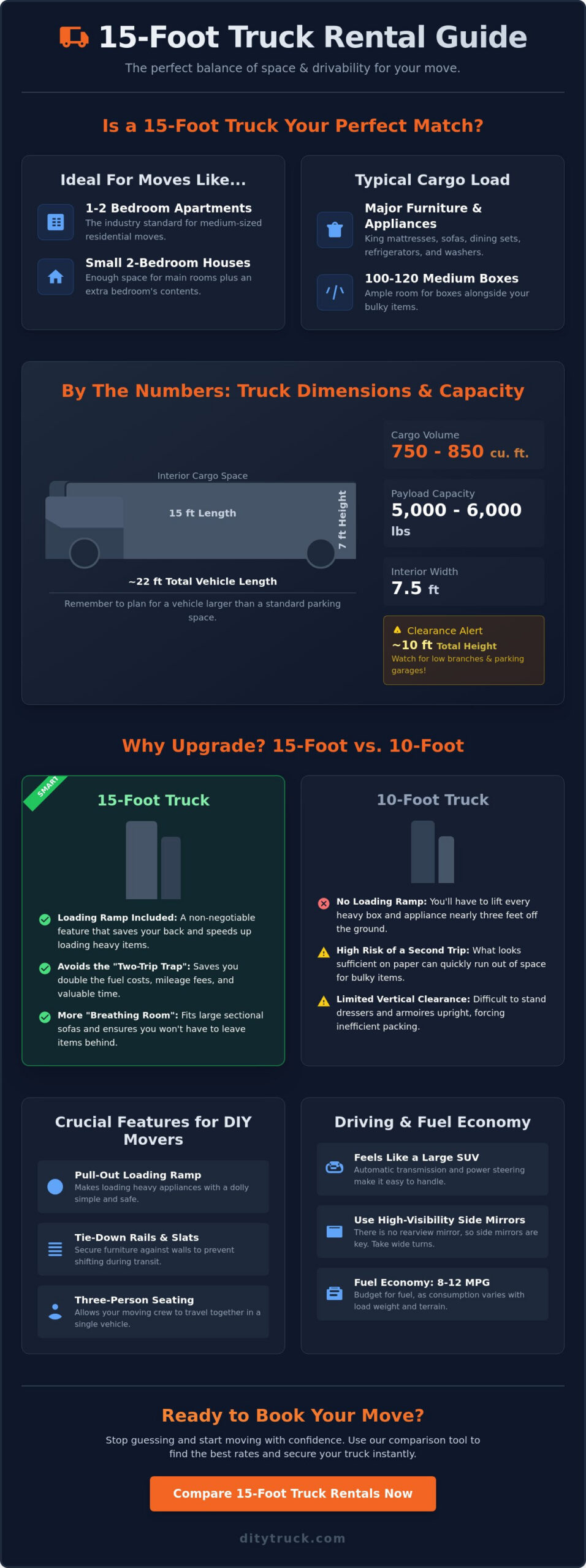
    A 15 foot truck rental is the industry standard for medium-sized residential moves. It occupies the essential middle ground between a small cargo van and a massive 26-foot freight truck. This specific type of box truck is designed for accessibility. It offers enough room for significant furniture without the intimidating wheelbase of a commercial semi-truck. Most standard 15-foot models provide between 750 and 850 cubic feet of storage space. This volume is generally ideal for 1-2 bedroom apartments or small 2-bedroom houses. It is the go-to choice for DIY movers who need a balance of high capacity and manageable drivability.

    The 15-Foot Inventory Checklist

    Capacity is about more than just cubic feet; it is about the physical footprint of your largest items. A 15 foot truck rental easily fits king-sized mattresses, large dining sets, and full-sized sofas. Unlike smaller vans, these trucks have the vertical clearance to stand dressers and armoires upright. You can expect to fit approximately 100 to 120 medium-sized moving boxes alongside your furniture. This size also accommodates major appliances that smaller vehicles cannot handle. If you are moving a refrigerator, a washing machine, or a dryer, the 15-foot model provides the necessary floor space and height. It even leaves room for awkward outdoor gear like bicycles or patio sets that often get left behind in smaller rentals.

    15-Foot vs. 10-Foot: When to Upgrade

    The jump from a 10-foot truck to a 15-foot model is often the smartest financial decision you can make. You should upgrade if your living room features a large sectional sofa or if you have a second bedroom. While a 10-foot truck might look sufficient on paper, it lacks a critical feature: the loading ramp. Most 15-foot models include a pull-out loading ramp that saves your back and speeds up the process. Without it, you are lifting every heavy box and appliance nearly three feet off the ground.

    Choosing the larger size helps you avoid the “two-trip” trap. Making two trips doubles your fuel costs and your mileage fees. It also drains your time. The extra 5 feet of length and additional overhead space act as an insurance policy against leaving items on the curb. If you are on the fence between sizes, the 15-foot option offers the breathing room needed to pack securely. It ensures you won’t have to play a high-stakes game of Tetris with your fragile belongings just to get the door closed.

    Understanding 15-Foot Box Truck Dimensions and Features

    The physical footprint of a 15 foot truck rental is larger than it appears in photos. You are managing a vehicle roughly 22 feet in total length. It typically stands 10 feet high. This height is critical for your route planning. You must watch for low-hanging branches, parking garage entrances, and apartment complex carports. Inside, the cargo area measures 15 feet long, 7.5 feet wide, and 7 feet high. These dimensions provide a square, usable box for stackable items. Most standard models handle a payload capacity between 5,000 and 6,000 lbs. This is more than enough for heavy solid wood furniture and dense boxes of books. Many providers use a low-deck design. This lowers the center of gravity and brings the floor closer to the pavement. Loading heavy items becomes a straightforward task rather than a vertical climb.

    Before you start loading your belongings, consult official consumer moving resources to understand your rights and safety requirements. Being informed prevents common logistical headaches during a high-stakes move.

    Crucial Features for DIY Movers

    Efficiency depends on the right tools. The pull-out loading ramp is a non-negotiable feature for a 15 foot truck rental. It slides out from under the deck to bridge the gap to the ground. You can wheel appliances up with a dolly instead of dead-lifting them. Inside the box, look for tie-down rails and wooden slats. These allow you to strap furniture against the walls to prevent shifting during turns. Most cabs feature three-person seating. This allows a couple with a helper to travel in one vehicle. It’s a small detail that simplifies the logistics of the trip.

    Driving a 15-Foot Truck: What to Expect

    Driving this vehicle is simpler than most people expect. Modern fleets use automatic transmissions and power steering. It feels remarkably like driving a large SUV. You won’t have a rearview mirror, but high-visibility side mirrors compensate for the blind spots. Take wide turns. Give yourself extra stopping distance. Fuel economy is a practical reality you should budget for. Most trucks in this class get between 8 and 12 MPG. This varies based on how heavy you pack and the terrain of your route. If you want to see which companies offer the most fuel-efficient fleets near you, compare local rental options before you commit to a booking.
    15 Foot Truck Rental: The Ultimate Size and Rate Comparison Guide for 2026

    Comparing the Best 15-Foot Truck Rental Providers in 2026

    Choosing the right provider for your 15 foot truck rental is just as important as choosing the right size. Each major company targets a specific type of mover. You don’t have to guess which one fits your needs. We’ve analyzed the top contenders to save you the legwork. Efficiency is the goal. Clarity is the result. Let’s look at how the big names stack up in the current market.

    Penske remains the top choice for those who value reliability above all else. They maintain one of the newest fleets in the industry. This means fewer breakdowns and better fuel efficiency on long hauls. If you’re moving across several states, their 24/7 roadside assistance and well-maintained vehicles provide peace of mind. Budget, on the other hand, lives up to its name. They are often the price leader for local moves. They frequently offer significant discounts for mid-week bookings and one-way trips. If your primary goal is the lowest possible base rate, Budget is usually your first stop.

    U-Haul offers the most pickup and drop-off locations in North America. This ubiquity is their greatest strength. You can find a U-Haul lot in almost every small town and major city. However, fleet age can vary significantly between locations. You should inspect the specific truck before you sign the paperwork. Enterprise caters to a different niche. Their 15-foot trucks are often commercial-grade. They frequently feature higher roofs than their competitors. This extra vertical space is a game-changer for tall armoires or stacked appliances. They are an excellent choice if your inventory includes professional equipment or oversized furniture.

    Local vs. One-Way Rental Differences

    The type of move you’re making changes how you should compare rates. Local moves are straightforward. You pay a low daily rate plus a fee for every mile you drive. This is perfect for across-town shifts where you return the truck to the same lot. One-way rentals are different. These usually involve a flat-rate package that includes a set number of days and an estimated mileage allowance. This provides the flexibility to drop the vehicle off at your destination. For a deeper look at state-to-state logistics, explore our guide on One Way Truck Rentals to find the best deals for 2026.

    The DityTruck Comparison Advantage

    You can stop switching between five different browser tabs. We’ve built a system that brings all these providers into a single view. You get real-time availability updates for 15-foot trucks across the country. Our platform prioritizes transparent pricing. We include estimated mileage and basic fees in our results so you don’t face sticker shock at the counter. It’s the smart assistant you need to find the shortest path between your old home and your new one. You see the rates. You make the choice. You get moving.

    Estimating Costs and Finding the Best 15-Foot Truck Rates

    Advertised rates for a 15 foot truck rental are often just the starting point. You see a low daily price and assume that’s the end of the story. It rarely is. That number usually excludes mileage, taxes, and mandatory fees. For a local move, the mileage fee is typically your largest variable expense. You need to map your route exactly. Include the distance to the rental lot, the trips between homes, and the return journey. Booking 2-4 weeks in advance is the optimal window for 15-foot truck savings. Planning ahead secures the vehicle and locks in the most competitive base rate before demand spikes.

    Timing dictates your total cost. Moving on a Saturday or during the final days of the month will cost you significantly more. Demand peaks during these windows; prices follow. If your schedule allows for flexibility, aim for a mid-week move. Booking on a Tuesday or Wednesday often results in better vehicle availability and lower rates. You avoid the weekend rush and the premium pricing that comes with it. To get an honest look at your total move cost, compare transparent truck rental rates before you commit to a provider.

    Moving Insurance and Protection Plans

    Don’t assume your personal auto insurance covers a 15 foot truck rental. Most standard policies and credit cards specifically exclude commercial box trucks. You need to understand the difference between damage waivers and cargo insurance. A damage waiver is often a smart investment for a 15-footer. It releases you from financial responsibility if the truck is scratched or dented. Cargo insurance is different; it protects your belongings inside the box rather than the vehicle itself. Liability coverage is also essential if you aren’t already covered for accidents involving large trucks. Review your existing documents before you reach the rental counter.

    Hidden Fees to Watch For

    Small charges add up quickly on your final invoice. You will likely see an environmental fee. This covers the cost of disposing of oil, tires, and other fluids. Fuel surcharges are another common hurdle. If you don’t return the tank at the exact level you started, the company will charge you a premium price per gallon to refill it. You can also avoid a $50 cleaning fee with just 10 minutes of sweeping. Rental companies expect the cargo area to be free of dirt and debris. Late return penalties are the most expensive mistake you can make. Missing your drop-off window by even one hour can trigger a full extra day of rental charges and insurance fees.

    How to Book Your 15-Foot Rental Truck Through DityTruck

    Securing a 15 foot truck rental doesn’t have to be a multi-hour project. Our comparison tool streamlines the entire process into a few clicks. Start by entering your pickup location and move date. This immediately narrows down the available inventory in your specific area. The DityTruck interface is built for speed. You don’t need to navigate complex menus or decipher industry jargon. Just input the basics. The tool does the heavy lifting by pulling live data from national providers.

    You can then filter for “Medium Truck” or “15 Foot” to see results tailored to your load size. This view allows you to compare total estimated costs side-by-side from top brands like Penske and Budget. You see the base rate, the mileage estimates, and the pickup locations in one transparent list. This eliminates the need to visit multiple websites or call local agents for quotes. Once you’ve found the best fit, select your provider and finalize your reservation in minutes. It’s the shortest path between planning and packing.

    Preparing for Pickup Day

    Efficiency continues at the rental counter. You need two critical documents: a valid driver’s license and a major credit card. Most people rush through the pickup process, but taking your time pays off. Perform a thorough pre-trip inspection before you drive off the lot. Walk around the vehicle and document every scratch or dent with your phone camera. If you see a scuff on the box that isn’t listed on the provider’s report, point it out immediately. This protects you from being charged for pre-existing damage when you return the vehicle.

    Pay close attention to the fueling policy too. Returning the truck full is always cheaper than paying the rental company’s premium refill rate. Check the tire tread and the wiper blades before you leave. A 15-foot truck is a large machine. You want it in peak condition before you hit the highway. Ensuring the vehicle is ready for the trip prevents delays and keeps your move on schedule. Taking ten minutes to verify these details saves you hours of frustration later.

    Start Your Comparison Now

    Don’t overpay by sticking to a single brand out of habit. Prices for a 15 foot truck rental fluctuate daily based on local demand and seasonal trends. A 2-bedroom home requires a specific amount of space. Choosing a 15-foot truck ensures you won’t leave your favorite armchair behind. Get the right size for your move today by seeing all your options in one place. You deserve a move that is both budget-friendly and stress-free. Compare 15-foot truck rental rates now and lock in your vehicle before the best deals disappear.

    Finalize Your 2026 Moving Strategy

    Choosing a 15 foot truck rental is the smartest way to balance cargo capacity with ease of driving. You now know that this size comfortably fits a 2-bedroom home while offering the essential loading ramp that smaller vans lack. By identifying the differences between providers like Penske and Budget, you can avoid the expensive “two-trip” trap. You don’t have to spend hours hunting for the best rate or worrying about hidden mileage costs.

    Logistics should be simple. DityTruck removes the guesswork by letting you compare Penske, Budget, and U-Haul in one place. Our comparison tool shows you the total cost with no hidden fees. This provides the transparency you need for a stress-free transition. We are trusted by thousands of DIY movers annually to find the most efficient path forward. Stop switching tabs and start packing. Find and Book the Cheapest 15-Foot Truck Rental today. Your new front door is closer than you think.

    Frequently Asked Questions

    Is a 15-foot truck big enough for a 2-bedroom apartment?

    Yes, a 15-foot truck is generally the perfect size for a 2-bedroom apartment or a small 2-bedroom house. These vehicles offer between 750 and 850 cubic feet of storage space. This volume allows you to fit several large furniture items, such as a king-sized bed and a sofa, alongside approximately 100 boxes. It provides the necessary breathing room to pack securely without needing a second trip.

    Do I need a special license to drive a 15-foot rental truck?

    No, you do not need a commercial driver’s license (CDL) to operate a 15 foot truck rental for personal use. A standard, valid driver’s license is sufficient for all major rental providers in the United States and Canada. These trucks are classified as light-duty or medium-duty vehicles. Just ensure you are comfortable with the vehicle’s height and wider turning radius before you hit the road.

    How much weight can a 15-foot box truck hold?

    A standard 15-foot truck can typically hold between 5,000 and 6,000 lbs of cargo. Specific capacities vary by brand; for example, a U-Haul 15-foot model has a maximum load of 6,385 lbs. Enterprise commercial trucks in this class may have a payload capacity of up to 4,300 lbs. Always check the specific gross vehicle weight rating (GVWR) on your rental agreement to ensure you don’t overload the suspension or tires.

    Does a 15-foot rental truck have a loading ramp?

    Yes, almost every major rental company includes a pull-out loading ramp with their 15-foot models. This feature is a primary reason many movers upgrade from a 10-foot truck, which often lacks a ramp. The ramp slides out from under the deck to create a steady incline. This allows you to use a utility dolly to move heavy appliances and furniture safely. It reduces physical strain and speeds up the loading process significantly.

    What is the gas mileage for a 15-foot moving truck?

    You should expect to get between 8 and 12 miles per gallon during your move. Fuel economy depends heavily on the total weight of your cargo and the terrain of your route. A fully loaded truck climbing through mountain passes will consume more fuel than an empty truck on a flat highway. Plan your budget for frequent fuel stops. Remember that these vehicles typically run on regular unleaded gasoline or diesel, depending on the specific fleet model.

    How much does it cost to rent a 15-foot truck for a one-way move?

    One-way pricing depends on the distance of your move and current demand at your destination. Companies often use flat-rate packages for one-way trips that include a set number of days and a mileage allowance. This differs from local moves, which usually charge a low daily rate plus a fee for every mile driven. To get an accurate total, use a comparison tool to see real-time rates that include all basic fees and protection plans.

    Can three people sit in the cab of a 15-foot truck?

    Yes, most 15-foot moving trucks feature a bench seat designed for three adults. This cab configuration includes three separate seatbelts to ensure everyone stays safe during transit. It is a convenient feature for small families or a driver traveling with two helpers. However, the middle seat can be narrow. If you are planning a long-distance trip, ensure everyone has enough legroom for a comfortable journey.

    Is a 15-foot truck difficult to drive for a beginner?

    Most beginners find a 15 foot truck rental surprisingly easy to handle. These vehicles feature automatic transmissions, power steering, and power brakes, which make them feel similar to a large SUV. The most significant adjustments are the lack of a rearview mirror and the vehicle’s 10-foot height. You must rely on your side mirrors and take wider turns than usual. Give yourself extra stopping distance and always stay alert for low-hanging branches or bridge clearances.
  • What Size Moving Truck Do I Need? A Universal 2026 Comparison Guide

    What Size Moving Truck Do I Need? A Universal 2026 Comparison Guide

    What if the 16-foot truck you’re eyeing is actually a recipe for a two-day headache? Most people guess their load size and end up either making three extra trips or paying for a massive, half-empty cargo hold. You don’t want to realize you’re out of room while the sun is setting and your couch is still on the sidewalk. It’s equally stressful to navigate a vehicle that feels way too large for your comfort level. Determining what size moving truck do I need shouldn’t feel like a high-stakes gamble.

    We understand that logistics are stressful enough without the math. This guide strips away the complexity to give you a clear, inventory-based recommendation. You’ll find the perfect balance between volume and weight capacity so your move stays safe, legal, and efficient. We promise to help you avoid wasted space and unnecessary costs. Our goal is to replace your moving anxiety with total clarity and simple, actionable steps.

    We will break down everything from 10-foot vans to 26-foot giants. You’ll learn how to estimate your cubic footage like a pro and discover how to lock in the lowest rates for the exact size you require.

    Key Takeaways

    • Master the “Goldilocks” principle. Avoid paying for empty space or making costly second trips.
    • Understand why room counts fail. Use cubic feet for a precise, reliable measurement of your belongings.
    • Follow our simple inventory audit. Finally answer what size moving truck do I need with total confidence.
    • Apply the 10-box-per-room rule. Prevent mid-move space shortages by accurately estimating your total box volume.
    • Compare real-time rates. Find the most cost-effective option for your specific move by viewing all brands in one place.

    Why Choosing the Right Moving Truck Size Is Your Biggest Money-Saver

    Determining what size moving truck do I need is the most impactful decision you’ll make for your budget. It’s the “Goldilocks” principle of logistics. A truck that is too small leads to a disaster. A truck that is too large is a waste of your hard-earned cash. Every extra inch of unused space represents money spent on fuel and higher daily rates. You don’t want to pay for air. Conversely, running out of room mid-day creates a bottleneck that can double your costs instantly.

    Efficiency starts with your wallet. Larger vehicles are heavier and less aerodynamic. They naturally return lower fuel economy. If you choose a 26-foot truck for a job that a 15-foot truck could handle, you are paying to burn more gas. Mileage fees also add up quickly. Most local rentals charge between $0.70 and $1.00 per mile. If you make a second trip because you underestimated the load, you pay those mileage fees twice. You also double your fuel consumption and your time on the road.

    The Cost of the Wrong Choice

    The math of a second trip is brutal. If your destination is 20 miles away, a second trip adds 40 miles to your total. At a standard rate of $0.85 per mile, that is an extra $34 just in mileage. Add the extra gas for a heavy truck and you’ve easily spent more than the cost of a larger rental. Time is your most valuable asset. A second trip can add four hours to your day. This leads to fatigue and unnecessary stress. There is also the risk of damage. Packing a truck that is too large often leaves gaps. Gaps allow furniture to shift during transit. Shifting cargo leads to broken legs on tables or cracked screens. A properly sized truck allows for a tight, secure load; this protects your belongings.

    Understanding the Industry Standard

    National rental providers don’t always use the same labels. One company might market a 12-foot vehicle as a “small truck.” Another might call it “medium.” This inconsistency makes it hard to answer the question: what size moving truck do I need? To find clarity, you must look past the marketing names. Focus on the standard moving truck sizes and their actual interior dimensions.

    Internal cubic footage is the only metric that matters. The length of the truck provides a baseline. The height and width of the box determine the total volume. By understanding these categories, you can make a logical choice. Choosing the right size saves money. It allows you to move faster. It ensures you only pay for the space you actually use. Efficiency is the shortest path to a successful moving day.

    Standard Moving Truck Sizes: From Cargo Vans to 26-Foot Box Trucks

    Most rental companies label their fleets with simple numbers, but these designations can be deceptive. A 10-foot truck from one provider may have significantly less interior volume than a 10-foot truck from another. This inconsistency is why answering the question what size moving truck do I need requires looking at the actual cubic footage. You are renting space, not just a length of metal. Understanding these categories helps you visualize your inventory inside the cargo hold.

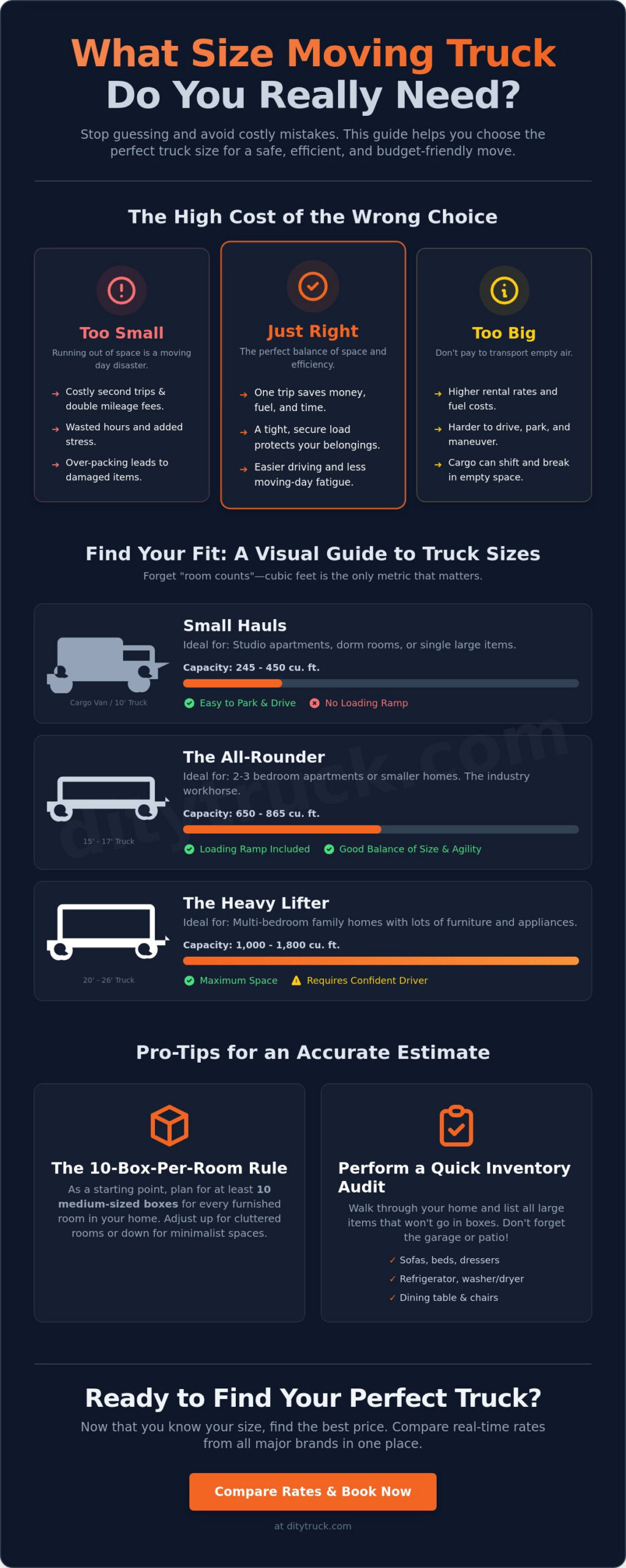
    The industry generally divides trucks into four main tiers. Cargo vans and pickups offer 245 to 320 cubic feet of space. Small box trucks, ranging from 10 to 12 feet, provide 350 to 450 cubic feet. Medium trucks between 15 and 17 feet jump to 650 to 865 cubic feet. Finally, large 20 to 26-foot trucks offer a massive 1,000 to 1,800 cubic feet. You can compare these dimensions across all major brands on ditytruck.com to see which fleet matches your inventory.

    Small Scale: Vans and 10-Footers

    Cargo vans and 10-foot trucks are the preferred choice for studio apartments, dorm rooms, or small office relocations. They are incredibly agile in urban environments. You can park these vehicles in standard residential spots or navigate tight city alleys with ease. This saves you from the stress of blocking traffic or receiving parking tickets. However, there is a crucial limitation to consider. Most cargo vans and 10-foot models do not include loading ramps. You will have to lift every box and appliance into the back by hand. This makes them ideal for boxes and small items, but difficult for heavy dressers or refrigerators. If you have any large furniture, skipping the ramp might be a painful mistake.

    The Family Move: 15 to 26-Foot Trucks

    The 16-foot truck is the industry workhorse. It is the most popular choice for the average family living in a two-bedroom apartment or a small home. These vehicles strike a perfect balance between capacity and drivability. They almost always include wide loading ramps and low decks. A low deck height means you don’t have to push heavy items up a steep incline. This reduces physical strain and speeds up the loading process.

    For larger three to five-bedroom households, the 26-foot truck is the standard requirement. These heavy-duty vehicles are designed for massive loads and long distances. They also offer superior towing capabilities. If you need to attach a car trailer or a tow dolly, you generally need at least a 15-foot truck to handle the weight safely. Always verify the towing capacity before you book. Choosing a truck with a built-in ramp and towing hitch ensures your entire household, including the family car, moves in a single trip.

    What Size Moving Truck Do I Need? A Universal 2026 Comparison Guide

    Beyond Room Counts: Understanding Cubic Feet and Weight Capacity

    Room counts are a trap. A “three-bedroom home” label is a vague marketing term used by rental companies to simplify a complex choice. It assumes a standard amount of furniture that may not match your reality. A minimalist’s bedroom is vastly different from a room filled with heavy oak dressers and floor-to-ceiling bookshelves. To accurately answer what size moving truck do I need, you must look at the math of cubic feet and weight capacity.

    Total volume is the primary metric for most moves. However, volume alone doesn’t tell the full story. You must also consider the Gross Vehicle Weight Rating (GVWR). This is the maximum weight the vehicle can safely carry, including the truck itself, passengers, fuel, and your cargo. Ignoring this limit leads to safety hazards and potential legal fines. It’s about more than just fitting everything inside; it’s about making sure the truck can actually move it.

    Cubic Feet vs. Real-World Space

    Visualizing cubic feet is difficult. It’s helpful to think in terms of stackable units. However, you should never plan to use 100% of the advertised space. We recommend the 80% rule. This accounts for awkward gaps between furniture, odd-shaped items, and the necessary air space for padding. If a truck offers 800 cubic feet, plan to fit about 640 cubic feet of actual inventory. This buffer prevents you from having to force items into tight spots, which often causes damage.

    High ceilings in modern box trucks change your packing strategy. You must stack items vertically to maximize the floor plan. Many trucks also feature an overhead compartment known as “Mom’s Attic.” This space is perfect for fragile items or light electronics that need to stay away from heavy furniture. Using this overhead space effectively can be the difference between needing a larger truck or fitting everything into a medium-sized one. If you’re asking what size moving truck do I need for a long-distance haul, these vertical dimensions become your best friend.

    The Weight Factor

    Weight capacity is often the hidden limitation of a move. Standard movers estimate between 1,000 and 1,500 pounds of weight per fully furnished room. Heavy appliances like refrigerators, washing machines, and cast-iron tubs add up quickly. A 16-foot truck may have the volume for your items but might struggle with the total payload if you’re moving heavy machinery or dense book collections.

    Overloading a truck is dangerous. It significantly increases your braking distance. It puts extreme stress on the tires, which leads to blowouts on the highway. In some states, rental trucks are required to stop at weigh stations. If you exceed the GVWR, you may face heavy fines or be forced to unload items on the spot. If your inventory is exceptionally heavy, it’s often smarter to opt for a 26-foot truck simply for its higher weight rating. This ensures a safer drive and keeps you compliant with federal regulations.

    The Inventory Audit: How to Accurately Estimate Your Load

    Answering the question what size moving truck do I need requires a methodical inventory audit. Guessing leads to stress and wasted money. A systematic approach ensures you book the right vehicle the first time. Follow these four steps to eliminate the guesswork and move with confidence.

    • Step 1: Identify your anchors. Count every “large footprint” item. This includes beds, sofas, dining tables, and large appliances. These pieces dictate the floor plan of the truck.
    • Step 2: Estimate your box count. A reliable rule of thumb is to allow 10 boxes per furnished room. This provides a baseline for the stackable portion of your load.
    • Step 3: Account for the garage factor. Don’t forget outdoor tools, patio gear, and bicycles. These items are often bulky and consume significant volume.
    • Step 4: Compare the totals. Take your total estimated volume and check it against the truck’s actual internal dimensions.

    Measuring Your Largest Items

    Moving is a game of Tetris. You must think in three dimensions. Accurately answering what size moving truck do I need depends on your ability to stack. Measure the length, width, and height of your largest furniture pieces. This data allows you to visualize how they will fit together in a tight, secure load. Disassembling items is a game changer. Taking the legs off a table or breaking down bed frames can save up to 20% of your total truck space. This simple step often allows you to fit into a smaller, cheaper truck category.

    Identify non-stackable items early. Electronics, delicate antiques, and mirrors cannot have weight placed on top of them. These items create “dead space” in your load. You must account for this lost volume. If you have many fragile or odd-shaped items, you might need to step up one size to avoid crushing your valuables. It’s better to have a little extra breathing room than to stack heavy boxes on a vintage lamp.

    The Box Estimation Guide

    Boxes are the building blocks of your move. Standard small boxes are roughly 1.5 cubic feet. Medium boxes are 3 cubic feet. Large boxes reach 4.5 cubic feet. Using uniform box sizes makes the loading process much faster. They stack securely and leave fewer gaps. If you use a mix of random containers, you’ll lose space to “honeycombing.” This is when items don’t fit snugly, leaving pockets of empty air you still have to pay for.

    Don’t forget the oddballs. Items like vacuum cleaners, floor lamps, and yard tools don’t fit in boxes. They are awkward and consume more space than their weight suggests. A single bicycle can take up the same volume as six medium boxes. Once you have your total count, compare real-time truck availability to find the most efficient match for your specific inventory.

    How DityTruck Simplifies Your Search for the Perfect Rental

    Logistics shouldn’t be a gamble. You’ve calculated your cubic footage. You’ve analyzed your payload limits. Now you need a reliable way to find that specific vehicle without calling five different rental offices. DityTruck serves as your savvy consumer advocate. We strip away the traditional hurdles of truck rental. Our platform provides a transparent, friction-free path to your destination. It’s the fastest way to solve the puzzle of what size moving truck do I need.

    Pricing transparency is our priority. Most people worry about hidden fees or bait-and-switch rates. We present real-time pricing for every category. Whether you need a 10-foot van or a massive 26-foot box truck, the data is clear. You see the costs upfront. This allows for total financial clarity before you commit. You can compare rates across multiple providers at once. This ensures you never overpay for the space you require.

    One Search, Every Size

    DityTruck aggregates major national providers into a single, intuitive interface. You can view all top industry brands side-by-side. No more jumping between browser tabs. No more repeating your move details on multiple forms. You simply enter your location and date. The system does the heavy lifting for you. This creates momentum toward your goal. You get a birds-eye view of every available option in your local area instantly.

    Filtering is where the efficiency happens. You can sort by truck type, length, or capacity. Match these filters to your recent inventory audit. If your audit showed you need 1,200 cubic feet, you can immediately narrow your search to 22-foot models. This is the smartest way to verify what size moving truck do I need based on real-time data. You see local availability across multiple national providers in one view. This saves hours of manual research. It gives you the confidence that you are getting the best deal in your area without the hassle of individual site searches.

    Secure Your Move Today

    Timing is everything in logistics. Approximately 62% of people who move choose the DIY route. This creates high demand for specific truck sizes, especially during peak season. If you wait until the last minute, you might be forced into a truck that is too large and expensive. Or worse, you might end up with a van that requires three trips. This leads to exhaustion and wasted fuel. Early action is the only way to protect your budget.

    Booking 4 to 6 weeks in advance is the golden rule. It secures your specific size before inventory runs low. DityTruck makes this reservation process simple. We charge a straightforward booking fee of $4.99 for local moves or $29.99 for one-way rentals. This small investment ensures your truck is ready when you are. It provides the peace of mind you deserve during a high-stakes task. Book Your Ideal Moving Truck Now and start your move with total confidence.

    Secure Your Moving Day Strategy

    Moving day success depends on preparation rather than guesswork. Room counts are just the beginning. The real math lies in cubic footage and payload capacity. Apply the 80% rule. Conduct a thorough inventory audit. These actions eliminate the risk of multiple trips. You won’t pay for a massive vehicle you don’t actually fill. These simple steps turn a high-stakes task into a manageable, logical process.

    Stop wondering what size moving truck do I need and start comparing your options with total clarity. DityTruck provides real-time pricing from top national providers. We offer a comprehensive selection from cargo vans to 26-foot trucks. Our transparent fee structure ensures you see the full financial picture before you book. Compare Moving Truck Sizes and Rates at DityTruck to secure the perfect vehicle for your timeline and inventory.

    You have the tools to move smarter. Logistics don’t have to be complicated when you have the right data. Take the next step. Finish your move with total confidence.

    Frequently Asked Questions

    Will a 10-foot truck fit a 1-bedroom apartment?

    A 10-foot truck usually fits a small one-bedroom apartment or a studio. These vehicles offer roughly 400 cubic feet of space. This is enough for a queen bed, a sofa, and about 20 boxes. If you have bulky appliances or a large dining set, you’ll likely need a 12-foot or 15-foot model instead. Always measure your largest items first to avoid making multiple trips.

    Is a 26-foot moving truck hard to drive for beginners?

    Driving a 26-foot truck requires extra focus but is manageable for most confident drivers. You must account for wider turns and significantly longer braking distances. Height clearance is the biggest risk. You have to watch for low-hanging branches and gas station awnings. Most beginners find that sticking to main roads and using a spotter for backing up makes the experience much safer.

    Can I tow my car behind a 16-foot rental truck?

    Yes, you can typically tow a vehicle behind a 16-foot rental truck. Most trucks in this size category come equipped with a towing hitch and the necessary engine power for a car trailer or tow dolly. Always verify the specific weight limits of the hitch before you depart. Towing adds length and complexity to your drive. It also decreases your fuel economy during the trip.

    What happens if I rent a truck that is too small?

    Renting a truck that is too small usually results in a second trip. This doubles your mileage fees and your fuel costs. If you’re moving long-distance, you might be forced to leave belongings behind or rent a second vehicle at the last minute. This creates massive stress and unexpected expenses. It’s always safer to choose one size larger than your initial estimate to provide a volume buffer.

    Do I need a special license to drive a large box truck?

    You do not need a Commercial Driver’s License (CDL) to rent most large box trucks. Standard rental trucks, even the 26-foot models, are designed to stay under the federal weight limit for non-commercial vehicles. A valid standard driver’s license is sufficient. However, you must be at least 18 or 21 years old depending on the rental provider’s specific policy. Always check state-specific requirements before booking.

    How much extra space should I leave in the truck for safety?

    We recommend following the 80% rule for loading. Leaving 20% of the truck’s volume empty provides a necessary buffer for awkward furniture shapes and padding materials. This prevents you from forcing items into tight spots; this reduces the risk of scratches or structural damage. A loosely packed truck is actually more dangerous because items can shift. Use tie-downs to secure the load within that available space.

    Does the truck size affect the price of insurance?

    Yes, the size of the vehicle often impacts the cost of your rental insurance. Larger trucks have a higher replacement value and carry more potential for damage in a collision. Providers usually offer tiered protection plans based on the truck’s size and the distance of your move. Reviewing these options helps you answer what size moving truck do I need while staying within your total insurance budget.

    What is the most popular truck size for a 3-bedroom house?

    The 26-foot truck is the most popular and reliable choice for a three-bedroom house. It provides up to 1,800 cubic feet of space. This capacity allows you to fit large appliances, multiple bedroom sets, and a full living room without the fear of running out of room. If you are a minimalist, a 22-foot truck might suffice. Most families prefer the extra space of the 26-footer for peace of mind.