
What if the most expensive part of your move isn’t the rental fee, but the six inches of space you didn’t account for? Standing in your driveway with a full truck and half a house left to pack is a logistics nightmare. Finding the right fit starts with a precise moving truck size calculator that cuts through the confusion of cubic feet and inconsistent brand labels. It’s the smartest way to ensure your furniture fits the first time without overpaying for empty air.
We know that moving is stressful enough without playing a high-stakes guessing game. You’ve likely felt the anxiety of staring at a stack of boxes and wondering if they’ll actually fit in one go. This guide will show you how to calculate the exact truck size you need for your specific inventory. You’ll avoid wasted space and secure the lowest possible price for your rental choice. We’ll break down sizing by room count, explain the inventory method, and compare top rental brands to get you moving with total confidence in 2026.
Key Takeaways
- Avoid the “second trip” nightmare by using the Goldilocks rule. It helps you find a truck that is neither too small nor too expensive.
- Use a moving truck size calculator to turn your inventory into precise cubic feet. This stops you from paying for empty air.
- Learn why truck dimensions vary between rental brands. Decipher nominal versus actual cargo space before you sign a contract.
- Master the inventory method and account for the “Tetris Factor.” This ensures your volume audit reflects real-world packing conditions.
- Move from estimation to booking. Use a comparison tool to filter the entire market and secure the lowest price for your specific size.
The Moving Truck Size Dilemma: Why Estimation Matters
Sizing is a balancing act. Too small, and you are left with leftovers on the sidewalk. Too large, and you are paying to transport empty air. This is the Goldilocks rule of logistics. You need a fit that is just right. In 2026, many rental fleets have standardized internal volumes. However, labels across the industry remain inconsistent. One provider’s “large” vehicle might be another’s “medium.” This makes a reliable moving truck size calculator essential for a friction-free move. It translates confusing marketing labels into actual cargo capacity.
Financial impact is the most immediate concern. Wrong sizing leads to mileage overages and wasted fuel. Safety is also a priority. An overstuffed truck is a road hazard. It changes vehicle handling and increases braking distances. Understanding standard moving truck sizes provides a foundational classification before you book. It ensures you don’t push a vehicle beyond its intended mechanical capacity.
The Hidden Costs of the “Second Trip”
Guessing usually results in a 20% cost increase. It’s rarely a clean mistake. You pay for extra gas and additional mileage fees. Then there is the labor. Doubling your trips means doubling your exhaustion. The psychological toll is heavy. A move that should take six hours quickly turns into a twelve-hour ordeal. It’s a high-stakes task that requires clarity from the start. Don’t wing it. Use a moving truck size calculator to get a definitive recommendation.
Volume vs. Weight: What Actually Limits You?
Space isn’t your only constraint. You must account for the Gross Vehicle Weight Rating (GVWR). This is the maximum weight the vehicle can safely carry. A truck full of heavy books requires different sizing than one filled with lightweight sofas. Suspension limits are real. If you pack for volume but ignore weight, you risk a breakdown or a fine at a weigh station. Balance your cubic footage with these mechanical limits. It’s the shortest path to a successful, stress-free relocation.
Metrics for Success: Bedrooms, Boxes, and Cubic Feet
Finding the right fit requires the right metrics. Most people start with the Bedroom Method. It’s the industry standard for quick planning. If you have a two-bedroom home, you look for a truck marketed for two bedrooms. It’s simple but risky. This method assumes you have an average amount of furniture. It doesn’t account for your massive sectional or that basement full of power tools. For a more accurate result, professional movers use the Cubic Foot Method. This calculates the actual volume of every item. A moving truck size calculator bridges the gap between these two approaches. It gives you a data-driven starting point so you don’t overpay for empty space.
According to the official consumer moving guide, understanding your inventory is the first step in avoiding unexpected costs. You can also use the Box Count Method if you’re a minimalist. If most of your belongings fit in medium boxes, you can estimate your needs based on total box volume rather than furniture pieces. A medium box is roughly 3 cubic feet. If you have 50 boxes, that’s 150 cubic feet before you even count the furniture. Converting rooms into truck feet is a matter of density. For every fully furnished room, plan for about 150 to 200 cubic feet of truck space. This level of detail prevents the “second trip” disaster mentioned earlier.
Standard Room-to-Volume Conversion Chart
Use these benchmarks as a starting point. They represent the typical density of modern American households in 2026. These numbers help you narrow down your search before looking at specific brand inventory.
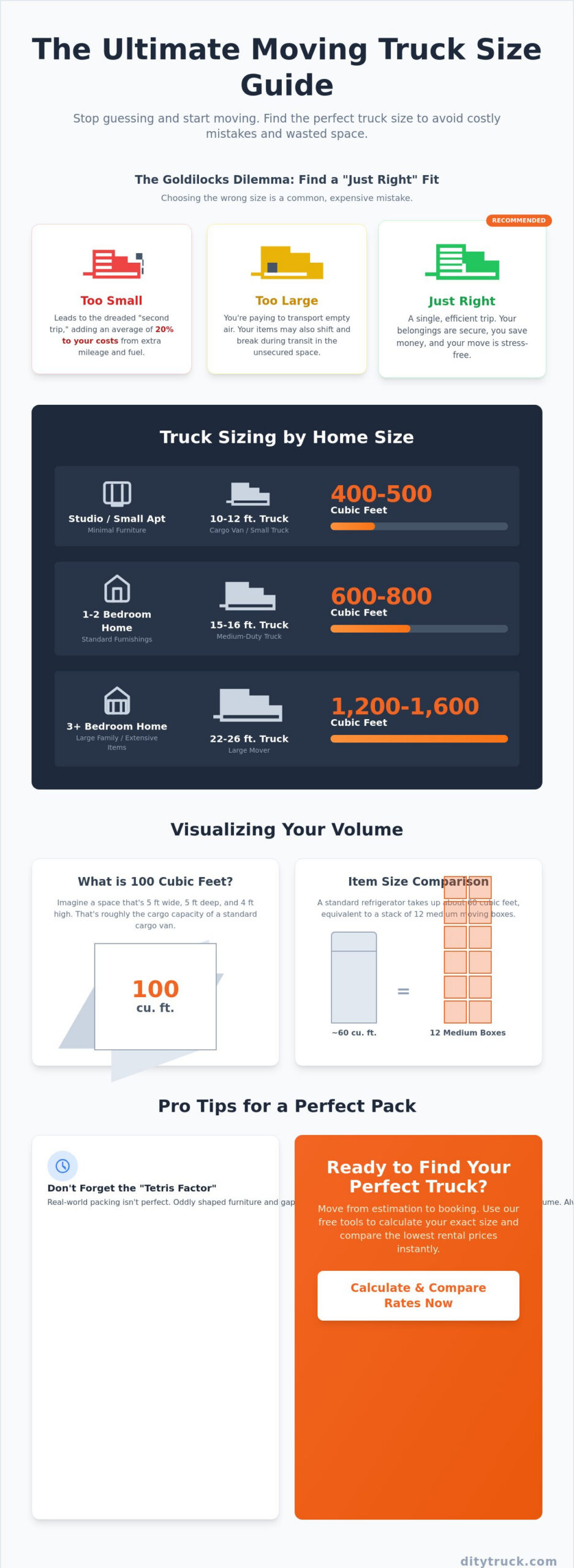
- Studio or Small Apartment: Requires a 10 to 12 ft truck. This provides approximately 400 to 500 cubic feet of cargo space.
- 1 to 2 Bedroom Home: Requires a 15 to 16 ft truck. This offers roughly 600 to 800 cubic feet.
- 3+ Bedroom Home: Requires a 22 to 26 ft truck. These larger vehicles provide 1,200 to 1,600 cubic feet of space.
Visualizing Cubic Feet: Real-World Examples
Cubic footage can be hard to picture. Think of your garage. A space that is 5 feet wide, 5 feet deep, and 4 feet high is exactly 100 cubic feet. That is roughly the size of a standard cargo van’s interior. For another comparison, consider a standard refrigerator. It takes up about 60 cubic feet of space. That same footprint could hold a stack of 12 medium moving boxes. A cubic foot is 1,728 cubic inches for precise inventory. Once you have these numbers, you can compare real-time rental rates based on your specific volume requirements. This ensures you only pay for the metal you actually need.
Universal Sizing Guide: Comparing Major Rental Brands
A 16-foot truck at one rental company isn’t the same as a 16-foot truck at another. This is a common industry challenge. Most providers use “nominal sizing,” which is a marketing label rather than a precise measurement of usable floor space. One brand might include the front bumper in their length calculation while another only measures the interior box. This inconsistency makes using a universal moving truck size calculator essential. It translates these confusing labels into actual cargo capacity so you can compare options accurately. You need to look past the sticker on the door to find the real usable volume.
The “Mom’s Attic” factor adds another layer of complexity to your choice. This is the storage compartment that extends over the truck cab. It adds significant cubic footage, but it isn’t floor space. You can’t put a heavy dresser or a refrigerator there. It’s designed for blankets, pillows, and fragile items. When you see a high volume rating, check how much of it is tucked into that attic. DityTruck simplifies this by aggregating these disparate sizes into a single comparison view. It strips away the marketing fluff to show what you’re actually renting. It’s about total transparency across the entire market.
Market Sizing Breakdown: Medium to Extra Large
The medium truck category, typically 15 to 17 feet, is the most popular choice for 2-bedroom moves. Some models in this range feature low deck heights to make loading heavy appliances easier without a steep ramp. Other providers utilize higher decks that align with loading docks. These might require more physical effort to load, but they often provide a smoother ride on the highway. The 26-foot truck remains the ceiling for DIY movers. It is the largest vehicle you can drive without a commercial driver’s license (CDL). It’s the heavy hitter for 4-bedroom homes and long-distance relocations.
Specialty Vehicles: When to Choose Vans and Pickups
You don’t always need a massive box truck. For dorm moves or studio apartments, a cargo van or pickup rental is often the smarter choice. These vehicles have higher availability for local moves and are much easier to park on tight city streets. If your moving truck size calculator shows a volume under 250 cubic feet, consider ditching the big rig. A smaller vehicle saves you money on fuel and insurance. It’s the shortest path to a quick, efficient move when you have a smaller inventory.
The Inventory Method: How to Calculate Your Load Manually
General estimates provide a baseline. However, a manual inventory audit offers the highest level of precision. This is where you account for the “Tetris Factor.” Professional movers are experts at utilizing every inch of a cargo hold. Most DIY movers are not. You must include a 15% safety buffer in your final calculation. This extra space accounts for the gaps between mismatched boxes and the awkward angles of your furniture. It’s the difference between a single trip and a midnight return to your old driveway. A moving truck size calculator works best when you feed it accurate, audited data from your specific home.
Step-by-Step DIY Volume Audit
Follow this five-step process to build a reliable inventory list. It strips away the guesswork and replaces it with functional data.
- Group by room: Walk through your home. List every major item room by room to ensure nothing is missed.
- Categorize items: Label everything as “stackable” or “fragile.” Stackable items like plastic bins form your base. Fragile items like lamps go on top.
- Estimate box counts: Use 10 boxes per room as your safe baseline. If you’ve lived in your home for over five years, increase this to 15.
- Identify non-stackables: Flag items like bicycles, treadmills, or large potted plants. These “space eaters” cannot have items placed on top of them.
- Measure the big three: Find your three tallest or widest items. Measure them to ensure they clear the door height of your chosen truck.
The “Stacking Height” Reality Check
Advertised volume is often a laboratory number. In the real world, usable volume is often 10 to 15% less than advertised volume due to wheel wells and interior hardware. Most DIYers also struggle with vertical space. The top 12 inches of a truck usually remain empty because it’s difficult and dangerous to stack heavy items that high without professional straps. If you aren’t comfortable stacking boxes above your head, you need to increase your truck size by one tier.
Don’t forget about your garage and patio. Exercise equipment and outdoor furniture are rarely uniform in shape. They create “dead air” in a truck that you can’t easily fill with boxes. Once you’ve completed your manual audit, you can book your ideal truck size with total confidence. Using a moving truck size calculator alongside your manual audit ensures you get the lowest price for the exact space you need. It’s about being smart with your time and your budget.
From Calculation to Comparison: Booking Your Ideal Truck
Knowing your volume is only half the battle. Now you need a rate that fits your budget. Market prices shift daily. A specific size might cost more on a Friday than a Tuesday. Using a moving truck size calculator gives you the specific volume you need. DityTruck then takes that data and finds every available match in your area. It is the fastest way to see the whole market at once. You skip the tedious task of visiting multiple websites. You get clarity instead of confusion.
The transition from estimation to reservation should be seamless. Once you have a definitive truck size recommendation, you can filter the comparison engine by that exact specification. This ensures you aren’t distracted by “deals” on trucks that are too small for your inventory. You focus only on the vehicles that can actually complete your move in a single trip. It is about efficiency and financial honesty.
Finding the Best Rate for Your Size
Rates fluctuate based on seasonal demand. During peak summer months, smaller trucks often sell out first. This can lead to a fleet oversupply of larger vehicles. Paradoxically, the larger truck is sometimes cheaper because the rental company needs it moved to a different location. Always check DityTruck for “pay now” discounts. These upfront payments often secure a lower total price for your specific size compared to paying at the counter.
Confirming Availability and Pickup
Understand the difference between a request and a guaranteed reservation. A request is just a placeholder. A guarantee means the truck will be on the lot when you arrive. If your calculated size isn’t available at the nearest lot, look at adjacent zip codes. Sometimes a ten-minute drive saves you significant money. Before you hit the final button, run through this checklist:
- Verify the pickup location and operating hours.
- Check for mileage limits on one-way moves.
- Confirm your insurance coverage options.
- Review the fuel return policy.
Book your moving truck rental today on DityTruck for the best rates. By combining your moving truck size calculator results with real-time market data, you ensure a friction-free move. You’ve done the math. You’ve compared the options. Now, secure your truck and start packing with total confidence.
Take Control of Your Move Today
Moving doesn’t have to be a guessing game. You now have the tools to avoid the “second trip” nightmare and the cost of wasted space. By mastering the inventory method and understanding the difference between nominal and actual cargo space, you’ve removed the biggest hurdles in the planning process. Using a moving truck size calculator ensures your furniture fits the first time. It replaces anxiety with a clear, data-driven plan. You’ve learned how to account for the “Tetris Factor” and safely buffer your load for real-world conditions.
The next step is simple. Compare Penske, Budget, and U-Haul in seconds to find the best rate for your specific needs. DityTruck provides real-time 2026 availability across the US with no hidden fees or surprise surcharges. You’ve done the heavy lifting of calculation. Now, let us handle the comparison. Compare moving truck rates and book your perfect size now. You are ready for a smooth, efficient transition to your new home. Secure your rental today and start packing with total peace of mind.
Frequently Asked Questions
What size moving truck do I need for a 2 bedroom house?
A 15 to 17 foot truck is the standard recommendation for a 2 bedroom house. This size typically provides 600 to 800 cubic feet of space. It’s ideal for a home with roughly 1,200 square feet of living space. If you have a large sectional or a packed garage, consider using a moving truck size calculator to see if you need to move up to a 20 foot model for a single trip.
Is a 10 foot or 15 foot truck better for a studio apartment?
A 10 foot truck is usually sufficient for a studio apartment with minimal furniture. It offers approximately 400 cubic feet of space, which fits a bed, a small sofa, and about 20 boxes. However, if you have oversized items like a king sized mattress or a large desk, a 15 foot truck provides a safer buffer. Choosing the larger option prevents the exhaustion of a second trip.
How many boxes can fit in a 16 foot moving truck?
A 16 foot moving truck can hold approximately 250 to 300 medium sized boxes if it is completely empty. In a real world move with furniture, you can typically fit 60 to 90 boxes alongside your larger items. This assumes you stack boxes efficiently from floor to ceiling. Always place heavier boxes at the bottom to create a stable base and protect your fragile belongings.
What happens if I rent a moving truck that is too small?
Renting a truck that is too small forces you to make multiple trips. This immediately increases your mileage fees and fuel costs. It also adds hours of extra labor to your moving day. In some cases, you might have to leave items behind or rent a second vehicle at the last minute. This mistake often results in a 20% increase in your total moving expenses.
Can I drive a 26 foot moving truck with a normal license?
Yes, you can drive a 26 foot moving truck with a standard driver’s license in the United States and Canada. These vehicles are classified for consumer use and fall below the weight limit that requires a Commercial Driver’s License. However, you must be at least 18 to 21 years old depending on the rental company and have a valid license. Always check specific brand requirements before booking.
Does the truck size include the space over the cab?
Yes, most rental companies include the over cab compartment in their total cubic footage ratings. While this space adds volume, it is not part of the main floor length. It is designed for fragile items, blankets, or light boxes. When using a moving truck size calculator, remember that this space cannot support heavy furniture. It is a supplement to the main cargo area, not a replacement.
Is it better to get a larger truck than I think I need?
Yes, renting one size larger than your estimate is a smart strategy to avoid the stress of tight packing. A larger truck allows for easier loading and prevents you from having to stack items dangerously high. While the daily rate might be slightly higher, it is far cheaper than the cost of a second trip or damaged furniture caused by overstuffing a small vehicle.
How do I calculate cubic feet for my furniture?
Calculate cubic feet by multiplying the length, width, and height of an item in feet. For example, a dresser that is 5 feet long, 2 feet wide, and 3 feet tall is 30 cubic feet. For a faster result, use a moving truck size calculator that provides pre set volumes for common household items. This ensures your inventory audit is accurate and saves you time during the planning phase.