
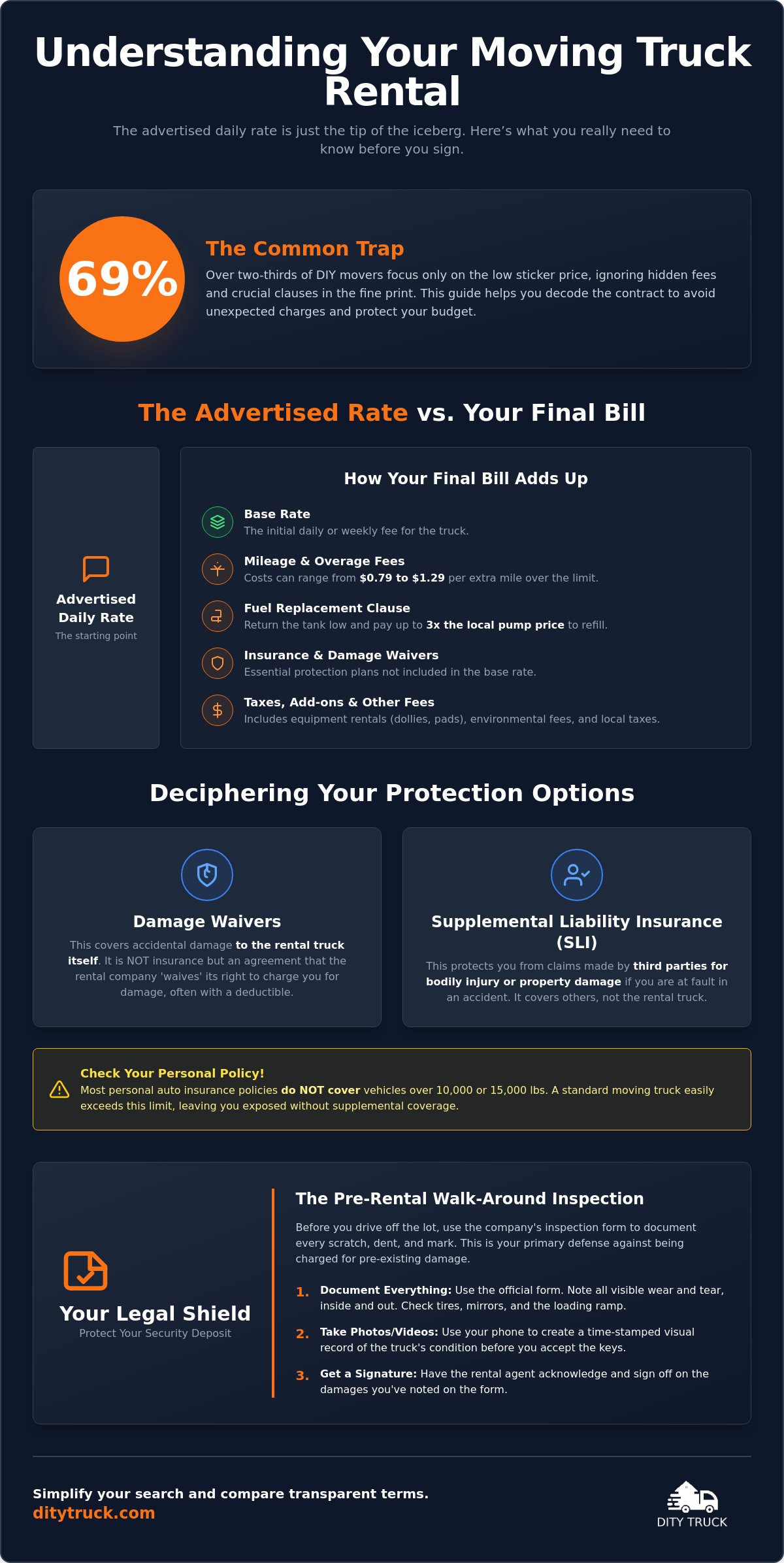
What if that low daily rate on the side of the truck is actually the least important number you see today? It is a common trap. Most of the 69% of people who choose to drive their own moving truck focus on the sticker price while ignoring the fine print. Truly understanding moving truck rental contracts is the only way to avoid a massive bill at the drop-off window. You want a simple move, not a legal headache.
We know that staring at a page of jargon feels overwhelming. You just want to move your belongings without hidden fees or anxiety about damage liability. This guide strips away the legal fluff to reveal the clauses that actually impact your budget. We will show you how to identify red flags in seconds, calculate the real total cost beyond the base rate, and protect your security deposit. Let’s turn that stack of paperwork into a clear roadmap for your move.
Key Takeaways
- Decode the gap between advertised base rates and your final bill to calculate an accurate moving budget.
- Differentiate between Damage Waivers and Supplemental Liability Insurance to avoid paying for third-party claims.
- Master understanding moving truck rental contracts to identify red-flag clauses that could jeopardize your security deposit.
- Use the walk-around inspection form as a legal shield against charges for pre-existing wear and tear.
- Compare total agreement costs instead of daily rates to find the most transparent and budget-friendly rental options.
The Anatomy of a Moving Truck Rental Contract
Think of your rental contract as a shield, not a hurdle. It is a binding rental agreement that defines exactly who is responsible for the vehicle at every moment. Understanding moving truck rental contracts is the first step toward a stress-free moving day. While the paperwork might look like a wall of text, it serves a clear purpose. It protects the rental company’s fleet while managing your expectations regarding costs and liabilities.
You will typically encounter two different layers of paperwork. The Master Agreement is a broad document that covers general company policies. The specific Rental Document is what you sign at the counter. This second document is the most critical. It lists your specific truck number, current mileage, and fuel level. It also confirms your return deadline. Missing that deadline by even an hour can trigger an entire extra day of charges. Accuracy here saves money later.
Key Definitions You Need to Know
Terminology matters when thousands of dollars are on the line. The Renter is the individual legally responsible for the contract. An Authorized Driver is someone specifically cleared by the rental company to operate the vehicle. If you let a friend drive without adding them to the contract, you risk losing all insurance protection. This distinction is non-negotiable for most providers. Keep the circle of drivers small and documented.
Pay close attention to the Rental Period. Most companies operate on 24-hour cycles rather than calendar days. If you keep the truck past your return window, the system automatically bills you for another full day. Additionally, your contract will specify if your move is In-Town or One-Way. In-Town rentals usually require returning the truck to the pickup location. One-Way agreements allow for different drop-off points. These often include fixed mileage caps that can be expensive to exceed. Plan your route carefully to stay within these limits.
Documents Required to Finalize the Agreement
Preparation prevents delays at the rental counter. You must present a valid driver’s license. For most box trucks up to 26 feet, a standard Class D license is sufficient. However, the name on the license must match the name on your payment method. Using a credit card is usually the fastest path to approval. If you use a debit card, be prepared for the company to hold a larger security deposit on your account until the truck is returned safely. This hold can impact your spending power during the move.
Finally, verify your insurance status before you sign. Many personal auto policies exclude vehicles over 10,000 or 15,000 pounds. Since a large moving truck easily exceeds these limits, your existing coverage might not apply. Checking this detail early helps you decide if you need to purchase supplemental protection at the counter. Being proactive ensures that understanding moving truck rental contracts leads to real financial security and peace of mind.
Financial Clauses That Determine Your Total Cost
The sticker price on the side of a truck is a marketing tool, not a final invoice. It’s the starting point for a complex calculation that happens behind the scenes. True transparency comes from understanding moving truck rental contracts at the granular level. When you learn how to rent a moving truck, you quickly realize that the base rate is just the entry fee. The contract reveals the gap between that low quote and the actual bill you pay at the end of the day.
Fuel is a major trap. Your contract includes a fuel replacement clause that is strictly enforced. If you return the tank lower than the initial level, the company charges a convenience fee plus the cost of gas. This typically results in paying three times the local pump price. Always keep your final gas receipt as proof of a full tank. It is a small step that protects your wallet from inflated surcharges.
Timing is everything. Rental periods are rigid 24-hour cycles. A 15-minute delay isn’t just a minor inconvenience for the staff. It’s a contractual trigger that often bills you for an entire second day. Plan to arrive at the lot 30 minutes early to handle the return paperwork. This buffer ensures you don’t pay for time you didn’t actually use.
Mileage and Boundary Restrictions
Most local moves rely on a per-mile fee structure. If you exceed your estimated distance, those extra miles add up fast. Overage fees typically range from $0.79 to $1.29 per extra mile. Check for geographic restrictions as well. Some agreements strictly forbid taking the vehicle across state lines. Violating this boundary can void your insurance and lead to heavy surcharges. Always verify your route against the contract’s allowed radius.
Add-ons and Equipment Rentals
Don’t ignore the line items for equipment. Dollies and furniture pads are rented separately and come with their own liability rules. If they aren’t returned in the same condition, you’ll face replacement costs that far exceed the rental price. Environmental fees and local taxes are also non-negotiable. These are often tucked into the footer of the document. Finally, keep the cargo area clean. A ‘dirty’ truck can trigger a cleaning fee of $25 or more. A quick sweep is the easiest way to protect your budget. You can compare total rental costs to see which companies offer the most transparent terms for your specific route.
Liability and Insurance: Deciphering Protection Plans
Protection plans are often the most confusing part of the paperwork. Many renters assume their personal auto insurance or credit card covers the rental truck. This is a dangerous assumption. Most personal policies exclude vehicles over a certain weight limit, such as a 26-foot box truck. Truly understanding moving truck rental contracts means recognizing that what you buy at the counter is often a waiver, not traditional insurance. These plans are designed to limit your financial exposure if things go wrong on the road.
A Collision Damage Waiver (CDW) or Loss Damage Waiver (LDW) is a contractual agreement. The rental company agrees to waive its right to sue you for damage to the vehicle. It is a shield for your bank account. Without it, you are legally responsible for the full value of the truck. Supplemental Liability Insurance (SLI) is different. It protects you against third-party claims. If you accidentally hit another car or damage a neighbor’s fence, SLI covers those costs. Finally, consider cargo protection. Your household goods are usually not covered by the base agreement. If a pipe leaks in the truck and ruins your sofa, you need specific cargo protection to recover those losses.
Beware of the overhead trap. This is a common exclusion in almost every rental agreement. Most contracts specifically exclude damage to the top of the truck. If you drive under a low bridge or hit a tree limb, the protection plan is void. You will be billed for the full repair of the “box” out of pocket. These repairs can cost thousands of dollars. Always know the exact height of your vehicle before leaving the lot.
Understanding the Deductible
Deductibles vary by plan. A “Zero Deductible” plan allows you to walk away from most accidents without paying a cent. Standard “Limited Liability” agreements might require you to pay the first $500 or $1,000 of any repair. Be aware of clauses that void your protection entirely. Driving on unpaved roads, leaving the keys in the ignition, or allowing an unauthorized driver to take the wheel will cancel your coverage instantly. Stick to the paved route and the drivers listed on your contract to stay protected.
What Happens in an Accident?
Contracts demand immediate action following an incident. You typically have a 24-hour window to file a police report and notify the rental company. Failure to document the accident properly can lead to a denial of your protection claim. You should also watch for “Loss of Use” fees. If the truck is in the repair shop, the company may charge you for the daily revenue they lose while the vehicle is out of service. Understanding moving truck rental contracts helps you identify if your plan covers these downtime charges or if you will be stuck with the bill. Check your roadside assistance clause as well. Some contracts cover jump-starts and tire changes, while others bill you for the service call fee.
The Walk-Around: Protecting Your Security Deposit
The walk-around is the most critical five minutes of your move. It is not just a quick look at the paint. The inspection form is a binding amendment to your agreement. If a scratch is not on that form, you are legally responsible for it when you return. Understanding moving truck rental contracts means knowing that the signature you provide at the counter covers the current physical state of the vehicle. You are essentially agreeing that the truck is in the condition described on the paperwork. This is your chance to correct the record.
Document every minor ding. Previous renters often leave behind small scars that the company might miss. Check the interior cargo area for cleanliness. If there is debris or a spill, ask for a different truck or have the agent note it. Verify your equipment count. If your contract lists two dollies and ten furniture pads, make sure they are physically in the truck. Missing items become expensive line items on your final bill. Research shows a security deposit of around $150 is common. Protecting this money requires meticulous attention to detail during the initial check.
Check the tires for low pressure or visible damage. Look under the front of the truck for active leaks. Ensuring the vehicle is contractually roadworthy is your right. If the truck breaks down due to a pre-existing issue you ignored, the delay is on your time. A thorough check ensures you aren’t paying for the previous renter’s negligence. It keeps your move on schedule and your budget intact.
Using Your Smartphone as a Witness
Use your phone. Take time-stamped photos of all four sides. Don’t forget the roof. Overhead damage is a common exclusion that can void your protection plan. Record a video walk-around for a continuous view. Focus on the windshield and tire treads. Email these files to yourself immediately. This creates a digital paper trail with a verifiable date. It acts as a silent witness if a dispute arises regarding your security deposit. Clear evidence stops arguments before they start.
Verifying the Odometer and Fuel Gauge
Verify the odometer and fuel gauge. Discrepancies here are the primary cause of contract disputes. If the fuel gauge is at 7/8 but the contract says “Full,” you will be overcharged at return. Point this out to the agent before you leave the lot. Ensure they update the digital record or sign off on the paper form. Never drive away until the paperwork matches the physical reality of the truck. Understanding moving truck rental contracts helps you realize that the recorded mileage is the only number that matters for billing. You can book a rental truck with providers that prioritize clear, digital inspection processes for your peace of mind.
Simplify the Search: Compare Transparent Terms with DityTruck
Comparing daily rates is a trap. A low sticker price often masks aggressive mileage fees or rigid insurance terms. True savings come from understanding moving truck rental contracts at the comparison stage. DityTruck acts as your savvy advocate. We strip away the complexity of DIY logistics. We present the total cost of the agreement upfront. No surprises. No hidden fees. Our goal is simple. We want to provide you with a friction-free solution for your move.
Most people spend hours digging through fine print on multiple websites. They get lost in insurance jargon and damage liability clauses. DityTruck solves this by centralizing the data. We compare the specific terms that impact your budget most. This includes mileage allowances and protection plan deductibles. You get a clear view of the financial roadmap before you provide a credit card. It is the shortest, most logical path to a successful move.
How to Compare Major Providers Side-by-Side
Our platform is built for speed and clarity. You can evaluate one way truck rentals for moving to find the best long-distance terms. This comparison guide highlights which companies offer the most generous mileage caps for 2026. If you are moving a large household, understanding the cost to rent a 26 foot moving truck is essential. We include the mandatory fees that others often hide until the final checkout screen. Use our comprehensive moving truck rental guide to master the entire booking process. It ensures you know exactly what to expect at the rental counter.
Ready to Book? Start Your Comparison Now
Enter your moving dates and locations to see real-time availability. Our system pulls live data from top providers. You can filter by truck size to find the perfect fit for your inventory. You can also filter by provider to see who has the best reputation for transparent contracts. This is not just about finding a truck. It is about finding the right agreement for your peace of mind.
Find your move. Compare the terms. Book with confidence. The process takes minutes, not hours. Once you have mastered understanding moving truck rental contracts, the final step is simple. Secure your vehicle through a platform that values honesty and efficiency. Compare Moving Truck Rates and Terms Now to see how much you can save on your upcoming move.
Take Control of Your Moving Budget Today
Mastering the fine print is your best defense against unexpected moving costs. You now know that the base rate is only the beginning of the calculation. You have the skills to protect your security deposit through a meticulous walk-around. You also recognize why supplemental protection is essential for heavy vehicles that personal insurance often ignores. Understanding moving truck rental contracts turns a confusing legal document into a practical tool for financial clarity and relief.
Don’t waste hours digging through multiple websites to find the best deal. DityTruck provides real-time rate comparisons from top national brands to help you find the best terms in minutes. We prioritize transparent pricing with no hidden surprises. Whether you need a local cargo van or a 26-foot truck for a cross-country journey, we offer easy online booking for local or long-distance moves. Compare Moving Truck Rates and Terms in Seconds and secure a rental that fits your budget and your peace of mind.
You have the facts. Now, start your journey with absolute confidence.
Frequently Asked Questions
Can I cancel my moving truck rental contract without a penalty?
Most major providers allow you to cancel for free if you do so at least 24 to 48 hours before your pickup time. If you cancel after this window or simply don’t show up, you will likely face a fee. This charge is often around $50. Always verify the specific cancellation window in your agreement to avoid an unnecessary penalty on your credit card.
What is a ‘Loss of Use’ fee in a rental agreement?
A ‘Loss of Use’ fee is a charge for the revenue a rental company loses while a vehicle is being repaired. If an accident occurs, you are often responsible for the daily rate of the truck for every day it is out of service. This is a critical detail in understanding moving truck rental contracts. Purchasing a damage waiver usually protects you from this specific financial risk.
Does my personal car insurance cover a rental moving truck?
Your personal car insurance almost never covers a large rental truck. Most standard policies have weight limits that exclude vehicles over 10,000 pounds. A typical box truck far exceeds this threshold. Additionally, many credit card rental benefits also exclude trucks of this size. Checking your policy limits before you arrive at the counter ensures you aren’t driving without any financial protection.
Is there a limit on how many people can drive the rental truck?
You can have multiple drivers, but every person must be officially authorized on the contract. Most companies charge a small daily fee for each additional driver. If an unlisted person is involved in an accident, your protection plan becomes void immediately. You will be held personally liable for all damages. Stick to the list of drivers you provided at the start of the rental.
What happens if I return the truck with less fuel than when I started?
Returning the truck with less fuel triggers a fueling service fee plus an inflated price per gallon. These rates are significantly higher than what you would pay at a local gas station. Most companies require you to return the tank to the exact level it was at when you picked it up. Keep your final gas receipt as proof to avoid any disputes during the return process.
Are there age restrictions in a moving truck rental contract?
The minimum age to rent most moving trucks is 21, though some providers allow 18-year-olds with an additional fee. Drivers between the ages of 18 and 23 often face a ‘Young Driver Fee’ that increases the daily cost. There may also be limits on the size of the truck younger drivers are allowed to operate. Always present a valid license and confirm age requirements before booking.
What is the difference between a Damage Waiver and actual insurance?
A Damage Waiver is a contract clause where the rental company agrees not to charge you for damage to their truck. It is not a formal insurance policy. Actual insurance, such as Supplemental Liability Insurance, provides coverage for injuries to other people or damage to their property. Understanding moving truck rental contracts helps you see that you might need both for complete peace of mind during your move.
Can I drive the rental truck into another country (like Canada or Mexico)?
Driving into Canada is generally allowed with prior notice, but driving into Mexico is strictly prohibited by most contracts. You must inform the rental company if you plan to cross any international border. They will provide the necessary insurance documents for Canadian travel. Crossing into Mexico without permission will void all protection plans and could lead to legal action or vehicle impoundment.