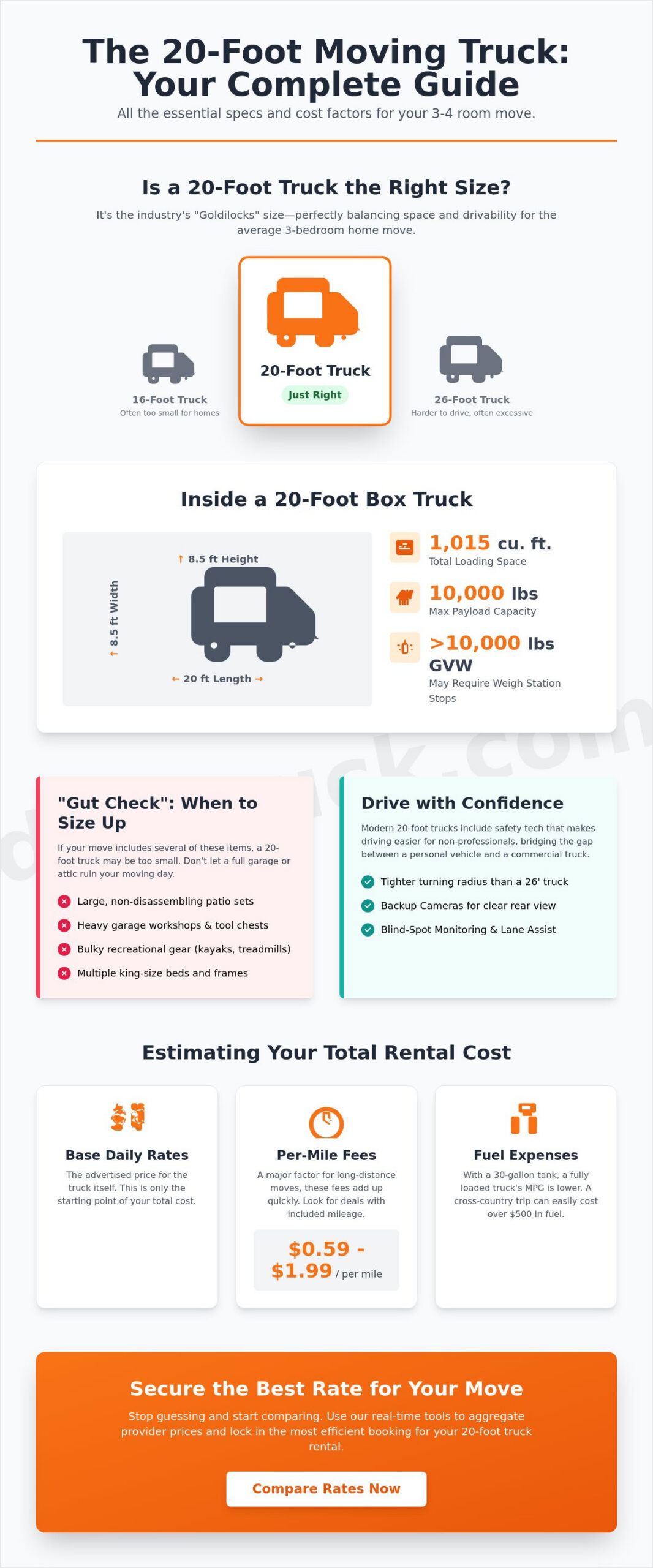
Choosing a moving van based on a gut-level guess is the fastest way to blow your budget or leave half your belongings on the sidewalk. Most people assume a medium sized vehicle is a safe bet, but the reality is that a 20 foot truck rental is the precise “Goldilocks” zone for a three bedroom home. These units often provide a 10,000 pound payload capacity. This makes them large enough to handle heavy appliances while remaining manageable enough for a first time driver to navigate traffic.
We know the logistics of a move feel like a high-stakes puzzle. You’re likely worried about fitting everything in one trip or getting hit with surprise mileage fees that can range from $0.59 to $1.99 per mile. This guide simplifies the process by breaking down 2026 capacities, comparing brand rates, and sharing booking strategies that save you money. You’ll learn how to verify if this size fits your inventory, identify the lowest total prices across major providers, and secure a stress-free booking so you can focus on your new home.
Key Takeaways
- Confirm the “3-4 room” capacity rule to ensure your inventory fits perfectly without needing a second trip.
- Navigate highway weigh stations with confidence by understanding Gross Vehicle Weight (GVW) requirements for larger box trucks.
- Evaluate fleet age and reliability across major providers to minimize the risk of breakdowns during long-distance moves.
- Avoid surprise charges by distinguishing between base daily rates and the total real-world cost of a 20 foot truck rental.
- Leverage real-time comparison tools to aggregate provider prices and lock in the most efficient booking.
Is a 20-Foot Truck Rental Right for Your Move?
The 20-foot truck is the workhorse of the residential moving industry. It sits at the critical tipping point where a vehicle transitions from a large van to a true box truck. This size is the standard choice for households that have outgrown small apartments but aren’t yet ready for a massive commercial freighter. It’s the most versatile option for medium to large residential moves. It offers the right balance of space and maneuverability.
Most rental agencies use a “3-4 room” rule of thumb for this category. It’s a reliable estimate for typical living room, dining room, and bedroom setups. Unlike smaller 16-foot models, the 20-foot chassis often includes a lift gate or a wider loading ramp. This feature is a lifesaver for heavy items. It makes the 20 foot truck rental the superior choice when your inventory includes bulky furniture that two people can’t easily lift. If your move involves a 10,000-pound payload capacity, you have the muscle needed for a full house.
The 3-Bedroom Benchmark: Will Your Life Fit?
A standard 3-bedroom home usually translates to about 1,100 cubic feet of belongings. The 20-foot truck handles this volume well if you stack items efficiently. Heavy appliances like refrigerators and washing machines consume significant floor space and weight capacity. If you have a garage or attic, you need to be careful. These “hidden” rooms often push a move beyond the capacity of a standard medium truck. Don’t let a basement full of boxes ruin your moving day.
Use this gut check list to see if you need to size up:
- Large Patio Sets: Tables and chairs that don’t disassemble take up massive volume.
- Garage Workshops: Heavy tool chests and workbenches add significant weight.
- Recreational Gear: Kayaks, bicycles, or treadmills require long, unobstructed floor space.
- Multiple King Beds: These frames and mattresses are bulky and difficult to stack around.
20-Foot Truck vs. 26-Foot Truck: Making the Call
Driving a 20-foot truck feels similar to a large pickup or a delivery van. It has a tighter turning radius than its 26-foot counterpart. This makes it easier to navigate residential cul-de-sacs and narrow apartment complex gates. A 26-foot truck is a different beast. It often requires more clearance and wider turns. This can be stressful for non-professional drivers. If you’re anxious about driving a large commercial vehicle, the 20-foot model is much more approachable.
A standard 20-foot moving truck provides approximately 1,015 cubic feet of storage space for furniture and boxes.
The price gap is also a factor. For long-distance moves, a 26-foot truck can cost significantly more in fuel and base rental fees. If you can fit your life into the 20-foot model, you’ll save money and reduce driving anxiety. It’s the logical path for most suburban families who want a stress-free booking process without paying for unused space.
Technical Specs and Capacity: Inside the 20-Foot Box Truck
Step inside a 20 foot truck rental and you’ll find a box designed for maximum volume. Standard interior dimensions for these vehicles average 20 feet in length, 8.5 feet in width, and 8.5 feet in height. This provides a rectangular cavern of roughly 1,015 cubic feet. It’s enough space to stack queen mattresses vertically and still have room for dozens of medium boxes. These specs make it the ideal choice for those moving a standard three-bedroom home without making multiple trips.
Gross Vehicle Weight (GVW) is a critical number you can’t ignore. It’s the total weight of the truck plus your gear. If your loaded vehicle exceeds 10,000 pounds, you may be required to stop at highway weigh stations in certain states. Ignoring a “Trucks Must Enter” sign can lead to a police escort and a hefty ticket. Consult the Protect Your Move resources from the FMCSA to understand your responsibilities on the road. Knowing your weight limits keeps your move legal and safe.
Fuel management is a major cost factor for any long-distance move. Most 2026 models feature a 5.2 Liter Diesel engine and a 30-gallon fuel tank. Expect lower MPG when you’re fully loaded because weight adds significant drag. Real-world data shows these costs add up quickly. One renter reported spending $583 on gas for a cross-country trip in a 20-foot unit. Planning your fuel stops ahead of time prevents highway anxiety. You can compare real-time specs and rates to find the most fuel-efficient options available for your route.
Modern safety tech bridges the gap for non-professional drivers. 2026 models often include blind-spot monitoring and lane assist. This is vital when merging on a busy interstate. Backup cameras provide a clear view of the area behind the rear door. These features turn a daunting commercial vehicle into something that feels more like a standard SUV. They provide the confidence you need to navigate tight parking lots or narrow residential streets.
Loading Mechanisms: Ramps vs. Lift Gates
Pull-out ramps are the standard for most rental fleets. They require physical strength to walk heavy items up a steep incline. It’s a high-intensity workout. Hydraulic lift gates are the premium alternative. These metal platforms do the heavy lifting for you by raising items from the ground to the truck bed level. Providers like Enterprise often prioritize these tuck-under gates. Choose a lift gate if you’re moving a piano, a heavy safe, or solid oak dressers. Your back will thank you for the upgrade.
Payload and Weight Limits
Understand the math before you start loading. Curb weight is the truck’s weight when empty. Payload capacity is the total weight of the cargo you can actually add. For a 20 foot truck rental, the payload is typically up to 10,000 pounds. Exceeding this limit is dangerous. It puts extreme stress on the brakes and suspension. It also increases your stopping distance significantly. Distribute your weight evenly for better stability. Place the heaviest items toward the front, near the cab. This keeps the vehicle balanced at highway speeds and prevents the front tires from losing traction.
Top 20-Foot Moving Truck Providers Compared
Choosing a provider for your 20 foot truck rental isn’t just about the lowest sticker price. You’re balancing location convenience, vehicle reliability, and contract flexibility. Each major brand targets a specific type of mover. Before you sign any paperwork, review this consumer checklist from the U.S. Department of Transportation to protect your belongings. For a broader look at the market, see our Moving Truck Rental: The Complete 2026 Comparison & Booking Guide.
U-Haul, Penske, and Budget are the primary choices for one-way, long-distance moves. Enterprise is a specialized player that dominates local logistics. Fleet age varies wildly between these companies. Newer trucks offer better fuel economy and fewer mechanical headaches. If you’re driving 1,000 miles, the age of the engine matters as much as the rental rate. Reliability is the key to a stress-free moving day.
U-Haul vs. Penske: The 20ft Showdown
U-Haul is the most accessible brand with over 21,000 locations. Their 20-foot truck offers 1,016 cubic feet of space. It features a low-deck design that makes walking up the ramp much easier. Penske takes a different approach. They don’t offer a 20-foot model. Instead, they provide a 22-foot truck as their mid-size option. Penske is known for maintaining a younger fleet than U-Haul. Their trucks are often more fuel-efficient and include more modern cab features. Penske also has a reputation for guaranteed reservations. U-Haul reservations are often preferred, meaning your pickup location might change at the last minute. If you value certainty, Penske is the stronger candidate.
Budget and Enterprise: The Value vs. Power Choice
Budget operates 2,800 locations and competes heavily on price. They offer frequent promotional discounts, especially for mid-week moves. If your schedule is flexible, Budget can often provide the lowest base rate for a 20 foot truck rental. Their trucks are standard industry models that perform well on open highways. Enterprise is the outlier. They have about 460 truck-specific branches. Their vehicles are business-class and often include hydraulic lift gates. These are perfect for heavy items that shouldn’t be carried up a ramp. However, Enterprise requires all rentals to be returned to the same branch. This makes them a local-only solution. Use Budget for your cross-country trip and Enterprise for your cross-town move.
Estimating Your Total 20-Foot Truck Rental Cost
Advertised base rates are often just the starting point. The sticker on the door might say $39.95, but your final bill for a 20 foot truck rental will look very different. You have to account for mileage, fuel, and mandatory fees. For local moves, companies charge a per-mile fee ranging from $0.59 to $1.99. If you’re driving 50 miles across town, that’s an extra $100 before you even buy gas. Transparency is the only way to avoid sticker shock at the drop-off counter.
Fuel is your largest variable expense. A 20-foot truck fully loaded with a three-bedroom home is heavy. This weight drops your fuel economy significantly. One cross-country mover in 2026 reported spending $583 on gas for a single trip. Expect to get between 8 and 12 miles per gallon. Always calculate your route distance and multiply it by current gas prices to get a realistic fuel budget. You can calculate your total estimated costs using our comparison tool to see which brand offers the best all-in price.
Don’t forget the physical tools needed for the job. Rental companies charge daily rates for equipment that protects your furniture. These costs include:
- Furniture Pads: $10 to $15 per dozen.
- Utility Dolly: $10 to $12 per day.
- Appliance Dolly: $12 to $15 per day.
These costs seem small but they are essential for a damage-free move. Skipping the pads to save $15 might result in a $500 scratch on your dining table. It’s a small price for total protection.
One-Way vs. Local Pricing Models
Local rentals are best for quick, same-day moves where you return the truck to the pickup spot. One-way contracts are different. They usually include a set number of miles and a specific number of days in the quote. This structure prevents you from worrying about every individual mile on the odometer. For a detailed breakdown of these contracts, read our One Way Truck Rentals for Moving: 2026 Comparison Guide. To avoid late fees, always confirm the exact drop-off time on your contract. Even being an hour late can trigger a full extra day of charges.
Insurance and Liability Protection
Most personal auto policies exclude vehicles over a certain weight. Your credit card’s rental insurance also likely stops at SUVs and vans. This leaves you vulnerable. Daily insurance coverage typically costs between $15 and $40. A Collision Damage Waiver (CDW) is the most popular choice. It releases you from financial responsibility if the truck is damaged. Personal Accident Insurance (PAI) provides medical coverage for you and your passengers. For most movers, the CDW is the “sweet spot” for protection. It removes the stress of paying for a $40,000 truck if a low-hanging tree limb catches the roof.
How to Secure the Best 20-Foot Truck Rental Rate via DityTruck
DityTruck acts as your personal logistics advocate. We pull real-time data from every major provider into one clear, actionable view. This removes the need to toggle between multiple browser tabs. Finding a 20 foot truck rental becomes a matter of seconds rather than hours of research. Our platform strips away the noise. It presents you with the total price, including those hidden fees that often inflate a final bill. This level of transparency ensures you never face a “counter surprise” when you arrive at the rental office to pick up your keys.
The process is built for speed. Follow these three steps to lock in your vehicle:
- Input Your Route: Enter your pickup and drop-off locations along with your moving dates.
- Analyze the Results: Use our comparison engine to see side-by-side rates for 20-foot units across all providers.
- Secure Your Booking: Select the best value and complete your reservation through our streamlined interface.
Demand for 20-foot trucks spikes during the summer and at the end of every month. To guarantee availability, book your vehicle 4 to 6 weeks in advance. This lead time is crucial for securing the specific size you need. Waiting until the last minute often forces you into a smaller truck that won’t fit your life or a much more expensive 26-foot model. Early booking is the simplest way to maintain your peace of mind.
The Savvy Mover’s Booking Strategy
Smart movers look for the “sweet spot” in pricing. Sometimes a 22-foot truck is cheaper than a 20-foot unit because of local inventory levels. Check the rates for 16-foot and 22-foot alternatives on our platform to see if a better deal exists. Timing also matters. Mid-week bookings can save you up to 20% on 20 foot truck rental inventory compared to weekend rates. If your schedule is flexible, move on a Tuesday or Wednesday. Always use the “One-Way” filter if you aren’t returning to the same branch. This narrows your search to contracts that include the necessary mileage and days for your specific journey.
Confirming Your Reservation
Once you choose a truck, have your documents ready. You’ll need a valid driver’s license and a credit card in the driver’s name. Most providers won’t accept debit cards for the initial deposit without a lengthy verification process. Verify the specific hours for your pickup location. Some smaller satellite branches have limited weekend hours. Double-check that your selected equipment, like dollies or pads, is confirmed in the reservation. This final check prevents delays on moving morning. You’re now ready to compare 20-foot truck rental rates now on DityTruck and start your move with confidence.
Secure Your 2026 Moving Day Strategy
Mastering your logistics starts with picking the right vehicle. A 20 foot truck rental provides the perfect balance of volume and driveability for a standard three-bedroom home. You now understand the technical specs, the real-world fuel costs, and the importance of booking early to avoid peak-season shortages. Don’t let hidden fees or poor availability derail your plans. Transparency is your best tool for a stress-free transition.
We’ve simplified the search for you. You can compare rates from Penske, Budget, and other major providers in seconds. Thousands of DIY movers nationwide trust our platform to deliver honest pricing for their 2026 moves. There are no hidden fees here. You see the total cost upfront. This allows you to book with confidence and focus on the road ahead.
Find the Lowest 20-Foot Truck Rental Rates on DityTruck
Your new home is waiting. Take the guesswork out of your booking and enjoy the clarity of a well-planned move.
Frequently Asked Questions
Do I need a CDL to drive a 20-foot rental truck?
You don’t need a Commercial Driver’s License (CDL) to operate a 20 foot truck rental. These vehicles are designed for consumer use and fall below the 26,001 pound weight limit that triggers federal licensing requirements. Anyone with a standard, valid driver’s license can legally drive one. Just remember that the increased height and weight require more stopping distance and a wider turning radius than your personal car.
How much gas does a 20-foot moving truck use?
Expect to achieve between 8 and 12 miles per gallon during your trip. Fuel efficiency depends heavily on the total weight of your cargo and your driving speed. Most 2026 models feature a 30 gallon fuel tank and a 5.2 liter diesel engine. If you’re driving a fully loaded truck through mountainous terrain, your MPG will likely sit at the lower end of that range.
What is the average cost of a 20-foot truck rental for a 500-mile move?
The cost for a 500 mile regional move varies based on the time of year and current demand. Since this is a one-way contract, the price typically includes a set number of days and miles. You should also budget for mileage fees which can range from $0.59 to $1.99 per mile if you exceed your limit. Fuel costs and insurance are separate expenses that you’ll need to calculate based on your specific route.
Will a 20-foot truck fit a 3-bedroom house?
A 20 foot truck rental is the industry standard for a three bedroom home. It provides approximately 1,015 cubic feet of space. This is enough to hold about 100 to 120 medium boxes along with several large furniture items. If you have a heavily furnished house or a garage full of gear, you might need to pack tightly. Use furniture pads to protect items and maximize vertical space.
Is it hard to drive a 20-foot box truck for the first time?
Most drivers find these trucks approachable because they handle similarly to a large delivery van or a heavy duty pickup. Modern 2026 models include helpful safety tech like backup cameras and blind spot monitoring to reduce driving anxiety. The biggest adjustment is the vehicle’s height. Always watch for low hanging branches and bridge clearances. Take wide turns and keep your eyes on the road ahead for a smooth experience.
Does a 20-foot truck rental come with a loading ramp?
Yes, almost every 20 foot unit comes equipped with a wide, pull out loading ramp. This ramp is stored under the truck bed and slides out for easy access. If you’re moving exceptionally heavy items like a piano or a commercial refrigerator, you might prefer a hydraulic lift gate. These are more common in Enterprise fleets and do the heavy lifting for you at the touch of a button.
Can I tow my car behind a 20-foot moving truck?
You can tow a vehicle behind most 20 foot trucks using a tow dolly or a car carrier. These trucks are built with a rear hitch specifically for this purpose. Just keep in mind that towing increases your total vehicle length and makes reversing much more difficult. It also adds significant weight, which will lower your fuel economy. Always check with your rental provider to ensure the hitch is rated for your car’s weight.
What happens if I return my 20-foot truck late?
Returning your truck late usually results in a full extra day’s rental fee. Most companies operate on a strict 24 hour clock. If you drop the truck off even one hour past your deadline, you’ll likely see an additional daily rate on your final bill. Some providers also charge a late return penalty. If you know you’re running behind, call the branch immediately to see if they can extend your reservation without extra fees.