If you’re currently debating between a 15-foot and a 20-foot rental, you’ve likely already outgrown the smaller truck. It’s a common trap. Selecting the right moving truck size for 2 bedroom apartment shouldn’t feel like a high-stakes gamble. You want to avoid paying for empty air. However, the fear of a second trip is even worse. We understand that anxiety. Nobody wants to realize at 4:00 PM that their dining table won’t fit. It’s frustrating and expensive.
This guide provides a definitive answer to your sizing dilemma so you can book with total confidence. We’ll strip away the confusion of cubic feet and weight capacities. You’ll learn exactly when a 15-foot truck works. You’ll also see when the 20-foot upgrade is the only way to ensure a stress-free loading day. We’re going to compare the real-world capacity of both options. Our goal is to help you keep your rental costs low and your move on schedule. Let’s find the shortest path to your new home.
Key Takeaways
- Decide between a 15-foot and 20-foot model by analyzing the cost-to-space ratio for your specific inventory.
- Avoid the nightmare of a second trip by calculating the correct moving truck size for 2 bedroom apartment based on standard box counts.
- Compare specifications between major rental brands to understand the difference between low-deck ease and high-capacity hauling.
- Learn how underestimating your space needs can double your mileage and gas expenses through hidden “second trip” costs.
- Streamline your logistics by comparing rates and booking your truck before peak season demand drives prices up.
The 15-Foot vs. 20-Foot Dilemma: Which Fits a 2-Bedroom Apartment?
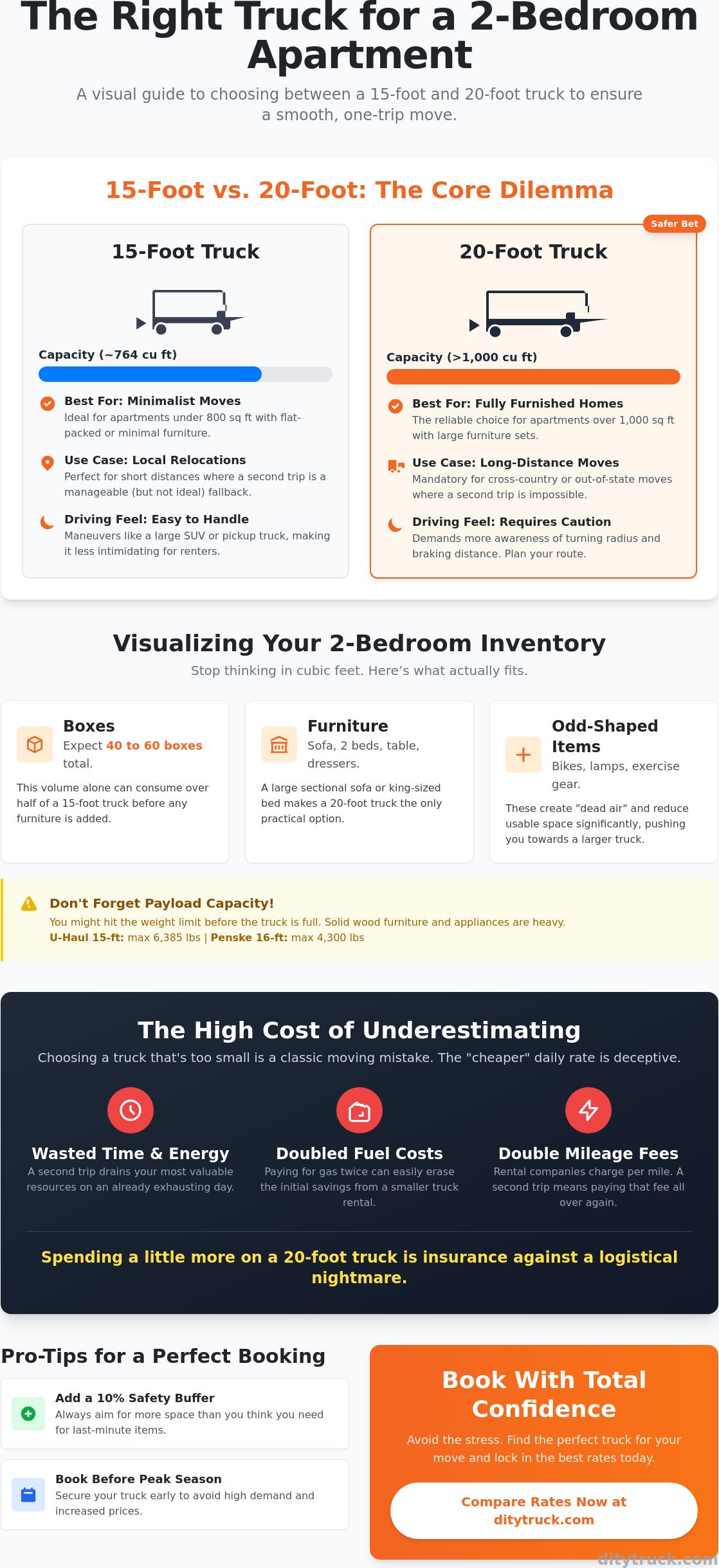
Industry standards usually point to the 15-foot truck as the baseline for a 2-bedroom move. It’s the most common recommendation you’ll find. However, this advice often ignores the reality of modern living. Choosing the correct moving truck size for 2 bedroom apartment depends heavily on your specific inventory and the distance of your move. A 15-foot truck offers roughly 764 cubic feet of space. A 20-foot truck jumps to over 1,000 cubic feet. That extra space represents more than just room for boxes; it’s your insurance policy against a logistics nightmare.
Smart spending means analyzing the cost-to-space ratio. While a larger truck has a higher daily rate, it often saves money on the back end. If you choose a truck that is too small, you face the “second trip” math. This doubles your mileage fees and fuel costs. It also drains your time and energy. Spending a few extra dollars on a larger vehicle is a proactive way to lower your total relocation expenses. It replaces chaos with a predictable, one-trip schedule.
Driving comfort is the other side of the coin. Many renters feel a sense of “driving anxiety” when considering larger vehicles. A 15-foot truck handles much like a standard pickup or a large SUV. It’s easier to park and navigate through narrow apartment complex gates. In contrast, a 20-foot truck requires a different mindset. You must account for a larger turning radius and increased braking distances. Understanding the different moving truck sizes helps you prepare for these physical demands. If you’re moving across town, the maneuverability of the 15-footer is a major plus. If you’re heading out of state, the stability and capacity of the 20-footer are worth the learning curve.
Finally, never skip the “Safety Buffer.” Aim for 10% more space than your initial estimate suggests. This extra room allows for inefficient packing or last-minute items you forgot to tally. It’s the difference between a truck that closes easily and a truck where you’re forced to leave your favorite armchair on the sidewalk.
When the 15-Foot Truck is Sufficient
The 15-foot truck is the ideal choice for minimalist 2-bedroom apartments, specifically those under 800 square feet. It’s the perfect fit if you’ve embraced a “less is more” lifestyle or primarily own flat-packed furniture. This size works best for local moves where the destination is nearby. If you happen to run out of room, a quick second trip is a manageable fallback plan. It’s also the right call if your inventory includes zero large appliances or heavy, vintage furniture pieces that can’t be disassembled.
Why the 20-Foot Truck is the Safer Bet
A 20-foot truck is the only reliable option for “fully furnished” 2-bedroom units exceeding 1,000 square feet. If your home includes a king-sized mattress, a large sectional sofa, or a full dining room set, the 15-foot truck will likely fail you. This larger size is mandatory for long-distance relocations. When you’re moving hundreds of miles away, there is absolutely no room for error. The 20-foot truck provides the high capacity needed to fit every box and heirloom in a single, secure load.
Inside the Box: Visualizing Your 2-Bedroom Inventory
Stop thinking in cubic feet. It’s an abstract number that doesn’t help when you’re staring at a mountain of boxes. For a standard two-bedroom unit, you are likely looking at 40 to 60 boxes in total. This volume alone can consume half of a 15-foot truck. When you add furniture, the math changes instantly. Selecting the right moving truck size for 2 bedroom apartment requires a detailed room-by-room audit. It’s the only way to avoid the stress of leaving a sofa on the sidewalk.
Don’t forget the “hidden rooms.” Your inventory isn’t just what’s visible in the bedrooms. Closets, balconies, and kitchen cabinets hold more than you think. A single patio set or a collection of heavy storage bins can derail a tight packing plan. Also, consider the payload capacity. A 15-foot U-Haul truck has a max load of 6,385 pounds. A 16-foot Penske truck supports up to 4,300 pounds. If you own heavy, solid wood furniture or large appliances, you might hit the weight limit before the truck is physically full.
The Standard 2-Bedroom Furniture List
A typical inventory includes two beds, one sofa, a kitchen table with chairs, and three to four dressers. Large appliances add a significant footprint. A standard fridge or a washer and dryer set takes up valuable floor space that cannot be used for stacking. Factor in “odd-shaped” items as well. Bicycles, floor lamps, and exercise equipment are difficult to pack efficiently. They create “dead air” around them, which reduces your usable volume. If you have these items, the 20-foot truck becomes the logical choice for a one-trip move.
Calculating Your Total Box Volume
Expect to pack 20 to 30 boxes per bedroom for clothing, linens, and personal items. The kitchen and living room often produce the heaviest and bulkiest loads. Books and kitchenware require smaller, heavy-duty boxes that stack well. However, the “Stacking Factor” is where most DIY movers struggle. You will lose space to air gaps between mismatched boxes. Most people lose about 15% of truck volume to poor stacking and irregular shapes. To see how these variables impact your specific needs, you can compare rental options to find the best fit for your inventory.
Rental Brand Breakdown: Comparing 15’ and 20’ Trucks
A “15-foot” label doesn’t mean the same thing at every rental counter. Dimensions and usable space vary significantly between providers. Selecting the right moving truck size for 2 bedroom apartment requires looking past the name on the side of the vehicle. You need to compare actual cubic volume and loading features to ensure your furniture fits on the first try. U-Haul, Penske, and Budget each offer different advantages for the mid-range move.
U-Haul’s 15-foot truck provides 764 cubic feet of space. It features a low deck design, which makes walking heavy items into the cargo area much easier. Their 20-foot model increases capacity for larger homes but maintains a similar loading height. Budget’s 16-foot truck is actually smaller than U-Haul’s 15-footer, offering only 658 cubic feet. If you have a dense inventory, that 100-cubic-foot difference is massive. Penske’s 16-foot truck is the roomiest in this class with 800 cubic feet of space. It often serves as the gold standard for reliability and volume.
Fuel economy also changes based on the vehicle’s footprint. Larger trucks are heavier and less aerodynamic, which impacts your total gas budget. Penske’s 16-foot truck is relatively efficient, reaching up to 12 mpg. Budget’s 16-foot model typically gets between 6 and 10 mpg. These small differences in fuel efficiency add up quickly during long-distance relocations. Always factor in the cost of fuel when comparing daily rental rates.
Penske vs. Budget for 2-Bedroom Moves
Penske’s 16-foot truck often feels larger than a U-Haul 15-footer because of its boxy interior dimensions. It’s a favorite for movers who prioritize reliability and clean cargo areas. Budget’s pricing strategy for 16-foot rentals is highly competitive and transparent, making it a strong choice for budget-conscious movers. However, pay attention to the loading equipment. Penske typically uses sturdy loading ramps with high weight capacities. Budget trucks often feature translucent roofs and interior lighting to help you organize your load effectively.
U-Haul’s Unique Sizing Logic
The 15-foot U-Haul truck includes “Mom’s Attic.” This is a specialized storage compartment located over the cab. It’s the perfect spot for fragile items, electronics, or small boxes that you don’t want crushed by heavier furniture. U-Haul is often the most convenient choice for local, quick-turnaround moves due to their massive network of locations. Before you commit to a single brand, you can compare moving truck rental rates across all these providers in seconds. This ensures you get the most volume for your dollar without jumping between multiple tabs.
The Cost of Underestimating: Why a Small Truck Costs More
Saving a few dollars on a rental can cost you hundreds by the end of the day. It’s a common trap. Underestimating the moving truck size for 2 bedroom apartment turns a simple Saturday into a logistical nightmare. When you run out of space, the “Second Trip” math begins. You aren’t just driving back for the last few boxes. You are doubling your mileage fees. You are burning twice the fuel. You are paying for extra hours of rental time. It’s a high price for a small error.
Time is your most valuable asset during a move. A 4-hour local move can easily stretch into an 8-hour ordeal if you have to unpack and repack a cramped truck. Late return fees are aggressive. Most rental companies charge for an entire extra day if you miss your window by even an hour. There is also the “stress tax.” The emotional toll of realizing your sectional sofa won’t fit is immense. You either leave it behind or pay a premium for a last-minute solution that you didn’t budget for.
Safety is the final, hidden cost. Overloading a small truck is a major liability risk. It negatively affects your braking distance and overall handling. If you exceed the payload capacity, you risk damaging the suspension or your belongings. Insurance policies may not cover accidents if the vehicle was packed beyond its legal weight limits. Choosing the right size isn’t just about convenience; it’s about protecting your investment.
Hidden Expenses of the Wrong Size
An overloaded small truck is a fuel hog. The engine works much harder to move the excess weight, often resulting in worse fuel economy than a larger truck carrying the same load comfortably. You also spend more on specialized supplies. You will need extra tie-downs and heavy-duty padding to “squeeze” items into tight gaps without causing damage. If you hire professional help, labor costs will skyrocket. Movers charge by the hour. They spend more time playing “Tetris” with your boxes in a small truck than they would simply loading a spacious one.
How to Get the Right Size Every Time
Follow the “One Size Up” rule. If you’re on the fence between a 15-foot and a 20-foot truck, the upgrade is your best insurance policy. Relying on a truck size calculator is a good starting point, but a human estimate often accounts for the “odd-shaped” items better. In 2026, the average cost difference between a 15-foot and 20-foot truck is approximately $10 to $15 per day for local rentals. It’s a small price to pay for a stress-free loading day. You can book your ideal truck size now to lock in the best available rates.
Secure Your Size: Comparing Rates and Booking Fast
Timing is the final hurdle in your moving journey. You’ve identified your inventory. You’ve analyzed the brands. Now, you must act before the inventory disappears. Truck rentals operate on a dynamic supply-and-demand model. During peak moving seasons, specifically weekends and the end of the month, popular sizes sell out weeks in advance. Securing the right moving truck size for 2 bedroom apartment requires speed and a clear view of the market.
DityTruck strips away the complexity of the search. Instead of opening a dozen browser tabs, you see every available option in one place. We prioritize transparency and real-time availability. You get a direct look at which brands have a 15-foot or 20-foot truck ready for your specific dates. It is the shortest path between your current problem and a confirmed reservation. No hidden obstacles. No unnecessary phone calls.
Before you hit the reserve button, run through a final checklist. Confirm your pick-up and drop-off locations carefully. Verify that your rental window includes enough time for loading, transit, and unloading. Most importantly, double-check your size choice. If you have any doubt about fitting your 2-bedroom home into a 15-footer, lock in the 20-footer now. The peace of mind is worth the small price difference. It ensures your move stays on track without last-minute panic.
Step-by-Step to a Confident Reservation
Start by inputting your move details to generate instant quotes. Look past the advertised daily rate. Focus on the bottom line, which includes mileage estimates, environmental fees, and insurance. This total cost provides the only honest comparison between brands. For a deeper dive into the logistics of the current market, consult our Moving Truck Rental: The Complete 2026 Comparison & Booking Guide. It covers everything you need to know about the latest industry shifts and pricing trends. Understanding these factors helps you avoid unexpected charges at the rental counter.
Ready to Move?
If you’re moving a standard two-bedroom apartment, the 20-foot truck remains our top recommendation for a stress-free experience. It eliminates the risk of a second trip and provides the safety buffer you need for oversized items. Don’t leave your loading day to chance. You can compare moving truck rental rates in one simple step right now. You’ve done the research. You have the facts. Lock in your rate today and focus on the next chapter of your move.
Lock In Your Stress-Free Move Today
Selecting the right moving truck size for 2 bedroom apartment doesn’t have to be a guessing game. You now know that while a 15-foot truck works for minimalists, the 20-foot model is the safer bet for a reason. It provides the necessary safety buffer to handle your beds, sofas, and boxes in a single trip. Choosing the larger size is a smart investment. It prevents the high costs of mileage overages and late return fees. It’s the shortest path to a successful loading day.
Efficiency is the goal. Compare Penske, Budget, and U-Haul side-by-side. Find the best fit for your budget. We provide real-time 2026 pricing. No hidden fees. Total transparency. It’s time to stop jumping between tabs and start packing with confidence. Use our tool to see your options instantly.
Compare 15ft and 20ft Moving Truck Rates Now
Your move is a major milestone. With the right truck secured, you can focus on the excitement of your new home. You have the data. Now, take the final step toward a seamless transition. You’re ready for a stress-free move.
Frequently Asked Questions
Is a 15-foot truck big enough for a 2-bedroom apartment?
A 15-foot truck is sufficient for minimalist apartments under 800 square feet. It typically offers around 764 cubic feet of space, which fits two rooms of furniture and about 40 boxes. If you have large appliances, a king-sized bed, or a heavy sectional sofa, this size will likely be too cramped for a single trip.
How many boxes can fit in a 20-foot moving truck?
You can comfortably fit over 100 medium boxes in a 20-foot truck alongside standard furniture. Since most 2-bedroom apartments require 40 to 60 boxes, this size provides a significant safety buffer. It allows room for “odd-shaped” items like bikes or floor lamps that don’t stack perfectly. This extra space prevents the need for a second trip.
What is the difference between a 15ft and 16ft moving truck?
The main difference lies in the total cubic volume and brand-specific dimensions. A 16-foot Penske truck provides 800 cubic feet of space, while a 15-foot U-Haul offers 764 cubic feet. That 36-cubic-foot gap can hold roughly 10 to 12 additional medium boxes. Always prioritize the cubic volume over the length when comparing rental options.
Should I get a 20-foot truck if I only have a small 2-bedroom?
Yes, especially if you are moving long-distance or have a lot of “hidden” items in closets. The daily rate difference is often as low as $10 to $15 for local moves. This small upgrade acts as an insurance policy against logistical errors. It ensures you won’t have to leave a single item behind on moving day.
How much gas does a 20-foot moving truck use compared to a 15-foot?
A 20-foot truck generally averages 6 to 10 miles per gallon, while a 15-foot truck can reach 10 to 12 mpg. However, an overloaded small truck burns more fuel because the engine works harder to move the weight. One trip in a 20-foot truck is almost always more fuel-efficient than making two trips in a smaller vehicle.
What happens if I rent a truck that is too small?
Renting a truck that is too small forces you into a “second trip” scenario. This doubles your mileage fees, fuel costs, and labor hours. You also risk aggressive late return fees if the extra trip pushes you past your scheduled drop-off time. In many cases, you may be forced to leave furniture behind or pay for a last-minute storage unit.
Can I drive a 20-foot moving truck with a standard driver’s license?
Yes, you can drive a 20-foot rental truck with a standard Class D driver’s license. These vehicles are not classified as commercial trucks and do not require a CDL. You should still be mindful of the increased turning radius and longer braking distances. Take corners wide and use your side mirrors constantly to stay safe.
Is it cheaper to rent two small trucks or one large truck?
It is significantly cheaper to rent one large truck. Renting two vehicles requires paying two daily rates, two insurance policies, and double the fuel. Determining the correct moving truck size for 2 bedroom apartment from the start is the most efficient way to lower your total costs. One large truck is the shortest path to a stress-free loading day.