The “standard” 1-bedroom truck size is a myth. Your ideal rental depends on your packing skill and furniture density more than your square footage. It’s a common trap to assume a small van will suffice, only to find yourself facing the dreaded double trip halfway through moving day. Finding the right moving truck size for 1 bedroom apartment is the difference between a seamless afternoon and a logistical nightmare. We know you want to avoid the frustration of a truck that’s too small or the waste of a rental that’s too big.
You deserve a move that fits into a single trip without paying for empty space you won’t use. This guide provides the exact dimensions and capacity details you need to make a confident choice. We’ll cut through the confusion of cubic feet and show you how to match your specific inventory to the right vehicle. You’ll gain the clarity needed to finish your move on time, under budget, and with your peace of mind intact. Let’s get your move sorted without the guesswork.
Key Takeaways
- Avoid the “double trip” trap by matching your furniture density to the right cubic footage.
- Identify when a 10-foot truck is enough and when a 15-foot model provides a necessary safety buffer.
- Determine the right moving truck size for 1 bedroom apartment by comparing 10-foot and 15-foot options.
- Learn the “Wall Method” to stack your belongings safely and maximize every inch of rented space.
- Compare real-time rental options with DityTruck to secure the best rate for your specific needs.
Why Truck Size is the Most Critical Decision for Your 1-Bedroom Move
Selecting the correct moving truck size for 1 bedroom apartment is the single most important choice you’ll make for your moving day. It dictates your timeline. It controls your stress levels. Most 1-bedroom apartments hold between 400 and 800 cubic feet of belongings. If you underestimate this volume, you face a logistical nightmare. If you overestimate, you pay for air. We aim for the “one-trip rule.” Sizing up slightly is often cheaper than paying for a second trip in fuel and mileage. Your goal is a friction-free transition where everything fits the first time.
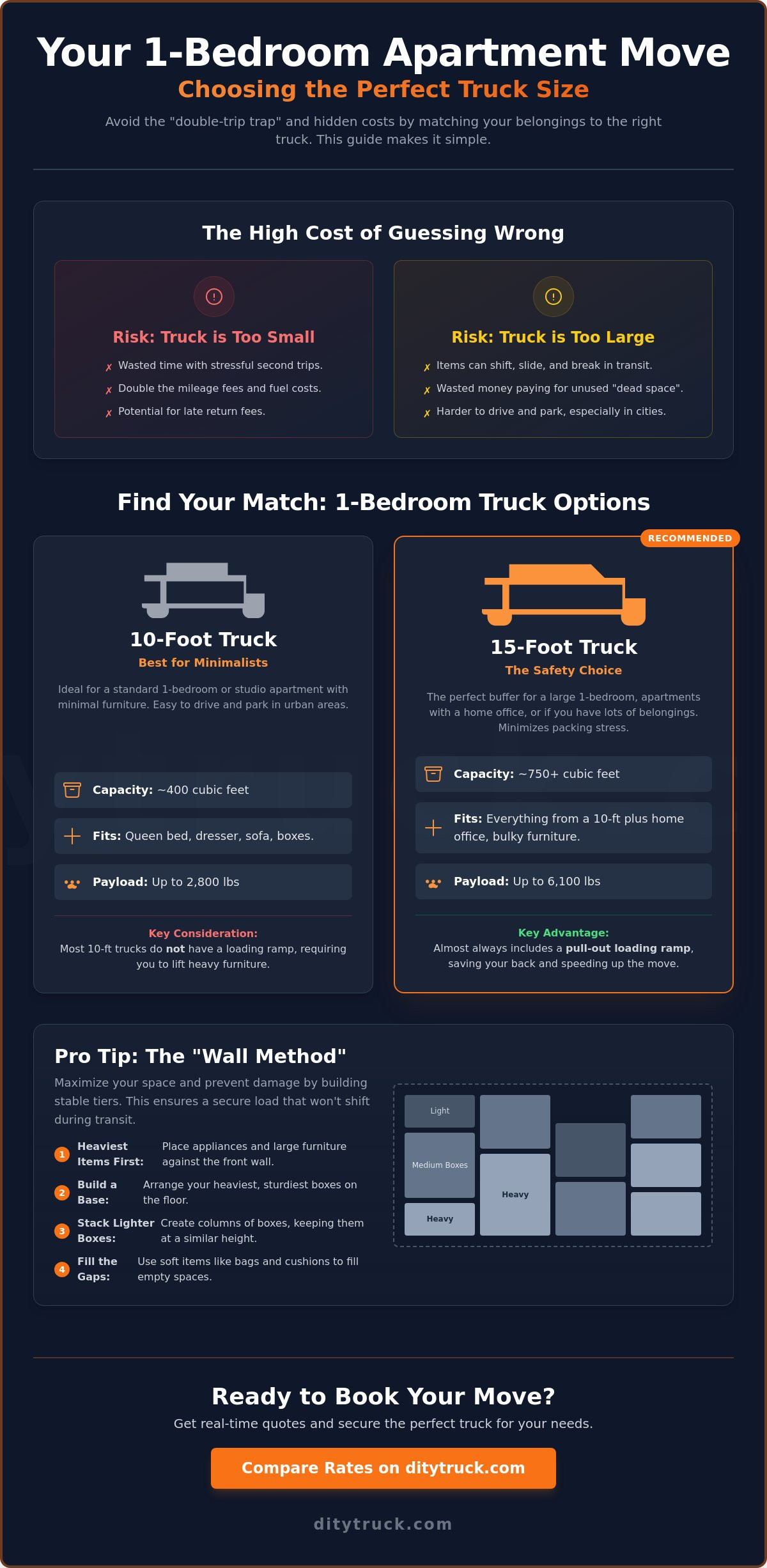
Most rental companies offer three primary tiers for this move type: cargo vans, 10-foot trucks, and 15-foot trucks. Cargo vans work for minimalists with few furniture items. 10-foot trucks handle standard setups. 15-foot trucks provide a safety buffer for those with home offices or extra furniture. Choosing between them requires an honest look at your inventory density rather than just your room count.
The Cost of Choosing Too Small vs. Too Large
Choosing a truck that’s too small triggers a chain reaction of expensive delays. You’ll pay double the mileage fees. You’ll burn twice the fuel. You’ll likely face late return fees if the second trip pushes you past your rental window. Beyond the money, the time lost is irreplaceable. Conversely, a truck that’s too large creates “dead space.” Without a full load, your furniture can slide and tip during transit. This leads to avoidable damage to your most prized possessions. You need to balance capacity with city maneuverability. A 10-foot truck feels like driving a large SUV. A 15-foot truck requires wider turns and significantly more overhead clearance.
Understanding Cubic Feet vs. Floor Space
Rental trucks are measured in length, but you pay for volume. When understanding box trucks, remember that height is your secret weapon. You aren’t just filling the floor. You’re building walls of boxes. A 400 cubic foot space is roughly the size of a small walk-in closet packed to the ceiling. To visualize this, imagine about 150 standard medium-sized moving boxes. If your furniture is bulky and can’t be stacked, you’ll run out of floor space long before you hit the cubic foot limit. Always account for non-stackable items like bicycles, standing desks, or floor lamps. They consume volume while offering no support for other items. This is why density matters more than square footage.
Comparing the Top Truck Sizes for 1-Bedroom Apartments
Choosing the right moving truck size for 1 bedroom apartment requires more than a guess. It requires a strategy. Most people assume a 10-foot truck is the default. It’s the industry standard for small apartments. However, the difference between a minimalist studio and a fully furnished 1-bedroom with a home office is massive. Selecting the right moving truck size ensures you don’t overpay for empty air or end up with furniture left on the curb. You need to match your specific inventory to the vehicle’s actual volume and weight limits.
Don’t be tempted by the low price of a cargo van for a full move. These vehicles are designed for small deliveries or college dorm rooms. They lack the vertical clearance for a queen-sized mattress or a full-sized dresser. The wheel wells also eat into your floor space, making it impossible to stack boxes efficiently. Unless you’re moving just a handful of suitcases and a desk, skip the van. It’s a recipe for a second trip.
The 10-Foot Truck: Best for Minimalists
This is the favorite for urban moves. It handles like a large SUV. It fits into tight street parking. It’s ideal for a single bedroom, a bathroom, and a small living area without major appliances. The fuel consumption is lower. The stress of driving is minimal. But there’s a catch. Most 10-foot models don’t have loading ramps. You’ll be lifting your couch and dresser by hand. This adds physical strain. It adds time to your day. If you have heavy solid-wood furniture, the lack of a ramp is a major hurdle.
The 15-Foot Truck: The Safety Choice
The 15-foot truck is the “safety zone.” It’s perfect for large 1-bedroom apartments. It’s the right choice if you have a dedicated workspace or a lot of “stuff” in every corner. It provides the buffer room you need if your packing skills aren’t professional grade. You don’t have to play a perfect game of Tetris to fit everything. Plus, these models almost always include a pull-out loading ramp. This single feature saves your back. It shaves an hour off your loading time. It’s the shortest path to a stress-free move.
Check your weight limits before booking. A 10-foot truck usually has a payload capacity around 2,800 lbs. A 15-foot truck can often handle over 6,000 lbs. If you have a collection of heavy books, gym equipment, or large furniture, the smaller truck might be unsafe. Overloading leads to poor braking. It can lead to fines at weigh stations. You can compare truck capacities and rates instantly to see which size fits your inventory and your budget.
Real-World Inventory: What Actually Fits in a 10-15 Foot Truck?
Visualizing the interior of your rental is like playing a high-stakes game of Tetris. You have to account for the voids created by irregular shapes. A bicycle or a curved floor lamp can’t support a stack of boxes. These items effectively double the floor space they occupy because nothing can sit on top of them. When calculating the moving truck size for 1 bedroom apartment, you must look beyond your primary furniture. Think about the hidden inventory. This includes items tucked away in kitchen cabinets, hall closets, and on your balcony. These small pieces often require more boxes than you anticipate.
Movers often forget the air space around furniture. A dining chair has four legs but creates empty space in the middle. Fill that space with small boxes or soft goods to avoid paying to move air. Your bed size is another major deciding factor. A Queen mattress is manageable in most small trucks. A King mattress is a different story. It’s significantly wider. It often forces you to lean it against the wall. This restricts where you can place tall dressers or wardrobes. If you have a King bed, you’re likely moving into 15-foot truck territory. This ensures you have enough clearance to load the mattress without blocking your entire packing path.
The Minimalist 1-Bedroom Checklist
A minimalist setup usually fits into a 10-foot or 12-foot truck. Flat-pack furniture is your ally here. Its rectangular shape allows for tight, efficient stacking. You can build solid walls of boxes and furniture with very little wasted space. If your lifestyle is streamlined, the 10-foot option is your most efficient path forward. Typical inventory includes:
- Queen bed and frame
- Standard two-seater sofa
- Small dining set (table and two chairs)
- 20-30 medium-sized moving boxes
The “Heavy” 1-Bedroom (Plus Storage) Checklist
A heavy 1-bedroom apartment often requires a 15-foot truck to avoid a second trip. You’ll run out of floor space in a smaller vehicle before the boxes are halfway loaded. This size provides the vertical clearance and depth needed for bulky items. It allows you to stack boxes safely without crushing electronics. Be honest about your accumulation. Selecting the right moving truck size for 1 bedroom apartment means accounting for everything. Common items in this category include:
- King bed and large headboard
- Sectional sofa or large recliner
- Full-sized desk and office chair
- 50+ boxes including kitchen and closet contents
Professional Packing Strategies to Maximize Your Rental Space
Mastering the “Wall Method” is essential for a successful move. Start at the front of the cargo area, nearest the cab. Build a solid wall of items from the floor to the ceiling. This vertical stacking prevents items from shifting. It ensures you use every inch of the moving truck size for 1 bedroom apartment. Secure each finished wall with tie-down straps before starting the next layer. This approach turns a chaotic pile into a stable, structured load. It maximizes your volume and protects your belongings.
Weight distribution is a matter of safety. Keep your heaviest items on the floor. Place them as close to the front of the truck as possible. This maintains a low center of gravity. It improves handling. It also makes braking more predictable. Disassembly is your best friend. If a table has removable legs, take them off. If a bed frame comes apart, break it down. Flat items are easier to pack. They occupy less room. They’re also less likely to break during the drive. Protecting your security deposit means preventing furniture damage. Use moving blankets between every layer to stop friction and scratches.
Loading the Tiers: Floor to Ceiling
Start with the heavy hitters. Place large appliances or heavy dressers at the base of your first wall. Slide mattresses against the side walls to create a flat surface for other items. The mid-tier consists of sturdy boxes and furniture with legs removed. Finally, use the “attic” space above the cab for your most fragile or lightweight items. This keeps them away from heavy, shifting loads. It turns unused space into a safe zone for lamps and small electronics. This tiered approach keeps your most valuable items secure.
Utilizing “Dead Space” in Furniture
Don’t move empty air. Fill your dresser drawers with clothes or linens to reduce your total box count. Use the interior of your microwave or refrigerator for small, soft items like towels or pillows. This protects the appliances from the inside out. Rolled rugs and sofa cushions serve as natural buffers. Wedge them into gaps between furniture pieces. This stops movement. It provides extra padding without the cost of extra supplies. You can book the right truck size today to put these professional strategies into practice.
How DityTruck Helps You Find and Book the Perfect Size
Stop guessing. One brand’s “10ft” truck is rarely identical to another’s. Dimensions vary. Wheel well placement differs. Internal height changes. These small details impact whether your specific furniture fits. Finding the ideal moving truck size for 1 bedroom apartment shouldn’t feel like a gamble. DityTruck simplifies the search. We aggregate real-time data from all major providers. You get a clear, unified view of your options. This transparency eliminates the stress of brand-hopping. You see the inventory that actually exists for your specific move date.
Our platform prioritizes your time. We strip away the complexity of logistics. You don’t need to be an expert in cubic footage. You just need the right tool. DityTruck acts as that tool. We provide the shortest path to a confirmed booking. Our interface is designed for speed. It’s built for rapid decision-making. You get the facts. You make the choice. You move on with your day.
Comparing Rates Across Multiple Providers Instantly
Use our filters to narrow your search. You can sort by vehicle type. Compare cargo vans against box trucks in seconds. We show you the total cost for the moving truck size for 1 bedroom apartment you select. This includes base rates and estimated fees. There are no hidden obstacles. Seeing a 10ft and a 15ft truck side-by-side is a game-changer. It allows you to weigh the cost of a safety buffer against your budget. You gain the confidence to book the larger size if your inventory is dense. Or, you can save money if you’re sure a smaller model works. Financial honesty is our baseline.
Streamlining Your 2026 Move
The 2026 moving season will be competitive. Demand for rental vehicles peaks between May and September. Booking early is the only way to guarantee your preferred size. DityTruck gives you the advantage. We provide reassurance through data. Our streamlined process handles the back-end coordination. You focus on packing. We focus on the vehicle. It’s a friction-free solution for a high-stakes task. Trust the data. Secure your rental. Start your new chapter with peace of mind. Ready to find your truck? Compare rates now at DityTruck.com.
Secure Your 2026 Move with Confidence
Selecting the correct moving truck size for 1 bedroom apartment is the foundation of a successful move. You’ve learned how to evaluate your inventory density and when to choose the safety buffer of a larger vehicle. By utilizing the “Wall Method” and filling dead space within your furniture, you maximize every cubic foot of your rental. This preparation eliminates the risk of a double trip. It keeps your budget on track. It ensures your belongings arrive safely in a single, organized load.
Don’t let logistical uncertainty slow you down. DityTruck offers the clarity you need to finalize your plans. Our platform provides real-time price comparisons from top national providers across the United States. You get transparent booking with no hidden fees and the reassurance of national coverage. Find the perfect truck size and compare rates today at DityTruck. You are ready for this transition. We provide the tools to make it happen efficiently. Happy moving.
Frequently Asked Questions
Is a 10-foot truck big enough for a 1-bedroom apartment?
A 10-foot truck is sufficient for minimalist 1-bedroom apartments. It comfortably handles a queen bed, a small sofa, and about 20 boxes. If you have a home office or large appliances, this size will likely be too tight. It’s the standard moving truck size for 1 bedroom apartment for those living in city centers with limited furniture. Always assess your furniture density before booking this smaller model.
What is the most popular truck size for a 1-bedroom move?
The 12-foot truck is the most popular choice for a standard 1-bedroom move. It offers a balance between maneuverability and volume. Many movers prefer the 15-foot model for the included loading ramp and extra “safety buffer.” This added space allows for less precise packing while ensuring everything fits in one trip. It’s the reliable middle ground for most apartment dwellers.
How many boxes can fit in a 12-foot moving truck?
You can typically fit 30 to 50 medium boxes in a 12-foot truck alongside your furniture. This capacity depends on how well you stack items from floor to ceiling. If you have very little furniture, that number can increase to over 100 boxes. Always place heavy boxes on the floor to maintain stability. Use smaller boxes for heavy items like books to make lifting easier.
Can I fit a king-size bed in a 10-foot rental truck?
A king-size mattress will fit in a 10-foot truck, but it occupies a large portion of the available width. You’ll need to stand it on its side against the interior wall. This often leaves little room for other bulky items like a sectional sofa. If you own a king bed and a full set of bedroom furniture, upgrading to a 15-foot truck is the safer path to a single trip.
Is it better to get a truck that is too big or too small?
Sizing up is almost always the smarter financial decision. A truck that is too small forces a second trip, which doubles your mileage and fuel expenses. A slightly larger truck provides breathing room for odd-shaped items. Just remember to use tie-down straps. Securing your load prevents furniture from sliding around in the extra space. This protects your belongings and your security deposit.
Do I need a special license to drive a 15-foot moving truck?
You don’t need a special commercial license for a 15-foot rental. A standard, valid driver’s license is all that’s required for personal moves. Ensure you are at least 18 years old, though some providers require drivers to be 21. Be aware that drivers under 25 may face additional young renter fees. Always check the specific age policies of your chosen rental company before arriving at the lot.
How do I calculate how much cubic space I need for my move?
Estimate your needs by total room count and furniture bulk. A typical 1-bedroom apartment needs between 400 and 800 cubic feet of space. You can calculate this by listing your large items and adding 20 percent for boxes and gaps. Choosing the right moving truck size for 1 bedroom apartment depends on this total volume. Using an online comparison tool can help you visualize which truck models meet these specific cubic requirements.
What happens if I rent a truck that is too small?
Renting a truck that’s too small leads to a second trip. This results in unexpected mileage charges and higher fuel consumption. It also wastes hours of your moving day. You might even incur late return fees if the extra trip delays your drop-off time. Avoid these complications by choosing a larger size if you’re uncertain. It’s the most efficient way to keep your moving costs predictable and low.